
A English
Nomenclature and oxidation State Questions in English
Class 12 Chemistry · Coordination Compounds · Nomenclature and oxidation State
316+
Questions
English
Language
100%
With Solutions
Showing 16 of 316 questions in English
301
EasyMCQ
Which among the following complexes can be named “dichlorido-bis-(ethane-$1, 2$-diamine)-platinum$(IV)$ nitrate"?
A
$[PtCl_2(en)_2](NO_3)_2$
B
$[PtCl_2(en)_2](NO_3)_4$
C
$[PtCl_2(en)_2(NO_3)]$
D
$[PtCl_2(en)_2(NO_2)]$
Solution
(A) The name "dichlorido-bis-(ethane-$1, 2$-diamine)-platinum$(IV)$ nitrate" indicates the following components:
$1$. Central metal: $Pt$ (Platinum) with oxidation state $+4$.
$2$. Ligands: Two chloride ions $(Cl^-)$ and two ethane-$1, 2$-diamine $(en)$ molecules.
$3$. Counter ion: Nitrate $(NO_3^-)$.
Calculation of oxidation state for $[PtCl_2(en)_2](NO_3)_2$:
Let the oxidation state of $Pt$ be $x$.
$x + 2(-1) + 2(0) + 2(-1) = 0$
$x - 2 - 2 = 0$
$x = +4$.
Thus,the complex is $[PtCl_2(en)_2](NO_3)_2$.
$1$. Central metal: $Pt$ (Platinum) with oxidation state $+4$.
$2$. Ligands: Two chloride ions $(Cl^-)$ and two ethane-$1, 2$-diamine $(en)$ molecules.
$3$. Counter ion: Nitrate $(NO_3^-)$.
Calculation of oxidation state for $[PtCl_2(en)_2](NO_3)_2$:
Let the oxidation state of $Pt$ be $x$.
$x + 2(-1) + 2(0) + 2(-1) = 0$
$x - 2 - 2 = 0$
$x = +4$.
Thus,the complex is $[PtCl_2(en)_2](NO_3)_2$.
0 likes
View Solution302
EasyMCQ
Select the correct $IUPAC$ name of $[Co(NH_3)_5(CO_3)]Cl$.
A
Pentaamminocarbonatocobalt$(III)$ chloride
B
Pentaamminocarbonatocobalt$(II)$ chloride
C
Carbonatopentaamminocobalt$(III)$ chloride
D
Pentaamminocarbonatocobalt$(IV)$ chloride
Solution
(A) $1$. Identify the ligands: $NH_3$ is ammine and $CO_3^{2-}$ is carbonato. Since there are $5$ ammine ligands,we use the prefix 'penta'.
$2$. Determine the oxidation state of the central metal atom $(Co)$: Let the oxidation state be $x$. The charge on $NH_3$ is $0$,$CO_3$ is $-2$,and $Cl$ is $-1$. Thus,$x + 5(0) + (-2) + (-1) = 0$,which gives $x = +3$.
$3$. Assemble the name: The ligands are listed alphabetically (ammine before carbonato). The name is Pentaamminocarbonatocobalt$(III)$ chloride.
$2$. Determine the oxidation state of the central metal atom $(Co)$: Let the oxidation state be $x$. The charge on $NH_3$ is $0$,$CO_3$ is $-2$,and $Cl$ is $-1$. Thus,$x + 5(0) + (-2) + (-1) = 0$,which gives $x = +3$.
$3$. Assemble the name: The ligands are listed alphabetically (ammine before carbonato). The name is Pentaamminocarbonatocobalt$(III)$ chloride.
0 likes
View Solution303
MediumMCQ
The sum of the oxidation state and the coordination number of the central metal atom is maximum for which of the following complexes?
A
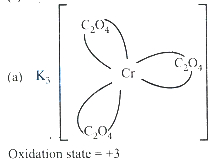
$K_3[Cr(C_2O_4)_3]$
B
$[Cr(CO)_6]$
C
$K_2[PtCl_6]$
D
$K_4[Fe(CN)_6]$
Solution
(C) For $K_3[Cr(C_2O_4)_3]$: Oxidation state $= +3$,Coordination number $= 6$,Sum $= 3 + 6 = 9$
For $[Cr(CO)_6]$: Oxidation state $= 0$,Coordination number $= 6$,Sum $= 0 + 6 = 6$
For $K_2[PtCl_6]$: Oxidation state $= +4$,Coordination number $= 6$,Sum $= 4 + 6 = 10$
For $K_4[Fe(CN)_6]$: Oxidation state $= +2$,Coordination number $= 6$,Sum $= 2 + 6 = 8$
Thus,the sum is maximum for $K_2[PtCl_6]$.
For $[Cr(CO)_6]$: Oxidation state $= 0$,Coordination number $= 6$,Sum $= 0 + 6 = 6$
For $K_2[PtCl_6]$: Oxidation state $= +4$,Coordination number $= 6$,Sum $= 4 + 6 = 10$
For $K_4[Fe(CN)_6]$: Oxidation state $= +2$,Coordination number $= 6$,Sum $= 2 + 6 = 8$
Thus,the sum is maximum for $K_2[PtCl_6]$.
0 likes
View Solution304
EasyMCQ
The oxidation number of the central metal in $[Pt(NH_3)_2Cl(NO_2)]$ and $[CoCl_2(en)_2]^{\oplus}$,respectively,are
A
$+2; +1$
B
$+2; +2$
C
$+2; +3$
D
$+3; +2$
Solution
(C) For $[Pt(NH_3)_2Cl(NO_2)]$:
Let the oxidation number of $Pt = x$.
$NH_3$ is a neutral ligand $(0)$,$Cl^-$ is $-1$,and $NO_2^-$ is $-1$.
$x + 2(0) + (-1) + (-1) = 0$
$x - 2 = 0 \implies x = +2$.
For $[CoCl_2(en)_2]^{\oplus}$:
Let the oxidation number of $Co = y$.
$en$ (ethylenediamine) is a neutral ligand $(0)$ and $Cl^-$ is $-1$.
$y + 2(-1) + 2(0) = +1$
$y - 2 = +1 \implies y = +3$.
Thus,the oxidation states are $+2$ and $+3$ respectively.
Let the oxidation number of $Pt = x$.
$NH_3$ is a neutral ligand $(0)$,$Cl^-$ is $-1$,and $NO_2^-$ is $-1$.
$x + 2(0) + (-1) + (-1) = 0$
$x - 2 = 0 \implies x = +2$.
For $[CoCl_2(en)_2]^{\oplus}$:
Let the oxidation number of $Co = y$.
$en$ (ethylenediamine) is a neutral ligand $(0)$ and $Cl^-$ is $-1$.
$y + 2(-1) + 2(0) = +1$
$y - 2 = +1 \implies y = +3$.
Thus,the oxidation states are $+2$ and $+3$ respectively.
0 likes
View Solution305
EasyMCQ
The name of the compound $[Ag(NH_3)_2][Ag(CN)_2]$ is
A
dicyanoargentate $(I)$ diammino $(I)$ silver
B
diamino silver dicyanate
C
diammine silver $(I)$ dicyanoargentate $(I)$
D
silver diamminedicyano argentate
Solution
(C) The given compound is $[Ag(NH_3)_2][Ag(CN)_2]$.
In this coordination entity,the cation is $[Ag(NH_3)_2]^+$ and the anion is $[Ag(CN)_2]^-$.
For the cation $[Ag(NH_3)_2]^+$,the name is diammine silver $(I)$.
For the anion $[Ag(CN)_2]^-$,the name is dicyanoargentate $(I)$.
Combining these,the $IUPAC$ name is diammine silver $(I)$ dicyanoargentate $(I)$.
In this coordination entity,the cation is $[Ag(NH_3)_2]^+$ and the anion is $[Ag(CN)_2]^-$.
For the cation $[Ag(NH_3)_2]^+$,the name is diammine silver $(I)$.
For the anion $[Ag(CN)_2]^-$,the name is dicyanoargentate $(I)$.
Combining these,the $IUPAC$ name is diammine silver $(I)$ dicyanoargentate $(I)$.
0 likes
View Solution306
EasyMCQ
Which one of the following is tris(ethane-$1,2$-diamine)cobalt$(III)$ sulphate?
A
$[Co(en)_2]_2(SO_4)_3$
B
$[Co(en)_2 SO_4]$
C
$[Co(en)_3] SO_4$
D
$[Co(en)_3]_2(SO_4)_3$
Solution
(D) The name tris(ethane-$1,2$-diamine)cobalt$(III)$ sulphate indicates a coordination complex.
$1$. The central metal is Cobalt $(Co)$ with an oxidation state of $+3$.
$2$. The ligand is ethane-$1,2$-diamine,abbreviated as $en$,which is a neutral bidentate ligand. Since there are three such ligands,the coordination sphere is $[Co(en)_3]^{3+}$.
$3$. The anion is sulphate,$SO_4^{2-}$.
$4$. To balance the charges,we need two $[Co(en)_3]^{3+}$ cations and three $SO_4^{2-}$ anions.
$5$. Thus,the chemical formula is $[Co(en)_3]_2(SO_4)_3$.
Hence,option $D$ is the correct answer.
$1$. The central metal is Cobalt $(Co)$ with an oxidation state of $+3$.
$2$. The ligand is ethane-$1,2$-diamine,abbreviated as $en$,which is a neutral bidentate ligand. Since there are three such ligands,the coordination sphere is $[Co(en)_3]^{3+}$.
$3$. The anion is sulphate,$SO_4^{2-}$.
$4$. To balance the charges,we need two $[Co(en)_3]^{3+}$ cations and three $SO_4^{2-}$ anions.
$5$. Thus,the chemical formula is $[Co(en)_3]_2(SO_4)_3$.
Hence,option $D$ is the correct answer.
0 likes
View Solution307
DifficultMCQ
The $IUPAC$ name of the compound $(NH_4)_2[Ni(C_2O_4)_2(H_2O)_2]$ is
A
Nickel $(II)$ diammino dioxalato diaquate
B
Dioxalato diammino diaquo nickelate $(III)$
C
Ammonium diaquabis (oxalato) nickelate $(II)$
D
$Ni$ dioxalato diaqua $(II)$ amminate
Solution
(C) The rules for naming a coordination compound are:
$1.$ Name the counterion first: $Ammonium$.
$2.$ Name the ligands in alphabetical order: $diaqua$ $(H_2O)$ and $oxalato$ $(C_2O_4^{2-})$. Since $oxalato$ is a polydentate ligand,we use $bis$ for the prefix.
$3.$ Name the central metal atom: Since the complex is anionic,we add the suffix $-ate$ to $Nickel$,resulting in $nickelate$.
$4.$ Determine the oxidation state of $Ni$: Let $x$ be the oxidation state of $Ni$. $2(+1) + x + 2(-2) + 2(0) = 0 \implies 2 + x - 4 = 0 \implies x = +2$.
$5.$ Combine the parts: $Ammonium$ $diaquabis(oxalato)nickelate(II)$.
$1.$ Name the counterion first: $Ammonium$.
$2.$ Name the ligands in alphabetical order: $diaqua$ $(H_2O)$ and $oxalato$ $(C_2O_4^{2-})$. Since $oxalato$ is a polydentate ligand,we use $bis$ for the prefix.
$3.$ Name the central metal atom: Since the complex is anionic,we add the suffix $-ate$ to $Nickel$,resulting in $nickelate$.
$4.$ Determine the oxidation state of $Ni$: Let $x$ be the oxidation state of $Ni$. $2(+1) + x + 2(-2) + 2(0) = 0 \implies 2 + x - 4 = 0 \implies x = +2$.
$5.$ Combine the parts: $Ammonium$ $diaquabis(oxalato)nickelate(II)$.
0 likes
View Solution308
MediumMCQ
$Pt + 3:1$ mixture of (conc. $HCl +$ conc. $HNO_3$) $\rightarrow [X]^{2-}$. What is the oxidation state of $Pt$ in $[X]^{2-}$ complex ion?
A
$2$
B
$3$
C
$4$
D
$6$
Solution
(C) When $Pt$ reacts with a $3:1$ mixture of concentrated hydrochloric acid $(HCl)$ and concentrated nitric acid $(HNO_3)$, it forms a solution known as aqua regia. Aqua regia is capable of dissolving platinum by forming chlorocomplexes. The reaction typically forms $H_2[PtCl_6]$.
In this complex, the $Pt$ is in the $+4$ oxidation state. The balanced chemical equation for the reaction is:
$Pt + 4HNO_3 + 6HCl \rightarrow H_2[PtCl_6] + 4NO_2 + 4H_2O$
So, in $[PtCl_6]^{2-}$ the oxidation state of $Pt$ is:
$x + 6(-1) = -2$
$x - 6 = -2$
$x = +4$
In this complex, the $Pt$ is in the $+4$ oxidation state. The balanced chemical equation for the reaction is:
$Pt + 4HNO_3 + 6HCl \rightarrow H_2[PtCl_6] + 4NO_2 + 4H_2O$
So, in $[PtCl_6]^{2-}$ the oxidation state of $Pt$ is:
$x + 6(-1) = -2$
$x - 6 = -2$
$x = +4$
0 likes
View Solution309
MediumMCQ
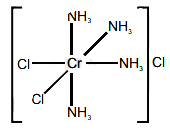
Indicate the correct $IUPAC$ name of the coordination compound shown in the figure.
A
$Cis-dichlorotetraamminochromium(III)$ chloride
B
$Trans-dichlorotetraamminochromium(III)$ chloride
C
$Trans-tetraamminodichlorochromium(III)$ chloride
D
$Cis-tetraamminodichlorochromium(III)$ chloride
Solution
(D) $1$. Identify the ligands: There are four $NH_3$ (ammine) ligands and two $Cl^-$ (chloro) ligands attached to the central $Cr$ atom.
$2$. Determine the geometry: The two $Cl^-$ ligands are adjacent to each other (at $90^\circ$ angle), which indicates a $cis$ configuration.
$3$. Apply $IUPAC$ nomenclature rules:
- List ligands alphabetically: $ammine$ comes before $chloro$.
- Use prefixes for the number of ligands: $tetra$ for four $NH_3$ and $di$ for two $Cl$.
- The name is $cis-tetraamminodichlorochromium(III)$ chloride.
$4$. Oxidation state of $Cr$: $x + 4(0) + 2(-1) = +1$ (since $Cl^-$ is outside the coordination sphere), so $x = +3$.
$2$. Determine the geometry: The two $Cl^-$ ligands are adjacent to each other (at $90^\circ$ angle), which indicates a $cis$ configuration.
$3$. Apply $IUPAC$ nomenclature rules:
- List ligands alphabetically: $ammine$ comes before $chloro$.
- Use prefixes for the number of ligands: $tetra$ for four $NH_3$ and $di$ for two $Cl$.
- The name is $cis-tetraamminodichlorochromium(III)$ chloride.
$4$. Oxidation state of $Cr$: $x + 4(0) + 2(-1) = +1$ (since $Cl^-$ is outside the coordination sphere), so $x = +3$.
0 likes
View Solution310
MediumMCQ
What is the correct $IUPAC$ name of the coordination compound $\text{Hg[Co(SCN)}_4]$?
A
Mercury$(II)$ tetrathiocyanato-$S$-cobaltate$(II)$
B
Mercury$(II)$ tetrathiocyanato-$N$-cobaltate$(II)$
C
Mercury$(I)$ tetrathiocyanato-$S$-cobalt$(III)$
D
Mercury$(I)$ tetrathiocyanato-$N$-cobalt$(III)$
Solution
(A) $1$. The given coordination compound is $\text{Hg[Co(SCN)}_4]$.
$2$. The compound dissociates into $\text{Hg}^{2+}$ and $\text{[Co(SCN)}_4]^{2-}$.
$3$. In the complex anion $\text{[Co(SCN)}_4]^{2-}$, the ligand is thiocyanate $(SCN^-)$, which is bonded through the sulfur atom, hence it is named 'thiocyanato-$S$'.
$4$. Let the oxidation state of cobalt $(Co)$ be $x$. Since the charge on the complex is $-2$ and the charge on $SCN^-$ is $-1$, we have: $x + 4(-1) = -2$, which gives $x = +2$.
$5$. The cation is mercury, which is in the $+2$ oxidation state, so it is named 'Mercury$(II)$'.
$6$. The complex anion is named 'tetrathiocyanato-$S$-cobaltate$(II)$' because the metal is in an anionic complex.
$7$. Combining these, the correct $IUPAC$ name is 'Mercury$(II)$ tetrathiocyanato-$S$-cobaltate$(II)$'.
$2$. The compound dissociates into $\text{Hg}^{2+}$ and $\text{[Co(SCN)}_4]^{2-}$.
$3$. In the complex anion $\text{[Co(SCN)}_4]^{2-}$, the ligand is thiocyanate $(SCN^-)$, which is bonded through the sulfur atom, hence it is named 'thiocyanato-$S$'.
$4$. Let the oxidation state of cobalt $(Co)$ be $x$. Since the charge on the complex is $-2$ and the charge on $SCN^-$ is $-1$, we have: $x + 4(-1) = -2$, which gives $x = +2$.
$5$. The cation is mercury, which is in the $+2$ oxidation state, so it is named 'Mercury$(II)$'.
$6$. The complex anion is named 'tetrathiocyanato-$S$-cobaltate$(II)$' because the metal is in an anionic complex.
$7$. Combining these, the correct $IUPAC$ name is 'Mercury$(II)$ tetrathiocyanato-$S$-cobaltate$(II)$'.
0 likes
View Solution311
MediumMCQ
The formula of tetraammineaquachloridocobalt$(III)$ chloride is
A
$[Co(NH_3)_4Cl] \cdot H_2O$
B
$[Co(NH_3)_4]Cl_3 \cdot H_2O$
C
$[Co(NH_3)_4(H_2O)Cl]Cl$
D
$[Co(NH_3)_4(H_2O)Cl]Cl_2$
Solution
(D) To determine the formula of the coordination compound tetraammineaquachloridocobalt$(III)$ chloride:
$1$. The central metal ion is Cobalt$(III)$, denoted as $Co^{3+}$.
$2$. The ligands are: 'tetraammine' $(4 \times NH_3)$,'aqua' $(1 \times H_2O)$, and 'chlorido' $(1 \times Cl^-)$.
$3$. The coordination sphere is $[Co(NH_3)_4(H_2O)Cl]$.
$4$. Calculate the charge on the coordination sphere: $Charge = (+3) + 4(0) + 1(0) + 1(-1) = +2$.
$5$. To balance the $+2$ charge of the complex ion, two chloride ions $(Cl^-)$ are required outside the coordination sphere.
$6$. Thus, the formula is $[Co(NH_3)_4(H_2O)Cl]Cl_2$.
$1$. The central metal ion is Cobalt$(III)$, denoted as $Co^{3+}$.
$2$. The ligands are: 'tetraammine' $(4 \times NH_3)$,'aqua' $(1 \times H_2O)$, and 'chlorido' $(1 \times Cl^-)$.
$3$. The coordination sphere is $[Co(NH_3)_4(H_2O)Cl]$.
$4$. Calculate the charge on the coordination sphere: $Charge = (+3) + 4(0) + 1(0) + 1(-1) = +2$.
$5$. To balance the $+2$ charge of the complex ion, two chloride ions $(Cl^-)$ are required outside the coordination sphere.
$6$. Thus, the formula is $[Co(NH_3)_4(H_2O)Cl]Cl_2$.
0 likes
View Solution312
DifficultMCQ
Identify the species having a metal atom in the $+6$ oxidation state from the following:
A
$MnO_4^{-}$
B
$[Cr(CN)_6]^{3-}$
C
$Cr_2O_3$
D
$CrO_2Cl_2$
Solution
(D) Step $1$: Calculate the oxidation state of the metal in each species.
Step $2$: For $MnO_4^{-}$, let the oxidation state of $Mn$ be $x$. $x + 4(-2) = -1 \implies x = +7$.
Step $3$: For $[Cr(CN)_6]^{3-}$, let the oxidation state of $Cr$ be $x$. $x + 6(-1) = -3 \implies x = +3$.
Step $4$: For $Cr_2O_3$, let the oxidation state of $Cr$ be $x$. $2x + 3(-2) = 0 \implies 2x = 6 \implies x = +3$.
Step $5$: For $CrO_2Cl_2$, let the oxidation state of $Cr$ be $x$. $x + 2(-2) + 2(-1) = 0 \implies x - 4 - 2 = 0 \implies x = +6$.
Step $6$: Thus, $CrO_2Cl_2$ contains the metal in the $+6$ oxidation state.
Step $2$: For $MnO_4^{-}$, let the oxidation state of $Mn$ be $x$. $x + 4(-2) = -1 \implies x = +7$.
Step $3$: For $[Cr(CN)_6]^{3-}$, let the oxidation state of $Cr$ be $x$. $x + 6(-1) = -3 \implies x = +3$.
Step $4$: For $Cr_2O_3$, let the oxidation state of $Cr$ be $x$. $2x + 3(-2) = 0 \implies 2x = 6 \implies x = +3$.
Step $5$: For $CrO_2Cl_2$, let the oxidation state of $Cr$ be $x$. $x + 2(-2) + 2(-1) = 0 \implies x - 4 - 2 = 0 \implies x = +6$.
Step $6$: Thus, $CrO_2Cl_2$ contains the metal in the $+6$ oxidation state.
0 likes
View Solution313
DifficultMCQ
Identify the formula of $\text{Bis(ethylenediamine)dithiocyanatoplatinum(IV) ion}$ from the following.
A
$[Pt(en)_2(NCS)_2]^{2+}$
B
$[Pt(en)_2(SCN)_2]^{4+}$
C
$[Pt(en)_2(SCN)_2]^{2+}$
D
$[Pt(en)_3(SCN)_2]^{4+}$
Solution
(C) $1$. The central metal ion is $\text{Platinum}$ in oxidation state $+IV$, denoted as $Pt^{4+}$.
$2$. $\text{Bis(ethylenediamine)}$ indicates two $en$ ligands, which are neutral ($0$ charge).
$3$. $\text{Dithiocyanato}$ indicates two $SCN^-$ ligands, each with a $-1$ charge.
$4$. The total charge on the complex ion is calculated as: $\text{Charge} = \text{Oxidation state of } Pt + (2 \times \text{charge of } en) + (2 \times \text{charge of } SCN^-)$.
$5$. $\text{Charge} = (+4) + (2 \times 0) + (2 \times -1) = +4 - 2 = +2$.
$6$. Thus, the formula is $[Pt(en)_2(SCN)_2]^{2+}$.
$2$. $\text{Bis(ethylenediamine)}$ indicates two $en$ ligands, which are neutral ($0$ charge).
$3$. $\text{Dithiocyanato}$ indicates two $SCN^-$ ligands, each with a $-1$ charge.
$4$. The total charge on the complex ion is calculated as: $\text{Charge} = \text{Oxidation state of } Pt + (2 \times \text{charge of } en) + (2 \times \text{charge of } SCN^-)$.
$5$. $\text{Charge} = (+4) + (2 \times 0) + (2 \times -1) = +4 - 2 = +2$.
$6$. Thus, the formula is $[Pt(en)_2(SCN)_2]^{2+}$.
0 likes
View Solution314
DifficultMCQ
The sum of the coordination number and the oxidation number of $M$ in $[M(en)_2C_2O_4]Cl$ is
A
$9$
B
$8$
C
$7$
D
$6$
Solution
(A) $1$. The coordination number of $M$ is calculated by considering the denticity of the ligands. $en$ (ethylenediamine) is a bidentate ligand and $C_2O_4^{2-}$ (oxalate) is also a bidentate ligand.
$2$. Coordination number $= (2 \times 2) + (1 \times 2) = 4 + 2 = 6$.
$3$. Let the oxidation number of $M$ be $x$. The charge on $en$ is $0$, the charge on $C_2O_4^{2-}$ is $-2$, and the charge on $Cl^-$ is $-1$.
$4$. The total charge of the complex $[M(en)_2C_2O_4]Cl$ is $0$. Thus, $x + 2(0) + 1(-2) - 1 = 0$.
$5$. $x - 2 - 1 = 0 \implies x = +3$.
$6$. The sum of the coordination number and the oxidation number $= 6 + 3 = 9$.
$2$. Coordination number $= (2 \times 2) + (1 \times 2) = 4 + 2 = 6$.
$3$. Let the oxidation number of $M$ be $x$. The charge on $en$ is $0$, the charge on $C_2O_4^{2-}$ is $-2$, and the charge on $Cl^-$ is $-1$.
$4$. The total charge of the complex $[M(en)_2C_2O_4]Cl$ is $0$. Thus, $x + 2(0) + 1(-2) - 1 = 0$.
$5$. $x - 2 - 1 = 0 \implies x = +3$.
$6$. The sum of the coordination number and the oxidation number $= 6 + 3 = 9$.
0 likes
View Solution315
MediumMCQ
Identify the oxidation state of the cobalt ion in the complex $[Co(NH_3)_5Br]SO_4$.
A
$+2$
B
$+3$
C
$+1$
D
$+4$
Solution
(B) $1$. The complex $[Co(NH_3)_5Br]SO_4$ dissociates into $[Co(NH_3)_5Br]^{2+}$ and $SO_4^{2-}$.
$2$. Let the oxidation state of $Co$ be $x$.
$3$. The oxidation state of $NH_3$ is $0$ and $Br$ is $-1$.
$4$. The charge on the complex ion $[Co(NH_3)_5Br]^{2+}$ is $+2$.
$5$. Setting up the equation: $x + 5(0) + (-1) = +2$.
$6$. Solving for $x$: $x - 1 = +2$, which gives $x = +3$.
$2$. Let the oxidation state of $Co$ be $x$.
$3$. The oxidation state of $NH_3$ is $0$ and $Br$ is $-1$.
$4$. The charge on the complex ion $[Co(NH_3)_5Br]^{2+}$ is $+2$.
$5$. Setting up the equation: $x + 5(0) + (-1) = +2$.
$6$. Solving for $x$: $x - 1 = +2$, which gives $x = +3$.
0 likes
View Solution316
MediumMCQ
What is the oxidation state of cobalt in $[Co(NH_3)_6]^{3+}$?
A
$+5$
B
$+4$
C
$+3$
D
$+2$
Solution
(C) Let the oxidation state of cobalt $(Co)$ be $x$.
The oxidation state of the neutral ligand ammonia $(NH_3)$ is $0$.
The overall charge on the complex ion $[Co(NH_3)_6]^{3+}$ is $+3$.
Setting up the equation: $x + 6(0) = +3$.
Solving for $x$: $x = +3$.
Therefore, the oxidation state of cobalt is $+3$.
The oxidation state of the neutral ligand ammonia $(NH_3)$ is $0$.
The overall charge on the complex ion $[Co(NH_3)_6]^{3+}$ is $+3$.
Setting up the equation: $x + 6(0) = +3$.
Solving for $x$: $x = +3$.
Therefore, the oxidation state of cobalt is $+3$.
0 likes
View SolutionCoordination Compounds — Nomenclature and oxidation State · Frequently Asked Questions
1Are these Coordination Compounds questions useful for JEE and NEET?
Yes. All questions in this section are mapped to JEE Main and NEET exam patterns. Previous year questions from JEE Main, NEET, GUJCET and state-level exams are included with full solutions.
2Can I switch to Hindi or Gujarati for these questions?
Yes. Use the language tabs in the hero section or the sidebar to view the same questions and solutions in English, Hindi or Gujarati.
3How do I generate a question paper from this subtopic?
Use the Vedclass Exam Paper Generator — select the chapter and subtopic, set difficulty, and generate Sets A, B, C, D automatically. First 3 chapters of every subject are free.
Vedclass Products
For Students
Vedclass Test Series
Mock tests in real JEE/NEET style with performance analysis. 5-day free trial.
Start Free TrialFor Teachers
Exam Paper Generator
Generate Set A/B/C/D papers from this chapter in 2 minutes. 3 chapters free.
Try FreeFor Institutes
Online Exam Module
Live online exams with unlimited students, 360° analytics & white-label branding.
See DemoFor Teachers & Institutes
Generate a Coordination Compounds Exam Paper in 2 Minutes
Select subtopic & difficulty — Sets A, B, C, D auto-generated with No Repeat logic.
First 3 chapters of every subject are free — no payment required.