
A English
Electrode potential and ECell Questions in English
Class 12 Chemistry · Electrochemistry · Electrode potential and ECell
436+
Questions
English
Language
100%
With Solutions
Showing 33 of 436 questions in English
401
EasyMCQ
Consider the systems having liquid-solid interface,$(A)$ copper wire in silver nitrate solution and $(B)$ silver wire in copper sulphate solution. Predict which interface will show spontaneous reaction,if $E_{Cu^{2+}/Cu}^{\circ} = 0.34 \ V$ and $E_{Ag^{+}/Ag}^{\circ} = 0.80 \ V$?
A
Copper-silver nitrate interface
B
Silver-copper sulphate interface
C
There will be no spontaneous reaction
D
Both interfaces will give spontaneous reaction
Solution
(A) reaction is spontaneous if the standard cell potential $E^{\circ}_{cell}$ is positive,which corresponds to a negative Gibbs free energy change $\Delta G^{\circ} = -nFE^{\circ}_{cell}$.
For system $(A)$: $Cu(s) + 2Ag^{+}(aq) \rightarrow Cu^{2+}(aq) + 2Ag(s)$.
$E^{\circ}_{cell} = E^{\circ}_{cathode} - E^{\circ}_{anode} = E^{\circ}_{Ag^{+}/Ag} - E^{\circ}_{Cu^{2+}/Cu} = 0.80 \ V - 0.34 \ V = 0.46 \ V$.
Since $E^{\circ}_{cell} > 0$,the reaction is spontaneous.
For system $(B)$: $Ag(s) + Cu^{2+}(aq) \rightarrow Ag^{+}(aq) + Cu(s)$.
$E^{\circ}_{cell} = E^{\circ}_{Cu^{2+}/Cu} - E^{\circ}_{Ag^{+}/Ag} = 0.34 \ V - 0.80 \ V = -0.46 \ V$.
Since $E^{\circ}_{cell} < 0$,the reaction is non-spontaneous.
Therefore,the copper-silver nitrate interface shows a spontaneous reaction.
For system $(A)$: $Cu(s) + 2Ag^{+}(aq) \rightarrow Cu^{2+}(aq) + 2Ag(s)$.
$E^{\circ}_{cell} = E^{\circ}_{cathode} - E^{\circ}_{anode} = E^{\circ}_{Ag^{+}/Ag} - E^{\circ}_{Cu^{2+}/Cu} = 0.80 \ V - 0.34 \ V = 0.46 \ V$.
Since $E^{\circ}_{cell} > 0$,the reaction is spontaneous.
For system $(B)$: $Ag(s) + Cu^{2+}(aq) \rightarrow Ag^{+}(aq) + Cu(s)$.
$E^{\circ}_{cell} = E^{\circ}_{Cu^{2+}/Cu} - E^{\circ}_{Ag^{+}/Ag} = 0.34 \ V - 0.80 \ V = -0.46 \ V$.
Since $E^{\circ}_{cell} < 0$,the reaction is non-spontaneous.
Therefore,the copper-silver nitrate interface shows a spontaneous reaction.
0 likes
View Solution402
DifficultMCQ
For the following cell reaction,$Ag | Ag^{+} | AgCl | Cl^{-} | Cl_2, Pt$
$\Delta G_f^{\circ}(AgCl) = -109 \ kJ/mol$
$\Delta G_f^{\circ}(Cl^{-}) = -129 \ kJ/mol$
$\Delta G_f^{\circ}(Ag^{+}) = 78 \ kJ/mol$
$E^{\circ}$ of the cell is
$\Delta G_f^{\circ}(AgCl) = -109 \ kJ/mol$
$\Delta G_f^{\circ}(Cl^{-}) = -129 \ kJ/mol$
$\Delta G_f^{\circ}(Ag^{+}) = 78 \ kJ/mol$
$E^{\circ}$ of the cell is
A
$-0.60 \ V$
B
$0.60 \ V$
C
$6.0 \ V$
D
None of these
Solution
(A) The cell reaction is: $Ag(s) + AgCl(s) \rightarrow Ag^{+}(aq) + Cl^{-}(aq) + Ag(s)$
Simplified net cell reaction: $AgCl(s) \rightarrow Ag^{+}(aq) + Cl^{-}(aq)$
Calculate $\Delta G^{\circ}_{reaction}$:
$\Delta G^{\circ}_{reaction} = [\Delta G_f^{\circ}(Ag^{+}) + \Delta G_f^{\circ}(Cl^{-})] - [\Delta G_f^{\circ}(AgCl)]$
$\Delta G^{\circ}_{reaction} = [78 + (-129)] - (-109) \ kJ/mol$
$\Delta G^{\circ}_{reaction} = -51 + 109 = 58 \ kJ/mol = 58000 \ J/mol$
Using the relation $\Delta G^{\circ} = -nFE^{\circ}_{cell}$:
Here,$n = 1$ (as $Ag \rightarrow Ag^{+} + e^{-}$ and $AgCl + e^{-} \rightarrow Ag + Cl^{-}$).
$58000 = -1 \times 96500 \times E^{\circ}_{cell}$
$E^{\circ}_{cell} = -\frac{58000}{96500} \approx -0.60 \ V$
Simplified net cell reaction: $AgCl(s) \rightarrow Ag^{+}(aq) + Cl^{-}(aq)$
Calculate $\Delta G^{\circ}_{reaction}$:
$\Delta G^{\circ}_{reaction} = [\Delta G_f^{\circ}(Ag^{+}) + \Delta G_f^{\circ}(Cl^{-})] - [\Delta G_f^{\circ}(AgCl)]$
$\Delta G^{\circ}_{reaction} = [78 + (-129)] - (-109) \ kJ/mol$
$\Delta G^{\circ}_{reaction} = -51 + 109 = 58 \ kJ/mol = 58000 \ J/mol$
Using the relation $\Delta G^{\circ} = -nFE^{\circ}_{cell}$:
Here,$n = 1$ (as $Ag \rightarrow Ag^{+} + e^{-}$ and $AgCl + e^{-} \rightarrow Ag + Cl^{-}$).
$58000 = -1 \times 96500 \times E^{\circ}_{cell}$
$E^{\circ}_{cell} = -\frac{58000}{96500} \approx -0.60 \ V$
0 likes
View Solution403
MediumMCQ
Calculate the $emf$ of the cell $Cu_{(s)} | Cu^{2+}_{(aq)} || Ag^+_{(aq)} | Ag_{(s)}$. Given: $E^0_{Cu^{2+}/Cu} = +0.34 \ V$,$E^0_{Ag^+/Ag} = +0.80 \ V$.
A
$+0.46 \ V$
B
$+1.14 \ V$
C
$+0.57 \ V$
D
$-0.46 \ V$
Solution
(A) The cell reaction is: $Cu_{(s)} + 2Ag^+_{(aq)} \rightarrow Cu^{2+}_{(aq)} + 2Ag_{(s)}$.
For the given cell,the cathode is $Ag^+/Ag$ and the anode is $Cu^{2+}/Cu$.
The standard cell potential is calculated as:
$E^0_{cell} = E^0_{cathode} - E^0_{anode}$
$E^0_{cell} = E^0_{Ag^+/Ag} - E^0_{Cu^{2+}/Cu}$
$E^0_{cell} = 0.80 \ V - 0.34 \ V = +0.46 \ V$.
For the given cell,the cathode is $Ag^+/Ag$ and the anode is $Cu^{2+}/Cu$.
The standard cell potential is calculated as:
$E^0_{cell} = E^0_{cathode} - E^0_{anode}$
$E^0_{cell} = E^0_{Ag^+/Ag} - E^0_{Cu^{2+}/Cu}$
$E^0_{cell} = 0.80 \ V - 0.34 \ V = +0.46 \ V$.
0 likes
View Solution404
MediumMCQ
The standard reduction potentials of $Zn^{2+}|Zn$,$Cu^{2+}|Cu$ and $Ag^{+}|Ag$ are respectively $-0.76 \ V$,$0.34 \ V$ and $0.80 \ V$. The following cells were constructed:
$(1)$ $Zn|Zn^{2+}||Cu^{2+}|Cu$
$(2)$ $Zn|Zn^{2+}||Ag^{+}|Ag$
$(3)$ $Cu|Cu^{2+}||Ag^{+}|Ag$
What is the correct order of $E_{\text{cell}}^{\circ}$ of these cells?
$(1)$ $Zn|Zn^{2+}||Cu^{2+}|Cu$
$(2)$ $Zn|Zn^{2+}||Ag^{+}|Ag$
$(3)$ $Cu|Cu^{2+}||Ag^{+}|Ag$
What is the correct order of $E_{\text{cell}}^{\circ}$ of these cells?
A
$2 > 3 > 1$
B
$2 > 1 > 3$
C
$1 > 2 > 3$
D
$3 > 1 > 2$
Solution
(B) Given standard reduction potentials:
$E^{\circ}_{Zn^{2+}|Zn} = -0.76 \ V$
$E^{\circ}_{Cu^{2+}|Cu} = 0.34 \ V$
$E^{\circ}_{Ag^{+}|Ag} = 0.80 \ V$
For cell $(1)$: $Zn|Zn^{2+}||Cu^{2+}|Cu$
$E^{\circ}_{cell} = E^{\circ}_{cathode} - E^{\circ}_{anode} = 0.34 - (-0.76) = 1.10 \ V$
For cell $(2)$: $Zn|Zn^{2+}||Ag^{+}|Ag$
$E^{\circ}_{cell} = E^{\circ}_{cathode} - E^{\circ}_{anode} = 0.80 - (-0.76) = 1.56 \ V$
For cell $(3)$: $Cu|Cu^{2+}||Ag^{+}|Ag$
$E^{\circ}_{cell} = E^{\circ}_{cathode} - E^{\circ}_{anode} = 0.80 - 0.34 = 0.46 \ V$
Comparing the values: $1.56 \ V (2) > 1.10 \ V (1) > 0.46 \ V (3)$.
Therefore,the correct order is $2 > 1 > 3$.
$E^{\circ}_{Zn^{2+}|Zn} = -0.76 \ V$
$E^{\circ}_{Cu^{2+}|Cu} = 0.34 \ V$
$E^{\circ}_{Ag^{+}|Ag} = 0.80 \ V$
For cell $(1)$: $Zn|Zn^{2+}||Cu^{2+}|Cu$
$E^{\circ}_{cell} = E^{\circ}_{cathode} - E^{\circ}_{anode} = 0.34 - (-0.76) = 1.10 \ V$
For cell $(2)$: $Zn|Zn^{2+}||Ag^{+}|Ag$
$E^{\circ}_{cell} = E^{\circ}_{cathode} - E^{\circ}_{anode} = 0.80 - (-0.76) = 1.56 \ V$
For cell $(3)$: $Cu|Cu^{2+}||Ag^{+}|Ag$
$E^{\circ}_{cell} = E^{\circ}_{cathode} - E^{\circ}_{anode} = 0.80 - 0.34 = 0.46 \ V$
Comparing the values: $1.56 \ V (2) > 1.10 \ V (1) > 0.46 \ V (3)$.
Therefore,the correct order is $2 > 1 > 3$.
0 likes
View Solution405
MediumMCQ
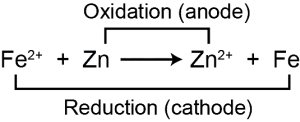
Given the standard half-cell potentials $(E^{\circ})$ as: $Zn \rightarrow Zn^{2+} + 2e^{-}$; $E^{\circ} = +0.76 \ V$ and $Fe \rightarrow Fe^{2+} + 2e^{-}$; $E^{\circ} = +0.41 \ V$. Then the standard e.m.f. of the cell with the reaction $Fe^{2+} + Zn \rightarrow Zn^{2+} + Fe$ is:
A
$-0.35 \ V$
B
$+0.35 \ V$
C
$+1.17 \ V$
D
$-1.17 \ V$
Solution
(B) The given cell reaction is $Fe^{2+} + Zn \rightarrow Zn^{2+} + Fe$.
Oxidation half-reaction: $Zn \rightarrow Zn^{2+} + 2e^{-}$, $E^{\circ}_{ox} = +0.76 \ V$.
Reduction half-reaction: $Fe^{2+} + 2e^{-} \rightarrow Fe$, $E^{\circ}_{red} = -0.41 \ V$ (since $E^{\circ}_{ox}$ for $Fe$ is $+0.41 \ V$, the reduction potential $E^{\circ}_{red} = -E^{\circ}_{ox}$).
The standard e.m.f. of the cell is:
$E^{\circ}_{cell} = E^{\circ}_{ox} + E^{\circ}_{red}$
$E^{\circ}_{cell} = 0.76 \ V + (-0.41 \ V) = +0.35 \ V$.
Oxidation half-reaction: $Zn \rightarrow Zn^{2+} + 2e^{-}$, $E^{\circ}_{ox} = +0.76 \ V$.
Reduction half-reaction: $Fe^{2+} + 2e^{-} \rightarrow Fe$, $E^{\circ}_{red} = -0.41 \ V$ (since $E^{\circ}_{ox}$ for $Fe$ is $+0.41 \ V$, the reduction potential $E^{\circ}_{red} = -E^{\circ}_{ox}$).
The standard e.m.f. of the cell is:
$E^{\circ}_{cell} = E^{\circ}_{ox} + E^{\circ}_{red}$
$E^{\circ}_{cell} = 0.76 \ V + (-0.41 \ V) = +0.35 \ V$.
0 likes
View Solution406
MediumMCQ
The two half-cell reactions of an electrochemical cell are given as: $Ag^{+} + e^{-} \rightarrow Ag$; $E^{\circ}_{Ag^{+}/Ag} = 0.7995 \ V$ and $Fe^{2+} \rightarrow Fe^{3+} + e^{-}$; $E^{\circ}_{Fe^{3+}/Fe^{2+}} = 0.7710 \ V$. The value of cell $EMF$ will be: (in $V$)
A
$0.0285$
B
$1.5705$
C
$-0.0285$
D
$-1.5705$
Solution
(A) The standard $EMF$ of the cell is calculated as: $E^{\circ}_{cell} = E^{\circ}_{cathode} - E^{\circ}_{anode}$.
Given reduction potentials are $E^{\circ}_{Ag^{+}/Ag} = 0.7995 \ V$ and $E^{\circ}_{Fe^{3+}/Fe^{2+}} = 0.7710 \ V$.
Since $E^{\circ}_{Ag^{+}/Ag} > E^{\circ}_{Fe^{3+}/Fe^{2+}}$, the silver electrode acts as the cathode and the iron electrode acts as the anode.
$E^{\circ}_{cell} = 0.7995 \ V - 0.7710 \ V = 0.0285 \ V$.
Given reduction potentials are $E^{\circ}_{Ag^{+}/Ag} = 0.7995 \ V$ and $E^{\circ}_{Fe^{3+}/Fe^{2+}} = 0.7710 \ V$.
Since $E^{\circ}_{Ag^{+}/Ag} > E^{\circ}_{Fe^{3+}/Fe^{2+}}$, the silver electrode acts as the cathode and the iron electrode acts as the anode.
$E^{\circ}_{cell} = 0.7995 \ V - 0.7710 \ V = 0.0285 \ V$.
0 likes
View Solution407
MediumMCQ
The formal potential of $Fe^{3+}/Fe^{2+}$ in a sulphuric acid and phosphoric acid mixture $(E^{\circ}=+0.61 \ V)$ is much lower than the standard potential $(E^{\circ}=+0.77 \ V)$. This is due to
A
formation of the species $[FeHPO_{4}]^{+}$
B
lowering of potential upon complexation
C
formation of the species $[FeSO_{4}]^{+}$
D
high acidity of the medium
Solution
(A) The standard reduction potential of $Fe^{3+}/Fe^{2+}$ is $+0.77 \ V$.
In a mixture of $H_{2}SO_{4}$ and $H_{3}PO_{4}$, $Fe^{3+}$ ions react with phosphate ions to form a stable complex, $[FeHPO_{4}]^{+}$.
According to the Nernst equation, $E = E^{\circ} - (0.059/n) \log(1/[Fe^{3+}])$.
As the concentration of free $Fe^{3+}$ ions decreases due to complex formation, the reduction potential decreases from $+0.77 \ V$ to $+0.61 \ V$.
In a mixture of $H_{2}SO_{4}$ and $H_{3}PO_{4}$, $Fe^{3+}$ ions react with phosphate ions to form a stable complex, $[FeHPO_{4}]^{+}$.
According to the Nernst equation, $E = E^{\circ} - (0.059/n) \log(1/[Fe^{3+}])$.
As the concentration of free $Fe^{3+}$ ions decreases due to complex formation, the reduction potential decreases from $+0.77 \ V$ to $+0.61 \ V$.
0 likes
View Solution408
EasyMCQ
$Li$ occupies a higher position in the electrochemical series of metals as compared to $Cu$ since:
A
the standard reduction potential of $Li^{+} / Li$ is lower than that of $Cu^{2+} / Cu$
B
the standard reduction potential of $Cu^{2+} / Cu$ is lower than that of $Li^{+} / Li$
C
the standard oxidation potential of $Li / Li^{+}$ is lower than that of $Cu / Cu^{2+}$
D
$Li$ is smaller in size as compared to $Cu$
Solution
(A) In the electrochemical series, metals are arranged in the increasing order of their standard reduction potential.
The standard reduction potential $(E^{\circ})$ of $Li^{+} / Li$ is $-3.05 \ V$.
The standard reduction potential $(E^{\circ})$ of $Cu^{2+} / Cu$ is $+0.34 \ V$.
Since $-3.05 \ V < +0.34 \ V$, $Li$ has a lower standard reduction potential than $Cu$.
Therefore, $Li$ is placed higher in the electrochemical series than $Cu$.
The standard reduction potential $(E^{\circ})$ of $Li^{+} / Li$ is $-3.05 \ V$.
The standard reduction potential $(E^{\circ})$ of $Cu^{2+} / Cu$ is $+0.34 \ V$.
Since $-3.05 \ V < +0.34 \ V$, $Li$ has a lower standard reduction potential than $Cu$.
Therefore, $Li$ is placed higher in the electrochemical series than $Cu$.
0 likes
View Solution409
MediumMCQ
The standard reduction potential $E^{\circ}$ for half reactions are
The $EMF$ of the cell reaction $Fe^{2+} + Zn \rightarrow Zn^{2+} + Fe$ is
| $Zn \rightarrow Zn^{2+} + 2e^-$ | $E^{\circ} = +0.76 \ V$ |
| $Fe \rightarrow Fe^{2+} + 2e^-$ | $E^{\circ} = +0.41 \ V$ |
The $EMF$ of the cell reaction $Fe^{2+} + Zn \rightarrow Zn^{2+} + Fe$ is
A
$-0.35 \ V$
B
$0.35 \ V$
C
$+1.17 \ V$
D
$-1.17 \ V$
Solution
(B) The given reactions are oxidation half-reactions, so the given $E^{\circ}$ values are oxidation potentials $(E^{\circ}_{op})$:
$Zn \rightarrow Zn^{2+} + 2e^-, E^{\circ}_{op} = +0.76 \ V$
$Fe \rightarrow Fe^{2+} + 2e^-, E^{\circ}_{op} = +0.41 \ V$
For the cell reaction $Fe^{2+} + Zn \rightarrow Zn^{2+} + Fe$, $Zn$ is oxidized (anode) and $Fe^{2+}$ is reduced (cathode).
The cell potential is given by: $E^{\circ}_{cell} = E^{\circ}_{op}(\text{anode}) + E^{\circ}_{rp}(\text{cathode})$
Since $E^{\circ}_{rp}(\text{cathode}) = -E^{\circ}_{op}(\text{cathode})$, we have:
$E^{\circ}_{cell} = E^{\circ}_{op}(Zn) - E^{\circ}_{op}(Fe)$
$E^{\circ}_{cell} = 0.76 \ V - 0.41 \ V = +0.35 \ V$.
$Zn \rightarrow Zn^{2+} + 2e^-, E^{\circ}_{op} = +0.76 \ V$
$Fe \rightarrow Fe^{2+} + 2e^-, E^{\circ}_{op} = +0.41 \ V$
For the cell reaction $Fe^{2+} + Zn \rightarrow Zn^{2+} + Fe$, $Zn$ is oxidized (anode) and $Fe^{2+}$ is reduced (cathode).
The cell potential is given by: $E^{\circ}_{cell} = E^{\circ}_{op}(\text{anode}) + E^{\circ}_{rp}(\text{cathode})$
Since $E^{\circ}_{rp}(\text{cathode}) = -E^{\circ}_{op}(\text{cathode})$, we have:
$E^{\circ}_{cell} = E^{\circ}_{op}(Zn) - E^{\circ}_{op}(Fe)$
$E^{\circ}_{cell} = 0.76 \ V - 0.41 \ V = +0.35 \ V$.
0 likes
View Solution410
DifficultMCQ
$MX$ is a sparingly soluble salt that follows the given solubility equilibrium at $298 \ K$: $MX_{(s)} \rightleftharpoons M^{+}_{(aq)} + X^{-}_{(aq)}$; $K_{sp} = 10^{-10}$. If the standard reduction potential for $M^{+}_{(aq)} + e^- \rightarrow M_{(s)}$ is $(E^{\ominus}_{M^{+}/M}) = 0.79 \ V$, then the value of the standard reduction potential for the metal/metal insoluble salt electrode $E^{\ominus}_{X^{-}/MX_{(s)}/M}$ is . . . . . . $mV$. (nearest integer) [Given: $\frac{2.303 RT}{F} = 0.059 \ V$]
A
$200$
B
$790$
C
$590$
D
$1380$
Solution
(A) The electrode reaction for the metal/metal insoluble salt electrode is: $MX_{(s)} + e^- \rightarrow M_{(s)} + X^-_{(aq)}$.
This can be expressed as the sum of two half-reactions:
$M^+_{(aq)} + e^- \rightarrow M_{(s)}$ $(E^{\circ} = 0.79 \ V)$
$MX_{(s)} \rightleftharpoons M^+_{(aq)} + X^-_{(aq)}$ $(K_{sp} = 10^{-10})$
Using the relation $E^{\circ}_{cell} = E^{\circ}_{M^+/M} + \frac{0.059}{n} \log K_{sp}$:
$E^{\circ}_{X^-/MX_{(s)}/M} = 0.79 + 0.059 \log(10^{-10})$
$E^{\circ} = 0.79 + 0.059 \times (-10)$
$E^{\circ} = 0.79 - 0.59 = 0.20 \ V$
Converting to $mV$: $0.20 \ V = 200 \ mV$.
This can be expressed as the sum of two half-reactions:
$M^+_{(aq)} + e^- \rightarrow M_{(s)}$ $(E^{\circ} = 0.79 \ V)$
$MX_{(s)} \rightleftharpoons M^+_{(aq)} + X^-_{(aq)}$ $(K_{sp} = 10^{-10})$
Using the relation $E^{\circ}_{cell} = E^{\circ}_{M^+/M} + \frac{0.059}{n} \log K_{sp}$:
$E^{\circ}_{X^-/MX_{(s)}/M} = 0.79 + 0.059 \log(10^{-10})$
$E^{\circ} = 0.79 + 0.059 \times (-10)$
$E^{\circ} = 0.79 - 0.59 = 0.20 \ V$
Converting to $mV$: $0.20 \ V = 200 \ mV$.
0 likes
View Solution411
DifficultMCQ
For a closed circuit Daniell cell, which of the following plots is the accurate one at a given temperature?
A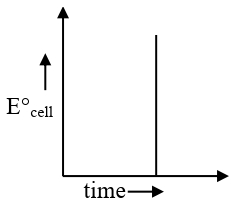
B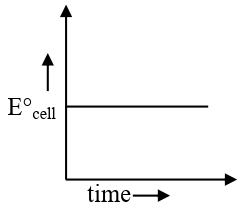
C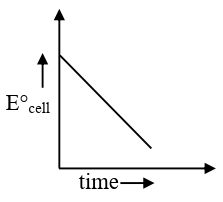
D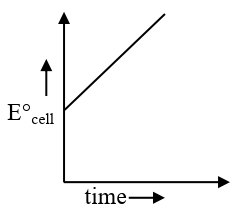
Solution
(B) The standard cell potential, denoted as $E_{cell}^0$, is a constant value for a given electrochemical cell at a specific temperature. It depends only on the standard reduction potentials of the half-cells involved and is independent of the concentrations of the reactants or the time the cell has been operating. Therefore, a plot of $E_{cell}^0$ versus time will be a horizontal line, indicating that the value remains constant over time.
0 likes
View Solution412
DifficultMCQ
Consider the following reduction processes:
$Al^{3+} + 3e^{-} \rightarrow Al_{(s)}, E^{\circ} = -1.66 \ V$
$Fe^{3+} + e^{-} \rightarrow Fe^{2+}, E^{\circ} = +0.77 \ V$
$Co^{3+} + e^{-} \rightarrow Co^{2+}, E^{\circ} = +1.81 \ V$
$Cr^{3+} + 3e^{-} \rightarrow Cr_{(s)}, E^{\circ} = -0.74 \ V$
The tendency to act as a reducing agent decreases in the order:
$Al^{3+} + 3e^{-} \rightarrow Al_{(s)}, E^{\circ} = -1.66 \ V$
$Fe^{3+} + e^{-} \rightarrow Fe^{2+}, E^{\circ} = +0.77 \ V$
$Co^{3+} + e^{-} \rightarrow Co^{2+}, E^{\circ} = +1.81 \ V$
$Cr^{3+} + 3e^{-} \rightarrow Cr_{(s)}, E^{\circ} = -0.74 \ V$
The tendency to act as a reducing agent decreases in the order:
A
$Al > Cr > Fe^{2+} > Co^{2+}$
B
$Al > Fe^{2+} > Cr > Co^{2+}$
C
$Al > Cr > Co^{2+} > Fe^{2+}$
D
$Cr > Fe^{2+} > Al > Co^{2+}$
Solution
(A) The reducing power of a species is inversely proportional to its standard reduction potential $(E^{\circ})$.
Lower reduction potential indicates a stronger tendency to undergo oxidation, thus acting as a better reducing agent.
The reduction potentials are:
$Al^{3+}/Al = -1.66 \ V$
$Cr^{3+}/Cr = -0.74 \ V$
$Fe^{3+}/Fe^{2+} = +0.77 \ V$
$Co^{3+}/Co^{2+} = +1.81 \ V$
Arranging these in increasing order of reduction potential:
$Al < Cr < Fe^{2+} < Co^{2+}$
Therefore, the order of reducing power (decreasing) is:
$Al > Cr > Fe^{2+} > Co^{2+}$
Lower reduction potential indicates a stronger tendency to undergo oxidation, thus acting as a better reducing agent.
The reduction potentials are:
$Al^{3+}/Al = -1.66 \ V$
$Cr^{3+}/Cr = -0.74 \ V$
$Fe^{3+}/Fe^{2+} = +0.77 \ V$
$Co^{3+}/Co^{2+} = +1.81 \ V$
Arranging these in increasing order of reduction potential:
$Al < Cr < Fe^{2+} < Co^{2+}$
Therefore, the order of reducing power (decreasing) is:
$Al > Cr > Fe^{2+} > Co^{2+}$
0 likes
View Solution413
MediumMCQ
Which statement is correct for $\Delta G$ and $E_{cell}$ for a cell reaction?
A
$\Delta G$ is an intensive property and $E_{cell}$ is an extensive property.
B
Both $\Delta G$ and $E_{cell}$ are intensive properties.
C
$\Delta G$ is an extensive property and $E_{cell}$ is an intensive property.
D
Both $\Delta G$ and $E_{cell}$ are extensive properties.
Solution
(C) An extensive property is a property that depends on the amount of matter present in the system. $\Delta G$ (Gibbs free energy) is proportional to the number of moles of reactants, making it an extensive property.
An intensive property is a property that is independent of the amount of matter present. $E_{cell}$ (electromotive force) is a potential difference that does not depend on the size or amount of the cell, making it an intensive property.
Therefore, $\Delta G$ is extensive and $E_{cell}$ is intensive. Thus, option $(C)$ is correct.
An intensive property is a property that is independent of the amount of matter present. $E_{cell}$ (electromotive force) is a potential difference that does not depend on the size or amount of the cell, making it an intensive property.
Therefore, $\Delta G$ is extensive and $E_{cell}$ is intensive. Thus, option $(C)$ is correct.
0 likes
View Solution414
MediumMCQ
Which of the following metals behaves as the weakest reducing agent?
$E^\circ_{(\text{Li}^+/\text{Li})} = -3.05 \text{ V}$, $E^\circ_{(\text{Au}^{3+}/\text{Au})} = 1.40 \text{ V}$, $E^\circ_{(\text{Ag}^+/\text{Ag})} = 0.80 \text{ V}$, $E^\circ_{(\text{Mg}^{2+}/\text{Mg})} = -2.36 \text{ V}$
$E^\circ_{(\text{Li}^+/\text{Li})} = -3.05 \text{ V}$, $E^\circ_{(\text{Au}^{3+}/\text{Au})} = 1.40 \text{ V}$, $E^\circ_{(\text{Ag}^+/\text{Ag})} = 0.80 \text{ V}$, $E^\circ_{(\text{Mg}^{2+}/\text{Mg})} = -2.36 \text{ V}$
A
Li
B
Ag
C
Au
D
Mg
Solution
(C) The reducing power of a metal is inversely proportional to its standard reduction potential $(E^\circ)$.
$A$ lower (more negative) $E^\circ$ value indicates a stronger reducing agent, while a higher (more positive) $E^\circ$ value indicates a weaker reducing agent.
Comparing the given values:
$E^\circ_{(\text{Li}^+/\text{Li})} = -3.05 \text{ V}$
$E^\circ_{(\text{Mg}^{2+}/\text{Mg})} = -2.36 \text{ V}$
$E^\circ_{(\text{Ag}^+/\text{Ag})} = 0.80 \text{ V}$
$E^\circ_{(\text{Au}^{3+}/\text{Au})} = 1.40 \text{ V}$
Since $\text{Au}^{3+}/\text{Au}$ has the highest positive standard reduction potential $(1.40 \text{ V})$, it is the weakest reducing agent.
$A$ lower (more negative) $E^\circ$ value indicates a stronger reducing agent, while a higher (more positive) $E^\circ$ value indicates a weaker reducing agent.
Comparing the given values:
$E^\circ_{(\text{Li}^+/\text{Li})} = -3.05 \text{ V}$
$E^\circ_{(\text{Mg}^{2+}/\text{Mg})} = -2.36 \text{ V}$
$E^\circ_{(\text{Ag}^+/\text{Ag})} = 0.80 \text{ V}$
$E^\circ_{(\text{Au}^{3+}/\text{Au})} = 1.40 \text{ V}$
Since $\text{Au}^{3+}/\text{Au}$ has the highest positive standard reduction potential $(1.40 \text{ V})$, it is the weakest reducing agent.
0 likes
View Solution415
MediumMCQ
Which of the following metals does not liberate $\text{H}_2$ gas by reacting with $\text{HCl}$?
A
Co
B
Cu
C
Ni
D
Zn
Solution
(B) Metals that have a negative standard reduction potential relative to hydrogen $(E^\circ < 0 \text{ V})$ can liberate $\text{H}_2$ gas from $\text{HCl}$.
Copper $(Cu)$ has a positive standard reduction potential $(E^\circ_{Cu^{2+}/Cu} \approx +0.34 \text{ V})$.
Since its reduction potential is higher than that of hydrogen $(E^\circ_{H^+/H_2} = 0.00 \text{ V})$, it is less reactive than hydrogen and cannot displace it from acids.
Copper $(Cu)$ has a positive standard reduction potential $(E^\circ_{Cu^{2+}/Cu} \approx +0.34 \text{ V})$.
Since its reduction potential is higher than that of hydrogen $(E^\circ_{H^+/H_2} = 0.00 \text{ V})$, it is less reactive than hydrogen and cannot displace it from acids.
0 likes
View Solution416
DifficultMCQ
Given at $298 \ K$: $E^\ominus_{Fe^{2+}/Fe} = X \ V$; $E^\ominus_{Fe^{3+}/Fe} = Y \ V$. The $E^\ominus_{Fe^{3+}/Fe^{2+}}$ in Volt at $298 \ K$ is given by:
A
$2X - 3Y$
B
$3Y - 2X$
C
$3Y + 2X$
D
$Y + X$
Solution
(B) $1$. For the reaction $Fe^{2+} + 2e^- \to Fe$, the standard Gibbs free energy change is $\Delta G^\circ_1 = -n_1 F E^\circ_{Fe^{2+}/Fe} = -2F X$.
$2$. For the reaction $Fe^{3+} + 3e^- \to Fe$, the standard Gibbs free energy change is $\Delta G^\circ_2 = -n_2 F E^\circ_{Fe^{3+}/Fe} = -3F Y$.
$3$. To find the potential for $Fe^{3+} + e^- \to Fe^{2+}$, we subtract the first reaction from the second: $(Fe^{3+} + 3e^- \to Fe) - (Fe^{2+} + 2e^- \to Fe) \implies Fe^{3+} + e^- \to Fe^{2+}$.
$4$. The change in Gibbs free energy for this reaction is $\Delta G^\circ_3 = \Delta G^\circ_2 - \Delta G^\circ_1 = -3FY - (-2FX) = 2FX - 3FY$.
$5$. Since $\Delta G^\circ_3 = -n_3 F E^\circ_{Fe^{3+}/Fe^{2+}}$ where $n_3 = 1$, we have $-1 \cdot F \cdot E^\circ_{Fe^{3+}/Fe^{2+}} = 2FX - 3FY$.
$6$. Therefore, $E^\circ_{Fe^{3+}/Fe^{2+}} = 3Y - 2X$.
$2$. For the reaction $Fe^{3+} + 3e^- \to Fe$, the standard Gibbs free energy change is $\Delta G^\circ_2 = -n_2 F E^\circ_{Fe^{3+}/Fe} = -3F Y$.
$3$. To find the potential for $Fe^{3+} + e^- \to Fe^{2+}$, we subtract the first reaction from the second: $(Fe^{3+} + 3e^- \to Fe) - (Fe^{2+} + 2e^- \to Fe) \implies Fe^{3+} + e^- \to Fe^{2+}$.
$4$. The change in Gibbs free energy for this reaction is $\Delta G^\circ_3 = \Delta G^\circ_2 - \Delta G^\circ_1 = -3FY - (-2FX) = 2FX - 3FY$.
$5$. Since $\Delta G^\circ_3 = -n_3 F E^\circ_{Fe^{3+}/Fe^{2+}}$ where $n_3 = 1$, we have $-1 \cdot F \cdot E^\circ_{Fe^{3+}/Fe^{2+}} = 2FX - 3FY$.
$6$. Therefore, $E^\circ_{Fe^{3+}/Fe^{2+}} = 3Y - 2X$.
0 likes
View Solution417
DifficultMCQ
The standard electrode potential $(E^\circ)$ for the half-cell reaction $Fe^{3+} + e^- \rightarrow Fe^{2+}$ at $298 K$ is (Given: $E^\circ(Fe^{3+}/Fe) = -0.04 V$ and $E^\circ(Fe^{2+}/Fe) = -0.44 V$ at $298 K$)
A
$+0.40 V$
B
$+0.76 V$
C
$-0.48 V$
D
$+0.92 V$
Solution
(B) To find the standard electrode potential for the reaction $Fe^{3+} + e^- \rightarrow Fe^{2+}$, we use the Gibbs free energy change $(\Delta G^\circ)$.
For reaction $(1): Fe^{3+} + 3e^- \rightarrow Fe$, $\Delta G_1^\circ = -n_1 F E_1^\circ = -3 \times F \times (-0.04) = 0.12 F$.
For reaction $(2): Fe^{2+} + 2e^- \rightarrow Fe$, $\Delta G_2^\circ = -n_2 F E_2^\circ = -2 \times F \times (-0.44) = 0.88 F$.
We want the reaction: $Fe^{3+} + e^- \rightarrow Fe^{2+}$, which is reaction $(1) - (2)$.
Therefore, $\Delta G_3^\circ = \Delta G_1^\circ - \Delta G_2^\circ = 0.12 F - 0.88 F = -0.76 F$.
Since $\Delta G_3^\circ = -n_3 F E_3^\circ$ and $n_3 = 1$, we have $-0.76 F = -1 \times F \times E_3^\circ$.
Thus, $E_3^\circ = +0.77 V$ (approximately $+0.76 V$ based on given values).
For reaction $(1): Fe^{3+} + 3e^- \rightarrow Fe$, $\Delta G_1^\circ = -n_1 F E_1^\circ = -3 \times F \times (-0.04) = 0.12 F$.
For reaction $(2): Fe^{2+} + 2e^- \rightarrow Fe$, $\Delta G_2^\circ = -n_2 F E_2^\circ = -2 \times F \times (-0.44) = 0.88 F$.
We want the reaction: $Fe^{3+} + e^- \rightarrow Fe^{2+}$, which is reaction $(1) - (2)$.
Therefore, $\Delta G_3^\circ = \Delta G_1^\circ - \Delta G_2^\circ = 0.12 F - 0.88 F = -0.76 F$.
Since $\Delta G_3^\circ = -n_3 F E_3^\circ$ and $n_3 = 1$, we have $-0.76 F = -1 \times F \times E_3^\circ$.
Thus, $E_3^\circ = +0.77 V$ (approximately $+0.76 V$ based on given values).
0 likes
View Solution418
DifficultMCQ
The $E^0_{cell}$ of the cell $Al(s)|Al^{3+}(1M)||Pb^{2+}(1M)|Pb(s)$ is $1.5 \text{ V}$. If $E^0_{Pb^{2+}/Pb}$ is $-0.14 \text{ V}$, then the standard electrode potential $E^0_{Al^{3+}/Al}$ will be: (in $\text{ V}$)
A
$1.64$
B
$-1.64$
C
$1.36$
D
$-1.36$
Solution
(B) The cell reaction is: $2Al(s) + 3Pb^{2+}(aq) \rightarrow 2Al^{3+}(aq) + 3Pb(s)$.
The standard cell potential is given by: $E^0_{cell} = E^0_{cathode} - E^0_{anode}$.
Here, the cathode is $Pb^{2+}/Pb$ and the anode is $Al^{3+}/Al$.
So, $E^0_{cell} = E^0_{Pb^{2+}/Pb} - E^0_{Al^{3+}/Al}$.
Given $E^0_{cell} = 1.5 \text{ V}$ and $E^0_{Pb^{2+}/Pb} = -0.14 \text{ V}$.
Substituting the values: $1.5 \text{ V} = -0.14 \text{ V} - E^0_{Al^{3+}/Al}$.
$E^0_{Al^{3+}/Al} = -0.14 \text{ V} - 1.5 \text{ V} = -1.64 \text{ V}$.
The standard cell potential is given by: $E^0_{cell} = E^0_{cathode} - E^0_{anode}$.
Here, the cathode is $Pb^{2+}/Pb$ and the anode is $Al^{3+}/Al$.
So, $E^0_{cell} = E^0_{Pb^{2+}/Pb} - E^0_{Al^{3+}/Al}$.
Given $E^0_{cell} = 1.5 \text{ V}$ and $E^0_{Pb^{2+}/Pb} = -0.14 \text{ V}$.
Substituting the values: $1.5 \text{ V} = -0.14 \text{ V} - E^0_{Al^{3+}/Al}$.
$E^0_{Al^{3+}/Al} = -0.14 \text{ V} - 1.5 \text{ V} = -1.64 \text{ V}$.
0 likes
View Solution419
EasyMCQ
Identify the reaction from the following for which the standard electrode potential of the $Cu^{+2}/Cu$ electrode is $0.34 \text{ V}$ with respect to the $SHE$?
A
$Cu \rightarrow Cu^{+2} + 2e^-$
B
$Cu^{+2} + 2e^- \rightarrow Cu$
C
$Cu^+ \rightarrow Cu^{+2} + e^-$
D
$Cu^{+3} \rightarrow Cu^{+2} + e^-$
Solution
(B) $1$. The standard electrode potential $(E^\circ)$ is defined for the reduction half-reaction.
$2$. The notation $Cu^{+2}/Cu$ represents the reduction of $Cu^{+2}$ ions to metallic $Cu$.
$3$. The corresponding reduction half-reaction is $Cu^{+2} + 2e^- \rightarrow Cu$.
$4$. Therefore, the correct reaction is option $B$.
$2$. The notation $Cu^{+2}/Cu$ represents the reduction of $Cu^{+2}$ ions to metallic $Cu$.
$3$. The corresponding reduction half-reaction is $Cu^{+2} + 2e^- \rightarrow Cu$.
$4$. Therefore, the correct reaction is option $B$.
0 likes
View Solution420
DifficultMCQ
If the emf of the cell $Cu(s) | Cu^{2+}(1M) || Ag^+(1M) | Ag(s)$ is $0.463 \text{ V}$ at $25^{\circ} \text{C}$ and the standard electrode potential of the $Cu$ electrode is $0.337 \text{ V}$, find the standard electrode potential of the $Ag$ electrode. (in $\text{ V}$)
A
$0.128$
B
$-0.128$
C
$0.8$
D
$-0.8$
Solution
(C) The cell reaction is: $Cu(s) + 2Ag^+(aq) \rightarrow Cu^{2+}(aq) + 2Ag(s)$.
The standard cell potential is given by $E^{\circ}_{cell} = E^{\circ}_{cathode} - E^{\circ}_{anode}$.
Since the concentrations are $1M$, the cell potential $E_{cell}$ is equal to the standard cell potential $E^{\circ}_{cell} = 0.463 \text{ V}$.
Here, $Ag$ is the cathode and $Cu$ is the anode.
$E^{\circ}_{cell} = E^{\circ}_{Ag^+/Ag} - E^{\circ}_{Cu^{2+}/Cu}$.
$0.463 \text{ V} = E^{\circ}_{Ag^+/Ag} - 0.337 \text{ V}$.
$E^{\circ}_{Ag^+/Ag} = 0.463 \text{ V} + 0.337 \text{ V} = 0.800 \text{ V}$.
The standard cell potential is given by $E^{\circ}_{cell} = E^{\circ}_{cathode} - E^{\circ}_{anode}$.
Since the concentrations are $1M$, the cell potential $E_{cell}$ is equal to the standard cell potential $E^{\circ}_{cell} = 0.463 \text{ V}$.
Here, $Ag$ is the cathode and $Cu$ is the anode.
$E^{\circ}_{cell} = E^{\circ}_{Ag^+/Ag} - E^{\circ}_{Cu^{2+}/Cu}$.
$0.463 \text{ V} = E^{\circ}_{Ag^+/Ag} - 0.337 \text{ V}$.
$E^{\circ}_{Ag^+/Ag} = 0.463 \text{ V} + 0.337 \text{ V} = 0.800 \text{ V}$.
0 likes
View Solution421
DifficultMCQ
If standard reduction potentials $(E^0)$ of $(Al^{+3}_{(aq)}|Al(s))$, $(Fe^{+2}_{(aq)}|Fe(s))$, $(Cu^{+2}_{(aq)}|Cu(s))$ and $(Ag^{+1}_{(aq)}|Ag(s))$ are $-1.66 \text{ V}$, $-0.44 \text{ V}$, $+0.34 \text{ V}$ and $+0.79 \text{ V}$ respectively, which of the following reactions is non-spontaneous?
A
$2Ag(s) + Fe^{+2}_{(aq)} \rightarrow 2Ag^{+1}_{(aq)} + Fe(s)$
B
$2Al(s) + 3Cu^{+2}_{(aq)} \rightarrow 2Al^{+3}_{(aq)} + 3Cu(s)$
C
$Fe(s) + Cu^{+2}_{(aq)} \rightarrow Fe^{+2}_{(aq)} + Cu(s)$
D
$2Al(s) + 3Fe^{+2}_{(aq)} \rightarrow 2Al^{+3}_{(aq)} + 3Fe(s)$
Solution
(A) reaction is non-spontaneous if the standard cell potential $E^0_{cell} < 0$.
$E^0_{cell} = E^0_{cathode} - E^0_{anode}$.
For option $(A)$: $2Ag(s) + Fe^{+2}_{(aq)} \rightarrow 2Ag^{+1}_{(aq)} + Fe(s)$.
$E^0_{cathode} = E^0_{(Fe^{+2}|Fe)} = -0.44 \text{ V}$.
$E^0_{anode} = E^0_{(Ag^{+1}|Ag)} = +0.79 \text{ V}$.
$E^0_{cell} = -0.44 - 0.79 = -1.23 \text{ V}$.
Since $E^0_{cell} < 0$, the reaction is non-spontaneous.
$E^0_{cell} = E^0_{cathode} - E^0_{anode}$.
For option $(A)$: $2Ag(s) + Fe^{+2}_{(aq)} \rightarrow 2Ag^{+1}_{(aq)} + Fe(s)$.
$E^0_{cathode} = E^0_{(Fe^{+2}|Fe)} = -0.44 \text{ V}$.
$E^0_{anode} = E^0_{(Ag^{+1}|Ag)} = +0.79 \text{ V}$.
$E^0_{cell} = -0.44 - 0.79 = -1.23 \text{ V}$.
Since $E^0_{cell} < 0$, the reaction is non-spontaneous.
0 likes
View Solution422
DifficultMCQ
If the standard reduction potentials of four electrodes $A$, $B$, $C$, and $D$ are $+2.5 \text{ V}$, $+3.0 \text{ V}$, $-2.0 \text{ V}$, and $-1.5 \text{ V}$ respectively, in which case is the standard $emf$ of the cell maximum?
A
$A$ is anode and $B$ is cathode
B
$B$ is anode and $D$ is cathode
C
$C$ is anode and $B$ is cathode
D
$B$ is anode and $C$ is cathode
Solution
(C) The standard $emf$ of a cell is given by $E^\circ_{\text{cell}} = E^\circ_{\text{cathode}} - E^\circ_{\text{anode}}$.
To maximize $E^\circ_{\text{cell}}$, we must choose the cathode with the highest reduction potential and the anode with the lowest reduction potential.
Given potentials: $E^\circ_A = +2.5 \text{ V}$, $E^\circ_B = +3.0 \text{ V}$, $E^\circ_C = -2.0 \text{ V}$, $E^\circ_D = -1.5 \text{ V}$.
Highest potential (cathode) is $B$ $(+3.0 \text{ V})$.
Lowest potential (anode) is $C$ $(-2.0 \text{ V})$.
$E^\circ_{\text{cell}} = E^\circ_B - E^\circ_C = 3.0 - (-2.0) = 5.0 \text{ V}$.
Thus, $C$ is the anode and $B$ is the cathode.
To maximize $E^\circ_{\text{cell}}$, we must choose the cathode with the highest reduction potential and the anode with the lowest reduction potential.
Given potentials: $E^\circ_A = +2.5 \text{ V}$, $E^\circ_B = +3.0 \text{ V}$, $E^\circ_C = -2.0 \text{ V}$, $E^\circ_D = -1.5 \text{ V}$.
Highest potential (cathode) is $B$ $(+3.0 \text{ V})$.
Lowest potential (anode) is $C$ $(-2.0 \text{ V})$.
$E^\circ_{\text{cell}} = E^\circ_B - E^\circ_C = 3.0 - (-2.0) = 5.0 \text{ V}$.
Thus, $C$ is the anode and $B$ is the cathode.
0 likes
View Solution423
MediumMCQ
If the standard reduction potentials of $Zn$, $Ni$, and $Fe$ are $-0.76 \text{ V}$, $-0.23 \text{ V}$, and $-0.44 \text{ V}$ respectively, determine the electrodes $X$ and $Y$ for the reaction $X(s) + Y^{+2}_{(aq)} \rightarrow X^{+2}_{(aq)} + Y(s)$ to be spontaneous.
A
$X = Ni, Y = Fe$
B
$X = Ni, Y = Zn$
C
$X = Fe, Y = Zn$
D
$X = Zn, Y = Ni$
Solution
(D) For a reaction to be spontaneous, the standard cell potential $E^\circ_{\text{cell}}$ must be positive.
$E^\circ_{\text{cell}} = E^\circ_{\text{cathode}} - E^\circ_{\text{anode}} = E^\circ_{Y^{+2}/Y} - E^\circ_{X^{+2}/X} > 0$.
This implies $E^\circ_{Y^{+2}/Y} > E^\circ_{X^{+2}/X}$.
Given potentials: $E^\circ_{Zn^{+2}/Zn} = -0.76 \text{ V}$, $E^\circ_{Fe^{+2}/Fe} = -0.44 \text{ V}$, $E^\circ_{Ni^{+2}/Ni} = -0.23 \text{ V}$.
Checking option $(D)$: $X = Zn$ $(E^\circ = -0.76 \text{ V})$ and $Y = Ni$ $(E^\circ = -0.23 \text{ V})$.
$E^\circ_{\text{cell}} = (-0.23) - (-0.76) = +0.53 \text{ V}$.
Since $E^\circ_{\text{cell}} > 0$, the reaction is spontaneous.
$E^\circ_{\text{cell}} = E^\circ_{\text{cathode}} - E^\circ_{\text{anode}} = E^\circ_{Y^{+2}/Y} - E^\circ_{X^{+2}/X} > 0$.
This implies $E^\circ_{Y^{+2}/Y} > E^\circ_{X^{+2}/X}$.
Given potentials: $E^\circ_{Zn^{+2}/Zn} = -0.76 \text{ V}$, $E^\circ_{Fe^{+2}/Fe} = -0.44 \text{ V}$, $E^\circ_{Ni^{+2}/Ni} = -0.23 \text{ V}$.
Checking option $(D)$: $X = Zn$ $(E^\circ = -0.76 \text{ V})$ and $Y = Ni$ $(E^\circ = -0.23 \text{ V})$.
$E^\circ_{\text{cell}} = (-0.23) - (-0.76) = +0.53 \text{ V}$.
Since $E^\circ_{\text{cell}} > 0$, the reaction is spontaneous.
0 likes
View Solution424
MediumMCQ
$A$ galvanic cell consists of a copper electrode and a standard hydrogen electrode. If $E^0_{(Cu^{2+}(aq)|Cu(s))} = +0.34 \text{ V}$, identify the reaction taking place at the positive electrode during the working of the cell.
A
$Cu(s) \rightarrow Cu^{2+}(aq) + 2e^-$
B
$Cu^{2+}(aq) + 2e^- \rightarrow Cu(s)$
C
$H_2(g) \rightarrow 2H^+(aq) + 2e^-$
D
$H^+(aq) + e^- \rightarrow \frac{1}{2} H_2(g)$
Solution
(B) $1$. In a galvanic cell, the electrode with the higher reduction potential acts as the cathode (positive electrode).
$2$. Given $E^0_{(Cu^{2+}|Cu)} = +0.34 \text{ V}$ and $E^0_{(H^+|H_2)} = 0.00 \text{ V}$.
$3$. Since $+0.34 \text{ V} > 0.00 \text{ V}$, the copper electrode is the cathode.
$4$. Reduction occurs at the cathode: $Cu^{2+}(aq) + 2e^- \rightarrow Cu(s)$.
$2$. Given $E^0_{(Cu^{2+}|Cu)} = +0.34 \text{ V}$ and $E^0_{(H^+|H_2)} = 0.00 \text{ V}$.
$3$. Since $+0.34 \text{ V} > 0.00 \text{ V}$, the copper electrode is the cathode.
$4$. Reduction occurs at the cathode: $Cu^{2+}(aq) + 2e^- \rightarrow Cu(s)$.
0 likes
View Solution425
DifficultMCQ
Identify which of the following cell reactions is spontaneous under standard state conditions.
A
$Ca(s) + Cd^{2+}(aq) \rightarrow Ca^{2+}(aq) + Cd(s)$ $[E^0_{Ca^{2+}/Ca} = -2.866 \text{ V}, E^0_{Cd^{2+}/Cd} = -0.403 \text{ V}]$
B
$2Br^-(aq) + Sn^{2+}(aq) \rightarrow Br_2(l) + Sn(s)$ $[E^0_{Br_2/Br^-} = 1.08 \text{ V}, E^0_{Sn^{2+}/Sn} = -0.136 \text{ V}]$
C
$2Ag(s) + Ni^{2+}(aq) \rightarrow 2Ag^+(aq) + Ni(s)$ $[E^0_{Ag^+/Ag} = 0.799 \text{ V}, E^0_{Ni^{2+}/Ni} = -0.257 \text{ V}]$
D
$2Au(s) + Zn^{2+}(aq) \rightarrow 2Au^+(aq) + Zn(s)$ $[E^0_{Au^+/Au} = 1.68 \text{ V}, E^0_{Zn^{2+}/Zn} = -0.763 \text{ V}]$
Solution
(A) reaction is spontaneous if $E^0_{cell} > 0$. $E^0_{cell} = E^0_{cathode} - E^0_{anode}$.
For $(A)$: $E^0_{cell} = (-0.403) - (-2.866) = +2.463 \text{ V}$. Since $E^0_{cell} > 0$, it is spontaneous.
For $(B)$: $E^0_{cell} = (-0.136) - (1.08) = -1.216 \text{ V}$. Non-spontaneous.
For $(C)$: $E^0_{cell} = (-0.257) - (0.799) = -1.056 \text{ V}$. Non-spontaneous.
For $(D)$: $E^0_{cell} = (-0.763) - (1.68) = -2.443 \text{ V}$. Non-spontaneous.
For $(A)$: $E^0_{cell} = (-0.403) - (-2.866) = +2.463 \text{ V}$. Since $E^0_{cell} > 0$, it is spontaneous.
For $(B)$: $E^0_{cell} = (-0.136) - (1.08) = -1.216 \text{ V}$. Non-spontaneous.
For $(C)$: $E^0_{cell} = (-0.257) - (0.799) = -1.056 \text{ V}$. Non-spontaneous.
For $(D)$: $E^0_{cell} = (-0.763) - (1.68) = -2.443 \text{ V}$. Non-spontaneous.
0 likes
View Solution426
DifficultMCQ
The $E^0_{cell}$ of the cell $Al(s)|Al^{3+}(1M)||Pb^{2+}(1M)|Pb(s)$ is $1.5 \text{ V}$. If $E^0_{Pb^{2+}/Pb}$ is $-0.14 \text{ V}$, then $E^0_{Al^{3+}/Al}$ will be: (in $\text{ V}$)
A
$1.64$
B
$-1.64$
C
$1.36$
D
$-1.36$
Solution
(B) The standard cell potential is given by the formula: $E^0_{cell} = E^0_{cathode} - E^0_{anode}$.
Here, the cathode is $Pb^{2+}/Pb$ and the anode is $Al^{3+}/Al$.
Given: $E^0_{cell} = 1.5 \text{ V}$ and $E^0_{cathode} = -0.14 \text{ V}$.
Substituting the values: $1.5 \text{ V} = -0.14 \text{ V} - E^0_{anode}$.
Rearranging the equation: $E^0_{anode} = -0.14 \text{ V} - 1.5 \text{ V}$.
Therefore, $E^0_{Al^{3+}/Al} = -1.64 \text{ V}$.
Here, the cathode is $Pb^{2+}/Pb$ and the anode is $Al^{3+}/Al$.
Given: $E^0_{cell} = 1.5 \text{ V}$ and $E^0_{cathode} = -0.14 \text{ V}$.
Substituting the values: $1.5 \text{ V} = -0.14 \text{ V} - E^0_{anode}$.
Rearranging the equation: $E^0_{anode} = -0.14 \text{ V} - 1.5 \text{ V}$.
Therefore, $E^0_{Al^{3+}/Al} = -1.64 \text{ V}$.
0 likes
View Solution427
EasyMCQ
Identify the reaction from the following that corresponds to the standard electrode potential of the $Cu^{+2}/Cu$ electrode being $0.34 \text{ V}$ with respect to the $SHE$?
A
$Cu \rightarrow Cu^{+2} + 2e^-$
B
$Cu^{+2} + 2e^- \rightarrow Cu$
C
$Cu^+ \rightarrow Cu^{+2} + e^-$
D
$Cu^{+3} \rightarrow Cu^{+2} + e^-$
Solution
(B) The standard electrode potential $E^\circ$ is defined for the reduction half-reaction.
For the $Cu^{+2}/Cu$ electrode, the reduction reaction is the gain of electrons by the copper ion to form metallic copper.
The reaction is: $Cu^{+2}(aq) + 2e^- \rightarrow Cu(s)$.
Thus, option $B$ represents the correct reduction reaction.
For the $Cu^{+2}/Cu$ electrode, the reduction reaction is the gain of electrons by the copper ion to form metallic copper.
The reaction is: $Cu^{+2}(aq) + 2e^- \rightarrow Cu(s)$.
Thus, option $B$ represents the correct reduction reaction.
0 likes
View Solution428
DifficultMCQ
If the $emf$ of the cell $Cu(s) | Cu^{2+}(1 \text{ M}) || Ag^+(1 \text{ M}) | Ag(s)$ is $0.463 \text{ V}$ at $25^{\circ} \text{C}$ and the standard electrode potential of the $Cu$ electrode is $0.337 \text{ V}$, find the standard electrode potential of the $Ag$ electrode. (in $\text{ V}$)
A
$0.128$
B
$-0.128$
C
$0.8$
D
$-0.8$
Solution
(C) The standard cell potential $E^0_{cell}$ is given by the difference between the standard reduction potentials of the cathode and the anode:
$E^0_{cell} = E^0_{cathode} - E^0_{anode}$
Here, the cathode is $Ag$ and the anode is $Cu$, so:
$E^0_{cell} = E^0_{Ag^+/Ag} - E^0_{Cu^{2+}/Cu}$
Given $E^0_{cell} = 0.463 \text{ V}$ and $E^0_{Cu^{2+}/Cu} = 0.337 \text{ V}$:
$0.463 \text{ V} = E^0_{Ag^+/Ag} - 0.337 \text{ V}$
$E^0_{Ag^+/Ag} = 0.463 \text{ V} + 0.337 \text{ V} = 0.800 \text{ V}$
Thus, the standard potential of the $Ag$ electrode is $0.8 \text{ V}$.
$E^0_{cell} = E^0_{cathode} - E^0_{anode}$
Here, the cathode is $Ag$ and the anode is $Cu$, so:
$E^0_{cell} = E^0_{Ag^+/Ag} - E^0_{Cu^{2+}/Cu}$
Given $E^0_{cell} = 0.463 \text{ V}$ and $E^0_{Cu^{2+}/Cu} = 0.337 \text{ V}$:
$0.463 \text{ V} = E^0_{Ag^+/Ag} - 0.337 \text{ V}$
$E^0_{Ag^+/Ag} = 0.463 \text{ V} + 0.337 \text{ V} = 0.800 \text{ V}$
Thus, the standard potential of the $Ag$ electrode is $0.8 \text{ V}$.
0 likes
View Solution429
DifficultMCQ
If standard reduction potentials $(E^0)$ of $(Al^{+3}(aq)|Al(s))$, $(Fe^{+2}(aq)|Fe(s))$, $(Cu^{+2}(aq)|Cu(s))$ and $(Ag^{+1}(aq)|Ag(s))$ are $-1.66 \text{ V}$, $-0.44 \text{ V}$, $+0.34 \text{ V}$ and $+0.79 \text{ V}$ respectively, which of the following reactions is non-spontaneous?
A
$2Ag(s) + Fe^{+2}(aq) \rightarrow 2Ag^{+}(aq) + Fe(s)$
B
$2Al(s) + 3Cu^{+2}(aq) \rightarrow 2Al^{+3}(aq) + 3Cu(s)$
C
$Fe(s) + Cu^{+2}(aq) \rightarrow Fe^{+2}(aq) + Cu(s)$
D
$2Al(s) + 3Fe^{+2}(aq) \rightarrow 2Al^{+3}(aq) + 3Fe(s)$
Solution
(A) reaction is non-spontaneous if the standard cell potential $E^0_{cell} < 0$.
For option $A$: $E^0_{cell} = E^0_{cathode} - E^0_{anode} = E^0_{Fe^{+2}/Fe} - E^0_{Ag^{+}/Ag} = -0.44 - 0.79 = -1.23 \text{ V}$. Since $E^0_{cell} < 0$, this reaction is non-spontaneous.
For option $B$: $E^0_{cell} = 0.34 - (-1.66) = 2.00 \text{ V} > 0$ (Spontaneous).
For option $C$: $E^0_{cell} = 0.34 - (-0.44) = 0.78 \text{ V} > 0$ (Spontaneous).
For option $D$: $E^0_{cell} = -0.44 - (-1.66) = 1.22 \text{ V} > 0$ (Spontaneous).
For option $A$: $E^0_{cell} = E^0_{cathode} - E^0_{anode} = E^0_{Fe^{+2}/Fe} - E^0_{Ag^{+}/Ag} = -0.44 - 0.79 = -1.23 \text{ V}$. Since $E^0_{cell} < 0$, this reaction is non-spontaneous.
For option $B$: $E^0_{cell} = 0.34 - (-1.66) = 2.00 \text{ V} > 0$ (Spontaneous).
For option $C$: $E^0_{cell} = 0.34 - (-0.44) = 0.78 \text{ V} > 0$ (Spontaneous).
For option $D$: $E^0_{cell} = -0.44 - (-1.66) = 1.22 \text{ V} > 0$ (Spontaneous).
0 likes
View Solution430
DifficultMCQ
If the standard reduction potentials of four electrodes $A$, $B$, $C$, and $D$ are $+2.5 \text{ V}$, $+3.0 \text{ V}$, $-2.0 \text{ V}$, and $-1.5 \text{ V}$ respectively, in which of the following cases is the standard $emf$ of the cell maximum?
A
$A$ is anode and $B$ is cathode
B
$B$ is anode and $D$ is cathode
C
$C$ is anode and $B$ is cathode
D
$B$ is anode and $C$ is cathode
Solution
(C) The standard $emf$ of a cell is given by $E^0_{cell} = E^0_{cathode} - E^0_{anode}$.
To maximize $E^0_{cell}$, we must choose the electrode with the highest reduction potential as the cathode and the electrode with the lowest reduction potential as the anode.
Given potentials: $E^0_A = +2.5 \text{ V}$, $E^0_B = +3.0 \text{ V}$, $E^0_C = -2.0 \text{ V}$, $E^0_D = -1.5 \text{ V}$.
Highest potential is $E^0_B = +3.0 \text{ V}$ (Cathode).
Lowest potential is $E^0_C = -2.0 \text{ V}$ (Anode).
$E^0_{cell} = E^0_B - E^0_C = 3.0 \text{ V} - (-2.0 \text{ V}) = 5.0 \text{ V}$.
Thus, the cell is maximum when $C$ is the anode and $B$ is the cathode.
To maximize $E^0_{cell}$, we must choose the electrode with the highest reduction potential as the cathode and the electrode with the lowest reduction potential as the anode.
Given potentials: $E^0_A = +2.5 \text{ V}$, $E^0_B = +3.0 \text{ V}$, $E^0_C = -2.0 \text{ V}$, $E^0_D = -1.5 \text{ V}$.
Highest potential is $E^0_B = +3.0 \text{ V}$ (Cathode).
Lowest potential is $E^0_C = -2.0 \text{ V}$ (Anode).
$E^0_{cell} = E^0_B - E^0_C = 3.0 \text{ V} - (-2.0 \text{ V}) = 5.0 \text{ V}$.
Thus, the cell is maximum when $C$ is the anode and $B$ is the cathode.
0 likes
View Solution431
DifficultMCQ
If the standard reduction potentials of $Zn$, $Ni$, and $Fe$ are $-0.76 \text{ V}$, $-0.23 \text{ V}$, and $-0.44 \text{ V}$ respectively, determine the electrodes $X$ and $Y$ for the reaction $X(s) + Y^{+2}(aq) \rightarrow X^{+2}(aq) + Y(s)$ to be spontaneous.
A
$X = Ni, Y = Fe$
B
$X = Ni, Y = Zn$
C
$X = Fe, Y = Zn$
D
$X = Zn, Y = Ni$
Solution
(D) For a redox reaction to be spontaneous, the standard cell potential $E^0_{cell}$ must be positive.
$E^0_{cell} = E^0_{cathode} - E^0_{anode} = E^0_{Y^{+2}/Y} - E^0_{X^{+2}/X} > 0$.
This implies $E^0_Y > E^0_X$.
Given potentials: $E^0_{Zn} = -0.76 \text{ V}$, $E^0_{Fe} = -0.44 \text{ V}$, $E^0_{Ni} = -0.23 \text{ V}$.
Checking option $D$: $X = Zn$ $(E^0 = -0.76 \text{ V})$ and $Y = Ni$ $(E^0 = -0.23 \text{ V})$.
$E^0_{cell} = -0.23 - (-0.76) = +0.53 \text{ V}$.
Since $E^0_{cell} > 0$, the reaction is spontaneous.
$E^0_{cell} = E^0_{cathode} - E^0_{anode} = E^0_{Y^{+2}/Y} - E^0_{X^{+2}/X} > 0$.
This implies $E^0_Y > E^0_X$.
Given potentials: $E^0_{Zn} = -0.76 \text{ V}$, $E^0_{Fe} = -0.44 \text{ V}$, $E^0_{Ni} = -0.23 \text{ V}$.
Checking option $D$: $X = Zn$ $(E^0 = -0.76 \text{ V})$ and $Y = Ni$ $(E^0 = -0.23 \text{ V})$.
$E^0_{cell} = -0.23 - (-0.76) = +0.53 \text{ V}$.
Since $E^0_{cell} > 0$, the reaction is spontaneous.
0 likes
View Solution432
MediumMCQ
$A$ galvanic cell consists of a copper electrode and a standard hydrogen electrode. If $E^\circ (Cu^{2+}_{(aq)} | Cu_{(s)}) = +0.34 \text{ V}$, identify the reaction taking place at the positive electrode during the working of the cell.
A
$Cu_{(s)} \longrightarrow Cu^{2+}_{(aq)} + 2e^-$
B
$Cu^{2+}_{(aq)} + 2e^- \longrightarrow Cu_{(s)}$
C
$H_2(g) \longrightarrow 2H^+_{(aq)} + 2e^-$
D
$H^+_{(aq)} + 2e^- \longrightarrow H_2(g)$
Solution
(B) $1$. In a galvanic cell, the electrode with the higher reduction potential acts as the cathode (positive electrode).
$2$. The standard reduction potential of the standard hydrogen electrode $(SHE)$ is $E^\circ (H^+ | H_2) = 0.00 \text{ V}$.
$3$. Since $E^\circ (Cu^{2+} | Cu) = +0.34 \text{ V} > 0.00 \text{ V}$, the copper electrode acts as the cathode.
$4$. Reduction occurs at the cathode: $Cu^{2+}_{(aq)} + 2e^- \longrightarrow Cu_{(s)}$.
$2$. The standard reduction potential of the standard hydrogen electrode $(SHE)$ is $E^\circ (H^+ | H_2) = 0.00 \text{ V}$.
$3$. Since $E^\circ (Cu^{2+} | Cu) = +0.34 \text{ V} > 0.00 \text{ V}$, the copper electrode acts as the cathode.
$4$. Reduction occurs at the cathode: $Cu^{2+}_{(aq)} + 2e^- \longrightarrow Cu_{(s)}$.
0 likes
View Solution433
DifficultMCQ
Given below are the half-cell reactions: $Mn^{2+} + 2e^- \rightarrow Mn$ $(E^0 = -1.18 \text{ V})$; $Mn^{3+} + e^- \rightarrow Mn^{2+}$ $(E^0 = +1.51 \text{ V})$. The $E^0_{cell}$ for $3Mn^{2+} \rightarrow Mn + 2Mn^{3+}$ will be . . . . . .
A
$-2.69 \text{ V}$, the reaction will not occur (Non-Spontaneous)
B
$-2.69 \text{ V}$, the reaction will occur (Spontaneous)
C
$-0.33 \text{ V}$, the reaction will not occur (Non-Spontaneous)
D
$-0.33 \text{ V}$, the reaction will occur (Spontaneous)
Solution
(A) Step $1$: Identify the oxidation and reduction half-reactions from the overall reaction $3Mn^{2+} \rightarrow Mn + 2Mn^{3+}$.
Step $2$: Oxidation: $Mn^{2+} \rightarrow Mn^{3+} + e^-$ $(E^0_{ox} = -1.51 \text{ V})$.
Step $3$: Reduction: $Mn^{2+} + 2e^- \rightarrow Mn$ $(E^0_{red} = -1.18 \text{ V})$.
Step $4$: Calculate $E^0_{cell} = E^0_{red} + E^0_{ox} = -1.18 \text{ V} + (-1.51 \text{ V}) = -2.69 \text{ V}$.
Step $5$: Since $E^0_{cell} < 0$, the reaction is non-spontaneous.
Step $2$: Oxidation: $Mn^{2+} \rightarrow Mn^{3+} + e^-$ $(E^0_{ox} = -1.51 \text{ V})$.
Step $3$: Reduction: $Mn^{2+} + 2e^- \rightarrow Mn$ $(E^0_{red} = -1.18 \text{ V})$.
Step $4$: Calculate $E^0_{cell} = E^0_{red} + E^0_{ox} = -1.18 \text{ V} + (-1.51 \text{ V}) = -2.69 \text{ V}$.
Step $5$: Since $E^0_{cell} < 0$, the reaction is non-spontaneous.
0 likes
View SolutionElectrochemistry — Electrode potential and ECell · Frequently Asked Questions
1Are these Electrochemistry questions useful for JEE and NEET?
Yes. All questions in this section are mapped to JEE Main and NEET exam patterns. Previous year questions from JEE Main, NEET, GUJCET and state-level exams are included with full solutions.
2Can I switch to Hindi or Gujarati for these questions?
Yes. Use the language tabs in the hero section or the sidebar to view the same questions and solutions in English, Hindi or Gujarati.
3How do I generate a question paper from this subtopic?
Use the Vedclass Exam Paper Generator — select the chapter and subtopic, set difficulty, and generate Sets A, B, C, D automatically. First 3 chapters of every subject are free.
Vedclass Products
For Students
Vedclass Test Series
Mock tests in real JEE/NEET style with performance analysis. 5-day free trial.
Start Free TrialFor Teachers
Exam Paper Generator
Generate Set A/B/C/D papers from this chapter in 2 minutes. 3 chapters free.
Try FreeFor Institutes
Online Exam Module
Live online exams with unlimited students, 360° analytics & white-label branding.
See DemoFor Teachers & Institutes
Generate a Electrochemistry Exam Paper in 2 Minutes
Select subtopic & difficulty — Sets A, B, C, D auto-generated with No Repeat logic.
First 3 chapters of every subject are free — no payment required.