
A English
Properties Questions in English
Class 12 Chemistry · 8-1.Aldehydes and Ketones · Properties
1760+
Questions
English
Language
100%
With Solutions
Showing 10 of 1760 questions in English
1751
MediumMCQ
Aldehydes are more reactive than ketones towards nucleophilic attack because of?
A
less steric hindrance in ketones
B
presence of two alkyl groups on ketones decreases their electrophilicity
C
presence of one alkyl group on aldehydes decreases their electrophilicity
D
alkyl groups have electron-withdrawing effect
Solution
(B) $1$. Nucleophilic addition reactions in carbonyl compounds depend on the electrophilicity of the carbonyl carbon and steric hindrance.
$2$. Aldehydes have one alkyl group and one hydrogen atom attached to the carbonyl carbon, whereas ketones have two alkyl groups.
$3$. Alkyl groups are electron-donating ($+I$ effect), which reduces the positive charge (electrophilicity) on the carbonyl carbon.
$4$. Ketones have two such groups, making them less electrophilic than aldehydes.
$5$. Additionally, two alkyl groups in ketones create more steric hindrance compared to one alkyl group and one small hydrogen atom in aldehydes, making the approach of the nucleophile more difficult in ketones.
$2$. Aldehydes have one alkyl group and one hydrogen atom attached to the carbonyl carbon, whereas ketones have two alkyl groups.
$3$. Alkyl groups are electron-donating ($+I$ effect), which reduces the positive charge (electrophilicity) on the carbonyl carbon.
$4$. Ketones have two such groups, making them less electrophilic than aldehydes.
$5$. Additionally, two alkyl groups in ketones create more steric hindrance compared to one alkyl group and one small hydrogen atom in aldehydes, making the approach of the nucleophile more difficult in ketones.
0 likes
View Solution1752
MediumMCQ
Which of the following statements is true regarding the Cannizzaro reaction?
A
Some aldehydes are converted to the respective alcohols and the salt of the respective carboxylic acid.
B
Alcohol is converted into aldehyde.
C
Primary amine is converted into isocyanide.
D
Acid is converted into amine.
Solution
(A) $1$. The Cannizzaro reaction is a disproportionation reaction involving aldehydes that do not have an $\alpha$-hydrogen atom.
$2$. In the presence of a concentrated base, one molecule of the aldehyde is reduced to the corresponding alcohol, while another molecule is oxidized to the salt of the corresponding carboxylic acid.
$3$. Therefore, the correct statement is that some aldehydes are converted to the respective alcohols and the salt of the respective carboxylic acid.
$2$. In the presence of a concentrated base, one molecule of the aldehyde is reduced to the corresponding alcohol, while another molecule is oxidized to the salt of the corresponding carboxylic acid.
$3$. Therefore, the correct statement is that some aldehydes are converted to the respective alcohols and the salt of the respective carboxylic acid.
0 likes
View Solution1753
DifficultMCQ
An organic compound $CH_3-CH=CH-CH_2-CHO$ is taken in two different containers $A$ and $B$. Sample in $A$ is treated with $H_2 / Ni$ forming new compound $P$. Sample in $B$ is treated with $LiAlH_4$ and hydrolyzed further forming new compound $Q$. Identify $P$ and $Q$.
A
$P = Q = CH_3-CH=CH-CH_2-CH_2OH$
B
$P = Q = CH_3(CH_2)_3CH_2OH$
C
$P = CH_3(CH_2)_3CHO$ and $Q = CH_3(CH_2)_3CH_2OH$
D
$P = CH_3(CH_2)_3CH_2OH$ and $Q = CH_3-CH=CH-CH_2-CH_2OH$
Solution
(D) Step $1$: Reaction in container $A$ with $H_2 / Ni$. $H_2 / Ni$ is a strong reducing agent that reduces both the alkene double bond and the aldehyde group. Thus, $CH_3-CH=CH-CH_2-CHO + 2H_2 \xrightarrow{Ni} CH_3-CH_2-CH_2-CH_2-CH_2OH$ (or $CH_3(CH_2)_3CH_2OH$). So, $P = CH_3(CH_2)_3CH_2OH$.
Step $2$: Reaction in container $B$ with $LiAlH_4$. $LiAlH_4$ is a selective reducing agent that reduces the aldehyde group to a primary alcohol but does not reduce the isolated alkene double bond. Thus, $CH_3-CH=CH-CH_2-CHO \xrightarrow{LiAlH_4 / H_3O^+} CH_3-CH=CH-CH_2-CH_2OH$. So, $Q = CH_3-CH=CH-CH_2-CH_2OH$.
Step $3$: Comparing with options, $P = CH_3(CH_2)_3CH_2OH$ and $Q = CH_3-CH=CH-CH_2-CH_2OH$ matches option $D$.
Step $2$: Reaction in container $B$ with $LiAlH_4$. $LiAlH_4$ is a selective reducing agent that reduces the aldehyde group to a primary alcohol but does not reduce the isolated alkene double bond. Thus, $CH_3-CH=CH-CH_2-CHO \xrightarrow{LiAlH_4 / H_3O^+} CH_3-CH=CH-CH_2-CH_2OH$. So, $Q = CH_3-CH=CH-CH_2-CH_2OH$.
Step $3$: Comparing with options, $P = CH_3(CH_2)_3CH_2OH$ and $Q = CH_3-CH=CH-CH_2-CH_2OH$ matches option $D$.
0 likes
View Solution1754
DifficultMCQ
Acetone on heating with $CrO_3$ mainly forms,
A
Acetic acid
B
Ethyl alcohol
C
Toluene
D
Dimethyl ether
Solution
(A) Step $1$: Acetone $(CH_3COCH_3)$ is a ketone.
Step $2$: $CrO_3$ is a strong oxidizing agent.
Step $3$: Oxidation of ketones with strong oxidizing agents like $CrO_3$ leads to the cleavage of $C-C$ bonds, resulting in a mixture of carboxylic acids with fewer carbon atoms than the original ketone.
Step $4$: The oxidation of acetone $(CH_3COCH_3)$ yields acetic acid $(CH_3COOH)$ and formic acid $(HCOOH)$, where acetic acid is the major product.
Therefore, the correct option is $A$.
Step $2$: $CrO_3$ is a strong oxidizing agent.
Step $3$: Oxidation of ketones with strong oxidizing agents like $CrO_3$ leads to the cleavage of $C-C$ bonds, resulting in a mixture of carboxylic acids with fewer carbon atoms than the original ketone.
Step $4$: The oxidation of acetone $(CH_3COCH_3)$ yields acetic acid $(CH_3COOH)$ and formic acid $(HCOOH)$, where acetic acid is the major product.
Therefore, the correct option is $A$.
0 likes
View Solution1755
MediumMCQ
Which of the following reactions is preferentially used to prepare the corresponding alkanes from alkanones?
A
Clemmensen reduction
B
Etard reaction
C
Rosenmund reduction
D
Haloform reaction
Solution
(A) $1$. The reduction of alkanones (ketones) to alkanes can be achieved using Clemmensen reduction.
$2$. In Clemmensen reduction, the carbonyl group $(>C=O)$ is reduced to a methylene group $(-CH_2-)$ using zinc amalgam $(Zn-Hg)$ and concentrated hydrochloric acid $(HCl)$.
$3$. The reaction is: $R-CO-R' + 4[H] \xrightarrow{Zn-Hg/HCl} R-CH_2-R' + H_2O$.
$4$. Etard reaction is used for the oxidation of toluene to benzaldehyde. Rosenmund reduction is used for the reduction of acid chlorides to aldehydes. Haloform reaction is used for the detection of methyl ketones.
$2$. In Clemmensen reduction, the carbonyl group $(>C=O)$ is reduced to a methylene group $(-CH_2-)$ using zinc amalgam $(Zn-Hg)$ and concentrated hydrochloric acid $(HCl)$.
$3$. The reaction is: $R-CO-R' + 4[H] \xrightarrow{Zn-Hg/HCl} R-CH_2-R' + H_2O$.
$4$. Etard reaction is used for the oxidation of toluene to benzaldehyde. Rosenmund reduction is used for the reduction of acid chlorides to aldehydes. Haloform reaction is used for the detection of methyl ketones.
0 likes
View Solution1756
MediumMCQ
Identify the alcohol obtained when an aldehyde other than formaldehyde $(HCHO)$ is treated with Grignard's reagent $(RMgX)$ followed by hydrolysis.
A
Primary alcohol
B
Secondary alcohol
C
Tertiary alcohol
D
Ketone
Solution
(B) $1$. The general reaction of an aldehyde with a Grignard reagent $(R'MgX)$ is: $RCHO + R'MgX \rightarrow RCH(OMgX)R'$.
$2$. Upon subsequent hydrolysis, the intermediate forms a secondary alcohol: $RCH(OMgX)R' + H_2O \rightarrow RCH(OH)R' + Mg(OH)X$.
$3$. Since formaldehyde $(HCHO)$ reacts with Grignard reagents to form primary alcohols, all other aldehydes ($RCHO$ where $R \neq H$) yield secondary alcohols.
$2$. Upon subsequent hydrolysis, the intermediate forms a secondary alcohol: $RCH(OMgX)R' + H_2O \rightarrow RCH(OH)R' + Mg(OH)X$.
$3$. Since formaldehyde $(HCHO)$ reacts with Grignard reagents to form primary alcohols, all other aldehydes ($RCHO$ where $R \neq H$) yield secondary alcohols.
0 likes
View Solution1757
DifficultMCQ
Identify the compound obtained when ethyl methyl ketone is treated with $CH_3MgBr$ followed by hydrolysis.
A
$(CH_3)_3C - OH$
B
$C_2H_5 - C(CH_3)_2 - OH$
C
$(C_2H_5)_3C - OH$
D
$CH_3 - C(C_2H_5)_2 - OH$
Solution
(B) Step $1$: Ethyl methyl ketone is $CH_3-CO-C_2H_5$.
Step $2$: Grignard reagent $CH_3MgBr$ acts as a nucleophile, where $CH_3^-$ attacks the carbonyl carbon.
Step $3$: The reaction is: $CH_3-CO-C_2H_5 + CH_3MgBr \rightarrow CH_3-C(OMgBr)(CH_3)-C_2H_5$.
Step $4$: Upon hydrolysis, the intermediate forms $CH_3-C(OH)(CH_3)-C_2H_5$, which is $2-methylbutan-2-ol$ or $C_2H_5-C(CH_3)_2-OH$.
Step $2$: Grignard reagent $CH_3MgBr$ acts as a nucleophile, where $CH_3^-$ attacks the carbonyl carbon.
Step $3$: The reaction is: $CH_3-CO-C_2H_5 + CH_3MgBr \rightarrow CH_3-C(OMgBr)(CH_3)-C_2H_5$.
Step $4$: Upon hydrolysis, the intermediate forms $CH_3-C(OH)(CH_3)-C_2H_5$, which is $2-methylbutan-2-ol$ or $C_2H_5-C(CH_3)_2-OH$.
0 likes
View Solution1758
DifficultMCQ
Identify the organic compounds $P$, $Q$, and $R$ in the following reaction sequence: $C_3H_6 \xrightarrow[ii) H_2O_2/NaOH]{i) BH_3} P \xrightarrow[anhydrous medium]{CrO_3} Q \xrightarrow[ii) H_3O^+]{i) CH_3MgBr} R + Mg(OH)Br$.
A
$P = H_3C-CH(OH)-CH_3, Q = H_3C-C(=O)-CH_3, R = H_3C-C(OH)(CH_3)_2$
B
$P = H_3C-CH_2-CH_2-OH, Q = H_3C-CH_2-CHO, R = H_3C-CH_2-CH(OH)-CH_3$
C
$P = H_3C-CH_2-CH_2-OH, Q = H_3C-CH_2-COOH, R = H_3C-CH_2-C(=O)-OCH_3$
D
$P = H_3C-CH(OH)-CH_3, Q = H_3C-C(=O)-CH_3, R = H_3C-CH(OCH_3)-CH_3$
Solution
(B) $1$. Hydroboration-oxidation of propene $(CH_3-CH=CH_2)$ follows anti-Markovnikov addition to yield propan$-1-$ol $(P = CH_3-CH_2-CH_2-OH)$.
$2$. Oxidation of primary alcohol $(P)$ with $CrO_3$ in anhydrous medium stops at the aldehyde stage, yielding propanal $(Q = CH_3-CH_2-CHO)$.
$3$. Reaction of propanal $(Q)$ with methylmagnesium bromide $(CH_3MgBr)$ followed by acid hydrolysis yields butan$-2-$ol $(R = CH_3-CH_2-CH(OH)-CH_3)$.
$2$. Oxidation of primary alcohol $(P)$ with $CrO_3$ in anhydrous medium stops at the aldehyde stage, yielding propanal $(Q = CH_3-CH_2-CHO)$.
$3$. Reaction of propanal $(Q)$ with methylmagnesium bromide $(CH_3MgBr)$ followed by acid hydrolysis yields butan$-2-$ol $(R = CH_3-CH_2-CH(OH)-CH_3)$.
0 likes
View Solution1759
MediumMCQ
Match the reagents in List-$I$ with the products obtained from their reaction with carbonyl compounds.
| List-$I$ | List-$II$ |
| $(a)$ $NH_2OH$ | $(i)$ Cyanohydrin |
| $(b)$ $R-NH_2$ | (ii) Oxime |
| $(c)$ $R-OH$ | (iii) Schiff base |
| $(d)$ $H-C\equiv N$ | (iv) Acetal |
A
$a-ii, b-iii, c-iv, d-i$
B
$a-i, b-ii, c-iii, d-iv$
C
$a-iii, b-ii, c-i, d-iv$
D
$a-i, b-iii, c-ii, d-iv$
Solution
(A) $1$. Reaction of carbonyl compounds with hydroxylamine $(NH_2OH)$ yields an oxime: $(a) \rightarrow (ii)$.
$2$. Reaction of carbonyl compounds with primary amines $(R-NH_2)$ yields a Schiff base: $(b) \rightarrow (iii)$.
$3$. Reaction of carbonyl compounds with alcohols $(R-OH)$ in the presence of dry $HCl$ yields an acetal: $(c) \rightarrow (iv)$.
$4$. Reaction of carbonyl compounds with hydrogen cyanide $(HCN)$ yields a cyanohydrin: $(d) \rightarrow (i)$.
Therefore, the correct matching is $a-ii, b-iii, c-iv, d-i$.
$2$. Reaction of carbonyl compounds with primary amines $(R-NH_2)$ yields a Schiff base: $(b) \rightarrow (iii)$.
$3$. Reaction of carbonyl compounds with alcohols $(R-OH)$ in the presence of dry $HCl$ yields an acetal: $(c) \rightarrow (iv)$.
$4$. Reaction of carbonyl compounds with hydrogen cyanide $(HCN)$ yields a cyanohydrin: $(d) \rightarrow (i)$.
Therefore, the correct matching is $a-ii, b-iii, c-iv, d-i$.
0 likes
View Solution1760
MediumMCQ
The major product ‘$A$’ in the given reaction is:
$\text{Benzaldehyde} + \text{Acetophenone} \xrightarrow[293 \text{ K}]{OH^-} \text{'A' (Major product)}$
$\text{Benzaldehyde} + \text{Acetophenone} \xrightarrow[293 \text{ K}]{OH^-} \text{'A' (Major product)}$
A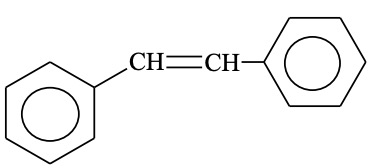
B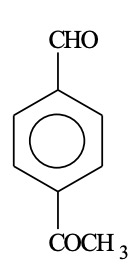
C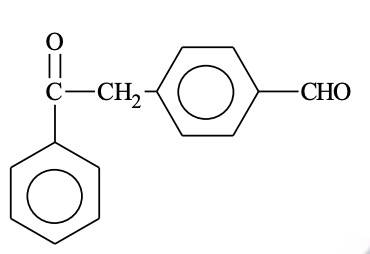
D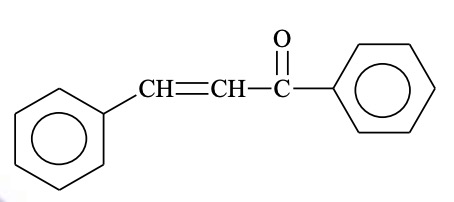
Solution
(D) The reaction between benzaldehyde and acetophenone in the presence of a dilute base $(OH^-)$ is a Claisen-Schmidt condensation reaction.
$1$. Acetophenone acts as the nucleophile because it has $\alpha$-hydrogens, which are removed by the base to form an enolate ion.
$2$. The enolate ion attacks the carbonyl carbon of benzaldehyde to form a $\beta$-hydroxy ketone.
$3$. The $\beta$-hydroxy ketone undergoes dehydration (loss of $H_2O$) to form an $\alpha, \beta$-unsaturated ketone, which is the stable major product.
$4$. The product is $1,3-\text{diphenylprop-2-en-1-one}$ (also known as chalcone), represented by option $D$.
$1$. Acetophenone acts as the nucleophile because it has $\alpha$-hydrogens, which are removed by the base to form an enolate ion.
$2$. The enolate ion attacks the carbonyl carbon of benzaldehyde to form a $\beta$-hydroxy ketone.
$3$. The $\beta$-hydroxy ketone undergoes dehydration (loss of $H_2O$) to form an $\alpha, \beta$-unsaturated ketone, which is the stable major product.
$4$. The product is $1,3-\text{diphenylprop-2-en-1-one}$ (also known as chalcone), represented by option $D$.
0 likes
View Solution8-1.Aldehydes and Ketones — Properties · Frequently Asked Questions
1Are these 8-1.Aldehydes and Ketones questions useful for JEE and NEET?
Yes. All questions in this section are mapped to JEE Main and NEET exam patterns. Previous year questions from JEE Main, NEET, GUJCET and state-level exams are included with full solutions.
2Can I switch to Hindi or Gujarati for these questions?
Yes. Use the language tabs in the hero section or the sidebar to view the same questions and solutions in English, Hindi or Gujarati.
3How do I generate a question paper from this subtopic?
Use the Vedclass Exam Paper Generator — select the chapter and subtopic, set difficulty, and generate Sets A, B, C, D automatically. First 3 chapters of every subject are free.
Vedclass Products
For Students
Vedclass Test Series
Mock tests in real JEE/NEET style with performance analysis. 5-day free trial.
Start Free TrialFor Teachers
Exam Paper Generator
Generate Set A/B/C/D papers from this chapter in 2 minutes. 3 chapters free.
Try FreeFor Institutes
Online Exam Module
Live online exams with unlimited students, 360° analytics & white-label branding.
See DemoFor Teachers & Institutes
Generate a 8-1.Aldehydes and Ketones Exam Paper in 2 Minutes
Select subtopic & difficulty — Sets A, B, C, D auto-generated with No Repeat logic.
First 3 chapters of every subject are free — no payment required.