
ChemistryQ351–400 of 806 questions
Page 8 of 12 · English
351
ChemistryDifficultMCQMHT CET · 2026
The rate law for the reaction $A + B \rightarrow P$ is given by $\text{rate} = k[A]^2[B]$. The rate constant of the reaction at $300 \text{ K}$ is $6.0 \text{ M}^{-2} \text{s}^{-1}$. Calculate the rate of the reaction when $[A] = 1 \text{ M}$ and $[B] = 0.2 \text{ M}$. (in $\text{ M s}^{-1}$)
A
$0.6$
B
$2$
C
$8$
D
$4$
Solution
(A) Step $1$: Identify the given values.
Rate constant $k = 6.0 \text{ M}^{-2} \text{s}^{-1}$.
Concentration $[A] = 1 \text{ M}$.
Concentration $[B] = 0.2 \text{ M}$.
Step $2$: Use the rate law expression.
$\text{Rate} = k[A]^2[B]$
Step $3$: Substitute the values into the equation.
$\text{Rate} = 6.0 \times (1)^2 \times (0.2)$
$\text{Rate} = 6.0 \times 1 \times 0.2$
$\text{Rate} = 1.2 \text{ M s}^{-1}$.
Note: The calculated value is $1.2 \text{ M s}^{-1}$. Since this is not among the options, the question options are incorrect.
Rate constant $k = 6.0 \text{ M}^{-2} \text{s}^{-1}$.
Concentration $[A] = 1 \text{ M}$.
Concentration $[B] = 0.2 \text{ M}$.
Step $2$: Use the rate law expression.
$\text{Rate} = k[A]^2[B]$
Step $3$: Substitute the values into the equation.
$\text{Rate} = 6.0 \times (1)^2 \times (0.2)$
$\text{Rate} = 6.0 \times 1 \times 0.2$
$\text{Rate} = 1.2 \text{ M s}^{-1}$.
Note: The calculated value is $1.2 \text{ M s}^{-1}$. Since this is not among the options, the question options are incorrect.
0 likesView Solution
352
ChemistryMediumMCQMHT CET · 2026
Which of the following is an example of a second-order reaction?
A
$2 H_2O_2(l) \rightarrow 2H_2O(l) + O_2(g)$
B
$CH_3CHO(g) \rightarrow CH_4(g) + CO(g)$
C
$2 NO_2(g) + F_2(g) \rightarrow 2NO_2F(g)$
D
$2 NO(g) + 2H_2(g) \rightarrow N_2(g) + 2H_2O(l)$
Solution
(C) Step $1$: Analyze the rate laws for the given reactions.
Step $2$: The reaction $2 NO_2(g) + F_2(g) \rightarrow 2NO_2F(g)$ follows the rate law $Rate = k[NO_2][F_2]$. This is a second-order reaction (first order with respect to $NO_2$ and first order with respect to $F_2$, total order $1+1=2$).
Step $3$: $2 H_2O_2(l) \rightarrow 2H_2O(l) + O_2(g)$ is a first-order reaction.
Step $4$: $CH_3CHO(g) \rightarrow CH_4(g) + CO(g)$ is a fractional order reaction (order $1.5$).
Step $5$: $2 NO(g) + 2H_2(g) \rightarrow N_2(g) + 2H_2O(l)$ is a third-order reaction.
Step $6$: Therefore, option $C$ is the correct answer.
Step $2$: The reaction $2 NO_2(g) + F_2(g) \rightarrow 2NO_2F(g)$ follows the rate law $Rate = k[NO_2][F_2]$. This is a second-order reaction (first order with respect to $NO_2$ and first order with respect to $F_2$, total order $1+1=2$).
Step $3$: $2 H_2O_2(l) \rightarrow 2H_2O(l) + O_2(g)$ is a first-order reaction.
Step $4$: $CH_3CHO(g) \rightarrow CH_4(g) + CO(g)$ is a fractional order reaction (order $1.5$).
Step $5$: $2 NO(g) + 2H_2(g) \rightarrow N_2(g) + 2H_2O(l)$ is a third-order reaction.
Step $6$: Therefore, option $C$ is the correct answer.
0 likesView Solution
353
ChemistryDifficultMCQMHT CET · 2026
For the reaction $2NOBr(g) \rightarrow 2NO(g) + Br_2(g)$, the rate law is $r = k[NOBr]^2$. If the rate constant $k = 1.62 \times 10^{-2} \text{ L mol}^{-1} \text{ s}^{-1}$ and the concentration of $[NOBr] = 2 \times 10^{-3} \text{ mol L}^{-1}$, what is the rate of reaction?
A
$6.48 \times 10^{-8} \text{ mol L}^{-1} \text{ s}^{-1}$
B
$3.24 \times 10^{-8} \text{ mol L}^{-1} \text{ s}^{-1}$
C
$1.62 \times 10^{-8} \text{ mol L}^{-1} \text{ s}^{-1}$
D
$8.10 \times 10^{-8} \text{ mol L}^{-1} \text{ s}^{-1}$
Solution
(A) Step $1$: Identify the given values: $k = 1.62 \times 10^{-2} \text{ L mol}^{-1} \text{ s}^{-1}$ and $[NOBr] = 2 \times 10^{-3} \text{ mol L}^{-1}$.
Step $2$: Use the rate law expression $r = k[NOBr]^2$.
Step $3$: Substitute the values into the equation: $r = (1.62 \times 10^{-2}) \times (2 \times 10^{-3})^2$.
Step $4$: Calculate the square of the concentration: $(2 \times 10^{-3})^2 = 4 \times 10^{-6} \text{ mol}^2 \text{ L}^{-2}$.
Step $5$: Multiply by the rate constant: $r = 1.62 \times 10^{-2} \times 4 \times 10^{-6} = 6.48 \times 10^{-8} \text{ mol L}^{-1} \text{ s}^{-1}$.
Step $2$: Use the rate law expression $r = k[NOBr]^2$.
Step $3$: Substitute the values into the equation: $r = (1.62 \times 10^{-2}) \times (2 \times 10^{-3})^2$.
Step $4$: Calculate the square of the concentration: $(2 \times 10^{-3})^2 = 4 \times 10^{-6} \text{ mol}^2 \text{ L}^{-2}$.
Step $5$: Multiply by the rate constant: $r = 1.62 \times 10^{-2} \times 4 \times 10^{-6} = 6.48 \times 10^{-8} \text{ mol L}^{-1} \text{ s}^{-1}$.
0 likesView Solution
354
ChemistryMediumMCQMHT CET · 2026
Which of the following reactions has an overall order of $1.5$?
A
$2H_2O_2(g) \rightarrow 2H_2O(l) + O_2(g)$
B
$H_2(g) + I_2(g) \rightarrow 2HI(g)$
C
$CH_3CHO(g) \rightarrow CH_4(g) + CO(g)$
D
$2NO(g) + 2H_2(g) \rightarrow N_2(g) + 2H_2O(l)$
Solution
(C) Step $1$: Analyze the rate laws for the given reactions.
Step $2$: The decomposition of acetaldehyde, $CH_3CHO(g) \rightarrow CH_4(g) + CO(g)$, follows the rate law $Rate = k[CH_3CHO]^{1.5}$.
Step $3$: The overall order of a reaction is the sum of the powers of the concentration terms in the rate law expression.
Step $4$: For the decomposition of acetaldehyde, the order is $1.5$.
Step $5$: Other reactions listed are typically first or second order. Thus, option $C$ is correct.
Step $2$: The decomposition of acetaldehyde, $CH_3CHO(g) \rightarrow CH_4(g) + CO(g)$, follows the rate law $Rate = k[CH_3CHO]^{1.5}$.
Step $3$: The overall order of a reaction is the sum of the powers of the concentration terms in the rate law expression.
Step $4$: For the decomposition of acetaldehyde, the order is $1.5$.
Step $5$: Other reactions listed are typically first or second order. Thus, option $C$ is correct.
0 likesView Solution
355
ChemistryDifficultMCQMHT CET · 2026
For the reaction $2NOBr(g) \rightarrow 2NO(g) + Br_2(g)$, the rate law is $r = k[NOBr]^2$. If the rate constant $k = 1.62 \text{ M}^{-1} \text{ s}^{-1}$ and the concentration of $NOBr$ is $5 \times 10^{-3} \text{ M}$, what is the rate of the reaction?
A
$4.05 \times 10^{-5} \text{ M s}^{-1}$
B
$4.05 \times 10^{-6} \text{ M s}^{-1}$
C
$1.62 \times 10^{-5} \text{ M s}^{-1}$
D
$8.10 \times 10^{-6} \text{ M s}^{-1}$
Solution
(A) Given:
Rate law: $r = k[NOBr]^2$
Rate constant $k = 1.62 \text{ M}^{-1} \text{ s}^{-1}$
Concentration $[NOBr] = 5 \times 10^{-3} \text{ M}$
Substitute the values into the rate law:
$r = (1.62 \text{ M}^{-1} \text{ s}^{-1}) \times (5 \times 10^{-3} \text{ M})^2$
$r = 1.62 \times 25 \times 10^{-6} \text{ M s}^{-1}$
$r = 40.5 \times 10^{-6} \text{ M s}^{-1}$
$r = 4.05 \times 10^{-5} \text{ M s}^{-1}$
Rate law: $r = k[NOBr]^2$
Rate constant $k = 1.62 \text{ M}^{-1} \text{ s}^{-1}$
Concentration $[NOBr] = 5 \times 10^{-3} \text{ M}$
Substitute the values into the rate law:
$r = (1.62 \text{ M}^{-1} \text{ s}^{-1}) \times (5 \times 10^{-3} \text{ M})^2$
$r = 1.62 \times 25 \times 10^{-6} \text{ M s}^{-1}$
$r = 40.5 \times 10^{-6} \text{ M s}^{-1}$
$r = 4.05 \times 10^{-5} \text{ M s}^{-1}$
0 likesView Solution
356
ChemistryMediumMCQMHT CET · 2026
Which of the following is an example of a fractional order reaction?
A
$2H_2O_2(g) \rightarrow 2H_2O(l) + O_2(g)$
B
$H_2(g) + I_2(g) \rightarrow 2HI(g)$
C
$CH_3CHO(g) \rightarrow CH_4(g) + CO(g)$
D
$2NO(g) + 2H_2(g) \rightarrow N_2(g) + 2H_2O(l)$
Solution
(C) Step $1$: Analyze the order of the given reactions.
Step $2$: The decomposition of acetaldehyde $(CH_3CHO)$ follows a chain mechanism where the rate law is given by $\text{Rate} = k[CH_3CHO]^{3/2}$.
Step $3$: Since the exponent of the concentration term is $3/2$ (which is $1.5$), this reaction is of fractional order.
Step $4$: The other reactions listed are typically elementary or follow integer order kinetics under standard conditions.
Step $5$: Therefore, option $C$ is the correct example of a fractional order reaction.
Step $2$: The decomposition of acetaldehyde $(CH_3CHO)$ follows a chain mechanism where the rate law is given by $\text{Rate} = k[CH_3CHO]^{3/2}$.
Step $3$: Since the exponent of the concentration term is $3/2$ (which is $1.5$), this reaction is of fractional order.
Step $4$: The other reactions listed are typically elementary or follow integer order kinetics under standard conditions.
Step $5$: Therefore, option $C$ is the correct example of a fractional order reaction.
0 likesView Solution
357
ChemistryMediumMCQMHT CET · 2026
Which of the following is an elementary reaction?
A
$O_3(g) \rightarrow O_2(g) + O(g)$
B
$2NO_2Cl(g) \rightarrow 2NO_2(g) + Cl_2(g)$
C
$2NO_2(g) + F_2(g) \rightarrow 2NO_2F(g)$
D
$2NO(g) + Cl_2(g) \rightarrow 2NOCl(g)$
Solution
(A) An elementary reaction is a single-step reaction that occurs in one go without any intermediate.
Option $A$: The decomposition of ozone $O_3(g) \rightarrow O_2(g) + O(g)$ is a single-step unimolecular elementary reaction.
Option $B$, $C$, and $D$ are complex reactions involving multiple steps and intermediates.
Therefore, the correct answer is $A$.
Option $A$: The decomposition of ozone $O_3(g) \rightarrow O_2(g) + O(g)$ is a single-step unimolecular elementary reaction.
Option $B$, $C$, and $D$ are complex reactions involving multiple steps and intermediates.
Therefore, the correct answer is $A$.
0 likesView Solution
358
ChemistryMediumMCQMHT CET · 2026
What is the order and molecularity of the following elementary reaction? $2NO_2(g) \rightarrow 2NO(g) + O_2(g)$, rate $= k[NO_2]^2$
A
The reaction is second order and bimolecular.
B
The reaction is first order and bimolecular.
C
The reaction is second order and unimolecular.
D
The reaction is zero order and bimolecular.
Solution
(A) $1$. The order of a reaction is the sum of the powers of the concentration terms in the rate law expression. Here, the rate $= k[NO_2]^2$, so the order is $2$.
$2$. The molecularity of an elementary reaction is the number of reacting species (atoms, ions, or molecules) taking part in the reaction. In the reaction $2NO_2(g) \rightarrow 2NO(g) + O_2(g)$, two molecules of $NO_2$ are involved, so the molecularity is $2$.
$3$. $A$ reaction with molecularity $2$ is called bimolecular.
$4$. Therefore, the reaction is second order and bimolecular.
$2$. The molecularity of an elementary reaction is the number of reacting species (atoms, ions, or molecules) taking part in the reaction. In the reaction $2NO_2(g) \rightarrow 2NO(g) + O_2(g)$, two molecules of $NO_2$ are involved, so the molecularity is $2$.
$3$. $A$ reaction with molecularity $2$ is called bimolecular.
$4$. Therefore, the reaction is second order and bimolecular.
0 likesView Solution
359
ChemistryDifficultMCQMHT CET · 2026
Calculate the rate constant of a first-order reaction $A \rightarrow B$ having a rate of $5.4 \times 10^{-6} \text{ mol dm}^{-3} \text{ s}^{-1}$ and concentration $[A] = 0.3 \text{ M}$.
A
$1.8 \times 10^{-5} \text{ s}^{-1}$
B
$1.8 \times 10^{-4} \text{ s}^{-1}$
C
$2.5 \times 10^{-5} \text{ s}^{-1}$
D
$3.2 \times 10^{-4} \text{ s}^{-1}$
Solution
(A) For a first-order reaction, the rate law is given by: $\text{Rate} = k[A]$.
Given: $\text{Rate} = 5.4 \times 10^{-6} \text{ mol dm}^{-3} \text{ s}^{-1}$ and $[A] = 0.3 \text{ M} = 0.3 \text{ mol dm}^{-3}$.
Rearranging the formula for the rate constant $k$: $k = \frac{\text{Rate}}{[A]}$.
Substituting the values: $k = \frac{5.4 \times 10^{-6}}{0.3} \text{ s}^{-1}$.
$k = 18 \times 10^{-6} \text{ s}^{-1} = 1.8 \times 10^{-5} \text{ s}^{-1}$.
Given: $\text{Rate} = 5.4 \times 10^{-6} \text{ mol dm}^{-3} \text{ s}^{-1}$ and $[A] = 0.3 \text{ M} = 0.3 \text{ mol dm}^{-3}$.
Rearranging the formula for the rate constant $k$: $k = \frac{\text{Rate}}{[A]}$.
Substituting the values: $k = \frac{5.4 \times 10^{-6}}{0.3} \text{ s}^{-1}$.
$k = 18 \times 10^{-6} \text{ s}^{-1} = 1.8 \times 10^{-5} \text{ s}^{-1}$.
0 likesView Solution
360
ChemistryMediumMCQMHT CET · 2026
Which of the following factors increases the rate of a unimolecular nucleophilic substitution $(S_N1)$ reaction?
A
Aprotic solvent
B
Stronger nucleophile
C
Weaker nucleophile
D
Polar protic solvent
Solution
(D) $1$. The rate-determining step of an $S_N1$ reaction is the formation of a carbocation intermediate.
$2$. Polar protic solvents (like $H_2O$ or $ROH$) stabilize the carbocation intermediate and the leaving group through solvation (hydrogen bonding), thereby lowering the activation energy.
$3$. $A$ stronger nucleophile does not affect the rate of an $S_N1$ reaction because the nucleophile is involved only in the second, fast step.
$4$. Therefore, a polar protic solvent increases the rate of an $S_N1$ reaction.
$2$. Polar protic solvents (like $H_2O$ or $ROH$) stabilize the carbocation intermediate and the leaving group through solvation (hydrogen bonding), thereby lowering the activation energy.
$3$. $A$ stronger nucleophile does not affect the rate of an $S_N1$ reaction because the nucleophile is involved only in the second, fast step.
$4$. Therefore, a polar protic solvent increases the rate of an $S_N1$ reaction.
0 likesView Solution
361
ChemistryMediumMCQMHT CET · 2026
Identify the major product of the dehydrohalogenation of $CH_3-CH_2-CH(Br)-CH_3$ using an alcoholic base.
A
$CH_3-CH_2-CH=CH_2$
B
$CH_3-CH=CH-CH_3$
C
$CH_3-(CH_2)_2CH_3$
D
$CH_3-(CH_2)_2CHO$
Solution
(B) $1$. Dehydrohalogenation follows $Saytzeff's$ rule, which states that the more substituted alkene is the major product.
$2$. The reactant is $2-bromobutane$ $(CH_3-CH_2-CH(Br)-CH_3)$.
$3$. Elimination of $HBr$ can occur from $C_1$ or $C_3$ to form $but-1-ene$ or $but-2-ene$ respectively.
$4$. $But-2-ene$ $(CH_3-CH=CH-CH_3)$ is a disubstituted alkene, making it more stable than the monosubstituted $but-1-ene$ $(CH_3-CH_2-CH=CH_2)$.
$5$. Therefore, $CH_3-CH=CH-CH_3$ is the major product.
$2$. The reactant is $2-bromobutane$ $(CH_3-CH_2-CH(Br)-CH_3)$.
$3$. Elimination of $HBr$ can occur from $C_1$ or $C_3$ to form $but-1-ene$ or $but-2-ene$ respectively.
$4$. $But-2-ene$ $(CH_3-CH=CH-CH_3)$ is a disubstituted alkene, making it more stable than the monosubstituted $but-1-ene$ $(CH_3-CH_2-CH=CH_2)$.
$5$. Therefore, $CH_3-CH=CH-CH_3$ is the major product.
0 likesView Solution
362
ChemistryEasyMCQMHT CET · 2026
Which of the following compounds is formed when chloroform $(CHCl_3)$ is exposed to air and light?
A
Phosgene
B
Phosphine
C
Carbon dioxide
D
Carbon tetrachloride
Solution
(A) When chloroform $(CHCl_3)$ is exposed to air and light, it undergoes slow oxidation to form an extremely poisonous gas called phosgene ($COCl_2$, carbonyl chloride).
The chemical equation is:
$2CHCl_3 + O_2 \xrightarrow{\text{light}} 2COCl_2 + 2HCl$
The chemical equation is:
$2CHCl_3 + O_2 \xrightarrow{\text{light}} 2COCl_2 + 2HCl$
0 likesView Solution
363
ChemistryMediumMCQMHT CET · 2026
Which of the following compounds is obtained when $Bromoethane$ is reacted with silver acetate?
A
propanal
B
acetic acid
C
ethyl acetate
D
methyl acetate
Solution
(C) The reaction between $Bromoethane$ $(C_2H_5Br)$ and silver acetate $(CH_3COOAg)$ is a nucleophilic substitution reaction.
$C_2H_5Br + CH_3COOAg \rightarrow CH_3COOC_2H_5 + AgBr$
In this reaction, the acetate ion $(CH_3COO^-)$ acts as a nucleophile and replaces the bromide ion $(Br^-)$ to form ethyl acetate $(CH_3COOC_2H_5)$.
$C_2H_5Br + CH_3COOAg \rightarrow CH_3COOC_2H_5 + AgBr$
In this reaction, the acetate ion $(CH_3COO^-)$ acts as a nucleophile and replaces the bromide ion $(Br^-)$ to form ethyl acetate $(CH_3COOC_2H_5)$.
0 likesView Solution
364
ChemistryMediumMCQMHT CET · 2026
Which of the following factors favors an $S_N1$ reaction?
A
Strong nucleophile
B
Non-polar solvent
C
Bulky alkyl groups on the carbon atom attached to the halogen atom
D
Small alkyl groups on the carbon atom attached to the halogen atom
Solution
(C) $1$. The $S_N1$ reaction mechanism proceeds via the formation of a carbocation intermediate.
$2$. The rate-determining step is the formation of this carbocation.
$3$. Bulky alkyl groups around the carbocation center stabilize the positive charge through the inductive effect and hyperconjugation, making the formation of the carbocation easier.
$4$. Therefore, tertiary alkyl halides (which have bulky groups) favor $S_N1$ reactions over primary or secondary alkyl halides.
$5$. Strong nucleophiles favor $S_N2$ reactions, and polar protic solvents are required for $S_N1$ reactions.
$2$. The rate-determining step is the formation of this carbocation.
$3$. Bulky alkyl groups around the carbocation center stabilize the positive charge through the inductive effect and hyperconjugation, making the formation of the carbocation easier.
$4$. Therefore, tertiary alkyl halides (which have bulky groups) favor $S_N1$ reactions over primary or secondary alkyl halides.
$5$. Strong nucleophiles favor $S_N2$ reactions, and polar protic solvents are required for $S_N1$ reactions.
0 likesView Solution
365
ChemistryEasyMCQMHT CET · 2026
What is the general molecular formula of alkyl halides?
A
$C_nH_{2n+2}X$
B
$C_nH_{2n+1}X$
C
$C_nH_{2n}X$
D
$C_nH_{2n-2}X$
Solution
(B) Alkyl halides are derived from alkanes by replacing one hydrogen atom with a halogen atom $(X)$.
The general formula for an alkane is $C_nH_{2n+2}$.
Replacing one $H$ atom with $X$ gives: $C_nH_{2n+2-1}X = C_nH_{2n+1}X$.
Therefore, the correct option is $B$.
The general formula for an alkane is $C_nH_{2n+2}$.
Replacing one $H$ atom with $X$ gives: $C_nH_{2n+2-1}X = C_nH_{2n+1}X$.
Therefore, the correct option is $B$.
0 likesView Solution
366
ChemistryEasyMCQMHT CET · 2026
Which of the following halogen derivatives forms poisonous phosgene gas when it comes in contact with air and light?
A
$CHCl_3$
B
$PCl_3$
C
$C_6H_5Cl$
D
$CH_2Cl_2$
Solution
(A) Chloroform $(CHCl_3)$ undergoes slow oxidation in the presence of air and light to form a highly poisonous gas known as phosgene $(COCl_2)$.
The chemical equation is:
$2CHCl_3 + O_2 \xrightarrow{\text{light}} 2COCl_2 + 2HCl$
The chemical equation is:
$2CHCl_3 + O_2 \xrightarrow{\text{light}} 2COCl_2 + 2HCl$
0 likesView Solution
367
ChemistryEasyMCQMHT CET · 2026
The method of preparation of alkyl fluoride given by the reaction $2R-Br + Hg_2F_2 \rightarrow 2R-F + Hg_2Br_2$ is known as:
A
Finkelstein reaction
B
Swartz reaction
C
Sandmeyer reaction
D
Wurtz reaction
Solution
(B) Step $1$: The reaction involves the exchange of a bromine atom in an alkyl bromide with a fluorine atom using a metallic fluoride like $Hg_2F_2$.
Step $2$: This specific method for the synthesis of alkyl fluorides by heating alkyl chlorides or bromides in the presence of metallic fluorides (such as $AgF$, $Hg_2F_2$, $CoF_2$, or $SbF_3$) is called the Swartz reaction.
Step $2$: This specific method for the synthesis of alkyl fluorides by heating alkyl chlorides or bromides in the presence of metallic fluorides (such as $AgF$, $Hg_2F_2$, $CoF_2$, or $SbF_3$) is called the Swartz reaction.
0 likesView Solution
368
ChemistryEasyMCQMHT CET · 2026
In benzylic halides, the halogen atom is bonded to
A
$sp$ hybridized carbon atom.
B
$sp^2$ hybridized carbon atom.
C
$sp^3$ hybridized carbon atom.
D
$dsp^2$ hybridized carbon atom.
Solution
(C) $1$. $A$ benzylic halide is a compound in which the halogen atom is bonded to an $sp^3$ hybridized carbon atom, which is further attached to an aromatic ring.
$2$. The general structure is $C_6H_5-CH_2-X$, where $X$ is the halogen atom.
$3$. In the group $-CH_2-X$, the carbon atom is bonded to two hydrogen atoms, one halogen atom, and one phenyl group, making it $sp^3$ hybridized.
$2$. The general structure is $C_6H_5-CH_2-X$, where $X$ is the halogen atom.
$3$. In the group $-CH_2-X$, the carbon atom is bonded to two hydrogen atoms, one halogen atom, and one phenyl group, making it $sp^3$ hybridized.
0 likesView Solution
369
ChemistryMediumMCQMHT CET · 2026
Which of the following is a correct feature of the $SN^2$ mechanism?
A
The $SN^2$ mechanism proceeds mainly with racemization.
B
The $SN^2$ mechanism includes a transition state with penta-coordinated carbon.
C
The $SN^2$ mechanism involves the formation of a planar carbocation intermediate in the first step.
D
The $SN^2$ mechanism involves the formation of a carbocation with $sp^2$ hybridized carbon.
Solution
(B) $1$. The $SN^2$ mechanism is a concerted, single-step reaction.
$2$. It involves a backside attack by the nucleophile, leading to an inversion of configuration (Walden inversion), not racemization.
$3$. During the reaction, the nucleophile and the leaving group are both partially bonded to the central carbon atom in a transition state, where the carbon atom is penta-coordinated (bonded to five groups).
$4$. $SN^2$ reactions do not involve the formation of carbocation intermediates.
$5$. Therefore, the correct feature is that it includes a transition state with a penta-coordinated carbon.
$2$. It involves a backside attack by the nucleophile, leading to an inversion of configuration (Walden inversion), not racemization.
$3$. During the reaction, the nucleophile and the leaving group are both partially bonded to the central carbon atom in a transition state, where the carbon atom is penta-coordinated (bonded to five groups).
$4$. $SN^2$ reactions do not involve the formation of carbocation intermediates.
$5$. Therefore, the correct feature is that it includes a transition state with a penta-coordinated carbon.
0 likesView Solution
370
ChemistryMediumMCQMHT CET · 2026
Which of the following alkyl halides undergoes $SN^1$ reaction most readily?
A
$(CH_3)_3C-F$
B
$(CH_3)_3C-Cl$
C
$(CH_3)_3C-Br$
D
$(CH_3)_3C-I$
Solution
(D) $1$. The rate-determining step in an $SN^1$ reaction is the formation of a carbocation by the departure of the leaving group.
$2$. The ease of departure of the leaving group depends on the strength of the $C-X$ bond.
$3$. The bond dissociation energy decreases as the size of the halogen atom increases $(I > Br > Cl > F)$.
$4$. Therefore, the $C-I$ bond is the weakest and breaks most easily, making the iodide ion the best leaving group.
$5$. Thus, $(CH_3)_3C-I$ undergoes $SN^1$ reaction most readily.
$2$. The ease of departure of the leaving group depends on the strength of the $C-X$ bond.
$3$. The bond dissociation energy decreases as the size of the halogen atom increases $(I > Br > Cl > F)$.
$4$. Therefore, the $C-I$ bond is the weakest and breaks most easily, making the iodide ion the best leaving group.
$5$. Thus, $(CH_3)_3C-I$ undergoes $SN^1$ reaction most readily.
0 likesView Solution
371
ChemistryMediumMCQMHT CET · 2026
Which of the following alkyl halides is hydrolyzed most rapidly by the $S_N2$ mechanism?
A
$CH_3-Br$
B
$(CH_3)_3C-Br$
C
$CH_3-CH_2-Br$
D
$(CH_3)_2CH-Br$
Solution
(A) The rate of $S_N2$ reaction depends on the steric hindrance around the electrophilic carbon atom.
$1$. The order of reactivity for $S_N2$ reactions is: $Methyl \ halide > Primary \ (1^\circ) > Secondary \ (2^\circ) > Tertiary \ (3^\circ)$.
$2$. $CH_3-Br$ is a methyl halide, which has the least steric hindrance.
$3$. $(CH_3)_3C-Br$ is a tertiary halide, $(CH_3)_2CH-Br$ is a secondary halide, and $CH_3-CH_2-Br$ is a primary halide.
$4$. Therefore, $CH_3-Br$ reacts most rapidly.
$1$. The order of reactivity for $S_N2$ reactions is: $Methyl \ halide > Primary \ (1^\circ) > Secondary \ (2^\circ) > Tertiary \ (3^\circ)$.
$2$. $CH_3-Br$ is a methyl halide, which has the least steric hindrance.
$3$. $(CH_3)_3C-Br$ is a tertiary halide, $(CH_3)_2CH-Br$ is a secondary halide, and $CH_3-CH_2-Br$ is a primary halide.
$4$. Therefore, $CH_3-Br$ reacts most rapidly.
0 likesView Solution
372
ChemistryMediumMCQMHT CET · 2026
What is the product $P$ obtained in the following reaction? $CH_3CH_2Br + AgCN_{(alc)} \rightarrow P$
A
$CH_3CH_2NC$
B
$CH_3CH_2CN$
C
$CH_3CH_2CONH_2$
D
$CH_3CH_2NH_2$
Solution
(A) $1$. $AgCN$ is a covalent compound.
$2$. In $AgCN$, the nitrogen atom has a lone pair of electrons available for nucleophilic attack, while the carbon atom is not free to act as a nucleophile.
$3$. Therefore, the reaction follows an $S_N2$ mechanism where the nitrogen atom attacks the alkyl halide.
$4$. The reaction is: $CH_3CH_2Br + AgCN \rightarrow CH_3CH_2NC + AgBr$.
$5$. The product $P$ is ethyl isocyanide $(CH_3CH_2NC)$.
$2$. In $AgCN$, the nitrogen atom has a lone pair of electrons available for nucleophilic attack, while the carbon atom is not free to act as a nucleophile.
$3$. Therefore, the reaction follows an $S_N2$ mechanism where the nitrogen atom attacks the alkyl halide.
$4$. The reaction is: $CH_3CH_2Br + AgCN \rightarrow CH_3CH_2NC + AgBr$.
$5$. The product $P$ is ethyl isocyanide $(CH_3CH_2NC)$.
0 likesView Solution
373
ChemistryMediumMCQMHT CET · 2026
Which among the following is an allylic halide?
A
$CH_3 - CH_2 - CH_2 - X$
B
$C_6H_5 - CH_2 - X$
C
$CH_2 = CH - CH_2 - X$
D
$CH_3 - CH = CH - X$
Solution
(C) An allylic halide is a compound in which the halogen atom is bonded to an $sp^3$ hybridized carbon atom next to a carbon-carbon double bond $(C=C)$.
In the structure $CH_2 = CH - CH_2 - X$, the halogen atom $X$ is attached to a carbon atom that is adjacent to the $C=C$ double bond.
Therefore, $CH_2 = CH - CH_2 - X$ is an allylic halide.
In the structure $CH_2 = CH - CH_2 - X$, the halogen atom $X$ is attached to a carbon atom that is adjacent to the $C=C$ double bond.
Therefore, $CH_2 = CH - CH_2 - X$ is an allylic halide.
0 likesView Solution
374
ChemistryEasyMCQMHT CET · 2026
Which of the following reactions is used for the preparation of alkyl fluorides from alkyl chlorides?
A
Sandmeyer reaction
B
Fittig reaction
C
Swarts reaction
D
Finkelstein reaction
Solution
(C) The preparation of alkyl fluorides is best achieved by heating alkyl chlorides or alkyl bromides in the presence of a metallic fluoride such as $AgF$, $Hg_2F_2$, $CoF_2$, or $SbF_3$. This specific reaction is known as the $Swarts$ reaction.
Step $1$: The general reaction is $R-X + AgF \rightarrow R-F + AgX$ (where $X = Cl, Br$).
Step $2$: Since $Finkelstein$ reaction is used for alkyl iodides and $Sandmeyer$ or $Fittig$ reactions are for aryl halides, the correct choice is the $Swarts$ reaction.
Step $1$: The general reaction is $R-X + AgF \rightarrow R-F + AgX$ (where $X = Cl, Br$).
Step $2$: Since $Finkelstein$ reaction is used for alkyl iodides and $Sandmeyer$ or $Fittig$ reactions are for aryl halides, the correct choice is the $Swarts$ reaction.
0 likesView Solution
375
ChemistryDifficultMCQMHT CET · 2026
Identify the product obtained when $2-\text{chloro}-2-\text{methylbutane}$ is reacted with sodium metal in the presence of dry ether.
A
$2,2,3,3-\text{tetramethyloctane}$
B
$3,3,4,4-\text{tetramethyloctane}$
C
$2,2,3,3-\text{tetramethylhexane}$
D
$3,3,4,4-\text{tetramethylhexane}$
Solution
(D) The reaction of an alkyl halide with sodium metal in the presence of dry ether is known as the Wurtz reaction.
$2-\text{chloro}-2-\text{methylbutane}$ is a tertiary alkyl halide with the structure $CH_3-CH_2-C(CH_3)(Cl)-CH_3$.
In the Wurtz reaction, two molecules of the alkyl halide couple to form a higher alkane.
Two radicals of $2-\text{methylbutan-2-yl}$ $(CH_3-CH_2-C(CH_3)_2^{\bullet})$ combine at the tertiary carbon atoms.
The resulting structure is $CH_3-CH_2-C(CH_3)_2-C(CH_3)_2-CH_2-CH_3$.
Naming the longest chain: the longest chain has $6$ carbons (hexane), with methyl groups at positions $3$ and $4$.
The $IUPAC$ name is $3,3,4,4-\text{tetramethylhexane}$.
$2-\text{chloro}-2-\text{methylbutane}$ is a tertiary alkyl halide with the structure $CH_3-CH_2-C(CH_3)(Cl)-CH_3$.
In the Wurtz reaction, two molecules of the alkyl halide couple to form a higher alkane.
Two radicals of $2-\text{methylbutan-2-yl}$ $(CH_3-CH_2-C(CH_3)_2^{\bullet})$ combine at the tertiary carbon atoms.
The resulting structure is $CH_3-CH_2-C(CH_3)_2-C(CH_3)_2-CH_2-CH_3$.
Naming the longest chain: the longest chain has $6$ carbons (hexane), with methyl groups at positions $3$ and $4$.
The $IUPAC$ name is $3,3,4,4-\text{tetramethylhexane}$.
0 likesView Solution
376
ChemistryMediumMCQMHT CET · 2026
Identify the product obtained when $2$-chlorobutane is heated with an aqueous solution of potassium hydroxide.
A
$But-1-ene$
B
$But-2-ene$
C
$Butan-1-ol$
D
$Butan-2-ol$
Solution
(D) Step $1$: The reaction of an alkyl halide with an aqueous solution of $KOH$ is a nucleophilic substitution reaction.
Step $2$: In this reaction, the hydroxide ion $(OH^-)$ acts as a nucleophile and replaces the chloride ion $(Cl^-)$ from the $2$-chlorobutane.
Step $3$: The reaction is: $CH_3CH_2CHClCH_3 + KOH_{(aq)} \rightarrow CH_3CH_2CH(OH)CH_3 + KCl$.
Step $4$: The product formed is $butan-2-ol$.
Step $2$: In this reaction, the hydroxide ion $(OH^-)$ acts as a nucleophile and replaces the chloride ion $(Cl^-)$ from the $2$-chlorobutane.
Step $3$: The reaction is: $CH_3CH_2CHClCH_3 + KOH_{(aq)} \rightarrow CH_3CH_2CH(OH)CH_3 + KCl$.
Step $4$: The product formed is $butan-2-ol$.
0 likesView Solution
377
ChemistryMediumMCQMHT CET · 2026
Identify reagent $B$ in the following reaction: $R - X \xrightarrow{B} \text{Nitroalkane}$
A
$AgNO_2$
B
$NaOR$
C
$KCN \text{ (alc.)}$
D
$KNO_2$
Solution
(A) $1$. The reaction of alkyl halides $(R-X)$ with silver nitrite $(AgNO_2)$ yields nitroalkanes $(R-NO_2)$ as the major product.
$2$. This occurs because the $Ag-O$ bond is covalent, making the nitrogen atom the nucleophilic center.
$3$. In contrast, reaction with potassium nitrite $(KNO_2)$ is ionic and yields alkyl nitrites $(R-ONO)$ as the major product.
$4$. Therefore, reagent $B$ is $AgNO_2$.
$2$. This occurs because the $Ag-O$ bond is covalent, making the nitrogen atom the nucleophilic center.
$3$. In contrast, reaction with potassium nitrite $(KNO_2)$ is ionic and yields alkyl nitrites $(R-ONO)$ as the major product.
$4$. Therefore, reagent $B$ is $AgNO_2$.
0 likesView Solution
378
ChemistryDifficultMCQMHT CET · 2026
Identify the product $B$ in the following reaction: $CH_3Br \xrightarrow{KCN} A \xrightarrow{Na / C_2H_5OH} B$
A
Ethane
B
Ethanamine
C
Ethanol
D
Methanol
Solution
(B) Step $1$: Reaction of $CH_3Br$ with $KCN$ is a nucleophilic substitution reaction. $CH_3Br + KCN \rightarrow CH_3CN + KBr$. Thus, $A$ is $CH_3CN$ (ethanenitrile).
Step $2$: Reduction of $CH_3CN$ with $Na / C_2H_5OH$ (Mendius reduction) yields a primary amine. $CH_3CN + 4[H] \xrightarrow{Na / C_2H_5OH} CH_3CH_2NH_2$. Thus, $B$ is $CH_3CH_2NH_2$ (ethanamine).
Step $2$: Reduction of $CH_3CN$ with $Na / C_2H_5OH$ (Mendius reduction) yields a primary amine. $CH_3CN + 4[H] \xrightarrow{Na / C_2H_5OH} CH_3CH_2NH_2$. Thus, $B$ is $CH_3CH_2NH_2$ (ethanamine).
0 likesView Solution
379
ChemistryMediumMCQMHT CET · 2026
Which reagent is used to convert an $Alkyl \ halide$ $(R-X)$ into an $Alkyl \ nitrite$ $(R-O-N=O)$?
A
$Silver \ nitrite$ $(AgNO_2)$
B
$Silver \ cyanide$ $(AgCN)$
C
$Potassium \ nitrite$ $(KNO_2)$
D
$Silver \ carboxylate$ $(RCOOAg)$
Solution
(A) $1$. $Alkyl \ halides$ react with $Silver \ nitrite$ $(AgNO_2)$ to form $Alkyl \ nitrites$ $(R-O-N=O)$ as the major product.
$2$. This occurs because $AgNO_2$ is a covalent compound, and the oxygen atom is more nucleophilic than the nitrogen atom.
$3$. In contrast, $Potassium \ nitrite$ $(KNO_2)$ is an ionic compound, which provides the $NO_2^-$ ion, leading to the formation of $Nitroalkanes$ $(R-NO_2)$ as the major product.
$2$. This occurs because $AgNO_2$ is a covalent compound, and the oxygen atom is more nucleophilic than the nitrogen atom.
$3$. In contrast, $Potassium \ nitrite$ $(KNO_2)$ is an ionic compound, which provides the $NO_2^-$ ion, leading to the formation of $Nitroalkanes$ $(R-NO_2)$ as the major product.
0 likesView Solution
380
ChemistryMediumMCQMHT CET · 2026
Which among the following is $NOT$ a feature of $S_N2$ mechanism?
A
Single step mechanism
B
Backside attack of nucleophile
C
Formation of planar carbocation intermediate
D
Involves simultaneous bond breaking and bond forming
Solution
(C) $1$. The $S_N2$ mechanism is a concerted, single-step reaction.
$2$. In this mechanism, the nucleophile attacks from the backside of the carbon atom, leading to an inversion of configuration.
$3$. Bond breaking and bond formation occur simultaneously through a pentacoordinate transition state.
$4$. $S_N2$ reactions do not involve the formation of a carbocation intermediate; carbocation formation is a characteristic of $S_N1$ mechanisms.
$5$. Therefore, the formation of a planar carbocation intermediate is $NOT$ a feature of the $S_N2$ mechanism.
$2$. In this mechanism, the nucleophile attacks from the backside of the carbon atom, leading to an inversion of configuration.
$3$. Bond breaking and bond formation occur simultaneously through a pentacoordinate transition state.
$4$. $S_N2$ reactions do not involve the formation of a carbocation intermediate; carbocation formation is a characteristic of $S_N1$ mechanisms.
$5$. Therefore, the formation of a planar carbocation intermediate is $NOT$ a feature of the $S_N2$ mechanism.
0 likesView Solution
381
ChemistryEasyMCQMHT CET · 2026
In the Finkelstein reaction, which one of the following reagents is used?
A
$HI$ in dry acetone
B
$NaI$ in dry acetone
C
$NaOI$ in dry acetone
D
$NaI$ in dry ether
Solution
(B) The Finkelstein reaction is a type of nucleophilic substitution reaction $(S_N2)$ used to prepare alkyl iodides from alkyl chlorides or alkyl bromides.
In this reaction, the alkyl halide is treated with sodium iodide $(NaI)$ in the presence of dry acetone.
Acetone acts as a solvent in which $NaI$ is soluble, while the byproduct $NaCl$ or $NaBr$ is insoluble and precipitates out, driving the reaction forward according to Le Chatelier's principle.
Therefore, the correct reagent is $NaI$ in dry acetone.
In this reaction, the alkyl halide is treated with sodium iodide $(NaI)$ in the presence of dry acetone.
Acetone acts as a solvent in which $NaI$ is soluble, while the byproduct $NaCl$ or $NaBr$ is insoluble and precipitates out, driving the reaction forward according to Le Chatelier's principle.
Therefore, the correct reagent is $NaI$ in dry acetone.
0 likesView Solution
382
ChemistryMediumMCQMHT CET · 2026
What is the major product formed when $2$-bromopentane reacts with alcoholic $KOH$?
A
$Pent-1-ene$
B
$Pent-2-ene$
C
$Pentane$
D
$Pentan-2-ol$
Solution
(B) Step $1$: The reaction of $2$-bromopentane with alcoholic $KOH$ is a dehydrohalogenation reaction (an elimination reaction).
Step $2$: According to $Saytzeff's$ rule, in elimination reactions, the more substituted alkene is the major product.
Step $3$: The reaction is: $CH_3-CH(Br)-CH_2-CH_2-CH_3 + KOH (alc.) \rightarrow CH_3-CH=CH-CH_2-CH_3 + KBr + H_2O$.
Step $4$: $Pent-2-ene$ is more substituted than $Pent-1-ene$, hence it is the major product.
Step $2$: According to $Saytzeff's$ rule, in elimination reactions, the more substituted alkene is the major product.
Step $3$: The reaction is: $CH_3-CH(Br)-CH_2-CH_2-CH_3 + KOH (alc.) \rightarrow CH_3-CH=CH-CH_2-CH_3 + KBr + H_2O$.
Step $4$: $Pent-2-ene$ is more substituted than $Pent-1-ene$, hence it is the major product.
0 likesView Solution
383
ChemistryEasyMCQMHT CET · 2026
Which of the following is a dihydric alcohol?
A
Glycerol
B
Ethylene glycol
C
Sorbitol
D
Methanol
Solution
(B) $1$. $A$ dihydric alcohol is an alcohol that contains two hydroxyl $(-OH)$ groups in its molecule.
$2$. Glycerol $(CH_2OH-CHOH-CH_2OH)$ is a trihydric alcohol.
$3$. Ethylene glycol $(HOCH_2-CH_2OH)$ contains two $-OH$ groups, making it a dihydric alcohol.
$4$. Sorbitol $(C_6H_{14}O_6)$ is a hexahydric alcohol.
$5$. Methanol $(CH_3OH)$ is a monohydric alcohol.
$6$. Therefore, the correct option is $B$.
$2$. Glycerol $(CH_2OH-CHOH-CH_2OH)$ is a trihydric alcohol.
$3$. Ethylene glycol $(HOCH_2-CH_2OH)$ contains two $-OH$ groups, making it a dihydric alcohol.
$4$. Sorbitol $(C_6H_{14}O_6)$ is a hexahydric alcohol.
$5$. Methanol $(CH_3OH)$ is a monohydric alcohol.
$6$. Therefore, the correct option is $B$.
0 likesView Solution
384
ChemistryMediumMCQMHT CET · 2026
Which of the following ethers, on hydrolysis, gives two different products that are successive members of the homologous series?
A
$CH_3OCH_3$
B
$CH_3OCH_2CH_3$
C
$CH_3CH_2OCH_2CH_2CH_3$
D
$CH_3OCH_2CH_2CH_3$
Solution
(B) $1$. Hydrolysis of an ether $(R-O-R')$ yields two alcohols: $R-OH$ and $R'-OH$.
$2$. For the products to be successive members of a homologous series, they must differ by a $-CH_2-$ group.
$3$. In $CH_3OCH_2CH_3$ (Methoxyethane), hydrolysis gives $CH_3OH$ (Methanol) and $CH_3CH_2OH$ (Ethanol).
$4$. Methanol $(CH_3OH)$ and Ethanol $(CH_3CH_2OH)$ are successive members of the alcohol homologous series, differing by one $-CH_2-$ group.
$2$. For the products to be successive members of a homologous series, they must differ by a $-CH_2-$ group.
$3$. In $CH_3OCH_2CH_3$ (Methoxyethane), hydrolysis gives $CH_3OH$ (Methanol) and $CH_3CH_2OH$ (Ethanol).
$4$. Methanol $(CH_3OH)$ and Ethanol $(CH_3CH_2OH)$ are successive members of the alcohol homologous series, differing by one $-CH_2-$ group.
0 likesView Solution
385
ChemistryEasyMCQMHT CET · 2026
Identify the trihydric phenol from the following.
A
Hydroquinone
B
Catechol
C
$o$-Cresol
D
Pyrogallol
Solution
(D) $1$. $A$ trihydric phenol is a benzene ring substituted with three hydroxyl $(-OH)$ groups.
$2$. Hydroquinone is a dihydric phenol ($1,4$-dihydroxybenzene).
$3$. Catechol is a dihydric phenol ($1,2$-dihydroxybenzene).
$4$. $o$-Cresol is a monohydric phenol ($2$-methylphenol).
$5$. Pyrogallol is a trihydric phenol ($1,2,3$-trihydroxybenzene).
$6$. Therefore, the correct option is $D$.
$2$. Hydroquinone is a dihydric phenol ($1,4$-dihydroxybenzene).
$3$. Catechol is a dihydric phenol ($1,2$-dihydroxybenzene).
$4$. $o$-Cresol is a monohydric phenol ($2$-methylphenol).
$5$. Pyrogallol is a trihydric phenol ($1,2,3$-trihydroxybenzene).
$6$. Therefore, the correct option is $D$.
0 likesView Solution
386
ChemistryMediumMCQMHT CET · 2026
Which among the following compounds has the highest solubility in water?
A
Phenol
B
p-Cresol
C
o-Nitrophenol
D
p-Nitrophenol
Solution
(D) $1$. Solubility in water depends on the ability of the compound to form hydrogen bonds with water molecules.
$2$. $o-Nitrophenol$ exhibits intramolecular hydrogen bonding, which reduces its ability to form intermolecular hydrogen bonds with water.
$3$. $p-Nitrophenol$ exhibits intermolecular hydrogen bonding with water molecules due to the presence of the polar $-NO_2$ group and the $-OH$ group, making it more soluble than the others.
$4$. Phenol and $p-Cresol$ have hydrophobic hydrocarbon parts that limit their solubility compared to $p-Nitrophenol$.
$2$. $o-Nitrophenol$ exhibits intramolecular hydrogen bonding, which reduces its ability to form intermolecular hydrogen bonds with water.
$3$. $p-Nitrophenol$ exhibits intermolecular hydrogen bonding with water molecules due to the presence of the polar $-NO_2$ group and the $-OH$ group, making it more soluble than the others.
$4$. Phenol and $p-Cresol$ have hydrophobic hydrocarbon parts that limit their solubility compared to $p-Nitrophenol$.
0 likesView Solution
387
ChemistryMediumMCQMHT CET · 2026
Which among the following has the highest melting point?
A
Phenol
B
o-Nitrophenol
C
p-Nitrophenol
D
p-Cresol
Solution
(C) $1$. $o-Nitrophenol$ exhibits intramolecular hydrogen bonding, which reduces the intermolecular forces of attraction.
$2$. $p-Nitrophenol$ exhibits strong intermolecular hydrogen bonding, leading to the association of molecules.
$3$. Due to this strong intermolecular association, $p-Nitrophenol$ requires more energy to break the lattice structure, resulting in a significantly higher melting point compared to $Phenol$, $o-Nitrophenol$, and $p-Cresol$.
$2$. $p-Nitrophenol$ exhibits strong intermolecular hydrogen bonding, leading to the association of molecules.
$3$. Due to this strong intermolecular association, $p-Nitrophenol$ requires more energy to break the lattice structure, resulting in a significantly higher melting point compared to $Phenol$, $o-Nitrophenol$, and $p-Cresol$.
0 likesView Solution
388
ChemistryMediumMCQMHT CET · 2026
Which of the following is a suitable method for the preparation of ether via the $Williamson$ synthesis?
A
Reacting $sodium \ methoxide$ and $tertiary \ butyl \ bromide$
B
Reacting $sodium \ tertiary \ butoxide$ and $methyl \ bromide$
C
Reacting $methyl \ alcohol$ and $ethene$
D
Reacting $methyl \ alcohol$ and $methyl \ bromide$
Solution
(B) $1$. The $Williamson$ synthesis involves the reaction of an alkoxide ion with a primary alkyl halide to form an ether.
$2$. In option $B$, $sodium \ tertiary \ butoxide$ ($CH_3)_3CONa$ reacts with $methyl \ bromide$ $(CH_3Br)$. Since $methyl \ bromide$ is a primary alkyl halide, $S_N2$ reaction occurs efficiently to form $tert-butyl \ methyl \ ether$.
$3$. In option $A$, the use of a tertiary alkyl halide $(tertiary \ butyl \ bromide)$ with an alkoxide leads to an elimination reaction (forming an alkene) rather than substitution, making it unsuitable for ether synthesis.
$2$. In option $B$, $sodium \ tertiary \ butoxide$ ($CH_3)_3CONa$ reacts with $methyl \ bromide$ $(CH_3Br)$. Since $methyl \ bromide$ is a primary alkyl halide, $S_N2$ reaction occurs efficiently to form $tert-butyl \ methyl \ ether$.
$3$. In option $A$, the use of a tertiary alkyl halide $(tertiary \ butyl \ bromide)$ with an alkoxide leads to an elimination reaction (forming an alkene) rather than substitution, making it unsuitable for ether synthesis.
0 likesView Solution
389
ChemistryMediumMCQMHT CET · 2026
What type of mechanism is followed by the dehydration of alcohol to form ether at $413 \text{ K}$?
A
Nucleophilic substitution unimolecular reaction $(S_N1)$
B
Nucleophilic substitution bimolecular reaction $(S_N2)$
C
Electrophilic substitution reaction
D
Electrophilic addition reaction
Solution
(B) Step $1$: The dehydration of primary alcohols to ethers at $413 \text{ K}$ involves the protonation of the alcohol molecule by an acid catalyst.
Step $2$: $A$ second molecule of alcohol acts as a nucleophile and attacks the protonated alcohol.
Step $3$: This attack occurs via an $S_N2$ mechanism, where the nucleophile displaces a water molecule from the protonated alcohol.
Step $4$: Finally, deprotonation yields the ether product. Thus, the mechanism is a nucleophilic substitution bimolecular reaction $(S_N2)$.
Step $2$: $A$ second molecule of alcohol acts as a nucleophile and attacks the protonated alcohol.
Step $3$: This attack occurs via an $S_N2$ mechanism, where the nucleophile displaces a water molecule from the protonated alcohol.
Step $4$: Finally, deprotonation yields the ether product. Thus, the mechanism is a nucleophilic substitution bimolecular reaction $(S_N2)$.
0 likesView Solution
390
ChemistryMediumMCQMHT CET · 2026
Which of the following compounds is obtained by Williamson synthesis?
A
only simple ethers
B
only mixed ethers
C
simple and mixed ethers
D
esters
Solution
(C) Williamson synthesis is a reaction of an alkoxide ion $(R-O^-)$ with an alkyl halide $(R'-X)$ to form an ether $(R-O-R')$.
Step $1$: If $R$ and $R'$ are the same alkyl groups, a simple (symmetrical) ether is formed.
Step $2$: If $R$ and $R'$ are different alkyl groups, a mixed (unsymmetrical) ether is formed.
Step $3$: Therefore, Williamson synthesis is used to prepare both simple and mixed ethers.
Step $1$: If $R$ and $R'$ are the same alkyl groups, a simple (symmetrical) ether is formed.
Step $2$: If $R$ and $R'$ are different alkyl groups, a mixed (unsymmetrical) ether is formed.
Step $3$: Therefore, Williamson synthesis is used to prepare both simple and mixed ethers.
0 likesView Solution
391
ChemistryMediumMCQMHT CET · 2026
What is the product of the reaction between $CH_3ONa$ and $CH_3CH_2Br$?
$CH_3ONa + CH_3CH_2Br \rightarrow$ ?
$CH_3ONa + CH_3CH_2Br \rightarrow$ ?
A
Formation of $CH_3OCH_2CH_3 + NaBr$
B
Formation of $CH_3OH + NaBr$
C
Formation of $CH_3CH_2OH$
D
Formation of $(CH_3)_2O$
Solution
(A) $1$. The reaction between sodium methoxide $(CH_3ONa)$ and bromoethane $(CH_3CH_2Br)$ is a Williamson ether synthesis.
$2$. $CH_3ONa$ acts as a strong nucleophile $(CH_3O^-)$.
$3$. The nucleophile attacks the electrophilic carbon of the ethyl bromide $(CH_3CH_2Br)$ via an $S_N2$ mechanism.
$4$. The bromide ion $(Br^-)$ acts as a leaving group, resulting in the formation of ethyl methyl ether $(CH_3OCH_2CH_3)$ and sodium bromide $(NaBr)$.
$5$. The balanced chemical equation is: $CH_3ONa + CH_3CH_2Br \rightarrow CH_3OCH_2CH_3 + NaBr$.
$2$. $CH_3ONa$ acts as a strong nucleophile $(CH_3O^-)$.
$3$. The nucleophile attacks the electrophilic carbon of the ethyl bromide $(CH_3CH_2Br)$ via an $S_N2$ mechanism.
$4$. The bromide ion $(Br^-)$ acts as a leaving group, resulting in the formation of ethyl methyl ether $(CH_3OCH_2CH_3)$ and sodium bromide $(NaBr)$.
$5$. The balanced chemical equation is: $CH_3ONa + CH_3CH_2Br \rightarrow CH_3OCH_2CH_3 + NaBr$.
0 likesView Solution
392
ChemistryMediumMCQMHT CET · 2026
Which among the following does $NOT$ undergo Williamson's synthesis?
A
$C_2H_5Br$
B
$CH_3-CH(CH_3)-CH_2Br$
C
$C_6H_5Br$
D
$C_6H_5-CH_2Br$
Solution
(C) Williamson's synthesis involves an $S_N2$ reaction between an alkyl halide and an alkoxide ion.
For the reaction to proceed, the alkyl halide must be primary $(1^\circ)$ or secondary $(2^\circ)$ to minimize steric hindrance.
$C_6H_5Br$ (bromobenzene) does not undergo $S_N2$ reactions because the $C-Br$ bond has partial double-bond character due to resonance, and the $sp^2$ hybridized carbon atom is sterically hindered.
Therefore, $C_6H_5Br$ does not undergo Williamson's synthesis.
For the reaction to proceed, the alkyl halide must be primary $(1^\circ)$ or secondary $(2^\circ)$ to minimize steric hindrance.
$C_6H_5Br$ (bromobenzene) does not undergo $S_N2$ reactions because the $C-Br$ bond has partial double-bond character due to resonance, and the $sp^2$ hybridized carbon atom is sterically hindered.
Therefore, $C_6H_5Br$ does not undergo Williamson's synthesis.
0 likesView Solution
393
ChemistryEasyMCQMHT CET · 2026
What happens when $phenol$ reacts with bromine water?
A
Brown coloured liquid is obtained
B
Colourless gas evolves
C
White precipitate formed
D
Pink colored solution is obtained
Solution
(C) When $phenol$ reacts with bromine water, it undergoes electrophilic substitution at all ortho and para positions simultaneously.
This results in the formation of $2,4,6-tribromophenol$, which appears as a white precipitate.
The chemical equation is: $C_6H_5OH + 3Br_2(aq) \rightarrow C_6H_2Br_3OH + 3HBr$.
This results in the formation of $2,4,6-tribromophenol$, which appears as a white precipitate.
The chemical equation is: $C_6H_5OH + 3Br_2(aq) \rightarrow C_6H_2Br_3OH + 3HBr$.
0 likesView Solution
394
ChemistryMediumMCQMHT CET · 2026
An organic compound with the molecular formula $C_6H_6O$ dissolves in $NaOH$, gives a characteristic colour with neutral $FeCl_3$ and on treatment with bromine water gives a tri-bromo derivative. Which is that compound among the following?
A
Alcohol
B
Ether
C
Ketone
D
Phenol
Solution
(D) $1$. The molecular formula $C_6H_6O$ corresponds to the degree of unsaturation $U = 6 - \frac{6}{2} + 1 = 4$, which suggests an aromatic ring.
$2$. The compound dissolves in $NaOH$, indicating it is acidic in nature.
$3$. It gives a characteristic violet colour with neutral $FeCl_3$, which is a standard test for phenolic groups.
$4$. It reacts with bromine water to form a tri-bromo derivative $(2,4,6-\text{tribromophenol})$, which is characteristic of phenol due to the strong activating effect of the $-OH$ group.
$5$. Therefore, the compound is phenol.
$2$. The compound dissolves in $NaOH$, indicating it is acidic in nature.
$3$. It gives a characteristic violet colour with neutral $FeCl_3$, which is a standard test for phenolic groups.
$4$. It reacts with bromine water to form a tri-bromo derivative $(2,4,6-\text{tribromophenol})$, which is characteristic of phenol due to the strong activating effect of the $-OH$ group.
$5$. Therefore, the compound is phenol.
0 likesView Solution
395
ChemistryDifficultMCQMHT CET · 2026
In the following sequence of the reaction, the final product "$C$" is:
$Phenol \xrightarrow[NaOH]{CHCl_3} A \xrightarrow[H_3O^+]{} B \xrightarrow[Oxidation]{} C$
$Phenol \xrightarrow[NaOH]{CHCl_3} A \xrightarrow[H_3O^+]{} B \xrightarrow[Oxidation]{} C$
A
B
C
D
Solution
(B) The given reaction sequence is the Reimer-Tiemann reaction followed by oxidation:
$1$. $Phenol$ reacts with $CHCl_3$ and $NaOH$ to form $o-hydroxybenzaldehyde$ (Salicylaldehyde) as the major product $(A)$.
$2$. The intermediate $A$ is already $Salicylaldehyde$. The step $\xrightarrow[H_3O^+]{} B$ typically refers to the acidification of the phenoxide intermediate to obtain the final aldehyde product $B$.
$3$. Oxidation of $Salicylaldehyde$ $(B)$ using an oxidizing agent converts the $-CHO$ group into a $-COOH$ group, resulting in $Salicylic \ acid$ $(C)$.
Therefore, the final product $C$ is $Salicylic \ acid$.
$1$. $Phenol$ reacts with $CHCl_3$ and $NaOH$ to form $o-hydroxybenzaldehyde$ (Salicylaldehyde) as the major product $(A)$.
$2$. The intermediate $A$ is already $Salicylaldehyde$. The step $\xrightarrow[H_3O^+]{} B$ typically refers to the acidification of the phenoxide intermediate to obtain the final aldehyde product $B$.
$3$. Oxidation of $Salicylaldehyde$ $(B)$ using an oxidizing agent converts the $-CHO$ group into a $-COOH$ group, resulting in $Salicylic \ acid$ $(C)$.
Therefore, the final product $C$ is $Salicylic \ acid$.
0 likesView Solution
396
ChemistryEasyMCQMHT CET · 2026
Identify the name of the reaction when phenol reacts with chloroform in the presence of aqueous $NaOH$.
A
Kolbe's reaction
B
Reimer-Tiemann reaction
C
Williamson synthesis
D
Friedel-Crafts acylation
Solution
(B) Step $1$: The reaction of phenol with chloroform $(CHCl_3)$ in the presence of aqueous sodium hydroxide $(NaOH)$ at $340 \text{ K}$ followed by hydrolysis leads to the formation of salicylaldehyde (o-hydroxybenzaldehyde).
Step $2$: This specific chemical reaction is known as the Reimer-Tiemann reaction.
Step $3$: The electrophile involved in this reaction is dichlorocarbene $(:CCl_2)$.
Step $2$: This specific chemical reaction is known as the Reimer-Tiemann reaction.
Step $3$: The electrophile involved in this reaction is dichlorocarbene $(:CCl_2)$.
0 likesView Solution
397
ChemistryMediumMCQMHT CET · 2026
Identify '$Z$' in the following reaction: $Ar-OH + Cl-C(=O)-R \xrightarrow{\text{Pyridine}} Z + HCl$
A
$Ar-O-R$
B
$Ar-O-C(=O)-R$
C
$R-C(=O)-O-Ar$
D
$Ar-C(=O)-R$
Solution
(B) Step $1$: The reaction between a phenol $(Ar-OH)$ and an acid chloride $(R-COCl)$ in the presence of a base like pyridine is known as the Schotten-Baumann reaction.
Step $2$: The lone pair on the oxygen atom of the phenol attacks the electrophilic carbonyl carbon of the acid chloride.
Step $3$: The chloride ion $(Cl^-)$ acts as a leaving group, and the pyridine neutralizes the $HCl$ produced to drive the reaction forward.
Step $4$: The product formed is an ester, specifically an aryl ester, with the structure $Ar-O-C(=O)-R$.
Step $2$: The lone pair on the oxygen atom of the phenol attacks the electrophilic carbonyl carbon of the acid chloride.
Step $3$: The chloride ion $(Cl^-)$ acts as a leaving group, and the pyridine neutralizes the $HCl$ produced to drive the reaction forward.
Step $4$: The product formed is an ester, specifically an aryl ester, with the structure $Ar-O-C(=O)-R$.
0 likesView Solution
398
ChemistryMediumMCQMHT CET · 2026
Identify the product $P$ obtained in the following reaction: $C_6H_5OH + HCHO \xrightarrow{\text{Acid}} P$
A
B
C
D
Solution
(D) The reaction between phenol $(C_6H_5OH)$ and formaldehyde $(HCHO)$ in the presence of an acid catalyst is an electrophilic aromatic substitution reaction.
Phenol is an ortho/para-directing group due to the electron-donating $-OH$ group.
Formaldehyde acts as an electrophile in the presence of acid.
The reaction leads to the formation of hydroxybenzyl alcohol (also known as saligenin) as the major product, specifically the ortho-isomer ($o$-hydroxybenzyl alcohol).
Thus, the product $P$ is $o$-hydroxybenzyl alcohol.
Phenol is an ortho/para-directing group due to the electron-donating $-OH$ group.
Formaldehyde acts as an electrophile in the presence of acid.
The reaction leads to the formation of hydroxybenzyl alcohol (also known as saligenin) as the major product, specifically the ortho-isomer ($o$-hydroxybenzyl alcohol).
Thus, the product $P$ is $o$-hydroxybenzyl alcohol.
0 likesView Solution
399
ChemistryMediumMCQMHT CET · 2026
In the following reaction, condition '$A$' is -
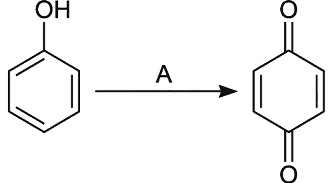
A
Reduction with Zinc dust
B
Dehydration with $H_2SO_4 / 443 \text{ K}$
C
Treatment with $CS_2 / \text{low temperature}$
D
Oxidation with $CrO_3$
Solution
(D) The reaction shows the oxidation of phenol to $p$-benzoquinone.
Phenol undergoes oxidation in the presence of chromic acid ($CrO_3$ in acidic medium) to form a conjugated diketone known as $p$-benzoquinone.
Therefore, the correct condition '$A$' is oxidation with $CrO_3$.
Phenol undergoes oxidation in the presence of chromic acid ($CrO_3$ in acidic medium) to form a conjugated diketone known as $p$-benzoquinone.
Therefore, the correct condition '$A$' is oxidation with $CrO_3$.
0 likesView Solution
400
ChemistryDifficultMCQMHT CET · 2026
How many moles of hydrogen gas are liberated when $6 \text{ moles}$ of ethyl alcohol reacts with sodium metal?
A
$2$
B
$3$
C
$4$
D
$6$
Solution
(B) The chemical reaction between ethyl alcohol $(C_2H_5OH)$ and sodium metal $(Na)$ is:
$2C_2H_5OH + 2Na \rightarrow 2C_2H_5ONa + H_2 \uparrow$
From the balanced chemical equation, $2 \text{ moles}$ of ethyl alcohol produce $1 \text{ mole}$ of hydrogen gas $(H_2)$.
Therefore, $6 \text{ moles}$ of ethyl alcohol will produce:
$\frac{1}{2} \times 6 = 3 \text{ moles}$ of $H_2$ gas.
Thus, the correct option is $B$.
$2C_2H_5OH + 2Na \rightarrow 2C_2H_5ONa + H_2 \uparrow$
From the balanced chemical equation, $2 \text{ moles}$ of ethyl alcohol produce $1 \text{ mole}$ of hydrogen gas $(H_2)$.
Therefore, $6 \text{ moles}$ of ethyl alcohol will produce:
$\frac{1}{2} \times 6 = 3 \text{ moles}$ of $H_2$ gas.
Thus, the correct option is $B$.
0 likesView Solution
Vedclass Products
For Students
Vedclass Test Series
Mock tests in real MHT CET style covering Chemistry with performance analysis. 5-day free trial.
Start Free TrialFor Teachers
Exam Paper Generator
Generate Set A/B/C/D Chemistry papers from 7.5L+ questions in 2 minutes. 3 chapters free.
Try FreeFor Institutes
Online Exam Module
Run live MHT CET mock exams with unlimited students, 360° analytics & white-label branding.
See DemoFrequently Asked Questions
How many Chemistry questions are in MHT CET 2026?
There are 806 Chemistry questions from the MHT CET 2026 paper on Vedclass, each with a detailed step-by-step solution in English.
Are MHT CET 2026 Chemistry solutions available in English?
Yes. All solutions on this page are in English. You can also switch to English or Hindi using the language buttons above the questions.
Can I practice MHT CET 2026 Chemistry as a timed test?
Yes. Use the Vedclass Test Series to attempt a full MHT CET mock test covering Chemistry with time limits and instant score analysis.
Can teachers create Chemistry papers from MHT CET previous year questions?
Yes. The Vedclass Exam Paper Generator lets teachers mix MHT CET Chemistry questions and generate Set A/B/C/D papers in minutes.
For Teachers & Institutes
Build a Custom Chemistry Paper
Pick MHT CET 2026 Chemistry questions, set difficulty, and generate Set A/B/C/D in 2 minutes.