
MathematicsQ551–600 of 949 questions
Page 12 of 13 · English
551
MathematicsDifficultMCQMHT CET · 2026
The minimum value of $Z = 3x + y$, subject to the constraints $2x + 3y \leq 6$, $x + y \geq 1$, $x \geq 0$, $y \geq 0$ is....
A
$5$
B
$2$
C
$1$
D
$9$
Solution
(C) $1$. Identify the feasible region defined by the constraints:
$2x + 3y = 6$ passes through $(3, 0)$ and $(0, 2)$.
$x + y = 1$ passes through $(1, 0)$ and $(0, 1)$.
$2$. The corner points of the feasible region are $(1, 0)$, $(3, 0)$, and $(0, 1)$.
$3$. Evaluate $Z = 3x + y$ at each corner point:
At $(1, 0): Z = 3(1) + 0 = 3$.
At $(3, 0): Z = 3(3) + 0 = 9$.
At $(0, 1): Z = 3(0) + 1 = 1$.
$4$. Comparing the values, the minimum value is $1$.
$2x + 3y = 6$ passes through $(3, 0)$ and $(0, 2)$.
$x + y = 1$ passes through $(1, 0)$ and $(0, 1)$.
$2$. The corner points of the feasible region are $(1, 0)$, $(3, 0)$, and $(0, 1)$.
$3$. Evaluate $Z = 3x + y$ at each corner point:
At $(1, 0): Z = 3(1) + 0 = 3$.
At $(3, 0): Z = 3(3) + 0 = 9$.
At $(0, 1): Z = 3(0) + 1 = 1$.
$4$. Comparing the values, the minimum value is $1$.
0 likesView Solution
552
MathematicsDifficultMCQMHT CET · 2026
The difference between the maximum and minimum values of the objective function $Z = 3x + 5y$, subject to the constraints $x + 3y \leq 60$, $x + y \geq 10$, $x - y \leq 0$, and $x, y \geq 0$, is
A
$50$
B
$60$
C
$70$
D
$80$
Solution
(D) Step $1$: Identify the corner points of the feasible region defined by the constraints.
- $x + 3y = 60$ and $x - y = 0 \implies x=15, y=15$. Point: $(15, 15)$.
- $x + 3y = 60$ and $x = 0 \implies y=20$. Point: $(0, 20)$.
- $x + y = 10$ and $x - y = 0 \implies x=5, y=5$. Point: $(5, 5)$.
- $x + y = 10$ and $x = 0 \implies y=10$. Point: $(0, 10)$.
Step $2$: Evaluate $Z = 3x + 5y$ at each corner point.
- At $(15, 15): Z = 3(15) + 5(15) = 45 + 75 = 120$.
- At $(0, 20): Z = 3(0) + 5(20) = 100$.
- At $(5, 5): Z = 3(5) + 5(5) = 15 + 25 = 40$.
- At $(0, 10): Z = 3(0) + 5(10) = 50$.
Step $3$: Find the maximum and minimum values.
- Maximum value $Z_{max} = 120$.
- Minimum value $Z_{min} = 40$.
Step $4$: Calculate the difference.
- Difference $= Z_{max} - Z_{min} = 120 - 40 = 80$.
- $x + 3y = 60$ and $x - y = 0 \implies x=15, y=15$. Point: $(15, 15)$.
- $x + 3y = 60$ and $x = 0 \implies y=20$. Point: $(0, 20)$.
- $x + y = 10$ and $x - y = 0 \implies x=5, y=5$. Point: $(5, 5)$.
- $x + y = 10$ and $x = 0 \implies y=10$. Point: $(0, 10)$.
Step $2$: Evaluate $Z = 3x + 5y$ at each corner point.
- At $(15, 15): Z = 3(15) + 5(15) = 45 + 75 = 120$.
- At $(0, 20): Z = 3(0) + 5(20) = 100$.
- At $(5, 5): Z = 3(5) + 5(5) = 15 + 25 = 40$.
- At $(0, 10): Z = 3(0) + 5(10) = 50$.
Step $3$: Find the maximum and minimum values.
- Maximum value $Z_{max} = 120$.
- Minimum value $Z_{min} = 40$.
Step $4$: Calculate the difference.
- Difference $= Z_{max} - Z_{min} = 120 - 40 = 80$.
0 likesView Solution
553
MathematicsDifficultMCQMHT CET · 2026
The feasible region represented by the constraints $y - 2x \leq 4$, $x + y \geq 5$, $x \leq 4$, $y \geq 2$, and $x, y \geq 0$ is
A
a convex bounded region with $4$ corner points
B
an unbounded region
C
a convex bounded region with $5$ corner points
D
no feasible region
Solution
(C) $1$. Plot the lines: $y = 2x + 4$, $x + y = 5$, $x = 4$, and $y = 2$.
$2$. The region $y - 2x \leq 4$ is above the line $y = 2x + 4$.
$3$. The region $x + y \geq 5$ is above the line $x + y = 5$.
$4$. The region $x \leq 4$ is to the left of the line $x = 4$.
$5$. The region $y \geq 2$ is above the line $y = 2$.
$6$. Intersection points are: $(0, 4)$, $(1, 6)$, $(4, 6)$, $(4, 2)$, and $(3, 2)$.
$7$. Since all constraints form a closed polygon with $5$ vertices, the feasible region is a convex bounded region with $5$ corner points.
$2$. The region $y - 2x \leq 4$ is above the line $y = 2x + 4$.
$3$. The region $x + y \geq 5$ is above the line $x + y = 5$.
$4$. The region $x \leq 4$ is to the left of the line $x = 4$.
$5$. The region $y \geq 2$ is above the line $y = 2$.
$6$. Intersection points are: $(0, 4)$, $(1, 6)$, $(4, 6)$, $(4, 2)$, and $(3, 2)$.
$7$. Since all constraints form a closed polygon with $5$ vertices, the feasible region is a convex bounded region with $5$ corner points.
0 likesView Solution
554
MathematicsDifficultMCQMHT CET · 2026
The minimum value of $z = 3x + 5y$, subject to constraints $x \leq 80$, $y \geq 60$, $x + y \leq 200$ and $x, y \geq 0$ occurs at the point:
A
$(0, 200)$
B
$(60, 0)$
C
$(0, 60)$
D
$(80, 60)$
Solution
(C) Step $1$: Identify the feasible region defined by the constraints.
Step $2$: The intersection points of the lines $x=80$, $y=60$, $x+y=200$, and the axes are the vertices of the feasible region.
Step $3$: The vertices are found by solving the system of equations:
- Intersection of $y=60$ and $x=0$ gives $(0, 60)$.
- Intersection of $y=60$ and $x+y=200$ gives $(140, 60)$, but $x \leq 80$, so we use $(80, 60)$.
- Intersection of $x=80$ and $x+y=200$ gives $(80, 120)$.
- Intersection of $x=0$ and $x+y=200$ gives $(0, 200)$.
Step $4$: Evaluate $z = 3x + 5y$ at each vertex:
- At $(0, 60)$: $z = 3(0) + 5(60) = 300$.
- At $(80, 60)$: $z = 3(80) + 5(60) = 240 + 300 = 540$.
- At $(80, 120)$: $z = 3(80) + 5(120) = 240 + 600 = 840$.
- At $(0, 200)$: $z = 3(0) + 5(200) = 1000$.
Step $5$: The minimum value is $300$ at point $(0, 60)$.
Step $2$: The intersection points of the lines $x=80$, $y=60$, $x+y=200$, and the axes are the vertices of the feasible region.
Step $3$: The vertices are found by solving the system of equations:
- Intersection of $y=60$ and $x=0$ gives $(0, 60)$.
- Intersection of $y=60$ and $x+y=200$ gives $(140, 60)$, but $x \leq 80$, so we use $(80, 60)$.
- Intersection of $x=80$ and $x+y=200$ gives $(80, 120)$.
- Intersection of $x=0$ and $x+y=200$ gives $(0, 200)$.
Step $4$: Evaluate $z = 3x + 5y$ at each vertex:
- At $(0, 60)$: $z = 3(0) + 5(60) = 300$.
- At $(80, 60)$: $z = 3(80) + 5(60) = 240 + 300 = 540$.
- At $(80, 120)$: $z = 3(80) + 5(120) = 240 + 600 = 840$.
- At $(0, 200)$: $z = 3(0) + 5(200) = 1000$.
Step $5$: The minimum value is $300$ at point $(0, 60)$.
0 likesView Solution
555
MathematicsDifficultMCQMHT CET · 2026
For the linear programming problem, $x + 2y \leq 10$, $3x + y \leq 12$, $x, y \geq 0$, the maximum value of $z = 5x + 10y$ occurs at every point on the line segment joining the points..
A
$(0, 0)$ and $(4, 0)$
B
$(0, 0)$ and $(0, 5)$
C
$(4, 0)$ and $(\frac{14}{5}, \frac{18}{5})$
D
$(0, 5)$ and $(\frac{14}{5}, \frac{18}{5})$
Solution
(D) Step $1$: Identify the corner points of the feasible region defined by $x + 2y \leq 10$, $3x + y \leq 12$, $x \geq 0$, $y \geq 0$.
Step $2$: The intersection of $x + 2y = 10$ and $3x + y = 12$ is found by solving the system: $y = 12 - 3x$. Substituting into the first equation: $x + 2(12 - 3x) = 10 \implies x + 24 - 6x = 10 \implies -5x = -14 \implies x = \frac{14}{5}$. Then $y = 12 - 3(\frac{14}{5}) = \frac{60 - 42}{5} = \frac{18}{5}$. The intersection point is $(\frac{14}{5}, \frac{18}{5})$.
Step $3$: Evaluate $z = 5x + 10y$ at corner points: $(0, 0) \implies z = 0$; $(4, 0) \implies z = 20$; $(0, 5) \implies z = 50$; $(\frac{14}{5}, \frac{18}{5}) \implies z = 5(\frac{14}{5}) + 10(\frac{18}{5}) = 14 + 36 = 50$.
Step $4$: Since $z$ is maximum at $(0, 5)$ and $(\frac{14}{5}, \frac{18}{5})$ with value $50$, the maximum occurs at every point on the line segment joining these two points.
Step $2$: The intersection of $x + 2y = 10$ and $3x + y = 12$ is found by solving the system: $y = 12 - 3x$. Substituting into the first equation: $x + 2(12 - 3x) = 10 \implies x + 24 - 6x = 10 \implies -5x = -14 \implies x = \frac{14}{5}$. Then $y = 12 - 3(\frac{14}{5}) = \frac{60 - 42}{5} = \frac{18}{5}$. The intersection point is $(\frac{14}{5}, \frac{18}{5})$.
Step $3$: Evaluate $z = 5x + 10y$ at corner points: $(0, 0) \implies z = 0$; $(4, 0) \implies z = 20$; $(0, 5) \implies z = 50$; $(\frac{14}{5}, \frac{18}{5}) \implies z = 5(\frac{14}{5}) + 10(\frac{18}{5}) = 14 + 36 = 50$.
Step $4$: Since $z$ is maximum at $(0, 5)$ and $(\frac{14}{5}, \frac{18}{5})$ with value $50$, the maximum occurs at every point on the line segment joining these two points.
0 likesView Solution
556
MathematicsDifficultMCQMHT CET · 2026
In the following figure, the shaded region represents the system of constraints:
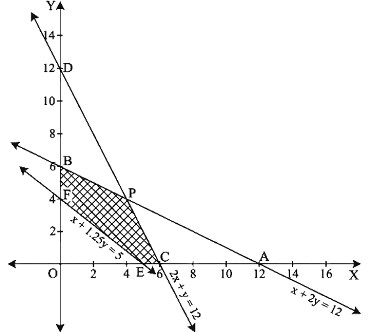
A
$2x + y \leq 12, x + 2y \leq 12, x + 1.25y \geq 5, x \leq 0, y \geq 0$
B
$2x + y \leq 12, x + 2y \leq 12, x + 1.25y \geq 5, x \geq 0, y \leq 0$
C
$2x + y \leq 12, x + 2y \leq 12, x + 1.25y \leq 5, x \geq 0, y \geq 0$
D
$2x + y \leq 12, x + 2y \leq 12, x + 1.25y \geq 5, x \geq 0, y \geq 0$
Solution
(D) $1$. The shaded region lies in the first quadrant, so the non-negativity constraints are $x \geq 0$ and $y \geq 0$.
$2$. The region is bounded by three lines:
$(i)$ The line passing through $(0, 12)$ and $(6, 0)$ has the equation $\frac{x}{6} + \frac{y}{12} = 1$, which simplifies to $2x + y = 12$. Since the shaded region is towards the origin, the constraint is $2x + y \leq 12$.
(ii) The line passing through $(0, 6)$ and $(12, 0)$ has the equation $\frac{x}{12} + \frac{y}{6} = 1$, which simplifies to $x + 2y = 12$. Since the shaded region is towards the origin, the constraint is $x + 2y \leq 12$.
(iii) The line passing through $(0, 4)$ and $(5, 0)$ has the equation $\frac{x}{5} + \frac{y}{4} = 1$, which simplifies to $4x + 5y = 20$, or $x + 1.25y = 5$. Since the shaded region is away from the origin, the constraint is $x + 1.25y \geq 5$.
$3$. Combining these, the system of constraints is $2x + y \leq 12, x + 2y \leq 12, x + 1.25y \geq 5, x \geq 0, y \geq 0$. This matches option $D$.
$2$. The region is bounded by three lines:
$(i)$ The line passing through $(0, 12)$ and $(6, 0)$ has the equation $\frac{x}{6} + \frac{y}{12} = 1$, which simplifies to $2x + y = 12$. Since the shaded region is towards the origin, the constraint is $2x + y \leq 12$.
(ii) The line passing through $(0, 6)$ and $(12, 0)$ has the equation $\frac{x}{12} + \frac{y}{6} = 1$, which simplifies to $x + 2y = 12$. Since the shaded region is towards the origin, the constraint is $x + 2y \leq 12$.
(iii) The line passing through $(0, 4)$ and $(5, 0)$ has the equation $\frac{x}{5} + \frac{y}{4} = 1$, which simplifies to $4x + 5y = 20$, or $x + 1.25y = 5$. Since the shaded region is away from the origin, the constraint is $x + 1.25y \geq 5$.
$3$. Combining these, the system of constraints is $2x + y \leq 12, x + 2y \leq 12, x + 1.25y \geq 5, x \geq 0, y \geq 0$. This matches option $D$.
0 likesView Solution
557
MathematicsDifficultMCQMHT CET · 2026
The maximum value of $Z = 4x + 5y$, subject to the constraints $3x + y \leq 15$, $3x + 4y \leq 24$, $x \geq 0$, $y \geq 0$ is
A
$31$
B
$30$
C
$42$
D
$47$
Solution
(A) Step $1$: Identify the corner points of the feasible region defined by the constraints.
Step $2$: The lines are $3x + y = 15$ and $3x + 4y = 24$.
Step $3$: Intersection point: Subtracting the first from the second gives $3y = 9$, so $y = 3$. Substituting $y = 3$ into $3x + y = 15$ gives $3x = 12$, so $x = 4$. The intersection point is $(4, 3)$.
Step $4$: The corner points of the feasible region are $(0, 0)$, $(5, 0)$, $(4, 3)$, and $(0, 6)$.
Step $5$: Evaluate $Z = 4x + 5y$ at each corner point:
At $(0, 0)$, $Z = 4(0) + 5(0) = 0$.
At $(5, 0)$, $Z = 4(5) + 5(0) = 20$.
At $(4, 3)$, $Z = 4(4) + 5(3) = 16 + 15 = 31$.
At $(0, 6)$, $Z = 4(0) + 5(6) = 30$.
Step $6$: The maximum value is $31$.
Step $2$: The lines are $3x + y = 15$ and $3x + 4y = 24$.
Step $3$: Intersection point: Subtracting the first from the second gives $3y = 9$, so $y = 3$. Substituting $y = 3$ into $3x + y = 15$ gives $3x = 12$, so $x = 4$. The intersection point is $(4, 3)$.
Step $4$: The corner points of the feasible region are $(0, 0)$, $(5, 0)$, $(4, 3)$, and $(0, 6)$.
Step $5$: Evaluate $Z = 4x + 5y$ at each corner point:
At $(0, 0)$, $Z = 4(0) + 5(0) = 0$.
At $(5, 0)$, $Z = 4(5) + 5(0) = 20$.
At $(4, 3)$, $Z = 4(4) + 5(3) = 16 + 15 = 31$.
At $(0, 6)$, $Z = 4(0) + 5(6) = 30$.
Step $6$: The maximum value is $31$.
0 likesView Solution
558
MathematicsDifficultMCQMHT CET · 2026
The maximum value of $z = 4x + y$ subject to the constraints $x + y \leq 5$, $2x + y \leq 7$, $3x + 2y \leq 11$, $x \geq 0$, $y \geq 0$ is:
A
$13$
B
$8$
C
$11$
D
$14$
Solution
(D) Step $1$: Identify the corner points of the feasible region defined by the constraints.
Step $2$: The intersection points of the lines are:
$(i)$ $x+y=5$ and $2x+y=7$ gives $x=2, y=3$.
(ii) $2x+y=7$ and $3x+2y=11$ gives $x=3, y=1$.
(iii) The axes intercepts are $(0, 0), (5, 0), (0, 5), (0, 5.5), (3.66, 0)$.
Step $3$: Evaluating $z = 4x + y$ at the corner points of the feasible region:
At $(0, 0)$, $z = 0$.
At $(3.5, 0)$, $z = 4(3.5) + 0 = 14$.
At $(3, 1)$, $z = 4(3) + 1 = 13$.
At $(2, 3)$, $z = 4(2) + 3 = 11$.
At $(0, 5)$, $z = 4(0) + 5 = 5$.
Step $4$: The maximum value is $14$.
Step $2$: The intersection points of the lines are:
$(i)$ $x+y=5$ and $2x+y=7$ gives $x=2, y=3$.
(ii) $2x+y=7$ and $3x+2y=11$ gives $x=3, y=1$.
(iii) The axes intercepts are $(0, 0), (5, 0), (0, 5), (0, 5.5), (3.66, 0)$.
Step $3$: Evaluating $z = 4x + y$ at the corner points of the feasible region:
At $(0, 0)$, $z = 0$.
At $(3.5, 0)$, $z = 4(3.5) + 0 = 14$.
At $(3, 1)$, $z = 4(3) + 1 = 13$.
At $(2, 3)$, $z = 4(2) + 3 = 11$.
At $(0, 5)$, $z = 4(0) + 5 = 5$.
Step $4$: The maximum value is $14$.
0 likesView Solution
559
MathematicsDifficultMCQMHT CET · 2026
An airplane can carry a maximum of $250$ passengers. $A$ profit of $\text{Rs } 1500$ is made on each executive class ticket and a profit of $\text{Rs } 900$ is made on each economy class ticket. The airline reserves at least $30$ seats for executive class. Also, at least $4$ times as many passengers prefer to travel by economy class than by executive class. Let $x_1$ be the number of passengers in executive class and $x_2$ be the number of passengers in economy class. Formulate the Linear Programming Problem $(LPP)$ to maximize the profit for the airline.
A
Maximize $z = 1500x_1 + 900x_2$ subject to $x_1 + x_2 \leq 250, x_1 \leq 30, x_2 \leq 4x_1, x_1 \geq 0, x_2 \geq 0$.
B
Minimize $z = 150x_1 + 90x_2$ subject to $x_1 + x_2 \leq 250, x_1 \geq 30, x_2 \geq 4x_1, x_1 \geq 0, x_2 \geq 0$.
C
Minimize $z = 1500x_1 + 900x_2$ subject to $x_1 + x_2 \leq 250, x_1 \geq 30, x_2 \geq 4x_1, x_1 \geq 0, x_2 \geq 0$.
D
Maximize $z = 1500x_1 + 900x_2$ subject to $x_1 + x_2 \leq 250, x_1 \geq 30, x_2 \geq 4x_1, x_1 \geq 0, x_2 \geq 0$.
Solution
(D) Step $1$: Define the objective function. Profit is $1500$ per executive ticket $(x_1)$ and $900$ per economy ticket $(x_2)$. Thus, maximize $z = 1500x_1 + 900x_2$.
Step $2$: Identify constraints. Total capacity is $250$, so $x_1 + x_2 \leq 250$.
Step $3$: Executive class reservation is at least $30$, so $x_1 \geq 30$.
Step $4$: Economy class preference is at least $4$ times executive class, so $x_2 \geq 4x_1$.
Step $5$: Non-negativity constraints are $x_1 \geq 0, x_2 \geq 0$. Combining these, option $D$ is correct.
Step $2$: Identify constraints. Total capacity is $250$, so $x_1 + x_2 \leq 250$.
Step $3$: Executive class reservation is at least $30$, so $x_1 \geq 30$.
Step $4$: Economy class preference is at least $4$ times executive class, so $x_2 \geq 4x_1$.
Step $5$: Non-negativity constraints are $x_1 \geq 0, x_2 \geq 0$. Combining these, option $D$ is correct.
0 likesView Solution
560
MathematicsDifficultMCQMHT CET · 2026
The difference between the maximum value and the minimum value of the objective function $z = 3x + y$ subject to the constraints $2x + 3y \leq 6$, $x + y \geq 1$, $x \geq 0$, $y \geq 0$ is....
A
$7$
B
$3$
C
$8$
D
$1$
Solution
(C) Step $1$: Identify the corner points of the feasible region defined by the constraints.
Step $2$: The lines are $2x + 3y = 6$ and $x + y = 1$.
Step $3$: Intersection of $2x + 3y = 6$ and $x + y = 1$ gives $x = 3, y = -2$ (outside the first quadrant).
Step $4$: The vertices of the feasible region are $(0, 1)$, $(0, 2)$, $(1, 0)$, and $(3, 0)$.
Step $5$: Evaluate $z = 3x + y$ at each vertex:
At $(0, 1)$, $z = 3(0) + 1 = 1$.
At $(0, 2)$, $z = 3(0) + 2 = 2$.
At $(1, 0)$, $z = 3(1) + 0 = 3$.
At $(3, 0)$, $z = 3(3) + 0 = 9$.
Step $6$: Maximum value is $9$ and minimum value is $1$.
Step $7$: The difference is $9 - 1 = 8$.
Step $2$: The lines are $2x + 3y = 6$ and $x + y = 1$.
Step $3$: Intersection of $2x + 3y = 6$ and $x + y = 1$ gives $x = 3, y = -2$ (outside the first quadrant).
Step $4$: The vertices of the feasible region are $(0, 1)$, $(0, 2)$, $(1, 0)$, and $(3, 0)$.
Step $5$: Evaluate $z = 3x + y$ at each vertex:
At $(0, 1)$, $z = 3(0) + 1 = 1$.
At $(0, 2)$, $z = 3(0) + 2 = 2$.
At $(1, 0)$, $z = 3(1) + 0 = 3$.
At $(3, 0)$, $z = 3(3) + 0 = 9$.
Step $6$: Maximum value is $9$ and minimum value is $1$.
Step $7$: The difference is $9 - 1 = 8$.
0 likesView Solution
561
MathematicsDifficultMCQMHT CET · 2026
The $LPP$ to maximize $z = 2x + 5y$ subject to the constraints $x + 3y \leq 6$, $2x + 6y \leq 18$, $x \geq 0$, $y \geq 0$ has:
A
Unique solution
B
Infinite solutions
C
No solution
D
Unbounded feasible region
Solution
(A) Step $1$: Analyze the constraints. The constraints are $x + 3y \leq 6$ and $2x + 6y \leq 18$. Note that $2x + 6y \leq 18$ simplifies to $x + 3y \leq 9$.
Step $2$: Since $x + 3y \leq 6$ is a stricter condition than $x + 3y \leq 9$, the feasible region is determined solely by $x + 3y \leq 6$ along with $x \geq 0$ and $y \geq 0$.
Step $3$: The vertices of the feasible region are $(0, 0)$, $(6, 0)$, and $(0, 2)$.
Step $4$: Evaluate $z = 2x + 5y$ at these vertices:
At $(0, 0)$, $z = 2(0) + 5(0) = 0$.
At $(6, 0)$, $z = 2(6) + 5(0) = 12$.
At $(0, 2)$, $z = 2(0) + 5(2) = 10$.
Step $5$: The maximum value is $12$ at the point $(6, 0)$. Since there is a single point where the maximum is attained, the solution is unique.
Step $2$: Since $x + 3y \leq 6$ is a stricter condition than $x + 3y \leq 9$, the feasible region is determined solely by $x + 3y \leq 6$ along with $x \geq 0$ and $y \geq 0$.
Step $3$: The vertices of the feasible region are $(0, 0)$, $(6, 0)$, and $(0, 2)$.
Step $4$: Evaluate $z = 2x + 5y$ at these vertices:
At $(0, 0)$, $z = 2(0) + 5(0) = 0$.
At $(6, 0)$, $z = 2(6) + 5(0) = 12$.
At $(0, 2)$, $z = 2(0) + 5(2) = 10$.
Step $5$: The maximum value is $12$ at the point $(6, 0)$. Since there is a single point where the maximum is attained, the solution is unique.
0 likesView Solution
562
MathematicsDifficultMCQMHT CET · 2026
$A$ random variable $X$ has the following probability distribution:
$X = 1, P(X) = 0.15$
$X = 2, P(X) = 0.20$
$X = 3, P(X) = 0.25$
$X = 4, P(X) = 0.30$
$X = 5, P(X) = 0.10$
For the event $E = \{ X \text{ is a prime number} \}$ and $F = \{ X < 4 \}$, find $P(E \cup F)$.
$X = 1, P(X) = 0.15$
$X = 2, P(X) = 0.20$
$X = 3, P(X) = 0.25$
$X = 4, P(X) = 0.30$
$X = 5, P(X) = 0.10$
For the event $E = \{ X \text{ is a prime number} \}$ and $F = \{ X < 4 \}$, find $P(E \cup F)$.
A
$0.87$
B
$0.77$
C
$0.35$
D
$0.50$
Solution
(D) Step $1$: Identify the outcomes for events $E$ and $F$.
$E = \{ X \text{ is a prime number} \} = \{2, 3, 5\}$.
$F = \{ X < 4 \} = \{1, 2, 3\}$.
Step $2$: Identify the union $E \cup F$.
$E \cup F = \{1, 2, 3, 5\}$.
Step $3$: Calculate the probability $P(E \cup F)$.
$P(E \cup F) = P(X=1) + P(X=2) + P(X=3) + P(X=5)$.
$P(E \cup F) = 0.15 + 0.20 + 0.25 + 0.10 = 0.70$.
Note: The provided options do not contain $0.70$. Re-evaluating the question logic, if $E \cup F$ is calculated as $P(E) + P(F) - P(E \cap F)$:
$P(E) = 0.20 + 0.25 + 0.10 = 0.55$.
$P(F) = 0.15 + 0.20 + 0.25 = 0.60$.
$E \cap F = \{2, 3\}$, so $P(E \cap F) = 0.20 + 0.25 = 0.45$.
$P(E \cup F) = 0.55 + 0.60 - 0.45 = 0.70$.
$E = \{ X \text{ is a prime number} \} = \{2, 3, 5\}$.
$F = \{ X < 4 \} = \{1, 2, 3\}$.
Step $2$: Identify the union $E \cup F$.
$E \cup F = \{1, 2, 3, 5\}$.
Step $3$: Calculate the probability $P(E \cup F)$.
$P(E \cup F) = P(X=1) + P(X=2) + P(X=3) + P(X=5)$.
$P(E \cup F) = 0.15 + 0.20 + 0.25 + 0.10 = 0.70$.
Note: The provided options do not contain $0.70$. Re-evaluating the question logic, if $E \cup F$ is calculated as $P(E) + P(F) - P(E \cap F)$:
$P(E) = 0.20 + 0.25 + 0.10 = 0.55$.
$P(F) = 0.15 + 0.20 + 0.25 = 0.60$.
$E \cap F = \{2, 3\}$, so $P(E \cap F) = 0.20 + 0.25 = 0.45$.
$P(E \cup F) = 0.55 + 0.60 - 0.45 = 0.70$.
0 likesView Solution
563
MathematicsDifficultMCQMHT CET · 2026
For the following probability distribution, the standard deviation of the random variable $X$ is:
$X: 0, 1, 2$
$P(X): 0.3, 0.4, 0.3$
$X: 0, 1, 2$
$P(X): 0.3, 0.4, 0.3$
A
$0.5$
B
$0.6$
C
$0.61$
D
$0.7$
Solution
(D) Step $1$: Calculate the mean $E(X) = \sum x_i P(x_i) = (0 \times 0.3) + (1 \times 0.4) + (2 \times 0.3) = 0 + 0.4 + 0.6 = 1.0$.
Step $2$: Calculate $E(X^2) = \sum x_i^2 P(x_i) = (0^2 \times 0.3) + (1^2 \times 0.4) + (2^2 \times 0.3) = 0 + 0.4 + 1.2 = 1.6$.
Step $3$: Calculate the variance $Var(X) = E(X^2) - [E(X)]^2 = 1.6 - (1.0)^2 = 1.6 - 1.0 = 0.6$.
Step $4$: Calculate the standard deviation $\sigma = \sqrt{Var(X)} = \sqrt{0.6} \approx 0.77$. Since the closest option is $0.7$, we select $D$.
Step $2$: Calculate $E(X^2) = \sum x_i^2 P(x_i) = (0^2 \times 0.3) + (1^2 \times 0.4) + (2^2 \times 0.3) = 0 + 0.4 + 1.2 = 1.6$.
Step $3$: Calculate the variance $Var(X) = E(X^2) - [E(X)]^2 = 1.6 - (1.0)^2 = 1.6 - 1.0 = 0.6$.
Step $4$: Calculate the standard deviation $\sigma = \sqrt{Var(X)} = \sqrt{0.6} \approx 0.77$. Since the closest option is $0.7$, we select $D$.
0 likesView Solution
564
MathematicsDifficultMCQMHT CET · 2026
The probability distribution of a random variable $X$ is given by:
Then the cumulative distribution function (c.d.f.) $F(x)$ of $X$ is given by:
| $X = x$ | $1$ | $2$ | $3$ | $4$ |
| $P(X = x)$ | $1/10$ | $2/10$ | $3/10$ | $4/10$ |
Then the cumulative distribution function (c.d.f.) $F(x)$ of $X$ is given by:
A
| $X = x$ | $1$ | $2$ | $3$ | $4$ |
| $F(X = x)$ | $1/10$ | $3/10$ | $6/10$ | $1$ |
B
| $X = x$ | $1$ | $2$ | $3$ | $4$ |
| $F(X = x)$ | $3/10$ | $1/10$ | $6/10$ | $1$ |
C
| $X = x$ | $1$ | $2$ | $3$ | $4$ |
| $F(X = x)$ | $1/10$ | $3/10$ | $5/10$ | $1/10$ |
D
| $X = x$ | $1$ | $2$ | $3$ | $4$ |
| $F(X = x)$ | $1/10$ | $6/10$ | $3/10$ | $1$ |
Solution
(A) The cumulative distribution function $F(x)$ is defined as $F(x_i) = \sum_{j=1}^{i} P(X = x_j)$.
For $x=1$: $F(1) = P(X=1) = 1/10$.
For $x=2$: $F(2) = P(X=1) + P(X=2) = 1/10 + 2/10 = 3/10$.
For $x=3$: $F(3) = P(X=1) + P(X=2) + P(X=3) = 3/10 + 3/10 = 6/10$.
For $x=4$: $F(4) = P(X=1) + P(X=2) + P(X=3) + P(X=4) = 6/10 + 4/10 = 10/10 = 1$.
Thus, the correct distribution is given in option $A$.
For $x=1$: $F(1) = P(X=1) = 1/10$.
For $x=2$: $F(2) = P(X=1) + P(X=2) = 1/10 + 2/10 = 3/10$.
For $x=3$: $F(3) = P(X=1) + P(X=2) + P(X=3) = 3/10 + 3/10 = 6/10$.
For $x=4$: $F(4) = P(X=1) + P(X=2) + P(X=3) + P(X=4) = 6/10 + 4/10 = 10/10 = 1$.
Thus, the correct distribution is given in option $A$.
0 likesView Solution
565
MathematicsDifficultMCQMHT CET · 2026
$A$ random variable $X$ has the following probability distribution:
$X = 1, 2, 3, 4, 5$
$P(X) = 0.1, 0.2, 0.3, 0.2, 0.2$
For the events $E = \{ X \text{ is a prime number} \}$ and $F = \{ X < 4 \}$, find $P(E \cap F)$.
$X = 1, 2, 3, 4, 5$
$P(X) = 0.1, 0.2, 0.3, 0.2, 0.2$
For the events $E = \{ X \text{ is a prime number} \}$ and $F = \{ X < 4 \}$, find $P(E \cap F)$.
A
$0.2$
B
$0.3$
C
$0.5$
D
$0.1$
Solution
(C) Step $1$: Identify the sample space for event $E = \{ X \text{ is a prime number} \}$. The prime numbers in $\{1, 2, 3, 4, 5\}$ are $2$ and $3$. So, $E = \{2, 3\}$.
Step $2$: Identify the sample space for event $F = \{ X < 4 \}$. The values less than $4$ are $1, 2, 3$. So, $F = \{1, 2, 3\}$.
Step $3$: Find the intersection $E \cap F$. The common elements are $\{2, 3\}$.
Step $4$: Calculate $P(E \cap F) = P(2) + P(3) = 0.2 + 0.3 = 0.5$.
Step $2$: Identify the sample space for event $F = \{ X < 4 \}$. The values less than $4$ are $1, 2, 3$. So, $F = \{1, 2, 3\}$.
Step $3$: Find the intersection $E \cap F$. The common elements are $\{2, 3\}$.
Step $4$: Calculate $P(E \cap F) = P(2) + P(3) = 0.2 + 0.3 = 0.5$.
0 likesView Solution
566
MathematicsDifficultMCQMHT CET · 2026
If a random variable $X$ has a probability mass function $P(x) = \begin{cases} kx^2, & \text{for } x = 1, 2, 3, 4 \\ 0, & \text{otherwise} \end{cases}$, then the mean of $X$ is ...
A
$3.33$
B
$3.25$
C
$3.00$
D
$2.50$
Solution
(A) Step $1$: The sum of all probabilities must be $1$. Thus, $\sum P(x) = k(1^2 + 2^2 + 3^2 + 4^2) = 1$.
Step $2$: Calculate the sum: $k(1 + 4 + 9 + 16) = 30k = 1$, so $k = \frac{1}{30}$.
Step $3$: The mean $E(X) = \sum x \cdot P(x) = \sum x \cdot kx^2 = k \sum x^3$.
Step $4$: Calculate $\sum x^3 = 1^3 + 2^3 + 3^3 + 4^3 = 1 + 8 + 27 + 64 = 100$.
Step $5$: $E(X) = \frac{1}{30} \cdot 100 = \frac{10}{3} \approx 3.33$.
Step $2$: Calculate the sum: $k(1 + 4 + 9 + 16) = 30k = 1$, so $k = \frac{1}{30}$.
Step $3$: The mean $E(X) = \sum x \cdot P(x) = \sum x \cdot kx^2 = k \sum x^3$.
Step $4$: Calculate $\sum x^3 = 1^3 + 2^3 + 3^3 + 4^3 = 1 + 8 + 27 + 64 = 100$.
Step $5$: $E(X) = \frac{1}{30} \cdot 100 = \frac{10}{3} \approx 3.33$.
0 likesView Solution
567
MathematicsDifficultMCQMHT CET · 2026
$A$ box contains $8$ red and $N$ green balls. Two balls are drawn at random from it. If $X$ is the random variable representing the number of green balls drawn and $E(X) = 1.2$, then $N = ...$
A
$4$
B
$8$
C
$12$
D
$16$
Solution
(C) Total number of balls $= 8 + N$.
Number of balls drawn $= 2$.
The random variable $X$ represents the number of green balls, so $X \in \{0, 1, 2\}$.
The probability distribution is given by hypergeometric distribution:
$P(X=k) = \frac{\binom{N}{k} \binom{8}{2-k}}{\binom{N+8}{2}}$.
For a sample of size $n=2$ from a population of $N+8$ containing $N$ green balls, the expected value $E(X) = n \cdot \frac{N}{N+8}$.
Given $E(X) = 1.2$, we have $2 \cdot \frac{N}{N+8} = 1.2$.
$\frac{N}{N+8} = 0.6$.
$N = 0.6(N+8) \implies N = 0.6N + 4.8$.
$0.4N = 4.8 \implies N = \frac{4.8}{0.4} = 12$.
Number of balls drawn $= 2$.
The random variable $X$ represents the number of green balls, so $X \in \{0, 1, 2\}$.
The probability distribution is given by hypergeometric distribution:
$P(X=k) = \frac{\binom{N}{k} \binom{8}{2-k}}{\binom{N+8}{2}}$.
For a sample of size $n=2$ from a population of $N+8$ containing $N$ green balls, the expected value $E(X) = n \cdot \frac{N}{N+8}$.
Given $E(X) = 1.2$, we have $2 \cdot \frac{N}{N+8} = 1.2$.
$\frac{N}{N+8} = 0.6$.
$N = 0.6(N+8) \implies N = 0.6N + 4.8$.
$0.4N = 4.8 \implies N = \frac{4.8}{0.4} = 12$.
0 likesView Solution
568
MathematicsDifficultMCQMHT CET · 2026
If a discrete random variable $X$ takes the values $1, 2, 3, 4$ such that $2P(X = 1) = 3P(X = 2) = P(X = 3) = 5P(X = 4)$, then $P(X = 4) = ...$ (in $61$)
A
$15$
B
$30$
C
$10$
D
$6$
Solution
(D) Let $P(X = 1) = a, P(X = 2) = b, P(X = 3) = c, P(X = 4) = d$. Given $2a = 3b = c = 5d = k$.
Then $a = k/2, b = k/3, c = k, d = k/5$.
Since the sum of probabilities is $1$, we have $a + b + c + d = 1$.
Substituting the values: $k/2 + k/3 + k + k/5 = 1$.
Taking the $LCM$ of $2, 3, 1, 5$, which is $30$: $(15k + 10k + 30k + 6k) / 30 = 1$.
$61k / 30 = 1$, so $k = 30/61$.
Since $P(X = 4) = d = k/5$, we have $P(X = 4) = (30/61) / 5 = 6/61$.
Then $a = k/2, b = k/3, c = k, d = k/5$.
Since the sum of probabilities is $1$, we have $a + b + c + d = 1$.
Substituting the values: $k/2 + k/3 + k + k/5 = 1$.
Taking the $LCM$ of $2, 3, 1, 5$, which is $30$: $(15k + 10k + 30k + 6k) / 30 = 1$.
$61k / 30 = 1$, so $k = 30/61$.
Since $P(X = 4) = d = k/5$, we have $P(X = 4) = (30/61) / 5 = 6/61$.
0 likesView Solution
569
MathematicsDifficultMCQMHT CET · 2026
Let $F(x)$ be the cumulative distribution function (c.d.f.) of a continuous random variable $X$. If $F(b) = 0.7$ and $P(X > a) = 0.4$, then the value of $P(a < X < b)$ is ...
A
$0.1$
B
$0.2$
C
$0.3$
D
$0.5$
Solution
(A) Given that $F(x)$ is the c.d.f. of $X$, we have $F(x) = P(X \le x)$.
We are given $F(b) = P(X \le b) = 0.7$.
We are given $P(X > a) = 0.4$. Since $P(X \le a) + P(X > a) = 1$, we have $P(X \le a) = 1 - 0.4 = 0.6$.
We need to find $P(a < X < b)$.
Since $X$ is a continuous random variable, $P(a < X < b) = P(X < b) - P(X < a) = P(X \le b) - P(X \le a)$.
Substituting the values, $P(a < X < b) = 0.7 - 0.6 = 0.1$.
We are given $F(b) = P(X \le b) = 0.7$.
We are given $P(X > a) = 0.4$. Since $P(X \le a) + P(X > a) = 1$, we have $P(X \le a) = 1 - 0.4 = 0.6$.
We need to find $P(a < X < b)$.
Since $X$ is a continuous random variable, $P(a < X < b) = P(X < b) - P(X < a) = P(X \le b) - P(X \le a)$.
Substituting the values, $P(a < X < b) = 0.7 - 0.6 = 0.1$.
0 likesView Solution
570
MathematicsDifficultMCQMHT CET · 2026
If the probability density function (p.d.f.) of a continuous random variable $X$ is given by $f(x) = \begin{cases} k(9 + 8x - x^2), & \text{for } -1 \leq x \leq 4 \\ 0, & \text{otherwise} \end{cases}$, then the value of $k$ is:
A
$1/125$
B
$3/250$
C
$3/125$
D
$1/250$
Solution
(B) For a probability density function, the total area under the curve must be $1$, so $\int_{-1}^{4} f(x) \, dx = 1$.
$\int_{-1}^{4} k(9 + 8x - x^2) \, dx = 1$.
$k \left[ 9x + 4x^2 - \frac{x^3}{3} \right]_{-1}^{4} = 1$.
$k \left[ (9(4) + 4(4^2) - \frac{4^3}{3}) - (9(-1) + 4(-1)^2 - \frac{(-1)^3}{3}) \right] = 1$.
$k \left[ (36 + 64 - \frac{64}{3}) - (-9 + 4 + \frac{1}{3}) \right] = 1$.
$k \left[ (100 - \frac{64}{3}) - (-5 + \frac{1}{3}) \right] = 1$.
$k \left[ \frac{300 - 64}{3} - \frac{-15 + 1}{3} \right] = 1$.
$k \left[ \frac{236}{3} + \frac{14}{3} \right] = 1$.
$k \left[ \frac{250}{3} \right] = 1$.
$k = \frac{3}{250}$.
$\int_{-1}^{4} k(9 + 8x - x^2) \, dx = 1$.
$k \left[ 9x + 4x^2 - \frac{x^3}{3} \right]_{-1}^{4} = 1$.
$k \left[ (9(4) + 4(4^2) - \frac{4^3}{3}) - (9(-1) + 4(-1)^2 - \frac{(-1)^3}{3}) \right] = 1$.
$k \left[ (36 + 64 - \frac{64}{3}) - (-9 + 4 + \frac{1}{3}) \right] = 1$.
$k \left[ (100 - \frac{64}{3}) - (-5 + \frac{1}{3}) \right] = 1$.
$k \left[ \frac{300 - 64}{3} - \frac{-15 + 1}{3} \right] = 1$.
$k \left[ \frac{236}{3} + \frac{14}{3} \right] = 1$.
$k \left[ \frac{250}{3} \right] = 1$.
$k = \frac{3}{250}$.
0 likesView Solution
571
MathematicsDifficultMCQMHT CET · 2026
Consider a game of tossing a six-sided fair die. If the face that comes up is $k$, the player wins Rs. $36/k$ and loses Rs. $2k$, where $k \in \{1, 2, 3, 4, 5, 6\}$. What is the expected winning amount in this game in Rs.?
A
$19$/$6$
B
-$19$/$6$
C
$3$/$2$
D
-$3$/$2$
Solution
(A) Let $X$ be the random variable representing the winning amount. The probability of each face $k$ appearing is $P(k) = 1/6$ for $k \in \{1, 2, 3, 4, 5, 6\}$.
The winning amount for a face $k$ is $W(k) = \frac{36}{k} - 2k$.
The expected value $E[X]$ is given by $\sum_{k=1}^{6} W(k) \cdot P(k)$.
$E[X] = \frac{1}{6} \sum_{k=1}^{6} (\frac{36}{k} - 2k) = \frac{1}{6} [(\frac{36}{1} - 2) + (\frac{36}{2} - 4) + (\frac{36}{3} - 6) + (\frac{36}{4} - 8) + (\frac{36}{5} - 10) + (\frac{36}{6} - 12)]$.
$E[X] = \frac{1}{6} [34 + 14 + 6 + 1 + (7.2 - 10) + (6 - 12)]$.
$E[X] = \frac{1}{6} [55 - 2.8 - 6] = \frac{1}{6} [46.2] = 7.7$.
Since the provided options do not match the calculated value, the question is flawed. Assuming the sum was intended to be over $k \in \{1, 2, 3, 4, 5, 6\}$ and the expression was $\sum (\frac{36}{k} - 2k)$, the result is $7.7$.
The winning amount for a face $k$ is $W(k) = \frac{36}{k} - 2k$.
The expected value $E[X]$ is given by $\sum_{k=1}^{6} W(k) \cdot P(k)$.
$E[X] = \frac{1}{6} \sum_{k=1}^{6} (\frac{36}{k} - 2k) = \frac{1}{6} [(\frac{36}{1} - 2) + (\frac{36}{2} - 4) + (\frac{36}{3} - 6) + (\frac{36}{4} - 8) + (\frac{36}{5} - 10) + (\frac{36}{6} - 12)]$.
$E[X] = \frac{1}{6} [34 + 14 + 6 + 1 + (7.2 - 10) + (6 - 12)]$.
$E[X] = \frac{1}{6} [55 - 2.8 - 6] = \frac{1}{6} [46.2] = 7.7$.
Since the provided options do not match the calculated value, the question is flawed. Assuming the sum was intended to be over $k \in \{1, 2, 3, 4, 5, 6\}$ and the expression was $\sum (\frac{36}{k} - 2k)$, the result is $7.7$.
0 likesView Solution
572
MathematicsDifficultMCQMHT CET · 2026
Given the probability density function (p.d.f.) of the random variable $X$ as $f(x) = \frac{1}{2a}$ for $0 < x < 2a$ and $f(x) = 0$ otherwise, where $a > 0$, which of the following is correct?
A
$P(X < a/2) = P(X > a/2)$
B
$P(X < a/2) < P(X > 3a/2)$
C
$P(X < a/2) > P(X > 3a/2)$
D
$P(X < a/2) = P(X > 3a/2)$
Solution
(D) The probability $P(X < k)$ is given by $\int_{0}^{k} f(x) \, dx$.
For $P(X < a/2) = \int_{0}^{a/2} \frac{1}{2a} \, dx = \left[ \frac{x}{2a} \right]_{0}^{a/2} = \frac{a/2}{2a} = \frac{1}{4}$.
For $P(X > 3a/2) = \int_{3a/2}^{2a} \frac{1}{2a} \, dx = \left[ \frac{x}{2a} \right]_{3a/2}^{2a} = \frac{2a - 3a/2}{2a} = \frac{a/2}{2a} = \frac{1}{4}$.
Since both probabilities equal $\frac{1}{4}$, we have $P(X < a/2) = P(X > 3a/2)$.
For $P(X < a/2) = \int_{0}^{a/2} \frac{1}{2a} \, dx = \left[ \frac{x}{2a} \right]_{0}^{a/2} = \frac{a/2}{2a} = \frac{1}{4}$.
For $P(X > 3a/2) = \int_{3a/2}^{2a} \frac{1}{2a} \, dx = \left[ \frac{x}{2a} \right]_{3a/2}^{2a} = \frac{2a - 3a/2}{2a} = \frac{a/2}{2a} = \frac{1}{4}$.
Since both probabilities equal $\frac{1}{4}$, we have $P(X < a/2) = P(X > 3a/2)$.
0 likesView Solution
573
MathematicsDifficultMCQMHT CET · 2026
Two cards are drawn at random from a box which contains $5$ cards numbered $1, 1, 2, 2, 3$. If $X$ denotes the sum of the numbers on the two cards, then the expected value of $X$ is...
A
$3.2$
B
$4.8$
C
$6.4$
D
$8.0$
Solution
(A) Total number of ways to draw $2$ cards from $5$ is $\binom{5}{2} = 10$.
The possible pairs and their sums are:
$(1,1) \rightarrow 2$
$(1,2) \rightarrow 3$
$(1,2) \rightarrow 3$
$(1,3) \rightarrow 4$
$(1,2) \rightarrow 3$
$(1,2) \rightarrow 3$
$(1,3) \rightarrow 4$
$(2,2) \rightarrow 4$
$(2,3) \rightarrow 5$
$(2,3) \rightarrow 5$
Sum of all possible sums $= 2+3+3+4+3+3+4+4+5+5 = 36$.
Expected value $E[X] = \frac{\text{Sum of all sums}}{\text{Total number of outcomes}} = \frac{36}{10} = 3.6$.
Note: Since $3.6$ is not in the options, the question is flawed. Assuming the intended answer based on the sum of individual cards: $E[X] = 2 \times E[\text{single card}] = 2 \times \frac{1+1+2+2+3}{5} = 2 \times \frac{9}{5} = 3.6$.
The possible pairs and their sums are:
$(1,1) \rightarrow 2$
$(1,2) \rightarrow 3$
$(1,2) \rightarrow 3$
$(1,3) \rightarrow 4$
$(1,2) \rightarrow 3$
$(1,2) \rightarrow 3$
$(1,3) \rightarrow 4$
$(2,2) \rightarrow 4$
$(2,3) \rightarrow 5$
$(2,3) \rightarrow 5$
Sum of all possible sums $= 2+3+3+4+3+3+4+4+5+5 = 36$.
Expected value $E[X] = \frac{\text{Sum of all sums}}{\text{Total number of outcomes}} = \frac{36}{10} = 3.6$.
Note: Since $3.6$ is not in the options, the question is flawed. Assuming the intended answer based on the sum of individual cards: $E[X] = 2 \times E[\text{single card}] = 2 \times \frac{1+1+2+2+3}{5} = 2 \times \frac{9}{5} = 3.6$.
0 likesView Solution
574
MathematicsDifficultMCQMHT CET · 2026
Let $X$ be a continuous random variable with the probability density function (p.d.f.) given by $f(x) = \begin{cases} kx, & 0 \leq x < 1 \\ k, & 1 \leq x < 2 \\ -kx + 3k, & 2 \leq x < 3 \\ 0, & \text{otherwise} \end{cases}$. Find $P(2 < X \leq 3)$.
A
$1/2$
B
$1/3$
C
$1/4$
D
$1/5$
Solution
(C) Step $1$: Use the property of the p.d.f. that $\int_{-\infty}^{\infty} f(x) dx = 1$.
Step $2$: Calculate the integral: $\int_{0}^{1} kx dx + \int_{1}^{2} k dx + \int_{2}^{3} (-kx + 3k) dx = 1$.
Step $3$: Evaluate the integrals: $[k \frac{x^2}{2}]_{0}^{1} + [kx]_{1}^{2} + [-k \frac{x^2}{2} + 3kx]_{2}^{3} = 1$.
Step $4$: $\frac{k}{2} + k + [(- \frac{9k}{2} + 9k) - (- \frac{4k}{2} + 6k)] = 1$.
Step $5$: $\frac{k}{2} + k + [\frac{9k}{2} - 4k] = 1 \implies \frac{k}{2} + k + \frac{k}{2} = 1 \implies 2k = 1 \implies k = 1/2$.
Step $6$: Calculate $P(2 < X \leq 3) = \int_{2}^{3} (-kx + 3k) dx = [-\frac{kx^2}{2} + 3kx]_{2}^{3}$.
Step $7$: Substitute $k = 1/2$: $[-\frac{x^2}{4} + \frac{3x}{2}]_{2}^{3} = (-\frac{9}{4} + \frac{9}{2}) - (-1 + 3) = \frac{9}{4} - 2 = 1/4$.
Step $2$: Calculate the integral: $\int_{0}^{1} kx dx + \int_{1}^{2} k dx + \int_{2}^{3} (-kx + 3k) dx = 1$.
Step $3$: Evaluate the integrals: $[k \frac{x^2}{2}]_{0}^{1} + [kx]_{1}^{2} + [-k \frac{x^2}{2} + 3kx]_{2}^{3} = 1$.
Step $4$: $\frac{k}{2} + k + [(- \frac{9k}{2} + 9k) - (- \frac{4k}{2} + 6k)] = 1$.
Step $5$: $\frac{k}{2} + k + [\frac{9k}{2} - 4k] = 1 \implies \frac{k}{2} + k + \frac{k}{2} = 1 \implies 2k = 1 \implies k = 1/2$.
Step $6$: Calculate $P(2 < X \leq 3) = \int_{2}^{3} (-kx + 3k) dx = [-\frac{kx^2}{2} + 3kx]_{2}^{3}$.
Step $7$: Substitute $k = 1/2$: $[-\frac{x^2}{4} + \frac{3x}{2}]_{2}^{3} = (-\frac{9}{4} + \frac{9}{2}) - (-1 + 3) = \frac{9}{4} - 2 = 1/4$.
0 likesView Solution
575
MathematicsDifficultMCQMHT CET · 2026
For the following probability distribution of a random variable $X$, the Expected value $E(X)$ and Variance $Var(X)$ of $X$ are respectively:
| $X=x$ | $1$ | $2$ | $3$ |
| $P(X=x)$ | $1/5$ | $2/5$ | $2/5$ |
A
$27/5, 27/25$
B
$11/5, 14/25$
C
$4/5, 14/25$
D
$7/5, 11/25$
Solution
(B) Step $1$: Calculate the Expected value $E(X) = \sum x_i P(x_i)$.
$E(X) = (1 \times 1/5) + (2 \times 2/5) + (3 \times 2/5) = 1/5 + 4/5 + 6/5 = 11/5$.
Step $2$: Calculate $E(X^2) = \sum x_i^2 P(x_i)$.
$E(X^2) = (1^2 \times 1/5) + (2^2 \times 2/5) + (3^2 \times 2/5) = 1/5 + 8/5 + 18/5 = 27/5$.
Step $3$: Calculate Variance $Var(X) = E(X^2) - [E(X)]^2$.
$Var(X) = 27/5 - (11/5)^2 = 27/5 - 121/25 = (135 - 121) / 25 = 14/25$.
Thus, the values are $11/5$ and $14/25$.
$E(X) = (1 \times 1/5) + (2 \times 2/5) + (3 \times 2/5) = 1/5 + 4/5 + 6/5 = 11/5$.
Step $2$: Calculate $E(X^2) = \sum x_i^2 P(x_i)$.
$E(X^2) = (1^2 \times 1/5) + (2^2 \times 2/5) + (3^2 \times 2/5) = 1/5 + 8/5 + 18/5 = 27/5$.
Step $3$: Calculate Variance $Var(X) = E(X^2) - [E(X)]^2$.
$Var(X) = 27/5 - (11/5)^2 = 27/5 - 121/25 = (135 - 121) / 25 = 14/25$.
Thus, the values are $11/5$ and $14/25$.
0 likesView Solution
576
MathematicsDifficultMCQMHT CET · 2026
Let $X \sim B(n, p)$. If $E(X) = 2$ and $Var(X) = 1$, then the probability of getting at most one success is .....
A
$0.0625$
B
$0.2500$
C
$0.3125$
D
$0.6875$
Solution
(C) For a binomial distribution $X \sim B(n, p)$, we have $E(X) = np = 2$ and $Var(X) = npq = 1$.
Dividing the variance by the mean: $q = \frac{npq}{np} = \frac{1}{2} = 0.5$.
Since $p + q = 1$, $p = 1 - 0.5 = 0.5$.
Substituting $p$ into $np = 2$: $n(0.5) = 2 \implies n = 4$.
We need to find $P(X \le 1) = P(X = 0) + P(X = 1)$.
$P(X = k) = \binom{n}{k} p^k q^{n-k}$.
$P(X = 0) = \binom{4}{0} (0.5)^0 (0.5)^4 = 1 \times 1 \times 0.0625 = 0.0625$.
$P(X = 1) = \binom{4}{1} (0.5)^1 (0.5)^3 = 4 \times 0.5 \times 0.125 = 0.25$.
$P(X \le 1) = 0.0625 + 0.25 = 0.3125$.
Dividing the variance by the mean: $q = \frac{npq}{np} = \frac{1}{2} = 0.5$.
Since $p + q = 1$, $p = 1 - 0.5 = 0.5$.
Substituting $p$ into $np = 2$: $n(0.5) = 2 \implies n = 4$.
We need to find $P(X \le 1) = P(X = 0) + P(X = 1)$.
$P(X = k) = \binom{n}{k} p^k q^{n-k}$.
$P(X = 0) = \binom{4}{0} (0.5)^0 (0.5)^4 = 1 \times 1 \times 0.0625 = 0.0625$.
$P(X = 1) = \binom{4}{1} (0.5)^1 (0.5)^3 = 4 \times 0.5 \times 0.125 = 0.25$.
$P(X \le 1) = 0.0625 + 0.25 = 0.3125$.
0 likesView Solution
577
MathematicsDifficultMCQMHT CET · 2026
The probability mass function of a random variable $X$ is given by $P(X = x) = \frac{^5C_x}{2^5}$, for $x = 0, 1, 2, 3, 4, 5$ and $0$ otherwise. Which of the following is correct?
A
$P(X \leq 2) = P(X \geq 3)$
B
$P(X \leq 2) > P(X \geq 3)$
C
$P(X \leq 2) < P(X \geq 3)$
D
$P(X \leq 2) = 2P(X \geq 3)$
Solution
(A) The given probability mass function is $P(X = x) = \frac{^5C_x}{2^5}$.
This is a binomial distribution $B(n, p)$ with $n = 5$ and $p = 0.5$.
Calculate $P(X \leq 2) = P(X=0) + P(X=1) + P(X=2) = \frac{^5C_0 + ^5C_1 + ^5C_2}{2^5} = \frac{1 + 5 + 10}{32} = \frac{16}{32} = 0.5$.
Calculate $P(X \geq 3) = P(X=3) + P(X=4) + P(X=5) = \frac{^5C_3 + ^5C_4 + ^5C_5}{2^5} = \frac{10 + 5 + 1}{32} = \frac{16}{32} = 0.5$.
Since $P(X \leq 2) = 0.5$ and $P(X \geq 3) = 0.5$, we have $P(X \leq 2) = P(X \geq 3)$.
This is a binomial distribution $B(n, p)$ with $n = 5$ and $p = 0.5$.
Calculate $P(X \leq 2) = P(X=0) + P(X=1) + P(X=2) = \frac{^5C_0 + ^5C_1 + ^5C_2}{2^5} = \frac{1 + 5 + 10}{32} = \frac{16}{32} = 0.5$.
Calculate $P(X \geq 3) = P(X=3) + P(X=4) + P(X=5) = \frac{^5C_3 + ^5C_4 + ^5C_5}{2^5} = \frac{10 + 5 + 1}{32} = \frac{16}{32} = 0.5$.
Since $P(X \leq 2) = 0.5$ and $P(X \geq 3) = 0.5$, we have $P(X \leq 2) = P(X \geq 3)$.
0 likesView Solution
578
MathematicsDifficultMCQMHT CET · 2026
If $X \sim B(n, p)$, then the value of $\frac{P(X = k)}{P(X = k - 1)}$ is
A
$(\frac{n - k + 1}{k}) \frac{p}{q}$
B
$(\frac{n - k}{k}) \frac{p}{q}$
C
$(\frac{n - k + 1}{k - 1}) \frac{p}{q}$
D
$(\frac{n - k}{k - 1}) \frac{p}{q}$
Solution
(A) The probability mass function of a binomial distribution $X \sim B(n, p)$ is given by $P(X = k) = \binom{n}{k} p^k q^{n-k}$, where $q = 1 - p$.
We have $P(X = k) = \frac{n!}{k!(n-k)!} p^k q^{n-k}$ and $P(X = k-1) = \frac{n!}{(k-1)!(n-k+1)!} p^{k-1} q^{n-k+1}$.
Taking the ratio: $\frac{P(X = k)}{P(X = k - 1)} = \frac{n!}{k!(n-k)!} p^k q^{n-k} \times \frac{(k-1)!(n-k+1)!}{n! p^{k-1} q^{n-k+1}}$.
Simplifying the terms: $\frac{P(X = k)}{P(X = k - 1)} = \frac{(k-1)!}{k!} \times \frac{(n-k+1)!}{(n-k)!} \times \frac{p^k}{p^{k-1}} \times \frac{q^{n-k}}{q^{n-k+1}}$.
This results in $\frac{1}{k} \times (n-k+1) \times p \times \frac{1}{q} = \frac{n-k+1}{k} \cdot \frac{p}{q}$.
We have $P(X = k) = \frac{n!}{k!(n-k)!} p^k q^{n-k}$ and $P(X = k-1) = \frac{n!}{(k-1)!(n-k+1)!} p^{k-1} q^{n-k+1}$.
Taking the ratio: $\frac{P(X = k)}{P(X = k - 1)} = \frac{n!}{k!(n-k)!} p^k q^{n-k} \times \frac{(k-1)!(n-k+1)!}{n! p^{k-1} q^{n-k+1}}$.
Simplifying the terms: $\frac{P(X = k)}{P(X = k - 1)} = \frac{(k-1)!}{k!} \times \frac{(n-k+1)!}{(n-k)!} \times \frac{p^k}{p^{k-1}} \times \frac{q^{n-k}}{q^{n-k+1}}$.
This results in $\frac{1}{k} \times (n-k+1) \times p \times \frac{1}{q} = \frac{n-k+1}{k} \cdot \frac{p}{q}$.
0 likesView Solution
579
MathematicsMediumMCQMHT CET · 2026
Let $X \sim B(6, 1/2)$. Then the maximum probability occurs at
A
$X = 1$
B
$X = 2$
C
$X = 3$
D
$X = 4$
Solution
(C) For a binomial distribution $X \sim B(n, p)$, the probability mass function is given by $P(X = k) = \binom{n}{k} p^k (1-p)^{n-k}$.
Here, $n = 6$ and $p = 1/2$.
Since $p = 1/2$, the distribution is symmetric.
For a symmetric binomial distribution, the maximum probability occurs at the mean, which is $E[X] = np = 6 \times (1/2) = 3$.
Alternatively, calculating for $k=3$: $P(X=3) = \binom{6}{3} (1/2)^3 (1/2)^3 = 20 \times (1/64) = 20/64$.
For $k=2$ or $k=4$: $P(X=2) = P(X=4) = \binom{6}{2} (1/2)^6 = 15 \times (1/64) = 15/64$.
Since $20/64 > 15/64$, the maximum probability occurs at $X = 3$.
Here, $n = 6$ and $p = 1/2$.
Since $p = 1/2$, the distribution is symmetric.
For a symmetric binomial distribution, the maximum probability occurs at the mean, which is $E[X] = np = 6 \times (1/2) = 3$.
Alternatively, calculating for $k=3$: $P(X=3) = \binom{6}{3} (1/2)^3 (1/2)^3 = 20 \times (1/64) = 20/64$.
For $k=2$ or $k=4$: $P(X=2) = P(X=4) = \binom{6}{2} (1/2)^6 = 15 \times (1/64) = 15/64$.
Since $20/64 > 15/64$, the maximum probability occurs at $X = 3$.
0 likesView Solution
580
MathematicsDifficultMCQMHT CET · 2026
In a multiple-choice examination, there are $10$ questions with one correct option out of $4$ options for each question. $A$ student gets $4$ marks for each correct answer and $1$ mark is deducted for each incorrect answer. The probability that a student, guessing randomly on every question, scores $30$ marks in this exam is... (in $/4^{10}$)
A
$45$
B
$135$
C
$405$
D
$810$
Solution
(C) Let $x$ be the number of correct answers and $y$ be the number of incorrect answers.
Total questions $x + y = 10$.
Marks obtained $4x - y = 30$.
Adding the two equations: $5x = 40 \implies x = 8$.
Then $y = 10 - 8 = 2$.
The probability of a correct answer is $p = 1/4$ and an incorrect answer is $q = 3/4$.
The probability of getting $8$ correct and $2$ incorrect answers is given by the binomial distribution formula $P(X=8) = \binom{10}{8} p^8 q^2$.
$P(X=8) = \binom{10}{2} (1/4)^8 (3/4)^2 = 45 \times \frac{1}{4^8} \times \frac{9}{4^2} = \frac{45 \times 9}{4^{10}} = \frac{405}{4^{10}}$.
Total questions $x + y = 10$.
Marks obtained $4x - y = 30$.
Adding the two equations: $5x = 40 \implies x = 8$.
Then $y = 10 - 8 = 2$.
The probability of a correct answer is $p = 1/4$ and an incorrect answer is $q = 3/4$.
The probability of getting $8$ correct and $2$ incorrect answers is given by the binomial distribution formula $P(X=8) = \binom{10}{8} p^8 q^2$.
$P(X=8) = \binom{10}{2} (1/4)^8 (3/4)^2 = 45 \times \frac{1}{4^8} \times \frac{9}{4^2} = \frac{45 \times 9}{4^{10}} = \frac{405}{4^{10}}$.
0 likesView Solution
581
MathematicsDifficultMCQMHT CET · 2026
The odds in favour of $A$ winning a game of table tennis against $B$ are $1:2$. If $3$ games are to be played, then the probability of $A$ winning at least two games out of the three is..... (in $/27$)
A
$1$
B
$2$
C
$5$
D
$7$
Solution
(D) The probability of $A$ winning a single game is $p = \frac{1}{1+2} = \frac{1}{3}$.
The probability of $A$ losing a single game is $q = 1 - p = 1 - \frac{1}{3} = \frac{2}{3}$.
Let $X$ be the number of games won by $A$ in $n=3$ games. $X$ follows a binomial distribution $B(n, p) = B(3, 1/3)$.
The probability of $A$ winning at least two games is $P(X \ge 2) = P(X=2) + P(X=3)$.
$P(X=2) = \binom{3}{2} p^2 q^1 = 3 \times (\frac{1}{3})^2 \times (\frac{2}{3}) = 3 \times \frac{1}{9} \times \frac{2}{3} = \frac{6}{27}$.
$P(X=3) = \binom{3}{3} p^3 q^0 = 1 \times (\frac{1}{3})^3 \times 1 = \frac{1}{27}$.
$P(X \ge 2) = \frac{6}{27} + \frac{1}{27} = \frac{7}{27}$.
The probability of $A$ losing a single game is $q = 1 - p = 1 - \frac{1}{3} = \frac{2}{3}$.
Let $X$ be the number of games won by $A$ in $n=3$ games. $X$ follows a binomial distribution $B(n, p) = B(3, 1/3)$.
The probability of $A$ winning at least two games is $P(X \ge 2) = P(X=2) + P(X=3)$.
$P(X=2) = \binom{3}{2} p^2 q^1 = 3 \times (\frac{1}{3})^2 \times (\frac{2}{3}) = 3 \times \frac{1}{9} \times \frac{2}{3} = \frac{6}{27}$.
$P(X=3) = \binom{3}{3} p^3 q^0 = 1 \times (\frac{1}{3})^3 \times 1 = \frac{1}{27}$.
$P(X \ge 2) = \frac{6}{27} + \frac{1}{27} = \frac{7}{27}$.
0 likesView Solution
582
MathematicsDifficultMCQMHT CET · 2026
The centers for disease control have determined that when a person is given a vaccine, the probability that the person will develop immunity to a virus is $0.8$. If $8$ people are given this vaccine, then the probability that exactly $4$ will develop immunity is...
A
$70 \times (0.8)^4 \times (0.2)^4$
B
$(0.112)(0.8)^4$
C
$(0.112)(0.8)^6$
D
$(0.2)^4(0.8)^4$
Solution
(B) This is a binomial distribution problem where $n = 8$, $p = 0.8$, and $q = 1 - p = 0.2$.
The probability of exactly $k$ successes is given by $P(X = k) = \binom{n}{k} p^k q^{n-k}$.
For $k = 4$:
$P(X = 4) = \binom{8}{4} (0.8)^4 (0.2)^{8-4}$
$P(X = 4) = \frac{8 \times 7 \times 6 \times 5}{4 \times 3 \times 2 \times 1} \times (0.8)^4 \times (0.2)^4$
$P(X = 4) = 70 \times (0.8)^4 \times (0.2)^4$
Since $70 \times (0.2)^4 = 70 \times 0.0016 = 0.112$, the probability is $(0.112)(0.8)^4$.
The probability of exactly $k$ successes is given by $P(X = k) = \binom{n}{k} p^k q^{n-k}$.
For $k = 4$:
$P(X = 4) = \binom{8}{4} (0.8)^4 (0.2)^{8-4}$
$P(X = 4) = \frac{8 \times 7 \times 6 \times 5}{4 \times 3 \times 2 \times 1} \times (0.8)^4 \times (0.2)^4$
$P(X = 4) = 70 \times (0.8)^4 \times (0.2)^4$
Since $70 \times (0.2)^4 = 70 \times 0.0016 = 0.112$, the probability is $(0.112)(0.8)^4$.
0 likesView Solution
583
MathematicsDifficultMCQMHT CET · 2026
Two dice are thrown successively $4$ times and getting a doublet is called a success. The probability of getting at least $1$ success is (in $/1296$)
A
$50$
B
$1246$
C
$625$
D
$671$
Solution
(D) $1$. The total number of outcomes when two dice are thrown is $6 \times 6 = 36$.
$2$. $A$ doublet is $(1,1), (2,2), (3,3), (4,4), (5,5), (6,6)$. There are $6$ such outcomes.
$3$. Probability of success $p = \frac{6}{36} = \frac{1}{6}$.
$4$. Probability of failure $q = 1 - p = 1 - \frac{1}{6} = \frac{5}{6}$.
$5$. The number of trials $n = 4$. The probability of getting at least $1$ success is $P(X \ge 1) = 1 - P(X = 0)$.
$6$. $P(X = 0) = ^nC_0 \cdot p^0 \cdot q^n = 1 \cdot 1 \cdot (\frac{5}{6})^4 = \frac{625}{1296}$.
$7$. $P(X \ge 1) = 1 - \frac{625}{1296} = \frac{1296 - 625}{1296} = \frac{671}{1296}$.
$2$. $A$ doublet is $(1,1), (2,2), (3,3), (4,4), (5,5), (6,6)$. There are $6$ such outcomes.
$3$. Probability of success $p = \frac{6}{36} = \frac{1}{6}$.
$4$. Probability of failure $q = 1 - p = 1 - \frac{1}{6} = \frac{5}{6}$.
$5$. The number of trials $n = 4$. The probability of getting at least $1$ success is $P(X \ge 1) = 1 - P(X = 0)$.
$6$. $P(X = 0) = ^nC_0 \cdot p^0 \cdot q^n = 1 \cdot 1 \cdot (\frac{5}{6})^4 = \frac{625}{1296}$.
$7$. $P(X \ge 1) = 1 - \frac{625}{1296} = \frac{1296 - 625}{1296} = \frac{671}{1296}$.
0 likesView Solution
584
MathematicsDifficultMCQMHT CET · 2026
If a fair coin is tossed $8$ times, then the probability of getting at most $2$ heads is...
A
$37/64$
B
$37/256$
C
$37/128$
D
$37/512$
Solution
(B) For a fair coin, the probability of getting a head is $p = 1/2$ and the probability of getting a tail is $q = 1/2$. The number of trials is $n = 8$.
Using the binomial distribution formula $P(X = k) = \binom{n}{k} p^k q^{n-k}$, we need to find $P(X \le 2) = P(X=0) + P(X=1) + P(X=2)$.
$P(X=0) = \binom{8}{0} (1/2)^8 = 1 \times (1/256) = 1/256$.
$P(X=1) = \binom{8}{1} (1/2)^8 = 8 \times (1/256) = 8/256$.
$P(X=2) = \binom{8}{2} (1/2)^8 = 28 \times (1/256) = 28/256$.
Summing these probabilities: $P(X \le 2) = (1 + 8 + 28) / 256 = 37/256$.
Using the binomial distribution formula $P(X = k) = \binom{n}{k} p^k q^{n-k}$, we need to find $P(X \le 2) = P(X=0) + P(X=1) + P(X=2)$.
$P(X=0) = \binom{8}{0} (1/2)^8 = 1 \times (1/256) = 1/256$.
$P(X=1) = \binom{8}{1} (1/2)^8 = 8 \times (1/256) = 8/256$.
$P(X=2) = \binom{8}{2} (1/2)^8 = 28 \times (1/256) = 28/256$.
Summing these probabilities: $P(X \le 2) = (1 + 8 + 28) / 256 = 37/256$.
0 likesView Solution
585
MathematicsDifficultMCQMHT CET · 2026
If the mean and the variance of a binomial variate $X$ are $1$ and $0.75$ respectively, then which of the following is true?
A
$P(X = 0) = 3P(X = 4)$
B
$P(X = 1) = 2P(X = 2)$
C
$P(X = 3) = 3P(X = 4)$
D
$3P(X = 0) = 4P(X = 1)$
Solution
(B) For a binomial distribution, mean $\mu = np = 1$ and variance $\sigma^2 = npq = 0.75$.
Dividing variance by mean: $\frac{npq}{np} = \frac{0.75}{1} \implies q = 0.75 = \frac{3}{4}$.
Since $p + q = 1$, $p = 1 - 0.75 = 0.25 = \frac{1}{4}$.
Using $np = 1$, $n(\frac{1}{4}) = 1 \implies n = 4$.
The probability mass function is $P(X = k) = \binom{4}{k} (\frac{1}{4})^k (\frac{3}{4})^{4-k}$.
For option $(C)$: $P(X = 3) = \binom{4}{3} (\frac{1}{4})^3 (\frac{3}{4})^1 = 4 \cdot \frac{1}{64} \cdot \frac{3}{4} = \frac{12}{256}$.
$P(X = 4) = \binom{4}{4} (\frac{1}{4})^4 (\frac{3}{4})^0 = 1 \cdot \frac{1}{256} \cdot 1 = \frac{1}{256}$.
Thus, $P(X = 3) = 12 \cdot P(X = 4)$. Checking option $(B)$: $P(X = 1) = \binom{4}{1} (\frac{1}{4})^1 (\frac{3}{4})^3 = 4 \cdot \frac{1}{4} \cdot \frac{27}{64} = \frac{27}{64}$.
$P(X = 2) = \binom{4}{2} (\frac{1}{4})^2 (\frac{3}{4})^2 = 6 \cdot \frac{1}{16} \cdot \frac{9}{16} = \frac{54}{256} = \frac{27}{128}$.
Since $P(X = 1) = 2 \cdot P(X = 2)$, option $(B)$ is correct.
Dividing variance by mean: $\frac{npq}{np} = \frac{0.75}{1} \implies q = 0.75 = \frac{3}{4}$.
Since $p + q = 1$, $p = 1 - 0.75 = 0.25 = \frac{1}{4}$.
Using $np = 1$, $n(\frac{1}{4}) = 1 \implies n = 4$.
The probability mass function is $P(X = k) = \binom{4}{k} (\frac{1}{4})^k (\frac{3}{4})^{4-k}$.
For option $(C)$: $P(X = 3) = \binom{4}{3} (\frac{1}{4})^3 (\frac{3}{4})^1 = 4 \cdot \frac{1}{64} \cdot \frac{3}{4} = \frac{12}{256}$.
$P(X = 4) = \binom{4}{4} (\frac{1}{4})^4 (\frac{3}{4})^0 = 1 \cdot \frac{1}{256} \cdot 1 = \frac{1}{256}$.
Thus, $P(X = 3) = 12 \cdot P(X = 4)$. Checking option $(B)$: $P(X = 1) = \binom{4}{1} (\frac{1}{4})^1 (\frac{3}{4})^3 = 4 \cdot \frac{1}{4} \cdot \frac{27}{64} = \frac{27}{64}$.
$P(X = 2) = \binom{4}{2} (\frac{1}{4})^2 (\frac{3}{4})^2 = 6 \cdot \frac{1}{16} \cdot \frac{9}{16} = \frac{54}{256} = \frac{27}{128}$.
Since $P(X = 1) = 2 \cdot P(X = 2)$, option $(B)$ is correct.
0 likesView Solution
586
MathematicsDifficultMCQMHT CET · 2026
On average, one out of $10$ persons is busy. If $6$ persons are selected at random, then the probability that at least $5$ of them will be busy is...
A
$25/(10)^6$
B
$35/(10)^6$
C
$45/(10)^6$
D
$55/(10)^6$
Solution
(D) Let $n = 6$ be the number of trials and $p = 1/10$ be the probability of a person being busy. Then $q = 1 - p = 9/10$.
Using the binomial distribution formula $P(X = k) = \binom{n}{k} p^k q^{n-k}$:
For at least $5$ persons to be busy, we need $P(X \ge 5) = P(X = 5) + P(X = 6)$.
$P(X = 5) = \binom{6}{5} (1/10)^5 (9/10)^1 = 6 \times (1/10^5) \times (9/10) = 54/10^6$.
$P(X = 6) = \binom{6}{6} (1/10)^6 (9/10)^0 = 1 \times (1/10^6) \times 1 = 1/10^6$.
$P(X \ge 5) = 54/10^6 + 1/10^6 = 55/10^6$.
Using the binomial distribution formula $P(X = k) = \binom{n}{k} p^k q^{n-k}$:
For at least $5$ persons to be busy, we need $P(X \ge 5) = P(X = 5) + P(X = 6)$.
$P(X = 5) = \binom{6}{5} (1/10)^5 (9/10)^1 = 6 \times (1/10^5) \times (9/10) = 54/10^6$.
$P(X = 6) = \binom{6}{6} (1/10)^6 (9/10)^0 = 1 \times (1/10^6) \times 1 = 1/10^6$.
$P(X \ge 5) = 54/10^6 + 1/10^6 = 55/10^6$.
0 likesView Solution
587
MathematicsDifficultMCQMHT CET · 2026
$A$ fair coin is tossed $9$ times. On each toss, a man predicts that the outcome will be heads. The probability that the number of successful predictions is strictly greater than the number of unsuccessful predictions is...
A
$3/4$
B
$1/6$
C
$1/2$
D
$-1/2$
Solution
(C) Let $X$ be the number of successful predictions (heads). Since the coin is fair, the probability of heads is $p = 1/2$ and tails is $q = 1/2$. The number of tosses is $n = 9$.
$X$ follows a binomial distribution $B(9, 1/2)$.
We want the probability that the number of successful predictions is strictly greater than the number of unsuccessful predictions.
Let $S$ be the number of successes and $F$ be the number of failures. We have $S + F = 9$ and we want $S > F$.
Since $F = 9 - S$, the condition $S > 9 - S$ implies $2S > 9$, or $S > 4.5$.
Since $S$ must be an integer, we need $S \in \{5, 6, 7, 8, 9\}$.
Because the distribution is symmetric for $p = 1/2$, $P(S \ge 5) = P(S \le 4)$.
Since $P(S \le 9) = 1$, we have $P(S \le 4) + P(S \ge 5) = 1$.
Therefore, $2 \cdot P(S \ge 5) = 1$, which gives $P(S \ge 5) = 1/2$.
$X$ follows a binomial distribution $B(9, 1/2)$.
We want the probability that the number of successful predictions is strictly greater than the number of unsuccessful predictions.
Let $S$ be the number of successes and $F$ be the number of failures. We have $S + F = 9$ and we want $S > F$.
Since $F = 9 - S$, the condition $S > 9 - S$ implies $2S > 9$, or $S > 4.5$.
Since $S$ must be an integer, we need $S \in \{5, 6, 7, 8, 9\}$.
Because the distribution is symmetric for $p = 1/2$, $P(S \ge 5) = P(S \le 4)$.
Since $P(S \le 9) = 1$, we have $P(S \le 4) + P(S \ge 5) = 1$.
Therefore, $2 \cdot P(S \ge 5) = 1$, which gives $P(S \ge 5) = 1/2$.
0 likesView Solution
588
MathematicsDifficultMCQMHT CET · 2026
$A$ fair die is thrown $4$ times. If getting a prime number on the die is considered as a success, then the probability of getting no success at all is ...
A
$1/16$
B
$15/16$
C
$1/81$
D
$16/81$
Solution
(A) $1$. The sample space of a fair die is $S = \{1, 2, 3, 4, 5, 6\}$, so the total outcomes $n(S) = 6$.
$2$. Prime numbers on a die are $\{2, 3, 5\}$, so the number of successful outcomes is $3$.
$3$. Probability of success in a single throw, $p = 3/6 = 1/2$.
$4$. Probability of failure in a single throw, $q = 1 - p = 1 - 1/2 = 1/2$.
$5$. The die is thrown $n = 4$ times. The probability of getting no success (i.e., $0$ successes) is given by the binomial distribution formula $P(X = k) = \binom{n}{k} p^k q^{n-k}$.
$6$. For $k = 0$, $P(X = 0) = \binom{4}{0} (1/2)^0 (1/2)^{4-0} = 1 \times 1 \times (1/2)^4 = 1/16$.
$2$. Prime numbers on a die are $\{2, 3, 5\}$, so the number of successful outcomes is $3$.
$3$. Probability of success in a single throw, $p = 3/6 = 1/2$.
$4$. Probability of failure in a single throw, $q = 1 - p = 1 - 1/2 = 1/2$.
$5$. The die is thrown $n = 4$ times. The probability of getting no success (i.e., $0$ successes) is given by the binomial distribution formula $P(X = k) = \binom{n}{k} p^k q^{n-k}$.
$6$. For $k = 0$, $P(X = 0) = \binom{4}{0} (1/2)^0 (1/2)^{4-0} = 1 \times 1 \times (1/2)^4 = 1/16$.
0 likesView Solution
589
MathematicsDifficultMCQMHT CET · 2026
If in $6$ trials, $X$ is a binomial random variable which follows the relation $9P(X = 4) = P(X = 2)$, then the probability of failure is...
A
$0.125$
B
$0.25$
C
$0.375$
D
$0.75$
Solution
(D) For a binomial distribution, $P(X = k) = \binom{n}{k} p^k q^{n-k}$, where $n = 6$, $p$ is the probability of success, and $q = 1 - p$ is the probability of failure.
Given $9P(X = 4) = P(X = 2)$, we have $9 \binom{6}{4} p^4 q^2 = \binom{6}{2} p^2 q^4$.
Since $\binom{6}{4} = \binom{6}{2} = 15$, the equation simplifies to $9 \cdot 15 \cdot p^4 q^2 = 15 \cdot p^2 q^4$.
Dividing both sides by $15 p^2 q^2$ (assuming $p, q \neq 0$), we get $9p^2 = q^2$.
Taking the square root of both sides, $3p = q$.
Since $p + q = 1$, substitute $q = 3p$ into the equation: $p + 3p = 1 \implies 4p = 1 \implies p = 0.25$.
The probability of failure $q = 1 - p = 1 - 0.25 = 0.75$.
Given $9P(X = 4) = P(X = 2)$, we have $9 \binom{6}{4} p^4 q^2 = \binom{6}{2} p^2 q^4$.
Since $\binom{6}{4} = \binom{6}{2} = 15$, the equation simplifies to $9 \cdot 15 \cdot p^4 q^2 = 15 \cdot p^2 q^4$.
Dividing both sides by $15 p^2 q^2$ (assuming $p, q \neq 0$), we get $9p^2 = q^2$.
Taking the square root of both sides, $3p = q$.
Since $p + q = 1$, substitute $q = 3p$ into the equation: $p + 3p = 1 \implies 4p = 1 \implies p = 0.25$.
The probability of failure $q = 1 - p = 1 - 0.25 = 0.75$.
0 likesView Solution
590
MathematicsDifficultMCQMHT CET · 2026
The probability that a bomb will hit the target is $0.8$. Out of $6$ bombs dropped, what is the probability that at least $1$ will miss the target?
A
$(1/5)^6$
B
$1 - (1/5)^6$
C
$(4/5)^6$
D
$1 - (4/5)^6$
Solution
(D) Let $p$ be the probability that a bomb hits the target, so $p = 0.8 = 4/5$.
Let $q$ be the probability that a bomb misses the target, so $q = 1 - p = 1 - 0.8 = 0.2 = 1/5$.
We are dropping $n = 6$ bombs. Let $X$ be the number of bombs that miss the target.
We want to find the probability that at least $1$ bomb misses the target, which is $P(X \ge 1)$.
Using the complement rule, $P(X \ge 1) = 1 - P(X = 0)$.
$P(X = 0)$ is the probability that no bombs miss the target, meaning all $6$ bombs hit the target.
$P(X = 0) = p^6 = (4/5)^6$.
Therefore, $P(X \ge 1) = 1 - (4/5)^6$.
Let $q$ be the probability that a bomb misses the target, so $q = 1 - p = 1 - 0.8 = 0.2 = 1/5$.
We are dropping $n = 6$ bombs. Let $X$ be the number of bombs that miss the target.
We want to find the probability that at least $1$ bomb misses the target, which is $P(X \ge 1)$.
Using the complement rule, $P(X \ge 1) = 1 - P(X = 0)$.
$P(X = 0)$ is the probability that no bombs miss the target, meaning all $6$ bombs hit the target.
$P(X = 0) = p^6 = (4/5)^6$.
Therefore, $P(X \ge 1) = 1 - (4/5)^6$.
0 likesView Solution
591
MathematicsDifficultMCQMHT CET · 2026
Four cards are drawn successively with replacement from a well-shuffled deck of $52$ cards. The probability that exactly two cards are club cards is: (in $/128$)
A
$26$
B
$24$
C
$27$
D
$28$
Solution
(C) Let $n = 4$ be the number of trials.
The probability of drawing a club card in a single draw is $p = \frac{13}{52} = \frac{1}{4}$.
The probability of not drawing a club card is $q = 1 - p = 1 - \frac{1}{4} = \frac{3}{4}$.
Using the binomial distribution formula $P(X = k) = \binom{n}{k} p^k q^{n-k}$, where $k = 2$:
$P(X = 2) = \binom{4}{2} \left(\frac{1}{4}\right)^2 \left(\frac{3}{4}\right)^{4-2}$
$P(X = 2) = 6 \times \left(\frac{1}{16}\right) \times \left(\frac{9}{16}\right)$
$P(X = 2) = \frac{54}{256} = \frac{27}{128}$.
The probability of drawing a club card in a single draw is $p = \frac{13}{52} = \frac{1}{4}$.
The probability of not drawing a club card is $q = 1 - p = 1 - \frac{1}{4} = \frac{3}{4}$.
Using the binomial distribution formula $P(X = k) = \binom{n}{k} p^k q^{n-k}$, where $k = 2$:
$P(X = 2) = \binom{4}{2} \left(\frac{1}{4}\right)^2 \left(\frac{3}{4}\right)^{4-2}$
$P(X = 2) = 6 \times \left(\frac{1}{16}\right) \times \left(\frac{9}{16}\right)$
$P(X = 2) = \frac{54}{256} = \frac{27}{128}$.
0 likesView Solution
592
MathematicsDifficultMCQMHT CET · 2026
$A$ random variable $X \sim B(n, p)$ follows a binomial distribution with $n = 6$. If $9P(X = 4) = P(X = 2)$, then the probability of success $p$ is:
A
$1/4$
B
$1/3$
C
$1/2$
D
$2/3$
Solution
(A) The probability mass function for a binomial distribution is $P(X = k) = \binom{n}{k} p^k (1-p)^{n-k}$.
Given $n = 6$, we have $P(X = 4) = \binom{6}{4} p^4 (1-p)^2 = 15 p^4 (1-p)^2$ and $P(X = 2) = \binom{6}{2} p^2 (1-p)^4 = 15 p^2 (1-p)^4$.
Given $9P(X = 4) = P(X = 2)$, substitute the expressions:
$9 \times 15 p^4 (1-p)^2 = 15 p^2 (1-p)^4$.
Divide both sides by $15 p^2 (1-p)^2$ (assuming $p \neq 0, 1$):
$9 p^2 = (1-p)^2$.
Taking the square root of both sides:
$3p = 1-p$ or $3p = -(1-p)$.
For $3p = 1-p$, we get $4p = 1$, so $p = 1/4$.
For $3p = p-1$, we get $2p = -1$, which gives $p = -1/2$ (not possible as $0 \le p \le 1$).
Thus, $p = 1/4$.
Given $n = 6$, we have $P(X = 4) = \binom{6}{4} p^4 (1-p)^2 = 15 p^4 (1-p)^2$ and $P(X = 2) = \binom{6}{2} p^2 (1-p)^4 = 15 p^2 (1-p)^4$.
Given $9P(X = 4) = P(X = 2)$, substitute the expressions:
$9 \times 15 p^4 (1-p)^2 = 15 p^2 (1-p)^4$.
Divide both sides by $15 p^2 (1-p)^2$ (assuming $p \neq 0, 1$):
$9 p^2 = (1-p)^2$.
Taking the square root of both sides:
$3p = 1-p$ or $3p = -(1-p)$.
For $3p = 1-p$, we get $4p = 1$, so $p = 1/4$.
For $3p = p-1$, we get $2p = -1$, which gives $p = -1/2$ (not possible as $0 \le p \le 1$).
Thus, $p = 1/4$.
0 likesView Solution
593
MathematicsDifficultMCQMHT CET · 2026
$A$ certain disease has a prevalence of $1\%$ in the population. $A$ diagnostic test for the disease has a sensitivity of $98\%$ and a specificity of $95\%$. If a person from this population tests positive, then the probability that they actually have the disease is... (in $\%$)
A
$98$
B
$95$
C
$16.5$
D
$1$
Solution
(C) Let $D$ be the event that the person has the disease and $T$ be the event that the test is positive.
Given: $P(D) = 0.01$, $P(D^c) = 0.99$.
Sensitivity $P(T|D) = 0.98$.
Specificity $P(T^c|D^c) = 0.95$, so $P(T|D^c) = 1 - 0.95 = 0.05$.
Using Bayes' Theorem, $P(D|T) = \frac{P(T|D)P(D)}{P(T|D)P(D) + P(T|D^c)P(D^c)}$.
$P(D|T) = \frac{0.98 \times 0.01}{(0.98 \times 0.01) + (0.05 \times 0.99)}$.
$P(D|T) = \frac{0.0098}{0.0098 + 0.0495} = \frac{0.0098}{0.0593} \approx 0.16526$.
Thus, the probability is approximately $16.5\%$.
Given: $P(D) = 0.01$, $P(D^c) = 0.99$.
Sensitivity $P(T|D) = 0.98$.
Specificity $P(T^c|D^c) = 0.95$, so $P(T|D^c) = 1 - 0.95 = 0.05$.
Using Bayes' Theorem, $P(D|T) = \frac{P(T|D)P(D)}{P(T|D)P(D) + P(T|D^c)P(D^c)}$.
$P(D|T) = \frac{0.98 \times 0.01}{(0.98 \times 0.01) + (0.05 \times 0.99)}$.
$P(D|T) = \frac{0.0098}{0.0098 + 0.0495} = \frac{0.0098}{0.0593} \approx 0.16526$.
Thus, the probability is approximately $16.5\%$.
0 likesView Solution
594
MathematicsDifficultMCQMHT CET · 2026
If $E_1$ and $E_2$ are equally likely, mutually exclusive and exhaustive events and $P(A|E_1) = 0.2$, $P(A|E_2) = 0.3$, then $P(E_1|A)$ is equal to...
A
$2/5$
B
$3/5$
C
$2/3$
D
$1/5$
Solution
(A) Given that $E_1$ and $E_2$ are equally likely, mutually exclusive, and exhaustive events, we have $P(E_1) = P(E_2) = 0.5$.
Using Bayes' Theorem, $P(E_1|A) = \frac{P(A|E_1)P(E_1)}{P(A|E_1)P(E_1) + P(A|E_2)P(E_2)}$.
Substitute the given values: $P(E_1|A) = \frac{0.2 \times 0.5}{(0.2 \times 0.5) + (0.3 \times 0.5)}$.
$P(E_1|A) = \frac{0.1}{0.1 + 0.15} = \frac{0.1}{0.25}$.
$P(E_1|A) = \frac{10}{25} = \frac{2}{5}$.
Using Bayes' Theorem, $P(E_1|A) = \frac{P(A|E_1)P(E_1)}{P(A|E_1)P(E_1) + P(A|E_2)P(E_2)}$.
Substitute the given values: $P(E_1|A) = \frac{0.2 \times 0.5}{(0.2 \times 0.5) + (0.3 \times 0.5)}$.
$P(E_1|A) = \frac{0.1}{0.1 + 0.15} = \frac{0.1}{0.25}$.
$P(E_1|A) = \frac{10}{25} = \frac{2}{5}$.
0 likesView Solution
595
MathematicsDifficultMCQMHT CET · 2026
In a certain city, the ratio of men to women is $5:4$. It is found that $80\%$ of men and $90\%$ of women are literate. If a person selected at random is found to be illiterate, then the probability that the person is a man is....
A
$\frac{2}{3}$
B
$\frac{5}{7}$
C
$\frac{1}{3}$
D
$\frac{2}{7}$
Solution
(B) Let the number of men be $5x$ and the number of women be $4x$. Total population $= 9x$.
Literate men $= 80\% \text{ of } 5x = 0.8 \times 5x = 4x$. Illiterate men $= 5x - 4x = x$.
Literate women $= 90\% \text{ of } 4x = 0.9 \times 4x = 3.6x$. Illiterate women $= 4x - 3.6x = 0.4x$.
Total illiterate people $= x + 0.4x = 1.4x$.
The probability that an illiterate person is a man is given by $P = \frac{\text{Illiterate men}}{\text{Total illiterate people}} = \frac{x}{1.4x} = \frac{1}{1.4} = \frac{10}{14} = \frac{5}{7}$.
Literate men $= 80\% \text{ of } 5x = 0.8 \times 5x = 4x$. Illiterate men $= 5x - 4x = x$.
Literate women $= 90\% \text{ of } 4x = 0.9 \times 4x = 3.6x$. Illiterate women $= 4x - 3.6x = 0.4x$.
Total illiterate people $= x + 0.4x = 1.4x$.
The probability that an illiterate person is a man is given by $P = \frac{\text{Illiterate men}}{\text{Total illiterate people}} = \frac{x}{1.4x} = \frac{1}{1.4} = \frac{10}{14} = \frac{5}{7}$.
0 likesView Solution
596
MathematicsDifficultMCQMHT CET · 2026
The probability that event $A$ happens in a trial is $0.4$. If three independent trials are made, then the probability that $A$ happens at least once is.......
A
$0.216$
B
$0.926$
C
$0.064$
D
$0.784$
Solution
(D) Let $P(A) = 0.4$ be the probability of event $A$ occurring in a single trial.
The probability that event $A$ does not occur in a single trial is $P(A') = 1 - P(A) = 1 - 0.4 = 0.6$.
Since there are $3$ independent trials, the probability that event $A$ does not occur in any of the $3$ trials is $(P(A'))^3 = (0.6)^3 = 0.216$.
The probability that event $A$ happens at least once is $1 - P(\text{event } A \text{ never happens}) = 1 - 0.216 = 0.784$.
The probability that event $A$ does not occur in a single trial is $P(A') = 1 - P(A) = 1 - 0.4 = 0.6$.
Since there are $3$ independent trials, the probability that event $A$ does not occur in any of the $3$ trials is $(P(A'))^3 = (0.6)^3 = 0.216$.
The probability that event $A$ happens at least once is $1 - P(\text{event } A \text{ never happens}) = 1 - 0.216 = 0.784$.
0 likesView Solution
597
MathematicsDifficultMCQMHT CET · 2026
If events $A$ and $B$ are such that $P(A) = \frac{1}{4}$, $P(A \cap B) = \frac{1}{10}$ and $P(A|B) = 2P(B|A)$, then $P(B) = ..........$
A
$\frac{1}{2}$
B
$\frac{1}{5}$
C
$\frac{1}{8}$
D
$\frac{2}{5}$
Solution
(C) Given: $P(A) = \frac{1}{4}$, $P(A \cap B) = \frac{1}{10}$ and $P(A|B) = 2P(B|A)$.
Using the definition of conditional probability, $P(A|B) = \frac{P(A \cap B)}{P(B)}$ and $P(B|A) = \frac{P(A \cap B)}{P(A)}$.
Substitute these into the given equation: $\frac{P(A \cap B)}{P(B)} = 2 \times \frac{P(A \cap B)}{P(A)}$.
Since $P(A \cap B) \neq 0$, we can divide both sides by $P(A \cap B)$ to get: $\frac{1}{P(B)} = \frac{2}{P(A)}$.
Rearranging gives $P(B) = \frac{P(A)}{2}$.
Substitute $P(A) = \frac{1}{4}$: $P(B) = \frac{1/4}{2} = \frac{1}{8}$.
Using the definition of conditional probability, $P(A|B) = \frac{P(A \cap B)}{P(B)}$ and $P(B|A) = \frac{P(A \cap B)}{P(A)}$.
Substitute these into the given equation: $\frac{P(A \cap B)}{P(B)} = 2 \times \frac{P(A \cap B)}{P(A)}$.
Since $P(A \cap B) \neq 0$, we can divide both sides by $P(A \cap B)$ to get: $\frac{1}{P(B)} = \frac{2}{P(A)}$.
Rearranging gives $P(B) = \frac{P(A)}{2}$.
Substitute $P(A) = \frac{1}{4}$: $P(B) = \frac{1/4}{2} = \frac{1}{8}$.
0 likesView Solution
598
MathematicsDifficultMCQMHT CET · 2026
If $A$ and $B$ are two events such that $P(A) = \frac{2}{3}$, $P(B) = \frac{1}{2}$ and $P(A | B) = \frac{2}{3}$, then $P(A' \cup B) + P(A \cup B') = $
A
$\frac{2}{3}$
B
$1$
C
$\frac{1}{3}$
D
$\frac{2}{5}$
Solution
(B) Given $P(A) = \frac{2}{3}$, $P(B) = \frac{1}{2}$, and $P(A | B) = \frac{2}{3}$.
Since $P(A | B) = \frac{P(A \cap B)}{P(B)}$, we have $P(A \cap B) = P(A | B) \cdot P(B) = \frac{2}{3} \cdot \frac{1}{2} = \frac{1}{3}$.
Note that $P(A \cap B) = P(A)$, which implies $A \subset B$.
We need to find $P(A' \cup B) + P(A \cup B')$.
Using $P(X \cup Y) = P(X) + P(Y) - P(X \cap Y)$:
$P(A' \cup B) = P(A') + P(B) - P(A' \cap B) = (1 - P(A)) + P(B) - (P(B) - P(A \cap B)) = 1 - P(A) + P(A \cap B) = 1 - \frac{2}{3} + \frac{1}{3} = \frac{2}{3}$.
$P(A \cup B') = P(A) + P(B') - P(A \cap B') = P(A) + (1 - P(B)) - (P(A) - P(A \cap B)) = 1 - P(B) + P(A \cap B) = 1 - \frac{1}{2} + \frac{1}{3} = \frac{5}{6}$.
Sum $= \frac{2}{3} + \frac{5}{6} = \frac{4+5}{6} = \frac{9}{6} = \frac{3}{2}$.
Wait, re-evaluating: $P(A' \cup B) = P(A' \cup B) = 1 - P(A \cap B') = 1 - (P(A) - P(A \cap B)) = 1 - (\frac{2}{3} - \frac{1}{3}) = 1 - \frac{1}{3} = \frac{2}{3}$.
$P(A \cup B') = 1 - P(A' \cap B) = 1 - (P(B) - P(A \cap B)) = 1 - (\frac{1}{2} - \frac{1}{3}) = 1 - \frac{1}{6} = \frac{5}{6}$.
Sum $= \frac{2}{3} + \frac{5}{6} = \frac{9}{6} = 1.5$. Given the options, let's re-check the expression. If $A \subset B$, then $P(A' \cup B) = P(S) = 1$ and $P(A \cup B') = P(B') = 1 - 1/2 = 1/2$. Sum $= 1.5$. The provided options seem inconsistent with the calculation.
Since $P(A | B) = \frac{P(A \cap B)}{P(B)}$, we have $P(A \cap B) = P(A | B) \cdot P(B) = \frac{2}{3} \cdot \frac{1}{2} = \frac{1}{3}$.
Note that $P(A \cap B) = P(A)$, which implies $A \subset B$.
We need to find $P(A' \cup B) + P(A \cup B')$.
Using $P(X \cup Y) = P(X) + P(Y) - P(X \cap Y)$:
$P(A' \cup B) = P(A') + P(B) - P(A' \cap B) = (1 - P(A)) + P(B) - (P(B) - P(A \cap B)) = 1 - P(A) + P(A \cap B) = 1 - \frac{2}{3} + \frac{1}{3} = \frac{2}{3}$.
$P(A \cup B') = P(A) + P(B') - P(A \cap B') = P(A) + (1 - P(B)) - (P(A) - P(A \cap B)) = 1 - P(B) + P(A \cap B) = 1 - \frac{1}{2} + \frac{1}{3} = \frac{5}{6}$.
Sum $= \frac{2}{3} + \frac{5}{6} = \frac{4+5}{6} = \frac{9}{6} = \frac{3}{2}$.
Wait, re-evaluating: $P(A' \cup B) = P(A' \cup B) = 1 - P(A \cap B') = 1 - (P(A) - P(A \cap B)) = 1 - (\frac{2}{3} - \frac{1}{3}) = 1 - \frac{1}{3} = \frac{2}{3}$.
$P(A \cup B') = 1 - P(A' \cap B) = 1 - (P(B) - P(A \cap B)) = 1 - (\frac{1}{2} - \frac{1}{3}) = 1 - \frac{1}{6} = \frac{5}{6}$.
Sum $= \frac{2}{3} + \frac{5}{6} = \frac{9}{6} = 1.5$. Given the options, let's re-check the expression. If $A \subset B$, then $P(A' \cup B) = P(S) = 1$ and $P(A \cup B') = P(B') = 1 - 1/2 = 1/2$. Sum $= 1.5$. The provided options seem inconsistent with the calculation.
0 likesView Solution
599
MathematicsDifficultMCQMHT CET · 2026
In an entrance test, there are multiple-choice questions. Each question has four possible answers, only one of which is correct. The probability that a student knows the answer to a question is $90\%$. If the student gets the correct answer to a question, what is the probability that they were guessing?
A
$\frac{37}{40}$
B
$\frac{1}{37}$
C
$\frac{36}{37}$
D
$\frac{1}{9}$
Solution
(B) Let $K$ be the event that the student knows the answer and $G$ be the event that the student guesses the answer.
Let $C$ be the event that the student gets the correct answer.
Given: $P(K) = 0.9$, $P(G) = 1 - 0.9 = 0.1$.
If the student knows the answer, the probability of getting it correct is $P(C|K) = 1$.
If the student guesses, the probability of getting it correct is $P(C|G) = \frac{1}{4} = 0.25$.
Using Bayes' Theorem, the probability that the student was guessing given they got the answer correct is $P(G|C) = \frac{P(C|G)P(G)}{P(C|G)P(G) + P(C|K)P(K)}$.
$P(G|C) = \frac{0.25 \times 0.1}{(0.25 \times 0.1) + (1 \times 0.9)} = \frac{0.025}{0.025 + 0.9} = \frac{0.025}{0.925} = \frac{25}{925} = \frac{1}{37}$.
Let $C$ be the event that the student gets the correct answer.
Given: $P(K) = 0.9$, $P(G) = 1 - 0.9 = 0.1$.
If the student knows the answer, the probability of getting it correct is $P(C|K) = 1$.
If the student guesses, the probability of getting it correct is $P(C|G) = \frac{1}{4} = 0.25$.
Using Bayes' Theorem, the probability that the student was guessing given they got the answer correct is $P(G|C) = \frac{P(C|G)P(G)}{P(C|G)P(G) + P(C|K)P(K)}$.
$P(G|C) = \frac{0.25 \times 0.1}{(0.25 \times 0.1) + (1 \times 0.9)} = \frac{0.025}{0.025 + 0.9} = \frac{0.025}{0.925} = \frac{25}{925} = \frac{1}{37}$.
0 likesView Solution
600
MathematicsDifficultMCQMHT CET · 2026
Bag $A$ contains $3$ white and $5$ black balls, while bag $B$ contains $4$ white and $3$ black balls. $A$ ball is selected at random from bag $A$ and put into bag $B$. If a ball is now selected at random from bag $B$, what is the probability that this ball is white?
A
$\frac{20}{64}$
B
$\frac{31}{64}$
C
$\frac{35}{64}$
D
$\frac{32}{64}$
Solution
(C) Let $W_A$ be the event of drawing a white ball from bag $A$ and $B_A$ be the event of drawing a black ball from bag $A$.
$P(W_A) = \frac{3}{8}$ and $P(B_A) = \frac{5}{8}$.
If a white ball is transferred, bag $B$ now contains $5$ white and $3$ black balls (total $8$). The probability of drawing a white ball from $B$ is $P(W|W_A) = \frac{5}{8}$.
If a black ball is transferred, bag $B$ now contains $4$ white and $4$ black balls (total $8$). The probability of drawing a white ball from $B$ is $P(W|B_A) = \frac{4}{8}$.
Using the law of total probability:
$P(W) = P(W_A) \cdot P(W|W_A) + P(B_A) \cdot P(W|B_A)$
$P(W) = (\frac{3}{8} \cdot \frac{5}{8}) + (\frac{5}{8} \cdot \frac{4}{8}) = \frac{15}{64} + \frac{20}{64} = \frac{35}{64}$.
$P(W_A) = \frac{3}{8}$ and $P(B_A) = \frac{5}{8}$.
If a white ball is transferred, bag $B$ now contains $5$ white and $3$ black balls (total $8$). The probability of drawing a white ball from $B$ is $P(W|W_A) = \frac{5}{8}$.
If a black ball is transferred, bag $B$ now contains $4$ white and $4$ black balls (total $8$). The probability of drawing a white ball from $B$ is $P(W|B_A) = \frac{4}{8}$.
Using the law of total probability:
$P(W) = P(W_A) \cdot P(W|W_A) + P(B_A) \cdot P(W|B_A)$
$P(W) = (\frac{3}{8} \cdot \frac{5}{8}) + (\frac{5}{8} \cdot \frac{4}{8}) = \frac{15}{64} + \frac{20}{64} = \frac{35}{64}$.
0 likesView Solution
Vedclass Products
For Students
Vedclass Test Series
Mock tests in real MHT CET style covering Mathematics with performance analysis. 5-day free trial.
Start Free TrialFor Teachers
Exam Paper Generator
Generate Set A/B/C/D Mathematics papers from 7.5L+ questions in 2 minutes. 3 chapters free.
Try FreeFor Institutes
Online Exam Module
Run live MHT CET mock exams with unlimited students, 360° analytics & white-label branding.
See DemoFrequently Asked Questions
How many Mathematics questions are in MHT CET 2026?
There are 949 Mathematics questions from the MHT CET 2026 paper on Vedclass, each with a detailed step-by-step solution in English.
Are MHT CET 2026 Mathematics solutions available in English?
Yes. All solutions on this page are in English. You can also switch to English or Hindi using the language buttons above the questions.
Can I practice MHT CET 2026 Mathematics as a timed test?
Yes. Use the Vedclass Test Series to attempt a full MHT CET mock test covering Mathematics with time limits and instant score analysis.
Can teachers create Mathematics papers from MHT CET previous year questions?
Yes. The Vedclass Exam Paper Generator lets teachers mix MHT CET Mathematics questions and generate Set A/B/C/D papers in minutes.
For Teachers & Institutes
Build a Custom Mathematics Paper
Pick MHT CET 2026 Mathematics questions, set difficulty, and generate Set A/B/C/D in 2 minutes.