
MathematicsQ401–450 of 949 questions
Page 9 of 13 · English
401
MathematicsDifficultMCQMHT CET · 2026
If $a + b + c = 0$, $|a| = |b| = |c| = 3$ and $\theta$ is the angle between $b$ and $c$, then $\tan^2 \theta + \cot^2 \theta =$ (in $/3$)
A
$2$
B
$5$
C
$8$
D
$10$
Solution
(D) Given $a + b + c = 0$, we have $a = -(b + c)$.
Squaring both sides: $|a|^2 = |-(b + c)|^2 = |b + c|^2$.
$|a|^2 = |b|^2 + |c|^2 + 2|b||c| \cos \theta$.
Since $|a| = |b| = |c| = 3$, we have $3^2 = 3^2 + 3^2 + 2(3)(3) \cos \theta$.
$9 = 9 + 9 + 18 \cos \theta$.
$18 \cos \theta = -9$, so $\cos \theta = -1/2$.
Since $\cos \theta = -1/2$, $\theta = 120^\circ$.
Then $\tan \theta = \tan(120^\circ) = -\sqrt{3}$ and $\cot \theta = \cot(120^\circ) = -1/\sqrt{3}$.
$\tan^2 \theta = (-\sqrt{3})^2 = 3$.
$\cot^2 \theta = (-1/\sqrt{3})^2 = 1/3$.
$\tan^2 \theta + \cot^2 \theta = 3 + 1/3 = 10/3$.
Squaring both sides: $|a|^2 = |-(b + c)|^2 = |b + c|^2$.
$|a|^2 = |b|^2 + |c|^2 + 2|b||c| \cos \theta$.
Since $|a| = |b| = |c| = 3$, we have $3^2 = 3^2 + 3^2 + 2(3)(3) \cos \theta$.
$9 = 9 + 9 + 18 \cos \theta$.
$18 \cos \theta = -9$, so $\cos \theta = -1/2$.
Since $\cos \theta = -1/2$, $\theta = 120^\circ$.
Then $\tan \theta = \tan(120^\circ) = -\sqrt{3}$ and $\cot \theta = \cot(120^\circ) = -1/\sqrt{3}$.
$\tan^2 \theta = (-\sqrt{3})^2 = 3$.
$\cot^2 \theta = (-1/\sqrt{3})^2 = 1/3$.
$\tan^2 \theta + \cot^2 \theta = 3 + 1/3 = 10/3$.
0 likesView Solution
402
MathematicsDifficultMCQMHT CET · 2026
$A$ parallelogram is constructed with $5\vec{a} + 2\vec{b}$ and $\vec{a} - 3\vec{b}$ as its adjacent sides, where $|\vec{a}| = 2\sqrt{2}$ and $|\vec{b}| = 3$. The angle between $\vec{a}$ and $\vec{b}$ is $\frac{\pi}{4}$. Find the lengths of the diagonals of the parallelogram.
A
$15, \sqrt{593}$
B
$15, 593$
C
$225, 593$
D
$20, 593$
Solution
(A) Let $\vec{u} = 5\vec{a} + 2\vec{b}$ and $\vec{v} = \vec{a} - 3\vec{b}$.
The diagonals are $\vec{d_1} = \vec{u} + \vec{v} = 6\vec{a} - \vec{b}$ and $\vec{d_2} = \vec{u} - \vec{v} = 4\vec{a} + 5\vec{b}$.
Given $|\vec{a}|^2 = 8$, $|\vec{b}|^2 = 9$, and $\vec{a} \cdot \vec{b} = |\vec{a}||\vec{b}| \cos(\frac{\pi}{4}) = (2\sqrt{2})(3)(\frac{1}{\sqrt{2}}) = 6$.
$|\vec{d_1}|^2 = (6\vec{a} - \vec{b}) \cdot (6\vec{a} - \vec{b}) = 36|\vec{a}|^2 + |\vec{b}|^2 - 12(\vec{a} \cdot \vec{b}) = 36(8) + 9 - 12(6) = 288 + 9 - 72 = 225$.
So, $|\vec{d_1}| = \sqrt{225} = 15$.
$|\vec{d_2}|^2 = (4\vec{a} + 5\vec{b}) \cdot (4\vec{a} + 5\vec{b}) = 16|\vec{a}|^2 + 25|\vec{b}|^2 + 40(\vec{a} \cdot \vec{b}) = 16(8) + 25(9) + 40(6) = 128 + 225 + 240 = 593$.
So, $|\vec{d_2}| = \sqrt{593}$.
The lengths are $15$ and $\sqrt{593}$.
The diagonals are $\vec{d_1} = \vec{u} + \vec{v} = 6\vec{a} - \vec{b}$ and $\vec{d_2} = \vec{u} - \vec{v} = 4\vec{a} + 5\vec{b}$.
Given $|\vec{a}|^2 = 8$, $|\vec{b}|^2 = 9$, and $\vec{a} \cdot \vec{b} = |\vec{a}||\vec{b}| \cos(\frac{\pi}{4}) = (2\sqrt{2})(3)(\frac{1}{\sqrt{2}}) = 6$.
$|\vec{d_1}|^2 = (6\vec{a} - \vec{b}) \cdot (6\vec{a} - \vec{b}) = 36|\vec{a}|^2 + |\vec{b}|^2 - 12(\vec{a} \cdot \vec{b}) = 36(8) + 9 - 12(6) = 288 + 9 - 72 = 225$.
So, $|\vec{d_1}| = \sqrt{225} = 15$.
$|\vec{d_2}|^2 = (4\vec{a} + 5\vec{b}) \cdot (4\vec{a} + 5\vec{b}) = 16|\vec{a}|^2 + 25|\vec{b}|^2 + 40(\vec{a} \cdot \vec{b}) = 16(8) + 25(9) + 40(6) = 128 + 225 + 240 = 593$.
So, $|\vec{d_2}| = \sqrt{593}$.
The lengths are $15$ and $\sqrt{593}$.
0 likesView Solution
403
MathematicsDifficultMCQMHT CET · 2026
Let $A, B, C, D$ be the points in the plane with position vectors $\vec{a} = -2\hat{i} - \hat{j}$, $\vec{b} = 4\hat{i}$, $\vec{c} = 3\hat{i} + 3\hat{j}$, and $\vec{d} = -3\hat{i} + 2\hat{j}$ respectively. Then $ABCD$ is:
A
a parallelogram which is neither a rhombus nor a rectangle
B
a square
C
a rectangle but not a square
D
a rhombus but not a square
Solution
(A) The vectors representing the sides are:
$\vec{AB} = \vec{b} - \vec{a} = (4 - (-2))\hat{i} + (0 - (-1))\hat{j} = 6\hat{i} + \hat{j}$
$\vec{BC} = \vec{c} - \vec{b} = (3 - 4)\hat{i} + (3 - 0)\hat{j} = -\hat{i} + 3\hat{j}$
$\vec{CD} = \vec{d} - \vec{c} = (-3 - 3)\hat{i} + (2 - 3)\hat{j} = -6\hat{i} - \hat{j}$
$\vec{DA} = \vec{a} - \vec{d} = (-2 - (-3))\hat{i} + (-1 - 2)\hat{j} = \hat{i} - 3\hat{j}$
Since $\vec{AB} = -\vec{CD}$ and $\vec{BC} = -\vec{DA}$, $ABCD$ is a parallelogram.
Calculate dot product of adjacent sides: $\vec{AB} \cdot \vec{BC} = (6)(-1) + (1)(3) = -6 + 3 = -3 \neq 0$. Thus, it is not a rectangle.
Calculate magnitudes: $|\vec{AB}| = \sqrt{6^2 + 1^2} = \sqrt{37}$ and $|\vec{BC}| = \sqrt{(-1)^2 + 3^2} = \sqrt{10}$.
Since $|\vec{AB}| \neq |\vec{BC}|$, it is not a rhombus.
Therefore, $ABCD$ is a parallelogram which is neither a rhombus nor a rectangle.
$\vec{AB} = \vec{b} - \vec{a} = (4 - (-2))\hat{i} + (0 - (-1))\hat{j} = 6\hat{i} + \hat{j}$
$\vec{BC} = \vec{c} - \vec{b} = (3 - 4)\hat{i} + (3 - 0)\hat{j} = -\hat{i} + 3\hat{j}$
$\vec{CD} = \vec{d} - \vec{c} = (-3 - 3)\hat{i} + (2 - 3)\hat{j} = -6\hat{i} - \hat{j}$
$\vec{DA} = \vec{a} - \vec{d} = (-2 - (-3))\hat{i} + (-1 - 2)\hat{j} = \hat{i} - 3\hat{j}$
Since $\vec{AB} = -\vec{CD}$ and $\vec{BC} = -\vec{DA}$, $ABCD$ is a parallelogram.
Calculate dot product of adjacent sides: $\vec{AB} \cdot \vec{BC} = (6)(-1) + (1)(3) = -6 + 3 = -3 \neq 0$. Thus, it is not a rectangle.
Calculate magnitudes: $|\vec{AB}| = \sqrt{6^2 + 1^2} = \sqrt{37}$ and $|\vec{BC}| = \sqrt{(-1)^2 + 3^2} = \sqrt{10}$.
Since $|\vec{AB}| \neq |\vec{BC}|$, it is not a rhombus.
Therefore, $ABCD$ is a parallelogram which is neither a rhombus nor a rectangle.
0 likesView Solution
404
MathematicsDifficultMCQMHT CET · 2026
If a vector $\vec{v} = 3\hat{i} + 4\hat{j} - 5\hat{k}$ is rotated about the origin, its magnitude remains constant. If the new vector is $\vec{v}' = (a + 1)\hat{i} - 3\hat{j} + 5\hat{k}$, find the possible values of $a$.
A
$5 \text{ or } 3$
B
$5 \text{ or } -3$
C
$4 \text{ or } -2$
D
$-5 \text{ or } 3$
Solution
(D) The magnitude of a vector remains invariant under rotation. Therefore, $|\vec{v}|^2 = |\vec{v}'|^2$.
$|\vec{v}|^2 = 3^2 + 4^2 + (-5)^2 = 9 + 16 + 25 = 50$.
$|\vec{v}'|^2 = (a + 1)^2 + (-3)^2 + 5^2 = (a + 1)^2 + 9 + 25 = (a + 1)^2 + 34$.
Equating the two: $(a + 1)^2 + 34 = 50$.
$(a + 1)^2 = 16$.
$a + 1 = \pm 4$.
Case $1$: $a + 1 = 4 \implies a = 3$.
Case $2$: $a + 1 = -4 \implies a = -5$.
Thus, the possible values of $a$ are $3$ or $-5$.
$|\vec{v}|^2 = 3^2 + 4^2 + (-5)^2 = 9 + 16 + 25 = 50$.
$|\vec{v}'|^2 = (a + 1)^2 + (-3)^2 + 5^2 = (a + 1)^2 + 9 + 25 = (a + 1)^2 + 34$.
Equating the two: $(a + 1)^2 + 34 = 50$.
$(a + 1)^2 = 16$.
$a + 1 = \pm 4$.
Case $1$: $a + 1 = 4 \implies a = 3$.
Case $2$: $a + 1 = -4 \implies a = -5$.
Thus, the possible values of $a$ are $3$ or $-5$.
0 likesView Solution
405
MathematicsDifficultMCQMHT CET · 2026
If $\vec{a} = 4\hat{i} + \hat{j} + \hat{k}$, $\vec{b} = 2\hat{i} + \hat{j} + 2\hat{k}$ and $\vec{c} = 3\hat{i} + 4\hat{j} + 5\hat{k}$, then $(\vec{a} + \vec{b}) \cdot (\vec{b} + \vec{c}) =$
A
$30$
B
$21$
C
$61$
D
$10$
Solution
(C) Step $1$: Calculate $(\vec{a} + \vec{b}) = (4\hat{i} + \hat{j} + \hat{k}) + (2\hat{i} + \hat{j} + 2\hat{k}) = 6\hat{i} + 2\hat{j} + 3\hat{k}$.
Step $2$: Calculate $(\vec{b} + \vec{c}) = (2\hat{i} + \hat{j} + 2\hat{k}) + (3\hat{i} + 4\hat{j} + 5\hat{k}) = 5\hat{i} + 5\hat{j} + 7\hat{k}$.
Step $3$: Calculate the dot product $(\vec{a} + \vec{b}) \cdot (\vec{b} + \vec{c}) = (6\hat{i} + 2\hat{j} + 3\hat{k}) \cdot (5\hat{i} + 5\hat{j} + 7\hat{k})$.
Step $4$: Perform the scalar multiplication: $(6 \times 5) + (2 \times 5) + (3 \times 7) = 30 + 10 + 21 = 61$.
Step $2$: Calculate $(\vec{b} + \vec{c}) = (2\hat{i} + \hat{j} + 2\hat{k}) + (3\hat{i} + 4\hat{j} + 5\hat{k}) = 5\hat{i} + 5\hat{j} + 7\hat{k}$.
Step $3$: Calculate the dot product $(\vec{a} + \vec{b}) \cdot (\vec{b} + \vec{c}) = (6\hat{i} + 2\hat{j} + 3\hat{k}) \cdot (5\hat{i} + 5\hat{j} + 7\hat{k})$.
Step $4$: Perform the scalar multiplication: $(6 \times 5) + (2 \times 5) + (3 \times 7) = 30 + 10 + 21 = 61$.
0 likesView Solution
406
MathematicsDifficultMCQMHT CET · 2026
Let $\vec{a} = \lambda \hat{i} + \hat{j} + \hat{k}$, $\vec{b} = 2\hat{i} + 4\hat{j} + 4\hat{k}$, and $\vec{c} = \hat{i} + \mu \hat{j} + \hat{k}$. If $\vec{a}$ is parallel to $\vec{b}$ and $\vec{b}$ is perpendicular to $\vec{c}$, then find the value of $\lambda - \mu$.
A
-$2$
B
-$1$
C
$2$
D
$1$
Solution
(C) Step $1$: Since $\vec{a} \parallel \vec{b}$, their components are proportional: $\frac{\lambda}{2} = \frac{1}{4} = \frac{1}{4}$.
Step $2$: From $\frac{\lambda}{2} = \frac{1}{4}$, we get $\lambda = \frac{2}{4} = 0.5$.
Step $3$: Since $\vec{b} \perp \vec{c}$, their dot product is zero: $\vec{b} \cdot \vec{c} = 0$.
Step $4$: $(2\hat{i} + 4\hat{j} + 4\hat{k}) \cdot (\hat{i} + \mu \hat{j} + \hat{k}) = 0 \implies (2)(1) + (4)(\mu) + (4)(1) = 0$.
Step $5$: $2 + 4\mu + 4 = 0 \implies 4\mu = -6 \implies \mu = -1.5$.
Step $6$: Calculate $\lambda - \mu = 0.5 - (-1.5) = 0.5 + 1.5 = 2$.
Step $2$: From $\frac{\lambda}{2} = \frac{1}{4}$, we get $\lambda = \frac{2}{4} = 0.5$.
Step $3$: Since $\vec{b} \perp \vec{c}$, their dot product is zero: $\vec{b} \cdot \vec{c} = 0$.
Step $4$: $(2\hat{i} + 4\hat{j} + 4\hat{k}) \cdot (\hat{i} + \mu \hat{j} + \hat{k}) = 0 \implies (2)(1) + (4)(\mu) + (4)(1) = 0$.
Step $5$: $2 + 4\mu + 4 = 0 \implies 4\mu = -6 \implies \mu = -1.5$.
Step $6$: Calculate $\lambda - \mu = 0.5 - (-1.5) = 0.5 + 1.5 = 2$.
0 likesView Solution
407
MathematicsDifficultMCQMHT CET · 2026
The value of $b$ such that the scalar product of the vector $\vec{a} = \hat{i} + \hat{j} + \hat{k}$ with the unit vector parallel to the sum of the vectors $\vec{u} = 2\hat{i} + 4\hat{j} - 5\hat{k}$ and $\vec{v} = b\hat{i} + 2\hat{j} + 3\hat{k}$ is $1$, is...
A
-$2$
B
-$1$
C
$0$
D
$1$
Solution
(D) Let $\vec{s} = \vec{u} + \vec{v} = (2+b)\hat{i} + (4+2)\hat{j} + (-5+3)\hat{k} = (2+b)\hat{i} + 6\hat{j} - 2\hat{k}$.
The unit vector parallel to $\vec{s}$ is $\hat{s} = \frac{\vec{s}}{|\vec{s}|} = \frac{(2+b)\hat{i} + 6\hat{j} - 2\hat{k}}{\sqrt{(2+b)^2 + 6^2 + (-2)^2}}$.
The scalar product of $\vec{a}$ and $\hat{s}$ is $1$, so $\vec{a} \cdot \hat{s} = 1$.
$\frac{(1)(2+b) + (1)(6) + (1)(-2)}{\sqrt{(2+b)^2 + 36 + 4}} = 1$.
$\frac{b+6}{\sqrt{(2+b)^2 + 40}} = 1$.
Squaring both sides: $(b+6)^2 = (2+b)^2 + 40$.
$b^2 + 12b + 36 = b^2 + 4b + 4 + 40$.
$8b = 8$, so $b = 1$.
The unit vector parallel to $\vec{s}$ is $\hat{s} = \frac{\vec{s}}{|\vec{s}|} = \frac{(2+b)\hat{i} + 6\hat{j} - 2\hat{k}}{\sqrt{(2+b)^2 + 6^2 + (-2)^2}}$.
The scalar product of $\vec{a}$ and $\hat{s}$ is $1$, so $\vec{a} \cdot \hat{s} = 1$.
$\frac{(1)(2+b) + (1)(6) + (1)(-2)}{\sqrt{(2+b)^2 + 36 + 4}} = 1$.
$\frac{b+6}{\sqrt{(2+b)^2 + 40}} = 1$.
Squaring both sides: $(b+6)^2 = (2+b)^2 + 40$.
$b^2 + 12b + 36 = b^2 + 4b + 4 + 40$.
$8b = 8$, so $b = 1$.
0 likesView Solution
408
MathematicsDifficultMCQMHT CET · 2026
$A$ vector which is orthogonal to the vector $\vec{a} = \hat{i} + 2\hat{j} + 3\hat{k}$ and coplanar with the vectors $\vec{b} = 3\hat{i} + 2\hat{j}$ and $\vec{c} = 2\hat{i} + \hat{j} + 3\hat{k}$ is
A
$25\hat{i} + 19\hat{j} - 21\hat{k}$
B
$-25\hat{i} + 19\hat{j} - 21\hat{k}$
C
$-25\hat{i} + 19\hat{j} + 21\hat{k}$
D
$25\hat{i} + 19\hat{j} + 21\hat{k}$
Solution
(A) Let the required vector be $\vec{v}$. Since $\vec{v}$ is coplanar with $\vec{b}$ and $\vec{c}$, it can be written as $\vec{v} = \vec{b} \times (\vec{b} \times \vec{c})$ or simply as a linear combination $\vec{v} = \vec{b} \times (\vec{a} \times \vec{c})$ is not correct here. The vector coplanar to $\vec{b}$ and $\vec{c}$ and orthogonal to $\vec{a}$ is given by $\vec{v} = \vec{a} \times (\vec{b} \times \vec{c})$.
First, calculate $\vec{b} \times \vec{c} = \begin{vmatrix} \hat{i} & \hat{j} & \hat{k} \\ 3 & 2 & 0 \\ 2 & 1 & 3 \end{vmatrix} = \hat{i}(6-0) - \hat{j}(9-0) + \hat{k}(3-4) = 6\hat{i} - 9\hat{j} - \hat{k}$.
Now, calculate $\vec{v} = \vec{a} \times (6\hat{i} - 9\hat{j} - \hat{k}) = \begin{vmatrix} \hat{i} & \hat{j} & \hat{k} \\ 1 & 2 & 3 \\ 6 & -9 & -1 \end{vmatrix}$.
$= \hat{i}(-2 - (-27)) - \hat{j}(-1 - 18) + \hat{k}(-9 - 12) = 25\hat{i} + 19\hat{j} - 21\hat{k}$.
First, calculate $\vec{b} \times \vec{c} = \begin{vmatrix} \hat{i} & \hat{j} & \hat{k} \\ 3 & 2 & 0 \\ 2 & 1 & 3 \end{vmatrix} = \hat{i}(6-0) - \hat{j}(9-0) + \hat{k}(3-4) = 6\hat{i} - 9\hat{j} - \hat{k}$.
Now, calculate $\vec{v} = \vec{a} \times (6\hat{i} - 9\hat{j} - \hat{k}) = \begin{vmatrix} \hat{i} & \hat{j} & \hat{k} \\ 1 & 2 & 3 \\ 6 & -9 & -1 \end{vmatrix}$.
$= \hat{i}(-2 - (-27)) - \hat{j}(-1 - 18) + \hat{k}(-9 - 12) = 25\hat{i} + 19\hat{j} - 21\hat{k}$.
0 likesView Solution
409
MathematicsDifficultMCQMHT CET · 2026
Let $a$ and $b$ be linearly independent vectors such that $|a| = \sqrt{3}$, $|b| = 3$, and $|a - b| = 4$. If $a \times (2i + 2j - k) = (2i + 2j - k) \times b$ and $|(a + b) \cdot (3i + 4j + 2k)| = \sqrt{\lambda}$, then $\lambda = ...$
A
$32$
B
$64$
C
$256$
D
$128$
Solution
(D) Given $|a| = \sqrt{3}$, $|b| = 3$, and $|a - b| = 4$. Squaring $|a - b| = 4$ gives $|a|^2 + |b|^2 - 2(a \cdot b) = 16$, so $3 + 9 - 2(a \cdot b) = 16$, which implies $a \cdot b = -2$.
Let $v = 2i + 2j - k$. The equation $a \times v = v \times b$ can be written as $a \times v + b \times v = 0$, so $(a + b) \times v = 0$.
This implies $(a + b)$ is parallel to $v = 2i + 2j - k$. Thus, $a + b = k(2i + 2j - k)$ for some scalar $k$.
Calculate $|a + b|^2 = |a|^2 + |b|^2 + 2(a \cdot b) = 3 + 9 + 2(-2) = 8$.
Since $|a + b|^2 = k^2(2^2 + 2^2 + (-1)^2) = 9k^2$, we have $9k^2 = 8$, so $k^2 = 8/9$ and $|k| = \frac{2\sqrt{2}}{3}$.
We need $|(a + b) \cdot (3i + 4j + 2k)| = |k(2i + 2j - k) \cdot (3i + 4j + 2k)| = |k(6 + 8 - 2)| = |12k| = 12 \cdot \frac{2\sqrt{2}}{3} = 8\sqrt{2}$.
Given this equals $\sqrt{\lambda}$, so $\sqrt{\lambda} = 8\sqrt{2} = \sqrt{64 \cdot 2} = \sqrt{128}$. Thus $\lambda = 128$.
Let $v = 2i + 2j - k$. The equation $a \times v = v \times b$ can be written as $a \times v + b \times v = 0$, so $(a + b) \times v = 0$.
This implies $(a + b)$ is parallel to $v = 2i + 2j - k$. Thus, $a + b = k(2i + 2j - k)$ for some scalar $k$.
Calculate $|a + b|^2 = |a|^2 + |b|^2 + 2(a \cdot b) = 3 + 9 + 2(-2) = 8$.
Since $|a + b|^2 = k^2(2^2 + 2^2 + (-1)^2) = 9k^2$, we have $9k^2 = 8$, so $k^2 = 8/9$ and $|k| = \frac{2\sqrt{2}}{3}$.
We need $|(a + b) \cdot (3i + 4j + 2k)| = |k(2i + 2j - k) \cdot (3i + 4j + 2k)| = |k(6 + 8 - 2)| = |12k| = 12 \cdot \frac{2\sqrt{2}}{3} = 8\sqrt{2}$.
Given this equals $\sqrt{\lambda}$, so $\sqrt{\lambda} = 8\sqrt{2} = \sqrt{64 \cdot 2} = \sqrt{128}$. Thus $\lambda = 128$.
0 likesView Solution
410
MathematicsDifficultMCQMHT CET · 2026
If $\triangle ABC$ is a right-angled triangle in which $BC$ is the hypotenuse, and the position vectors of $B$ and $C$ are $\vec{b} = 3\hat{i} - 2\hat{j} + \hat{k}$ and $\vec{c} = 5\hat{i} + \hat{j} - 3\hat{k}$ respectively, then the value of $\vec{AB} \cdot \vec{AC} + \vec{BA} \cdot \vec{BC} + \vec{CA} \cdot \vec{CB}$ is:
A
$25$
B
$27$
C
$29$
D
$31$
Solution
(C) Since $\triangle ABC$ is right-angled at $A$, we have $\vec{AB} \cdot \vec{AC} = 0$.
Given expression: $E = \vec{AB} \cdot \vec{AC} + \vec{BA} \cdot \vec{BC} + \vec{CA} \cdot \vec{CB}$.
Since $\vec{AB} \cdot \vec{AC} = 0$, the expression becomes $E = \vec{BA} \cdot \vec{BC} + \vec{CA} \cdot \vec{CB}$.
Note that $\vec{BA} \cdot \vec{BC} = |\vec{BA}| |\vec{BC}| \cos B = |\vec{BA}|^2$ (projection of $\vec{BA}$ on $\vec{BC}$ is $\vec{BA}$ itself in right triangle).
Actually, in right triangle $ABC$ with hypotenuse $BC$, $\vec{BA} \cdot \vec{BC} = |\vec{BA}|^2$ and $\vec{CA} \cdot \vec{CB} = |\vec{CA}|^2$.
Thus, $E = |\vec{BA}|^2 + |\vec{CA}|^2 = |\vec{BC}|^2$.
Calculate $|\vec{BC}|^2 = |\vec{c} - \vec{b}|^2 = |(5-3)\hat{i} + (1-(-2))\hat{j} + (-3-1)\hat{k}|^2 = |2\hat{i} + 3\hat{j} - 4\hat{k}|^2$.
$|\vec{BC}|^2 = 2^2 + 3^2 + (-4)^2 = 4 + 9 + 16 = 29$.
Given expression: $E = \vec{AB} \cdot \vec{AC} + \vec{BA} \cdot \vec{BC} + \vec{CA} \cdot \vec{CB}$.
Since $\vec{AB} \cdot \vec{AC} = 0$, the expression becomes $E = \vec{BA} \cdot \vec{BC} + \vec{CA} \cdot \vec{CB}$.
Note that $\vec{BA} \cdot \vec{BC} = |\vec{BA}| |\vec{BC}| \cos B = |\vec{BA}|^2$ (projection of $\vec{BA}$ on $\vec{BC}$ is $\vec{BA}$ itself in right triangle).
Actually, in right triangle $ABC$ with hypotenuse $BC$, $\vec{BA} \cdot \vec{BC} = |\vec{BA}|^2$ and $\vec{CA} \cdot \vec{CB} = |\vec{CA}|^2$.
Thus, $E = |\vec{BA}|^2 + |\vec{CA}|^2 = |\vec{BC}|^2$.
Calculate $|\vec{BC}|^2 = |\vec{c} - \vec{b}|^2 = |(5-3)\hat{i} + (1-(-2))\hat{j} + (-3-1)\hat{k}|^2 = |2\hat{i} + 3\hat{j} - 4\hat{k}|^2$.
$|\vec{BC}|^2 = 2^2 + 3^2 + (-4)^2 = 4 + 9 + 16 = 29$.
0 likesView Solution
411
MathematicsDifficultMCQMHT CET · 2026
If $|\vec{a}| = 3, |\vec{b}| = 4, |\vec{c}| = 5$ such that each vector is perpendicular to the sum of the other two, then $|\vec{a} + \vec{b} + \vec{c}|$ is equal to
A
$5\sqrt{2}$
B
$10\sqrt{2}$
C
$5\sqrt{3}$
D
$4\sqrt{3}$
Solution
(A) Given that each vector is perpendicular to the sum of the other two:
$\vec{a} \cdot (\vec{b} + \vec{c}) = 0 \implies \vec{a} \cdot \vec{b} + \vec{a} \cdot \vec{c} = 0$
$\vec{b} \cdot (\vec{a} + \vec{c}) = 0 \implies \vec{b} \cdot \vec{a} + \vec{b} \cdot \vec{c} = 0$
$\vec{c} \cdot (\vec{a} + \vec{b}) = 0 \implies \vec{c} \cdot \vec{a} + \vec{c} \cdot \vec{b} = 0$
Adding these equations, we get $2(\vec{a} \cdot \vec{b} + \vec{b} \cdot \vec{c} + \vec{c} \cdot \vec{a}) = 0$, so $\vec{a} \cdot \vec{b} + \vec{b} \cdot \vec{c} + \vec{c} \cdot \vec{a} = 0$.
Now, $|\vec{a} + \vec{b} + \vec{c}|^2 = |\vec{a}|^2 + |\vec{b}|^2 + |\vec{c}|^2 + 2(\vec{a} \cdot \vec{b} + \vec{b} \cdot \vec{c} + \vec{c} \cdot \vec{a})$.
$|\vec{a} + \vec{b} + \vec{c}|^2 = 3^2 + 4^2 + 5^2 + 2(0) = 9 + 16 + 25 = 50$.
Therefore, $|\vec{a} + \vec{b} + \vec{c}| = \sqrt{50} = 5\sqrt{2}$.
$\vec{a} \cdot (\vec{b} + \vec{c}) = 0 \implies \vec{a} \cdot \vec{b} + \vec{a} \cdot \vec{c} = 0$
$\vec{b} \cdot (\vec{a} + \vec{c}) = 0 \implies \vec{b} \cdot \vec{a} + \vec{b} \cdot \vec{c} = 0$
$\vec{c} \cdot (\vec{a} + \vec{b}) = 0 \implies \vec{c} \cdot \vec{a} + \vec{c} \cdot \vec{b} = 0$
Adding these equations, we get $2(\vec{a} \cdot \vec{b} + \vec{b} \cdot \vec{c} + \vec{c} \cdot \vec{a}) = 0$, so $\vec{a} \cdot \vec{b} + \vec{b} \cdot \vec{c} + \vec{c} \cdot \vec{a} = 0$.
Now, $|\vec{a} + \vec{b} + \vec{c}|^2 = |\vec{a}|^2 + |\vec{b}|^2 + |\vec{c}|^2 + 2(\vec{a} \cdot \vec{b} + \vec{b} \cdot \vec{c} + \vec{c} \cdot \vec{a})$.
$|\vec{a} + \vec{b} + \vec{c}|^2 = 3^2 + 4^2 + 5^2 + 2(0) = 9 + 16 + 25 = 50$.
Therefore, $|\vec{a} + \vec{b} + \vec{c}| = \sqrt{50} = 5\sqrt{2}$.
0 likesView Solution
412
MathematicsDifficultMCQMHT CET · 2026
If $A(a)$, $B(b)$, and $C(c)$ are vertices of $\Delta ABC$. Point $D$ divides segment $BC$ internally in the ratio $2 : 1$. Point $E$ divides segment $AD$ internally in the ratio $1 : 2$, then the position vector of $E$ is
A
$\frac{3a + 2b + c}{6}$
B
$\frac{6a + 2b + c}{9}$
C
$\frac{3a + 2b + 4c}{9}$
D
$\frac{a + 2b + c}{3}$
Solution
(D) Step $1$: Find the position vector of point $D$ which divides $BC$ in ratio $2:1$. Using section formula, $\vec{d} = \frac{2\vec{c} + 1\vec{b}}{2+1} = \frac{\vec{b} + 2\vec{c}}{3}$.
Step $2$: Point $E$ divides $AD$ in ratio $1:2$. Using section formula, $\vec{e} = \frac{1(\vec{d}) + 2(\vec{a})}{1+2} = \frac{\vec{d} + 2\vec{a}}{3}$.
Step $3$: Substitute $\vec{d}$ into the expression for $\vec{e}$: $\vec{e} = \frac{\frac{\vec{b} + 2\vec{c}}{3} + 2\vec{a}}{3} = \frac{\vec{b} + 2\vec{c} + 6\vec{a}}{9} = \frac{6\vec{a} + \vec{b} + 2\vec{c}}{9}$.
Step $2$: Point $E$ divides $AD$ in ratio $1:2$. Using section formula, $\vec{e} = \frac{1(\vec{d}) + 2(\vec{a})}{1+2} = \frac{\vec{d} + 2\vec{a}}{3}$.
Step $3$: Substitute $\vec{d}$ into the expression for $\vec{e}$: $\vec{e} = \frac{\frac{\vec{b} + 2\vec{c}}{3} + 2\vec{a}}{3} = \frac{\vec{b} + 2\vec{c} + 6\vec{a}}{9} = \frac{6\vec{a} + \vec{b} + 2\vec{c}}{9}$.
0 likesView Solution
413
MathematicsDifficultMCQMHT CET · 2026
If $a, b, c$ are three vectors such that $a \perp (b + c)$, $b \perp (c + a)$ and $c \perp (a + b)$, and $|a| = 1, |b| = 2, |c| = 3$, then $|a + b + c|$ is equal to:
A
$\sqrt{8}$
B
$8$
C
$14$
D
$\sqrt{14}$
Solution
(D) Given that $a \cdot (b + c) = 0$, $b \cdot (c + a) = 0$, and $c \cdot (a + b) = 0$.
This implies $a \cdot b + a \cdot c = 0$, $b \cdot c + b \cdot a = 0$, and $c \cdot a + c \cdot b = 0$.
Adding these three equations: $2(a \cdot b + b \cdot c + c \cdot a) = 0$, so $a \cdot b + b \cdot c + c \cdot a = 0$.
Since $a \cdot b + a \cdot c = 0$, it follows that $a \cdot b = 0$, $b \cdot c = 0$, and $c \cdot a = 0$.
Now, $|a + b + c|^2 = |a|^2 + |b|^2 + |c|^2 + 2(a \cdot b + b \cdot c + c \cdot a)$.
$|a + b + c|^2 = 1^2 + 2^2 + 3^2 + 2(0) = 1 + 4 + 9 = 14$.
Therefore, $|a + b + c| = \sqrt{14}$.
This implies $a \cdot b + a \cdot c = 0$, $b \cdot c + b \cdot a = 0$, and $c \cdot a + c \cdot b = 0$.
Adding these three equations: $2(a \cdot b + b \cdot c + c \cdot a) = 0$, so $a \cdot b + b \cdot c + c \cdot a = 0$.
Since $a \cdot b + a \cdot c = 0$, it follows that $a \cdot b = 0$, $b \cdot c = 0$, and $c \cdot a = 0$.
Now, $|a + b + c|^2 = |a|^2 + |b|^2 + |c|^2 + 2(a \cdot b + b \cdot c + c \cdot a)$.
$|a + b + c|^2 = 1^2 + 2^2 + 3^2 + 2(0) = 1 + 4 + 9 = 14$.
Therefore, $|a + b + c| = \sqrt{14}$.
0 likesView Solution
414
MathematicsDifficultMCQMHT CET · 2026
If $a, b$ and $c$ are three vectors such that $|a + b + c| = 1$, $c = \lambda(a \times b)$, and $|a| = \frac{1}{\sqrt{3}}$, $|b| = \frac{1}{\sqrt{2}}$, $|c| = \frac{1}{\sqrt{6}}$, then the angle between $a$ and $b$ is
A
$\frac{\pi}{6}$
B
$\frac{\pi}{4}$
C
$\frac{\pi}{3}$
D
$\frac{\pi}{2}$
Solution
(D) Given $|a+b+c|^2 = 1^2 = 1$. Since $c = \lambda(a \times b)$, $c$ is perpendicular to both $a$ and $b$, so $a \cdot c = 0$ and $b \cdot c = 0$.
Expanding $|a+b+c|^2 = |a|^2 + |b|^2 + |c|^2 + 2(a \cdot b + b \cdot c + c \cdot a) = 1$.
Substituting the values: $(\frac{1}{\sqrt{3}})^2 + (\frac{1}{\sqrt{2}})^2 + (\frac{1}{\sqrt{6}})^2 + 2(a \cdot b + 0 + 0) = 1$.
$\frac{1}{3} + \frac{1}{2} + \frac{1}{6} + 2(a \cdot b) = 1$.
$\frac{2+3+1}{6} + 2(a \cdot b) = 1 \implies 1 + 2(a \cdot b) = 1 \implies a \cdot b = 0$.
Since $a \cdot b = |a||b| \cos \theta = 0$ and $|a|, |b| \neq 0$, we have $\cos \theta = 0$, so $\theta = \frac{\pi}{2}$.
Expanding $|a+b+c|^2 = |a|^2 + |b|^2 + |c|^2 + 2(a \cdot b + b \cdot c + c \cdot a) = 1$.
Substituting the values: $(\frac{1}{\sqrt{3}})^2 + (\frac{1}{\sqrt{2}})^2 + (\frac{1}{\sqrt{6}})^2 + 2(a \cdot b + 0 + 0) = 1$.
$\frac{1}{3} + \frac{1}{2} + \frac{1}{6} + 2(a \cdot b) = 1$.
$\frac{2+3+1}{6} + 2(a \cdot b) = 1 \implies 1 + 2(a \cdot b) = 1 \implies a \cdot b = 0$.
Since $a \cdot b = |a||b| \cos \theta = 0$ and $|a|, |b| \neq 0$, we have $\cos \theta = 0$, so $\theta = \frac{\pi}{2}$.
0 likesView Solution
415
MathematicsDifficultMCQMHT CET · 2026
Let $\vec{OD} = \hat{i} + 2\hat{j} + 6\hat{k}$ and $\vec{CB} = -3\hat{i} - 2\hat{k}$ be the diagonals of the parallelogram $OBDC$. If $\vec{OA} = \hat{i} + 2\hat{j} + 3\hat{k}$, then the volume of the parallelepiped determined by vectors $\vec{OA}, \vec{OB}$, and $\vec{OC}$ (in cubic units) is:
A
$3$
B
$6$
C
$9$
D
$12$
Solution
(C) In parallelogram $OBDC$, diagonals are $\vec{d_1} = \vec{OD} = \hat{i} + 2\hat{j} + 6\hat{k}$ and $\vec{d_2} = \vec{CB} = \vec{OB} - \vec{OC} = -3\hat{i} - 2\hat{k}$.
We know $\vec{OD} = \vec{OB} + \vec{OC}$.
Adding the two equations: $2\vec{OB} = (\hat{i} + 2\hat{j} + 6\hat{k}) + (-3\hat{i} - 2\hat{k}) = -2\hat{i} + 2\hat{j} + 4\hat{k} \implies \vec{OB} = -\hat{i} + \hat{j} + 2\hat{k}$.
Subtracting the two equations: $2\vec{OC} = (\hat{i} + 2\hat{j} + 6\hat{k}) - (-3\hat{i} - 2\hat{k}) = 4\hat{i} + 2\hat{j} + 8\hat{k} \implies \vec{OC} = 2\hat{i} + \hat{j} + 4\hat{k}$.
The volume of the parallelepiped is given by the scalar triple product $|\vec{OA} \cdot (\vec{OB} \times \vec{OC})|$.
$\vec{OA} \cdot (\vec{OB} \times \vec{OC}) = \begin{vmatrix} 1 & 2 & 3 \\ -1 & 1 & 2 \\ 2 & 1 & 4 \end{vmatrix}$.
$= 1(4 - 2) - 2(-4 - 4) + 3(-1 - 2) = 1(2) - 2(-8) + 3(-3) = 2 + 16 - 9 = 9$.
Thus, the volume is $9$ cubic units.
We know $\vec{OD} = \vec{OB} + \vec{OC}$.
Adding the two equations: $2\vec{OB} = (\hat{i} + 2\hat{j} + 6\hat{k}) + (-3\hat{i} - 2\hat{k}) = -2\hat{i} + 2\hat{j} + 4\hat{k} \implies \vec{OB} = -\hat{i} + \hat{j} + 2\hat{k}$.
Subtracting the two equations: $2\vec{OC} = (\hat{i} + 2\hat{j} + 6\hat{k}) - (-3\hat{i} - 2\hat{k}) = 4\hat{i} + 2\hat{j} + 8\hat{k} \implies \vec{OC} = 2\hat{i} + \hat{j} + 4\hat{k}$.
The volume of the parallelepiped is given by the scalar triple product $|\vec{OA} \cdot (\vec{OB} \times \vec{OC})|$.
$\vec{OA} \cdot (\vec{OB} \times \vec{OC}) = \begin{vmatrix} 1 & 2 & 3 \\ -1 & 1 & 2 \\ 2 & 1 & 4 \end{vmatrix}$.
$= 1(4 - 2) - 2(-4 - 4) + 3(-1 - 2) = 1(2) - 2(-8) + 3(-3) = 2 + 16 - 9 = 9$.
Thus, the volume is $9$ cubic units.
0 likesView Solution
416
MathematicsDifficultMCQMHT CET · 2026
Let $\vec{a} = \hat{i} + \hat{j} + \hat{k}$, $\vec{b} = \hat{i} - 3\hat{j} + 2\hat{k}$ and $\vec{c} = 3\hat{i} - 2\hat{k}$. If a vector $\vec{p}$ satisfies the conditions $\vec{p} \cdot \vec{c} = 0$ and $\vec{p} \times \vec{a} = \vec{b} \times \vec{a}$, then the value of $|\vec{p}|$ is:
A
$\sqrt{13}$
B
$\sqrt{14}$
C
$\sqrt{17}$
D
$\sqrt{19}$
Solution
(C) Given $\vec{p} \times \vec{a} = \vec{b} \times \vec{a}$, we can write $\vec{p} \times \vec{a} - \vec{b} \times \vec{a} = 0$, which implies $(\vec{p} - \vec{b}) \times \vec{a} = 0$.
This means $(\vec{p} - \vec{b})$ is parallel to $\vec{a}$, so $\vec{p} - \vec{b} = t\vec{a}$ for some scalar $t$.
Thus, $\vec{p} = \vec{b} + t\vec{a} = (\hat{i} - 3\hat{j} + 2\hat{k}) + t(\hat{i} + \hat{j} + \hat{k}) = (1+t)\hat{i} + (t-3)\hat{j} + (t+2)\hat{k}$.
Given $\vec{p} \cdot \vec{c} = 0$, where $\vec{c} = 3\hat{i} - 2\hat{k}$, we have $((1+t)\hat{i} + (t-3)\hat{j} + (t+2)\hat{k}) \cdot (3\hat{i} - 2\hat{k}) = 0$.
$3(1+t) - 2(t+2) = 0 \implies 3 + 3t - 2t - 4 = 0 \implies t - 1 = 0 \implies t = 1$.
Substituting $t=1$ into $\vec{p}$, we get $\vec{p} = (1+1)\hat{i} + (1-3)\hat{j} + (1+2)\hat{k} = 2\hat{i} - 2\hat{j} + 3\hat{k}$.
Finally, $|\vec{p}| = \sqrt{2^2 + (-2)^2 + 3^2} = \sqrt{4 + 4 + 9} = \sqrt{17}$.
This means $(\vec{p} - \vec{b})$ is parallel to $\vec{a}$, so $\vec{p} - \vec{b} = t\vec{a}$ for some scalar $t$.
Thus, $\vec{p} = \vec{b} + t\vec{a} = (\hat{i} - 3\hat{j} + 2\hat{k}) + t(\hat{i} + \hat{j} + \hat{k}) = (1+t)\hat{i} + (t-3)\hat{j} + (t+2)\hat{k}$.
Given $\vec{p} \cdot \vec{c} = 0$, where $\vec{c} = 3\hat{i} - 2\hat{k}$, we have $((1+t)\hat{i} + (t-3)\hat{j} + (t+2)\hat{k}) \cdot (3\hat{i} - 2\hat{k}) = 0$.
$3(1+t) - 2(t+2) = 0 \implies 3 + 3t - 2t - 4 = 0 \implies t - 1 = 0 \implies t = 1$.
Substituting $t=1$ into $\vec{p}$, we get $\vec{p} = (1+1)\hat{i} + (1-3)\hat{j} + (1+2)\hat{k} = 2\hat{i} - 2\hat{j} + 3\hat{k}$.
Finally, $|\vec{p}| = \sqrt{2^2 + (-2)^2 + 3^2} = \sqrt{4 + 4 + 9} = \sqrt{17}$.
0 likesView Solution
417
MathematicsDifficultMCQMHT CET · 2026
Find the area (in square units) of the region bounded by the circle $x^2 + y^2 = 9$ and the parabola $y^2 \leq 8x$.
A
$8\frac{\sqrt{2}}{3} + \frac{9\pi}{2} - 2\sqrt{2} - 9\sin^{-1}\frac{1}{3}$
B
$8\frac{\sqrt{2}}{3} + \frac{9\pi}{2} + 2\sqrt{2} + 9\sin^{-1}\frac{1}{3}$
C
$4\frac{\sqrt{2}}{3} + \frac{9\pi}{4} - \sqrt{2} - \frac{9}{2}\sin^{-1}\frac{1}{3}$
D
$4\frac{\sqrt{2}}{3} + \frac{9\pi}{4} + \sqrt{2} + \frac{9}{2}\sin^{-1}\frac{1}{3}$
Solution
(A) Step $1$: Find the intersection points of $x^2 + y^2 = 9$ and $y^2 = 8x$. Substituting $y^2 = 8x$ into the circle equation: $x^2 + 8x - 9 = 0 \implies (x+9)(x-1) = 0$. Since $x \geq 0$, $x = 1$. Then $y^2 = 8$, so $y = \pm 2\sqrt{2}$.
Step $2$: The area is symmetric about the $x$-axis. Area $= 2 \left[ \int_{0}^{1} \sqrt{8x} \, dx + \int_{1}^{3} \sqrt{9-x^2} \, dx \right]$.
Step $3$: Calculate the first integral: $2 \int_{0}^{1} 2\sqrt{2} x^{1/2} \, dx = 4\sqrt{2} [\frac{2}{3} x^{3/2}]_0^1 = \frac{8\sqrt{2}}{3}$.
Step $4$: Calculate the second integral: $2 [\frac{x}{2}\sqrt{9-x^2} + \frac{9}{2}\sin^{-1}(\frac{x}{3})]_1^3 = 2 [(\frac{3}{2}(0) + \frac{9}{2}\sin^{-1}(1)) - (\frac{1}{2}\sqrt{8} + \frac{9}{2}\sin^{-1}(\frac{1}{3}))] = 2 [\frac{9\pi}{4} - \sqrt{2} - \frac{9}{2}\sin^{-1}(\frac{1}{3})] = \frac{9\pi}{2} - 2\sqrt{2} - 9\sin^{-1}(\frac{1}{3})$.
Step $5$: Total Area $= \frac{8\sqrt{2}}{3} + \frac{9\pi}{2} - 2\sqrt{2} - 9\sin^{-1}(\frac{1}{3})$.
Step $2$: The area is symmetric about the $x$-axis. Area $= 2 \left[ \int_{0}^{1} \sqrt{8x} \, dx + \int_{1}^{3} \sqrt{9-x^2} \, dx \right]$.
Step $3$: Calculate the first integral: $2 \int_{0}^{1} 2\sqrt{2} x^{1/2} \, dx = 4\sqrt{2} [\frac{2}{3} x^{3/2}]_0^1 = \frac{8\sqrt{2}}{3}$.
Step $4$: Calculate the second integral: $2 [\frac{x}{2}\sqrt{9-x^2} + \frac{9}{2}\sin^{-1}(\frac{x}{3})]_1^3 = 2 [(\frac{3}{2}(0) + \frac{9}{2}\sin^{-1}(1)) - (\frac{1}{2}\sqrt{8} + \frac{9}{2}\sin^{-1}(\frac{1}{3}))] = 2 [\frac{9\pi}{4} - \sqrt{2} - \frac{9}{2}\sin^{-1}(\frac{1}{3})] = \frac{9\pi}{2} - 2\sqrt{2} - 9\sin^{-1}(\frac{1}{3})$.
Step $5$: Total Area $= \frac{8\sqrt{2}}{3} + \frac{9\pi}{2} - 2\sqrt{2} - 9\sin^{-1}(\frac{1}{3})$.
0 likesView Solution
418
MathematicsDifficultMCQMHT CET · 2026
The area bounded by the curves $y = |x| - 1$ and $y = -|x| + 1$ is
A
$1$ sq. unit
B
$2$ sq. units
C
$2\sqrt{2}$ sq. units
D
$4$ sq. units
Solution
(B) Step $1$: Identify the curves. The curve $y = |x| - 1$ represents a $V$-shape with vertex at $(0, -1)$. The curve $y = -|x| + 1$ represents an inverted $V$-shape with vertex at $(0, 1)$.
Step $2$: Find the intersection points. Setting $|x| - 1 = -|x| + 1$, we get $2|x| = 2$, so $|x| = 1$, which means $x = 1$ or $x = -1$. At $x = 1$, $y = 0$. At $x = -1$, $y = 0$. The intersection points are $(1, 0)$ and $(-1, 0)$.
Step $3$: The bounded region is a square (or rhombus) with vertices at $(0, 1), (1, 0), (0, -1),$ and $(-1, 0)$.
Step $4$: The area of a rhombus with diagonals $d_1$ and $d_2$ is $\frac{1}{2} \times d_1 \times d_2$. Here, $d_1$ (vertical) $= 1 - (-1) = 2$ and $d_2$ (horizontal) $= 1 - (-1) = 2$.
Step $5$: Area $= \frac{1}{2} \times 2 \times 2 = 2$ sq. units.
Step $2$: Find the intersection points. Setting $|x| - 1 = -|x| + 1$, we get $2|x| = 2$, so $|x| = 1$, which means $x = 1$ or $x = -1$. At $x = 1$, $y = 0$. At $x = -1$, $y = 0$. The intersection points are $(1, 0)$ and $(-1, 0)$.
Step $3$: The bounded region is a square (or rhombus) with vertices at $(0, 1), (1, 0), (0, -1),$ and $(-1, 0)$.
Step $4$: The area of a rhombus with diagonals $d_1$ and $d_2$ is $\frac{1}{2} \times d_1 \times d_2$. Here, $d_1$ (vertical) $= 1 - (-1) = 2$ and $d_2$ (horizontal) $= 1 - (-1) = 2$.
Step $5$: Area $= \frac{1}{2} \times 2 \times 2 = 2$ sq. units.
0 likesView Solution
419
MathematicsDifficultMCQMHT CET · 2026
Evaluate the definite integral: $\int_{0}^{3} \sqrt{9 - x^2} dx$.
A
$\frac{3\pi}{4}$
B
$\frac{9\pi}{4}$
C
$\frac{7\pi}{4}$
D
$\frac{5\pi}{4}$
Solution
(B) Let $I = \int_{0}^{3} \sqrt{3^2 - x^2} dx$.
Using the standard integral formula $\int \sqrt{a^2 - x^2} dx = \frac{x}{2} \sqrt{a^2 - x^2} + \frac{a^2}{2} \sin^{-1}(\frac{x}{a}) + C$, where $a = 3$.
Applying the limits from $0$ to $3$:
$I = [\frac{x}{2} \sqrt{9 - x^2} + \frac{9}{2} \sin^{-1}(\frac{x}{3})]_{0}^{3}$
$I = (\frac{3}{2} \sqrt{9 - 9} + \frac{9}{2} \sin^{-1}(\frac{3}{3})) - (\frac{0}{2} \sqrt{9 - 0} + \frac{9}{2} \sin^{-1}(\frac{0}{3}))$
$I = (0 + \frac{9}{2} \sin^{-1}(1)) - (0 + 0)$
$I = \frac{9}{2} \times \frac{\pi}{2} = \frac{9\pi}{4}$.
Using the standard integral formula $\int \sqrt{a^2 - x^2} dx = \frac{x}{2} \sqrt{a^2 - x^2} + \frac{a^2}{2} \sin^{-1}(\frac{x}{a}) + C$, where $a = 3$.
Applying the limits from $0$ to $3$:
$I = [\frac{x}{2} \sqrt{9 - x^2} + \frac{9}{2} \sin^{-1}(\frac{x}{3})]_{0}^{3}$
$I = (\frac{3}{2} \sqrt{9 - 9} + \frac{9}{2} \sin^{-1}(\frac{3}{3})) - (\frac{0}{2} \sqrt{9 - 0} + \frac{9}{2} \sin^{-1}(\frac{0}{3}))$
$I = (0 + \frac{9}{2} \sin^{-1}(1)) - (0 + 0)$
$I = \frac{9}{2} \times \frac{\pi}{2} = \frac{9\pi}{4}$.
0 likesView Solution
420
MathematicsDifficultMCQMHT CET · 2026
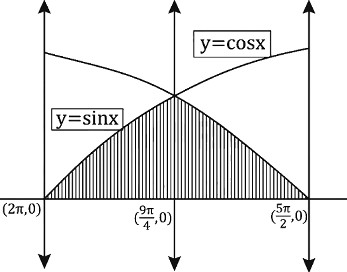
The area of the shaded region bounded by the curves $y = \sin x$, $y = \cos x$ and the $x$-axis between $x = 2\pi$ and $x = \frac{5\pi}{2}$ is ... sq. units.
A
$2 - \sqrt{2}$
B
$2 + \sqrt{2}$
C
$\sqrt{2}$
D
$2$
Solution
(A) The shaded region is bounded by $y = \sin x$ from $x = 2\pi$ to $x = \frac{9\pi}{4}$ and by $y = \cos x$ from $x = \frac{9\pi}{4}$ to $x = \frac{5\pi}{2}$.
The intersection point is where $\sin x = \cos x$, which is $\tan x = 1$, so $x = \frac{9\pi}{4}$.
The area $A$ is given by:
$A = \int_{2\pi}^{9\pi/4} \sin x \, dx + \int_{9\pi/4}^{5\pi/2} \cos x \, dx$
$A = [-\cos x]_{2\pi}^{9\pi/4} + [\sin x]_{9\pi/4}^{5\pi/2}$
$A = -(\cos(9\pi/4) - \cos(2\pi)) + (\sin(5\pi/2) - \sin(9\pi/4))$
$A = -(\frac{1}{\sqrt{2}} - 1) + (1 - \frac{1}{\sqrt{2}})$
$A = 1 - \frac{1}{\sqrt{2}} + 1 - \frac{1}{\sqrt{2}} = 2 - \frac{2}{\sqrt{2}} = 2 - \sqrt{2}$ sq. units.
The intersection point is where $\sin x = \cos x$, which is $\tan x = 1$, so $x = \frac{9\pi}{4}$.
The area $A$ is given by:
$A = \int_{2\pi}^{9\pi/4} \sin x \, dx + \int_{9\pi/4}^{5\pi/2} \cos x \, dx$
$A = [-\cos x]_{2\pi}^{9\pi/4} + [\sin x]_{9\pi/4}^{5\pi/2}$
$A = -(\cos(9\pi/4) - \cos(2\pi)) + (\sin(5\pi/2) - \sin(9\pi/4))$
$A = -(\frac{1}{\sqrt{2}} - 1) + (1 - \frac{1}{\sqrt{2}})$
$A = 1 - \frac{1}{\sqrt{2}} + 1 - \frac{1}{\sqrt{2}} = 2 - \frac{2}{\sqrt{2}} = 2 - \sqrt{2}$ sq. units.
0 likesView Solution
421
MathematicsDifficultMCQMHT CET · 2026
The area bounded by the curve $y = x |\sin(\frac{x}{2})|$ and the $X$-axis between the lines $x = 0$ and $x = 4\pi$ (in square units) is: (in $\pi$)
A
$4$
B
$8$
C
$12$
D
$16$
Solution
(D) The area $A$ is given by $\int_{0}^{4\pi} x |\sin(\frac{x}{2})| dx$.
Since $\sin(\frac{x}{2}) \ge 0$ for $x \in [0, 2\pi]$ and $\sin(\frac{x}{2}) \le 0$ for $x \in [2\pi, 4\pi]$, we have:
$A = \int_{0}^{2\pi} x \sin(\frac{x}{2}) dx + \int_{2\pi}^{4\pi} x (-\sin(\frac{x}{2})) dx$.
Using integration by parts $\int u dv = uv - \int v du$ with $u=x, dv=\sin(\frac{x}{2})dx$:
$\int x \sin(\frac{x}{2}) dx = -2x \cos(\frac{x}{2}) + 4 \sin(\frac{x}{2})$.
Evaluating the first integral: $[-2x \cos(\frac{x}{2}) + 4 \sin(\frac{x}{2})]_{0}^{2\pi} = (-2(2\pi)(-1) + 0) - (0) = 4\pi$.
Evaluating the second integral: $-[-2x \cos(\frac{x}{2}) + 4 \sin(\frac{x}{2})]_{2\pi}^{4\pi} = -[(-2(4\pi)(1) + 0) - (-2(2\pi)(-1) + 0)] = -[-8\pi - 4\pi] = 12\pi$.
Total area $A = 4\pi + 12\pi = 16\pi$ square units.
Since $\sin(\frac{x}{2}) \ge 0$ for $x \in [0, 2\pi]$ and $\sin(\frac{x}{2}) \le 0$ for $x \in [2\pi, 4\pi]$, we have:
$A = \int_{0}^{2\pi} x \sin(\frac{x}{2}) dx + \int_{2\pi}^{4\pi} x (-\sin(\frac{x}{2})) dx$.
Using integration by parts $\int u dv = uv - \int v du$ with $u=x, dv=\sin(\frac{x}{2})dx$:
$\int x \sin(\frac{x}{2}) dx = -2x \cos(\frac{x}{2}) + 4 \sin(\frac{x}{2})$.
Evaluating the first integral: $[-2x \cos(\frac{x}{2}) + 4 \sin(\frac{x}{2})]_{0}^{2\pi} = (-2(2\pi)(-1) + 0) - (0) = 4\pi$.
Evaluating the second integral: $-[-2x \cos(\frac{x}{2}) + 4 \sin(\frac{x}{2})]_{2\pi}^{4\pi} = -[(-2(4\pi)(1) + 0) - (-2(2\pi)(-1) + 0)] = -[-8\pi - 4\pi] = 12\pi$.
Total area $A = 4\pi + 12\pi = 16\pi$ square units.
0 likesView Solution
422
MathematicsDifficultMCQMHT CET · 2026
The area of the region (in sq. units) bounded by the curve $y = 2\sqrt{1 - x^2}$ and the $X$-axis is . . . . . . .
A
$\frac{\pi}{2}$
B
$\frac{\pi^2}{2}$
C
$\pi$
D
$\frac{2\pi}{3}$
Solution
(C) The given equation is $y = 2\sqrt{1 - x^2}$.
Squaring both sides, we get $y^2 = 4(1 - x^2)$, which implies $x^2 + \frac{y^2}{4} = 1$.
This is the equation of an ellipse $\frac{x^2}{a^2} + \frac{y^2}{b^2} = 1$ where $a = 1$ and $b = 2$.
The curve $y = 2\sqrt{1 - x^2}$ represents the upper half of the ellipse.
The area of the full ellipse is $A = \pi ab = \pi(1)(2) = 2\pi$.
The area bounded by the curve and the $X$-axis is the area of the upper half of the ellipse.
Area $= \frac{1}{2} \times 2\pi = \pi \text{ sq. units}$.
Squaring both sides, we get $y^2 = 4(1 - x^2)$, which implies $x^2 + \frac{y^2}{4} = 1$.
This is the equation of an ellipse $\frac{x^2}{a^2} + \frac{y^2}{b^2} = 1$ where $a = 1$ and $b = 2$.
The curve $y = 2\sqrt{1 - x^2}$ represents the upper half of the ellipse.
The area of the full ellipse is $A = \pi ab = \pi(1)(2) = 2\pi$.
The area bounded by the curve and the $X$-axis is the area of the upper half of the ellipse.
Area $= \frac{1}{2} \times 2\pi = \pi \text{ sq. units}$.
0 likesView Solution
423
MathematicsDifficultMCQMHT CET · 2026
The area of the region bounded by the curve $y = x^3$ and the lines $y = 8$ and $x = 0$ is ... square units.
A
$8$
B
$12$
C
$16$
D
$10$
Solution
(B) The region is bounded by $y = x^3$, $y = 8$, and $x = 0$.
Expressing $x$ in terms of $y$, we get $x = y^{1/3}$.
The intersection of $y = x^3$ and $y = 8$ occurs at $x^3 = 8$, which gives $x = 2$.
The area $A$ is given by the integral of $x$ with respect to $y$ from $y = 0$ to $y = 8$:
$A = \int_{0}^{8} y^{1/3} \, dy$
$A = \left[ \frac{y^{4/3}}{4/3} \right]_{0}^{8}$
$A = \frac{3}{4} [8^{4/3} - 0^{4/3}]$
$A = \frac{3}{4} [(2^3)^{4/3}] = \frac{3}{4} [2^4] = \frac{3}{4} \times 16 = 12$ square units.
Expressing $x$ in terms of $y$, we get $x = y^{1/3}$.
The intersection of $y = x^3$ and $y = 8$ occurs at $x^3 = 8$, which gives $x = 2$.
The area $A$ is given by the integral of $x$ with respect to $y$ from $y = 0$ to $y = 8$:
$A = \int_{0}^{8} y^{1/3} \, dy$
$A = \left[ \frac{y^{4/3}}{4/3} \right]_{0}^{8}$
$A = \frac{3}{4} [8^{4/3} - 0^{4/3}]$
$A = \frac{3}{4} [(2^3)^{4/3}] = \frac{3}{4} [2^4] = \frac{3}{4} \times 16 = 12$ square units.
0 likesView Solution
424
MathematicsDifficultMCQMHT CET · 2026
The area of the region bounded by the curve $y = 2^{kx}$ and the lines $x = 0$ and $x = 2$ in the first quadrant is $\frac{2}{\ln 2}$. Find the value of $k$.
A
$1$
B
$2$
C
$\frac{1}{2}$
D
$-\frac{1}{2}$
Solution
(C) The area $A$ is given by the integral $\int_{0}^{2} 2^{kx} dx = \frac{2}{\ln 2}$.
Using the formula $\int a^x dx = \frac{a^x}{\ln a}$, we have $\int_{0}^{2} 2^{kx} dx = \left[ \frac{2^{kx}}{k \ln 2} \right]_{0}^{2}$.
Substituting the limits: $\frac{1}{k \ln 2} (2^{2k} - 2^0) = \frac{2}{\ln 2}$.
$\frac{2^{2k} - 1}{k} = 2$.
$2^{2k} - 1 = 2k$.
By inspection, if $k = 1$, $2^2 - 1 = 3 \neq 2(1)$.
If $k = 1/2$, $2^{2(1/2)} - 1 = 2^1 - 1 = 1$, and $2k = 2(1/2) = 1$.
Since $1 = 1$, the value of $k$ is $\frac{1}{2}$.
Using the formula $\int a^x dx = \frac{a^x}{\ln a}$, we have $\int_{0}^{2} 2^{kx} dx = \left[ \frac{2^{kx}}{k \ln 2} \right]_{0}^{2}$.
Substituting the limits: $\frac{1}{k \ln 2} (2^{2k} - 2^0) = \frac{2}{\ln 2}$.
$\frac{2^{2k} - 1}{k} = 2$.
$2^{2k} - 1 = 2k$.
By inspection, if $k = 1$, $2^2 - 1 = 3 \neq 2(1)$.
If $k = 1/2$, $2^{2(1/2)} - 1 = 2^1 - 1 = 1$, and $2k = 2(1/2) = 1$.
Since $1 = 1$, the value of $k$ is $\frac{1}{2}$.
0 likesView Solution
425
MathematicsDifficultMCQMHT CET · 2026
If the area bounded by the curve $x^2 = by$ and the lines $y = 1, y = 4$ in the first quadrant is $28$ sq. units, then the value of $b$ is...
A
$36$
B
$6$
C
$9$
D
$3$
Solution
(A) The equation of the curve is $x^2 = by$, which implies $x = \sqrt{b} \sqrt{y}$ (since it is in the first quadrant).
The area $A$ is given by the integral of $x$ with respect to $y$ from $y = 1$ to $y = 4$:
$A = \int_{1}^{4} \sqrt{b} \sqrt{y} \, dy = 28$
$\sqrt{b} \int_{1}^{4} y^{1/2} \, dy = 28$
$\sqrt{b} \left[ \frac{y^{3/2}}{3/2} \right]_{1}^{4} = 28$
$\sqrt{b} \cdot \frac{2}{3} [4^{3/2} - 1^{3/2}] = 28$
$\sqrt{b} \cdot \frac{2}{3} [8 - 1] = 28$
$\sqrt{b} \cdot \frac{2}{3} \cdot 7 = 28$
$\sqrt{b} = \frac{28 \cdot 3}{14} = 2 \cdot 3 = 6$
$b = 6^2 = 36$.
The area $A$ is given by the integral of $x$ with respect to $y$ from $y = 1$ to $y = 4$:
$A = \int_{1}^{4} \sqrt{b} \sqrt{y} \, dy = 28$
$\sqrt{b} \int_{1}^{4} y^{1/2} \, dy = 28$
$\sqrt{b} \left[ \frac{y^{3/2}}{3/2} \right]_{1}^{4} = 28$
$\sqrt{b} \cdot \frac{2}{3} [4^{3/2} - 1^{3/2}] = 28$
$\sqrt{b} \cdot \frac{2}{3} [8 - 1] = 28$
$\sqrt{b} \cdot \frac{2}{3} \cdot 7 = 28$
$\sqrt{b} = \frac{28 \cdot 3}{14} = 2 \cdot 3 = 6$
$b = 6^2 = 36$.
0 likesView Solution
426
MathematicsDifficultMCQMHT CET · 2026
The area of the region bounded by the curves $y = |x - 4|$, $x = 3$, $x = 5$, and the $X$-axis is:
A
$5$ sq. units
B
$3$ sq. units
C
$6$ sq. units
D
$1$ sq. unit
Solution
(D) The area $A$ is given by the integral $\int_{3}^{5} |x - 4| \, dx$.
Since $|x - 4| = -(x - 4)$ for $x < 4$ and $|x - 4| = (x - 4)$ for $x \ge 4$, we split the integral:
$A = \int_{3}^{4} -(x - 4) \, dx + \int_{4}^{5} (x - 4) \, dx$.
Evaluating the first part: $\int_{3}^{4} (-x + 4) \, dx = [-\frac{x^2}{2} + 4x]_{3}^{4} = (-8 + 16) - (-4.5 + 12) = 8 - 7.5 = 0.5$.
Evaluating the second part: $\int_{4}^{5} (x - 4) \, dx = [\frac{x^2}{2} - 4x]_{4}^{5} = (12.5 - 20) - (8 - 16) = -7.5 - (-8) = 0.5$.
Total area $A = 0.5 + 0.5 = 1$ sq. unit.
Since $|x - 4| = -(x - 4)$ for $x < 4$ and $|x - 4| = (x - 4)$ for $x \ge 4$, we split the integral:
$A = \int_{3}^{4} -(x - 4) \, dx + \int_{4}^{5} (x - 4) \, dx$.
Evaluating the first part: $\int_{3}^{4} (-x + 4) \, dx = [-\frac{x^2}{2} + 4x]_{3}^{4} = (-8 + 16) - (-4.5 + 12) = 8 - 7.5 = 0.5$.
Evaluating the second part: $\int_{4}^{5} (x - 4) \, dx = [\frac{x^2}{2} - 4x]_{4}^{5} = (12.5 - 20) - (8 - 16) = -7.5 - (-8) = 0.5$.
Total area $A = 0.5 + 0.5 = 1$ sq. unit.
0 likesView Solution
427
MathematicsDifficultMCQMHT CET · 2026
The area of the region bounded by the lines $2x - y + 1 = 0$, $y = -1$, $y = 3$ and the $y$-axis is . . . . . . .
A
$2$
B
$5$
C
$3$
D
$4$
Solution
(A) Step $1$: Express $x$ in terms of $y$ from the equation $2x - y + 1 = 0$. We get $2x = y - 1$, so $x = \frac{y - 1}{2}$.
Step $2$: The area $A$ bounded by the curve $x = f(y)$, the $y$-axis, and the lines $y = c$ and $y = d$ is given by $A = \int_{c}^{d} |x| \, dy$.
Step $3$: Substitute the limits $y = -1$ to $y = 3$: $A = \int_{-1}^{3} |\frac{y - 1}{2}| \, dy$.
Step $4$: The expression $\frac{y - 1}{2}$ changes sign at $y = 1$. Thus, $A = \int_{-1}^{1} -(\frac{y - 1}{2}) \, dy + \int_{1}^{3} (\frac{y - 1}{2}) \, dy$.
Step $5$: Calculate the integrals: $\frac{1}{2} [-( \frac{y^2}{2} - y )]_{-1}^{1} + \frac{1}{2} [ \frac{y^2}{2} - y ]_{1}^{3} = \frac{1}{2} [-( (\frac{1}{2} - 1) - (\frac{1}{2} + 1) )] + \frac{1}{2} [ (\frac{9}{2} - 3) - (\frac{1}{2} - 1) ] = \frac{1}{2} [ -(-\frac{1}{2} - \frac{3}{2}) ] + \frac{1}{2} [ \frac{3}{2} - (-\frac{1}{2}) ] = \frac{1}{2} [2] + \frac{1}{2} [2] = 1 + 1 = 2$ square units.
Step $2$: The area $A$ bounded by the curve $x = f(y)$, the $y$-axis, and the lines $y = c$ and $y = d$ is given by $A = \int_{c}^{d} |x| \, dy$.
Step $3$: Substitute the limits $y = -1$ to $y = 3$: $A = \int_{-1}^{3} |\frac{y - 1}{2}| \, dy$.
Step $4$: The expression $\frac{y - 1}{2}$ changes sign at $y = 1$. Thus, $A = \int_{-1}^{1} -(\frac{y - 1}{2}) \, dy + \int_{1}^{3} (\frac{y - 1}{2}) \, dy$.
Step $5$: Calculate the integrals: $\frac{1}{2} [-( \frac{y^2}{2} - y )]_{-1}^{1} + \frac{1}{2} [ \frac{y^2}{2} - y ]_{1}^{3} = \frac{1}{2} [-( (\frac{1}{2} - 1) - (\frac{1}{2} + 1) )] + \frac{1}{2} [ (\frac{9}{2} - 3) - (\frac{1}{2} - 1) ] = \frac{1}{2} [ -(-\frac{1}{2} - \frac{3}{2}) ] + \frac{1}{2} [ \frac{3}{2} - (-\frac{1}{2}) ] = \frac{1}{2} [2] + \frac{1}{2} [2] = 1 + 1 = 2$ square units.
0 likesView Solution
428
MathematicsDifficultMCQMHT CET · 2026
The area (in square units) bounded by the line $y = x$, the $X$-axis and the lines $x = -2$ and $x = 4$ is...
A
$6$
B
$\frac{15}{2}$
C
$\frac{17}{2}$
D
$10$
Solution
(D) The area $A$ is given by the integral of $|y|$ with respect to $x$ from $x = -2$ to $x = 4$.
$A = \int_{-2}^{4} |x| \, dx$
Since $|x| = -x$ for $x < 0$ and $|x| = x$ for $x \ge 0$, we split the integral:
$A = \int_{-2}^{0} (-x) \, dx + \int_{0}^{4} x \, dx$
$A = \left[ -\frac{x^2}{2} \right]_{-2}^{0} + \left[ \frac{x^2}{2} \right]_{0}^{4}$
$A = (0 - (-\frac{(-2)^2}{2})) + (\frac{4^2}{2} - 0)$
$A = (0 - (-2)) + (8 - 0)$
$A = 2 + 8 = 10 \text{ square units}$.
$A = \int_{-2}^{4} |x| \, dx$
Since $|x| = -x$ for $x < 0$ and $|x| = x$ for $x \ge 0$, we split the integral:
$A = \int_{-2}^{0} (-x) \, dx + \int_{0}^{4} x \, dx$
$A = \left[ -\frac{x^2}{2} \right]_{-2}^{0} + \left[ \frac{x^2}{2} \right]_{0}^{4}$
$A = (0 - (-\frac{(-2)^2}{2})) + (\frac{4^2}{2} - 0)$
$A = (0 - (-2)) + (8 - 0)$
$A = 2 + 8 = 10 \text{ square units}$.
0 likesView Solution
429
MathematicsDifficultMCQMHT CET · 2026
If the area bounded by the curve $y = x^3 + ax$ (where $a > 0$), the $x$-axis, and the lines $x = -2$ and $x = 1$ is $\frac{37}{4}$ square units, find the value of $a$.
A
$a = 4$
B
$a = 2$
C
$a = 10$
D
$a = 20$
Solution
(B) The area $A$ is given by $\int_{-2}^{1} |x^3 + ax| \, dx$.
Since $y = x^3 + ax = x(x^2 + a)$, and $a > 0$, the curve crosses the $x$-axis only at $x = 0$ in the interval $[-2, 1]$.
For $x \in [-2, 0]$, $x^3 + ax \le 0$, so $|x^3 + ax| = -(x^3 + ax)$.
For $x \in [0, 1]$, $x^3 + ax \ge 0$, so $|x^3 + ax| = x^3 + ax$.
Area $= \int_{-2}^{0} -(x^3 + ax) \, dx + \int_{0}^{1} (x^3 + ax) \, dx = \frac{37}{4}$.
Evaluating the integrals: $-[\frac{x^4}{4} + \frac{ax^2}{2}]_{-2}^{0} + [\frac{x^4}{4} + \frac{ax^2}{2}]_{0}^{1} = \frac{37}{4}$.
$-(0 - (4 + 2a)) + (\frac{1}{4} + \frac{a}{2}) = \frac{37}{4}$.
$4 + 2a + \frac{1}{4} + \frac{a}{2} = \frac{37}{4}$.
$\frac{5a}{2} = \frac{37}{4} - \frac{17}{4} = \frac{20}{4} = 5$.
$a = 2$.
Since $y = x^3 + ax = x(x^2 + a)$, and $a > 0$, the curve crosses the $x$-axis only at $x = 0$ in the interval $[-2, 1]$.
For $x \in [-2, 0]$, $x^3 + ax \le 0$, so $|x^3 + ax| = -(x^3 + ax)$.
For $x \in [0, 1]$, $x^3 + ax \ge 0$, so $|x^3 + ax| = x^3 + ax$.
Area $= \int_{-2}^{0} -(x^3 + ax) \, dx + \int_{0}^{1} (x^3 + ax) \, dx = \frac{37}{4}$.
Evaluating the integrals: $-[\frac{x^4}{4} + \frac{ax^2}{2}]_{-2}^{0} + [\frac{x^4}{4} + \frac{ax^2}{2}]_{0}^{1} = \frac{37}{4}$.
$-(0 - (4 + 2a)) + (\frac{1}{4} + \frac{a}{2}) = \frac{37}{4}$.
$4 + 2a + \frac{1}{4} + \frac{a}{2} = \frac{37}{4}$.
$\frac{5a}{2} = \frac{37}{4} - \frac{17}{4} = \frac{20}{4} = 5$.
$a = 2$.
0 likesView Solution
430
MathematicsDifficultMCQMHT CET · 2026
If the area of the region bounded by the parabola $y^2 = 4kx$ and the line $x = k$ (where $k > 0$) is $\frac{128}{3} \text{ sq. units}$, then the value of $\sin^{-1}(\frac{2}{k})$ is equal to...
A
$\frac{\pi}{4}$
B
$\frac{\pi}{6}$
C
$\frac{\pi}{3}$
D
$\frac{\pi}{2}$
Solution
(B) The area $A$ bounded by the parabola $y^2 = 4kx$ and the line $x = k$ is given by $A = 2 \int_{0}^{k} \sqrt{4kx} \, dx$.
$A = 2 \cdot 2\sqrt{k} \int_{0}^{k} x^{1/2} \, dx = 4\sqrt{k} \left[ \frac{x^{3/2}}{3/2} \right]_{0}^{k}$.
$A = 4\sqrt{k} \cdot \frac{2}{3} k^{3/2} = \frac{8}{3} k^2$.
Given $A = \frac{128}{3}$, so $\frac{8}{3} k^2 = \frac{128}{3}$.
$8k^2 = 128 \implies k^2 = 16 \implies k = 4$ (since $k > 0$).
We need to find $\sin^{-1}(\frac{2}{k}) = \sin^{-1}(\frac{2}{4}) = \sin^{-1}(\frac{1}{2})$.
$\sin^{-1}(\frac{1}{2}) = \frac{\pi}{6}$.
$A = 2 \cdot 2\sqrt{k} \int_{0}^{k} x^{1/2} \, dx = 4\sqrt{k} \left[ \frac{x^{3/2}}{3/2} \right]_{0}^{k}$.
$A = 4\sqrt{k} \cdot \frac{2}{3} k^{3/2} = \frac{8}{3} k^2$.
Given $A = \frac{128}{3}$, so $\frac{8}{3} k^2 = \frac{128}{3}$.
$8k^2 = 128 \implies k^2 = 16 \implies k = 4$ (since $k > 0$).
We need to find $\sin^{-1}(\frac{2}{k}) = \sin^{-1}(\frac{2}{4}) = \sin^{-1}(\frac{1}{2})$.
$\sin^{-1}(\frac{1}{2}) = \frac{\pi}{6}$.
0 likesView Solution
431
MathematicsDifficultMCQMHT CET · 2026
The area (in sq. units) of the region bounded by the curve $y = 2x - x^2$ and the $X$-axis is...
A
$\frac{4}{3}$
B
$\frac{8}{3}$
C
$\frac{20}{3}$
D
$\frac{2}{3}$
Solution
(A) Step $1$: Find the points of intersection with the $X$-axis by setting $y = 0$.
$2x - x^2 = 0 \implies x(2 - x) = 0$.
So, $x = 0$ and $x = 2$.
Step $2$: The area $A$ is given by the integral $\int_{0}^{2} (2x - x^2) \, dx$.
Step $3$: Evaluate the integral: $\left[ x^2 - \frac{x^3}{3} \right]_{0}^{2}$.
Step $4$: Substitute the limits: $\left( 2^2 - \frac{2^3}{3} \right) - (0 - 0) = 4 - \frac{8}{3} = \frac{12 - 8}{3} = \frac{4}{3} \text{ sq. units}$.
$2x - x^2 = 0 \implies x(2 - x) = 0$.
So, $x = 0$ and $x = 2$.
Step $2$: The area $A$ is given by the integral $\int_{0}^{2} (2x - x^2) \, dx$.
Step $3$: Evaluate the integral: $\left[ x^2 - \frac{x^3}{3} \right]_{0}^{2}$.
Step $4$: Substitute the limits: $\left( 2^2 - \frac{2^3}{3} \right) - (0 - 0) = 4 - \frac{8}{3} = \frac{12 - 8}{3} = \frac{4}{3} \text{ sq. units}$.
0 likesView Solution
432
MathematicsDifficultMCQMHT CET · 2026
The area of the region lying in the first quadrant and bounded by the curve $y = 4x^2$, the $Y$-axis, and the lines $y = 2$ and $y = 4$ is:
A
$\frac{1}{3}[8 - 2\sqrt{2}]$ sq. units
B
$\frac{1}{3}[8 + 2\sqrt{2}]$ sq. units
C
$\frac{1}{2}[8 - 2\sqrt{2}]$ sq. units
D
$\frac{1}{2}[8 + 2\sqrt{2}]$ sq. units
Solution
(A) Given the curve $y = 4x^2$, we express $x$ in terms of $y$ as $x = \sqrt{\frac{y}{4}} = \frac{\sqrt{y}}{2}$.
The area $A$ in the first quadrant bounded by the $Y$-axis and the lines $y = 2$ and $y = 4$ is given by the integral:
$A = \int_{2}^{4} x \, dy = \int_{2}^{4} \frac{\sqrt{y}}{2} \, dy$.
$A = \frac{1}{2} \int_{2}^{4} y^{1/2} \, dy = \frac{1}{2} \left[ \frac{y^{3/2}}{3/2} \right]_{2}^{4} = \frac{1}{2} \cdot \frac{2}{3} [y^{3/2}]_{2}^{4}$.
$A = \frac{1}{3} [4^{3/2} - 2^{3/2}] = \frac{1}{3} [8 - 2\sqrt{2}]$ sq. units.
The area $A$ in the first quadrant bounded by the $Y$-axis and the lines $y = 2$ and $y = 4$ is given by the integral:
$A = \int_{2}^{4} x \, dy = \int_{2}^{4} \frac{\sqrt{y}}{2} \, dy$.
$A = \frac{1}{2} \int_{2}^{4} y^{1/2} \, dy = \frac{1}{2} \left[ \frac{y^{3/2}}{3/2} \right]_{2}^{4} = \frac{1}{2} \cdot \frac{2}{3} [y^{3/2}]_{2}^{4}$.
$A = \frac{1}{3} [4^{3/2} - 2^{3/2}] = \frac{1}{3} [8 - 2\sqrt{2}]$ sq. units.
0 likesView Solution
433
MathematicsDifficultMCQMHT CET · 2026
The area in square units of the region bounded by the curve $y = \sqrt{16 - x^2}$ and the lines $x = 0, x = 4$ above the $X$-axis is: (in $\pi$)
A
$16$
B
$12$
C
$8$
D
$4$
Solution
(D) The given curve is $y = \sqrt{16 - x^2}$, which represents the upper semi-circle of $x^2 + y^2 = 4^2$ with radius $r = 4$.
We need to find the area bounded by $x = 0$ and $x = 4$ above the $X$-axis.
This region represents one-quarter of the circle with radius $r = 4$.
The area of a full circle is $A = \pi r^2 = \pi(4)^2 = 16\pi$.
The area of the required region is $\frac{1}{4} \times 16\pi = 4\pi$ square units.
We need to find the area bounded by $x = 0$ and $x = 4$ above the $X$-axis.
This region represents one-quarter of the circle with radius $r = 4$.
The area of a full circle is $A = \pi r^2 = \pi(4)^2 = 16\pi$.
The area of the required region is $\frac{1}{4} \times 16\pi = 4\pi$ square units.
0 likesView Solution
434
MathematicsDifficultMCQMHT CET · 2026
$A$ spherical raindrop evaporates at a rate proportional to its surface area. The differential equation involving the rate of change of its radius $r$ with time $t$ is ... (where $k$ is a positive constant)
A
$\frac{dr}{dt} + k = 0$
B
$\frac{dr}{dt} - k = 0$
C
$\frac{dr}{dt} + kr = 0$
D
$\frac{dr}{dt} - kr = 0$
Solution
(A) Let $V$ be the volume and $S$ be the surface area of the spherical raindrop.
$V = \frac{4}{3} \pi r^3$ and $S = 4 \pi r^2$.
The rate of evaporation is the rate of change of volume, $\frac{dV}{dt}$.
Given $\frac{dV}{dt} \propto -S$, so $\frac{dV}{dt} = -k' S$ (where $k' > 0$ is a constant).
Differentiating $V$ with respect to $t$: $\frac{dV}{dt} = \frac{d}{dt} (\frac{4}{3} \pi r^3) = 4 \pi r^2 \frac{dr}{dt}$.
Equating the two expressions for $\frac{dV}{dt}$:
$4 \pi r^2 \frac{dr}{dt} = -k' (4 \pi r^2)$.
Dividing both sides by $4 \pi r^2$:
$\frac{dr}{dt} = -k'$.
Rearranging gives $\frac{dr}{dt} + k' = 0$. Since $k'$ is a positive constant, we can write it as $k$.
Thus, $\frac{dr}{dt} + k = 0$.
$V = \frac{4}{3} \pi r^3$ and $S = 4 \pi r^2$.
The rate of evaporation is the rate of change of volume, $\frac{dV}{dt}$.
Given $\frac{dV}{dt} \propto -S$, so $\frac{dV}{dt} = -k' S$ (where $k' > 0$ is a constant).
Differentiating $V$ with respect to $t$: $\frac{dV}{dt} = \frac{d}{dt} (\frac{4}{3} \pi r^3) = 4 \pi r^2 \frac{dr}{dt}$.
Equating the two expressions for $\frac{dV}{dt}$:
$4 \pi r^2 \frac{dr}{dt} = -k' (4 \pi r^2)$.
Dividing both sides by $4 \pi r^2$:
$\frac{dr}{dt} = -k'$.
Rearranging gives $\frac{dr}{dt} + k' = 0$. Since $k'$ is a positive constant, we can write it as $k$.
Thus, $\frac{dr}{dt} + k = 0$.
0 likesView Solution
435
MathematicsDifficultMCQMHT CET · 2026
The solution of the differential equation $\frac{dy}{dx} = \frac{a + bx}{c + dy}$ represents a family of circles centered at the origin if...
A
$a = c = 0, b + d = 0$
B
$a = c = 0, b = d$
C
$b = d = 0, a + c = 0$
D
$b = d = 0, a = c$
Solution
(A) Step $1$: Rewrite the differential equation as $(c + dy) dy = (a + bx) dx$.
Step $2$: Integrate both sides: $\int (c + dy) dy = \int (a + bx) dx$.
Step $3$: This gives $cy + \frac{d}{2} y^2 = ax + \frac{b}{2} x^2 + C$.
Step $4$: Rearrange the terms: $\frac{b}{2} x^2 - \frac{d}{2} y^2 - ax + cy + C = 0$.
Step $5$: For this to represent a circle centered at the origin, the coefficients of $x^2$ and $y^2$ must be equal, and the coefficients of $x$ and $y$ must be zero.
Step $6$: Thus, $a = 0$, $c = 0$, and $\frac{b}{2} = -\frac{d}{2}$, which implies $b = -d$ or $b + d = 0$.
Step $2$: Integrate both sides: $\int (c + dy) dy = \int (a + bx) dx$.
Step $3$: This gives $cy + \frac{d}{2} y^2 = ax + \frac{b}{2} x^2 + C$.
Step $4$: Rearrange the terms: $\frac{b}{2} x^2 - \frac{d}{2} y^2 - ax + cy + C = 0$.
Step $5$: For this to represent a circle centered at the origin, the coefficients of $x^2$ and $y^2$ must be equal, and the coefficients of $x$ and $y$ must be zero.
Step $6$: Thus, $a = 0$, $c = 0$, and $\frac{b}{2} = -\frac{d}{2}$, which implies $b = -d$ or $b + d = 0$.
0 likesView Solution
436
MathematicsDifficultMCQMHT CET · 2026
The solution of the differential equation $x \frac{dy}{dx} + y = x^3y^6$ is:
A
$y^{-5} = \frac{5}{2}x^{-3} + cx^5$
B
$y^{-5} = \frac{5}{2}x^3 + cx^5$
C
$y^{-5} = -\frac{5}{2}x^3 + cx^5$
D
$y^{-5} = -\frac{5}{2}x^{-3} + cx^5$
Solution
(B) Step $1$: Divide the equation by $xy^6$ to get $\frac{1}{y^6} \frac{dy}{dx} + \frac{1}{xy^5} = x^2$.
Step $2$: Let $v = y^{-5}$, then $\frac{dv}{dx} = -5y^{-6} \frac{dy}{dx}$, which implies $\frac{1}{y^6} \frac{dy}{dx} = -\frac{1}{5} \frac{dv}{dx}$.
Step $3$: Substitute into the equation: $-\frac{1}{5} \frac{dv}{dx} + \frac{v}{x} = x^2$, which simplifies to $\frac{dv}{dx} - \frac{5}{x}v = -5x^2$.
Step $4$: The integrating factor is $IF = e^{\int -\frac{5}{x} dx} = e^{-5 \ln x} = x^{-5}$.
Step $5$: The solution is $v \cdot x^{-5} = \int (-5x^2) \cdot x^{-5} dx = \int -5x^{-3} dx = -5 \frac{x^{-2}}{-2} + c = \frac{5}{2}x^{-2} + c$.
Step $6$: Multiplying by $x^5$, we get $v = \frac{5}{2}x^3 + cx^5$, so $y^{-5} = \frac{5}{2}x^3 + cx^5$.
Step $2$: Let $v = y^{-5}$, then $\frac{dv}{dx} = -5y^{-6} \frac{dy}{dx}$, which implies $\frac{1}{y^6} \frac{dy}{dx} = -\frac{1}{5} \frac{dv}{dx}$.
Step $3$: Substitute into the equation: $-\frac{1}{5} \frac{dv}{dx} + \frac{v}{x} = x^2$, which simplifies to $\frac{dv}{dx} - \frac{5}{x}v = -5x^2$.
Step $4$: The integrating factor is $IF = e^{\int -\frac{5}{x} dx} = e^{-5 \ln x} = x^{-5}$.
Step $5$: The solution is $v \cdot x^{-5} = \int (-5x^2) \cdot x^{-5} dx = \int -5x^{-3} dx = -5 \frac{x^{-2}}{-2} + c = \frac{5}{2}x^{-2} + c$.
Step $6$: Multiplying by $x^5$, we get $v = \frac{5}{2}x^3 + cx^5$, so $y^{-5} = \frac{5}{2}x^3 + cx^5$.
0 likesView Solution
437
MathematicsDifficultMCQMHT CET · 2026
The solution of the differential equation $2x \frac{dy}{dx} - y = 3$ represents a family of
A
straight lines
B
circles
C
parabolas
D
ellipses
Solution
(C) Given differential equation: $2x \frac{dy}{dx} - y = 3$
Rearranging the terms: $2x \frac{dy}{dx} = y + 3$
Separating the variables: $\frac{dy}{y + 3} = \frac{dx}{2x}$
Integrating both sides: $\int \frac{dy}{y + 3} = \int \frac{dx}{2x}$
$\ln|y + 3| = \frac{1}{2} \ln|x| + C$
Multiply by $2$: $2 \ln|y + 3| = \ln|x| + 2C$
$\ln(y + 3)^2 = \ln|x| + C'$
$(y + 3)^2 = kx$, where $k = e^{C'}$
This equation is of the form $(y - k_1)^2 = 4a(x - k_2)$, which represents a family of parabolas.
Rearranging the terms: $2x \frac{dy}{dx} = y + 3$
Separating the variables: $\frac{dy}{y + 3} = \frac{dx}{2x}$
Integrating both sides: $\int \frac{dy}{y + 3} = \int \frac{dx}{2x}$
$\ln|y + 3| = \frac{1}{2} \ln|x| + C$
Multiply by $2$: $2 \ln|y + 3| = \ln|x| + 2C$
$\ln(y + 3)^2 = \ln|x| + C'$
$(y + 3)^2 = kx$, where $k = e^{C'}$
This equation is of the form $(y - k_1)^2 = 4a(x - k_2)$, which represents a family of parabolas.
0 likesView Solution
438
MathematicsDifficultMCQMHT CET · 2026
The general solution of the differential equation $(x + y) \frac{dy}{dx} = 1$ is
A
$x + y + 1 = ce^y$, where $c$ is a constant of integration
B
$x + y + 1 = ce^{-y}$, where $c$ is a constant of integration
C
$x + y - 1 = ce^y$, where $c$ is a constant of integration
D
$x + y + 1 = ce^y$, where $c$ is a constant of integration
Solution
(A) Given: $(x + y) \frac{dy}{dx} = 1$.
Rewrite as: $\frac{dx}{dy} = x + y$.
This is a linear differential equation of the form $\frac{dx}{dy} - x = y$.
Here, $P = -1$ and $Q = y$.
The integrating factor $IF = e^{\int P dy} = e^{\int -1 dy} = e^{-y}$.
The solution is given by $x \cdot IF = \int (Q \cdot IF) dy + c$.
$x e^{-y} = \int y e^{-y} dy + c$.
Using integration by parts: $\int y e^{-y} dy = y(-e^{-y}) - \int 1(-e^{-y}) dy = -y e^{-y} - e^{-y}$.
So, $x e^{-y} = -y e^{-y} - e^{-y} + c$.
Multiply by $e^y$: $x = -y - 1 + ce^y$.
Rearranging gives: $x + y + 1 = ce^y$.
Rewrite as: $\frac{dx}{dy} = x + y$.
This is a linear differential equation of the form $\frac{dx}{dy} - x = y$.
Here, $P = -1$ and $Q = y$.
The integrating factor $IF = e^{\int P dy} = e^{\int -1 dy} = e^{-y}$.
The solution is given by $x \cdot IF = \int (Q \cdot IF) dy + c$.
$x e^{-y} = \int y e^{-y} dy + c$.
Using integration by parts: $\int y e^{-y} dy = y(-e^{-y}) - \int 1(-e^{-y}) dy = -y e^{-y} - e^{-y}$.
So, $x e^{-y} = -y e^{-y} - e^{-y} + c$.
Multiply by $e^y$: $x = -y - 1 + ce^y$.
Rearranging gives: $x + y + 1 = ce^y$.
0 likesView Solution
439
MathematicsDifficultMCQMHT CET · 2026
The solution of the differential equation $x^2 \frac{dy}{dx} - xy = 1$ is...
A
$2xy - 2cx^2 - 1 = 0$
B
$2xy + 2cx^2 + 1 = 0$
C
$2xy - 2cx^2 + 1 = 0$
D
$2x^2y - 2cx + 1 = 0$
Solution
(C) Step $1$: Rewrite the differential equation in the standard linear form $\frac{dy}{dx} + P(x)y = Q(x)$.
Divide by $x^2$: $\frac{dy}{dx} - \frac{1}{x}y = \frac{1}{x^2}$.
Step $2$: Find the integrating factor $IF = e^{\int P(x) dx} = e^{\int -\frac{1}{x} dx} = e^{-\ln|x|} = \frac{1}{x}$.
Step $3$: Multiply the equation by $IF$ and integrate: $\frac{1}{x} \frac{dy}{dx} - \frac{1}{x^2} y = \frac{1}{x^3}$.
This is $\frac{d}{dx} (y \cdot \frac{1}{x}) = x^{-3}$.
Step $4$: Integrate both sides: $y \cdot \frac{1}{x} = \int x^{-3} dx = \frac{x^{-2}}{-2} + c = -\frac{1}{2x^2} + c$.
Step $5$: Multiply by $2x^2$: $2xy = -1 + 2cx^2$, which rearranges to $2xy - 2cx^2 + 1 = 0$.
Divide by $x^2$: $\frac{dy}{dx} - \frac{1}{x}y = \frac{1}{x^2}$.
Step $2$: Find the integrating factor $IF = e^{\int P(x) dx} = e^{\int -\frac{1}{x} dx} = e^{-\ln|x|} = \frac{1}{x}$.
Step $3$: Multiply the equation by $IF$ and integrate: $\frac{1}{x} \frac{dy}{dx} - \frac{1}{x^2} y = \frac{1}{x^3}$.
This is $\frac{d}{dx} (y \cdot \frac{1}{x}) = x^{-3}$.
Step $4$: Integrate both sides: $y \cdot \frac{1}{x} = \int x^{-3} dx = \frac{x^{-2}}{-2} + c = -\frac{1}{2x^2} + c$.
Step $5$: Multiply by $2x^2$: $2xy = -1 + 2cx^2$, which rearranges to $2xy - 2cx^2 + 1 = 0$.
0 likesView Solution
440
MathematicsDifficultMCQMHT CET · 2026
The solution of the differential equation $(x + 2y^3) \frac{dy}{dx} - y = 0$ is
A
$x = (c + y^2)y$, where $c$ is the constant of integration
B
$y = (c + y^2)x$, where $c$ is the constant of integration
C
$x = (c + y)y$, where $c$ is the constant of integration
D
$x = (c + y^2)y^2$, where $c$ is the constant of integration
Solution
(A) Given equation: $(x + 2y^3) \frac{dy}{dx} - y = 0$
Rearranging the equation: $(x + 2y^3) = y \frac{dx}{dy}$
$\frac{dx}{dy} = \frac{x + 2y^3}{y} = \frac{x}{y} + 2y^2$
$\frac{dx}{dy} - \frac{1}{y} x = 2y^2$
This is a linear differential equation of the form $\frac{dx}{dy} + Px = Q$, where $P = -\frac{1}{y}$ and $Q = 2y^2$.
Integrating factor $IF = e^{\int P dy} = e^{\int -\frac{1}{y} dy} = e^{-\ln y} = \frac{1}{y}$.
The solution is $x \cdot IF = \int (Q \cdot IF) dy + c$.
$x \cdot \frac{1}{y} = \int (2y^2 \cdot \frac{1}{y}) dy + c$
$\frac{x}{y} = \int 2y dy + c$
$\frac{x}{y} = y^2 + c$
$x = y(y^2 + c) = (c + y^2)y$.
Rearranging the equation: $(x + 2y^3) = y \frac{dx}{dy}$
$\frac{dx}{dy} = \frac{x + 2y^3}{y} = \frac{x}{y} + 2y^2$
$\frac{dx}{dy} - \frac{1}{y} x = 2y^2$
This is a linear differential equation of the form $\frac{dx}{dy} + Px = Q$, where $P = -\frac{1}{y}$ and $Q = 2y^2$.
Integrating factor $IF = e^{\int P dy} = e^{\int -\frac{1}{y} dy} = e^{-\ln y} = \frac{1}{y}$.
The solution is $x \cdot IF = \int (Q \cdot IF) dy + c$.
$x \cdot \frac{1}{y} = \int (2y^2 \cdot \frac{1}{y}) dy + c$
$\frac{x}{y} = \int 2y dy + c$
$\frac{x}{y} = y^2 + c$
$x = y(y^2 + c) = (c + y^2)y$.
0 likesView Solution
441
MathematicsDifficultMCQMHT CET · 2026
The integrating factor of the differential equation $(1 + t^2) + (x - e^{\tan^{-1} t}) \frac{dt}{dx} = 0$ is
A
$e^{\tan^{-1} t}$
B
$e^{-\tan^{-1} t}$
C
$e^{\tan^{-1} t}$
D
$e^{-\tan^{-1} t}$
Solution
(A) The given differential equation is $(1 + t^2) + (x - e^{\tan^{-1} t}) \frac{dt}{dx} = 0$.
Rearranging the terms, we get $(x - e^{\tan^{-1} t}) \frac{dt}{dx} = -(1 + t^2)$.
Taking the reciprocal, $\frac{dx}{dt} = -\frac{x - e^{\tan^{-1} t}}{1 + t^2} = -\frac{x}{1 + t^2} + \frac{e^{\tan^{-1} t}}{1 + t^2}$.
This can be written as $\frac{dx}{dt} + \frac{1}{1 + t^2} x = \frac{e^{\tan^{-1} t}}{1 + t^2}$.
This is a linear differential equation of the form $\frac{dx}{dt} + P(t)x = Q(t)$, where $P(t) = \frac{1}{1 + t^2}$.
The integrating factor $(IF)$ is given by $e^{\int P(t) dt} = e^{\int \frac{1}{1 + t^2} dt} = e^{\tan^{-1} t}$.
Rearranging the terms, we get $(x - e^{\tan^{-1} t}) \frac{dt}{dx} = -(1 + t^2)$.
Taking the reciprocal, $\frac{dx}{dt} = -\frac{x - e^{\tan^{-1} t}}{1 + t^2} = -\frac{x}{1 + t^2} + \frac{e^{\tan^{-1} t}}{1 + t^2}$.
This can be written as $\frac{dx}{dt} + \frac{1}{1 + t^2} x = \frac{e^{\tan^{-1} t}}{1 + t^2}$.
This is a linear differential equation of the form $\frac{dx}{dt} + P(t)x = Q(t)$, where $P(t) = \frac{1}{1 + t^2}$.
The integrating factor $(IF)$ is given by $e^{\int P(t) dt} = e^{\int \frac{1}{1 + t^2} dt} = e^{\tan^{-1} t}$.
0 likesView Solution
442
MathematicsDifficultMCQMHT CET · 2026
If $y = e^{-mx}$ is a solution of the differential equation $\frac{d^2y}{dx^2} + 4\frac{dy}{dx} + 3y = 0$, then the values of $m$ are
A
$1, 3$
B
$-1, 3$
C
$-1, -3$
D
$1, -3$
Solution
(A) Given $y = e^{-mx}$.
First derivative: $\frac{dy}{dx} = -m e^{-mx}$.
Second derivative: $\frac{d^2y}{dx^2} = m^2 e^{-mx}$.
Substitute these into the differential equation: $m^2 e^{-mx} + 4(-m e^{-mx}) + 3(e^{-mx}) = 0$.
Factor out $e^{-mx}$: $e^{-mx}(m^2 - 4m + 3) = 0$.
Since $e^{-mx} \neq 0$, we have $m^2 - 4m + 3 = 0$.
Factor the quadratic: $(m - 1)(m - 3) = 0$.
Thus, $m = 1$ or $m = 3$.
First derivative: $\frac{dy}{dx} = -m e^{-mx}$.
Second derivative: $\frac{d^2y}{dx^2} = m^2 e^{-mx}$.
Substitute these into the differential equation: $m^2 e^{-mx} + 4(-m e^{-mx}) + 3(e^{-mx}) = 0$.
Factor out $e^{-mx}$: $e^{-mx}(m^2 - 4m + 3) = 0$.
Since $e^{-mx} \neq 0$, we have $m^2 - 4m + 3 = 0$.
Factor the quadratic: $(m - 1)(m - 3) = 0$.
Thus, $m = 1$ or $m = 3$.
0 likesView Solution
443
MathematicsDifficultMCQMHT CET · 2026
The general solution of the differential equation $\sec y + (x - e^{\sin y}) \frac{dy}{dx} = 0$ is...
A
$e^{\sin y} = x + c$
B
$x e^{\sin y} = \frac{e^{2 \sin y}}{2} + c$
C
$2x \cos y = e^x + c$
D
$x \sin y - e^{\sin y} = c$
Solution
(B) Given: $\sec y + (x - e^{\sin y}) \frac{dy}{dx} = 0$
Rearranging the equation: $(e^{\sin y} - x) \frac{dy}{dx} = \sec y$
$\frac{dx}{dy} = \frac{e^{\sin y} - x}{\sec y} = (e^{\sin y} - x) \cos y$
$\frac{dx}{dy} + x \cos y = e^{\sin y} \cos y$
This is a linear differential equation of the form $\frac{dx}{dy} + Px = Q$, where $P = \cos y$ and $Q = e^{\sin y} \cos y$.
Integrating factor $IF = e^{\int P dy} = e^{\int \cos y dy} = e^{\sin y}$.
The solution is $x \cdot IF = \int (Q \cdot IF) dy + c$.
$x e^{\sin y} = \int (e^{\sin y} \cos y \cdot e^{\sin y}) dy + c$.
Let $u = \sin y$, then $du = \cos y dy$.
$x e^{\sin y} = \int e^{2u} du + c = \frac{e^{2u}}{2} + c$.
$x e^{\sin y} = \frac{e^{2 \sin y}}{2} + c$.
Rearranging the equation: $(e^{\sin y} - x) \frac{dy}{dx} = \sec y$
$\frac{dx}{dy} = \frac{e^{\sin y} - x}{\sec y} = (e^{\sin y} - x) \cos y$
$\frac{dx}{dy} + x \cos y = e^{\sin y} \cos y$
This is a linear differential equation of the form $\frac{dx}{dy} + Px = Q$, where $P = \cos y$ and $Q = e^{\sin y} \cos y$.
Integrating factor $IF = e^{\int P dy} = e^{\int \cos y dy} = e^{\sin y}$.
The solution is $x \cdot IF = \int (Q \cdot IF) dy + c$.
$x e^{\sin y} = \int (e^{\sin y} \cos y \cdot e^{\sin y}) dy + c$.
Let $u = \sin y$, then $du = \cos y dy$.
$x e^{\sin y} = \int e^{2u} du + c = \frac{e^{2u}}{2} + c$.
$x e^{\sin y} = \frac{e^{2 \sin y}}{2} + c$.
0 likesView Solution
444
MathematicsDifficultMCQMHT CET · 2026
The general solution of the differential equation $x \sin x \frac{dy}{dx} + (x \cos x + \sin x)y = \sin x$ is
A
$x \sin x + y \cos x = c$
B
$y \sin x + x \cos x = c$
C
$xy \sin x - \cos x = c$
D
$xy \sin x + \cos x = c$
Solution
(D) Step $1$: Divide the equation by $x \sin x$ to get the standard linear form $\frac{dy}{dx} + P(x)y = Q(x)$.
$\frac{dy}{dx} + \frac{x \cos x + \sin x}{x \sin x} y = \frac{1}{x}$.
Step $2$: Identify $P(x) = \frac{x \cos x + \sin x}{x \sin x} = \cot x + \frac{1}{x}$.
Step $3$: Find the integrating factor $IF = e^{\int P(x) dx} = e^{\int (\cot x + \frac{1}{x}) dx} = e^{\ln |\sin x| + \ln |x|} = e^{\ln |x \sin x|} = x \sin x$.
Step $4$: The solution is $y \cdot IF = \int Q(x) \cdot IF dx$.
$y(x \sin x) = \int \frac{1}{x} (x \sin x) dx = \int \sin x dx$.
$xy \sin x = -\cos x + c$.
$xy \sin x + \cos x = c$.
$\frac{dy}{dx} + \frac{x \cos x + \sin x}{x \sin x} y = \frac{1}{x}$.
Step $2$: Identify $P(x) = \frac{x \cos x + \sin x}{x \sin x} = \cot x + \frac{1}{x}$.
Step $3$: Find the integrating factor $IF = e^{\int P(x) dx} = e^{\int (\cot x + \frac{1}{x}) dx} = e^{\ln |\sin x| + \ln |x|} = e^{\ln |x \sin x|} = x \sin x$.
Step $4$: The solution is $y \cdot IF = \int Q(x) \cdot IF dx$.
$y(x \sin x) = \int \frac{1}{x} (x \sin x) dx = \int \sin x dx$.
$xy \sin x = -\cos x + c$.
$xy \sin x + \cos x = c$.
0 likesView Solution
445
MathematicsDifficultMCQMHT CET · 2026
The integrating factor of the differential equation $x \frac{dy}{dx} + 2y = x^2 \log x$ is
A
$x^3$
B
$x^2$
C
$\frac{1}{x^2}$
D
$\frac{1}{x}$
Solution
(B) Step $1$: Rewrite the differential equation in the standard linear form $\frac{dy}{dx} + P(x)y = Q(x)$.
Divide the given equation $x \frac{dy}{dx} + 2y = x^2 \log x$ by $x$:
$\frac{dy}{dx} + \frac{2}{x}y = x \log x$.
Step $2$: Identify $P(x)$.
Here, $P(x) = \frac{2}{x}$.
Step $3$: Calculate the integrating factor $(IF)$.
$IF = e^{\int P(x) dx} = e^{\int \frac{2}{x} dx} = e^{2 \log x} = e^{\log x^2} = x^2$.
Divide the given equation $x \frac{dy}{dx} + 2y = x^2 \log x$ by $x$:
$\frac{dy}{dx} + \frac{2}{x}y = x \log x$.
Step $2$: Identify $P(x)$.
Here, $P(x) = \frac{2}{x}$.
Step $3$: Calculate the integrating factor $(IF)$.
$IF = e^{\int P(x) dx} = e^{\int \frac{2}{x} dx} = e^{2 \log x} = e^{\log x^2} = x^2$.
0 likesView Solution
446
MathematicsDifficultMCQMHT CET · 2026
If the solution of the differential equation $(1 + x^3) \frac{dy}{dx} + 6x^2y = 1 + x^2$ is $y = \frac{1}{(1 + x^3)^s} [x + \frac{x^p}{p} + \frac{x^q}{q} + \frac{x^r}{r} + c]$, then the $LCM$ of $p, q, r$ and $s$ is...
A
$1$
B
$6$
C
$4$
D
$12$
Solution
(D) Step $1$: Rewrite the equation in standard linear form $\frac{dy}{dx} + P(x)y = Q(x)$.
$\frac{dy}{dx} + \frac{6x^2}{1+x^3}y = \frac{1+x^2}{1+x^3}$.
Step $2$: Find the integrating factor $IF = e^{\int P(x) dx} = e^{\int \frac{6x^2}{1+x^3} dx} = e^{2 \ln(1+x^3)} = (1+x^3)^2$.
Step $3$: Multiply by $IF$ and integrate: $y(1+x^3)^2 = \int (1+x^2)(1+x^3) dx = \int (1 + x^2 + x^3 + x^5) dx = x + \frac{x^3}{3} + \frac{x^4}{4} + \frac{x^6}{6} + c$.
Step $4$: Comparing with $y = \frac{1}{(1+x^3)^2} [x + \frac{x^3}{3} + \frac{x^4}{4} + \frac{x^6}{6} + c]$, we get $s=2, p=3, q=4, r=6$.
Step $5$: The $LCM$ of $2, 3, 4, 6$ is $12$.
$\frac{dy}{dx} + \frac{6x^2}{1+x^3}y = \frac{1+x^2}{1+x^3}$.
Step $2$: Find the integrating factor $IF = e^{\int P(x) dx} = e^{\int \frac{6x^2}{1+x^3} dx} = e^{2 \ln(1+x^3)} = (1+x^3)^2$.
Step $3$: Multiply by $IF$ and integrate: $y(1+x^3)^2 = \int (1+x^2)(1+x^3) dx = \int (1 + x^2 + x^3 + x^5) dx = x + \frac{x^3}{3} + \frac{x^4}{4} + \frac{x^6}{6} + c$.
Step $4$: Comparing with $y = \frac{1}{(1+x^3)^2} [x + \frac{x^3}{3} + \frac{x^4}{4} + \frac{x^6}{6} + c]$, we get $s=2, p=3, q=4, r=6$.
Step $5$: The $LCM$ of $2, 3, 4, 6$ is $12$.
0 likesView Solution
447
MathematicsDifficultMCQMHT CET · 2026
If $\tan x$ is an integrating factor of the differential equation $\frac{dy}{dx} + Py = Q$, then $P$ can be
A
$2 \sec 2x$
B
$\tan 2x$
C
$\sin 2x$
D
$2 \csc 2x$
Solution
(D) The integrating factor $(IF)$ of the linear differential equation $\frac{dy}{dx} + Py = Q$ is given by $IF = e^{\int P \, dx}$.
Given $IF = \tan x$, we have $e^{\int P \, dx} = \tan x$.
Taking the natural logarithm on both sides: $\int P \, dx = \ln(\tan x)$.
Differentiating both sides with respect to $x$: $P = \frac{d}{dx}(\ln(\tan x))$.
Using the chain rule: $P = \frac{1}{\tan x} \cdot \sec^2 x$.
$P = \frac{\cos x}{\sin x} \cdot \frac{1}{\cos^2 x} = \frac{1}{\sin x \cos x}$.
Multiply numerator and denominator by $2$: $P = \frac{2}{2 \sin x \cos x} = \frac{2}{\sin 2x} = 2 \csc 2x$.
Given $IF = \tan x$, we have $e^{\int P \, dx} = \tan x$.
Taking the natural logarithm on both sides: $\int P \, dx = \ln(\tan x)$.
Differentiating both sides with respect to $x$: $P = \frac{d}{dx}(\ln(\tan x))$.
Using the chain rule: $P = \frac{1}{\tan x} \cdot \sec^2 x$.
$P = \frac{\cos x}{\sin x} \cdot \frac{1}{\cos^2 x} = \frac{1}{\sin x \cos x}$.
Multiply numerator and denominator by $2$: $P = \frac{2}{2 \sin x \cos x} = \frac{2}{\sin 2x} = 2 \csc 2x$.
0 likesView Solution
448
MathematicsDifficultMCQMHT CET · 2026
The general solution of the differential equation $\frac{dy}{dx} + \frac{y}{x} = x^2 + 5$ is ....
A
$xy = \frac{x^4}{4} + \frac{5x^2}{2} + c$
B
$xy = \frac{x^4}{5} + \frac{5x^2}{2} + c$
C
$xy = \frac{x^4}{4} + 5x + c$
D
$xy = \frac{x^4}{5} + 5x + c$
Solution
(A) The given differential equation is a linear differential equation of the form $\frac{dy}{dx} + Py = Q$, where $P = \frac{1}{x}$ and $Q = x^2 + 5$.
Step $1$: Find the integrating factor $(IF)$.
$IF = e^{\int P dx} = e^{\int \frac{1}{x} dx} = e^{\ln|x|} = x$.
Step $2$: Multiply the differential equation by $IF$ and integrate.
$x \frac{dy}{dx} + y = x(x^2 + 5) = x^3 + 5x$.
$\frac{d}{dx}(xy) = x^3 + 5x$.
Integrating both sides with respect to $x$:
$xy = \int (x^3 + 5x) dx = \frac{x^4}{4} + \frac{5x^2}{2} + c$.
Step $1$: Find the integrating factor $(IF)$.
$IF = e^{\int P dx} = e^{\int \frac{1}{x} dx} = e^{\ln|x|} = x$.
Step $2$: Multiply the differential equation by $IF$ and integrate.
$x \frac{dy}{dx} + y = x(x^2 + 5) = x^3 + 5x$.
$\frac{d}{dx}(xy) = x^3 + 5x$.
Integrating both sides with respect to $x$:
$xy = \int (x^3 + 5x) dx = \frac{x^4}{4} + \frac{5x^2}{2} + c$.
0 likesView Solution
449
MathematicsDifficultMCQMHT CET · 2026
The solution of the differential equation $\frac{dy}{dx} = \frac{x + y}{x - y}$ is
A
$c(x^2 + y^2)^{\frac{1}{2}} + e^{\tan^{-1}(\frac{y}{x})} = 0$, where $c$ is an arbitrary constant
B
$c(x^2 + y^2)^{\frac{1}{2}} = e^{\tan^{-1}(\frac{y}{x})}$, where $c$ is an arbitrary constant
C
$c(x^2 - y^2) = e^{\tan^{-1}(\frac{y}{x})}$, where $c$ is an arbitrary constant
D
$c(x^2 + y^2) = e^{\tan^{-1}(\frac{y}{x})}$, where $c$ is an arbitrary constant
Solution
(B) Given $\frac{dy}{dx} = \frac{x + y}{x - y}$.
Let $y = vx$, then $\frac{dy}{dx} = v + x\frac{dv}{dx}$.
Substituting into the equation: $v + x\frac{dv}{dx} = \frac{x + vx}{x - vx} = \frac{1 + v}{1 - v}$.
$x\frac{dv}{dx} = \frac{1 + v}{1 - v} - v = \frac{1 + v - v + v^2}{1 - v} = \frac{1 + v^2}{1 - v}$.
Separating variables: $\int \frac{1 - v}{1 + v^2} dv = \int \frac{1}{x} dx$.
$\int \frac{1}{1 + v^2} dv - \int \frac{v}{1 + v^2} dv = \ln|x| + C$.
$\tan^{-1}(v) - \frac{1}{2} \ln(1 + v^2) = \ln|x| + C$.
$\tan^{-1}(\frac{y}{x}) = \ln|x| + \frac{1}{2} \ln(1 + \frac{y^2}{x^2}) + C = \ln|x| + \frac{1}{2} \ln(\frac{x^2 + y^2}{x^2}) + C$.
$\tan^{-1}(\frac{y}{x}) = \ln|x| + \frac{1}{2} \ln(x^2 + y^2) - \ln|x| + C = \frac{1}{2} \ln(x^2 + y^2) + C$.
$2\tan^{-1}(\frac{y}{x}) = \ln(x^2 + y^2) + 2C$.
Taking exponential on both sides: $e^{2\tan^{-1}(\frac{y}{x})} = e^{\ln(x^2 + y^2)} \cdot e^{2C} = k(x^2 + y^2)$.
This matches the form $c(x^2 + y^2)^{\frac{1}{2}} = e^{\tan^{-1}(\frac{y}{x})}$.
Let $y = vx$, then $\frac{dy}{dx} = v + x\frac{dv}{dx}$.
Substituting into the equation: $v + x\frac{dv}{dx} = \frac{x + vx}{x - vx} = \frac{1 + v}{1 - v}$.
$x\frac{dv}{dx} = \frac{1 + v}{1 - v} - v = \frac{1 + v - v + v^2}{1 - v} = \frac{1 + v^2}{1 - v}$.
Separating variables: $\int \frac{1 - v}{1 + v^2} dv = \int \frac{1}{x} dx$.
$\int \frac{1}{1 + v^2} dv - \int \frac{v}{1 + v^2} dv = \ln|x| + C$.
$\tan^{-1}(v) - \frac{1}{2} \ln(1 + v^2) = \ln|x| + C$.
$\tan^{-1}(\frac{y}{x}) = \ln|x| + \frac{1}{2} \ln(1 + \frac{y^2}{x^2}) + C = \ln|x| + \frac{1}{2} \ln(\frac{x^2 + y^2}{x^2}) + C$.
$\tan^{-1}(\frac{y}{x}) = \ln|x| + \frac{1}{2} \ln(x^2 + y^2) - \ln|x| + C = \frac{1}{2} \ln(x^2 + y^2) + C$.
$2\tan^{-1}(\frac{y}{x}) = \ln(x^2 + y^2) + 2C$.
Taking exponential on both sides: $e^{2\tan^{-1}(\frac{y}{x})} = e^{\ln(x^2 + y^2)} \cdot e^{2C} = k(x^2 + y^2)$.
This matches the form $c(x^2 + y^2)^{\frac{1}{2}} = e^{\tan^{-1}(\frac{y}{x})}$.
0 likesView Solution
450
MathematicsDifficultMCQMHT CET · 2026
The equation of the curve passing through the point $(0, 1)$ and having a slope of the tangent at any point $(x, y)$ equal to $\frac{y}{x + y}$ is:
A
$x = e^{-\frac{y}{x}}$
B
$y = e^{-\frac{y}{x}} + 1$
C
$x = e^{\frac{x}{y}} - 1$
D
$y = e^{\frac{x}{y}}$
Solution
(D) Given the differential equation: $\frac{dy}{dx} = \frac{y}{x + y}$.
Taking the reciprocal: $\frac{dx}{dy} = \frac{x + y}{y} = \frac{x}{y} + 1$.
This is a linear differential equation of the form $\frac{dx}{dy} - \frac{1}{y}x = 1$.
The integrating factor $IF = e^{\int -\frac{1}{y} dy} = e^{-\ln y} = \frac{1}{y}$.
Multiplying by $IF$: $\frac{1}{y} \frac{dx}{dy} - \frac{1}{y^2} x = \frac{1}{y}$.
Integrating both sides with respect to $y$: $\frac{x}{y} = \int \frac{1}{y} dy = \ln |y| + C$.
Since the curve passes through $(0, 1)$, substitute $x=0, y=1$: $\frac{0}{1} = \ln(1) + C \implies C = 0$.
Thus, $\frac{x}{y} = \ln y$, which implies $y = e^{\frac{x}{y}}$.
Taking the reciprocal: $\frac{dx}{dy} = \frac{x + y}{y} = \frac{x}{y} + 1$.
This is a linear differential equation of the form $\frac{dx}{dy} - \frac{1}{y}x = 1$.
The integrating factor $IF = e^{\int -\frac{1}{y} dy} = e^{-\ln y} = \frac{1}{y}$.
Multiplying by $IF$: $\frac{1}{y} \frac{dx}{dy} - \frac{1}{y^2} x = \frac{1}{y}$.
Integrating both sides with respect to $y$: $\frac{x}{y} = \int \frac{1}{y} dy = \ln |y| + C$.
Since the curve passes through $(0, 1)$, substitute $x=0, y=1$: $\frac{0}{1} = \ln(1) + C \implies C = 0$.
Thus, $\frac{x}{y} = \ln y$, which implies $y = e^{\frac{x}{y}}$.
0 likesView Solution
Vedclass Products
For Students
Vedclass Test Series
Mock tests in real MHT CET style covering Mathematics with performance analysis. 5-day free trial.
Start Free TrialFor Teachers
Exam Paper Generator
Generate Set A/B/C/D Mathematics papers from 7.5L+ questions in 2 minutes. 3 chapters free.
Try FreeFor Institutes
Online Exam Module
Run live MHT CET mock exams with unlimited students, 360° analytics & white-label branding.
See DemoFrequently Asked Questions
How many Mathematics questions are in MHT CET 2026?
There are 949 Mathematics questions from the MHT CET 2026 paper on Vedclass, each with a detailed step-by-step solution in English.
Are MHT CET 2026 Mathematics solutions available in English?
Yes. All solutions on this page are in English. You can also switch to English or Hindi using the language buttons above the questions.
Can I practice MHT CET 2026 Mathematics as a timed test?
Yes. Use the Vedclass Test Series to attempt a full MHT CET mock test covering Mathematics with time limits and instant score analysis.
Can teachers create Mathematics papers from MHT CET previous year questions?
Yes. The Vedclass Exam Paper Generator lets teachers mix MHT CET Mathematics questions and generate Set A/B/C/D papers in minutes.
For Teachers & Institutes
Build a Custom Mathematics Paper
Pick MHT CET 2026 Mathematics questions, set difficulty, and generate Set A/B/C/D in 2 minutes.