
MathematicsQ1–60 of 60 questions
Page 1 of 1 · English
1
MathematicsDifficultMCQKCET · 2026
The probability of at least one of the events $A$ and $B$ occurring is $0.6$. If $A$ and $B$ occur simultaneously with probability $0.2$, then $P(\overline{A}) + P(\overline{B})$ is
A
$1$
B
$0.8$
C
$0.6$
D
$1.2$
Solution
(D) Given: $P(A \cup B) = 0.6$ and $P(A \cap B) = 0.2$.
Using the formula $P(A \cup B) = P(A) + P(B) - P(A \cap B)$:
$0.6 = P(A) + P(B) - 0.2$
$P(A) + P(B) = 0.8$
We know that $P(\overline{A}) = 1 - P(A)$ and $P(\overline{B}) = 1 - P(B)$.
Therefore, $P(\overline{A}) + P(\overline{B}) = (1 - P(A)) + (1 - P(B)) = 2 - (P(A) + P(B))$.
Substituting the value: $2 - 0.8 = 1.2$.
Using the formula $P(A \cup B) = P(A) + P(B) - P(A \cap B)$:
$0.6 = P(A) + P(B) - 0.2$
$P(A) + P(B) = 0.8$
We know that $P(\overline{A}) = 1 - P(A)$ and $P(\overline{B}) = 1 - P(B)$.
Therefore, $P(\overline{A}) + P(\overline{B}) = (1 - P(A)) + (1 - P(B)) = 2 - (P(A) + P(B))$.
Substituting the value: $2 - 0.8 = 1.2$.
0 likesView Solution
2
MathematicsDifficultMCQKCET · 2026
The maximum value of $\sin(x + \pi/6) + \cos(x + \pi/6)$ is attained at $x =$
A
$\pi/2$
B
$\pi/4$
C
$\pi/6$
D
$\pi/12$
Solution
(D) Let $f(x) = \sin(x + \pi/6) + \cos(x + \pi/6)$.
Using the identity $\sin \theta + \cos \theta = \sqrt{2} \sin(\theta + \pi/4)$, we have $f(x) = \sqrt{2} \sin(x + \pi/6 + \pi/4)$.
The maximum value of the sine function is $1$, which occurs when the argument is $\pi/2$.
Set $x + \pi/6 + \pi/4 = \pi/2$.
$x + 5\pi/12 = \pi/2$.
$x = \pi/2 - 5\pi/12 = 6\pi/12 - 5\pi/12 = \pi/12$.
Using the identity $\sin \theta + \cos \theta = \sqrt{2} \sin(\theta + \pi/4)$, we have $f(x) = \sqrt{2} \sin(x + \pi/6 + \pi/4)$.
The maximum value of the sine function is $1$, which occurs when the argument is $\pi/2$.
Set $x + \pi/6 + \pi/4 = \pi/2$.
$x + 5\pi/12 = \pi/2$.
$x = \pi/2 - 5\pi/12 = 6\pi/12 - 5\pi/12 = \pi/12$.
0 likesView Solution
3
MathematicsDifficultMCQKCET · 2026
The angles of a triangle are in $A.P.$ and the greatest angle is double the least angle. Find the sine of the third angle.
A
$\frac{\sqrt{3}}{2}$
B
$\frac{1}{\sqrt{2}}$
C
$\frac{1}{2}$
D
$0$
Solution
(A) Let the angles of the triangle be $(A-d)$, $A$, and $(A+d)$.
Since the sum of angles in a triangle is $180^\circ$, we have $(A-d) + A + (A+d) = 180^\circ$, which gives $3A = 180^\circ$, so $A = 60^\circ$.
The angles are $(60^\circ-d)$, $60^\circ$, and $(60^\circ+d)$.
The greatest angle is $(60^\circ+d)$ and the least angle is $(60^\circ-d)$.
Given that the greatest angle is double the least angle: $60^\circ+d = 2(60^\circ-d)$.
$60^\circ+d = 120^\circ - 2d \implies 3d = 60^\circ \implies d = 20^\circ$.
The angles are $60^\circ-20^\circ = 40^\circ$, $60^\circ$, and $60^\circ+20^\circ = 80^\circ$.
The third angle is $60^\circ$.
Therefore, $\sin(60^\circ) = \frac{\sqrt{3}}{2}$.
Since the sum of angles in a triangle is $180^\circ$, we have $(A-d) + A + (A+d) = 180^\circ$, which gives $3A = 180^\circ$, so $A = 60^\circ$.
The angles are $(60^\circ-d)$, $60^\circ$, and $(60^\circ+d)$.
The greatest angle is $(60^\circ+d)$ and the least angle is $(60^\circ-d)$.
Given that the greatest angle is double the least angle: $60^\circ+d = 2(60^\circ-d)$.
$60^\circ+d = 120^\circ - 2d \implies 3d = 60^\circ \implies d = 20^\circ$.
The angles are $60^\circ-20^\circ = 40^\circ$, $60^\circ$, and $60^\circ+20^\circ = 80^\circ$.
The third angle is $60^\circ$.
Therefore, $\sin(60^\circ) = \frac{\sqrt{3}}{2}$.
0 likesView Solution
4
MathematicsDifficultMCQKCET · 2026
The mean and standard deviation of $100$ items are $50$ and $4$, respectively. Then the sum of the squares of all the items is:
A
$250000$
B
$251600$
C
$256100$
D
$265100$
Solution
(B) Given: $n = 100$, mean $\bar{x} = 50$, and standard deviation $\sigma = 4$.
The formula for variance is $\sigma^2 = \frac{\sum x_i^2}{n} - (\bar{x})^2$.
Substitute the given values: $4^2 = \frac{\sum x_i^2}{100} - (50)^2$.
$16 = \frac{\sum x_i^2}{100} - 2500$.
$16 + 2500 = \frac{\sum x_i^2}{100}$.
$2516 = \frac{\sum x_i^2}{100}$.
$\sum x_i^2 = 2516 \times 100 = 251600$.
The formula for variance is $\sigma^2 = \frac{\sum x_i^2}{n} - (\bar{x})^2$.
Substitute the given values: $4^2 = \frac{\sum x_i^2}{100} - (50)^2$.
$16 = \frac{\sum x_i^2}{100} - 2500$.
$16 + 2500 = \frac{\sum x_i^2}{100}$.
$2516 = \frac{\sum x_i^2}{100}$.
$\sum x_i^2 = 2516 \times 100 = 251600$.
0 likesView Solution
5
MathematicsMediumMCQKCET · 2026
The probability of occurrence of an event $A$ is $1/2$ and that of $B$ is $3/10$. If $A$ and $B$ are mutually exclusive, then the probability of occurrence of neither $A$ nor $B$ is (in $/5$)
A
$4$
B
$3$
C
$2$
D
$1$
Solution
(D) Given: $P(A) = 1/2$ and $P(B) = 3/10$.
Since $A$ and $B$ are mutually exclusive, $P(A \cap B) = 0$.
The probability of occurrence of either $A$ or $B$ is $P(A \cup B) = P(A) + P(B) - P(A \cap B) = 1/2 + 3/10 - 0$.
$P(A \cup B) = 5/10 + 3/10 = 8/10 = 4/5$.
The probability of occurrence of neither $A$ nor $B$ is $P(A' \cap B') = 1 - P(A \cup B)$.
$P(A' \cap B') = 1 - 4/5 = 1/5$.
Since $A$ and $B$ are mutually exclusive, $P(A \cap B) = 0$.
The probability of occurrence of either $A$ or $B$ is $P(A \cup B) = P(A) + P(B) - P(A \cap B) = 1/2 + 3/10 - 0$.
$P(A \cup B) = 5/10 + 3/10 = 8/10 = 4/5$.
The probability of occurrence of neither $A$ nor $B$ is $P(A' \cap B') = 1 - P(A \cup B)$.
$P(A' \cap B') = 1 - 4/5 = 1/5$.
0 likesView Solution
6
MathematicsMediumMCQKCET · 2026
The probability of obtaining an even prime number on each die when a pair of dice is rolled is
A
$0$
B
$\frac{1}{6}$
C
$\frac{1}{12}$
D
$\frac{1}{36}$
Solution
(D) The only even prime number on a standard die is $2$.
The probability of getting $2$ on one die is $P(2) = \frac{1}{6}$.
Since the two dice are rolled independently, the probability of getting $2$ on both dice is $P(2 \text{ and } 2) = P(2) \times P(2) = \frac{1}{6} \times \frac{1}{6} = \frac{1}{36}$.
The probability of getting $2$ on one die is $P(2) = \frac{1}{6}$.
Since the two dice are rolled independently, the probability of getting $2$ on both dice is $P(2 \text{ and } 2) = P(2) \times P(2) = \frac{1}{6} \times \frac{1}{6} = \frac{1}{36}$.
0 likesView Solution
7
MathematicsDifficultMCQKCET · 2026
The probability that a man and his wife will be alive after $20 \text{ years}$ are $\frac{1}{4}$ and $\frac{1}{3}$ respectively. The probability that neither the man nor his wife will be alive after $20 \text{ years}$ is
A
$\frac{3}{4}$
B
$\frac{1}{12}$
C
$\frac{7}{12}$
D
$\frac{1}{2}$
Solution
(D) Let $P(M)$ be the probability that the man is alive and $P(W)$ be the probability that the wife is alive.
Given $P(M) = \frac{1}{4}$ and $P(W) = \frac{1}{3}$.
The probability that the man is not alive is $P(M') = 1 - P(M) = 1 - \frac{1}{4} = \frac{3}{4}$.
The probability that the wife is not alive is $P(W') = 1 - P(W) = 1 - \frac{1}{3} = \frac{2}{3}$.
Since the events are independent, the probability that neither is alive is $P(M' \cap W') = P(M') \times P(W')$.
$P(M' \cap W') = \frac{3}{4} \times \frac{2}{3} = \frac{6}{12} = \frac{1}{2}$.
Given $P(M) = \frac{1}{4}$ and $P(W) = \frac{1}{3}$.
The probability that the man is not alive is $P(M') = 1 - P(M) = 1 - \frac{1}{4} = \frac{3}{4}$.
The probability that the wife is not alive is $P(W') = 1 - P(W) = 1 - \frac{1}{3} = \frac{2}{3}$.
Since the events are independent, the probability that neither is alive is $P(M' \cap W') = P(M') \times P(W')$.
$P(M' \cap W') = \frac{3}{4} \times \frac{2}{3} = \frac{6}{12} = \frac{1}{2}$.
0 likesView Solution
8
MathematicsDifficultMCQKCET · 2026
If $\alpha$ and $\beta$ are acute angles such that $\alpha+\beta$ and $\alpha-\beta$ satisfy the equation $\tan^2\theta - 4\tan\theta + 1 = 0$, then $\alpha$ and $\beta$ are respectively:
A
$45^\circ, 30^\circ$
B
$30^\circ, 45^\circ$
C
$30^\circ, 60^\circ$
D
$60^\circ, 45^\circ$
Solution
(A) Given the quadratic equation $\tan^2\theta - 4\tan\theta + 1 = 0$.
Using the quadratic formula $\tan\theta = \frac{-b \pm \sqrt{b^2 - 4ac}}{2a}$, we get $\tan\theta = \frac{4 \pm \sqrt{16 - 4}}{2} = \frac{4 \pm \sqrt{12}}{2} = 2 \pm \sqrt{3}$.
Since $\alpha$ and $\beta$ are acute angles, $\alpha+\beta$ and $\alpha-\beta$ are also acute. We know $\tan 75^\circ = 2+\sqrt{3}$ and $\tan 15^\circ = 2-\sqrt{3}$.
Thus, $\alpha+\beta = 75^\circ$ and $\alpha-\beta = 15^\circ$.
Adding the two equations: $2\alpha = 90^\circ \implies \alpha = 45^\circ$.
Subtracting the two equations: $2\beta = 60^\circ \implies \beta = 30^\circ$.
Using the quadratic formula $\tan\theta = \frac{-b \pm \sqrt{b^2 - 4ac}}{2a}$, we get $\tan\theta = \frac{4 \pm \sqrt{16 - 4}}{2} = \frac{4 \pm \sqrt{12}}{2} = 2 \pm \sqrt{3}$.
Since $\alpha$ and $\beta$ are acute angles, $\alpha+\beta$ and $\alpha-\beta$ are also acute. We know $\tan 75^\circ = 2+\sqrt{3}$ and $\tan 15^\circ = 2-\sqrt{3}$.
Thus, $\alpha+\beta = 75^\circ$ and $\alpha-\beta = 15^\circ$.
Adding the two equations: $2\alpha = 90^\circ \implies \alpha = 45^\circ$.
Subtracting the two equations: $2\beta = 60^\circ \implies \beta = 30^\circ$.
0 likesView Solution
9
MathematicsMediumMCQKCET · 2026
$\sum_{n=1}^{4} (\sqrt{-1})^{2n} = $
A
$2$
B
$-i$
C
$0$
D
$i$
Solution
(C) We know that $\sqrt{-1} = i$.
Therefore, the expression becomes $\sum_{n=1}^{4} (i)^{2n} = i^2 + i^4 + i^6 + i^8$.
Since $i^2 = -1$, $i^4 = 1$, $i^6 = -1$, and $i^8 = 1$.
Substituting these values: $-1 + 1 - 1 + 1 = 0$.
Therefore, the expression becomes $\sum_{n=1}^{4} (i)^{2n} = i^2 + i^4 + i^6 + i^8$.
Since $i^2 = -1$, $i^4 = 1$, $i^6 = -1$, and $i^8 = 1$.
Substituting these values: $-1 + 1 - 1 + 1 = 0$.
0 likesView Solution
10
MathematicsDifficultMCQKCET · 2026
The solution of the inequality $3(x-1) \leq 2(x-3)$ is
A
$x \leq -3$
B
$x \geq -3$
C
$x \leq 3$
D
$x \geq 3$
Solution
(A) Step $1$: Expand both sides of the inequality: $3x - 3 \leq 2x - 6$.
Step $2$: Subtract $2x$ from both sides: $3x - 2x - 3 \leq -6$.
Step $3$: Add $3$ to both sides: $x \leq -6 + 3$.
Step $4$: Simplify to get the final result: $x \leq -3$.
Step $2$: Subtract $2x$ from both sides: $3x - 2x - 3 \leq -6$.
Step $3$: Add $3$ to both sides: $x \leq -6 + 3$.
Step $4$: Simplify to get the final result: $x \leq -3$.
0 likesView Solution
11
MathematicsDifficultMCQKCET · 2026
$10$ distinct points are taken on a circle. Then using these points:
Statement $I$: The number of triangles that can be formed is $100$
Statement $II$: The number of chords that can be formed is $45$
Which of the following is correct?
Statement $I$: The number of triangles that can be formed is $100$
Statement $II$: The number of chords that can be formed is $45$
Which of the following is correct?
A
Both statement $I$ and statement $II$ are true
B
Both statement $I$ and statement $II$ are false
C
Statement $I$ is true and statement $II$ is false
D
Statement $I$ is false and statement $II$ is true
Solution
(D) Step $1$: The number of triangles formed by $n$ points on a circle is given by $^{n}C_3$. For $n=10$, number of triangles = $^{10}C_3 = \frac{10 \times 9 \times 8}{3 \times 2 \times 1} = 120$. Thus, Statement $I$ is false.
Step $2$: The number of chords formed by $n$ points on a circle is given by $^{n}C_2$. For $n=10$, number of chords = $^{10}C_2 = \frac{10 \times 9}{2} = 45$. Thus, Statement $II$ is true.
Step $3$: Comparing the results, Statement $I$ is false and Statement $II$ is true.
Step $2$: The number of chords formed by $n$ points on a circle is given by $^{n}C_2$. For $n=10$, number of chords = $^{10}C_2 = \frac{10 \times 9}{2} = 45$. Thus, Statement $II$ is true.
Step $3$: Comparing the results, Statement $I$ is false and Statement $II$ is true.
0 likesView Solution
12
MathematicsDifficultMCQKCET · 2026
How many ways can you arrange all the characters in "$KCET$ $2025$" such that the arrangement starts with $K$ and ends with $5$?
A
$720$
B
$360$
C
$120$
D
$180$
Solution
(B) The string "$KCET$ $2025$" contains $8$ characters: $K, C, E, T, \text{space}, 2, 0, 2, 5$. However, assuming the space is ignored and we consider the $8$ characters: $K, C, E, T, 2, 0, 2, 5$.
Fix $K$ at the first position and $5$ at the last position.
The remaining $6$ characters are $C, E, T, 2, 0, 2$.
Among these $6$ characters, the digit $2$ repeats twice.
The number of ways to arrange these $6$ characters is $\frac{6!}{2!} = \frac{720}{2} = 360$ ways.
Fix $K$ at the first position and $5$ at the last position.
The remaining $6$ characters are $C, E, T, 2, 0, 2$.
Among these $6$ characters, the digit $2$ repeats twice.
The number of ways to arrange these $6$ characters is $\frac{6!}{2!} = \frac{720}{2} = 360$ ways.
0 likesView Solution
13
MathematicsMediumMCQKCET · 2026
The value of the expression $\frac{x^3 + 3x^2 + 3x + 1}{x^4 + 4x^3 + 6x^2 + 4x + 1}$ at $x = 2$ is:
A
$3$
B
$\frac{25}{61}$
C
$\frac{1}{3}$
D
$\frac{19}{73}$
Solution
(C) The given expression is $\frac{x^3 + 3x^2 + 3x + 1}{x^4 + 4x^3 + 6x^2 + 4x + 1}$.
Using the binomial expansion formula $(a+b)^n$, we can write the numerator as $(x+1)^3$ and the denominator as $(x+1)^4$.
Thus, the expression simplifies to $\frac{(x+1)^3}{(x+1)^4} = \frac{1}{x+1}$.
Substituting $x = 2$ into the simplified expression, we get $\frac{1}{2+1} = \frac{1}{3}$.
Using the binomial expansion formula $(a+b)^n$, we can write the numerator as $(x+1)^3$ and the denominator as $(x+1)^4$.
Thus, the expression simplifies to $\frac{(x+1)^3}{(x+1)^4} = \frac{1}{x+1}$.
Substituting $x = 2$ into the simplified expression, we get $\frac{1}{2+1} = \frac{1}{3}$.
0 likesView Solution
14
MathematicsDifficultMCQKCET · 2026
If we insert two numbers between $\sqrt{2}$ and $4$ so that the resulting sequence is in $G.P.$, then the inserted numbers in the order are
A
$8, \sqrt{2}$
B
$2, \sqrt{8}$
C
$\sqrt{8}, 2$
D
$\sqrt{2}, 8$
Solution
(B) Let the sequence be $\sqrt{2}, g_1, g_2, 4$.
Here, the first term $a = \sqrt{2}$ and the fourth term $ar^3 = 4$.
$r^3 = \frac{4}{\sqrt{2}} = \frac{2^2}{2^{1/2}} = 2^{2 - 1/2} = 2^{3/2}$.
Taking the cube root on both sides, $r = (2^{3/2})^{1/3} = 2^{1/2} = \sqrt{2}$.
Thus, the inserted numbers are:
$g_1 = a \cdot r = \sqrt{2} \cdot \sqrt{2} = 2$.
$g_2 = a \cdot r^2 = \sqrt{2} \cdot (\sqrt{2})^2 = \sqrt{2} \cdot 2 = 2\sqrt{2} = \sqrt{8}$.
Here, the first term $a = \sqrt{2}$ and the fourth term $ar^3 = 4$.
$r^3 = \frac{4}{\sqrt{2}} = \frac{2^2}{2^{1/2}} = 2^{2 - 1/2} = 2^{3/2}$.
Taking the cube root on both sides, $r = (2^{3/2})^{1/3} = 2^{1/2} = \sqrt{2}$.
Thus, the inserted numbers are:
$g_1 = a \cdot r = \sqrt{2} \cdot \sqrt{2} = 2$.
$g_2 = a \cdot r^2 = \sqrt{2} \cdot (\sqrt{2})^2 = \sqrt{2} \cdot 2 = 2\sqrt{2} = \sqrt{8}$.
0 likesView Solution
15
MathematicsDifficultMCQKCET · 2026
The line $L_1$ passes through the points $(-1, 2)$ and $(3, 6)$. If $L_1$ divides the line $L_2$ (which passes through $(3, -1)$) in the ratio $1:3$ internally, and the point of intersection lies on $L_1$, find the equation of $L_2$ given that it is perpendicular to $L_1$.
A
$4x - 3y - 15 = 0$
B
$x + y - 2 = 0$
C
$x + y + 2 = 0$
D
$x - y - 4 = 0$
Solution
(B) Step $1$: Find the slope of $L_1$. The slope $m_1 = \frac{6 - 2}{3 - (-1)} = \frac{4}{4} = 1$.
Step $2$: Since $L_2$ is perpendicular to $L_1$, the slope of $L_2$ is $m_2 = -\frac{1}{m_1} = -1$.
Step $3$: Use the point-slope form for $L_2$ passing through $(3, -1)$ with slope $-1$: $y - (-1) = -1(x - 3)$.
Step $4$: Simplify the equation: $y + 1 = -x + 3$, which gives $x + y - 2 = 0$.
Step $2$: Since $L_2$ is perpendicular to $L_1$, the slope of $L_2$ is $m_2 = -\frac{1}{m_1} = -1$.
Step $3$: Use the point-slope form for $L_2$ passing through $(3, -1)$ with slope $-1$: $y - (-1) = -1(x - 3)$.
Step $4$: Simplify the equation: $y + 1 = -x + 3$, which gives $x + y - 2 = 0$.
0 likesView Solution
16
MathematicsMediumMCQKCET · 2026
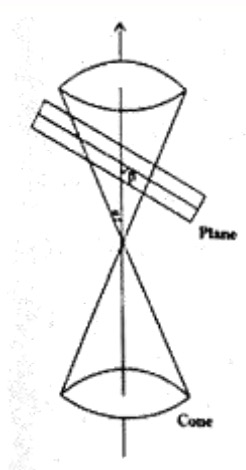
In the figure, Statement $I$: when $\alpha > \beta \ge 0$, the section is a hyperbola. Statement $II$: when $\beta > 90^\circ$, the section is an ellipse.
A
Statement $I$ is true, statement $II$ is false
B
Statement $I$ is false, statement $II$ is true
C
Both the statements are true
D
Both the statements are false
Solution
(A) For a hyperbola, the condition is $\alpha > \beta \ge 0$.
For an ellipse, the condition is $0 \le \alpha < \beta < 90^\circ$.
Thus, Statement $I$ is true and Statement $II$ is false.
For an ellipse, the condition is $0 \le \alpha < \beta < 90^\circ$.
Thus, Statement $I$ is true and Statement $II$ is false.
0 likesView Solution
17
MathematicsDifficultMCQKCET · 2026
If $\lim_{x \to 3} \frac{x^2 - ax - 3b}{x - 3} = 5$, then $a + b =$
A
$1$
B
$2$
C
$3$
D
$4$
Solution
(C) Given $\lim_{x \to 3} \frac{x^2 - ax - 3b}{x - 3} = 5$.
Since the denominator approaches $0$ as $x \to 3$, the limit exists only if the numerator also approaches $0$ at $x = 3$.
Substituting $x = 3$ in the numerator: $3^2 - a(3) - 3b = 0$.
$9 - 3a - 3b = 0$.
$3(3 - a - b) = 0$.
$3 - a - b = 0$.
Therefore, $a + b = 3$.
Since the denominator approaches $0$ as $x \to 3$, the limit exists only if the numerator also approaches $0$ at $x = 3$.
Substituting $x = 3$ in the numerator: $3^2 - a(3) - 3b = 0$.
$9 - 3a - 3b = 0$.
$3(3 - a - b) = 0$.
$3 - a - b = 0$.
Therefore, $a + b = 3$.
0 likesView Solution
18
MathematicsDifficultMCQKCET · 2026
The area enclosed by the curve $x = \sqrt{3} \cos \theta, y = \sqrt{3} \sin \theta$ is
A
$\sqrt{3} \pi \text{ sq. units}$
B
$9\pi \text{ sq. units}$
C
$6\pi \text{ sq. units}$
D
$3\pi \text{ sq. units}$
Solution
(D) Given the parametric equations $x = \sqrt{3} \cos \theta$ and $y = \sqrt{3} \sin \theta$.
Squaring and adding both equations: $x^2 + y^2 = (\sqrt{3} \cos \theta)^2 + (\sqrt{3} \sin \theta)^2$.
$x^2 + y^2 = 3 \cos^2 \theta + 3 \sin^2 \theta = 3(\cos^2 \theta + \sin^2 \theta) = 3$.
This represents a circle with radius $r = \sqrt{3}$.
The area of a circle is given by $A = \pi r^2$.
$A = \pi (\sqrt{3})^2 = 3\pi \text{ sq. units}$.
Squaring and adding both equations: $x^2 + y^2 = (\sqrt{3} \cos \theta)^2 + (\sqrt{3} \sin \theta)^2$.
$x^2 + y^2 = 3 \cos^2 \theta + 3 \sin^2 \theta = 3(\cos^2 \theta + \sin^2 \theta) = 3$.
This represents a circle with radius $r = \sqrt{3}$.
The area of a circle is given by $A = \pi r^2$.
$A = \pi (\sqrt{3})^2 = 3\pi \text{ sq. units}$.
0 likesView Solution
19
MathematicsMediumMCQKCET · 2026
If $A = \{a, b, c, d, e, f\}$, then the number of subsets of $A$ which contains at least $2$ elements is
A
$64$
B
$65$
C
$57$
D
$59$
Solution
(C) The total number of subsets of a set with $n$ elements is $2^n$.
Here, $n = 6$, so the total number of subsets is $2^6 = 64$.
Subsets with $0$ elements (the empty set) $= \binom{6}{0} = 1$.
Subsets with $1$ element $= \binom{6}{1} = 6$.
Subsets with at least $2$ elements $=$ Total subsets $-$ (Subsets with $0$ elements $+$ Subsets with $1$ element).
Subsets with at least $2$ elements $= 64 - (1 + 6) = 64 - 7 = 57$.
Here, $n = 6$, so the total number of subsets is $2^6 = 64$.
Subsets with $0$ elements (the empty set) $= \binom{6}{0} = 1$.
Subsets with $1$ element $= \binom{6}{1} = 6$.
Subsets with at least $2$ elements $=$ Total subsets $-$ (Subsets with $0$ elements $+$ Subsets with $1$ element).
Subsets with at least $2$ elements $= 64 - (1 + 6) = 64 - 7 = 57$.
0 likesView Solution
20
MathematicsMediumMCQKCET · 2026
If $A = \{1, 2, 3, 4, \dots, 10\}$, then the number of non-empty subsets of $A$ containing only even numbers is
A
$31$
B
$32$
C
$30$
D
$29$
Solution
(A) The even numbers in set $A$ are $\{2, 4, 6, 8, 10\}$.
There are $5$ such even numbers.
The total number of subsets that can be formed using these $5$ elements is $2^5 = 32$.
Since we need non-empty subsets, we exclude the empty set $\emptyset$.
Therefore, the number of non-empty subsets is $32 - 1 = 31$.
There are $5$ such even numbers.
The total number of subsets that can be formed using these $5$ elements is $2^5 = 32$.
Since we need non-empty subsets, we exclude the empty set $\emptyset$.
Therefore, the number of non-empty subsets is $32 - 1 = 31$.
0 likesView Solution
21
MathematicsMediumMCQKCET · 2026
If $n(A) = 2$ and the number of relations from set $A$ to set $B$ is $1024$, then $n(B)$ is
A
$2$
B
$5$
C
$2^5$
D
$5^2$
Solution
(B) The number of relations from set $A$ to set $B$ is given by $2^{n(A) \times n(B)}$.
Given that $2^{n(A) \times n(B)} = 1024$.
Since $1024 = 2^{10}$, we have $n(A) \times n(B) = 10$.
Given $n(A) = 2$, we substitute the value: $2 \times n(B) = 10$.
Therefore, $n(B) = \frac{10}{2} = 5$.
Given that $2^{n(A) \times n(B)} = 1024$.
Since $1024 = 2^{10}$, we have $n(A) \times n(B) = 10$.
Given $n(A) = 2$, we substitute the value: $2 \times n(B) = 10$.
Therefore, $n(B) = \frac{10}{2} = 5$.
0 likesView Solution
22
MathematicsMediumMCQKCET · 2026
Let $R$ be a relation in the set of natural numbers $N$ defined by $R = \{(a, b) : a = b - 2, b > 6\}$. Which of the following is correct?
A
$(2, 4) \in R$
B
$(3, 8) \in R$
C
$(6, 8) \in R$
D
$(8, 7) \in R$
Solution
(C) The relation is defined as $R = \{(a, b) : a = b - 2, b > 6\}$.
For $(2, 4)$: $b = 4$, which is not greater than $6$. Thus, $(2, 4) \notin R$.
For $(3, 8)$: $a = 3$ and $b = 8$. Checking the condition $a = b - 2$: $3 = 8 - 2 = 6$, which is false.
For $(6, 8)$: $a = 6$ and $b = 8$. Checking the condition $a = b - 2$: $6 = 8 - 2 = 6$, which is true. Also, $b = 8 > 6$ is true. Thus, $(6, 8) \in R$.
For $(8, 7)$: $a = 8$ and $b = 7$. Checking the condition $a = b - 2$: $8 = 7 - 2 = 5$, which is false.
Therefore, the correct option is $(6, 8) \in R$.
For $(2, 4)$: $b = 4$, which is not greater than $6$. Thus, $(2, 4) \notin R$.
For $(3, 8)$: $a = 3$ and $b = 8$. Checking the condition $a = b - 2$: $3 = 8 - 2 = 6$, which is false.
For $(6, 8)$: $a = 6$ and $b = 8$. Checking the condition $a = b - 2$: $6 = 8 - 2 = 6$, which is true. Also, $b = 8 > 6$ is true. Thus, $(6, 8) \in R$.
For $(8, 7)$: $a = 8$ and $b = 7$. Checking the condition $a = b - 2$: $8 = 7 - 2 = 5$, which is false.
Therefore, the correct option is $(6, 8) \in R$.
0 likesView Solution
23
MathematicsDifficultMCQKCET · 2026
Find the sum of the series: $\tan^{-1} \left( \frac{1}{1 + 1 \times 2} \right) + \tan^{-1} \left( \frac{1}{1 + 2 \times 3} \right) + \dots + \tan^{-1} \left( \frac{1}{1 + n(n + 1)} \right) =$
A
$\tan^{-1} \left( \frac{n}{n + 2} \right)$
B
$\tan^{-1} \left( \frac{n + 1}{n} \right)$
C
$\tan^{-1} \left( \frac{n}{n + 1} \right)$
D
$\tan^{-1} \left( \frac{n + 2}{n} \right)$
Solution
(A) The general term of the series is $T_k = \tan^{-1} \left( \frac{1}{1 + k(k + 1)} \right)$.
We can rewrite the argument as $\frac{(k + 1) - k}{1 + k(k + 1)}$.
Using the identity $\tan^{-1} x - \tan^{-1} y = \tan^{-1} \left( \frac{x - y}{1 + xy} \right)$, we get $T_k = \tan^{-1}(k + 1) - \tan^{-1}(k)$.
The sum $S_n = \sum_{k=1}^{n} (\tan^{-1}(k + 1) - \tan^{-1}(k))$.
This is a telescoping series: $S_n = (\tan^{-1} 2 - \tan^{-1} 1) + (\tan^{-1} 3 - \tan^{-1} 2) + \dots + (\tan^{-1}(n + 1) - \tan^{-1} n)$.
All intermediate terms cancel out, leaving $S_n = \tan^{-1}(n + 1) - \tan^{-1}(1)$.
Using the identity again, $S_n = \tan^{-1} \left( \frac{(n + 1) - 1}{1 + (n + 1)(1)} \right) = \tan^{-1} \left( \frac{n}{n + 2} \right)$.
We can rewrite the argument as $\frac{(k + 1) - k}{1 + k(k + 1)}$.
Using the identity $\tan^{-1} x - \tan^{-1} y = \tan^{-1} \left( \frac{x - y}{1 + xy} \right)$, we get $T_k = \tan^{-1}(k + 1) - \tan^{-1}(k)$.
The sum $S_n = \sum_{k=1}^{n} (\tan^{-1}(k + 1) - \tan^{-1}(k))$.
This is a telescoping series: $S_n = (\tan^{-1} 2 - \tan^{-1} 1) + (\tan^{-1} 3 - \tan^{-1} 2) + \dots + (\tan^{-1}(n + 1) - \tan^{-1} n)$.
All intermediate terms cancel out, leaving $S_n = \tan^{-1}(n + 1) - \tan^{-1}(1)$.
Using the identity again, $S_n = \tan^{-1} \left( \frac{(n + 1) - 1}{1 + (n + 1)(1)} \right) = \tan^{-1} \left( \frac{n}{n + 2} \right)$.
0 likesView Solution
24
MathematicsDifficultMCQKCET · 2026
The corner points of the feasible region determined by the system of linear constraints are $(0, 10)$, $(5, 5)$, $(15, 15)$, and $(0, 20)$. Let $z = px + qy$ where $p, q > 0$. The condition on $p$ and $q$ such that the maximum value of $z$ occurs at both points $(15, 15)$ and $(0, 20)$ is
A
$p = q$
B
$p = 2q$
C
$q = 2p$
D
$q = 3p$
Solution
(D) For the maximum value of $z$ to occur at both points $(15, 15)$ and $(0, 20)$, the value of $z$ must be equal at these two points.
Substitute the coordinates into the objective function $z = px + qy$:
At $(15, 15)$, $z_1 = p(15) + q(15) = 15p + 15q$.
At $(0, 20)$, $z_2 = p(0) + q(20) = 20q$.
Equating $z_1$ and $z_2$:
$15p + 15q = 20q$.
Subtract $15q$ from both sides:
$15p = 5q$.
Divide by $5$:
$q = 3p$.
Substitute the coordinates into the objective function $z = px + qy$:
At $(15, 15)$, $z_1 = p(15) + q(15) = 15p + 15q$.
At $(0, 20)$, $z_2 = p(0) + q(20) = 20q$.
Equating $z_1$ and $z_2$:
$15p + 15q = 20q$.
Subtract $15q$ from both sides:
$15p = 5q$.
Divide by $5$:
$q = 3p$.
0 likesView Solution
25
MathematicsMediumMCQKCET · 2026
In a linear programming problem $(LPP)$, if the objective function $Z = ax + by$ has the same maximum value at two distinct corner points, then the number of points at which $Z_{max}$ occurs is
A
$1$
B
$2$
C
$0$
D
Infinitely many
Solution
(D) $1$. In an $LPP$, the objective function $Z = ax + by$ is a linear function.
$2$. If $Z$ attains the same maximum value at two distinct corner points, then by the property of linear functions, $Z$ will attain the same maximum value at every point on the line segment joining these two corner points.
$3$. Since a line segment contains an infinite number of points, the objective function $Z$ attains its maximum value at infinitely many points.
$2$. If $Z$ attains the same maximum value at two distinct corner points, then by the property of linear functions, $Z$ will attain the same maximum value at every point on the line segment joining these two corner points.
$3$. Since a line segment contains an infinite number of points, the objective function $Z$ attains its maximum value at infinitely many points.
0 likesView Solution
26
MathematicsDifficultMCQKCET · 2026
The integrating factor of the differential equation $(1 - x^2) \frac{dy}{dx} - xy = 1$ is
A
$1 - x^2$
B
$\frac{1}{2} \log |1 - x^2|$
C
$\frac{x}{1 + x^2}$
D
$\sqrt{1 - x^2}$
Solution
(D) The given differential equation is $(1 - x^2) \frac{dy}{dx} - xy = 1$.
Divide by $(1 - x^2)$ to get the standard linear form $\frac{dy}{dx} + P(x)y = Q(x)$:
$\frac{dy}{dx} - \frac{x}{1 - x^2}y = \frac{1}{1 - x^2}$.
Here, $P(x) = -\frac{x}{1 - x^2}$.
The integrating factor $(I.F.)$ is given by $e^{\int P(x) dx} = e^{\int -\frac{x}{1 - x^2} dx}$.
Let $t = 1 - x^2$, then $dt = -2x dx$, which implies $-x dx = \frac{dt}{2}$.
$I.F. = e^{\int \frac{dt}{2t}} = e^{\frac{1}{2} \log |t|} = e^{\log |t|^{1/2}} = \sqrt{t} = \sqrt{1 - x^2}$.
Divide by $(1 - x^2)$ to get the standard linear form $\frac{dy}{dx} + P(x)y = Q(x)$:
$\frac{dy}{dx} - \frac{x}{1 - x^2}y = \frac{1}{1 - x^2}$.
Here, $P(x) = -\frac{x}{1 - x^2}$.
The integrating factor $(I.F.)$ is given by $e^{\int P(x) dx} = e^{\int -\frac{x}{1 - x^2} dx}$.
Let $t = 1 - x^2$, then $dt = -2x dx$, which implies $-x dx = \frac{dt}{2}$.
$I.F. = e^{\int \frac{dt}{2t}} = e^{\frac{1}{2} \log |t|} = e^{\log |t|^{1/2}} = \sqrt{t} = \sqrt{1 - x^2}$.
0 likesView Solution
27
MathematicsDifficultMCQKCET · 2026
Recent studies suggest that $12\%$ of the world population is left-handed. Depending on parents' hand usage, the chances of having left-handed children are as follows: $A$. Both parents are left-handed, chances of having left-handed children = $24\%$. $B$. Both parents are right-handed, chance of having left-handed children = $9\%$. $C$. Father left-handed and mother right-handed, chances of having left-handed children = $17\%$. $D$. Father right-handed and mother left-handed, chances of having left-handed children = $22\%$. Given $P(A) = P(B) = P(C) = P(D) = 1/4$ and $L$ denotes the event that the child is left-handed. What is the probability $P(A|L)$?
A
$\frac{17}{100}$
B
$\frac{19}{25}$
C
$\frac{1}{3}$
D
$\frac{2}{3}$
Solution
(C) Using Bayes' theorem: $P(A|L) = \frac{P(L|A)P(A)}{P(L|A)P(A) + P(L|B)P(B) + P(L|C)P(C) + P(L|D)P(D)}$.
Given $P(A) = P(B) = P(C) = P(D) = 1/4$, the terms $1/4$ cancel out:
$P(A|L) = \frac{P(L|A)}{P(L|A) + P(L|B) + P(L|C) + P(L|D)}$.
Substituting the given probabilities: $P(A|L) = \frac{0.24}{0.24 + 0.09 + 0.17 + 0.22}$.
$P(A|L) = \frac{0.24}{0.72} = \frac{1}{3}$.
Given $P(A) = P(B) = P(C) = P(D) = 1/4$, the terms $1/4$ cancel out:
$P(A|L) = \frac{P(L|A)}{P(L|A) + P(L|B) + P(L|C) + P(L|D)}$.
Substituting the given probabilities: $P(A|L) = \frac{0.24}{0.24 + 0.09 + 0.17 + 0.22}$.
$P(A|L) = \frac{0.24}{0.72} = \frac{1}{3}$.
0 likesView Solution
28
MathematicsMediumMCQKCET · 2026
Match List-$I$ with List-$II$:
| List-$I$ | List-$II$ |
| a) $A$ matrix which is not a square matrix | i) Symmetric matrix |
| b) $A$ square matrix $A' = A$ | ii) Null matrix |
| c) The diagonal elements of a diagonal matrix are same | iii) Rectangular matrix |
| d) $A$ matrix which is both symmetric and skew symmetric | iv) Scalar matrix |
A
$a-iii, b-i, c-ii, d-iv$
B
$a-iii, b-ii, c-iv, d-i$
C
$a-iii, b-i, c-iv, d-ii$
D
$a-iii, b-iv, c-i, d-ii$
Solution
(C) Step $1$: $A$ matrix where the number of rows is not equal to the number of columns is a $Rectangular \ matrix$ (a-iii).
Step $2$: $A$ square matrix $A$ is symmetric if $A' = A$ (b-i).
Step $3$: $A$ diagonal matrix where all diagonal elements are equal is a $Scalar \ matrix$ (c-iv).
Step $4$: $A$ matrix that is both symmetric $(A' = A)$ and skew-symmetric $(A' = -A)$ must satisfy $A = -A$, which implies $2A = 0$, so $A$ is a $Null \ matrix$ (d-ii).
Therefore, the correct matching is $a-iii, b-i, c-iv, d-ii$.
Step $2$: $A$ square matrix $A$ is symmetric if $A' = A$ (b-i).
Step $3$: $A$ diagonal matrix where all diagonal elements are equal is a $Scalar \ matrix$ (c-iv).
Step $4$: $A$ matrix that is both symmetric $(A' = A)$ and skew-symmetric $(A' = -A)$ must satisfy $A = -A$, which implies $2A = 0$, so $A$ is a $Null \ matrix$ (d-ii).
Therefore, the correct matching is $a-iii, b-i, c-iv, d-ii$.
0 likesView Solution
29
MathematicsMediumMCQKCET · 2026
Consider the following statements:
Statement $I$: If $A$ is a non-singular matrix, then $A^{-1}$ exists.
Statement $II$: If $A$ and $B$ are symmetric matrices of the same order, then $(AB - BA)$ is a skew-symmetric matrix.
Choose the correct option.
Statement $I$: If $A$ is a non-singular matrix, then $A^{-1}$ exists.
Statement $II$: If $A$ and $B$ are symmetric matrices of the same order, then $(AB - BA)$ is a skew-symmetric matrix.
Choose the correct option.
A
Statement $I$ is true and statement $II$ is false
B
Statement $I$ is false and statement $II$ is false
C
Statement $I$ is true and statement $II$ is true
D
Statement $I$ is false and statement $II$ is true
Solution
(C) Step $1$: Statement $I$ is true because for a non-singular matrix, $|A| \neq 0$, which is the necessary and sufficient condition for the existence of the inverse matrix $A^{-1}$.
Step $2$: Statement $II$ is true. Given $A$ and $B$ are symmetric, $A' = A$ and $B' = B$. Consider the transpose of $(AB - BA)$:
$(AB - BA)' = (AB)' - (BA)' = B'A' - A'B' = BA - AB = -(AB - BA)$.
Since the transpose of $(AB - BA)$ is its negative, $(AB - BA)$ is a skew-symmetric matrix.
Step $2$: Statement $II$ is true. Given $A$ and $B$ are symmetric, $A' = A$ and $B' = B$. Consider the transpose of $(AB - BA)$:
$(AB - BA)' = (AB)' - (BA)' = B'A' - A'B' = BA - AB = -(AB - BA)$.
Since the transpose of $(AB - BA)$ is its negative, $(AB - BA)$ is a skew-symmetric matrix.
0 likesView Solution
30
MathematicsEasyMCQKCET · 2026
$A$ row matrix has only
A
One element
B
One row with one or more columns
C
One column with one or more rows
D
One row and one column
Solution
(B) matrix is called a row matrix if it has only one row. The number of columns can be any positive integer $n \ge 1$. Thus, a row matrix is of the order $1 \times n$.
0 likesView Solution
31
MathematicsMediumMCQKCET · 2026
Let $X$ be a matrix of order $2 \times n$ and $Z$ be a matrix of order $2 \times p$. If $n = p$, then the order of the matrix $8X - 9Z$ is
A
$2 \times n$
B
$p \times 2$
C
$n \times 3$
D
$pn \times 1$
Solution
(A) For the addition or subtraction of two matrices, they must have the same order.
Given that matrix $X$ has order $2 \times n$ and matrix $Z$ has order $2 \times p$.
Since $n = p$, both matrices have the same order $2 \times n$.
The resulting matrix obtained by the operation $8X - 9Z$ will also have the same order, which is $2 \times n$.
Given that matrix $X$ has order $2 \times n$ and matrix $Z$ has order $2 \times p$.
Since $n = p$, both matrices have the same order $2 \times n$.
The resulting matrix obtained by the operation $8X - 9Z$ will also have the same order, which is $2 \times n$.
0 likesView Solution
32
MathematicsEasyMCQKCET · 2026
Which of the following statements is correct regarding a determinant?
A
Determinant is a square matrix.
B
Determinant is a number associated with a matrix.
C
Determinant is a unique number associated with a square matrix.
D
Determinant is not defined for a square matrix.
Solution
(C) $1$. $A$ determinant is defined only for square matrices.
$2$. For every square matrix $A$, there exists a unique scalar value associated with it, which is called its determinant, denoted by $|A|$ or $\det(A)$.
$3$. Therefore, the correct statement is that a determinant is a unique number associated with a square matrix.
$2$. For every square matrix $A$, there exists a unique scalar value associated with it, which is called its determinant, denoted by $|A|$ or $\det(A)$.
$3$. Therefore, the correct statement is that a determinant is a unique number associated with a square matrix.
0 likesView Solution
33
MathematicsMediumMCQKCET · 2026
If $A$ and $B$ are invertible matrices of the same order, then which of the following is not correct?
A
$A(\text{adj } A) = (\text{adj } A)A = AI$
B
$A(\text{adj } A) = (\text{adj } A)A = |A|I$
C
$(AB)^{-1} = B^{-1}A^{-1}$
D
$|A| \neq 0, |B| \neq 0$
Solution
(A) Step $1$: The fundamental property of the adjoint of a matrix $A$ is $A(\text{adj } A) = (\text{adj } A)A = |A|I$, where $|A|$ is the determinant of $A$ and $I$ is the identity matrix.
Step $2$: Option $(A)$ states $A(\text{adj } A) = (\text{adj } A)A = AI$. This is incorrect because it omits the determinant factor $|A|$.
Step $3$: Option $(B)$ is the correct identity. Option $(C)$ is the standard reversal law for the inverse of a product of matrices. Option $(D)$ is the condition for a matrix to be invertible.
Step $4$: Therefore, the incorrect statement is $(A)$.
Step $2$: Option $(A)$ states $A(\text{adj } A) = (\text{adj } A)A = AI$. This is incorrect because it omits the determinant factor $|A|$.
Step $3$: Option $(B)$ is the correct identity. Option $(C)$ is the standard reversal law for the inverse of a product of matrices. Option $(D)$ is the condition for a matrix to be invertible.
Step $4$: Therefore, the incorrect statement is $(A)$.
0 likesView Solution
34
MathematicsMediumMCQKCET · 2026
If $A$ and $B$ are invertible square matrices of order $n$, then which of the following is not correct?
A
$det(AB) = det(A) \cdot det(B)$
B
$det(kA) = k^n det(A)$
C
$det(A + B) = det(A) + det(B)$
D
$det(A') = 1 / det(A^{-1})$
Solution
(C) $1$. The property $det(AB) = det(A) \cdot det(B)$ is true for all square matrices.
$2$. The property $det(kA) = k^n det(A)$ is true for a matrix of order $n$.
$3$. The property $det(A') = det(A) = 1 / det(A^{-1})$ is true for invertible matrices.
$4$. The determinant of a sum is not generally the sum of the determinants, i.e., $det(A + B) \neq det(A) + det(B)$. Thus, option $C$ is incorrect.
$2$. The property $det(kA) = k^n det(A)$ is true for a matrix of order $n$.
$3$. The property $det(A') = det(A) = 1 / det(A^{-1})$ is true for invertible matrices.
$4$. The determinant of a sum is not generally the sum of the determinants, i.e., $det(A + B) \neq det(A) + det(B)$. Thus, option $C$ is incorrect.
0 likesView Solution
35
MathematicsDifficultMCQKCET · 2026
The area of the triangle with vertices $(3, 8)$, $(-4, 2)$ and $(5, 1)$ is $\frac{P}{4}$. The value of $P$ is:
A
$\frac{61}{2}$
B
$\frac{2}{61}$
C
$122$
D
$\frac{1}{122}$
Solution
(C) The area of a triangle with vertices $(x_1, y_1)$, $(x_2, y_2)$ and $(x_3, y_3)$ is given by $\text{Area} = \frac{1}{2} |x_1(y_2 - y_3) + x_2(y_3 - y_1) + x_3(y_1 - y_2)|$.
Substituting the given vertices $(3, 8)$, $(-4, 2)$ and $(5, 1)$:
$\text{Area} = \frac{1}{2} |3(2 - 1) + (-4)(1 - 8) + 5(8 - 2)|$
$\text{Area} = \frac{1}{2} |3(1) - 4(-7) + 5(6)|$
$\text{Area} = \frac{1}{2} |3 + 28 + 30| = \frac{61}{2}$.
Given that $\text{Area} = \frac{P}{4}$, we have $\frac{P}{4} = \frac{61}{2}$.
Multiplying both sides by $4$, we get $P = \frac{61 \times 4}{2} = 122$.
Substituting the given vertices $(3, 8)$, $(-4, 2)$ and $(5, 1)$:
$\text{Area} = \frac{1}{2} |3(2 - 1) + (-4)(1 - 8) + 5(8 - 2)|$
$\text{Area} = \frac{1}{2} |3(1) - 4(-7) + 5(6)|$
$\text{Area} = \frac{1}{2} |3 + 28 + 30| = \frac{61}{2}$.
Given that $\text{Area} = \frac{P}{4}$, we have $\frac{P}{4} = \frac{61}{2}$.
Multiplying both sides by $4$, we get $P = \frac{61 \times 4}{2} = 122$.
0 likesView Solution
36
MathematicsMediumMCQKCET · 2026
The system of equations $x + 2y = 3$ and $2x + 3y = 3$ has
A
No solution
B
Unique solution
C
Infinite solutions
D
Only two solutions
Solution
(B) For a system of linear equations $a_1x + b_1y = c_1$ and $a_2x + b_2y = c_2$, the condition for a unique solution is $\frac{a_1}{a_2} \neq \frac{b_1}{b_2}$.
Here, $a_1 = 1, b_1 = 2, c_1 = 3$ and $a_2 = 2, b_2 = 3, c_2 = 3$.
Calculating the ratios: $\frac{a_1}{a_2} = \frac{1}{2}$ and $\frac{b_1}{b_2} = \frac{2}{3}$.
Since $\frac{1}{2} \neq \frac{2}{3}$, the system has a unique solution.
Here, $a_1 = 1, b_1 = 2, c_1 = 3$ and $a_2 = 2, b_2 = 3, c_2 = 3$.
Calculating the ratios: $\frac{a_1}{a_2} = \frac{1}{2}$ and $\frac{b_1}{b_2} = \frac{2}{3}$.
Since $\frac{1}{2} \neq \frac{2}{3}$, the system has a unique solution.
0 likesView Solution
37
MathematicsDifficultMCQKCET · 2026
If $\vec{a} = 2\hat{i} + 2\hat{j} - \hat{k}$, $\vec{b} = \alpha\hat{i} + \beta\hat{j} + 2\hat{k}$ and $|\vec{a} + \vec{b}| = |\vec{a} - \vec{b}|$, then $\alpha + \beta$ is equal to
A
$2$
B
$-1$
C
$0$
D
$1$
Solution
(D) Given $|\vec{a} + \vec{b}| = |\vec{a} - \vec{b}|$.
Squaring both sides, we get $|\vec{a} + \vec{b}|^2 = |\vec{a} - \vec{b}|^2$.
Using the property $|\vec{u} \pm \vec{v}|^2 = |\vec{u}|^2 + |\vec{v}|^2 \pm 2(\vec{u} \cdot \vec{v})$, we have $|\vec{a}|^2 + |\vec{b}|^2 + 2(\vec{a} \cdot \vec{b}) = |\vec{a}|^2 + |\vec{b}|^2 - 2(\vec{a} \cdot \vec{b})$.
This simplifies to $4(\vec{a} \cdot \vec{b}) = 0$, which implies $\vec{a} \cdot \vec{b} = 0$.
Calculating the dot product: $(2\hat{i} + 2\hat{j} - \hat{k}) \cdot (\alpha\hat{i} + \beta\hat{j} + 2\hat{k}) = 0$.
$2\alpha + 2\beta - 2 = 0$.
Dividing by $2$, we get $\alpha + \beta - 1 = 0$, so $\alpha + \beta = 1$.
Squaring both sides, we get $|\vec{a} + \vec{b}|^2 = |\vec{a} - \vec{b}|^2$.
Using the property $|\vec{u} \pm \vec{v}|^2 = |\vec{u}|^2 + |\vec{v}|^2 \pm 2(\vec{u} \cdot \vec{v})$, we have $|\vec{a}|^2 + |\vec{b}|^2 + 2(\vec{a} \cdot \vec{b}) = |\vec{a}|^2 + |\vec{b}|^2 - 2(\vec{a} \cdot \vec{b})$.
This simplifies to $4(\vec{a} \cdot \vec{b}) = 0$, which implies $\vec{a} \cdot \vec{b} = 0$.
Calculating the dot product: $(2\hat{i} + 2\hat{j} - \hat{k}) \cdot (\alpha\hat{i} + \beta\hat{j} + 2\hat{k}) = 0$.
$2\alpha + 2\beta - 2 = 0$.
Dividing by $2$, we get $\alpha + \beta - 1 = 0$, so $\alpha + \beta = 1$.
0 likesView Solution
38
MathematicsDifficultMCQKCET · 2026
If $\vec{a} = \hat{i} + \hat{j} + \hat{k}$, $\vec{b} = \hat{j} - \hat{k}$ and $\vec{a} \times \vec{c} = \vec{b}$, $\vec{a} \cdot \vec{c} = 3$, then $\vec{c}$ is
A
$\frac{5}{3}\hat{i} + \frac{2}{3}\hat{j} - \frac{2}{3}\hat{k}$
B
$-\frac{2}{3}\hat{i} + \frac{2}{3}\hat{j} - \hat{k}$
C
$\frac{5}{3}\hat{i} + \frac{2}{3}\hat{j} + \frac{2}{3}\hat{k}$
D
$\frac{5}{3}\hat{i} - \frac{2}{3}\hat{j} - \frac{2}{3}\hat{k}$
Solution
(C) Let $\vec{c} = x\hat{i} + y\hat{j} + z\hat{k}$.
Given $\vec{a} \times \vec{c} = \vec{b}$, we have:
$\begin{vmatrix} \hat{i} & \hat{j} & \hat{k} \\ 1 & 1 & 1 \\ x & y & z \end{vmatrix} = \hat{j} - \hat{k}$
$(z-y)\hat{i} + (x-z)\hat{j} + (y-x)\hat{k} = 0\hat{i} + 1\hat{j} - 1\hat{k}$.
Comparing components: $z-y=0 \Rightarrow z=y$, $x-z=1$, and $y-x=-1$.
Given $\vec{a} \cdot \vec{c} = 3$, we have $x+y+z=3$.
Substituting $z=y$ into $x-z=1$, we get $x-y=1 \Rightarrow x=y+1$.
Substituting $x=y+1$ and $z=y$ into $x+y+z=3$:
$(y+1) + y + y = 3 \Rightarrow 3y = 2 \Rightarrow y = \frac{2}{3}$.
Then $z = \frac{2}{3}$ and $x = \frac{2}{3} + 1 = \frac{5}{3}$.
Thus, $\vec{c} = \frac{5}{3}\hat{i} + \frac{2}{3}\hat{j} + \frac{2}{3}\hat{k}$.
Given $\vec{a} \times \vec{c} = \vec{b}$, we have:
$\begin{vmatrix} \hat{i} & \hat{j} & \hat{k} \\ 1 & 1 & 1 \\ x & y & z \end{vmatrix} = \hat{j} - \hat{k}$
$(z-y)\hat{i} + (x-z)\hat{j} + (y-x)\hat{k} = 0\hat{i} + 1\hat{j} - 1\hat{k}$.
Comparing components: $z-y=0 \Rightarrow z=y$, $x-z=1$, and $y-x=-1$.
Given $\vec{a} \cdot \vec{c} = 3$, we have $x+y+z=3$.
Substituting $z=y$ into $x-z=1$, we get $x-y=1 \Rightarrow x=y+1$.
Substituting $x=y+1$ and $z=y$ into $x+y+z=3$:
$(y+1) + y + y = 3 \Rightarrow 3y = 2 \Rightarrow y = \frac{2}{3}$.
Then $z = \frac{2}{3}$ and $x = \frac{2}{3} + 1 = \frac{5}{3}$.
Thus, $\vec{c} = \frac{5}{3}\hat{i} + \frac{2}{3}\hat{j} + \frac{2}{3}\hat{k}$.
0 likesView Solution
39
MathematicsDifficultMCQKCET · 2026
The value of $\lambda$ for which the vectors $\vec{a} = 2\hat{i} + \lambda\hat{j} + \hat{k}$ and $\vec{b} = \hat{i} + 2\hat{j} + 3\hat{k}$ are orthogonal is
A
$\frac{5}{2}$
B
$-\frac{5}{2}$
C
$\frac{2}{5}$
D
$-\frac{2}{5}$
Solution
(B) Two vectors are orthogonal if their dot product is zero, i.e., $\vec{a} \cdot \vec{b} = 0$.
Given $\vec{a} = 2\hat{i} + \lambda\hat{j} + \hat{k}$ and $\vec{b} = \hat{i} + 2\hat{j} + 3\hat{k}$.
Calculating the dot product: $(2)(1) + (\lambda)(2) + (1)(3) = 0$.
$2 + 2\lambda + 3 = 0$.
$2\lambda + 5 = 0$.
$2\lambda = -5$.
$\lambda = -\frac{5}{2}$.
Given $\vec{a} = 2\hat{i} + \lambda\hat{j} + \hat{k}$ and $\vec{b} = \hat{i} + 2\hat{j} + 3\hat{k}$.
Calculating the dot product: $(2)(1) + (\lambda)(2) + (1)(3) = 0$.
$2 + 2\lambda + 3 = 0$.
$2\lambda + 5 = 0$.
$2\lambda = -5$.
$\lambda = -\frac{5}{2}$.
0 likesView Solution
40
MathematicsDifficultMCQKCET · 2026
The angle between the lines whose direction ratios are $a, b, c$ and $b - c, c - a, a - b$ is (in $^\circ$)
A
$90$
B
$60$
C
$30$
D
$0$
Solution
(A) Let the two direction vectors be $\vec{v_1} = a\hat{i} + b\hat{j} + c\hat{k}$ and $\vec{v_2} = (b-c)\hat{i} + (c-a)\hat{j} + (a-b)\hat{k}$.
Calculate the dot product $\vec{v_1} \cdot \vec{v_2} = a(b-c) + b(c-a) + c(a-b)$.
Expand the terms: $ab - ac + bc - ba + ca - cb$.
Simplify the expression: $(ab - ba) + (bc - cb) + (ca - ac) = 0 + 0 + 0 = 0$.
Since the dot product is $0$, the vectors are perpendicular, and the angle between the lines is $90^\circ$.
Calculate the dot product $\vec{v_1} \cdot \vec{v_2} = a(b-c) + b(c-a) + c(a-b)$.
Expand the terms: $ab - ac + bc - ba + ca - cb$.
Simplify the expression: $(ab - ba) + (bc - cb) + (ca - ac) = 0 + 0 + 0 = 0$.
Since the dot product is $0$, the vectors are perpendicular, and the angle between the lines is $90^\circ$.
0 likesView Solution
41
MathematicsDifficultMCQKCET · 2026
The measure of the angle between the lines $x = k + 1, y = 2k - 1, z = 2k + 3, k \in R$ and $\frac{x-1}{2} = \frac{y-2}{1} = \frac{z-3}{1}$ is
A
$\cos^{-1}(\frac{2}{3})$
B
$\cos^{-1}(\sqrt{\frac{2}{3}})$
C
$\cos^{-1}(\sqrt{\frac{3}{2}})$
D
$\cos^{-1}(\frac{3}{2})$
Solution
(B) The first line is given by $x = 1 + 1k, y = -1 + 2k, z = 3 + 2k$. Its direction ratios are $\vec{a} = (1, 2, 2)$.
The second line is $\frac{x-1}{2} = \frac{y-2}{1} = \frac{z-3}{1}$. Its direction ratios are $\vec{b} = (2, 1, 1)$.
The angle $\theta$ between the lines is given by $\cos \theta = \frac{|\vec{a} \cdot \vec{b}|}{|\vec{a}| |\vec{b}|}$.
$\vec{a} \cdot \vec{b} = (1)(2) + (2)(1) + (2)(1) = 2 + 2 + 2 = 6$.
$|\vec{a}| = \sqrt{1^2 + 2^2 + 2^2} = \sqrt{1 + 4 + 4} = \sqrt{9} = 3$.
$|\vec{b}| = \sqrt{2^2 + 1^2 + 1^2} = \sqrt{4 + 1 + 1} = \sqrt{6}$.
$\cos \theta = \frac{6}{3 \cdot \sqrt{6}} = \frac{2}{\sqrt{6}} = \sqrt{\frac{4}{6}} = \sqrt{\frac{2}{3}}$.
Therefore, $\theta = \cos^{-1}(\sqrt{\frac{2}{3}})$.
The second line is $\frac{x-1}{2} = \frac{y-2}{1} = \frac{z-3}{1}$. Its direction ratios are $\vec{b} = (2, 1, 1)$.
The angle $\theta$ between the lines is given by $\cos \theta = \frac{|\vec{a} \cdot \vec{b}|}{|\vec{a}| |\vec{b}|}$.
$\vec{a} \cdot \vec{b} = (1)(2) + (2)(1) + (2)(1) = 2 + 2 + 2 = 6$.
$|\vec{a}| = \sqrt{1^2 + 2^2 + 2^2} = \sqrt{1 + 4 + 4} = \sqrt{9} = 3$.
$|\vec{b}| = \sqrt{2^2 + 1^2 + 1^2} = \sqrt{4 + 1 + 1} = \sqrt{6}$.
$\cos \theta = \frac{6}{3 \cdot \sqrt{6}} = \frac{2}{\sqrt{6}} = \sqrt{\frac{4}{6}} = \sqrt{\frac{2}{3}}$.
Therefore, $\theta = \cos^{-1}(\sqrt{\frac{2}{3}})$.
0 likesView Solution
42
MathematicsDifficultMCQKCET · 2026
The three points $A(2, 4, 3)$, $B(4, a, 9)$ and $C(10, -1, 7)$ form a right-angled triangle with $\angle B = 90^\circ$. The value of $a$ is
A
$1$ or $4$
B
$-1$ or $4$
C
$1$ or $-4$
D
$-1$ or $-4$
Solution
(B) Step $1$: Find the vectors $\vec{AB}$ and $\vec{BC}$.
$\vec{AB} = (4-2)\hat{i} + (a-4)\hat{j} + (9-3)\hat{k} = 2\hat{i} + (a-4)\hat{j} + 6\hat{k}$.
$\vec{BC} = (10-4)\hat{i} + (-1-a)\hat{j} + (7-9)\hat{k} = 6\hat{i} - (1+a)\hat{j} - 2\hat{k}$.
Step $2$: Since $\angle B = 90^\circ$, the dot product $\vec{AB} \cdot \vec{BC} = 0$.
Step $3$: Calculate the dot product: $2(6) + (a-4)(-(1+a)) + 6(-2) = 0$.
Step $4$: Simplify the equation: $12 - (a-4)(a+1) - 12 = 0$.
Step $5$: Solve for $a$: $-(a-4)(a+1) = 0$, which gives $(a-4)(a+1) = 0$.
Therefore, $a = 4$ or $a = -1$.
$\vec{AB} = (4-2)\hat{i} + (a-4)\hat{j} + (9-3)\hat{k} = 2\hat{i} + (a-4)\hat{j} + 6\hat{k}$.
$\vec{BC} = (10-4)\hat{i} + (-1-a)\hat{j} + (7-9)\hat{k} = 6\hat{i} - (1+a)\hat{j} - 2\hat{k}$.
Step $2$: Since $\angle B = 90^\circ$, the dot product $\vec{AB} \cdot \vec{BC} = 0$.
Step $3$: Calculate the dot product: $2(6) + (a-4)(-(1+a)) + 6(-2) = 0$.
Step $4$: Simplify the equation: $12 - (a-4)(a+1) - 12 = 0$.
Step $5$: Solve for $a$: $-(a-4)(a+1) = 0$, which gives $(a-4)(a+1) = 0$.
Therefore, $a = 4$ or $a = -1$.
0 likesView Solution
43
MathematicsDifficultMCQKCET · 2026
If $f(x) = \begin{cases} x^2 - 1, & \text{if } x \ge 2 \\ x + 1, & \text{if } x < 2 \end{cases}$, then $\lim_{x \to 1} f(x) + \lim_{x \to 2} f(x) =$
A
$3$
B
$5$
C
$7$
D
$9$
Solution
(B) Step $1$: Calculate $\lim_{x \to 1} f(x)$. Since $1 < 2$, we use $f(x) = x + 1$. Thus, $\lim_{x \to 1} (x + 1) = 1 + 1 = 2$.
Step $2$: Calculate $\lim_{x \to 2} f(x)$. We check the left-hand and right-hand limits.
Left-hand limit: $\lim_{x \to 2^-} f(x) = \lim_{x \to 2} (x + 1) = 2 + 1 = 3$.
Right-hand limit: $\lim_{x \to 2^+} f(x) = \lim_{x \to 2} (x^2 - 1) = 2^2 - 1 = 4 - 1 = 3$.
Since both limits are equal, $\lim_{x \to 2} f(x) = 3$.
Step $3$: The sum is $\lim_{x \to 1} f(x) + \lim_{x \to 2} f(x) = 2 + 3 = 5$.
Step $2$: Calculate $\lim_{x \to 2} f(x)$. We check the left-hand and right-hand limits.
Left-hand limit: $\lim_{x \to 2^-} f(x) = \lim_{x \to 2} (x + 1) = 2 + 1 = 3$.
Right-hand limit: $\lim_{x \to 2^+} f(x) = \lim_{x \to 2} (x^2 - 1) = 2^2 - 1 = 4 - 1 = 3$.
Since both limits are equal, $\lim_{x \to 2} f(x) = 3$.
Step $3$: The sum is $\lim_{x \to 1} f(x) + \lim_{x \to 2} f(x) = 2 + 3 = 5$.
0 likesView Solution
44
MathematicsDifficultMCQKCET · 2026
If $y = \sqrt[3]{\tan x + y}$, then $\frac{dy}{dx} =$
A
$\frac{\sec^2 x}{3y^2 + 1}$
B
$\frac{\sec^2 x}{3y^2 - 1}$
C
$\frac{\tan x}{3y^2 - 1}$
D
$\frac{\sec^2 x}{3y - 1}$
Solution
(B) Given $y = (\tan x + y)^{1/3}$.
Cube both sides: $y^3 = \tan x + y$.
Differentiating both sides with respect to $x$: $\frac{d}{dx}(y^3) = \frac{d}{dx}(\tan x + y)$.
$3y^2 \frac{dy}{dx} = \sec^2 x + \frac{dy}{dx}$.
Rearranging the terms: $3y^2 \frac{dy}{dx} - \frac{dy}{dx} = \sec^2 x$.
$\frac{dy}{dx}(3y^2 - 1) = \sec^2 x$.
Therefore, $\frac{dy}{dx} = \frac{\sec^2 x}{3y^2 - 1}$.
Cube both sides: $y^3 = \tan x + y$.
Differentiating both sides with respect to $x$: $\frac{d}{dx}(y^3) = \frac{d}{dx}(\tan x + y)$.
$3y^2 \frac{dy}{dx} = \sec^2 x + \frac{dy}{dx}$.
Rearranging the terms: $3y^2 \frac{dy}{dx} - \frac{dy}{dx} = \sec^2 x$.
$\frac{dy}{dx}(3y^2 - 1) = \sec^2 x$.
Therefore, $\frac{dy}{dx} = \frac{\sec^2 x}{3y^2 - 1}$.
0 likesView Solution
45
MathematicsDifficultMCQKCET · 2026
If $f(x) = \begin{cases} ax + 7, & \text{if } x < 1 \\ 3x - 1, & \text{if } x = 1 \\ \frac{x + 3}{b}, & \text{if } x > 1 \end{cases}$ is continuous at $x = 1$, then
A
$a = 5, b = 2$
B
$a = -5, b = -2$
C
$a = 5, b = -2$
D
$a = -5, b = 2$
Solution
(D) For $f(x)$ to be continuous at $x = 1$, the condition $\lim_{x \to 1^-} f(x) = \lim_{x \to 1^+} f(x) = f(1)$ must hold.
Step $1$: Calculate $f(1) = 3(1) - 1 = 2$.
Step $2$: Calculate the left-hand limit: $\lim_{x \to 1^-} (ax + 7) = a(1) + 7 = a + 7$. Equating to $f(1)$, we get $a + 7 = 2$, which implies $a = -5$.
Step $3$: Calculate the right-hand limit: $\lim_{x \to 1^+} \frac{x + 3}{b} = \frac{1 + 3}{b} = \frac{4}{b}$. Equating to $f(1)$, we get $\frac{4}{b} = 2$, which implies $b = 2$.
Thus, $a = -5$ and $b = 2$.
Step $1$: Calculate $f(1) = 3(1) - 1 = 2$.
Step $2$: Calculate the left-hand limit: $\lim_{x \to 1^-} (ax + 7) = a(1) + 7 = a + 7$. Equating to $f(1)$, we get $a + 7 = 2$, which implies $a = -5$.
Step $3$: Calculate the right-hand limit: $\lim_{x \to 1^+} \frac{x + 3}{b} = \frac{1 + 3}{b} = \frac{4}{b}$. Equating to $f(1)$, we get $\frac{4}{b} = 2$, which implies $b = 2$.
Thus, $a = -5$ and $b = 2$.
0 likesView Solution
46
MathematicsDifficultMCQKCET · 2026
The second order derivative of $\cos^{-1}(4x^3 - 3x)$ with respect to $\cos^{-1}(2x^2 - 1)$, where $\frac{1}{2} < x < 1$ is
A
$0$
B
$\frac{-1}{\sqrt{1 - x^2}}$
C
$\frac{3}{2}$
D
$\frac{-3}{2}$
Solution
(A) Let $u = \cos^{-1}(4x^3 - 3x)$ and $v = \cos^{-1}(2x^2 - 1)$.
Given $\frac{1}{2} < x < 1$, we can substitute $x = \cos \theta$, where $0 < \theta < \frac{\pi}{3}$.
Then $u = \cos^{-1}(\cos 3\theta) = 3\theta$ and $v = \cos^{-1}(\cos 2\theta) = 2\theta$.
We need to find $\frac{d^2u}{dv^2}$.
Since $u = 3\theta$ and $v = 2\theta$, we have $\theta = \frac{v}{2}$.
Substituting $\theta$ in $u$, we get $u = 3(\frac{v}{2}) = \frac{3}{2}v$.
Now, $\frac{du}{dv} = \frac{3}{2}$.
Therefore, the second order derivative $\frac{d^2u}{dv^2} = \frac{d}{dv}(\frac{3}{2}) = 0$.
Given $\frac{1}{2} < x < 1$, we can substitute $x = \cos \theta$, where $0 < \theta < \frac{\pi}{3}$.
Then $u = \cos^{-1}(\cos 3\theta) = 3\theta$ and $v = \cos^{-1}(\cos 2\theta) = 2\theta$.
We need to find $\frac{d^2u}{dv^2}$.
Since $u = 3\theta$ and $v = 2\theta$, we have $\theta = \frac{v}{2}$.
Substituting $\theta$ in $u$, we get $u = 3(\frac{v}{2}) = \frac{3}{2}v$.
Now, $\frac{du}{dv} = \frac{3}{2}$.
Therefore, the second order derivative $\frac{d^2u}{dv^2} = \frac{d}{dv}(\frac{3}{2}) = 0$.
0 likesView Solution
47
MathematicsDifficultMCQKCET · 2026
If $f(x) = \sin^{-1} \left( \frac{2x}{1 + x^2} \right)$, then $f' \left( \frac{1}{2} \right) =$
A
$\frac{8}{5}$
B
$\frac{5}{8}$
C
$\frac{4}{5}$
D
$0$
Solution
(A) Let $x = \tan \theta$. For $|x| \le 1$, $f(x) = \sin^{-1}(\sin 2\theta) = 2\theta = 2\tan^{-1} x$.
Then, $f'(x) = \frac{d}{dx}(2\tan^{-1} x) = \frac{2}{1 + x^2}$.
Substituting $x = \frac{1}{2}$:
$f' \left( \frac{1}{2} \right) = \frac{2}{1 + (1/2)^2} = \frac{2}{1 + 1/4} = \frac{2}{5/4} = \frac{8}{5}$.
Then, $f'(x) = \frac{d}{dx}(2\tan^{-1} x) = \frac{2}{1 + x^2}$.
Substituting $x = \frac{1}{2}$:
$f' \left( \frac{1}{2} \right) = \frac{2}{1 + (1/2)^2} = \frac{2}{1 + 1/4} = \frac{2}{5/4} = \frac{8}{5}$.
0 likesView Solution
48
MathematicsDifficultMCQKCET · 2026
If $x^{1/2} y^{1/3} = (x + y)^n$ and $x \frac{dy}{dx} - y = 0$, then $n =$
A
$1$
B
$\frac{6}{5}$
C
$\frac{5}{6}$
D
$\frac{4}{9}$
Solution
(C) Given $x^{1/2} y^{1/3} = (x + y)^n$.
Taking natural logarithm on both sides: $\frac{1}{2} \ln x + \frac{1}{3} \ln y = n \ln(x + y)$.
Differentiating with respect to $x$: $\frac{1}{2x} + \frac{1}{3y} \frac{dy}{dx} = \frac{n}{x + y} (1 + \frac{dy}{dx})$.
Given $x \frac{dy}{dx} - y = 0 \implies \frac{dy}{dx} = \frac{y}{x}$.
Substituting $\frac{dy}{dx} = \frac{y}{x}$ into the differentiated equation: $\frac{1}{2x} + \frac{1}{3y} (\frac{y}{x}) = \frac{n}{x + y} (1 + \frac{y}{x})$.
$\frac{1}{2x} + \frac{1}{3x} = \frac{n}{x + y} (\frac{x + y}{x})$.
$\frac{3 + 2}{6x} = \frac{n}{x}$.
$\frac{5}{6x} = \frac{n}{x} \implies n = \frac{5}{6}$.
Taking natural logarithm on both sides: $\frac{1}{2} \ln x + \frac{1}{3} \ln y = n \ln(x + y)$.
Differentiating with respect to $x$: $\frac{1}{2x} + \frac{1}{3y} \frac{dy}{dx} = \frac{n}{x + y} (1 + \frac{dy}{dx})$.
Given $x \frac{dy}{dx} - y = 0 \implies \frac{dy}{dx} = \frac{y}{x}$.
Substituting $\frac{dy}{dx} = \frac{y}{x}$ into the differentiated equation: $\frac{1}{2x} + \frac{1}{3y} (\frac{y}{x}) = \frac{n}{x + y} (1 + \frac{y}{x})$.
$\frac{1}{2x} + \frac{1}{3x} = \frac{n}{x + y} (\frac{x + y}{x})$.
$\frac{3 + 2}{6x} = \frac{n}{x}$.
$\frac{5}{6x} = \frac{n}{x} \implies n = \frac{5}{6}$.
0 likesView Solution
49
MathematicsDifficultMCQKCET · 2026
In a Maha Kumbh, a drone camera is moving along the curve $3y = x^3 - 3$. The camera captures high-quality pictures when the $y$-coordinate changes $9$ times as fast as the $x$-coordinate. Which of the following is a precise position of the drone at that instant?
A
$(-3, -8)$
B
$(3, -8)$
C
$(3, 8)$
D
$(-3, 8)$
Solution
(C) Given the equation of the path: $3y = x^3 - 3$.
Differentiating both sides with respect to time $t$: $3 \frac{dy}{dt} = 3x^2 \frac{dx}{dt}$.
Given the condition: $\frac{dy}{dt} = 9 \frac{dx}{dt}$.
Substituting the condition into the differentiated equation: $3(9 \frac{dx}{dt}) = 3x^2 \frac{dx}{dt}$.
This simplifies to $27 \frac{dx}{dt} = 3x^2 \frac{dx}{dt}$, which implies $x^2 = 9$, so $x = \pm 3$.
If $x = 3$, then $3y = (3)^3 - 3 = 27 - 3 = 24$, so $y = 8$. The point is $(3, 8)$.
If $x = -3$, then $3y = (-3)^3 - 3 = -27 - 3 = -30$, so $y = -10$. The point is $(-3, -10)$.
Comparing with the given options, $(3, 8)$ is the correct position.
Differentiating both sides with respect to time $t$: $3 \frac{dy}{dt} = 3x^2 \frac{dx}{dt}$.
Given the condition: $\frac{dy}{dt} = 9 \frac{dx}{dt}$.
Substituting the condition into the differentiated equation: $3(9 \frac{dx}{dt}) = 3x^2 \frac{dx}{dt}$.
This simplifies to $27 \frac{dx}{dt} = 3x^2 \frac{dx}{dt}$, which implies $x^2 = 9$, so $x = \pm 3$.
If $x = 3$, then $3y = (3)^3 - 3 = 27 - 3 = 24$, so $y = 8$. The point is $(3, 8)$.
If $x = -3$, then $3y = (-3)^3 - 3 = -27 - 3 = -30$, so $y = -10$. The point is $(-3, -10)$.
Comparing with the given options, $(3, 8)$ is the correct position.
0 likesView Solution
50
MathematicsDifficultMCQKCET · 2026
$A$ YouTube short video is going viral according to the function $f(t) = -2t^3 + 3t^2 + 5$. At what time $t$ (in hours) does the video get the maximum number of shares?
A
$1 \text{ hour}$
B
$2 \text{ hours}$
C
$0 \text{ hours}$
D
$0.5 \text{ hours}$
Solution
(A) Step $1$: Find the first derivative of the function $f(t) = -2t^3 + 3t^2 + 5$ with respect to $t$.
$f'(t) = \frac{d}{dt}(-2t^3 + 3t^2 + 5) = -6t^2 + 6t$.
Step $2$: Set the first derivative to zero to find the critical points.
$-6t^2 + 6t = 0 \Rightarrow -6t(t - 1) = 0$.
This gives $t = 0$ and $t = 1$.
Step $3$: Find the second derivative to determine the nature of the critical points.
$f''(t) = \frac{d}{dt}(-6t^2 + 6t) = -12t + 6$.
Step $4$: Evaluate the second derivative at the critical points.
For $t = 1$, $f''(1) = -12(1) + 6 = -6$.
Since $f''(1) < 0$, the function has a local maximum at $t = 1$ hour.
$f'(t) = \frac{d}{dt}(-2t^3 + 3t^2 + 5) = -6t^2 + 6t$.
Step $2$: Set the first derivative to zero to find the critical points.
$-6t^2 + 6t = 0 \Rightarrow -6t(t - 1) = 0$.
This gives $t = 0$ and $t = 1$.
Step $3$: Find the second derivative to determine the nature of the critical points.
$f''(t) = \frac{d}{dt}(-6t^2 + 6t) = -12t + 6$.
Step $4$: Evaluate the second derivative at the critical points.
For $t = 1$, $f''(1) = -12(1) + 6 = -6$.
Since $f''(1) < 0$, the function has a local maximum at $t = 1$ hour.
0 likesView Solution
51
MathematicsDifficultMCQKCET · 2026
If $\int x f(x) dx + \frac{f(x)}{2} = 0$, then $f(x)$ is equal to
A
$C e^{-x^2}$
B
$C e^{x^2}$
C
$C e^{-2x^2}$
D
$C e^{2x^2}$
Solution
(A) Given the equation: $\int x f(x) dx + \frac{f(x)}{2} = 0$.
Differentiating both sides with respect to $x$ using the Fundamental Theorem of Calculus:
$x f(x) + \frac{1}{2} f'(x) = 0$.
Rearranging the terms to separate variables:
$\frac{f'(x)}{f(x)} = -2x$.
Integrating both sides with respect to $x$:
$\int \frac{f'(x)}{f(x)} dx = \int -2x dx$.
$\ln|f(x)| = -x^2 + C_1$.
Exponentiating both sides:
$f(x) = e^{-x^2 + C_1} = e^{C_1} \cdot e^{-x^2}$.
Letting $e^{C_1} = C$, we get $f(x) = C e^{-x^2}$.
Differentiating both sides with respect to $x$ using the Fundamental Theorem of Calculus:
$x f(x) + \frac{1}{2} f'(x) = 0$.
Rearranging the terms to separate variables:
$\frac{f'(x)}{f(x)} = -2x$.
Integrating both sides with respect to $x$:
$\int \frac{f'(x)}{f(x)} dx = \int -2x dx$.
$\ln|f(x)| = -x^2 + C_1$.
Exponentiating both sides:
$f(x) = e^{-x^2 + C_1} = e^{C_1} \cdot e^{-x^2}$.
Letting $e^{C_1} = C$, we get $f(x) = C e^{-x^2}$.
0 likesView Solution
52
MathematicsDifficultMCQKCET · 2026
One of the possible functions $f(x)$ which satisfies $\int_{-2}^{2} f(x) dx = 0$ is
A
$\log \left( \frac{2+x}{2-x} \right)$
B
$\sin(2+x)$
C
$2x^3 + 2x + 1$
D
$2x \tan x$
Solution
(A) The integral of an odd function over a symmetric interval $[-a, a]$ is zero.
Let $f(x) = \log \left( \frac{2+x}{2-x} \right)$.
Then $f(-x) = \log \left( \frac{2-x}{2-(-x)} \right) = \log \left( \frac{2-x}{2+x} \right) = \log \left( \left( \frac{2+x}{2-x} \right)^{-1} \right) = -\log \left( \frac{2+x}{2-x} \right) = -f(x)$.
Since $f(-x) = -f(x)$, the function is odd, and therefore $\int_{-2}^{2} f(x) dx = 0$.
Let $f(x) = \log \left( \frac{2+x}{2-x} \right)$.
Then $f(-x) = \log \left( \frac{2-x}{2-(-x)} \right) = \log \left( \frac{2-x}{2+x} \right) = \log \left( \left( \frac{2+x}{2-x} \right)^{-1} \right) = -\log \left( \frac{2+x}{2-x} \right) = -f(x)$.
Since $f(-x) = -f(x)$, the function is odd, and therefore $\int_{-2}^{2} f(x) dx = 0$.
0 likesView Solution
53
MathematicsDifficultMCQKCET · 2026
$\int_{a-6}^{b-6} f(x+6) dx$ is equal to
A
$\int_{a}^{b} f(x-6) dx$
B
$\int_{a}^{b} f(x+6) dx$
C
$\int_{a}^{b} f(x) dx$
D
$\int_{a}^{b} f(-x) dx$
Solution
(C) Let $t = x+6$, then $dt = dx$.
When $x = a-6$, $t = (a-6)+6 = a$.
When $x = b-6$, $t = (b-6)+6 = b$.
Substituting these into the integral, we get $\int_{a}^{b} f(t) dt$.
Since the variable of integration is a dummy variable, $\int_{a}^{b} f(t) dt = \int_{a}^{b} f(x) dx$.
When $x = a-6$, $t = (a-6)+6 = a$.
When $x = b-6$, $t = (b-6)+6 = b$.
Substituting these into the integral, we get $\int_{a}^{b} f(t) dt$.
Since the variable of integration is a dummy variable, $\int_{a}^{b} f(t) dt = \int_{a}^{b} f(x) dx$.
0 likesView Solution
54
MathematicsDifficultMCQKCET · 2026
If $n$ is a natural number, then $\int \frac{\sin^n x}{\cos^{n+2} x} dx =$
A
$\frac{\tan^{n-1} x}{n-1} + C$
B
$\frac{\tan^n x}{n} + C$
C
$\frac{\tan^{n+2} x}{n+2} + C$
D
$\frac{\tan^{n+1} x}{n+1} + C$
Solution
(D) We have the integral $I = \int \frac{\sin^n x}{\cos^{n+2} x} dx$.
Rewrite the integrand as $I = \int \left( \frac{\sin x}{\cos x} \right)^n \cdot \frac{1}{\cos^2 x} dx$.
Since $\frac{\sin x}{\cos x} = \tan x$ and $\frac{1}{\cos^2 x} = \sec^2 x$, we get $I = \int \tan^n x \sec^2 x dx$.
Let $t = \tan x$, then $dt = \sec^2 x dx$.
Substituting these into the integral, we get $I = \int t^n dt$.
Using the power rule for integration, $I = \frac{t^{n+1}}{n+1} + C$.
Substituting $t = \tan x$ back, we get $I = \frac{\tan^{n+1} x}{n+1} + C$.
Rewrite the integrand as $I = \int \left( \frac{\sin x}{\cos x} \right)^n \cdot \frac{1}{\cos^2 x} dx$.
Since $\frac{\sin x}{\cos x} = \tan x$ and $\frac{1}{\cos^2 x} = \sec^2 x$, we get $I = \int \tan^n x \sec^2 x dx$.
Let $t = \tan x$, then $dt = \sec^2 x dx$.
Substituting these into the integral, we get $I = \int t^n dt$.
Using the power rule for integration, $I = \frac{t^{n+1}}{n+1} + C$.
Substituting $t = \tan x$ back, we get $I = \frac{\tan^{n+1} x}{n+1} + C$.
0 likesView Solution
55
MathematicsDifficultMCQKCET · 2026
$\int e^{-x \log 2} 2^x dx =$
A
$\log x + C$
B
$x + C$
C
$\frac{1}{x} + C$
D
$\frac{x^2}{2} + C$
Solution
(B) Step $1$: Simplify the integrand using the property $e^{\log a} = a$. We have $e^{-x \log 2} = (e^{\log 2})^{-x} = 2^{-x}$.
Step $2$: Substitute this into the integral: $\int 2^{-x} \cdot 2^x dx$.
Step $3$: Simplify the product: $\int 2^{-x+x} dx = \int 2^0 dx = \int 1 dx$.
Step $4$: Integrate with respect to $x$: $\int 1 dx = x + C$.
Step $2$: Substitute this into the integral: $\int 2^{-x} \cdot 2^x dx$.
Step $3$: Simplify the product: $\int 2^{-x+x} dx = \int 2^0 dx = \int 1 dx$.
Step $4$: Integrate with respect to $x$: $\int 1 dx = x + C$.
0 likesView Solution
56
MathematicsDifficultMCQKCET · 2026
The area of the region bounded by the curve $y^2 = x^3$, the $y$-axis and the lines $y = 1$ and $y = 8$ is
A
$\frac{155}{3} \text{ sq. units}$
B
$\frac{93}{5} \text{ sq. units}$
C
$93 \text{ sq. units}$
D
$155 \text{ sq. units}$
Solution
(B) Given the curve $y^2 = x^3$, we express $x$ in terms of $y$ as $x = y^{2/3}$.
The area $A$ bounded by the curve, the $y$-axis, and the lines $y = 1$ and $y = 8$ is given by the integral:
$A = \int_{1}^{8} x \, dy = \int_{1}^{8} y^{2/3} \, dy$
Integrating $y^{2/3}$ with respect to $y$:
$A = \left[ \frac{y^{(2/3) + 1}}{(2/3) + 1} \right]_{1}^{8} = \left[ \frac{y^{5/3}}{5/3} \right]_{1}^{8} = \left[ \frac{3}{5} y^{5/3} \right]_{1}^{8}$
Evaluating the definite integral:
$A = \frac{3}{5} [8^{5/3} - 1^{5/3}]$
Since $8^{5/3} = (2^3)^{5/3} = 2^5 = 32$ and $1^{5/3} = 1$:
$A = \frac{3}{5} [32 - 1] = \frac{3}{5} \times 31 = \frac{93}{5} \text{ sq. units}$.
The area $A$ bounded by the curve, the $y$-axis, and the lines $y = 1$ and $y = 8$ is given by the integral:
$A = \int_{1}^{8} x \, dy = \int_{1}^{8} y^{2/3} \, dy$
Integrating $y^{2/3}$ with respect to $y$:
$A = \left[ \frac{y^{(2/3) + 1}}{(2/3) + 1} \right]_{1}^{8} = \left[ \frac{y^{5/3}}{5/3} \right]_{1}^{8} = \left[ \frac{3}{5} y^{5/3} \right]_{1}^{8}$
Evaluating the definite integral:
$A = \frac{3}{5} [8^{5/3} - 1^{5/3}]$
Since $8^{5/3} = (2^3)^{5/3} = 2^5 = 32$ and $1^{5/3} = 1$:
$A = \frac{3}{5} [32 - 1] = \frac{3}{5} \times 31 = \frac{93}{5} \text{ sq. units}$.
0 likesView Solution
57
MathematicsDifficultMCQKCET · 2026
The sum of the squares of the order and degree (if defined) of the differential equation $2y' + (y'')^2 = \sqrt{y'' - 3}$ is
A
$3$
B
$20$
C
$8$
D
$16$
Solution
(B) Given differential equation: $2y' + (y'')^2 = \sqrt{y'' - 3}$.
To define the degree, we must eliminate the radical by squaring both sides: $(2y' + (y'')^2)^2 = y'' - 3$.
The highest order derivative present is $y''$, so the order is $2$.
The highest power of the highest order derivative after making the equation a polynomial in derivatives is $4$ (since $(y'')^2$ squared becomes $(y'')^4$). Thus, the degree is $4$.
The sum of the squares of the order and degree is $2^2 + 4^2 = 4 + 16 = 20$.
To define the degree, we must eliminate the radical by squaring both sides: $(2y' + (y'')^2)^2 = y'' - 3$.
The highest order derivative present is $y''$, so the order is $2$.
The highest power of the highest order derivative after making the equation a polynomial in derivatives is $4$ (since $(y'')^2$ squared becomes $(y'')^4$). Thus, the degree is $4$.
The sum of the squares of the order and degree is $2^2 + 4^2 = 4 + 16 = 20$.
0 likesView Solution
58
MathematicsMediumMCQKCET · 2026
The domain of the function $f(x) = \sqrt{\frac{x-7}{9-x}}$ is
A
$(7, 9)$
B
$[7, 9)$
C
$[7, 9]$
D
$(7, 9]$
Solution
(B) For the function to be defined, the expression under the square root must be non-negative: $\frac{x-7}{9-x} \ge 0$.
Multiply both sides by $-1$ and reverse the inequality sign: $\frac{x-7}{x-9} \le 0$.
The critical points are $x = 7$ and $x = 9$.
Since the denominator cannot be zero, $x \neq 9$.
Testing the intervals $(-\infty, 7]$, $[7, 9)$, and $[9, \infty)$, the inequality $\frac{x-7}{x-9} \le 0$ holds for $x \in [7, 9)$.
Thus, the domain is $[7, 9)$.
Multiply both sides by $-1$ and reverse the inequality sign: $\frac{x-7}{x-9} \le 0$.
The critical points are $x = 7$ and $x = 9$.
Since the denominator cannot be zero, $x \neq 9$.
Testing the intervals $(-\infty, 7]$, $[7, 9)$, and $[9, \infty)$, the inequality $\frac{x-7}{x-9} \le 0$ holds for $x \in [7, 9)$.
Thus, the domain is $[7, 9)$.
0 likesView Solution
59
MathematicsMediumMCQKCET · 2026
If $f(x) = (x + 1)^2$ for $x \ge 1$, and $g(x)$ is a function whose graph is the reflection of the graph of $f(x)$ in the line $y = x$, then $g(x)$ is:
A
$-\sqrt{x} - 1$
B
$\sqrt{x} + 1$
C
$\sqrt{x} - 1$
D
$\sqrt{x - 1}$
Solution
(C) The reflection of the graph of a function $f(x)$ in the line $y = x$ is its inverse function $f^{-1}(x)$.
Let $y = f(x) = (x + 1)^2$.
To find the inverse, solve for $x$ in terms of $y$:
$y = (x + 1)^2$
$\sqrt{y} = x + 1$ (since $x \ge 1$, $x+1 \ge 2$, so we take the positive root)
$x = \sqrt{y} - 1$.
Thus, $g(x) = f^{-1}(x) = \sqrt{x} - 1$.
Let $y = f(x) = (x + 1)^2$.
To find the inverse, solve for $x$ in terms of $y$:
$y = (x + 1)^2$
$\sqrt{y} = x + 1$ (since $x \ge 1$, $x+1 \ge 2$, so we take the positive root)
$x = \sqrt{y} - 1$.
Thus, $g(x) = f^{-1}(x) = \sqrt{x} - 1$.
0 likesView Solution
60
MathematicsMediumMCQKCET · 2026
If $\sin^{-1} x + \sin^{-1} y = \pi/2$, then $x^2$ is equal to
A
$1 - y^2$
B
$1 + y^2$
C
$\sqrt{1 - y^2}$
D
$\sqrt{1 + y^2}$
Solution
(A) Given $\sin^{-1} x + \sin^{-1} y = \pi/2$.
We know that $\sin^{-1} y + \cos^{-1} y = \pi/2$, so $\sin^{-1} y = \pi/2 - \cos^{-1} y$.
Substituting this into the given equation: $\sin^{-1} x = \pi/2 - \sin^{-1} y = \cos^{-1} y$.
Taking $\sin$ on both sides: $x = \sin(\cos^{-1} y)$.
Using the identity $\sin(\cos^{-1} y) = \sqrt{1 - y^2}$, we get $x = \sqrt{1 - y^2}$.
Squaring both sides, we get $x^2 = 1 - y^2$.
We know that $\sin^{-1} y + \cos^{-1} y = \pi/2$, so $\sin^{-1} y = \pi/2 - \cos^{-1} y$.
Substituting this into the given equation: $\sin^{-1} x = \pi/2 - \sin^{-1} y = \cos^{-1} y$.
Taking $\sin$ on both sides: $x = \sin(\cos^{-1} y)$.
Using the identity $\sin(\cos^{-1} y) = \sqrt{1 - y^2}$, we get $x = \sqrt{1 - y^2}$.
Squaring both sides, we get $x^2 = 1 - y^2$.
0 likesView Solution
Vedclass Products
For Students
Vedclass Test Series
Mock tests in real KCET style covering Mathematics with performance analysis. 5-day free trial.
Start Free TrialFor Teachers
Exam Paper Generator
Generate Set A/B/C/D Mathematics papers from 7.5L+ questions in 2 minutes. 3 chapters free.
Try FreeFor Institutes
Online Exam Module
Run live KCET mock exams with unlimited students, 360° analytics & white-label branding.
See DemoFrequently Asked Questions
How many Mathematics questions are in KCET 2026?
There are 60 Mathematics questions from the KCET 2026 paper on Vedclass, each with a detailed step-by-step solution in English.
Are KCET 2026 Mathematics solutions available in English?
Yes. All solutions on this page are in English. You can also switch to English or Hindi using the language buttons above the questions.
Can I practice KCET 2026 Mathematics as a timed test?
Yes. Use the Vedclass Test Series to attempt a full KCET mock test covering Mathematics with time limits and instant score analysis.
Can teachers create Mathematics papers from KCET previous year questions?
Yes. The Vedclass Exam Paper Generator lets teachers mix KCET Mathematics questions and generate Set A/B/C/D papers in minutes.
For Teachers & Institutes
Build a Custom Mathematics Paper
Pick KCET 2026 Mathematics questions, set difficulty, and generate Set A/B/C/D in 2 minutes.