
PhysicsQ1–61 of 61 questions
Page 1 of 1 · English
1
PhysicsDifficultMCQKCET · 2026
Match the physical quantities given in List-$I$ with dimensions expressed in terms of mass $(M)$, length $(L)$, time $(T)$ and electric current $(A)$ given in List-$II$.
| List-$I$ | List-$II$ |
| $(a)$ Torque | $(i)$ $[M^{-1}L^{-2}T^4A^2]$ |
| $(b)$ Gravitational constant | (ii) $[M^1L^2T^{-1}]$ |
| $(c)$ Capacitance | (iii) $[M^{-1}L^3T^{-2}]$ |
| $(d)$ Planck’s constant | (iv) $[M^1L^2T^{-2}]$ |
A
a - iv, b - ii, c - iii, d - i
B
a - iv, b - iii, c - i, d - ii
C
a - iv, b - i, c - iii, d - ii
D
a - ii, b - i, c - iii, d - iv
Solution
(B) $1$. Torque $(\tau) = \text{Force} \times \text{distance} = [MLT^{-2}] \times [L] = [ML^2T^{-2}]$ (iv).
$2$. Gravitational constant $(G) = \frac{Fr^2}{m^2} = \frac{[MLT^{-2}][L^2]}{[M^2]} = [M^{-1}L^3T^{-2}]$ (iii).
$3$. Capacitance $(C) = \frac{Q}{V} = \frac{[AT]}{[ML^2T^{-3}A^{-1}]} = [M^{-1}L^{-2}T^4A^2]$ $(i)$.
$4$. Planck’s constant $(h) = \frac{E}{f} = \frac{[ML^2T^{-2}]}{[T^{-1}]} = [ML^2T^{-1}]$ (ii).
Thus, the correct matching is $a-iv, b-iii, c-i, d-ii$.
$2$. Gravitational constant $(G) = \frac{Fr^2}{m^2} = \frac{[MLT^{-2}][L^2]}{[M^2]} = [M^{-1}L^3T^{-2}]$ (iii).
$3$. Capacitance $(C) = \frac{Q}{V} = \frac{[AT]}{[ML^2T^{-3}A^{-1}]} = [M^{-1}L^{-2}T^4A^2]$ $(i)$.
$4$. Planck’s constant $(h) = \frac{E}{f} = \frac{[ML^2T^{-2}]}{[T^{-1}]} = [ML^2T^{-1}]$ (ii).
Thus, the correct matching is $a-iv, b-iii, c-i, d-ii$.
0 likesView Solution
2
PhysicsDifficultMCQKCET · 2026
$A$ car covers the first half of the distance between two places at $40 \text{ km/h}$ and the second half at $50 \text{ km/h}$. The average speed of the car is (in $text{ km/h}$)
A
$45.00$
B
$44.44$
C
$43.14$
D
$42.04$
Solution
(B) Let the total distance be $2d$. The time taken for the first half is $t_1 = \frac{d}{40}$ and for the second half is $t_2 = \frac{d}{50}$.
Average speed = $\frac{\text{Total distance}}{\text{Total time}} = \frac{2d}{t_1 + t_2} = \frac{2d}{\frac{d}{40} + \frac{d}{50}}$.
Average speed = $\frac{2}{\frac{1}{40} + \frac{1}{50}} = \frac{2 \times 40 \times 50}{40 + 50} = \frac{4000}{90} \approx 44.44 \text{ km/h}$.
Average speed = $\frac{\text{Total distance}}{\text{Total time}} = \frac{2d}{t_1 + t_2} = \frac{2d}{\frac{d}{40} + \frac{d}{50}}$.
Average speed = $\frac{2}{\frac{1}{40} + \frac{1}{50}} = \frac{2 \times 40 \times 50}{40 + 50} = \frac{4000}{90} \approx 44.44 \text{ km/h}$.
0 likesView Solution
3
PhysicsDifficultMCQKCET · 2026
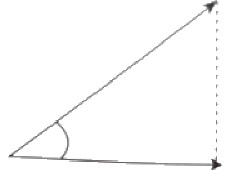
Two bodies are projected with the same velocity. If one is projected at an angle of $30^\circ$ and the other at $45^\circ$ to the horizontal, then the ratio of maximum heights attained is
A
$1:2$
B
$1:\sqrt{2}$
C
$2:1$
D
$1:4$
Solution
(A) The formula for the maximum height $H$ attained by a projectile is $H = \frac{u^2 \sin^2 \theta}{2g}$, where $u$ is the initial velocity and $\theta$ is the angle of projection.
Since $u$ and $g$ are constant for both bodies, the ratio of the maximum heights is given by $\frac{H_1}{H_2} = \frac{\sin^2 \theta_1}{\sin^2 \theta_2}$.
Given $\theta_1 = 30^\circ$ and $\theta_2 = 45^\circ$, we have:
$\frac{H_1}{H_2} = \frac{\sin^2(30^\circ)}{\sin^2(45^\circ)} = \frac{(1/2)^2}{(1/\sqrt{2})^2} = \frac{1/4}{1/2} = \frac{1}{2}$.
Thus, the ratio is $1:2$.
Since $u$ and $g$ are constant for both bodies, the ratio of the maximum heights is given by $\frac{H_1}{H_2} = \frac{\sin^2 \theta_1}{\sin^2 \theta_2}$.
Given $\theta_1 = 30^\circ$ and $\theta_2 = 45^\circ$, we have:
$\frac{H_1}{H_2} = \frac{\sin^2(30^\circ)}{\sin^2(45^\circ)} = \frac{(1/2)^2}{(1/\sqrt{2})^2} = \frac{1/4}{1/2} = \frac{1}{2}$.
Thus, the ratio is $1:2$.
0 likesView Solution
4
PhysicsMediumMCQKCET · 2026
Match the physical quantities in List-$I$ with their dimensional formulas in terms of mass $(M)$, length $(L)$, time $(T)$ and electric current $(A)$ given in List-$II$.
| List-$I$ | List-$II$ |
| $(a)$ Torque | $(i)$ $[M^{-1}L^{-2}T^4A^2]$ |
| $(b)$ Gravitational constant | (ii) $[M^1L^2T^{-1}]$ |
| $(c)$ Capacitance | (iii) $[M^{-1}L^3T^{-2}]$ |
| $(d)$ Planck's constant | (iv) $[M^1L^2T^{-2}]$ |
A
$a-iv, b-iii, c-i, d-ii$
B
$a-iv, b-iii, c-ii, d-i$
C
$a-iv, b-i, c-iii, d-ii$
D
$a-ii, b-i, c-iii, d-iv$
Solution
(A) $1$. Torque $(\tau) = \text{Force} \times \text{distance} = [MLT^{-2}] \times [L] = [ML^2T^{-2}]$. Matches $(iv)$.
$2$. Gravitational constant $(G)$: From $F = G \frac{m_1m_2}{r^2}$, $G = \frac{Fr^2}{m^2} = \frac{[MLT^{-2}][L^2]}{[M^2]} = [M^{-1}L^3T^{-2}]$. Matches $(iii)$.
$3$. Capacitance $(C)$: From $Q = CV$, $C = \frac{Q}{V} = \frac{Q}{W/Q} = \frac{Q^2}{W} = \frac{[AT]^2}{[ML^2T^{-2}]} = [M^{-1}L^{-2}T^4A^2]$. Matches $(i)$.
$4$. Planck's constant $(h)$: From $E = h\nu$, $h = \frac{E}{\nu} = \frac{[ML^2T^{-2}]}{[T^{-1}]} = [ML^2T^{-1}]$. Matches $(ii)$.
Therefore, the correct matching is $a-iv, b-iii, c-i, d-ii$.
$2$. Gravitational constant $(G)$: From $F = G \frac{m_1m_2}{r^2}$, $G = \frac{Fr^2}{m^2} = \frac{[MLT^{-2}][L^2]}{[M^2]} = [M^{-1}L^3T^{-2}]$. Matches $(iii)$.
$3$. Capacitance $(C)$: From $Q = CV$, $C = \frac{Q}{V} = \frac{Q}{W/Q} = \frac{Q^2}{W} = \frac{[AT]^2}{[ML^2T^{-2}]} = [M^{-1}L^{-2}T^4A^2]$. Matches $(i)$.
$4$. Planck's constant $(h)$: From $E = h\nu$, $h = \frac{E}{\nu} = \frac{[ML^2T^{-2}]}{[T^{-1}]} = [ML^2T^{-1}]$. Matches $(ii)$.
Therefore, the correct matching is $a-iv, b-iii, c-i, d-ii$.
0 likesView Solution
5
PhysicsDifficultMCQKCET · 2026
The velocity of a particle moving along the $x$-axis is given by $V = x^2 - 5x + 4$ (in $\text{m/s}$), where $x$ denotes the $x$-coordinate of the particle in metres. The magnitude of the acceleration of the particle when the velocity is zero is:
A
$2 \text{ m/s}^2$
B
$3 \text{ m/s}^2$
C
Zero
D
$1 \text{ m/s}^2$
Solution
(C) The acceleration $a$ is given by $a = V \frac{dV}{dx}$.
Given $V = x^2 - 5x + 4$, we find $\frac{dV}{dx} = 2x - 5$.
Thus, $a = (x^2 - 5x + 4)(2x - 5)$.
Velocity is zero when $x^2 - 5x + 4 = 0$, which implies $(x-1)(x-4) = 0$, so $x = 1 \text{ m}$ or $x = 4 \text{ m}$.
At $x = 1 \text{ m}$, $a = (0)(2(1) - 5) = 0 \text{ m/s}^2$.
At $x = 4 \text{ m}$, $a = (0)(2(4) - 5) = 0 \text{ m/s}^2$.
Therefore, the magnitude of acceleration is zero.
Given $V = x^2 - 5x + 4$, we find $\frac{dV}{dx} = 2x - 5$.
Thus, $a = (x^2 - 5x + 4)(2x - 5)$.
Velocity is zero when $x^2 - 5x + 4 = 0$, which implies $(x-1)(x-4) = 0$, so $x = 1 \text{ m}$ or $x = 4 \text{ m}$.
At $x = 1 \text{ m}$, $a = (0)(2(1) - 5) = 0 \text{ m/s}^2$.
At $x = 4 \text{ m}$, $a = (0)(2(4) - 5) = 0 \text{ m/s}^2$.
Therefore, the magnitude of acceleration is zero.
0 likesView Solution
6
PhysicsDifficultMCQKCET · 2026
$A$ man has a mass of $80 \text{ kg}$. He stands on a weighing scale in a lift which is moving upwards with a uniform acceleration of $6 \text{ m/s}^2$. What would be his apparent weight in $\text{kg}$? (Take $g = 10 \text{ m/s}^2$)
A
Zero
B
$48 \text{ kg}$
C
$120 \text{ kg}$
D
$128 \text{ kg}$
Solution
(D) The apparent weight $W'$ of a person in a lift moving upwards with acceleration $a$ is given by $W' = m(g + a)$.
Given mass $m = 80 \text{ kg}$, acceleration $a = 6 \text{ m/s}^2$, and $g = 10 \text{ m/s}^2$.
$W' = 80 \times (10 + 6) = 80 \times 16 = 1280 \text{ N}$.
To express this apparent weight in $\text{kg}$ (as indicated by the weighing scale), we divide by $g$:
$\text{Apparent weight in kg} = \frac{1280 \text{ N}}{10 \text{ m/s}^2} = 128 \text{ kg}$.
Thus, the correct option is $D$.
Given mass $m = 80 \text{ kg}$, acceleration $a = 6 \text{ m/s}^2$, and $g = 10 \text{ m/s}^2$.
$W' = 80 \times (10 + 6) = 80 \times 16 = 1280 \text{ N}$.
To express this apparent weight in $\text{kg}$ (as indicated by the weighing scale), we divide by $g$:
$\text{Apparent weight in kg} = \frac{1280 \text{ N}}{10 \text{ m/s}^2} = 128 \text{ kg}$.
Thus, the correct option is $D$.
0 likesView Solution
7
PhysicsDifficultMCQKCET · 2026
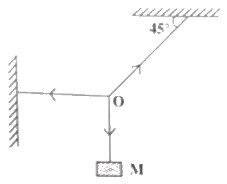
$A$ mass $M$ is suspended by a system of light inextensible strings as shown in the figure. Find the tension in the horizontal string.
A
$\sqrt{2} Mg$
B
$\sqrt{3} Mg$
C
$Mg$
D
$3 Mg$
Solution
(C) Let $T_1$ be the tension in the inclined string, $T_2$ be the tension in the horizontal string, and $T_3$ be the tension in the vertical string supporting mass $M$.
At equilibrium, the vertical string supports the weight, so $T_3 = Mg$.
Resolving forces at junction $O$:
Vertical component: $T_1 \sin 45^\circ = T_3 = Mg$.
$T_1 = \frac{Mg}{\sin 45^\circ} = \sqrt{2} Mg$.
Horizontal component: $T_2 = T_1 \cos 45^\circ$.
$T_2 = (\sqrt{2} Mg) \times \frac{1}{\sqrt{2}} = Mg$.
Thus, the tension in the horizontal string is $Mg$.
At equilibrium, the vertical string supports the weight, so $T_3 = Mg$.
Resolving forces at junction $O$:
Vertical component: $T_1 \sin 45^\circ = T_3 = Mg$.
$T_1 = \frac{Mg}{\sin 45^\circ} = \sqrt{2} Mg$.
Horizontal component: $T_2 = T_1 \cos 45^\circ$.
$T_2 = (\sqrt{2} Mg) \times \frac{1}{\sqrt{2}} = Mg$.
Thus, the tension in the horizontal string is $Mg$.
0 likesView Solution
8
PhysicsMediumMCQKCET · 2026
Two bodies with kinetic energies in the ratio of $3:1$ are moving with equal linear momentum. The ratio of their masses is
A
$1:4$
B
$1:3$
C
$1:2$
D
$1:1$
Solution
(B) The kinetic energy $K$ of a body with linear momentum $p$ and mass $m$ is given by $K = \frac{p^2}{2m}$.
Since the linear momentum $p$ is constant for both bodies, we have $K \propto \frac{1}{m}$.
Therefore, the ratio of masses is $\frac{m_1}{m_2} = \frac{K_2}{K_1}$.
Given the ratio of kinetic energies $\frac{K_1}{K_2} = \frac{3}{1}$, we substitute this into the equation:
$\frac{m_1}{m_2} = \frac{1}{3}$.
Thus, the ratio of their masses is $1:3$.
Since the linear momentum $p$ is constant for both bodies, we have $K \propto \frac{1}{m}$.
Therefore, the ratio of masses is $\frac{m_1}{m_2} = \frac{K_2}{K_1}$.
Given the ratio of kinetic energies $\frac{K_1}{K_2} = \frac{3}{1}$, we substitute this into the equation:
$\frac{m_1}{m_2} = \frac{1}{3}$.
Thus, the ratio of their masses is $1:3$.
0 likesView Solution
9
PhysicsDifficultMCQKCET · 2026
$A$ horizontal force of $5 \text{ N}$ is applied on a body of mass $5 \text{ kg}$, which is initially at rest on a frictionless table. What is the change in kinetic energy of the body after $10 \text{ s}$?
A
$25 \text{ J}$
B
Zero
C
$125 \text{ J}$
D
$250 \text{ J}$
Solution
(D) Step $1$: Calculate the acceleration using Newton's second law: $a = \frac{F}{m} = \frac{5 \text{ N}}{5 \text{ kg}} = 1 \text{ m/s}^2$.
Step $2$: Calculate the final velocity after $t = 10 \text{ s}$ using $v = u + at$: $v = 0 + (1 \text{ m/s}^2)(10 \text{ s}) = 10 \text{ m/s}$.
Step $3$: Calculate the change in kinetic energy: $\Delta K = K_f - K_i = \frac{1}{2}mv^2 - 0 = \frac{1}{2} \times 5 \text{ kg} \times (10 \text{ m/s})^2 = \frac{1}{2} \times 5 \times 100 = 250 \text{ J}$.
Step $2$: Calculate the final velocity after $t = 10 \text{ s}$ using $v = u + at$: $v = 0 + (1 \text{ m/s}^2)(10 \text{ s}) = 10 \text{ m/s}$.
Step $3$: Calculate the change in kinetic energy: $\Delta K = K_f - K_i = \frac{1}{2}mv^2 - 0 = \frac{1}{2} \times 5 \text{ kg} \times (10 \text{ m/s})^2 = \frac{1}{2} \times 5 \times 100 = 250 \text{ J}$.
0 likesView Solution
10
PhysicsMediumMCQKCET · 2026
The angular momentum of a moving body remains constant, if
A
net external force is applied
B
net pressure is applied
C
net external torque is applied
D
net external torque is not applied
Solution
(D) The relationship between torque $\vec{\tau}$ and angular momentum $\vec{L}$ is given by $\vec{\tau} = \frac{d\vec{L}}{dt}$.
If the net external torque acting on a body is zero $(\vec{\tau} = 0)$, then $\frac{d\vec{L}}{dt} = 0$.
This implies that the angular momentum $\vec{L}$ remains constant over time.
If the net external torque acting on a body is zero $(\vec{\tau} = 0)$, then $\frac{d\vec{L}}{dt} = 0$.
This implies that the angular momentum $\vec{L}$ remains constant over time.
0 likesView Solution
11
PhysicsDifficultMCQKCET · 2026
If the earth were to suddenly contract to half of its present radius, what would be the duration of the day (in $text{ h}$)?
A
$6$
B
$18$
C
$24$
D
$30$
Solution
(A) According to the law of conservation of angular momentum, $L = I\omega = \text{constant}$.
Since $I = \frac{2}{5}MR^2$ and $\omega = \frac{2\pi}{T}$, we have $I_1 \omega_1 = I_2 \omega_2$.
Substituting the values: $\frac{2}{5}MR^2 \left(\frac{2\pi}{T_1}\right) = \frac{2}{5}M\left(\frac{R}{2}\right)^2 \left(\frac{2\pi}{T_2}\right)$.
Simplifying the equation: $\frac{R^2}{T_1} = \frac{R^2}{4T_2}$.
Thus, $T_2 = \frac{T_1}{4}$.
Given $T_1 = 24 \text{ h}$, the new duration $T_2 = \frac{24}{4} = 6 \text{ h}$.
Since $I = \frac{2}{5}MR^2$ and $\omega = \frac{2\pi}{T}$, we have $I_1 \omega_1 = I_2 \omega_2$.
Substituting the values: $\frac{2}{5}MR^2 \left(\frac{2\pi}{T_1}\right) = \frac{2}{5}M\left(\frac{R}{2}\right)^2 \left(\frac{2\pi}{T_2}\right)$.
Simplifying the equation: $\frac{R^2}{T_1} = \frac{R^2}{4T_2}$.
Thus, $T_2 = \frac{T_1}{4}$.
Given $T_1 = 24 \text{ h}$, the new duration $T_2 = \frac{24}{4} = 6 \text{ h}$.
0 likesView Solution
12
PhysicsDifficultMCQKCET · 2026
Imagine a new planet having the same density as that of the earth, but it is two times bigger than the earth in size (radius). If the acceleration due to gravity on the surface of the new planet is $g'$ and that on the surface of the earth is $g$, then:
A
$g' = g/4$
B
$g' = 8g$
C
$g' = 2g$
D
$g' = 4g$
Solution
(C) The acceleration due to gravity $g$ on the surface of a planet is given by $g = \frac{GM}{R^2}$.
Since $M = \text{density} (\rho) \times \text{volume} (V) = \rho \times \frac{4}{3} \pi R^3$, we can write $g = \frac{G \rho \frac{4}{3} \pi R^3}{R^2} = \frac{4}{3} \pi G \rho R$.
For the earth, $g = \frac{4}{3} \pi G \rho R$.
For the new planet, $g' = \frac{4}{3} \pi G \rho (2R) = 2 \times (\frac{4}{3} \pi G \rho R) = 2g$.
Therefore, $g' = 2g$.
Since $M = \text{density} (\rho) \times \text{volume} (V) = \rho \times \frac{4}{3} \pi R^3$, we can write $g = \frac{G \rho \frac{4}{3} \pi R^3}{R^2} = \frac{4}{3} \pi G \rho R$.
For the earth, $g = \frac{4}{3} \pi G \rho R$.
For the new planet, $g' = \frac{4}{3} \pi G \rho (2R) = 2 \times (\frac{4}{3} \pi G \rho R) = 2g$.
Therefore, $g' = 2g$.
0 likesView Solution
13
PhysicsDifficultMCQKCET · 2026
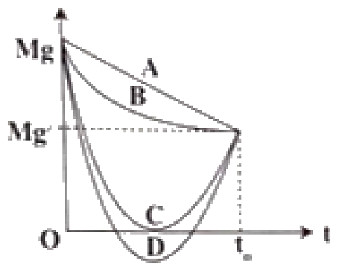
Suppose the acceleration due to gravity at the earth’s surface is $g \text{ m/s}^2$ and at the surface of the moon it is $g' \text{ m/s}^2$. An $M \text{ kg}$ passenger travels from the earth to the moon in a spaceship moving with a constant velocity. Neglecting all other celestial objects, which curve best represents the net gravitational force on the passenger as a function of time?
A
$A$
B
$B$
C
$C$
D
$D$
Solution
(C) Let $M_e$ and $R_e$ be the mass and radius of the earth, and $M_m$ and $R_m$ be the mass and radius of the moon. Let $D$ be the distance between the centers of the earth and the moon.
If the spaceship is at a distance $x$ from the center of the earth, the net gravitational force $F$ on the passenger of mass $M$ is given by $F = \frac{G M_e M}{x^2} - \frac{G M_m M}{(D-x)^2}$.
Since the spaceship moves with constant velocity $v$, $x = vt$. Thus, $F(t) = G M \left( \frac{M_e}{(vt)^2} - \frac{M_m}{(D-vt)^2} \right)$.
At $t=0$ (on Earth's surface), $F = Mg$. At $t=t_m$ (on Moon's surface), $F = Mg'$.
Between the Earth and the Moon, there exists a point (neutral point) where the gravitational pull of the Earth and the Moon cancel each other out, meaning $F=0$. This occurs at some time $t$ between $0$ and $t_m$.
Curve $C$ is the only one that shows the force decreasing from $Mg$, reaching zero at the neutral point, and then increasing to $Mg'$ at the moon's surface.
If the spaceship is at a distance $x$ from the center of the earth, the net gravitational force $F$ on the passenger of mass $M$ is given by $F = \frac{G M_e M}{x^2} - \frac{G M_m M}{(D-x)^2}$.
Since the spaceship moves with constant velocity $v$, $x = vt$. Thus, $F(t) = G M \left( \frac{M_e}{(vt)^2} - \frac{M_m}{(D-vt)^2} \right)$.
At $t=0$ (on Earth's surface), $F = Mg$. At $t=t_m$ (on Moon's surface), $F = Mg'$.
Between the Earth and the Moon, there exists a point (neutral point) where the gravitational pull of the Earth and the Moon cancel each other out, meaning $F=0$. This occurs at some time $t$ between $0$ and $t_m$.
Curve $C$ is the only one that shows the force decreasing from $Mg$, reaching zero at the neutral point, and then increasing to $Mg'$ at the moon's surface.
0 likesView Solution
14
PhysicsMediumMCQKCET · 2026
The instrument fitted in the carburetor of an automobile to provide the correct mixture of air and fuel necessary for combustion works on which of the following principles?
A
Pascal’s Law
B
Bernoulli’s Principle
C
Newton’s Law of Cooling
D
Archimedes’ Principle
Solution
(B) Step $1$: The carburetor of an automobile uses a venturi tube to mix air and fuel.
Step $2$: As air flows through the constricted part of the venturi, its velocity increases, which causes a decrease in pressure according to Bernoulli's Principle.
Step $3$: This low-pressure region draws fuel into the air stream, creating the required air-fuel mixture for combustion.
Step $4$: Therefore, the operation of the carburetor is based on Bernoulli’s Principle.
Step $2$: As air flows through the constricted part of the venturi, its velocity increases, which causes a decrease in pressure according to Bernoulli's Principle.
Step $3$: This low-pressure region draws fuel into the air stream, creating the required air-fuel mixture for combustion.
Step $4$: Therefore, the operation of the carburetor is based on Bernoulli’s Principle.
0 likesView Solution
15
PhysicsDifficultMCQKCET · 2026
There are two wires of the same material and same length. The diameter of the second wire is two times the diameter of the first wire. What is the ratio of the extensions produced in the wires by applying the same load?
A
$1:4$
B
$4:1$
C
$1:2$
D
$2:1$
Solution
(B) The extension $\Delta L$ in a wire is given by $\Delta L = \frac{FL}{AY}$, where $F$ is the load, $L$ is the length, $A$ is the cross-sectional area, and $Y$ is Young's modulus.
Since $A = \pi r^2 = \pi (d/2)^2 = \frac{\pi d^2}{4}$, we have $\Delta L = \frac{4FL}{\pi d^2 Y}$.
For the same material ($Y$ is constant) and same length ($L$ is constant) and same load ($F$ is constant), $\Delta L \propto \frac{1}{d^2}$.
Let $d_1 = d$ and $d_2 = 2d$. Then $\frac{\Delta L_1}{\Delta L_2} = \frac{d_2^2}{d_1^2} = \frac{(2d)^2}{d^2} = \frac{4d^2}{d^2} = 4:1$.
Since $A = \pi r^2 = \pi (d/2)^2 = \frac{\pi d^2}{4}$, we have $\Delta L = \frac{4FL}{\pi d^2 Y}$.
For the same material ($Y$ is constant) and same length ($L$ is constant) and same load ($F$ is constant), $\Delta L \propto \frac{1}{d^2}$.
Let $d_1 = d$ and $d_2 = 2d$. Then $\frac{\Delta L_1}{\Delta L_2} = \frac{d_2^2}{d_1^2} = \frac{(2d)^2}{d^2} = \frac{4d^2}{d^2} = 4:1$.
0 likesView Solution
16
PhysicsDifficultMCQKCET · 2026
In a capillary tube experiment, a vertical $30 \text{ cm}$ long capillary tube is dipped in water. Water rises up to a height of $10 \text{ cm}$ due to capillarity. If this experiment is conducted in a freely falling elevator, then the length of the water column becomes
A
$10 \text{ cm}$
B
$20 \text{ cm}$
C
$30 \text{ cm}$
D
Zero
Solution
(C) The height of the liquid column in a capillary tube is given by the formula $h = \frac{2T \cos \theta}{r \rho g}$, where $T$ is surface tension, $\theta$ is the contact angle, $r$ is the radius of the tube, $\rho$ is the density of the liquid, and $g$ is the acceleration due to gravity.
In a freely falling elevator, the effective acceleration due to gravity $g_{\text{eff}} = g - a$. Since the elevator is in free fall, $a = g$, therefore $g_{\text{eff}} = 0$.
As $h \propto \frac{1}{g_{\text{eff}}}$, when $g_{\text{eff}} = 0$, the height $h$ tends to infinity.
However, the water will rise until it reaches the top of the capillary tube. Since the tube is $30 \text{ cm}$ long, the water column will fill the entire tube.
In a freely falling elevator, the effective acceleration due to gravity $g_{\text{eff}} = g - a$. Since the elevator is in free fall, $a = g$, therefore $g_{\text{eff}} = 0$.
As $h \propto \frac{1}{g_{\text{eff}}}$, when $g_{\text{eff}} = 0$, the height $h$ tends to infinity.
However, the water will rise until it reaches the top of the capillary tube. Since the tube is $30 \text{ cm}$ long, the water column will fill the entire tube.
0 likesView Solution
17
PhysicsMediumMCQKCET · 2026
In thermodynamic processes, which of the following statements is not true?
A
In an isothermal process, the temperature remains constant
B
In an isobaric process, the volume remains constant
C
In an adiabatic process, the system is insulated from the surroundings
D
In an adiabatic process, $PV^\gamma = \text{constant}$
Solution
(B) Step $1$: An isothermal process is defined by constant temperature $(T = \text{constant})$.
Step $2$: An isobaric process is defined by constant pressure $(P = \text{constant})$, not constant volume. $A$ process with constant volume is called an isochoric process.
Step $3$: An adiabatic process is one where no heat is exchanged with the surroundings $(Q = 0)$, which implies the system is thermally insulated. The relation $PV^\gamma = \text{constant}$ holds for adiabatic processes of an ideal gas.
Step $4$: Therefore, the statement that volume remains constant in an isobaric process is false.
Step $2$: An isobaric process is defined by constant pressure $(P = \text{constant})$, not constant volume. $A$ process with constant volume is called an isochoric process.
Step $3$: An adiabatic process is one where no heat is exchanged with the surroundings $(Q = 0)$, which implies the system is thermally insulated. The relation $PV^\gamma = \text{constant}$ holds for adiabatic processes of an ideal gas.
Step $4$: Therefore, the statement that volume remains constant in an isobaric process is false.
0 likesView Solution
18
PhysicsMediumMCQKCET · 2026
The graph of pressure $P$ and volume $V$ of $1 \text{ mole}$ of an ideal gas at constant temperature is:
A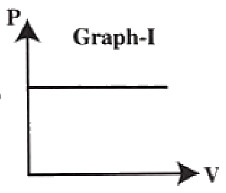
B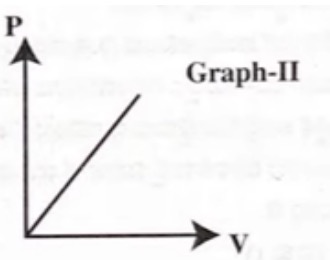
C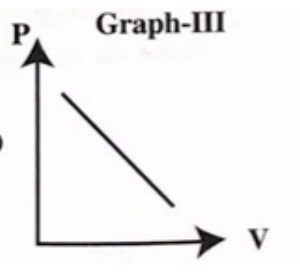
D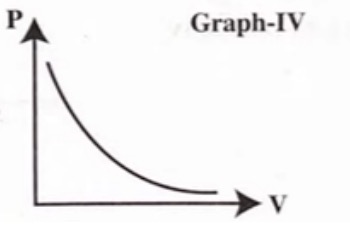
Solution
(D) According to Boyle's Law, for a fixed amount of an ideal gas at constant temperature, the product of pressure $P$ and volume $V$ is constant, i.e., $PV = \text{constant}$.
This implies $P = \frac{\text{constant}}{V}$, which means $P \propto \frac{1}{V}$.
The graph of $P$ versus $V$ for this relationship is a rectangular hyperbola, which corresponds to Graph-$IV$.
This implies $P = \frac{\text{constant}}{V}$, which means $P \propto \frac{1}{V}$.
The graph of $P$ versus $V$ for this relationship is a rectangular hyperbola, which corresponds to Graph-$IV$.
0 likesView Solution
19
PhysicsDifficultMCQKCET · 2026
$A$ mass of $1 \text{ kg}$ is executing $SHM$. Its displacement is given by $x = 6.0 \cos(100t + \pi/4) \text{ cm}$. What is the maximum kinetic energy (in $text{ J}$)?
A
$3$
B
$6$
C
$9$
D
$18$
Solution
(D) The maximum kinetic energy is given by $K_{max} = \frac{1}{2} m \omega^2 A^2$.
Given: mass $m = 1 \text{ kg}$, angular frequency $\omega = 100 \text{ rad/s}$, and amplitude $A = 6.0 \text{ cm} = 0.06 \text{ m}$.
Substituting the values:
$K_{max} = \frac{1}{2} \times 1 \text{ kg} \times (100 \text{ rad/s})^2 \times (0.06 \text{ m})^2$
$K_{max} = 0.5 \times 10000 \times 0.0036$
$K_{max} = 18 \text{ J}$.
Given: mass $m = 1 \text{ kg}$, angular frequency $\omega = 100 \text{ rad/s}$, and amplitude $A = 6.0 \text{ cm} = 0.06 \text{ m}$.
Substituting the values:
$K_{max} = \frac{1}{2} \times 1 \text{ kg} \times (100 \text{ rad/s})^2 \times (0.06 \text{ m})^2$
$K_{max} = 0.5 \times 10000 \times 0.0036$
$K_{max} = 18 \text{ J}$.
0 likesView Solution
20
PhysicsDifficultMCQKCET · 2026
$A$ source of frequency $\nu$ gives $6 \text{ beats/second}$ when sounded with a source of frequency $200 \text{ Hz}$. The second harmonic of frequency $2\nu$ of the source gives $8 \text{ beats/second}$ when sounded with a source of frequency $420 \text{ Hz}$. The value of $\nu$ is (in $text{ Hz}$)
A
$205$
B
$206$
C
$195$
D
$210$
Solution
(B) Step $1$: From the first condition, the beat frequency is $|\nu - 200| = 6$. This implies $\nu = 200 \pm 6$, so $\nu = 206 \text{ Hz}$ or $\nu = 194 \text{ Hz}$.
Step $2$: From the second condition, the beat frequency for the second harmonic $2\nu$ is $|2\nu - 420| = 8$. This implies $2\nu = 420 \pm 8$, so $2\nu = 428 \text{ Hz}$ or $2\nu = 412 \text{ Hz}$.
Step $3$: Solving for $\nu$ in the second condition gives $\nu = 214 \text{ Hz}$ or $\nu = 206 \text{ Hz}$.
Step $4$: Comparing the results from both conditions, the common value is $\nu = 206 \text{ Hz}$.
Step $2$: From the second condition, the beat frequency for the second harmonic $2\nu$ is $|2\nu - 420| = 8$. This implies $2\nu = 420 \pm 8$, so $2\nu = 428 \text{ Hz}$ or $2\nu = 412 \text{ Hz}$.
Step $3$: Solving for $\nu$ in the second condition gives $\nu = 214 \text{ Hz}$ or $\nu = 206 \text{ Hz}$.
Step $4$: Comparing the results from both conditions, the common value is $\nu = 206 \text{ Hz}$.
0 likesView Solution
21
PhysicsMediumMCQKCET · 2026
Following are statements of a few processes taking place in nature:
$I$. Free expansion of a gas
$II$. The combustion of a mixture of petrol and air ignited by a spark
$III$. The leaking of gas from the kitchen cylinder
$IV$. The transfer of heat from one heated part of a liquid to the other colder part
Which amongst these processes are irreversible in nature?
$I$. Free expansion of a gas
$II$. The combustion of a mixture of petrol and air ignited by a spark
$III$. The leaking of gas from the kitchen cylinder
$IV$. The transfer of heat from one heated part of a liquid to the other colder part
Which amongst these processes are irreversible in nature?
A
$I$ and $II$
B
$III$ and $IV$
C
$II$, $III$ and $IV$
D
$I$, $II$, $III$ and $IV$
Solution
(D) $1$. Free expansion of a gas is a spontaneous process where the system cannot return to its initial state without external work, making it irreversible.
$2$. Combustion is a chemical reaction that is highly exothermic and spontaneous, making it irreversible.
$3$. Gas leakage from a cylinder is a spontaneous expansion process that cannot be reversed spontaneously.
$4$. Heat transfer from a hotter body to a colder body is a spontaneous process that increases the entropy of the universe, making it irreversible.
Therefore, all the listed processes ($I$, $II$, $III$, and $IV$) are irreversible in nature.
$2$. Combustion is a chemical reaction that is highly exothermic and spontaneous, making it irreversible.
$3$. Gas leakage from a cylinder is a spontaneous expansion process that cannot be reversed spontaneously.
$4$. Heat transfer from a hotter body to a colder body is a spontaneous process that increases the entropy of the universe, making it irreversible.
Therefore, all the listed processes ($I$, $II$, $III$, and $IV$) are irreversible in nature.
0 likesView Solution
22
PhysicsDifficultMCQKCET · 2026
An electron falls from rest through a distance of $1.5 \text{ cm}$ in a uniform electric field of magnitude $2.0 \times 10^4 \text{ N/C}$. The time taken to cover this distance in seconds is . . . . . . . $(e = 1.6 \times 10^{-19} \text{ C}, m_e = 9.11 \times 10^{-31} \text{ kg})$
A
$2.9 \times 10^{-9}$
B
$2.9 \times 10^9$
C
$4 \times 10^{-6}$
D
$4 \times 10^6$
Solution
(A) $1$. The force on the electron is $F = eE = (1.6 \times 10^{-19} \text{ C})(2.0 \times 10^4 \text{ N/C}) = 3.2 \times 10^{-15} \text{ N}$.
$2$. The acceleration of the electron is $a = \frac{F}{m_e} = \frac{3.2 \times 10^{-15} \text{ N}}{9.11 \times 10^{-31} \text{ kg}} \approx 3.51 \times 10^{15} \text{ m/s}^2$.
$3$. Using the equation of motion $s = ut + \frac{1}{2}at^2$, where $u = 0$ and $s = 1.5 \text{ cm} = 0.015 \text{ m}$:
$0.015 = 0 + \frac{1}{2}(3.51 \times 10^{15})t^2$.
$4$. $t^2 = \frac{2 \times 0.015}{3.51 \times 10^{15}} = \frac{0.03}{3.51 \times 10^{15}} \approx 8.55 \times 10^{-18} \text{ s}^2$.
$5$. $t = \sqrt{8.55 \times 10^{-18}} \approx 2.92 \times 10^{-9} \text{ s}$.
$2$. The acceleration of the electron is $a = \frac{F}{m_e} = \frac{3.2 \times 10^{-15} \text{ N}}{9.11 \times 10^{-31} \text{ kg}} \approx 3.51 \times 10^{15} \text{ m/s}^2$.
$3$. Using the equation of motion $s = ut + \frac{1}{2}at^2$, where $u = 0$ and $s = 1.5 \text{ cm} = 0.015 \text{ m}$:
$0.015 = 0 + \frac{1}{2}(3.51 \times 10^{15})t^2$.
$4$. $t^2 = \frac{2 \times 0.015}{3.51 \times 10^{15}} = \frac{0.03}{3.51 \times 10^{15}} \approx 8.55 \times 10^{-18} \text{ s}^2$.
$5$. $t = \sqrt{8.55 \times 10^{-18}} \approx 2.92 \times 10^{-9} \text{ s}$.
0 likesView Solution
23
PhysicsDifficultMCQKCET · 2026
What will be the total electric flux through the faces of the cube of side length '$a$' if a charge '$Q$' is placed at '$B$', the midpoint of an edge of the cube (see figure)?
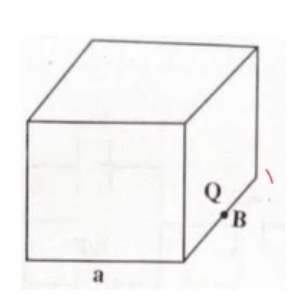
A
$\frac{Q}{8\epsilon_0}$
B
$\frac{Q}{3\epsilon_0}$
C
$\frac{Q}{4\epsilon_0}$
D
$\frac{Q}{2\epsilon_0}$
Solution
(C) According to Gauss's Law, the total electric flux through a closed surface is $\Phi = \frac{q_{enclosed}}{\epsilon_0}$.
To calculate the flux through the cube, we must enclose the charge '$Q$' completely.
An edge of a cube is shared by $4$ identical cubes in a symmetric arrangement.
Therefore, the charge '$Q$' placed at the midpoint of an edge is shared equally by $4$ such cubes.
The flux through one such cube is $\Phi = \frac{1}{4} \times \frac{Q}{\epsilon_0} = \frac{Q}{4\epsilon_0}$.
To calculate the flux through the cube, we must enclose the charge '$Q$' completely.
An edge of a cube is shared by $4$ identical cubes in a symmetric arrangement.
Therefore, the charge '$Q$' placed at the midpoint of an edge is shared equally by $4$ such cubes.
The flux through one such cube is $\Phi = \frac{1}{4} \times \frac{Q}{\epsilon_0} = \frac{Q}{4\epsilon_0}$.
0 likesView Solution
24
PhysicsMediumMCQKCET · 2026
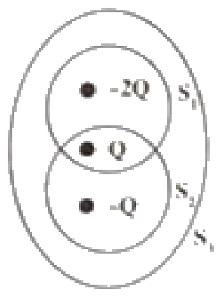
Consider three point charges $-2Q$, $Q$ and $-Q$ and three surfaces $S_1$, $S_2$ and $S_3$. Match the entries of List-$I$ with that of List-$II$ using Gauss's Law.
| List-$I$ | List-$II$ |
| $(a)$ Net flux through $S_1$ | $(i)$ $\frac{-2Q}{\epsilon_0}$ |
| $(b)$ Net flux through $S_2$ | (ii) $\frac{-Q}{\epsilon_0}$ |
| $(c)$ Net flux through $S_3$ | (iii) Zero |
A
$a-ii, b-i, c-iii$
B
$a-iii, b-ii, c-i$
C
$a-i, b-ii, c-iii$
D
$a-ii, b-iii, c-i$
Solution
(D) According to Gauss's Law, the net electric flux $\phi$ through a closed surface is given by $\phi = \frac{q_{enclosed}}{\epsilon_0}$.
$(a)$ Surface $S_1$ encloses charge $-2Q$ and $Q$. Net charge $q_{enclosed} = -2Q + Q = -Q$. Thus, flux $\phi_1 = \frac{-Q}{\epsilon_0}$. This matches (ii).
$(b)$ Surface $S_2$ encloses charge $Q$ and $-Q$. Net charge $q_{enclosed} = Q + (-Q) = 0$. Thus, flux $\phi_2 = 0$. This matches (iii).
$(c)$ Surface $S_3$ encloses all three charges $-2Q$, $Q$ and $-Q$. Net charge $q_{enclosed} = -2Q + Q - Q = -2Q$. Thus, flux $\phi_3 = \frac{-2Q}{\epsilon_0}$. This matches $(i)$.
Therefore, the correct matching is $a-ii, b-iii, c-i$.
$(a)$ Surface $S_1$ encloses charge $-2Q$ and $Q$. Net charge $q_{enclosed} = -2Q + Q = -Q$. Thus, flux $\phi_1 = \frac{-Q}{\epsilon_0}$. This matches (ii).
$(b)$ Surface $S_2$ encloses charge $Q$ and $-Q$. Net charge $q_{enclosed} = Q + (-Q) = 0$. Thus, flux $\phi_2 = 0$. This matches (iii).
$(c)$ Surface $S_3$ encloses all three charges $-2Q$, $Q$ and $-Q$. Net charge $q_{enclosed} = -2Q + Q - Q = -2Q$. Thus, flux $\phi_3 = \frac{-2Q}{\epsilon_0}$. This matches $(i)$.
Therefore, the correct matching is $a-ii, b-iii, c-i$.
0 likesView Solution
25
PhysicsMediumMCQKCET · 2026
$A$ parallel plate capacitor has a uniform electric field '$E$' in the space between the plates. If the distance between the plates is '$d$' and the area of each plate is '$A$', what is the energy stored in the capacitor?
A
$\frac{1}{2}\epsilon_0 E^2$
B
$\epsilon_0 EAd$
C
$\frac{1}{2}\epsilon_0 E^2 Ad$
D
$\frac{E^2 Ad}{\epsilon_0}$
Solution
(C) The energy density '$u$' in a region with an electric field '$E$' is given by $u = \frac{1}{2} \epsilon_0 E^2$.
Total energy '$U$' stored in the capacitor is the product of energy density and the volume '$V$' of the space between the plates.
The volume '$V$' is given by $V = A \times d$.
Therefore, the total energy stored is $U = u \times V = (\frac{1}{2} \epsilon_0 E^2) \times (Ad) = \frac{1}{2} \epsilon_0 E^2 Ad$.
Total energy '$U$' stored in the capacitor is the product of energy density and the volume '$V$' of the space between the plates.
The volume '$V$' is given by $V = A \times d$.
Therefore, the total energy stored is $U = u \times V = (\frac{1}{2} \epsilon_0 E^2) \times (Ad) = \frac{1}{2} \epsilon_0 E^2 Ad$.
0 likesView Solution
26
PhysicsDifficultMCQKCET · 2026
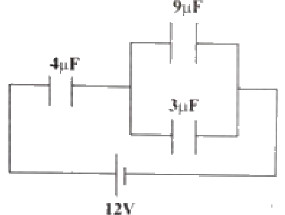
In the given circuit, the potential difference across the $4 \mu\text{F}$ capacitor is (in $text{ V}$)
A
$3$
B
$4$
C
$9$
D
$12$
Solution
(C) $1$. The circuit consists of a $4 \mu\text{F}$ capacitor in series with a parallel combination of $9 \mu\text{F}$ and $3 \mu\text{F}$ capacitors.
$2$. The equivalent capacitance of the parallel part is $C_p = 9 \mu\text{F} + 3 \mu\text{F} = 12 \mu\text{F}$.
$3$. The total equivalent capacitance $C_{eq}$ of the circuit is given by $\frac{1}{C_{eq}} = \frac{1}{4 \mu\text{F}} + \frac{1}{12 \mu\text{F}} = \frac{3+1}{12 \mu\text{F}} = \frac{4}{12 \mu\text{F}} = \frac{1}{3 \mu\text{F}}$. Thus, $C_{eq} = 3 \mu\text{F}$.
$4$. The total charge $Q$ supplied by the $12 \text{ V}$ battery is $Q = C_{eq} \times V = 3 \mu\text{F} \times 12 \text{ V} = 36 \mu\text{C}$.
$5$. This charge $Q$ flows through the $4 \mu\text{F}$ capacitor. The potential difference $V_1$ across the $4 \mu\text{F}$ capacitor is $V_1 = \frac{Q}{C_1} = \frac{36 \mu\text{C}}{4 \mu\text{F}} = 9 \text{ V}$.
$2$. The equivalent capacitance of the parallel part is $C_p = 9 \mu\text{F} + 3 \mu\text{F} = 12 \mu\text{F}$.
$3$. The total equivalent capacitance $C_{eq}$ of the circuit is given by $\frac{1}{C_{eq}} = \frac{1}{4 \mu\text{F}} + \frac{1}{12 \mu\text{F}} = \frac{3+1}{12 \mu\text{F}} = \frac{4}{12 \mu\text{F}} = \frac{1}{3 \mu\text{F}}$. Thus, $C_{eq} = 3 \mu\text{F}$.
$4$. The total charge $Q$ supplied by the $12 \text{ V}$ battery is $Q = C_{eq} \times V = 3 \mu\text{F} \times 12 \text{ V} = 36 \mu\text{C}$.
$5$. This charge $Q$ flows through the $4 \mu\text{F}$ capacitor. The potential difference $V_1$ across the $4 \mu\text{F}$ capacitor is $V_1 = \frac{Q}{C_1} = \frac{36 \mu\text{C}}{4 \mu\text{F}} = 9 \text{ V}$.
0 likesView Solution
27
PhysicsMediumMCQKCET · 2026
An electric dipole of dipole moment $\vec{P}$ is placed in a uniform electric field $\vec{E}$. Which of the following statements are correct?
Statement $I$: The torque on the dipole is $\vec{\tau} = \vec{P} \times \vec{E}$
Statement $II$: The potential energy of the dipole is $U = -\vec{P} \cdot \vec{E}$
Statement $III$: The net force on the dipole is non-zero
Statement $I$: The torque on the dipole is $\vec{\tau} = \vec{P} \times \vec{E}$
Statement $II$: The potential energy of the dipole is $U = -\vec{P} \cdot \vec{E}$
Statement $III$: The net force on the dipole is non-zero
A
$I$, $II$ and $III$
B
$I$ and $II$
C
$II$ and $III$
D
$I$ and $III$
Solution
(B) Step $1$: The torque $\vec{\tau}$ on an electric dipole in a uniform electric field is given by the cross product $\vec{P} \times \vec{E}$. Thus, Statement $I$ is correct.
Step $2$: The potential energy $U$ of an electric dipole in a uniform electric field is defined as $U = -\vec{P} \cdot \vec{E}$. Thus, Statement $II$ is correct.
Step $3$: In a uniform electric field, the force on the positive charge is $q\vec{E}$ and on the negative charge is $-q\vec{E}$. The net force is $q\vec{E} + (-q\vec{E}) = 0$. Thus, Statement $III$ is incorrect.
Step $4$: Since only Statement $I$ and Statement $II$ are correct, option $B$ is the correct answer.
Step $2$: The potential energy $U$ of an electric dipole in a uniform electric field is defined as $U = -\vec{P} \cdot \vec{E}$. Thus, Statement $II$ is correct.
Step $3$: In a uniform electric field, the force on the positive charge is $q\vec{E}$ and on the negative charge is $-q\vec{E}$. The net force is $q\vec{E} + (-q\vec{E}) = 0$. Thus, Statement $III$ is incorrect.
Step $4$: Since only Statement $I$ and Statement $II$ are correct, option $B$ is the correct answer.
0 likesView Solution
28
PhysicsDifficultMCQKCET · 2026
$A$ $200 \text{ J}$ of work is done in moving a charge of $5 \text{ C}$ from a point $A$ where the potential is $-20 \text{ V}$ to another point $B$ where the potential is $V \text{ V}$. The value of $V$ at point $B$ is: (in $text{ V}$)
A
$10$
B
$20$
C
$40$
D
$60$
Solution
(B) The work done $W$ in moving a charge $q$ from point $A$ to point $B$ is given by $W = q(V_B - V_A)$.
Given: $W = 200 \text{ J}$, $q = 5 \text{ C}$, $V_A = -20 \text{ V}$, $V_B = V$.
Substituting the values: $200 = 5 \times (V - (-20))$.
$200 = 5 \times (V + 20)$.
$40 = V + 20$.
$V = 40 - 20 = 20 \text{ V}$.
Thus, the potential at point $B$ is $20 \text{ V}$.
Given: $W = 200 \text{ J}$, $q = 5 \text{ C}$, $V_A = -20 \text{ V}$, $V_B = V$.
Substituting the values: $200 = 5 \times (V - (-20))$.
$200 = 5 \times (V + 20)$.
$40 = V + 20$.
$V = 40 - 20 = 20 \text{ V}$.
Thus, the potential at point $B$ is $20 \text{ V}$.
0 likesView Solution
29
PhysicsMediumMCQKCET · 2026
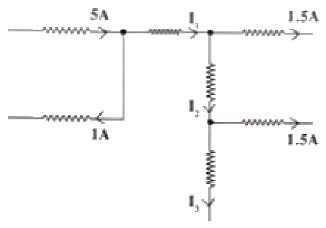
In the given circuit, the values of currents $I_1$, $I_2$ and $I_3$ respectively are:
A
$6 \text{ A}, 1.5 \text{ A}$ and $1 \text{ A}$
B
$4 \text{ A}, 2.5 \text{ A}$ and $2 \text{ A}$
C
$4 \text{ A}, 2.5 \text{ A}$ and $1 \text{ A}$
D
$6 \text{ A}, 4.5 \text{ A}$ and $1.5 \text{ A}$
Solution
(C) Applying Kirchhoff's Current Law $(KCL)$ at the nodes:
$1$. At the first junction: The incoming current is $5 \text{ A}$ and one outgoing branch is $1 \text{ A}$. Thus, the current entering the next part of the circuit is $I_1 = 5 \text{ A} - 1 \text{ A} = 4 \text{ A}$.
$2$. At the second junction: The incoming current is $I_1 = 4 \text{ A}$. Outgoing currents are $1.5 \text{ A}$ and $I_2$. Thus, $4 \text{ A} = 1.5 \text{ A} + I_2$, which gives $I_2 = 2.5 \text{ A}$.
$3$. At the third junction: The incoming current is $I_2 = 2.5 \text{ A}$. Outgoing currents are $1.5 \text{ A}$ and $I_3$. Thus, $2.5 \text{ A} = 1.5 \text{ A} + I_3$, which gives $I_3 = 1 \text{ A}$.
Therefore, the values are $I_1 = 4 \text{ A}$, $I_2 = 2.5 \text{ A}$, and $I_3 = 1 \text{ A}$.
$1$. At the first junction: The incoming current is $5 \text{ A}$ and one outgoing branch is $1 \text{ A}$. Thus, the current entering the next part of the circuit is $I_1 = 5 \text{ A} - 1 \text{ A} = 4 \text{ A}$.
$2$. At the second junction: The incoming current is $I_1 = 4 \text{ A}$. Outgoing currents are $1.5 \text{ A}$ and $I_2$. Thus, $4 \text{ A} = 1.5 \text{ A} + I_2$, which gives $I_2 = 2.5 \text{ A}$.
$3$. At the third junction: The incoming current is $I_2 = 2.5 \text{ A}$. Outgoing currents are $1.5 \text{ A}$ and $I_3$. Thus, $2.5 \text{ A} = 1.5 \text{ A} + I_3$, which gives $I_3 = 1 \text{ A}$.
Therefore, the values are $I_1 = 4 \text{ A}$, $I_2 = 2.5 \text{ A}$, and $I_3 = 1 \text{ A}$.
0 likesView Solution
30
PhysicsDifficultMCQKCET · 2026
The number of electrons moving per second through the filament of a lamp of $60 \text{ W}$ operating at $120 \text{ V}$ is nearly $(e = 1.6 \times 10^{-19} \text{ C})$
A
$6.2 \times 10^{18}$
B
$6.2 \times 10^{19}$
C
$3.1 \times 10^{18}$
D
$3.1 \times 10^{19}$
Solution
(C) Step $1$: Calculate the current $I$ using the power formula $P = VI$.
$I = \frac{P}{V} = \frac{60 \text{ W}}{120 \text{ V}} = 0.5 \text{ A}$.
Step $2$: Relate current to the number of electrons $n$ moving per second using $I = \frac{q}{t} = \frac{ne}{t}$.
Since $t = 1 \text{ s}$, $n = \frac{I}{e}$.
Step $3$: Substitute the values to find $n$.
$n = \frac{0.5 \text{ A}}{1.6 \times 10^{-19} \text{ C}} = \frac{5}{16} \times 10^{19} = 0.3125 \times 10^{19} = 3.125 \times 10^{18}$.
Thus, the number of electrons is nearly $3.1 \times 10^{18}$.
$I = \frac{P}{V} = \frac{60 \text{ W}}{120 \text{ V}} = 0.5 \text{ A}$.
Step $2$: Relate current to the number of electrons $n$ moving per second using $I = \frac{q}{t} = \frac{ne}{t}$.
Since $t = 1 \text{ s}$, $n = \frac{I}{e}$.
Step $3$: Substitute the values to find $n$.
$n = \frac{0.5 \text{ A}}{1.6 \times 10^{-19} \text{ C}} = \frac{5}{16} \times 10^{19} = 0.3125 \times 10^{19} = 3.125 \times 10^{18}$.
Thus, the number of electrons is nearly $3.1 \times 10^{18}$.
0 likesView Solution
31
PhysicsMediumMCQKCET · 2026
Given below are two statements:
Statement $I$: The resistivity of a conductor is independent of its temperature.
Statement $II$: The resistivity of a semiconductor decreases with an increase in temperature.
Select the correct option.
Statement $I$: The resistivity of a conductor is independent of its temperature.
Statement $II$: The resistivity of a semiconductor decreases with an increase in temperature.
Select the correct option.
A
Both Statement $I$ and Statement $II$ are false.
B
Both Statement $I$ and Statement $II$ are true.
C
Statement $I$ is true but Statement $II$ is false.
D
Statement $I$ is false but Statement $II$ is true.
Solution
(D) Step $1$: Analyze Statement $I$. The resistivity of a conductor is given by $\rho(T) = \rho_0 [1 + \alpha(T - T_0)]$. Since $\alpha > 0$ for conductors, resistivity increases with temperature. Thus, Statement $I$ is false.
Step $2$: Analyze Statement $II$. For semiconductors, the number of charge carriers increases exponentially with temperature, which dominates the decrease in relaxation time. Thus, resistivity decreases as temperature increases. Statement $II$ is true.
Step $3$: Conclusion. Statement $I$ is false and Statement $II$ is true.
Step $2$: Analyze Statement $II$. For semiconductors, the number of charge carriers increases exponentially with temperature, which dominates the decrease in relaxation time. Thus, resistivity decreases as temperature increases. Statement $II$ is true.
Step $3$: Conclusion. Statement $I$ is false and Statement $II$ is true.
0 likesView Solution
32
PhysicsMediumMCQKCET · 2026
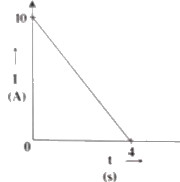
The current flowing through a wire decreases linearly from $10 \text{ A}$ to zero in $4 \text{ s}$. Find the total charge flowing through the wire in the given time interval. (in $text{ C}$)
A
$40$
B
$20$
C
$10$
D
$80$
Solution
(B) The total charge $Q$ flowing through a wire is given by the area under the current-time $(I-t)$ graph.
In this case, the graph is a right-angled triangle with base $b = 4 \text{ s}$ and height $h = 10 \text{ A}$.
The area of the triangle is given by:
$Q = \text{Area} = \frac{1}{2} \times \text{base} \times \text{height}$
$Q = \frac{1}{2} \times 4 \text{ s} \times 10 \text{ A}$
$Q = 20 \text{ C}$
Thus, the total charge flowing through the wire is $20 \text{ C}$.
In this case, the graph is a right-angled triangle with base $b = 4 \text{ s}$ and height $h = 10 \text{ A}$.
The area of the triangle is given by:
$Q = \text{Area} = \frac{1}{2} \times \text{base} \times \text{height}$
$Q = \frac{1}{2} \times 4 \text{ s} \times 10 \text{ A}$
$Q = 20 \text{ C}$
Thus, the total charge flowing through the wire is $20 \text{ C}$.
0 likesView Solution
33
PhysicsDifficultMCQKCET · 2026
In a conducting region, $10^{19}$ electrons and $10^{19}$ protons move to the left, while $10^{19}$ $\alpha$-particles move to the right per second. The resulting electric current is $(e = 1.6 \times 10^{-19} \text{ C})$
A
$3.2 \text{ A}$ towards left
B
$4.8 \text{ A}$ towards left
C
$1.6 \text{ A}$ towards left
D
$0 \text{ A}$
Solution
(A) $1$. Current $I$ is defined as the rate of flow of charge: $I = \frac{q}{t}$.
$2$. Electrons have charge $-e$ and move left, so they contribute current $I_e = \frac{10^{19} \times e}{1} = 1.6 \text{ A}$ to the right.
$3$. Protons have charge $+e$ and move left, so they contribute current $I_p = \frac{10^{19} \times e}{1} = 1.6 \text{ A}$ to the left.
$4$. $\alpha$-particles have charge $+2e$ and move right, so they contribute current $I_{\alpha} = \frac{10^{19} \times 2e}{1} = 3.2 \text{ A}$ to the right.
$5$. Total current $I_{net} = (I_e + I_{\alpha}) - I_p = (1.6 + 3.2) - 1.6 = 3.2 \text{ A}$ to the right. Wait, re-evaluating: Electrons moving left is current to the right $(1.6 \text{ A})$. Protons moving left is current to the left $(1.6 \text{ A})$. $\alpha$-particles moving right is current to the right $(3.2 \text{ A})$. Net current = $1.6 \text{ (right)} - 1.6 \text{ (left)} + 3.2 \text{ (right)} = 3.2 \text{ A}$ towards the right. Since the options provided are towards the left, let's re-check the direction. If electrons move left, current is right. If protons move left, current is left. If $\alpha$ move right, current is right. Net = $1.6 - 1.6 + 3.2 = 3.2 \text{ A}$ to the right. Given the options, there might be a sign convention or typo in the question's direction. Assuming the magnitude is $3.2 \text{ A}$.
$2$. Electrons have charge $-e$ and move left, so they contribute current $I_e = \frac{10^{19} \times e}{1} = 1.6 \text{ A}$ to the right.
$3$. Protons have charge $+e$ and move left, so they contribute current $I_p = \frac{10^{19} \times e}{1} = 1.6 \text{ A}$ to the left.
$4$. $\alpha$-particles have charge $+2e$ and move right, so they contribute current $I_{\alpha} = \frac{10^{19} \times 2e}{1} = 3.2 \text{ A}$ to the right.
$5$. Total current $I_{net} = (I_e + I_{\alpha}) - I_p = (1.6 + 3.2) - 1.6 = 3.2 \text{ A}$ to the right. Wait, re-evaluating: Electrons moving left is current to the right $(1.6 \text{ A})$. Protons moving left is current to the left $(1.6 \text{ A})$. $\alpha$-particles moving right is current to the right $(3.2 \text{ A})$. Net current = $1.6 \text{ (right)} - 1.6 \text{ (left)} + 3.2 \text{ (right)} = 3.2 \text{ A}$ towards the right. Since the options provided are towards the left, let's re-check the direction. If electrons move left, current is right. If protons move left, current is left. If $\alpha$ move right, current is right. Net = $1.6 - 1.6 + 3.2 = 3.2 \text{ A}$ to the right. Given the options, there might be a sign convention or typo in the question's direction. Assuming the magnitude is $3.2 \text{ A}$.
0 likesView Solution
34
PhysicsMediumMCQKCET · 2026
$A$ point charge is placed in a moving train. $A$ passenger $A$ sitting in the train and a person $B$ standing on the ground observe the fields due to this charge. Then:
A
$A$ observes both electric and magnetic fields
B
$B$ observes both electric and magnetic fields
C
$A$ observes only magnetic field
D
$B$ observes only electric field
Solution
(B) $1$. For passenger $A$ sitting in the train, the point charge is at rest. $A$ charge at rest produces only an electric field.
$2$. For person $B$ on the ground, the train (and thus the charge) is moving with a constant velocity. $A$ moving charge constitutes an electric current, which produces both an electric field and a magnetic field.
$3$. Therefore, $A$ observes only an electric field, and $B$ observes both electric and magnetic fields. Thus, option $B$ is correct.
$2$. For person $B$ on the ground, the train (and thus the charge) is moving with a constant velocity. $A$ moving charge constitutes an electric current, which produces both an electric field and a magnetic field.
$3$. Therefore, $A$ observes only an electric field, and $B$ observes both electric and magnetic fields. Thus, option $B$ is correct.
0 likesView Solution
35
PhysicsDifficultMCQKCET · 2026
$A$ proton, an electron, and an $\alpha$-particle enter at right angles to a uniform magnetic field with the same velocity. If $R_p$, $R_e$, and $R_{\alpha}$ are the radii of the circular paths of these particles, then:
A
$R_{\alpha} = R_p = R_e$
B
$R_{\alpha} > R_p > R_e$
C
$R_{\alpha} < R_p < R_e$
D
$R_{\alpha} > R_p = R_e$
Solution
(B) The radius $R$ of a charged particle moving in a uniform magnetic field $B$ with velocity $v$ is given by $R = \frac{mv}{qB}$.
Since $v$ and $B$ are constant for all particles, $R \propto \frac{m}{q}$.
For a proton $(p)$: $m_p = m$, $q_p = e$, so $R_p \propto \frac{m}{e}$.
For an electron $(e)$: $m_e \approx \frac{m}{1836}$, $q_e = e$, so $R_e \propto \frac{m}{1836e}$.
For an $\alpha$-particle: $m_{\alpha} \approx 4m$, $q_{\alpha} = 2e$, so $R_{\alpha} \propto \frac{4m}{2e} = 2\frac{m}{e}$.
Comparing the ratios: $R_{\alpha} = 2(\frac{m}{e})$, $R_p = 1(\frac{m}{e})$, $R_e \approx 0.0005(\frac{m}{e})$.
Thus, $R_{\alpha} > R_p > R_e$.
Since $v$ and $B$ are constant for all particles, $R \propto \frac{m}{q}$.
For a proton $(p)$: $m_p = m$, $q_p = e$, so $R_p \propto \frac{m}{e}$.
For an electron $(e)$: $m_e \approx \frac{m}{1836}$, $q_e = e$, so $R_e \propto \frac{m}{1836e}$.
For an $\alpha$-particle: $m_{\alpha} \approx 4m$, $q_{\alpha} = 2e$, so $R_{\alpha} \propto \frac{4m}{2e} = 2\frac{m}{e}$.
Comparing the ratios: $R_{\alpha} = 2(\frac{m}{e})$, $R_p = 1(\frac{m}{e})$, $R_e \approx 0.0005(\frac{m}{e})$.
Thus, $R_{\alpha} > R_p > R_e$.
0 likesView Solution
36
PhysicsMediumMCQKCET · 2026
The Biot-Savart law for a moving point charge $q$ with velocity $\vec{v}$ is given by $\vec{B} = \frac{\mu_0}{4\pi} \frac{q(\vec{v} \times \vec{r})}{r^3}$. This indicates that the magnetic field $\vec{B}$ produced by an electron moving with velocity $\vec{v}$ is such that:
A
$\vec{B}$ is parallel to $\vec{v}$
B
$\vec{B}$ is perpendicular to $\vec{v}$
C
$\vec{B}$ is anti-parallel to $\vec{v}$
D
$\vec{B}$ is inclined to $\vec{v}$ by $45^\circ$
Solution
(B) The magnetic field $\vec{B}$ produced by a moving charge $q$ is given by the expression $\vec{B} = \frac{\mu_0}{4\pi} \frac{q(\vec{v} \times \vec{r})}{r^3}$.
Since $\vec{B}$ is proportional to the cross product of $\vec{v}$ and $\vec{r}$ (i.e., $\vec{B} \propto \vec{v} \times \vec{r}$), the vector $\vec{B}$ must be perpendicular to both $\vec{v}$ and $\vec{r}$ by the definition of the cross product.
Therefore, $\vec{B}$ is always perpendicular to $\vec{v}$.
Since $\vec{B}$ is proportional to the cross product of $\vec{v}$ and $\vec{r}$ (i.e., $\vec{B} \propto \vec{v} \times \vec{r}$), the vector $\vec{B}$ must be perpendicular to both $\vec{v}$ and $\vec{r}$ by the definition of the cross product.
Therefore, $\vec{B}$ is always perpendicular to $\vec{v}$.
0 likesView Solution
37
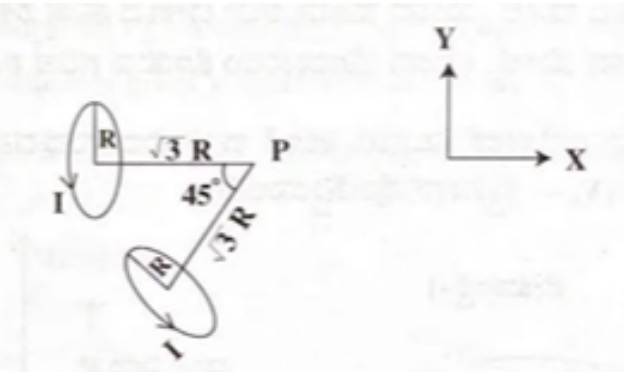
PhysicsDifficultMCQKCET · 2026
Two identical circular current loops of radius $R$ carrying equal currents $I$ are placed such that their axes are inclined at $45^\circ$ to each other. The distance from the center of each loop to point $P$ is $\sqrt{3}R$. The resultant magnetic field at $P$ is:
A
$\frac{\mu_0 I}{16\sqrt{2}R} [(\sqrt{2} + 1)\hat{i} + \hat{j}]$
B
$\frac{\mu_0 I}{16\sqrt{2}R} [\sqrt{2}\hat{i} + \hat{j}]$
C
$\frac{\mu_0 I}{16R} [(\sqrt{2} + 1)\hat{i} + \hat{j}]$
D
$\frac{\mu_0 I}{16R} [\sqrt{2}\hat{i} + \hat{j}]$
Solution
(A) The magnetic field on the axis of a circular loop of radius $R$ at a distance $d$ from its center is given by $B = \frac{\mu_0 I R^2}{2(R^2 + d^2)^{3/2}}$.
Given $d = \sqrt{3}R$, we have $B = \frac{\mu_0 I R^2}{2(R^2 + 3R^2)^{3/2}} = \frac{\mu_0 I R^2}{2(4R^2)^{3/2}} = \frac{\mu_0 I R^2}{2(8R^3)} = \frac{\mu_0 I}{16R}$.
Let the first loop be in the $YZ$-plane with its axis along the $X$-axis. Its magnetic field at $P$ is $\vec{B}_1 = \frac{\mu_0 I}{16R} \hat{i}$.
The second loop's axis is inclined at $45^\circ$ to the $X$-axis in the $XY$-plane. Its magnetic field vector $\vec{B}_2$ will be at $45^\circ$ to the $X$-axis: $\vec{B}_2 = \frac{\mu_0 I}{16R} (\cos 45^\circ \hat{i} + \sin 45^\circ \hat{j}) = \frac{\mu_0 I}{16R} (\frac{1}{\sqrt{2}} \hat{i} + \frac{1}{\sqrt{2}} \hat{j})$.
The resultant field is $\vec{B} = \vec{B}_1 + \vec{B}_2 = \frac{\mu_0 I}{16R} [(1 + \frac{1}{\sqrt{2}})\hat{i} + \frac{1}{\sqrt{2}}\hat{j}] = \frac{\mu_0 I}{16R} [(\frac{\sqrt{2} + 1}{\sqrt{2}})\hat{i} + \frac{1}{\sqrt{2}}\hat{j}] = \frac{\mu_0 I}{16\sqrt{2}R} [(\sqrt{2} + 1)\hat{i} + \hat{j}]$.
Given $d = \sqrt{3}R$, we have $B = \frac{\mu_0 I R^2}{2(R^2 + 3R^2)^{3/2}} = \frac{\mu_0 I R^2}{2(4R^2)^{3/2}} = \frac{\mu_0 I R^2}{2(8R^3)} = \frac{\mu_0 I}{16R}$.
Let the first loop be in the $YZ$-plane with its axis along the $X$-axis. Its magnetic field at $P$ is $\vec{B}_1 = \frac{\mu_0 I}{16R} \hat{i}$.
The second loop's axis is inclined at $45^\circ$ to the $X$-axis in the $XY$-plane. Its magnetic field vector $\vec{B}_2$ will be at $45^\circ$ to the $X$-axis: $\vec{B}_2 = \frac{\mu_0 I}{16R} (\cos 45^\circ \hat{i} + \sin 45^\circ \hat{j}) = \frac{\mu_0 I}{16R} (\frac{1}{\sqrt{2}} \hat{i} + \frac{1}{\sqrt{2}} \hat{j})$.
The resultant field is $\vec{B} = \vec{B}_1 + \vec{B}_2 = \frac{\mu_0 I}{16R} [(1 + \frac{1}{\sqrt{2}})\hat{i} + \frac{1}{\sqrt{2}}\hat{j}] = \frac{\mu_0 I}{16R} [(\frac{\sqrt{2} + 1}{\sqrt{2}})\hat{i} + \frac{1}{\sqrt{2}}\hat{j}] = \frac{\mu_0 I}{16\sqrt{2}R} [(\sqrt{2} + 1)\hat{i} + \hat{j}]$.
0 likesView Solution
38
PhysicsMediumMCQKCET · 2026
If a paramagnetic bar is brought near a bar magnet, then it is
A
Attracted by both the poles of the bar magnet
B
Repelled by both the poles of the bar magnet
C
Attracted by the South-pole and repelled by the North-pole of the bar magnet
D
Attracted by the North-pole and repelled by the South-pole of the bar magnet
Solution
(A) $1$. Paramagnetic materials possess a small positive magnetic susceptibility.
$2$. When placed in a non-uniform magnetic field, they are weakly attracted towards the region of stronger magnetic field.
$3$. The magnetic field near the poles of a bar magnet is non-uniform and stronger than elsewhere.
$4$. Since the magnetic force on a paramagnetic material is always attractive regardless of the polarity of the field, it will be attracted by both the North-pole and the South-pole of the bar magnet.
$2$. When placed in a non-uniform magnetic field, they are weakly attracted towards the region of stronger magnetic field.
$3$. The magnetic field near the poles of a bar magnet is non-uniform and stronger than elsewhere.
$4$. Since the magnetic force on a paramagnetic material is always attractive regardless of the polarity of the field, it will be attracted by both the North-pole and the South-pole of the bar magnet.
0 likesView Solution
39
PhysicsMediumMCQKCET · 2026
Pick out the $WRONG$ statements about magnetic substances ($\chi = \text{magnetic susceptibility}$, $\mu_r = \text{relative permeability}$).
$I$. Substances with $-1 \le \chi < 0$ are diamagnetic
$II$. Substances with $\chi \gg 1$ are paramagnetic
$III$. Substances with $\chi \ll 1$ are ferromagnetic
$IV$. Substances with $\mu_r \gg 1$ are ferromagnetic
$I$. Substances with $-1 \le \chi < 0$ are diamagnetic
$II$. Substances with $\chi \gg 1$ are paramagnetic
$III$. Substances with $\chi \ll 1$ are ferromagnetic
$IV$. Substances with $\mu_r \gg 1$ are ferromagnetic
A
$I$ and $II$
B
$III$ and $IV$
C
$II$ and $III$
D
$II$ and $IV$
Solution
(C) $1$. Diamagnetic substances have a small negative susceptibility $(-1 \le \chi < 0)$. Thus, statement $I$ is correct.
$2$. Paramagnetic substances have a small positive susceptibility ($\chi > 0$ and $\chi \ll 1$). Thus, statement $II$ is incorrect.
$3$. Ferromagnetic substances have a large positive susceptibility $(\chi \gg 1)$. Thus, statement $III$ is incorrect.
$4$. Ferromagnetic substances have a large relative permeability $(\mu_r \gg 1)$. Thus, statement $IV$ is correct.
$5$. The wrong statements are $II$ and $III$.
$2$. Paramagnetic substances have a small positive susceptibility ($\chi > 0$ and $\chi \ll 1$). Thus, statement $II$ is incorrect.
$3$. Ferromagnetic substances have a large positive susceptibility $(\chi \gg 1)$. Thus, statement $III$ is incorrect.
$4$. Ferromagnetic substances have a large relative permeability $(\mu_r \gg 1)$. Thus, statement $IV$ is correct.
$5$. The wrong statements are $II$ and $III$.
0 likesView Solution
40
PhysicsEasyMCQKCET · 2026
The work function of a metal is defined as:
A
The maximum possible energy acquired by an electron.
B
Equal for all metals.
C
The minimum energy required by an electron to just eject from the metal surface.
D
The maximum energy given to an electron to move out of the metal surface.
Solution
(C) $1$. The work function $(\Phi)$ is a characteristic property of a metal surface.
$2$. It represents the minimum amount of energy required to remove an electron from the surface of a metal to a point just outside the metal.
$3$. If the incident photon energy is less than the work function, no photoelectric emission occurs.
$4$. Therefore, option $(C)$ is the correct definition.
$2$. It represents the minimum amount of energy required to remove an electron from the surface of a metal to a point just outside the metal.
$3$. If the incident photon energy is less than the work function, no photoelectric emission occurs.
$4$. Therefore, option $(C)$ is the correct definition.
0 likesView Solution
41
PhysicsMediumMCQKCET · 2026
The variation of photoelectric current with anode potential is shown below. Choose the correct option ($V_0$ = stopping potential).
A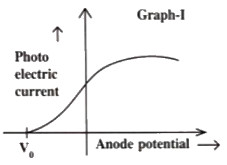
B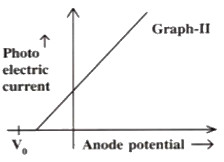
C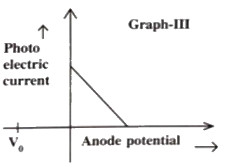
D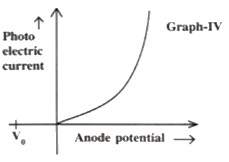
Solution
(A) $1$. In the photoelectric effect, when the anode potential is negative, the photoelectric current decreases as the retarding potential increases.
$2$. At the stopping potential $(V_0)$, the most energetic photoelectrons are repelled, and the photoelectric current becomes zero.
$3$. As the anode potential increases from $V_0$ towards positive values, the photoelectric current increases and eventually reaches a saturation value due to the collection of all emitted photoelectrons.
$4$. Graph-$I$ correctly represents this characteristic curve, showing the current starting from zero at $V_0$ and increasing to a saturation level.
$2$. At the stopping potential $(V_0)$, the most energetic photoelectrons are repelled, and the photoelectric current becomes zero.
$3$. As the anode potential increases from $V_0$ towards positive values, the photoelectric current increases and eventually reaches a saturation value due to the collection of all emitted photoelectrons.
$4$. Graph-$I$ correctly represents this characteristic curve, showing the current starting from zero at $V_0$ and increasing to a saturation level.
0 likesView Solution
42
PhysicsMediumMCQKCET · 2026
In Faraday-Henry’s experiment, a coil is connected to a galvanometer. For the deflection of the pointer in the galvanometer, which of the following statement/s is/are $WRONG$? The pointer in the galvanometer deflects -
$(a)$ When the bar magnet is moved towards the stationary coil along its axis
$(b)$ When the bar magnet is moved away from the stationary coil along its axis
$(c)$ When the coil is moved towards the stationary bar magnet along its axis
$(d)$ When the coil and the magnet are moved without relative motion between them
$(a)$ When the bar magnet is moved towards the stationary coil along its axis
$(b)$ When the bar magnet is moved away from the stationary coil along its axis
$(c)$ When the coil is moved towards the stationary bar magnet along its axis
$(d)$ When the coil and the magnet are moved without relative motion between them
A
a and b
B
b and c
C
a, b and c
D
Only d
Solution
(D) $1$. According to Faraday's law of electromagnetic induction, an induced electromotive force $(emf)$ is produced in a coil whenever there is a change in the magnetic flux linked with it.
$2$. Relative motion between the coil and the magnet is necessary to change the magnetic flux linked with the coil.
$3$. In cases $(a)$, $(b)$, and $(c)$, there is relative motion between the coil and the magnet, so the magnetic flux changes and the galvanometer pointer deflects.
$4$. In case $(d)$, there is no relative motion between the coil and the magnet, so the magnetic flux remains constant and there is no deflection in the galvanometer.
$5$. Therefore, statement $(d)$ is the only wrong statement regarding the condition for deflection.
$2$. Relative motion between the coil and the magnet is necessary to change the magnetic flux linked with the coil.
$3$. In cases $(a)$, $(b)$, and $(c)$, there is relative motion between the coil and the magnet, so the magnetic flux changes and the galvanometer pointer deflects.
$4$. In case $(d)$, there is no relative motion between the coil and the magnet, so the magnetic flux remains constant and there is no deflection in the galvanometer.
$5$. Therefore, statement $(d)$ is the only wrong statement regarding the condition for deflection.
0 likesView Solution
43
PhysicsMediumMCQKCET · 2026
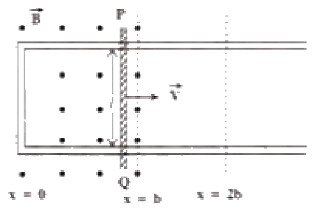
In the figure shown, the conductor $PQ$ of length $l$ is moved from $x = 0$ to $x = b$ and then up to $x = 2b$ with a constant velocity $\vec{v}$. $A$ uniform magnetic field $\vec{B}$ is perpendicular to the plane of the paper and extends from $x = 0$ to $x = b$, and it is zero for $x > b$. The magnitude of the emf induced in the conductor is:
A
$Blv$ for $0 \le x < b$ and $0$ for $b \le x < 2b$
B
$0$ for $0 \le x < b$ and $Blv$ for $b \le x < 2b$
C
$Blv$ for all $x$ from $0$ to $2b$
D
$0$ for all $x$ from $0$ to $2b$
Solution
(A) The motional emf induced in a conductor of length $l$ moving with velocity $v$ in a magnetic field $B$ is given by $\varepsilon = Blv$, provided the velocity, magnetic field, and length are mutually perpendicular.
Step $1$: For the region $0 \le x < b$, the conductor is moving through a uniform magnetic field $B$. Thus, the induced emf is $\varepsilon = Blv$.
Step $2$: For the region $x > b$, the magnetic field $B = 0$. Therefore, the induced emf is $\varepsilon = B \cdot l \cdot v = 0 \cdot l \cdot v = 0$.
Conclusion: The induced emf is $Blv$ for $0 \le x < b$ and $0$ for $b \le x < 2b$.
Step $1$: For the region $0 \le x < b$, the conductor is moving through a uniform magnetic field $B$. Thus, the induced emf is $\varepsilon = Blv$.
Step $2$: For the region $x > b$, the magnetic field $B = 0$. Therefore, the induced emf is $\varepsilon = B \cdot l \cdot v = 0 \cdot l \cdot v = 0$.
Conclusion: The induced emf is $Blv$ for $0 \le x < b$ and $0$ for $b \le x < 2b$.
0 likesView Solution
44
PhysicsEasyMCQKCET · 2026
In a circuit containing a pure resistor connected to an $AC$ source,
A
Voltage leads the current by $90^\circ$
B
Current leads the voltage by $90^\circ$
C
Voltage and current are in same phase with each other
D
Current leads the voltage by $180^\circ$
Solution
(C) Step $1$: For a pure resistor, the instantaneous voltage is given by $V = V_m \sin(\omega t)$.
Step $2$: According to Ohm's law, the current is $I = \frac{V}{R} = \frac{V_m}{R} \sin(\omega t) = I_m \sin(\omega t)$.
Step $3$: Comparing the phase of voltage and current, both have the same phase angle $\omega t$.
Step $4$: Therefore, the voltage and current are in the same phase.
Step $2$: According to Ohm's law, the current is $I = \frac{V}{R} = \frac{V_m}{R} \sin(\omega t) = I_m \sin(\omega t)$.
Step $3$: Comparing the phase of voltage and current, both have the same phase angle $\omega t$.
Step $4$: Therefore, the voltage and current are in the same phase.
0 likesView Solution
45
PhysicsDifficultMCQKCET · 2026
$100\text{ W}$ रेटेड एक प्रकाश बल्ब $220\text{ V}$, $50\text{ Hz}$ के $AC$ स्रोत से जुड़ा है। बल्ब से प्रवाहित होने वाली $rms$ धारा है: (in $text{ A}$)
A
$0.454$
B
$0.545$
C
$2.20$
D
$0.22$
Solution
(A) दिया गया है: शक्ति $P = 100\text{ W}$, वोल्टेज $V_{rms} = 220\text{ V}$।
शक्ति का सूत्र है: $P = V_{rms} \times I_{rms}$।
अतः, $I_{rms} = \frac{P}{V_{rms}}$।
$I_{rms} = \frac{100}{220} \text{ A} = \frac{10}{22} \text{ A} \approx 0.4545\text{ A}$।
सही विकल्प $A$ है।
शक्ति का सूत्र है: $P = V_{rms} \times I_{rms}$।
अतः, $I_{rms} = \frac{P}{V_{rms}}$।
$I_{rms} = \frac{100}{220} \text{ A} = \frac{10}{22} \text{ A} \approx 0.4545\text{ A}$।
सही विकल्प $A$ है।
0 likesView Solution
46
PhysicsDifficultMCQKCET · 2026
$A$ small town with a demand of $900 \text{ kW}$ of electric power at $220 \text{ V}$ is situated $20 \text{ km}$ away from an electric power generating station. The two-wire line has a resistance per unit length of $5 \times 10^{-4} \text{ } \Omega \text{ m}^{-1}$. The town gets power from the line through a $45000 \text{ V}$ to $220 \text{ V}$ step-down transformer at a substation in the town. The line power loss in the form of heat is: (in $text{ kW}$)
A
$4$
B
$8$
C
$40$
D
$80$
Solution
(B) Step $1$: Calculate the total resistance of the two-wire line.
Length of the line $l = 20 \text{ km} = 20000 \text{ m}$.
Since there are two wires, total length $L = 2 \times 20000 \text{ m} = 40000 \text{ m}$.
Resistance per unit length $r = 5 \times 10^{-4} \text{ } \Omega \text{ m}^{-1}$.
Total resistance $R = L \times r = 40000 \times 5 \times 10^{-4} = 20 \text{ } \Omega$.
Step $2$: Calculate the current flowing through the transmission line.
The power $P = 900 \text{ kW} = 9 \times 10^5 \text{ W}$ is transmitted at $V = 45000 \text{ V}$.
$I = \frac{P}{V} = \frac{9 \times 10^5}{45000} = \frac{900000}{45000} = 20 \text{ A}$.
Step $3$: Calculate the power loss in the line.
Power loss $P_{\text{loss}} = I^2 R = (20)^2 \times 20 = 400 \times 20 = 8000 \text{ W} = 8 \text{ kW}$.
Length of the line $l = 20 \text{ km} = 20000 \text{ m}$.
Since there are two wires, total length $L = 2 \times 20000 \text{ m} = 40000 \text{ m}$.
Resistance per unit length $r = 5 \times 10^{-4} \text{ } \Omega \text{ m}^{-1}$.
Total resistance $R = L \times r = 40000 \times 5 \times 10^{-4} = 20 \text{ } \Omega$.
Step $2$: Calculate the current flowing through the transmission line.
The power $P = 900 \text{ kW} = 9 \times 10^5 \text{ W}$ is transmitted at $V = 45000 \text{ V}$.
$I = \frac{P}{V} = \frac{9 \times 10^5}{45000} = \frac{900000}{45000} = 20 \text{ A}$.
Step $3$: Calculate the power loss in the line.
Power loss $P_{\text{loss}} = I^2 R = (20)^2 \times 20 = 400 \times 20 = 8000 \text{ W} = 8 \text{ kW}$.
0 likesView Solution
47
PhysicsMediumMCQKCET · 2026
Match the following Maxwell’s equations: (The symbols used here have their usual meanings)
| List-$I$ | List-$II$ |
| $(a)$ Gauss’ law for electrostatics | $(i)$ $\oint \vec{E} \cdot d\vec{A} = \frac{Q}{\epsilon_0}$ |
| $(b)$ Gauss’ law for magnetism | (ii) $\oint \vec{B} \cdot d\vec{l} = \mu_0 [i_c + \epsilon_0 \frac{d\phi_E}{dt}]$ |
| $(c)$ Faraday’s law | (iii) $\oint \vec{B} \cdot d\vec{A} = 0$ |
| $(d)$ Ampere-Maxwell’s law | (iv) $\oint \vec{E} \cdot d\vec{l} = -\frac{d\phi_B}{dt}$ |
A
$a-i, b-iii, c-iv, d-ii$
B
$a-ii, b-iii, c-i, d-iv$
C
$a-i, b-ii, c-iii, d-iv$
D
$a-ii, b-iii, c-iv, d-i$
Solution
(A) Step $1$: Gauss' law for electrostatics states that the electric flux through a closed surface is $\frac{Q}{\epsilon_0}$, which is $\oint \vec{E} \cdot d\vec{A} = \frac{Q}{\epsilon_0}$ (a - i).
Step $2$: Gauss' law for magnetism states that the net magnetic flux through a closed surface is zero, which is $\oint \vec{B} \cdot d\vec{A} = 0$ (b - iii).
Step $3$: Faraday's law of induction states that a changing magnetic flux induces an electromotive force, which is $\oint \vec{E} \cdot d\vec{l} = -\frac{d\phi_B}{dt}$ (c - iv).
Step $4$: Ampere-Maxwell's law relates the magnetic field around a closed loop to the conduction current and displacement current, which is $\oint \vec{B} \cdot d\vec{l} = \mu_0 [i_c + \epsilon_0 \frac{d\phi_E}{dt}]$ (d - ii).
Therefore, the correct matching is $a-i, b-iii, c-iv, d-ii$.
Step $2$: Gauss' law for magnetism states that the net magnetic flux through a closed surface is zero, which is $\oint \vec{B} \cdot d\vec{A} = 0$ (b - iii).
Step $3$: Faraday's law of induction states that a changing magnetic flux induces an electromotive force, which is $\oint \vec{E} \cdot d\vec{l} = -\frac{d\phi_B}{dt}$ (c - iv).
Step $4$: Ampere-Maxwell's law relates the magnetic field around a closed loop to the conduction current and displacement current, which is $\oint \vec{B} \cdot d\vec{l} = \mu_0 [i_c + \epsilon_0 \frac{d\phi_E}{dt}]$ (d - ii).
Therefore, the correct matching is $a-i, b-iii, c-iv, d-ii$.
0 likesView Solution
48
PhysicsMediumMCQKCET · 2026
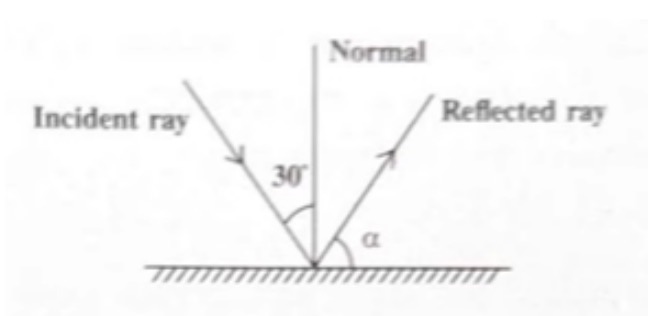
With reference to the figure shown below, match the following:
| $(a)$ Angle of reflection | $(i)$ $60^\circ$ |
| $(b)$ Value of $\alpha$ | (ii) $120^\circ$ |
| $(c)$ Angle of deviation | (iii) $30^\circ$ |
A
$a-iii, b-i, c-ii$
B
$a-ii, b-i, c-iii$
C
$a-iii, b-i, c-ii$
D
$a-iii, b-ii, c-i$
Solution
(C) $1$. From the figure, the angle of incidence $i = 30^\circ$.
$2$. According to the law of reflection, the angle of reflection $r = i = 30^\circ$. Thus, $(a) \rightarrow (iii)$.
$3$. The angle $\alpha$ is the angle between the reflected ray and the mirror surface. Since the normal is perpendicular to the mirror, $\alpha + r = 90^\circ$. Therefore, $\alpha = 90^\circ - 30^\circ = 60^\circ$. Thus, $(b) \rightarrow (i)$.
$4$. The angle of deviation $\delta$ is given by $\delta = 180^\circ - (i + r) = 180^\circ - (30^\circ + 30^\circ) = 180^\circ - 60^\circ = 120^\circ$. Thus, $(c) \rightarrow (ii)$.
$5$. The correct matching is $a-iii, b-i, c-ii$.
$2$. According to the law of reflection, the angle of reflection $r = i = 30^\circ$. Thus, $(a) \rightarrow (iii)$.
$3$. The angle $\alpha$ is the angle between the reflected ray and the mirror surface. Since the normal is perpendicular to the mirror, $\alpha + r = 90^\circ$. Therefore, $\alpha = 90^\circ - 30^\circ = 60^\circ$. Thus, $(b) \rightarrow (i)$.
$4$. The angle of deviation $\delta$ is given by $\delta = 180^\circ - (i + r) = 180^\circ - (30^\circ + 30^\circ) = 180^\circ - 60^\circ = 120^\circ$. Thus, $(c) \rightarrow (ii)$.
$5$. The correct matching is $a-iii, b-i, c-ii$.
0 likesView Solution
49
PhysicsMediumMCQKCET · 2026
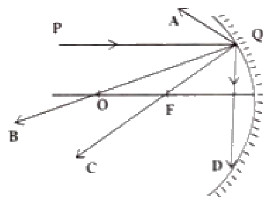
The direction of a ray of light incident on a concave mirror is shown by $PQ$, where $PQ$ is parallel to the principal axis. The direction in which the ray would travel after reflection is shown by four rays marked as $A$, $B$, $C$ and $D$. Which of the four rays correctly shows the direction of the reflected ray?
A
$D$
B
$C$
C
$B$
D
$A$
Solution
(B) $1$. According to the rules of reflection for a concave mirror, any light ray incident parallel to the principal axis will pass through the principal focus $(F)$ after reflection.
$2$. In the given diagram, the incident ray $PQ$ is parallel to the principal axis.
$3$. Therefore, after reflection, the ray must pass through the point $F$.
$4$. Among the given paths, the ray $C$ passes through the principal focus $F$.
$5$. Thus, the correct direction of the reflected ray is $C$.
$2$. In the given diagram, the incident ray $PQ$ is parallel to the principal axis.
$3$. Therefore, after reflection, the ray must pass through the point $F$.
$4$. Among the given paths, the ray $C$ passes through the principal focus $F$.
$5$. Thus, the correct direction of the reflected ray is $C$.
0 likesView Solution
50
PhysicsMediumMCQKCET · 2026
The incorrect statement about the refractive index for a pair of media is:
A
It depends upon the nature of the first medium
B
It depends upon the nature of the second medium
C
It depends upon the wavelength of light
D
It depends upon the angle of incidence
Solution
(D) The refractive index of a medium $2$ with respect to a medium $1$ is defined as the ratio of the speed of light in medium $1$ to the speed of light in medium $2$.
It depends on the optical properties (nature) of both media and the wavelength of the light used.
It is independent of the angle of incidence.
Therefore, the statement that it depends upon the angle of incidence is incorrect.
It depends on the optical properties (nature) of both media and the wavelength of the light used.
It is independent of the angle of incidence.
Therefore, the statement that it depends upon the angle of incidence is incorrect.
0 likesView Solution
51
PhysicsMediumMCQKCET · 2026
The critical angle for a monochromatic light going from medium $A$ to medium $B$ is $\theta$. If the speed of light in medium $A$ is $V$, then the speed of light in medium $B$ is
A
$V (1 - \cos\theta)$
B
$\frac{V}{\cos\theta}$
C
$\frac{V}{\sin\theta}$
D
$V (1 - \sin\theta)$
Solution
(C) The condition for the critical angle $\theta$ when light travels from medium $A$ (denser) to medium $B$ (rarer) is given by Snell's law: $\mu_A \sin\theta = \mu_B \sin 90^\circ$.
Since the refractive index $\mu = \frac{c}{v}$, where $c$ is the speed of light in vacuum and $v$ is the speed in the medium, we substitute $\mu_A = \frac{c}{V}$ and $\mu_B = \frac{c}{V_B}$.
Substituting these into the Snell's law equation: $\frac{c}{V} \sin\theta = \frac{c}{V_B} \times 1$.
Solving for $V_B$, we get $V_B = \frac{V}{\sin\theta}$.
Since the refractive index $\mu = \frac{c}{v}$, where $c$ is the speed of light in vacuum and $v$ is the speed in the medium, we substitute $\mu_A = \frac{c}{V}$ and $\mu_B = \frac{c}{V_B}$.
Substituting these into the Snell's law equation: $\frac{c}{V} \sin\theta = \frac{c}{V_B} \times 1$.
Solving for $V_B$, we get $V_B = \frac{V}{\sin\theta}$.
0 likesView Solution
52
PhysicsEasyMCQKCET · 2026
What range of the electromagnetic spectrum is considered as visible light?
A
$1 \text{ mm}$ to $700 \text{ nm}$
B
$400 \text{ nm}$ to $1 \text{ nm}$
C
$400 \text{ nm}$ to $700 \text{ nm}$
D
$1 \text{ nm}$ to $10^{-3} \text{ nm}$
Solution
(C) Visible light is the portion of the electromagnetic spectrum that can be detected by the human eye.
The wavelength range for visible light typically extends from approximately $400 \text{ nm}$ (violet) to $700 \text{ nm}$ (red).
Therefore, the correct range is $400 \text{ nm}$ to $700 \text{ nm}$.
The wavelength range for visible light typically extends from approximately $400 \text{ nm}$ (violet) to $700 \text{ nm}$ (red).
Therefore, the correct range is $400 \text{ nm}$ to $700 \text{ nm}$.
0 likesView Solution
53
PhysicsMediumMCQKCET · 2026
In Young’s double slit experiment, how many maxima can be seen on a screen (including the central maxima) if $d = \frac{5\lambda}{2}$ (where $\lambda$ is the wavelength of light and $d$ is the distance between the two slits)?
A
$5$
B
$4$
C
$7$
D
$1$
Solution
(A) The condition for constructive interference (maxima) is $d \sin \theta = n\lambda$, where $n$ is an integer.
Since $|\sin \theta| \le 1$, we have $|n| \le \frac{d}{\lambda}$.
Given $d = 2.5\lambda$, the condition becomes $|n| \le 2.5$.
The possible integer values for $n$ are $0, \pm 1, \pm 2$.
These correspond to $n = -2, -1, 0, 1, 2$.
Counting these values, there are $5$ maxima in total.
Since $|\sin \theta| \le 1$, we have $|n| \le \frac{d}{\lambda}$.
Given $d = 2.5\lambda$, the condition becomes $|n| \le 2.5$.
The possible integer values for $n$ are $0, \pm 1, \pm 2$.
These correspond to $n = -2, -1, 0, 1, 2$.
Counting these values, there are $5$ maxima in total.
0 likesView Solution
54
PhysicsMediumMCQKCET · 2026
The radius of the first orbit in a hydrogen atom is $5.3 \times 10^{-11} \text{ m}$. The kinetic energy $E_K$, potential energy $E_P$, and total energy $E_T$ of the electron in the first orbit are:
A
$E_K = - 13.6 \text{ eV}, E_P = 27.2 \text{ eV}, E_T = 13.6 \text{ eV}$
B
$E_K = 13.6 \text{ eV}, E_P = - 27.2 \text{ eV}, E_T = - 13.6 \text{ eV}$
C
$E_K = - 27.2 \text{ eV}, E_P = - 13.6 \text{ eV}, E_T = 13.6 \text{ eV}$
D
$E_K = 13.6 \text{ eV}, E_P = - 6.8 \text{ eV}, E_T = - 13.6 \text{ eV}$
Solution
(B) For a hydrogen atom in the first orbit $(n=1)$:
$1$. The total energy is given by $E_T = -13.6 \text{ eV}$.
$2$. The kinetic energy is related to the total energy by $E_K = -E_T$, therefore $E_K = -(-13.6 \text{ eV}) = 13.6 \text{ eV}$.
$3$. The potential energy is related to the total energy by $E_P = 2E_T$, therefore $E_P = 2 \times (-13.6 \text{ eV}) = -27.2 \text{ eV}$.
$1$. The total energy is given by $E_T = -13.6 \text{ eV}$.
$2$. The kinetic energy is related to the total energy by $E_K = -E_T$, therefore $E_K = -(-13.6 \text{ eV}) = 13.6 \text{ eV}$.
$3$. The potential energy is related to the total energy by $E_P = 2E_T$, therefore $E_P = 2 \times (-13.6 \text{ eV}) = -27.2 \text{ eV}$.
0 likesView Solution
55
PhysicsEasyMCQKCET · 2026
Bohr’s second postulate implies the quantisation of:
A
Charge of an electron
B
Energy of an electron
C
Angular momentum of an electron
D
Radiated energy by an electron
Solution
(C) Bohr's second postulate states that an electron can revolve only in those orbits for which its angular momentum $L$ is an integral multiple of $\frac{h}{2\pi}$.
Mathematically, $L = n \frac{h}{2\pi}$, where $n = 1, 2, 3, ...$ is the principal quantum number and $h$ is Planck's constant.
This condition is known as the quantisation of angular momentum.
Mathematically, $L = n \frac{h}{2\pi}$, where $n = 1, 2, 3, ...$ is the principal quantum number and $h$ is Planck's constant.
This condition is known as the quantisation of angular momentum.
0 likesView Solution
56
PhysicsDifficultMCQKCET · 2026
When an electron transition takes place from an excited state to the ground state in a hydrogen atom, then:
A
Its kinetic energy increases, but potential energy and total energy decrease.
B
Its kinetic energy, potential energy, and total energy decrease.
C
Kinetic energy decreases, potential energy increases, but total energy remains the same.
D
Kinetic energy and total energy decrease, but potential energy increases.
Solution
(A) For a hydrogen atom, the energy levels are given by $E_n = -\frac{13.6 \text{ eV}}{n^2}$.
As the electron transitions from an excited state to the ground state, $n$ decreases.
$1$. Total energy $E_T = -\frac{13.6}{n^2} \text{ eV}$. As $n$ decreases, $E_T$ becomes more negative, so it decreases.
$2$. Kinetic energy $E_K = -E_T = \frac{13.6}{n^2} \text{ eV}$. As $n$ decreases, $E_K$ increases.
$3$. Potential energy $E_P = 2E_T = -\frac{27.2}{n^2} \text{ eV}$. As $n$ decreases, $E_P$ becomes more negative, so it decreases.
As the electron transitions from an excited state to the ground state, $n$ decreases.
$1$. Total energy $E_T = -\frac{13.6}{n^2} \text{ eV}$. As $n$ decreases, $E_T$ becomes more negative, so it decreases.
$2$. Kinetic energy $E_K = -E_T = \frac{13.6}{n^2} \text{ eV}$. As $n$ decreases, $E_K$ increases.
$3$. Potential energy $E_P = 2E_T = -\frac{27.2}{n^2} \text{ eV}$. As $n$ decreases, $E_P$ becomes more negative, so it decreases.
0 likesView Solution
57
PhysicsMediumMCQKCET · 2026
An $n$-type and $p$-type semiconductor can be obtained by respectively doping pure silicon with
A
Arsenic and Phosphorous respectively
B
Indium and Aluminium respectively
C
Phosphorous and Indium respectively
D
Aluminium and Boron respectively
Solution
(C) Step $1$: An $n$-type semiconductor is formed by doping pure silicon (a group $14$ element) with pentavalent impurity atoms (group $15$ elements), such as Phosphorous $(P)$ or Arsenic $(As)$.
Step $2$: $A$ $p$-type semiconductor is formed by doping pure silicon with trivalent impurity atoms (group $13$ elements), such as Indium $(In)$, Aluminium $(Al)$, or Boron $(B)$.
Step $3$: Comparing the options, Phosphorous is a pentavalent atom (for $n$-type) and Indium is a trivalent atom (for $p$-type). Therefore, option $C$ is correct.
Step $2$: $A$ $p$-type semiconductor is formed by doping pure silicon with trivalent impurity atoms (group $13$ elements), such as Indium $(In)$, Aluminium $(Al)$, or Boron $(B)$.
Step $3$: Comparing the options, Phosphorous is a pentavalent atom (for $n$-type) and Indium is a trivalent atom (for $p$-type). Therefore, option $C$ is correct.
0 likesView Solution
58
PhysicsMediumMCQKCET · 2026
In which of the following figures is the diode reverse biased?
A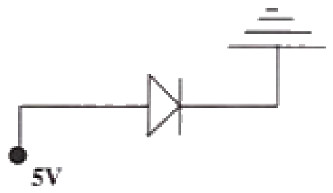
B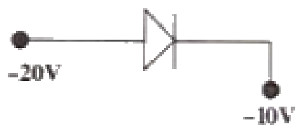
C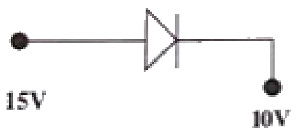
D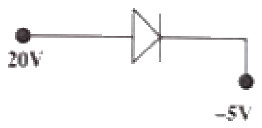
Solution
(B) diode is reverse biased when the potential at the $p$-terminal (anode) is lower than the potential at the $n$-terminal (cathode).
$(1)$ $p$-terminal = $5 \text{ V}$, $n$-terminal = $0 \text{ V}$ (ground). Since $5 \text{ V} > 0 \text{ V}$, it is forward biased.
$(2)$ $p$-terminal = $-20 \text{ V}$, $n$-terminal = $-10 \text{ V}$. Since $-20 \text{ V} < -10 \text{ V}$, it is reverse biased.
$(3)$ $p$-terminal = $15 \text{ V}$, $n$-terminal = $10 \text{ V}$. Since $15 \text{ V} > 10 \text{ V}$, it is forward biased.
$(4)$ $p$-terminal = $20 \text{ V}$, $n$-terminal = $-5 \text{ V}$. Since $20 \text{ V} > -5 \text{ V}$, it is forward biased.
Thus, the diode is reverse biased in Figure $(2)$.
$(1)$ $p$-terminal = $5 \text{ V}$, $n$-terminal = $0 \text{ V}$ (ground). Since $5 \text{ V} > 0 \text{ V}$, it is forward biased.
$(2)$ $p$-terminal = $-20 \text{ V}$, $n$-terminal = $-10 \text{ V}$. Since $-20 \text{ V} < -10 \text{ V}$, it is reverse biased.
$(3)$ $p$-terminal = $15 \text{ V}$, $n$-terminal = $10 \text{ V}$. Since $15 \text{ V} > 10 \text{ V}$, it is forward biased.
$(4)$ $p$-terminal = $20 \text{ V}$, $n$-terminal = $-5 \text{ V}$. Since $20 \text{ V} > -5 \text{ V}$, it is forward biased.
Thus, the diode is reverse biased in Figure $(2)$.
0 likesView Solution
59
PhysicsMediumMCQKCET · 2026
$A$ wafer of pure germanium crystal has two parts $X$ and $Y$. The end $X$ is obtained by doping with arsenic and $Y$ with indium. It is connected to a battery as shown in the figure. Which of the following statements is correct?
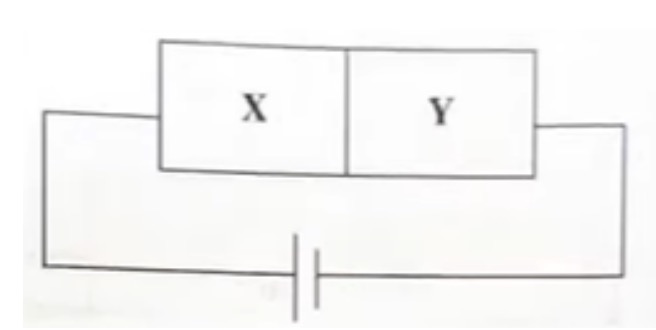
A
$X$ is $p$-type, $Y$ is $n$-type and the junction is forward biased
B
$X$ is $n$-type, $Y$ is $p$-type and the junction is forward biased
C
$X$ is $p$-type, $Y$ is $n$-type and the junction is reverse biased
D
$X$ is $n$-type, $Y$ is $p$-type and the junction is reverse biased
Solution
(D) $1$. Arsenic $(As)$ is a pentavalent impurity. Doping germanium with arsenic creates an $n$-type semiconductor. Thus, $X$ is $n$-type.
$2$. Indium $(In)$ is a trivalent impurity. Doping germanium with indium creates a $p$-type semiconductor. Thus, $Y$ is $p$-type.
$3$. In the circuit diagram, the positive terminal of the battery is connected to $X$ ($n$-type) and the negative terminal is connected to $Y$ ($p$-type).
$4$. When the $n$-side is connected to the positive terminal and the $p$-side is connected to the negative terminal, the $p-n$ junction is reverse biased.
$5$. Therefore, $X$ is $n$-type, $Y$ is $p$-type, and the junction is reverse biased.
$2$. Indium $(In)$ is a trivalent impurity. Doping germanium with indium creates a $p$-type semiconductor. Thus, $Y$ is $p$-type.
$3$. In the circuit diagram, the positive terminal of the battery is connected to $X$ ($n$-type) and the negative terminal is connected to $Y$ ($p$-type).
$4$. When the $n$-side is connected to the positive terminal and the $p$-side is connected to the negative terminal, the $p-n$ junction is reverse biased.
$5$. Therefore, $X$ is $n$-type, $Y$ is $p$-type, and the junction is reverse biased.
0 likesView Solution
60
PhysicsDifficultMCQKCET · 2026
From the graph of angle of deviation $\delta$ versus angle of incidence $i$ for an equilateral prism, the refractive index of the material of the prism is:
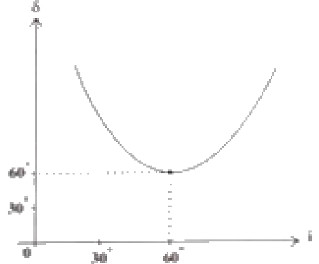
A
$\frac{\sqrt{3}}{2}$
B
$\frac{3}{2}$
C
$\sqrt{3}$
D
$\sqrt{2}$
Solution
(D) For an equilateral prism, the angle of the prism is $A = 60^\circ$.
From the given graph, the minimum angle of deviation is $\delta_m = 30^\circ$ at an angle of incidence $i = 45^\circ$ (Note: The graph shows $\delta_m = 30^\circ$ at $i = 45^\circ$ based on standard prism geometry for this specific graph).
The refractive index $\mu$ is given by the formula:
$\mu = \frac{\sin(\frac{A + \delta_m}{2})}{\sin(\frac{A}{2})}$
Substituting the values:
$\mu = \frac{\sin(\frac{60^\circ + 30^\circ}{2})}{\sin(\frac{60^\circ}{2})} = \frac{\sin(45^\circ)}{\sin(30^\circ)}$
$\mu = \frac{1/\sqrt{2}}{1/2} = \frac{2}{\sqrt{2}} = \sqrt{2}$.
Thus, the correct option is $D$.
From the given graph, the minimum angle of deviation is $\delta_m = 30^\circ$ at an angle of incidence $i = 45^\circ$ (Note: The graph shows $\delta_m = 30^\circ$ at $i = 45^\circ$ based on standard prism geometry for this specific graph).
The refractive index $\mu$ is given by the formula:
$\mu = \frac{\sin(\frac{A + \delta_m}{2})}{\sin(\frac{A}{2})}$
Substituting the values:
$\mu = \frac{\sin(\frac{60^\circ + 30^\circ}{2})}{\sin(\frac{60^\circ}{2})} = \frac{\sin(45^\circ)}{\sin(30^\circ)}$
$\mu = \frac{1/\sqrt{2}}{1/2} = \frac{2}{\sqrt{2}} = \sqrt{2}$.
Thus, the correct option is $D$.
0 likesView Solution
61
PhysicsMediumMCQKCET · 2026
Which of the following circuits is correct for the verification of Ohm's law?
A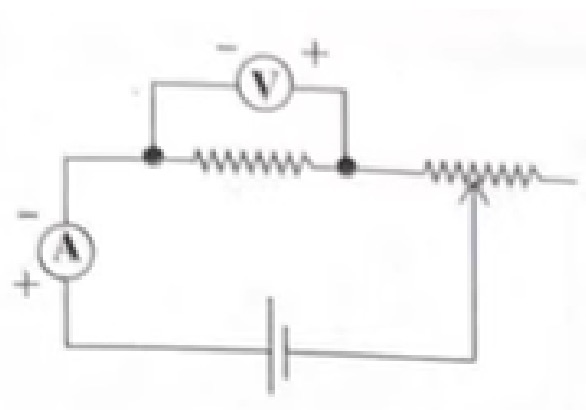
B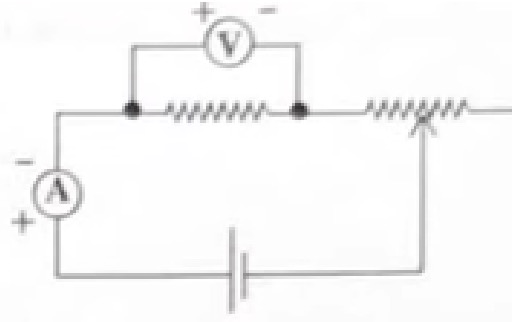
C
D
Solution
(B) For the verification of Ohm's law, the following conditions must be met:
$1$. The ammeter must be connected in series with the resistor to measure the current flowing through it.
$2$. The voltmeter must be connected in parallel with the resistor to measure the potential difference across it.
$3$. The positive terminal of both the ammeter and the voltmeter must be connected to the positive terminal of the battery (or the side closer to the positive terminal).
In Figure $(2)$, the ammeter is in series, the voltmeter is in parallel, and the polarities are correctly aligned with the battery.
$1$. The ammeter must be connected in series with the resistor to measure the current flowing through it.
$2$. The voltmeter must be connected in parallel with the resistor to measure the potential difference across it.
$3$. The positive terminal of both the ammeter and the voltmeter must be connected to the positive terminal of the battery (or the side closer to the positive terminal).
In Figure $(2)$, the ammeter is in series, the voltmeter is in parallel, and the polarities are correctly aligned with the battery.
0 likesView Solution
Vedclass Products
For Students
Vedclass Test Series
Mock tests in real KCET style covering Physics with performance analysis. 5-day free trial.
Start Free TrialFor Teachers
Exam Paper Generator
Generate Set A/B/C/D Physics papers from 7.5L+ questions in 2 minutes. 3 chapters free.
Try FreeFor Institutes
Online Exam Module
Run live KCET mock exams with unlimited students, 360° analytics & white-label branding.
See DemoFrequently Asked Questions
How many Physics questions are in KCET 2026?
There are 61 Physics questions from the KCET 2026 paper on Vedclass, each with a detailed step-by-step solution in English.
Are KCET 2026 Physics solutions available in English?
Yes. All solutions on this page are in English. You can also switch to English or Hindi using the language buttons above the questions.
Can I practice KCET 2026 Physics as a timed test?
Yes. Use the Vedclass Test Series to attempt a full KCET mock test covering Physics with time limits and instant score analysis.
Can teachers create Physics papers from KCET previous year questions?
Yes. The Vedclass Exam Paper Generator lets teachers mix KCET Physics questions and generate Set A/B/C/D papers in minutes.
For Teachers & Institutes
Build a Custom Physics Paper
Pick KCET 2026 Physics questions, set difficulty, and generate Set A/B/C/D in 2 minutes.