
ChemistryQ1–60 of 60 questions
Page 1 of 1 · English
1
ChemistryMediumMCQKCET · 2026
Statement $I$: Nitrogen in pyridine cannot be estimated by Kjeldahl’s method. Statement $II$: Nitrogen in pyridine changes to ammonium sulphate when heated with conc. $H_2SO_4$ in Kjeldahl’s method. Read the above given statements and choose the correct answer from the given options.
A
Statement $I$ is true but statement $II$ is false.
B
Statement $I$ and statement $II$ are false
C
Statement $I$ and statement $II$ are true
D
Statement $I$ is false but statement $II$ is true
Solution
(A) Step $1$: Kjeldahl's method is used for the estimation of nitrogen in organic compounds. However, it is not applicable to compounds containing nitrogen in a ring system, such as pyridine $(C_5H_5N)$, because the nitrogen atom in the ring is not easily converted to ammonium sulphate $( (NH_4)_2SO_4 )$ by heating with conc. $H_2SO_4$.
Step $2$: Since the nitrogen in the pyridine ring is highly stable and does not readily form ammonium sulphate, Statement $I$ is true.
Step $3$: Statement $II$ claims that nitrogen in pyridine changes to ammonium sulphate, which is incorrect as pyridine resists this reaction under standard Kjeldahl conditions. Therefore, Statement $II$ is false.
Step $2$: Since the nitrogen in the pyridine ring is highly stable and does not readily form ammonium sulphate, Statement $I$ is true.
Step $3$: Statement $II$ claims that nitrogen in pyridine changes to ammonium sulphate, which is incorrect as pyridine resists this reaction under standard Kjeldahl conditions. Therefore, Statement $II$ is false.
0 likesView Solution
2
ChemistryMediumMCQKCET · 2026
The number of chain isomers possible for the hydrocarbon with molecular formula $C_5H_{12}$ is
A
$4$
B
$3$
C
$2$
D
$1$
Solution
(B) Step $1$: The given molecular formula is $C_5H_{12}$, which follows the general formula $C_nH_{2n+2}$, indicating it is an alkane.
Step $2$: The chain isomers are structural isomers that differ in the arrangement of the carbon chain.
Step $3$: The possible isomers for $C_5H_{12}$ are:
$(i)$ $CH_3-CH_2-CH_2-CH_2-CH_3$ (n-pentane)
(ii) $CH_3-CH(CH_3)-CH_2-CH_3$ (isopentane or $2-$methylbutane)
(iii) $CH_3-C(CH_3)_2-CH_3$ (neopentane or $2,2-$dimethylpropane)
Step $4$: There are $3$ possible chain isomers.
Step $2$: The chain isomers are structural isomers that differ in the arrangement of the carbon chain.
Step $3$: The possible isomers for $C_5H_{12}$ are:
$(i)$ $CH_3-CH_2-CH_2-CH_2-CH_3$ (n-pentane)
(ii) $CH_3-CH(CH_3)-CH_2-CH_3$ (isopentane or $2-$methylbutane)
(iii) $CH_3-C(CH_3)_2-CH_3$ (neopentane or $2,2-$dimethylpropane)
Step $4$: There are $3$ possible chain isomers.
0 likesView Solution
3
ChemistryEasyMCQKCET · 2026
The compound with molecular formula $C_{20}H_{42}$ is
A
Decane
B
Dodecane
C
Eicosane
D
Hicosane
Solution
(C) The general formula for an alkane is $C_nH_{2n+2}$.
Given the molecular formula $C_{20}H_{42}$, we have $n = 20$.
Checking the hydrogen count: $2(20) + 2 = 40 + 2 = 42$.
Since it fits the general formula, it is an alkane with $20$ carbon atoms.
The $IUPAC$ name for an alkane with $20$ carbon atoms is $Eicosane$.
Given the molecular formula $C_{20}H_{42}$, we have $n = 20$.
Checking the hydrogen count: $2(20) + 2 = 40 + 2 = 42$.
Since it fits the general formula, it is an alkane with $20$ carbon atoms.
The $IUPAC$ name for an alkane with $20$ carbon atoms is $Eicosane$.
0 likesView Solution
4
ChemistryMediumMCQKCET · 2026
The correct $IUPAC$ name of $H_3C - C(CH_3)_2 - O - C_2H_5$ is
A
Tertiary butoxy ethane
B
$1$, $1-$Dimethyl$-1-$ethoxyethane
C
$2-$ethoxy$-2-$methyl propane
D
Ethoxy tertiary butane
Solution
(C) $1$. Identify the longest carbon chain attached to the oxygen atom. The chain containing the ether group is a $3$-carbon chain, which is propane.
$2$. Number the chain starting from the end that gives the substituent the lowest possible locant. Numbering from either end, the substituent is at position $2$.
$3$. The substituents are an ethoxy group $(-OC_2H_5)$ and a methyl group $(-CH_3)$ both at position $2$.
$4$. Combining these, the $IUPAC$ name is $2$-ethoxy-$2$-methylpropane.
$2$. Number the chain starting from the end that gives the substituent the lowest possible locant. Numbering from either end, the substituent is at position $2$.
$3$. The substituents are an ethoxy group $(-OC_2H_5)$ and a methyl group $(-CH_3)$ both at position $2$.
$4$. Combining these, the $IUPAC$ name is $2$-ethoxy-$2$-methylpropane.
0 likesView Solution
5
ChemistryMediumMCQKCET · 2026
Statement $I$: Staggered conformation of ethane is more stable than the eclipsed conformation.
Statement $II$: The torsional strain in staggered conformation is more than in the eclipsed conformation.
Statement $II$: The torsional strain in staggered conformation is more than in the eclipsed conformation.
A
Both statement $I$ and statement $II$ are false
B
Both statement $I$ and statement $II$ are true
C
Statement $I$ is true but statement $II$ is false
D
Statement $I$ is false but statement $II$ is true
Solution
(C) Step $1$: The staggered conformation of ethane has the hydrogen atoms on adjacent carbons as far apart as possible, resulting in minimum torsional strain and maximum stability.
Step $2$: The eclipsed conformation has the hydrogen atoms as close as possible, resulting in maximum torsional strain and minimum stability.
Step $3$: Therefore, Statement $I$ is true because staggered is more stable, and Statement $II$ is false because the torsional strain in staggered conformation is actually less than in the eclipsed conformation.
Step $2$: The eclipsed conformation has the hydrogen atoms as close as possible, resulting in maximum torsional strain and minimum stability.
Step $3$: Therefore, Statement $I$ is true because staggered is more stable, and Statement $II$ is false because the torsional strain in staggered conformation is actually less than in the eclipsed conformation.
0 likesView Solution
6
ChemistryMediumMCQKCET · 2026
From the given information, select the suitable law of chemical combination:
| Cupric Carbonate | % of $Cu$ | % of $C$ | % of $O$ |
| Natural sample | $51.35$ | $9.74$ | $38.91$ |
| Synthetic sample | $51.35$ | $9.74$ | $38.91$ |
A
Law of Multiple Proportions
B
Gay Lussac’s Law of Gaseous Volumes
C
Law of Definite Proportions
D
Law of Conservation of Mass
Solution
(C) Step $1$: Observe that the percentage composition of elements ($Cu$, $C$, and $O$) in both the natural and synthetic samples of $Cupric \ Carbonate$ is identical.
Step $2$: The Law of Definite Proportions states that a given chemical compound always contains its constituent elements in a fixed ratio by mass, regardless of its source or method of preparation.
Step $3$: Since the composition remains constant for both samples, this data illustrates the Law of Definite Proportions.
Step $2$: The Law of Definite Proportions states that a given chemical compound always contains its constituent elements in a fixed ratio by mass, regardless of its source or method of preparation.
Step $3$: Since the composition remains constant for both samples, this data illustrates the Law of Definite Proportions.
0 likesView Solution
7
ChemistryDifficultMCQKCET · 2026
Match List-$I$ with List-$II$ and select the correct option (Based on mole concept):
| List-$I$ | List-$II$ |
| $(a)$ $2 \text{ moles of ethene}$ | $(i)$ $11.2 \text{ L volume at STP}$ |
| $(b)$ $\text{Molar mass is equal to } 66 \text{ g}$ | $(ii)$ $56 \text{ g}$ |
| $(c)$ $1 \text{ g of } H_2$ | $(iii)$ $12.04 \times 10^{23} \text{ molecules}$ |
| $(d)$ $2 \text{ moles of water vapours}$ | $(iv)$ $1.5 \text{ mole of } CO_2$ |
A
$a-ii, b-iv, c-i, d-iii$
B
$a-iii, b-i, c-iv, d-ii$
C
$a-i, b-iv, c-ii, d-iii$
D
$a-ii, b-iii, c-i, d-iv$
Solution
(A) Step $1$: $(a)$ $2 \text{ moles of ethene } (C_2H_4) = 2 \times 28 \text{ g} = 56 \text{ g}$. Matches $(ii)$.
Step $2$: $(b)$ Molar mass of $CO_2 = 44 \text{ g/mol}$. $1.5 \text{ moles} = 1.5 \times 44 \text{ g} = 66 \text{ g}$. Matches $(iv)$.
Step $3$: $(c)$ $1 \text{ g of } H_2 = \frac{1}{2} \text{ mole} = 0.5 \times 6.022 \times 10^{23} \text{ molecules} = 3.011 \times 10^{23} \text{ molecules}$. Note: The provided options suggest a mismatch in the original question's $(c)$ and $(d)$ mapping. Based on standard calculations, $(c)$ corresponds to $0.5 \text{ mole}$ and $(d)$ $2 \text{ moles of } H_2O$ at $STP$ is $44.8 \text{ L}$. Given the options, $(a-ii, b-iv, c-i, d-iii)$ is the intended logical set.
Step $2$: $(b)$ Molar mass of $CO_2 = 44 \text{ g/mol}$. $1.5 \text{ moles} = 1.5 \times 44 \text{ g} = 66 \text{ g}$. Matches $(iv)$.
Step $3$: $(c)$ $1 \text{ g of } H_2 = \frac{1}{2} \text{ mole} = 0.5 \times 6.022 \times 10^{23} \text{ molecules} = 3.011 \times 10^{23} \text{ molecules}$. Note: The provided options suggest a mismatch in the original question's $(c)$ and $(d)$ mapping. Based on standard calculations, $(c)$ corresponds to $0.5 \text{ mole}$ and $(d)$ $2 \text{ moles of } H_2O$ at $STP$ is $44.8 \text{ L}$. Given the options, $(a-ii, b-iv, c-i, d-iii)$ is the intended logical set.
0 likesView Solution
8
ChemistryMediumMCQKCET · 2026
Match List – $I$ with List – $II$
| List – $I$ (Element, Atomic number) | List – $II$ (Position in periodic table) |
| $(a)$ $Ra$ – $88$ | $(i)$ $4^{th}$ period, $13^{th}$ group |
| $(b)$ $Ga$ – $31$ | (ii) $6^{th}$ period, $6^{th}$ group |
| $(c)$ $W$ – $74$ | (iii) $5^{th}$ period, $10^{th}$ group |
| $(d)$ $Pd$ – $46$ | (iv) $7^{th}$ period, $2^{nd}$ group |
A
$a-iv, b-i, c-ii, d-iii$
B
$a-i, b-ii, c-iii, d-iv$
C
$a-iv, b-ii, c-iii, d-i$
D
$a-iii, b-iv, c-i, d-ii$
Solution
(A) Step $1$: $Ra$ $(Z=88)$ belongs to group $2$ (alkaline earth metals) and period $7$. Thus, $a-iv$.
Step $2$: $Ga$ $(Z=31)$ has electronic configuration $[Ar] 3d^{10} 4s^2 4p^1$, placing it in period $4$ and group $13$. Thus, $b-i$.
Step $3$: $W$ $(Z=74)$ is a transition metal in period $6$ and group $6$. Thus, $c-ii$.
Step $4$: $Pd$ $(Z=46)$ is a transition metal in period $5$ and group $10$. Thus, $d-iii$.
Conclusion: The correct matching is $a-iv, b-i, c-ii, d-iii$.
Step $2$: $Ga$ $(Z=31)$ has electronic configuration $[Ar] 3d^{10} 4s^2 4p^1$, placing it in period $4$ and group $13$. Thus, $b-i$.
Step $3$: $W$ $(Z=74)$ is a transition metal in period $6$ and group $6$. Thus, $c-ii$.
Step $4$: $Pd$ $(Z=46)$ is a transition metal in period $5$ and group $10$. Thus, $d-iii$.
Conclusion: The correct matching is $a-iv, b-i, c-ii, d-iii$.
0 likesView Solution
9
ChemistryMediumMCQKCET · 2026
The types of hybrid orbitals of nitrogen in $NO_2^+$, $NO_3^-$ and $NH_4^+$ respectively are
A
$sp, sp^3$ and $sp^2$
B
$sp, sp^2$ and $sp^3$
C
$sp^2, sp$ and $sp^3$
D
$sp^2, sp^3$ and $sp$
Solution
(B) $1$. For $NO_2^+$: Steric number = $1/2 \times (5 + 0 - 1 + 0) = 2$. Hybridization is $sp$.
$2$. For $NO_3^-$: Steric number = $1/2 \times (5 + 0 + 1 - 0) = 3$. Hybridization is $sp^2$.
$3$. For $NH_4^+$: Steric number = $1/2 \times (5 + 4 - 1 + 0) = 4$. Hybridization is $sp^3$.
Thus, the correct order is $sp, sp^2$ and $sp^3$.
$2$. For $NO_3^-$: Steric number = $1/2 \times (5 + 0 + 1 - 0) = 3$. Hybridization is $sp^2$.
$3$. For $NH_4^+$: Steric number = $1/2 \times (5 + 4 - 1 + 0) = 4$. Hybridization is $sp^3$.
Thus, the correct order is $sp, sp^2$ and $sp^3$.
0 likesView Solution
10
ChemistryDifficultMCQKCET · 2026
In which of the following options, the order of arrangement does not agree with the variation of property indicated against it?
$(a)$ $BF_3 < NF_3 < NH_3$ (Dipole moment)
$(b)$ $HgCl_2 > NH_4^+ > SF_6$ (Bond angle)
$(a)$ $BF_3 < NF_3 < NH_3$ (Dipole moment)
$(b)$ $HgCl_2 > NH_4^+ > SF_6$ (Bond angle)
A
$(a)$ only
B
$(b)$ only
C
Both $(a)$ and $(b)$
D
None of these
Solution
(D) Step $1$: Analyze $(a)$. The dipole moment of $BF_3$ is $0$ (non-polar). In $NH_3$ and $NF_3$, both have lone pairs, but in $NH_3$, the bond dipoles and lone pair dipole are in the same direction, whereas in $NF_3$, they oppose each other. Thus, the order is $NH_3 > NF_3 > BF_3$. The given order $BF_3 < NF_3 < NH_3$ is correct.
Step $2$: Analyze $(b)$. $HgCl_2$ is linear $(180^\circ)$, $NH_4^+$ is tetrahedral $(109.5^\circ)$, and $SF_6$ is octahedral $(90^\circ)$. The order $HgCl_2 > NH_4^+ > SF_6$ is correct.
Step $3$: Since both orders are correct, the statement 'does not agree' is false for both. Therefore, the correct option is $(d)$.
Step $2$: Analyze $(b)$. $HgCl_2$ is linear $(180^\circ)$, $NH_4^+$ is tetrahedral $(109.5^\circ)$, and $SF_6$ is octahedral $(90^\circ)$. The order $HgCl_2 > NH_4^+ > SF_6$ is correct.
Step $3$: Since both orders are correct, the statement 'does not agree' is false for both. Therefore, the correct option is $(d)$.
0 likesView Solution
11
ChemistryMediumMCQKCET · 2026
With respect to resonance structures of $CO_3^{2-}$ ion, which of the following statements are correct?
$(a)$ All $C – O$ bonds in $CO_3^{2-}$ are equivalent
$(b)$ There are three resonance structures possible for $CO_3^{2-}$ ion
$(c)$ The position of carbon and oxygen should change in every resonance structure
$(d)$ The formal charge on carbon atom is $0$
$(a)$ All $C – O$ bonds in $CO_3^{2-}$ are equivalent
$(b)$ There are three resonance structures possible for $CO_3^{2-}$ ion
$(c)$ The position of carbon and oxygen should change in every resonance structure
$(d)$ The formal charge on carbon atom is $0$
A
$a, b$ and $c$
B
$a$ and $b$ only
C
$b$ and $d$ only
D
$a, b$ and $d$
Solution
(D) Step $1$: In resonance structures, only the positions of electrons change, not the positions of atoms. Thus, statement $(c)$ is incorrect.
Step $2$: The $CO_3^{2-}$ ion has three equivalent resonance structures, making all $C-O$ bonds equivalent due to resonance hybrid. Thus, $(a)$ and $(b)$ are correct.
Step $3$: The formal charge on an atom is calculated as $FC = V - L - \frac{1}{2}S$. For carbon in $CO_3^{2-}$, $V=4$, $L=0$, $S=8$, so $FC = 4 - 0 - 4 = 0$. Thus, $(d)$ is correct.
Step $4$: Combining these, statements $(a)$, $(b)$, and $(d)$ are correct.
Step $2$: The $CO_3^{2-}$ ion has three equivalent resonance structures, making all $C-O$ bonds equivalent due to resonance hybrid. Thus, $(a)$ and $(b)$ are correct.
Step $3$: The formal charge on an atom is calculated as $FC = V - L - \frac{1}{2}S$. For carbon in $CO_3^{2-}$, $V=4$, $L=0$, $S=8$, so $FC = 4 - 0 - 4 = 0$. Thus, $(d)$ is correct.
Step $4$: Combining these, statements $(a)$, $(b)$, and $(d)$ are correct.
0 likesView Solution
12
ChemistryMediumMCQKCET · 2026
Given below are two statements.
Statement $I$ : In $H_2O_2$, each oxygen atom is assigned an oxidation number of $-1$, and in $RbO_2$, each oxygen atom is assigned an oxidation number of $-\frac{1}{2}$.
Statement $II$ : The representation of $HAuCl_4$ and $MnO_2$ in Stock notation is $HAu(III)Cl_4$ and $Mn(IV)O_2$ respectively.
Examine the above statements and choose the correct answer.
Statement $I$ : In $H_2O_2$, each oxygen atom is assigned an oxidation number of $-1$, and in $RbO_2$, each oxygen atom is assigned an oxidation number of $-\frac{1}{2}$.
Statement $II$ : The representation of $HAuCl_4$ and $MnO_2$ in Stock notation is $HAu(III)Cl_4$ and $Mn(IV)O_2$ respectively.
Examine the above statements and choose the correct answer.
A
Both statement $I$ and statement $II$ are correct
B
Both statement $I$ and statement $II$ are incorrect
C
Statement $I$ is correct but statement $II$ is incorrect
D
Statement $I$ is incorrect but statement $II$ is correct
Solution
(C) Step $1$: Analyze Statement $I$. In $H_2O_2$ (hydrogen peroxide), oxygen is in the peroxide state, so its oxidation number is $-1$. In $RbO_2$ (rubidium superoxide), oxygen is in the superoxide state, so its oxidation number is $-\frac{1}{2}$. Thus, Statement $I$ is correct.
Step $2$: Analyze Statement $II$. In $HAuCl_4$, the oxidation state of $Au$ is $+3$, so it is represented as $HAu(III)Cl_4$. In $MnO_2$, the oxidation state of $Mn$ is $+4$ (since $x + 2(-2) = 0 \implies x = +4$), so it should be represented as $Mn(IV)O_2$. The statement claims $Mn(II)O_2$, which is incorrect. Thus, Statement $II$ is incorrect.
Step $2$: Analyze Statement $II$. In $HAuCl_4$, the oxidation state of $Au$ is $+3$, so it is represented as $HAu(III)Cl_4$. In $MnO_2$, the oxidation state of $Mn$ is $+4$ (since $x + 2(-2) = 0 \implies x = +4$), so it should be represented as $Mn(IV)O_2$. The statement claims $Mn(II)O_2$, which is incorrect. Thus, Statement $II$ is incorrect.
0 likesView Solution
13
ChemistryDifficultMCQKCET · 2026
For the balanced redox reaction $a C_2O_4^{2-} + b MnO_4^- + c H^+ \rightarrow x Mn^{2+} + y H_2O + z CO_2$, the values of $a$ and $x$ respectively are:
A
$5, 2$
B
$4, 1$
C
$3, 2$
D
$4, 2$
Solution
(A) Step $1$: Write the half-reactions.
Oxidation: $C_2O_4^{2-} \rightarrow 2 CO_2 + 2 e^-$
Reduction: $MnO_4^- + 8 H^+ + 5 e^- \rightarrow Mn^{2+} + 4 H_2O$
Step $2$: Balance the electrons by multiplying the oxidation half-reaction by $5$ and the reduction half-reaction by $2$.
$5 C_2O_4^{2-} \rightarrow 10 CO_2 + 10 e^-$
$2 MnO_4^- + 16 H^+ + 10 e^- \rightarrow 2 Mn^{2+} + 8 H_2O$
Step $3$: Add the two equations to get the balanced net ionic equation:
$5 C_2O_4^{2-} + 2 MnO_4^- + 16 H^+ \rightarrow 2 Mn^{2+} + 8 H_2O + 10 CO_2$
Comparing this with the given equation, we get $a = 5$ and $x = 2$.
Oxidation: $C_2O_4^{2-} \rightarrow 2 CO_2 + 2 e^-$
Reduction: $MnO_4^- + 8 H^+ + 5 e^- \rightarrow Mn^{2+} + 4 H_2O$
Step $2$: Balance the electrons by multiplying the oxidation half-reaction by $5$ and the reduction half-reaction by $2$.
$5 C_2O_4^{2-} \rightarrow 10 CO_2 + 10 e^-$
$2 MnO_4^- + 16 H^+ + 10 e^- \rightarrow 2 Mn^{2+} + 8 H_2O$
Step $3$: Add the two equations to get the balanced net ionic equation:
$5 C_2O_4^{2-} + 2 MnO_4^- + 16 H^+ \rightarrow 2 Mn^{2+} + 8 H_2O + 10 CO_2$
Comparing this with the given equation, we get $a = 5$ and $x = 2$.
0 likesView Solution
14
ChemistryEasyMCQKCET · 2026
Which of the following represents the de Broglie equation?
A
$\lambda = \frac{h}{\sqrt{mv}}$
B
$\lambda = \frac{h}{mv}$
C
$\lambda = \frac{h}{mp}$
D
$\lambda = \frac{\mu}{p}$
Solution
(B) The de Broglie wavelength $\lambda$ is given by the relation $\lambda = \frac{h}{p}$.
Since momentum $p = mv$, substituting this into the equation gives $\lambda = \frac{h}{mv}$.
Therefore, the correct representation is $\lambda = \frac{h}{mv}$.
Since momentum $p = mv$, substituting this into the equation gives $\lambda = \frac{h}{mv}$.
Therefore, the correct representation is $\lambda = \frac{h}{mv}$.
0 likesView Solution
15
ChemistryEasyMCQKCET · 2026
Which of the following is the $CORRECT$ statement about $\psi^2$?
A
$\psi^2$ represents atomic orbit
B
Probability density of the electron at that point
C
$\psi^2 \neq 0$ for nodes
D
$\psi^2$ has no physical meaning
Solution
(B) $1$. The wave function $\psi$ represents the amplitude of the electron wave.
$2$. The square of the wave function, $\psi^2$, represents the probability density of finding an electron at a specific point in space.
$3$. Therefore, $\psi^2$ is known as the probability density.
$2$. The square of the wave function, $\psi^2$, represents the probability density of finding an electron at a specific point in space.
$3$. Therefore, $\psi^2$ is known as the probability density.
0 likesView Solution
16
ChemistryMediumMCQKCET · 2026
Consider the following statements:
$(A)$ Entropy of a perfect crystalline solid at absolute zero approaches zero.
$(B)$ For spontaneity of a reaction at constant temperature and pressure, $T\Delta S > \Delta H$ (where $\Delta H$ is positive).
Identify the correct answer from the options given below.
$(A)$ Entropy of a perfect crystalline solid at absolute zero approaches zero.
$(B)$ For spontaneity of a reaction at constant temperature and pressure, $T\Delta S > \Delta H$ (where $\Delta H$ is positive).
Identify the correct answer from the options given below.
A
Both ‘$A$’ and ‘$B$’ are true
B
‘$A$’ is true but ‘$B$’ is false
C
Both ‘$A$’ and ‘$B$’ are false
D
‘$A$’ is false but ‘$B$’ is true
Solution
(A) Step $1$: Statement $(A)$ is the Third Law of Thermodynamics, which states that the entropy of a perfect crystalline substance at absolute zero $(0 \text{ K})$ is zero. Thus, $(A)$ is true.
Step $2$: Statement $(B)$ refers to the Gibbs free energy equation: $\Delta G = \Delta H - T\Delta S$. For a reaction to be spontaneous, $\Delta G < 0$. Therefore, $\Delta H - T\Delta S < 0$, which implies $\Delta H < T\Delta S$ or $T\Delta S > \Delta H$. Thus, $(B)$ is true.
Step $3$: Since both statements are correct, the correct option is $(A)$.
Step $2$: Statement $(B)$ refers to the Gibbs free energy equation: $\Delta G = \Delta H - T\Delta S$. For a reaction to be spontaneous, $\Delta G < 0$. Therefore, $\Delta H - T\Delta S < 0$, which implies $\Delta H < T\Delta S$ or $T\Delta S > \Delta H$. Thus, $(B)$ is true.
Step $3$: Since both statements are correct, the correct option is $(A)$.
0 likesView Solution
17
ChemistryMediumMCQKCET · 2026
Which of the following is a correct statement for a thermodynamic system?
A
The internal energy changes in all processes
B
Internal energy and entropy are state functions
C
Work is a state function
D
The work done in an adiabatic process is always zero
Solution
(B) $1$. Internal energy $(U)$ and entropy $(S)$ depend only on the state of the system, not on the path taken to reach that state, hence they are state functions.
$2$. Work $(w)$ and heat $(q)$ are path functions, not state functions.
$3$. Internal energy does not change in an isothermal process for an ideal gas $(\Delta U = 0)$.
$4$. Work done in an adiabatic process is not necessarily zero; it is given by $w = \Delta U$.
$2$. Work $(w)$ and heat $(q)$ are path functions, not state functions.
$3$. Internal energy does not change in an isothermal process for an ideal gas $(\Delta U = 0)$.
$4$. Work done in an adiabatic process is not necessarily zero; it is given by $w = \Delta U$.
0 likesView Solution
18
ChemistryDifficultMCQKCET · 2026
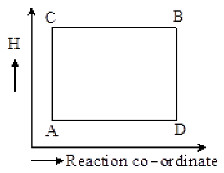
$A$ gas can be taken from state $A$ to state $B$ via two different paths $ACB$ and $ADB$. When path $ACB$ is used, $60 \text{ J}$ of heat flows into the system and $30 \text{ J}$ of work is done by the system. If path $ADB$ is used, the work done by the system is $10 \text{ J}$. The heat flow into the system in path $ADB$ is: (in $text{ J}$)
A
$80$
B
$20$
C
$100$
D
$40$
Solution
(D) According to the first law of thermodynamics, $\Delta U = q + w$.
For path $ACB$:
Heat flow into the system, $q_{ACB} = 60 \text{ J}$.
Work done by the system, $w_{ACB} = -30 \text{ J}$ (since work is done by the system).
Change in internal energy, $\Delta U = q_{ACB} + w_{ACB} = 60 \text{ J} - 30 \text{ J} = 30 \text{ J}$.
Since internal energy $\Delta U$ is a state function, it remains the same for any path between $A$ and $B$.
Therefore, for path $ADB$, $\Delta U = 30 \text{ J}$.
Given for path $ADB$, work done by the system, $w_{ADB} = -10 \text{ J}$.
Using $\Delta U = q_{ADB} + w_{ADB}$:
$30 \text{ J} = q_{ADB} - 10 \text{ J}$.
$q_{ADB} = 30 \text{ J} + 10 \text{ J} = 40 \text{ J}$.
For path $ACB$:
Heat flow into the system, $q_{ACB} = 60 \text{ J}$.
Work done by the system, $w_{ACB} = -30 \text{ J}$ (since work is done by the system).
Change in internal energy, $\Delta U = q_{ACB} + w_{ACB} = 60 \text{ J} - 30 \text{ J} = 30 \text{ J}$.
Since internal energy $\Delta U$ is a state function, it remains the same for any path between $A$ and $B$.
Therefore, for path $ADB$, $\Delta U = 30 \text{ J}$.
Given for path $ADB$, work done by the system, $w_{ADB} = -10 \text{ J}$.
Using $\Delta U = q_{ADB} + w_{ADB}$:
$30 \text{ J} = q_{ADB} - 10 \text{ J}$.
$q_{ADB} = 30 \text{ J} + 10 \text{ J} = 40 \text{ J}$.
0 likesView Solution
19
ChemistryDifficultMCQKCET · 2026
For the reversible reaction, $N_{2(g)} + 3H_{2(g)} \rightleftharpoons 2NH_{3(g)}$. When the partial pressure is measured in atmosphere, the value of $K_p$ at $500^{\circ}\text{C}$ is $1.44 \times 10^{-5}$. The value of $K_c$ when the concentration is expressed in $\text{mol L}^{-1}$ is:
A
$\frac{1.44 \times 10^{-5}}{(0.082 \times 500)^{-2}}$
B
$\frac{1.44 \times 10^{-5}}{(8.314 \times 773)^{-2}}$
C
$\frac{1.44 \times 10^{-5}}{(0.082 \times 773)^{2}}$
D
$\frac{1.44 \times 10^{-5}}{(0.082 \times 773)^{-2}}$
Solution
(D) The relationship between $K_p$ and $K_c$ is given by $K_p = K_c(RT)^{\Delta n}$.
For the reaction $N_{2(g)} + 3H_{2(g)} \rightleftharpoons 2NH_{3(g)}$, the change in moles of gas is $\Delta n = n_p - n_r = 2 - (1 + 3) = -2$.
The temperature $T = 500 + 273 = 773 \text{ K}$.
The gas constant $R = 0.082 \text{ L atm K}^{-1} \text{ mol}^{-1}$.
Substituting these values into the formula: $K_p = K_c(RT)^{-2}$.
Rearranging for $K_c$, we get $K_c = \frac{K_p}{(RT)^{-2}}$.
Substituting the given $K_p$ value: $K_c = \frac{1.44 \times 10^{-5}}{(0.082 \times 773)^{-2}}$.
For the reaction $N_{2(g)} + 3H_{2(g)} \rightleftharpoons 2NH_{3(g)}$, the change in moles of gas is $\Delta n = n_p - n_r = 2 - (1 + 3) = -2$.
The temperature $T = 500 + 273 = 773 \text{ K}$.
The gas constant $R = 0.082 \text{ L atm K}^{-1} \text{ mol}^{-1}$.
Substituting these values into the formula: $K_p = K_c(RT)^{-2}$.
Rearranging for $K_c$, we get $K_c = \frac{K_p}{(RT)^{-2}}$.
Substituting the given $K_p$ value: $K_c = \frac{1.44 \times 10^{-5}}{(0.082 \times 773)^{-2}}$.
0 likesView Solution
20
ChemistryMediumMCQKCET · 2026
For the following gaseous reversible reaction: $3A_{(g)} + B_{(g)} \rightleftharpoons A_3B_{(g)}$ $(\Delta H = -q \text{ kJ})$. The amount of product $A_3B_{(g)}$ is affected by . . . . . .
A
Temperature alone
B
Pressure alone
C
Both temperature and pressure
D
Temperature, pressure and catalyst
Solution
(C) $1$. The reaction involves a change in the total number of moles of gaseous species: $4 \text{ moles}$ on the reactant side and $1 \text{ mole}$ on the product side. According to Le Chatelier's principle, a change in pressure will shift the equilibrium.
$2$. Since the reaction is exothermic ($\Delta H = -q \text{ kJ}$, where $q > 0$), a change in temperature will also shift the equilibrium.
$3$. $A$ catalyst only increases the rate of both forward and backward reactions equally and does not affect the equilibrium position or the amount of product formed.
$4$. Therefore, the amount of product is affected by both temperature and pressure.
$2$. Since the reaction is exothermic ($\Delta H = -q \text{ kJ}$, where $q > 0$), a change in temperature will also shift the equilibrium.
$3$. $A$ catalyst only increases the rate of both forward and backward reactions equally and does not affect the equilibrium position or the amount of product formed.
$4$. Therefore, the amount of product is affected by both temperature and pressure.
0 likesView Solution
21
ChemistryDifficultMCQKCET · 2026
$A$ $0.15 \text{ mol}$ of pyridinium chloride is added to $500 \text{ cm}^3$ of $0.2 \text{ M}$ pyridine solution. Assuming no change in volume upon mixing, what is the $pH$ of the resulting solution? (Given: $pK_b$ of pyridine $= 8.75$)
A
$5.07$
B
$6.00$
C
$7.00$
D
$8.93$
Solution
(A) $1$. The solution is a basic buffer consisting of a weak base (pyridine) and its salt (pyridinium chloride).
$2$. The concentration of the base $[Base] = 0.2 \text{ M}$.
$3$. The concentration of the salt $[Salt] = \frac{0.15 \text{ mol}}{0.5 \text{ L}} = 0.3 \text{ M}$.
$4$. Using the Henderson-Hasselbalch equation for a basic buffer: $pOH = pK_b + \log\left(\frac{[Salt]}{[Base]}\right)$.
$5$. $pOH = 8.75 + \log\left(\frac{0.3}{0.2}\right) = 8.75 + \log(1.5) = 8.75 + 0.176 = 8.926$.
$6$. Since $pH + pOH = 14$, $pH = 14 - 8.926 = 5.074 \approx 5.07$.
$2$. The concentration of the base $[Base] = 0.2 \text{ M}$.
$3$. The concentration of the salt $[Salt] = \frac{0.15 \text{ mol}}{0.5 \text{ L}} = 0.3 \text{ M}$.
$4$. Using the Henderson-Hasselbalch equation for a basic buffer: $pOH = pK_b + \log\left(\frac{[Salt]}{[Base]}\right)$.
$5$. $pOH = 8.75 + \log\left(\frac{0.3}{0.2}\right) = 8.75 + \log(1.5) = 8.75 + 0.176 = 8.926$.
$6$. Since $pH + pOH = 14$, $pH = 14 - 8.926 = 5.074 \approx 5.07$.
0 likesView Solution
22
ChemistryMediumMCQKCET · 2026
The intermediates in heteropolar reactions are
A
Free radicals only
B
Cations only
C
Anions only
D
Both anions and cations
Solution
(D) $1$. Heteropolar reactions, also known as ionic reactions, involve the heterolytic cleavage of covalent bonds.
$2$. In heterolytic cleavage, the shared pair of electrons is transferred to one of the bonded atoms.
$3$. This process results in the formation of charged species, specifically cations and anions, as reaction intermediates.
$4$. Therefore, both anions and cations serve as intermediates in heteropolar reactions.
$2$. In heterolytic cleavage, the shared pair of electrons is transferred to one of the bonded atoms.
$3$. This process results in the formation of charged species, specifically cations and anions, as reaction intermediates.
$4$. Therefore, both anions and cations serve as intermediates in heteropolar reactions.
0 likesView Solution
23
ChemistryDifficultMCQKCET · 2026
During the electrolysis of acidified water, $16 \text{ g}$ of $O_2$ gas is formed at the anode. The volume of $H_2$ gas liberated at the cathode under $STP$ conditions is: (in $text{ L}$)
A
$22.4$
B
$11.2$
C
$2.24$
D
$1.12$
Solution
(A) The electrolysis reaction of water is: $2H_2O(l) \rightarrow 2H_2(g) + O_2(g)$.
According to Faraday's law of electrolysis, the number of equivalents of $H_2$ and $O_2$ produced are equal.
Equivalents of $O_2 = \frac{\text{mass}}{\text{equivalent mass}} = \frac{16 \text{ g}}{8 \text{ g/eq}} = 2 \text{ eq}$.
Therefore, equivalents of $H_2 = 2 \text{ eq}$.
Since the equivalent mass of $H_2$ is $1 \text{ g/eq}$, the mass of $H_2 = 2 \text{ eq} \times 1 \text{ g/eq} = 2 \text{ g}$.
Number of moles of $H_2 = \frac{\text{mass}}{\text{molar mass}} = \frac{2 \text{ g}}{2 \text{ g/mol}} = 1 \text{ mol}$.
At $STP$, $1 \text{ mole}$ of any gas occupies $22.4 \text{ L}$.
Thus, the volume of $H_2$ gas is $22.4 \text{ L}$.
According to Faraday's law of electrolysis, the number of equivalents of $H_2$ and $O_2$ produced are equal.
Equivalents of $O_2 = \frac{\text{mass}}{\text{equivalent mass}} = \frac{16 \text{ g}}{8 \text{ g/eq}} = 2 \text{ eq}$.
Therefore, equivalents of $H_2 = 2 \text{ eq}$.
Since the equivalent mass of $H_2$ is $1 \text{ g/eq}$, the mass of $H_2 = 2 \text{ eq} \times 1 \text{ g/eq} = 2 \text{ g}$.
Number of moles of $H_2 = \frac{\text{mass}}{\text{molar mass}} = \frac{2 \text{ g}}{2 \text{ g/mol}} = 1 \text{ mol}$.
At $STP$, $1 \text{ mole}$ of any gas occupies $22.4 \text{ L}$.
Thus, the volume of $H_2$ gas is $22.4 \text{ L}$.
0 likesView Solution
24
ChemistryMediumMCQKCET · 2026
$\Lambda_m^0(NH_4OH)$ is equal to:
A
$\Lambda_m^0(NH_4OH) + \Lambda_m^0(NH_4Cl) - \Lambda_m^0(HCl)$
B
$\Lambda_m^0(NH_4Cl) + \Lambda_m^0(NaOH) - \Lambda_m^0(NaCl)$
C
$\Lambda_m^0(NH_4Cl) + \Lambda_m^0(NaCl) - \Lambda_m^0(NaOH)$
D
$\Lambda_m^0(NaOH) + \Lambda_m^0(NaCl) - \Lambda_m^0(NH_4Cl)$
Solution
(B) According to Kohlrausch's law of independent migration of ions:
$\Lambda_m^0(NH_4OH) = \lambda^0(NH_4^+) + \lambda^0(OH^-)$
To obtain this, we use strong electrolytes:
$\Lambda_m^0(NH_4Cl) = \lambda^0(NH_4^+) + \lambda^0(Cl^-)$
$\Lambda_m^0(NaOH) = \lambda^0(Na^+) + \lambda^0(OH^-)$
$\Lambda_m^0(NaCl) = \lambda^0(Na^+) + \lambda^0(Cl^-)$
Adding the first two and subtracting the third:
$\Lambda_m^0(NH_4Cl) + \Lambda_m^0(NaOH) - \Lambda_m^0(NaCl) = (\lambda^0(NH_4^+) + \lambda^0(Cl^-)) + (\lambda^0(Na^+) + \lambda^0(OH^-)) - (\lambda^0(Na^+) + \lambda^0(Cl^-))$
$= \lambda^0(NH_4^+) + \lambda^0(OH^-) = \Lambda_m^0(NH_4OH)$.
$\Lambda_m^0(NH_4OH) = \lambda^0(NH_4^+) + \lambda^0(OH^-)$
To obtain this, we use strong electrolytes:
$\Lambda_m^0(NH_4Cl) = \lambda^0(NH_4^+) + \lambda^0(Cl^-)$
$\Lambda_m^0(NaOH) = \lambda^0(Na^+) + \lambda^0(OH^-)$
$\Lambda_m^0(NaCl) = \lambda^0(Na^+) + \lambda^0(Cl^-)$
Adding the first two and subtracting the third:
$\Lambda_m^0(NH_4Cl) + \Lambda_m^0(NaOH) - \Lambda_m^0(NaCl) = (\lambda^0(NH_4^+) + \lambda^0(Cl^-)) + (\lambda^0(Na^+) + \lambda^0(OH^-)) - (\lambda^0(Na^+) + \lambda^0(Cl^-))$
$= \lambda^0(NH_4^+) + \lambda^0(OH^-) = \Lambda_m^0(NH_4OH)$.
0 likesView Solution
25
ChemistryDifficultMCQKCET · 2026
Given below are the half-cell reactions: $Mn^{2+} + 2e^- \rightarrow Mn$ $(E^0 = -1.18 \text{ V})$; $Mn^{3+} + e^- \rightarrow Mn^{2+}$ $(E^0 = +1.51 \text{ V})$. The $E^0_{cell}$ for $3Mn^{2+} \rightarrow Mn + 2Mn^{3+}$ will be . . . . . .
A
$-2.69 \text{ V}$, the reaction will not occur (Non-Spontaneous)
B
$-2.69 \text{ V}$, the reaction will occur (Spontaneous)
C
$-0.33 \text{ V}$, the reaction will not occur (Non-Spontaneous)
D
$-0.33 \text{ V}$, the reaction will occur (Spontaneous)
Solution
(A) Step $1$: Identify the oxidation and reduction half-reactions from the overall reaction $3Mn^{2+} \rightarrow Mn + 2Mn^{3+}$.
Step $2$: Oxidation: $Mn^{2+} \rightarrow Mn^{3+} + e^-$ $(E^0_{ox} = -1.51 \text{ V})$.
Step $3$: Reduction: $Mn^{2+} + 2e^- \rightarrow Mn$ $(E^0_{red} = -1.18 \text{ V})$.
Step $4$: Calculate $E^0_{cell} = E^0_{red} + E^0_{ox} = -1.18 \text{ V} + (-1.51 \text{ V}) = -2.69 \text{ V}$.
Step $5$: Since $E^0_{cell} < 0$, the reaction is non-spontaneous.
Step $2$: Oxidation: $Mn^{2+} \rightarrow Mn^{3+} + e^-$ $(E^0_{ox} = -1.51 \text{ V})$.
Step $3$: Reduction: $Mn^{2+} + 2e^- \rightarrow Mn$ $(E^0_{red} = -1.18 \text{ V})$.
Step $4$: Calculate $E^0_{cell} = E^0_{red} + E^0_{ox} = -1.18 \text{ V} + (-1.51 \text{ V}) = -2.69 \text{ V}$.
Step $5$: Since $E^0_{cell} < 0$, the reaction is non-spontaneous.
0 likesView Solution
26
ChemistryDifficultMCQKCET · 2026
The conductivity of a centimolar solution of $KCl$ at $298\text{ K}$ is $0.021\text{ }\Omega^{-1}\text{ cm}^{-1}$ and the resistance of the cell containing the solution at $298\text{ K}$ is $60\text{ }\Omega$. The value of the cell constant $(G^*)$ is (in $text{ cm}^{-1}$)
A
$3.25$
B
$1.26$
C
$3.34$
D
$1.34$
Solution
(B) Given:
Conductivity $(\kappa) = 0.021\text{ }\Omega^{-1}\text{ cm}^{-1}$
Resistance $(R) = 60\text{ }\Omega$
Cell constant $(G^*) = \kappa \times R$
$G^* = 0.021\text{ }\Omega^{-1}\text{ cm}^{-1} \times 60\text{ }\Omega = 1.26\text{ cm}^{-1}$.
Conductivity $(\kappa) = 0.021\text{ }\Omega^{-1}\text{ cm}^{-1}$
Resistance $(R) = 60\text{ }\Omega$
Cell constant $(G^*) = \kappa \times R$
$G^* = 0.021\text{ }\Omega^{-1}\text{ cm}^{-1} \times 60\text{ }\Omega = 1.26\text{ cm}^{-1}$.
0 likesView Solution
27
ChemistryMediumMCQKCET · 2026
Which one of the following graphs is not applicable for a $1^{st}$ order reaction $(R \rightarrow P)$?
A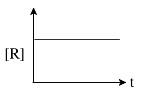
B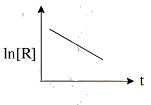
C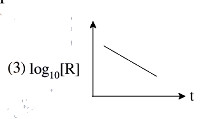
D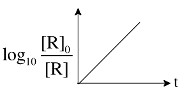
Solution
(A) For a $1^{st}$ order reaction, the integrated rate equation is $[R] = [R]_0 e^{-kt}$.
$(1)$ The plot of $[R]$ vs $t$ is an exponential decay curve, not a straight line.
$(2)$ The plot of $\ln[R]$ vs $t$ is a straight line with slope $-k$ and intercept $\ln[R]_0$.
$(3)$ The plot of $\log_{10}[R]$ vs $t$ is a straight line with slope $-\frac{k}{2.303}$ and intercept $\log_{10}[R]_0$.
$(4)$ The plot of $\log_{10}\frac{[R]_0}{[R]}$ vs $t$ is a straight line with slope $\frac{k}{2.303}$ passing through the origin.
Since the graph in option $A$ is shown as a horizontal straight line (which represents a zero-order reaction), it is not applicable for a $1^{st}$ order reaction.
$(1)$ The plot of $[R]$ vs $t$ is an exponential decay curve, not a straight line.
$(2)$ The plot of $\ln[R]$ vs $t$ is a straight line with slope $-k$ and intercept $\ln[R]_0$.
$(3)$ The plot of $\log_{10}[R]$ vs $t$ is a straight line with slope $-\frac{k}{2.303}$ and intercept $\log_{10}[R]_0$.
$(4)$ The plot of $\log_{10}\frac{[R]_0}{[R]}$ vs $t$ is a straight line with slope $\frac{k}{2.303}$ passing through the origin.
Since the graph in option $A$ is shown as a horizontal straight line (which represents a zero-order reaction), it is not applicable for a $1^{st}$ order reaction.
0 likesView Solution
28
ChemistryDifficultMCQKCET · 2026
For a reaction having three steps, the overall rate constant is $K = \frac{k_1 k_2}{k_3}$. The values of $E_{a1}$, $E_{a2}$ and $E_{a3}$ (activation energies for each step) are $40$, $50$ and $60 \text{ kJ mol}^{-1}$ respectively. The overall activation energy $E_a$ of the reaction is:
A
$30 \text{ kJ mol}^{-1}$
B
$40 \text{ kJ mol}^{-1}$
C
$50 \text{ kJ mol}^{-1}$
D
$60 \text{ kJ mol}^{-1}$
Solution
(A) The overall rate constant is given by $K = \frac{k_1 k_2}{k_3}$.
Taking the natural logarithm on both sides: $\ln K = \ln k_1 + \ln k_2 - \ln k_3$.
Differentiating with respect to temperature $T$: $\frac{d(\ln K)}{dT} = \frac{d(\ln k_1)}{dT} + \frac{d(\ln k_2)}{dT} - \frac{d(\ln k_3)}{dT}$.
Using the Arrhenius equation $\frac{d(\ln k)}{dT} = \frac{E_a}{RT^2}$, we get: $\frac{E_a}{RT^2} = \frac{E_{a1}}{RT^2} + \frac{E_{a2}}{RT^2} - \frac{E_{a3}}{RT^2}$.
Thus, $E_a = E_{a1} + E_{a2} - E_{a3}$.
Substituting the given values: $E_a = 40 + 50 - 60 = 30 \text{ kJ mol}^{-1}$.
Taking the natural logarithm on both sides: $\ln K = \ln k_1 + \ln k_2 - \ln k_3$.
Differentiating with respect to temperature $T$: $\frac{d(\ln K)}{dT} = \frac{d(\ln k_1)}{dT} + \frac{d(\ln k_2)}{dT} - \frac{d(\ln k_3)}{dT}$.
Using the Arrhenius equation $\frac{d(\ln k)}{dT} = \frac{E_a}{RT^2}$, we get: $\frac{E_a}{RT^2} = \frac{E_{a1}}{RT^2} + \frac{E_{a2}}{RT^2} - \frac{E_{a3}}{RT^2}$.
Thus, $E_a = E_{a1} + E_{a2} - E_{a3}$.
Substituting the given values: $E_a = 40 + 50 - 60 = 30 \text{ kJ mol}^{-1}$.
0 likesView Solution
29
ChemistryMediumMCQKCET · 2026
The $C - Cl$ bond in methyl chloride compared to the $C - Cl$ bond in chlorobenzene is:
A
Longer and stronger
B
Shorter and stronger
C
Shorter and weaker
D
Longer and weaker
Solution
(D) $1$. In methyl chloride $(CH_3Cl)$, the carbon atom is $sp^3$ hybridized. The $C - Cl$ bond is a pure single bond.
$2$. In chlorobenzene $(C_6H_5Cl)$, the lone pair of electrons on the chlorine atom participates in resonance with the benzene ring. This imparts partial double bond character to the $C - Cl$ bond.
$3$. Due to resonance, the $C - Cl$ bond in chlorobenzene is shorter and stronger than in methyl chloride.
$4$. Conversely, the $C - Cl$ bond in methyl chloride is longer and weaker than in chlorobenzene.
$2$. In chlorobenzene $(C_6H_5Cl)$, the lone pair of electrons on the chlorine atom participates in resonance with the benzene ring. This imparts partial double bond character to the $C - Cl$ bond.
$3$. Due to resonance, the $C - Cl$ bond in chlorobenzene is shorter and stronger than in methyl chloride.
$4$. Conversely, the $C - Cl$ bond in methyl chloride is longer and weaker than in chlorobenzene.
0 likesView Solution
30
ChemistryMediumMCQKCET · 2026
The compound from which chlorobenzene cannot be prepared easily is
A
Aniline
B
Benzene
C
Phenol
D
Benzene diazonium chloride
Solution
(C) Step $1$: Chlorobenzene can be prepared from aniline via the Sandmeyer reaction using $NaNO_2/HCl$ followed by $CuCl/HCl$.
Step $2$: It can be prepared from benzene via electrophilic substitution using $Cl_2/FeCl_3$.
Step $3$: It can be prepared from benzene diazonium chloride via the Sandmeyer reaction.
Step $4$: In phenol, the $C-O$ bond has partial double bond character due to resonance, making it very strong and difficult to break to replace the $-OH$ group with a $-Cl$ atom. Thus, chlorobenzene is not easily prepared from phenol.
Step $2$: It can be prepared from benzene via electrophilic substitution using $Cl_2/FeCl_3$.
Step $3$: It can be prepared from benzene diazonium chloride via the Sandmeyer reaction.
Step $4$: In phenol, the $C-O$ bond has partial double bond character due to resonance, making it very strong and difficult to break to replace the $-OH$ group with a $-Cl$ atom. Thus, chlorobenzene is not easily prepared from phenol.
0 likesView Solution
31
ChemistryMediumMCQKCET · 2026
In $S_N1$ reaction, the alkyl halide that on hydrolysis produces a racemic mixture is
A
Tertiary butyl bromide
B
$2-$bromobutane
C
Isopropyl bromide
D
Methyl bromide
Solution
(B) $S_N1$ reactions proceed via a planar carbocation intermediate.
For a racemic mixture to be formed, the starting alkyl halide must be chiral.
In $2$-bromobutane, the carbon atom attached to the bromine is chiral (bonded to four different groups: $-H, -CH_3, -C_2H_5, -Br$).
Upon hydrolysis, the leaving group departs to form a planar carbocation, which can be attacked by the nucleophile from either side with equal probability, resulting in a racemic mixture.
For a racemic mixture to be formed, the starting alkyl halide must be chiral.
In $2$-bromobutane, the carbon atom attached to the bromine is chiral (bonded to four different groups: $-H, -CH_3, -C_2H_5, -Br$).
Upon hydrolysis, the leaving group departs to form a planar carbocation, which can be attacked by the nucleophile from either side with equal probability, resulting in a racemic mixture.
0 likesView Solution
32
ChemistryEasyMCQKCET · 2026
Match the compounds of List-$I$ with their effects in List-$II$:
| List-$I$ | List-$II$ |
| $(a)$ $Chloramphenicol$ | $(i)$ $Malaria$ |
| $(b)$ $Thyroxine$ | (ii) $Anaesthetic$ |
| $(c)$ $Chloroquine$ | (iii) $Goiter$ |
| $(d)$ $Chloroform$ | (iv) $Typhoid \text{ } fever$ |
A
$a-i, b-ii, c-iii, d-iv$
B
$a-iv, b-iii, c-i, d-ii$
C
$a-i, b-iii, c-iv, d-ii$
D
$a-iv, b-iii, c-ii, d-i$
Solution
(B) $Chloramphenicol$ is an antibiotic used for the treatment of $Typhoid \text{ } fever$ $(a-iv)$.
$Thyroxine$ deficiency leads to $Goiter$ $(b-iii)$.
$Chloroquine$ is an antimalarial drug used for $Malaria$ $(c-i)$.
$Chloroform$ acts as an $Anaesthetic$ $(d-ii)$.
Therefore, the correct matching is $a-iv, b-iii, c-i, d-ii$.
$Thyroxine$ deficiency leads to $Goiter$ $(b-iii)$.
$Chloroquine$ is an antimalarial drug used for $Malaria$ $(c-i)$.
$Chloroform$ acts as an $Anaesthetic$ $(d-ii)$.
Therefore, the correct matching is $a-iv, b-iii, c-i, d-ii$.
0 likesView Solution
33
ChemistryMediumMCQKCET · 2026
$R - CH_2OH$ is converted into $R - CHO$ by reacting with . . . . . .
A
Alkaline $KMnO_4$
B
$LiAlH_4$
C
$Na/C_2H_5OH$
D
$PCC$ (Pyridinium Chlorochromate)
Solution
(D) $1$. $R - CH_2OH$ is a primary alcohol.
$2$. Alkaline $KMnO_4$ is a strong oxidizing agent that oxidizes primary alcohols directly to carboxylic acids.
$3$. $LiAlH_4$ and $Na/C_2H_5OH$ are reducing agents.
$4$. $PCC$ (Pyridinium Chlorochromate) is a mild oxidizing agent that selectively oxidizes primary alcohols to aldehydes without further oxidation to carboxylic acids.
$2$. Alkaline $KMnO_4$ is a strong oxidizing agent that oxidizes primary alcohols directly to carboxylic acids.
$3$. $LiAlH_4$ and $Na/C_2H_5OH$ are reducing agents.
$4$. $PCC$ (Pyridinium Chlorochromate) is a mild oxidizing agent that selectively oxidizes primary alcohols to aldehydes without further oxidation to carboxylic acids.
0 likesView Solution
34
ChemistryMediumMCQKCET · 2026
Glycerol is a trihydric alcohol. It contains . . . . . .
A
One primary, one secondary and one tertiary alcoholic groups.
B
Two primary and one secondary alcoholic groups.
C
Two secondary and one primary alcoholic groups.
D
One primary and two tertiary alcoholic groups.
Solution
(B) The chemical structure of glycerol is $CH_2(OH)CH(OH)CH_2(OH)$.
In this structure, the two terminal carbon atoms are bonded to one $-OH$ group each, making them primary alcoholic groups.
The central carbon atom is bonded to one $-OH$ group and two other carbon atoms, making it a secondary alcoholic group.
Therefore, glycerol contains two primary and one secondary alcoholic groups.
In this structure, the two terminal carbon atoms are bonded to one $-OH$ group each, making them primary alcoholic groups.
The central carbon atom is bonded to one $-OH$ group and two other carbon atoms, making it a secondary alcoholic group.
Therefore, glycerol contains two primary and one secondary alcoholic groups.
0 likesView Solution
35
ChemistryDifficultMCQKCET · 2026
Identify the organic compounds $P$, $Q$, and $R$ in the following reaction sequence: $C_3H_6 \xrightarrow[ii) H_2O_2/NaOH]{i) BH_3} P \xrightarrow[anhydrous medium]{CrO_3} Q \xrightarrow[ii) H_3O^+]{i) CH_3MgBr} R + Mg(OH)Br$.
A
$P = H_3C-CH(OH)-CH_3, Q = H_3C-C(=O)-CH_3, R = H_3C-C(OH)(CH_3)_2$
B
$P = H_3C-CH_2-CH_2-OH, Q = H_3C-CH_2-CHO, R = H_3C-CH_2-CH(OH)-CH_3$
C
$P = H_3C-CH_2-CH_2-OH, Q = H_3C-CH_2-COOH, R = H_3C-CH_2-C(=O)-OCH_3$
D
$P = H_3C-CH(OH)-CH_3, Q = H_3C-C(=O)-CH_3, R = H_3C-CH(OCH_3)-CH_3$
Solution
(B) $1$. Hydroboration-oxidation of propene $(CH_3-CH=CH_2)$ follows anti-Markovnikov addition to yield propan$-1-$ol $(P = CH_3-CH_2-CH_2-OH)$.
$2$. Oxidation of primary alcohol $(P)$ with $CrO_3$ in anhydrous medium stops at the aldehyde stage, yielding propanal $(Q = CH_3-CH_2-CHO)$.
$3$. Reaction of propanal $(Q)$ with methylmagnesium bromide $(CH_3MgBr)$ followed by acid hydrolysis yields butan$-2-$ol $(R = CH_3-CH_2-CH(OH)-CH_3)$.
$2$. Oxidation of primary alcohol $(P)$ with $CrO_3$ in anhydrous medium stops at the aldehyde stage, yielding propanal $(Q = CH_3-CH_2-CHO)$.
$3$. Reaction of propanal $(Q)$ with methylmagnesium bromide $(CH_3MgBr)$ followed by acid hydrolysis yields butan$-2-$ol $(R = CH_3-CH_2-CH(OH)-CH_3)$.
0 likesView Solution
36
ChemistryMediumMCQKCET · 2026
Match the reagents in List-$I$ with the products obtained from their reaction with carbonyl compounds.
| List-$I$ | List-$II$ |
| $(a)$ $NH_2OH$ | $(i)$ Cyanohydrin |
| $(b)$ $R-NH_2$ | (ii) Oxime |
| $(c)$ $R-OH$ | (iii) Schiff base |
| $(d)$ $H-C\equiv N$ | (iv) Acetal |
A
$a-ii, b-iii, c-iv, d-i$
B
$a-i, b-ii, c-iii, d-iv$
C
$a-iii, b-ii, c-i, d-iv$
D
$a-i, b-iii, c-ii, d-iv$
Solution
(A) $1$. Reaction of carbonyl compounds with hydroxylamine $(NH_2OH)$ yields an oxime: $(a) \rightarrow (ii)$.
$2$. Reaction of carbonyl compounds with primary amines $(R-NH_2)$ yields a Schiff base: $(b) \rightarrow (iii)$.
$3$. Reaction of carbonyl compounds with alcohols $(R-OH)$ in the presence of dry $HCl$ yields an acetal: $(c) \rightarrow (iv)$.
$4$. Reaction of carbonyl compounds with hydrogen cyanide $(HCN)$ yields a cyanohydrin: $(d) \rightarrow (i)$.
Therefore, the correct matching is $a-ii, b-iii, c-iv, d-i$.
$2$. Reaction of carbonyl compounds with primary amines $(R-NH_2)$ yields a Schiff base: $(b) \rightarrow (iii)$.
$3$. Reaction of carbonyl compounds with alcohols $(R-OH)$ in the presence of dry $HCl$ yields an acetal: $(c) \rightarrow (iv)$.
$4$. Reaction of carbonyl compounds with hydrogen cyanide $(HCN)$ yields a cyanohydrin: $(d) \rightarrow (i)$.
Therefore, the correct matching is $a-ii, b-iii, c-iv, d-i$.
0 likesView Solution
37
ChemistryMediumMCQKCET · 2026
The major product ‘$A$’ in the given reaction is:
$\text{Benzaldehyde} + \text{Acetophenone} \xrightarrow[293 \text{ K}]{OH^-} \text{'A' (Major product)}$
$\text{Benzaldehyde} + \text{Acetophenone} \xrightarrow[293 \text{ K}]{OH^-} \text{'A' (Major product)}$
A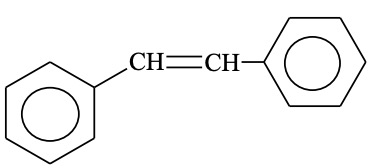
B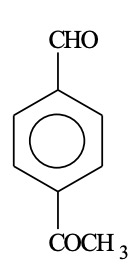
C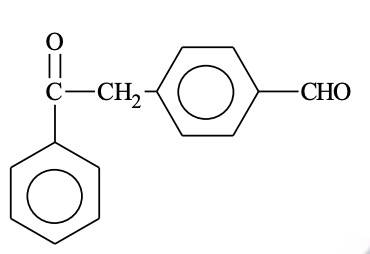
D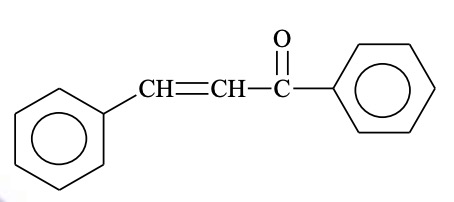
Solution
(D) The reaction between benzaldehyde and acetophenone in the presence of a dilute base $(OH^-)$ is a Claisen-Schmidt condensation reaction.
$1$. Acetophenone acts as the nucleophile because it has $\alpha$-hydrogens, which are removed by the base to form an enolate ion.
$2$. The enolate ion attacks the carbonyl carbon of benzaldehyde to form a $\beta$-hydroxy ketone.
$3$. The $\beta$-hydroxy ketone undergoes dehydration (loss of $H_2O$) to form an $\alpha, \beta$-unsaturated ketone, which is the stable major product.
$4$. The product is $1,3-\text{diphenylprop-2-en-1-one}$ (also known as chalcone), represented by option $D$.
$1$. Acetophenone acts as the nucleophile because it has $\alpha$-hydrogens, which are removed by the base to form an enolate ion.
$2$. The enolate ion attacks the carbonyl carbon of benzaldehyde to form a $\beta$-hydroxy ketone.
$3$. The $\beta$-hydroxy ketone undergoes dehydration (loss of $H_2O$) to form an $\alpha, \beta$-unsaturated ketone, which is the stable major product.
$4$. The product is $1,3-\text{diphenylprop-2-en-1-one}$ (also known as chalcone), represented by option $D$.
0 likesView Solution
38
ChemistryMediumMCQKCET · 2026
Carboxylic acids are more acidic than phenols because:
A
Formation of dimers
B
Intermolecular hydrogen bonding
C
More covalent nature
D
More resonance stabilization of their conjugate base
Solution
(D) Step $1$: The acidity of a compound depends on the stability of its conjugate base.
Step $2$: The conjugate base of a carboxylic acid is the carboxylate ion $(RCOO^-)$, where the negative charge is delocalized over two highly electronegative oxygen atoms.
Step $3$: The conjugate base of a phenol is the phenoxide ion $(C_6H_5O^-)$, where the negative charge is delocalized over the carbon atoms of the benzene ring and one oxygen atom.
Step $4$: Since oxygen is more electronegative than carbon, the negative charge is more effectively stabilized in the carboxylate ion than in the phenoxide ion. Therefore, carboxylic acids are more acidic.
Step $2$: The conjugate base of a carboxylic acid is the carboxylate ion $(RCOO^-)$, where the negative charge is delocalized over two highly electronegative oxygen atoms.
Step $3$: The conjugate base of a phenol is the phenoxide ion $(C_6H_5O^-)$, where the negative charge is delocalized over the carbon atoms of the benzene ring and one oxygen atom.
Step $4$: Since oxygen is more electronegative than carbon, the negative charge is more effectively stabilized in the carboxylate ion than in the phenoxide ion. Therefore, carboxylic acids are more acidic.
0 likesView Solution
39
ChemistryMediumMCQKCET · 2026
The compound that does not give the iodoform test is
A
Ethanal
B
Acetone
C
Ethanoic acid
D
Acetophenone
Solution
(C) The iodoform test is given by compounds containing the $CH_3CO-$ group or the $CH_3CH(OH)-$ group attached to a carbon or hydrogen atom.
$(1)$ Ethanal $(CH_3CHO)$ contains the $CH_3CO-$ group.
$(2)$ Acetone $(CH_3COCH_3)$ contains the $CH_3CO-$ group.
$(3)$ Acetophenone $(C_6H_5COCH_3)$ contains the $CH_3CO-$ group.
$(4)$ Ethanoic acid $(CH_3COOH)$ does not contain the $CH_3CO-$ group attached to a carbon or hydrogen atom, as the carbonyl carbon is bonded to an $-OH$ group. Therefore, it does not give the iodoform test.
$(1)$ Ethanal $(CH_3CHO)$ contains the $CH_3CO-$ group.
$(2)$ Acetone $(CH_3COCH_3)$ contains the $CH_3CO-$ group.
$(3)$ Acetophenone $(C_6H_5COCH_3)$ contains the $CH_3CO-$ group.
$(4)$ Ethanoic acid $(CH_3COOH)$ does not contain the $CH_3CO-$ group attached to a carbon or hydrogen atom, as the carbonyl carbon is bonded to an $-OH$ group. Therefore, it does not give the iodoform test.
0 likesView Solution
40
ChemistryMediumMCQKCET · 2026
Nitration of aniline in a strong acidic medium gives a significant amount of $m$-nitroaniline because:
A
In electrophilic substitution reactions, the amino group is meta-directing.
B
In a strong acidic medium, aniline is present as the anilinium ion.
C
The $-NH_2$ group always directs to the meta position.
D
$m$-nitroaniline has a higher molar mass than $o$- and $p$-nitroanilines.
Solution
(B) $1$. In a strong acidic medium, the lone pair of electrons on the nitrogen atom of aniline is protonated by the acid.
$2$. This results in the formation of the anilinium ion $(-NH_3^+)$.
$3$. The $-NH_3^+$ group is strongly electron-withdrawing due to its positive charge and exerts a $-I$ effect.
$4$. Consequently, it deactivates the benzene ring and directs the incoming electrophile to the meta position.
$2$. This results in the formation of the anilinium ion $(-NH_3^+)$.
$3$. The $-NH_3^+$ group is strongly electron-withdrawing due to its positive charge and exerts a $-I$ effect.
$4$. Consequently, it deactivates the benzene ring and directs the incoming electrophile to the meta position.
0 likesView Solution
41
ChemistryMediumMCQKCET · 2026
The basic strength of alkylamines in the aqueous phase is not decided by . . . . . . .
A
Inductive effect
B
Solvation effect
C
Steric hindrance
D
Hyperconjugation effect
Solution
(D) Step $1$: The basic strength of alkylamines in the aqueous phase depends on three main factors: inductive effect, solvation effect, and steric hindrance.
Step $2$: The inductive effect ($+I$ effect) increases the electron density on the nitrogen atom, making it more basic.
Step $3$: The solvation effect (stabilization of the conjugate acid by hydrogen bonding with water) stabilizes the cation; more substituted amines have less hydrogen bonding.
Step $4$: Steric hindrance (crowding around the nitrogen atom) hinders the approach of the proton.
Step $5$: Hyperconjugation effect does not play a significant role in determining the basicity of alkylamines in the aqueous phase. Therefore, the correct option is $D$.
Step $2$: The inductive effect ($+I$ effect) increases the electron density on the nitrogen atom, making it more basic.
Step $3$: The solvation effect (stabilization of the conjugate acid by hydrogen bonding with water) stabilizes the cation; more substituted amines have less hydrogen bonding.
Step $4$: Steric hindrance (crowding around the nitrogen atom) hinders the approach of the proton.
Step $5$: Hyperconjugation effect does not play a significant role in determining the basicity of alkylamines in the aqueous phase. Therefore, the correct option is $D$.
0 likesView Solution
42
ChemistryDifficultMCQKCET · 2026
Organic compound ‘$D$’ is in the reaction sequence: Nitrobenzene $\xrightarrow[323-333 \text{ K}]{\text{Conc. } HNO_3, \text{Conc. } H_2SO_4} A \xrightarrow{Fe/HCl} B \xrightarrow[273 \text{ K}]{NaNO_2/HCl} C \xrightarrow[ -N_2]{C_2H_5OH} D + CH_3CHO + HCl$. Identify ‘$D$’.
A
Aniline
B
Benzene
C
Nitrobenzene
D
$N$-ethylaniline
Solution
(C) Step $1$: Nitrobenzene reacts with conc. $HNO_3$ and conc. $H_2SO_4$ at $323-333 \text{ K}$ to form $m$-dinitrobenzene $(A)$.
Step $2$: $m$-dinitrobenzene is reduced by $Fe/HCl$ to form $m$-nitroaniline $(B)$.
Step $3$: $m$-nitroaniline reacts with $NaNO_2/HCl$ at $273 \text{ K}$ to form $m$-nitrobenzenediazonium chloride $(C)$.
Step $4$: $m$-nitrobenzenediazonium chloride reacts with ethanol $(C_2H_5OH)$ to form nitrobenzene $(D)$, acetaldehyde $(CH_3CHO)$, $N_2$ gas, and $HCl$. Thus, $D$ is nitrobenzene.
Step $2$: $m$-dinitrobenzene is reduced by $Fe/HCl$ to form $m$-nitroaniline $(B)$.
Step $3$: $m$-nitroaniline reacts with $NaNO_2/HCl$ at $273 \text{ K}$ to form $m$-nitrobenzenediazonium chloride $(C)$.
Step $4$: $m$-nitrobenzenediazonium chloride reacts with ethanol $(C_2H_5OH)$ to form nitrobenzene $(D)$, acetaldehyde $(CH_3CHO)$, $N_2$ gas, and $HCl$. Thus, $D$ is nitrobenzene.
0 likesView Solution
43
ChemistryMediumMCQKCET · 2026
Which of the following will not act as an oxidising agent?
A
$CrO_3$
B
$MoO_3$
C
$CrO_4^{2-}$
D
$Cr_2O_7^{2-}$
Solution
(B) $1$. An oxidising agent is a substance that undergoes reduction by gaining electrons.
$2$. In $CrO_3$, $CrO_4^{2-}$, and $Cr_2O_7^{2-}$, chromium is in the $+6$ oxidation state, which is a common state for chromium to be reduced to lower oxidation states.
$3$. In $MoO_3$, molybdenum is in the $+6$ oxidation state. Due to the stability of the $+6$ oxidation state in group $6$ elements, $Mo(VI)$ is much more stable than $Cr(VI)$.
$4$. Therefore, $MoO_3$ does not readily undergo reduction and acts as a very poor oxidising agent compared to the chromium species.
$2$. In $CrO_3$, $CrO_4^{2-}$, and $Cr_2O_7^{2-}$, chromium is in the $+6$ oxidation state, which is a common state for chromium to be reduced to lower oxidation states.
$3$. In $MoO_3$, molybdenum is in the $+6$ oxidation state. Due to the stability of the $+6$ oxidation state in group $6$ elements, $Mo(VI)$ is much more stable than $Cr(VI)$.
$4$. Therefore, $MoO_3$ does not readily undergo reduction and acts as a very poor oxidising agent compared to the chromium species.
0 likesView Solution
44
ChemistryMediumMCQKCET · 2026
The highest oxidation state of manganese in fluorides is $+4$ $(MnF_4)$, but the highest oxidation state in oxides is $+7$ $(Mn_2O_7)$, because
A
Fluorine is more electronegative than oxygen
B
Fluorine possesses d-orbitals
C
Fluorine stabilises lower oxidation state
D
In covalent compounds, fluorine can form single bond only, while oxygen forms double bond
Solution
(D) Step $1$: Manganese can exhibit a maximum oxidation state of $+7$ by using all its valence electrons $(3d^5 4s^2)$.
Step $2$: Oxygen has the unique ability to form multiple bonds (specifically $p\pi - d\pi$ multiple bonds) with transition metals, which stabilizes the higher oxidation states of the metal.
Step $3$: Fluorine, being highly electronegative and small, can only form single covalent bonds $(Mn-F)$. It cannot form multiple bonds with manganese.
Step $4$: Therefore, oxygen can satisfy the high valency of manganese in $Mn_2O_7$ through multiple bonding, whereas fluorine is restricted to $MnF_4$.
Step $2$: Oxygen has the unique ability to form multiple bonds (specifically $p\pi - d\pi$ multiple bonds) with transition metals, which stabilizes the higher oxidation states of the metal.
Step $3$: Fluorine, being highly electronegative and small, can only form single covalent bonds $(Mn-F)$. It cannot form multiple bonds with manganese.
Step $4$: Therefore, oxygen can satisfy the high valency of manganese in $Mn_2O_7$ through multiple bonding, whereas fluorine is restricted to $MnF_4$.
0 likesView Solution
45
ChemistryDifficultMCQKCET · 2026
The calculated spin-only magnetic moment of $Cr^{2+}$ ion is: (in $text{ BM}$)
A
$4.87$
B
$4.90$
C
$3.92$
D
$5.84$
Solution
(B) The electronic configuration of $Cr$ is $[Ar] 3d^5 4s^1$.
The electronic configuration of $Cr^{2+}$ ion is $[Ar] 3d^4 4s^0$.
Number of unpaired electrons $(n)$ = $4$.
The spin-only magnetic moment formula is $\mu = \sqrt{n(n+2)} \text{ BM}$.
Substituting $n = 4$ into the formula: $\mu = \sqrt{4(4+2)} = \sqrt{4 \times 6} = \sqrt{24} \approx 4.90 \text{ BM}$.
The electronic configuration of $Cr^{2+}$ ion is $[Ar] 3d^4 4s^0$.
Number of unpaired electrons $(n)$ = $4$.
The spin-only magnetic moment formula is $\mu = \sqrt{n(n+2)} \text{ BM}$.
Substituting $n = 4$ into the formula: $\mu = \sqrt{4(4+2)} = \sqrt{4 \times 6} = \sqrt{24} \approx 4.90 \text{ BM}$.
0 likesView Solution
46
ChemistryMediumMCQKCET · 2026
Which of the following is the most stable complex?
A
$[Fe(CO)_5]$
B
$[Fe(CN)_6]^{3-}$
C
$[Fe(C_2O_4)_3]^{3-}$
D
$[Fe(H_2O)_6]^{3+}$
Solution
(C) $1$. The stability of a coordination complex is significantly enhanced by the chelate effect.
$2$. The ligand $C_2O_4^{2-}$ (oxalate) is a bidentate chelating ligand that forms five-membered stable rings with the central metal ion.
$3$. Among the given options, $[Fe(C_2O_4)_3]^{3-}$ forms a stable chelated structure, making it the most stable complex due to the chelate effect.
$2$. The ligand $C_2O_4^{2-}$ (oxalate) is a bidentate chelating ligand that forms five-membered stable rings with the central metal ion.
$3$. Among the given options, $[Fe(C_2O_4)_3]^{3-}$ forms a stable chelated structure, making it the most stable complex due to the chelate effect.
0 likesView Solution
47
ChemistryMediumMCQKCET · 2026
How many ions per molecule are produced from the complex $[Co(NH_3)_6]Cl_2$ in solution?
A
$6$
B
$4$
C
$3$
D
$2$
Solution
(C) The complex $[Co(NH_3)_6]Cl_2$ dissociates in solution as follows:
$[Co(NH_3)_6]Cl_2 \rightarrow [Co(NH_3)_6]^{2+} + 2Cl^-$
Number of $[Co(NH_3)_6]^{2+}$ ions = $1$
Number of $Cl^-$ ions = $2$
Total number of ions per molecule = $1 + 2 = 3$.
$[Co(NH_3)_6]Cl_2 \rightarrow [Co(NH_3)_6]^{2+} + 2Cl^-$
Number of $[Co(NH_3)_6]^{2+}$ ions = $1$
Number of $Cl^-$ ions = $2$
Total number of ions per molecule = $1 + 2 = 3$.
0 likesView Solution
48
ChemistryMediumMCQKCET · 2026
Given below are two statements:
Statement $I$: The $M - C \sigma$ bond is formed by the donation of a lone pair of electrons on the carbonyl carbon into a vacant orbital of the metal.
Statement $II$: The $M - C \pi$ bond is formed by the donation of a pair of electrons from a filled $d$-orbital of the metal into the vacant antibonding $\pi^*$ orbital of carbon monoxide.
In the light of the above statements, choose the correct answer from the options given below:
Statement $I$: The $M - C \sigma$ bond is formed by the donation of a lone pair of electrons on the carbonyl carbon into a vacant orbital of the metal.
Statement $II$: The $M - C \pi$ bond is formed by the donation of a pair of electrons from a filled $d$-orbital of the metal into the vacant antibonding $\pi^*$ orbital of carbon monoxide.
In the light of the above statements, choose the correct answer from the options given below:
A
Both Statement $I$ and Statement $II$ are correct
B
Both Statement $I$ and Statement $II$ are incorrect
C
Statement $I$ is correct but Statement $II$ is incorrect
D
Statement $I$ is incorrect but Statement $II$ is correct
Solution
(A) Step $1$: In metal carbonyls, the $M - C \sigma$ bond is formed by the donation of a lone pair of electrons from the carbonyl carbon atom into a vacant orbital of the metal atom.
Step $2$: The $M - C \pi$ bond is formed by the back-donation of a pair of electrons from a filled $d$-orbital of the metal into the vacant antibonding $\pi^*$ molecular orbital of the carbon monoxide ligand.
Step $3$: Both statements accurately describe the synergistic bonding mechanism in metal carbonyls.
Conclusion: Both Statement $I$ and Statement $II$ are correct.
Step $2$: The $M - C \pi$ bond is formed by the back-donation of a pair of electrons from a filled $d$-orbital of the metal into the vacant antibonding $\pi^*$ molecular orbital of the carbon monoxide ligand.
Step $3$: Both statements accurately describe the synergistic bonding mechanism in metal carbonyls.
Conclusion: Both Statement $I$ and Statement $II$ are correct.
0 likesView Solution
49
ChemistryMediumMCQKCET · 2026
Match List – $I$ with List – $II$:
Choose the correct answer from the options given below.
| List - $I$ (Complex) | List – $II$ (Geometry) |
| $(a)$ $[Co(NH_3)_6]^{3+}$ | $(i)$ Trigonal bipyramidal |
| $(b)$ $[NiCl_4]^{2-}$ | (ii) Octahedral |
| $(c)$ $[Ni(CN)_4]^{2-}$ | (iii) Tetrahedral |
| $(d)$ $[Fe(CO)_5]$ | (iv) Square planar |
Choose the correct answer from the options given below.
A
$a-ii, b-iii, c-iv, d-i$
B
$a-ii, b-i, c-iii, d-iv$
C
$a-iii, b-ii, c-iv, d-i$
D
$a-i, b-iii, c-iv, d-ii$
Solution
(A) Step $1$: Determine the hybridization and geometry of each complex.
Step $2$: $[Co(NH_3)_6]^{3+}$ has $d^2sp^3$ hybridization, which corresponds to an octahedral geometry (ii).
Step $3$: $[NiCl_4]^{2-}$ has $sp^3$ hybridization, which corresponds to a tetrahedral geometry (iii).
Step $4$: $[Ni(CN)_4]^{2-}$ has $dsp^2$ hybridization, which corresponds to a square planar geometry (iv).
Step $5$: $[Fe(CO)_5]$ has $dsp^3$ hybridization, which corresponds to a trigonal bipyramidal geometry $(i)$.
Therefore, the correct match is $a-ii, b-iii, c-iv, d-i$.
Step $2$: $[Co(NH_3)_6]^{3+}$ has $d^2sp^3$ hybridization, which corresponds to an octahedral geometry (ii).
Step $3$: $[NiCl_4]^{2-}$ has $sp^3$ hybridization, which corresponds to a tetrahedral geometry (iii).
Step $4$: $[Ni(CN)_4]^{2-}$ has $dsp^2$ hybridization, which corresponds to a square planar geometry (iv).
Step $5$: $[Fe(CO)_5]$ has $dsp^3$ hybridization, which corresponds to a trigonal bipyramidal geometry $(i)$.
Therefore, the correct match is $a-ii, b-iii, c-iv, d-i$.
0 likesView Solution
50
ChemistryMediumMCQKCET · 2026
Match List – $I$ with List – $II$
Choose the correct answer from the options given below.
| List – $I$ (Vitamins) | List – $II$ (Deficiency Diseases) |
| $(a)$ $B_1$ | $(i)$ Convulsions |
| $(b)$ $B_2$ | (ii) $RBC$ deficiency in Haemoglobin |
| $(c)$ $B_6$ | (iii) Retarded growth |
| $(d)$ $B_{12}$ | (iv) Burning sensation of the skin |
Choose the correct answer from the options given below.
A
$a-ii, b-iv, c-iii, d-i$
B
$a-iii, b-iv, c-i, d-ii$
C
$a-i, b-ii, c-iii, d-iv$
D
$a-iv, b-iii, c-ii, d-i$
Solution
(B) Step $1$: Identify the deficiency diseases for each vitamin.
- Vitamin $B_1$ (Thiamine) deficiency leads to Beri-Beri, but among the given options, it is associated with retarded growth in some contexts or general metabolic issues.
- Vitamin $B_2$ (Riboflavin) deficiency causes cheilosis, glossitis, and burning sensation of the skin.
- Vitamin $B_6$ (Pyridoxine) deficiency leads to convulsions.
- Vitamin $B_{12}$ (Cyanocobalamin) deficiency leads to pernicious anaemia ($RBC$ deficiency in Haemoglobin).
Step $2$: Match the items:
$(a)$ $B_1$ - (iii) Retarded growth
$(b)$ $B_2$ - (iv) Burning sensation of the skin
$(c)$ $B_6$ - $(i)$ Convulsions
$(d)$ $B_{12}$ - (ii) $RBC$ deficiency in Haemoglobin
Step $3$: The correct sequence is $a-iii, b-iv, c-i, d-ii$.
- Vitamin $B_1$ (Thiamine) deficiency leads to Beri-Beri, but among the given options, it is associated with retarded growth in some contexts or general metabolic issues.
- Vitamin $B_2$ (Riboflavin) deficiency causes cheilosis, glossitis, and burning sensation of the skin.
- Vitamin $B_6$ (Pyridoxine) deficiency leads to convulsions.
- Vitamin $B_{12}$ (Cyanocobalamin) deficiency leads to pernicious anaemia ($RBC$ deficiency in Haemoglobin).
Step $2$: Match the items:
$(a)$ $B_1$ - (iii) Retarded growth
$(b)$ $B_2$ - (iv) Burning sensation of the skin
$(c)$ $B_6$ - $(i)$ Convulsions
$(d)$ $B_{12}$ - (ii) $RBC$ deficiency in Haemoglobin
Step $3$: The correct sequence is $a-iii, b-iv, c-i, d-ii$.
0 likesView Solution
51
ChemistryMediumMCQKCET · 2026
Consider the following statements:
Statement $I$: All monosaccharides are reducing sugars.
Statement $II$: Sucrose can reduce ammoniacal silver nitrate solution.
Choose the correct answer from the options given below.
Statement $I$: All monosaccharides are reducing sugars.
Statement $II$: Sucrose can reduce ammoniacal silver nitrate solution.
Choose the correct answer from the options given below.
A
Both Statement $I$ and Statement $II$ are correct.
B
Both Statement $I$ and Statement $II$ are incorrect.
C
Statement $I$ is correct but Statement $II$ is incorrect.
D
Statement $I$ is incorrect but Statement $II$ is correct.
Solution
(C) Step $1$: Monosaccharides contain a free aldehyde or ketone group, which makes them reducing sugars. Thus, Statement $I$ is correct.
Step $2$: Sucrose is a disaccharide composed of glucose and fructose linked by a glycosidic bond between their anomeric carbons. It lacks a free aldehyde or ketone group, making it a non-reducing sugar. Therefore, it cannot reduce ammoniacal silver nitrate solution (Tollens' reagent). Thus, Statement $II$ is incorrect.
Step $2$: Sucrose is a disaccharide composed of glucose and fructose linked by a glycosidic bond between their anomeric carbons. It lacks a free aldehyde or ketone group, making it a non-reducing sugar. Therefore, it cannot reduce ammoniacal silver nitrate solution (Tollens' reagent). Thus, Statement $II$ is incorrect.
0 likesView Solution
52
ChemistryMediumMCQKCET · 2026
Which of the following statements about $\alpha$-amino acids of proteins is incorrect?
A
Methionine is an essential amino acid
B
Glycine does not exhibit enantiomerism
C
Glycylalanylglutamine has three amide linkages
D
Zwitterion of valine exhibits amphoteric behaviour
Solution
(C) $1$. Methionine is an essential amino acid, which is correct.
$2$. Glycine $(H_2N-CH_2-COOH)$ has no chiral carbon atom, so it does not exhibit enantiomerism. This is correct.
$3$. Glycylalanylglutamine is a tripeptide formed by three amino acids (Glycine, Alanine, Glutamine). $A$ tripeptide contains only two peptide (amide) linkages. Thus, the statement that it has three amide linkages is incorrect.
$4$. Zwitterions of amino acids contain both acidic $(-COO^-)$ and basic $(-NH_3^+)$ groups, allowing them to act as amphoteric substances. This is correct.
$2$. Glycine $(H_2N-CH_2-COOH)$ has no chiral carbon atom, so it does not exhibit enantiomerism. This is correct.
$3$. Glycylalanylglutamine is a tripeptide formed by three amino acids (Glycine, Alanine, Glutamine). $A$ tripeptide contains only two peptide (amide) linkages. Thus, the statement that it has three amide linkages is incorrect.
$4$. Zwitterions of amino acids contain both acidic $(-COO^-)$ and basic $(-NH_3^+)$ groups, allowing them to act as amphoteric substances. This is correct.
0 likesView Solution
53
ChemistryMediumMCQKCET · 2026
Match List-$I$ with List-$II$ and select the correct option:
| List-$I$ (Functional group) | List-$II$ (Functional group reagent) |
| $(a)$ Aliphatic Alcohol | $(i)$ Neutral ferric chloride test |
| $(b)$ $C_6H_5NH_2$ | (ii) Azo dye test |
| $(c)$ $CH_3CH_2CHO$ | (iii) Ceric ammonium nitrate test |
| $(d)$ Phenol | (iv) Tollen’s reagent test |
A
$a-iv, b-i, c-ii, d-iii$
B
$a-iii, b-ii, c-iv, d-i$
C
$a-iii, b-ii, c-i, d-iv$
D
$a-ii, b-iii, c-iv, d-i$
Solution
(B) Step $1$: Aliphatic alcohols react with ceric ammonium nitrate to give a red color, so $(a)$ matches (iii).
Step $2$: $C_6H_5NH_2$ (aniline) is a primary aromatic amine which gives the azo dye test, so $(b)$ matches (ii).
Step $3$: $CH_3CH_2CHO$ (propanal) is an aldehyde which gives a silver mirror with Tollen’s reagent, so $(c)$ matches (iv).
Step $4$: Phenol reacts with neutral ferric chloride to give a violet color, so $(d)$ matches $(i)$.
Therefore, the correct matching is $a-iii, b-ii, c-iv, d-i$.
Step $2$: $C_6H_5NH_2$ (aniline) is a primary aromatic amine which gives the azo dye test, so $(b)$ matches (ii).
Step $3$: $CH_3CH_2CHO$ (propanal) is an aldehyde which gives a silver mirror with Tollen’s reagent, so $(c)$ matches (iv).
Step $4$: Phenol reacts with neutral ferric chloride to give a violet color, so $(d)$ matches $(i)$.
Therefore, the correct matching is $a-iii, b-ii, c-iv, d-i$.
0 likesView Solution
54
ChemistryMediumMCQKCET · 2026
When salt $BA$ is treated with concentrated $H_2SO_4$, a reddish-brown gas is liberated. The aqueous solution of $BA$ gives a pale yellow precipitate with $AgNO_3$ solution. Which of the following anions $(A^-)$ is present in the salt $BA$?
A
$Cl^-$
B
$CO_3^{2-}$
C
$SO_4^{2-}$
D
$Br^-$
Solution
(D) Step $1$: Reaction with concentrated $H_2SO_4$: Bromide salts $(Br^-)$ react with concentrated $H_2SO_4$ to produce hydrogen bromide gas, which is further oxidized to reddish-brown bromine $(Br_2)$ gas.
Step $2$: Reaction with $AgNO_3$: Bromide ions $(Br^-)$ react with silver nitrate $(AgNO_3)$ to form silver bromide $(AgBr)$, which appears as a pale yellow precipitate.
Step $3$: Conclusion: Since both observations match the characteristics of the bromide ion, the anion $A^-$ is $Br^-$.
Step $2$: Reaction with $AgNO_3$: Bromide ions $(Br^-)$ react with silver nitrate $(AgNO_3)$ to form silver bromide $(AgBr)$, which appears as a pale yellow precipitate.
Step $3$: Conclusion: Since both observations match the characteristics of the bromide ion, the anion $A^-$ is $Br^-$.
0 likesView Solution
55
ChemistryMediumMCQKCET · 2026
Which of the following is $CORRECT$ with respect to the property mentioned against it?
A
Osmotic pressure at $298 \text{ K}$ : $0.1 \text{ M NaCl solution} < 0.1 \text{ M Urea solution}$
B
Concentration of NaCl in the solution : $2 \text{ ppm} > 2 \text{ M}$
C
$\Delta T_b$ : $0.02 \text{ M Urea solution} > 0.02 \text{ M NaCl solution}$
D
Vapour pressure at $298 \text{ K}$ : Salt water < Pure water
Solution
(D) $1$. Osmotic pressure $(\pi = iCRT)$: For $0.1 \text{ M NaCl}$, $i=2$, so $\pi$ is higher than $0.1 \text{ M Urea}$ $(i=1)$. Option $A$ is incorrect.
$2$. Concentration: $2 \text{ M}$ is much higher than $2 \text{ ppm}$. Option $B$ is incorrect.
$3$. Elevation in boiling point $(\Delta T_b = i K_b m)$: For $0.02 \text{ M NaCl}$, $i=2$, so $\Delta T_b$ is higher than $0.02 \text{ M Urea}$ $(i=1)$. Option $C$ is incorrect.
$4$. Vapour pressure: Adding a non-volatile solute to a solvent lowers the vapour pressure. Thus, salt water has lower vapour pressure than pure water. Option $D$ is correct.
$2$. Concentration: $2 \text{ M}$ is much higher than $2 \text{ ppm}$. Option $B$ is incorrect.
$3$. Elevation in boiling point $(\Delta T_b = i K_b m)$: For $0.02 \text{ M NaCl}$, $i=2$, so $\Delta T_b$ is higher than $0.02 \text{ M Urea}$ $(i=1)$. Option $C$ is incorrect.
$4$. Vapour pressure: Adding a non-volatile solute to a solvent lowers the vapour pressure. Thus, salt water has lower vapour pressure than pure water. Option $D$ is correct.
0 likesView Solution
56
ChemistryMediumMCQKCET · 2026
Match List – $I$ (Laws) with the List – $II$ (Mathematical expression):
| List – $I$ | List – $II$ |
| $(a)$ Henry’s law | $(i)$ $p_1 = x_1 p_1^o$ |
| $(b)$ Raoult’s law | (ii) $p = K_H x$ |
| $(c)$ First law of thermodynamics | (iii) $\Lambda_m^o = \nu_+ \lambda_+^o + \nu_- \lambda_-^o$ |
| $(d)$ Kohlrausch’s law | (iv) $\Delta U = q + w$ |
A
$a – i, b – ii, c – iii, d – iv$
B
$a – ii, b – i, c – iii, d – iv$
C
$a – ii, b – i, c – iv, d – iii$
D
$a – i, b – ii, c – iv, d – iii$
Solution
(C) Step $1$: Henry's law states that the partial pressure of a gas in vapor phase is proportional to the mole fraction of the gas in the solution, given by $p = K_H x$. Thus, $(a) \rightarrow (ii)$.
Step $2$: Raoult's law states that for a solution of volatile liquids, the partial vapor pressure of each component is $p_1 = x_1 p_1^o$. Thus, $(b) \rightarrow (i)$.
Step $3$: The first law of thermodynamics states that the change in internal energy is the sum of heat and work, given by $\Delta U = q + w$. Thus, $(c) \rightarrow (iv)$.
Step $4$: Kohlrausch's law of independent migration of ions states that the limiting molar conductivity of an electrolyte is the sum of the individual contributions of its ions, given by $\Lambda_m^o = \nu_+ \lambda_+^o + \nu_- \lambda_-^o$. Thus, $(d) \rightarrow (iii)$.
Conclusion: The correct matching is $a – ii, b – i, c – iv, d – iii$.
Step $2$: Raoult's law states that for a solution of volatile liquids, the partial vapor pressure of each component is $p_1 = x_1 p_1^o$. Thus, $(b) \rightarrow (i)$.
Step $3$: The first law of thermodynamics states that the change in internal energy is the sum of heat and work, given by $\Delta U = q + w$. Thus, $(c) \rightarrow (iv)$.
Step $4$: Kohlrausch's law of independent migration of ions states that the limiting molar conductivity of an electrolyte is the sum of the individual contributions of its ions, given by $\Lambda_m^o = \nu_+ \lambda_+^o + \nu_- \lambda_-^o$. Thus, $(d) \rightarrow (iii)$.
Conclusion: The correct matching is $a – ii, b – i, c – iv, d – iii$.
0 likesView Solution
57
ChemistryDifficultMCQKCET · 2026
When $0.0106 \text{ mole}$ of acetic acid is dissolved in $1 \text{ kg}$ of water, the observed freezing point depression is $0.0205 \text{ K}$. If the calculated freezing point depression is $0.0197 \text{ K}$, the Van't Hoff factor $(i)$ and the degree of dissociation $(\alpha)$ of acetic acid are respectively:
A
$1.041$ and $0.041$
B
$1.041$ and $0.1041$
C
$0.041$ and $0.041$
D
$0.041$ and $1.041$
Solution
(A) Step $1$: Calculate the Van't Hoff factor $(i)$ using the formula: $i = \frac{\text{observed freezing point depression}}{\text{calculated freezing point depression}} = \frac{0.0205}{0.0197} \approx 1.041$.
Step $2$: For the dissociation of acetic acid $(CH_3COOH \rightleftharpoons CH_3COO^- + H^+)$, the number of ions produced per molecule is $n = 2$.
Step $3$: Calculate the degree of dissociation $(\alpha)$ using the formula: $\alpha = \frac{i-1}{n-1} = \frac{1.041-1}{2-1} = 0.041$.
Step $2$: For the dissociation of acetic acid $(CH_3COOH \rightleftharpoons CH_3COO^- + H^+)$, the number of ions produced per molecule is $n = 2$.
Step $3$: Calculate the degree of dissociation $(\alpha)$ using the formula: $\alpha = \frac{i-1}{n-1} = \frac{1.041-1}{2-1} = 0.041$.
0 likesView Solution
58
ChemistryDifficultMCQKCET · 2026
The relative lowering of vapour pressure produced by dissolving $18 \text{ g}$ of urea (molar mass = $60 \text{ g mol}^{-1}$) in $100 \text{ g}$ of water is
A
$0.025$
B
$0.5$
C
$0.05$
D
$0.25$
Solution
(C) Step $1$: Calculate moles of urea $(n_2)$: $n_2 = \frac{18 \text{ g}}{60 \text{ g mol}^{-1}} = 0.3 \text{ mol}$.
Step $2$: Calculate moles of water $(n_1)$: $n_1 = \frac{100 \text{ g}}{18 \text{ g mol}^{-1}} \approx 5.55 \text{ mol}$.
Step $3$: Calculate relative lowering of vapour pressure using the formula $\frac{P_A^o - P_A}{P_A^o} = \frac{n_2}{n_1 + n_2}$.
Step $4$: Substitute the values: $\frac{0.3}{5.55 + 0.3} = \frac{0.3}{5.85} \approx 0.051 \approx 0.05$.
Step $2$: Calculate moles of water $(n_1)$: $n_1 = \frac{100 \text{ g}}{18 \text{ g mol}^{-1}} \approx 5.55 \text{ mol}$.
Step $3$: Calculate relative lowering of vapour pressure using the formula $\frac{P_A^o - P_A}{P_A^o} = \frac{n_2}{n_1 + n_2}$.
Step $4$: Substitute the values: $\frac{0.3}{5.55 + 0.3} = \frac{0.3}{5.85} \approx 0.051 \approx 0.05$.
0 likesView Solution
59
ChemistryDifficultMCQKCET · 2026
For a $1^{st}$ order reaction $R \rightarrow P$, the concentration of reactant $R$ changes from $0.1 \text{ M}$ to $0.025 \text{ M}$ in $40 \text{ minutes}$. The rate of reaction when the concentration of $R$ is $0.01 \text{ M}$ is
A
$1.73 \times 10^{-5} \text{ M min}^{-1}$
B
$3.47 \times 10^{-4} \text{ M min}^{-1}$
C
$3.47 \times 10^{-5} \text{ M min}^{-1}$
D
$1.73 \times 10^{-4} \text{ M min}^{-1}$
Solution
(B) For a $1^{st}$ order reaction, the rate constant $k$ is given by $k = \frac{2.303}{t} \log \frac{[R]_0}{[R]_t}$.
Substituting the values: $k = \frac{2.303}{40} \log \frac{0.1}{0.025} = \frac{2.303}{40} \log 4 = \frac{2.303 \times 0.6021}{40} \approx 0.03466 \text{ min}^{-1}$.
The rate of reaction is given by $\text{Rate} = k[R]$.
For $[R] = 0.01 \text{ M}$, $\text{Rate} = 0.03466 \times 0.01 = 3.466 \times 10^{-4} \text{ M min}^{-1} \approx 3.47 \times 10^{-4} \text{ M min}^{-1}$.
Substituting the values: $k = \frac{2.303}{40} \log \frac{0.1}{0.025} = \frac{2.303}{40} \log 4 = \frac{2.303 \times 0.6021}{40} \approx 0.03466 \text{ min}^{-1}$.
The rate of reaction is given by $\text{Rate} = k[R]$.
For $[R] = 0.01 \text{ M}$, $\text{Rate} = 0.03466 \times 0.01 = 3.466 \times 10^{-4} \text{ M min}^{-1} \approx 3.47 \times 10^{-4} \text{ M min}^{-1}$.
0 likesView Solution
60
ChemistryDifficultMCQKCET · 2026
The activation energy for the reaction $X \rightarrow Y$ is $150 \text{ kJ mol}^{-1}$. The change in enthalpy for the above reaction is $-135 \text{ kJ mol}^{-1}$. What is the activation energy for the reverse reaction $Y \rightarrow X$?
A
$280 \text{ kJ mol}^{-1}$
B
$285 \text{ kJ mol}^{-1}$
C
$270 \text{ kJ mol}^{-1}$
D
$15 \text{ kJ mol}^{-1}$
Solution
(B) The relationship between enthalpy change $\Delta H$, activation energy of the forward reaction $(E_a)_f$, and activation energy of the backward reaction $(E_a)_b$ is given by: $\Delta H = (E_a)_f - (E_a)_b$.
Given: $(E_a)_f = 150 \text{ kJ mol}^{-1}$ and $\Delta H = -135 \text{ kJ mol}^{-1}$.
Substituting the values: $-135 = 150 - (E_a)_b$.
Rearranging for $(E_a)_b$: $(E_a)_b = 150 + 135 = 285 \text{ kJ mol}^{-1}$.
Given: $(E_a)_f = 150 \text{ kJ mol}^{-1}$ and $\Delta H = -135 \text{ kJ mol}^{-1}$.
Substituting the values: $-135 = 150 - (E_a)_b$.
Rearranging for $(E_a)_b$: $(E_a)_b = 150 + 135 = 285 \text{ kJ mol}^{-1}$.
0 likesView Solution
Vedclass Products
For Students
Vedclass Test Series
Mock tests in real KCET style covering Chemistry with performance analysis. 5-day free trial.
Start Free TrialFor Teachers
Exam Paper Generator
Generate Set A/B/C/D Chemistry papers from 7.5L+ questions in 2 minutes. 3 chapters free.
Try FreeFor Institutes
Online Exam Module
Run live KCET mock exams with unlimited students, 360° analytics & white-label branding.
See DemoFrequently Asked Questions
How many Chemistry questions are in KCET 2026?
There are 60 Chemistry questions from the KCET 2026 paper on Vedclass, each with a detailed step-by-step solution in English.
Are KCET 2026 Chemistry solutions available in English?
Yes. All solutions on this page are in English. You can also switch to English or Hindi using the language buttons above the questions.
Can I practice KCET 2026 Chemistry as a timed test?
Yes. Use the Vedclass Test Series to attempt a full KCET mock test covering Chemistry with time limits and instant score analysis.
Can teachers create Chemistry papers from KCET previous year questions?
Yes. The Vedclass Exam Paper Generator lets teachers mix KCET Chemistry questions and generate Set A/B/C/D papers in minutes.
For Teachers & Institutes
Build a Custom Chemistry Paper
Pick KCET 2026 Chemistry questions, set difficulty, and generate Set A/B/C/D in 2 minutes.