
PhysicsQ351–450 of 817 questions
Page 8 of 9 · English
351
PhysicsMediumMCQMHT CET · 2026
Two waves of same frequency $(n)$ approaching each other with same velocity of $18\text{ m/s}$ interfere. The distance between two consecutive antinodes is
A
$18/n$
B
$10/n$
C
$9/n$
D
$n/18$
Solution
(C) When two waves of the same frequency and velocity travel in opposite directions, they form a standing wave.
For a wave, the relationship between velocity $(v)$, frequency $(n)$, and wavelength $(\lambda)$ is given by $v = n \lambda$.
Given $v = 18\text{ m/s}$, we have $18 = n \lambda$, which implies $\lambda = 18/n$.
In a standing wave, the distance between two consecutive antinodes is equal to half the wavelength $(\lambda/2)$.
Therefore, the distance between two consecutive antinodes $= \lambda/2 = (18/n) / 2 = 9/n\text{ m}$.
For a wave, the relationship between velocity $(v)$, frequency $(n)$, and wavelength $(\lambda)$ is given by $v = n \lambda$.
Given $v = 18\text{ m/s}$, we have $18 = n \lambda$, which implies $\lambda = 18/n$.
In a standing wave, the distance between two consecutive antinodes is equal to half the wavelength $(\lambda/2)$.
Therefore, the distance between two consecutive antinodes $= \lambda/2 = (18/n) / 2 = 9/n\text{ m}$.
0 likesView Solution
352
PhysicsMediumMCQMHT CET · 2026
For a stationary wave, $y = 12 \cos \left( \frac{\pi x}{10} \right) \sin(36\pi t) \text{ cm}$, the distance between a node and the successive antinode is (in $\text{ cm}$)
A
$20$
B
$12$
C
$10$
D
$5$
Solution
(D) The standard equation of a stationary wave is given by $y = A \cos(kx) \sin(\omega t)$.
Comparing the given equation $y = 12 \cos \left( \frac{\pi x}{10} \right) \sin(36\pi t)$ with the standard form, we get the wave number $k = \frac{\pi}{10} \text{ rad/cm}$.
The wave number $k$ is related to the wavelength $\lambda$ by the formula $k = \frac{2\pi}{\lambda}$.
Substituting the value of $k$, we have $\frac{\pi}{10} = \frac{2\pi}{\lambda}$, which gives $\lambda = 20 \text{ cm}$.
The distance between a node and the successive antinode in a stationary wave is equal to $\frac{\lambda}{4}$.
Therefore, the required distance is $\frac{20 \text{ cm}}{4} = 5 \text{ cm}$.
Comparing the given equation $y = 12 \cos \left( \frac{\pi x}{10} \right) \sin(36\pi t)$ with the standard form, we get the wave number $k = \frac{\pi}{10} \text{ rad/cm}$.
The wave number $k$ is related to the wavelength $\lambda$ by the formula $k = \frac{2\pi}{\lambda}$.
Substituting the value of $k$, we have $\frac{\pi}{10} = \frac{2\pi}{\lambda}$, which gives $\lambda = 20 \text{ cm}$.
The distance between a node and the successive antinode in a stationary wave is equal to $\frac{\lambda}{4}$.
Therefore, the required distance is $\frac{20 \text{ cm}}{4} = 5 \text{ cm}$.
0 likesView Solution
353
PhysicsMediumMCQMHT CET · 2026
Two sound waves each of wavelength $\lambda$ and same amplitude $A$ interfere at point $Q$. If the path difference is $\frac{\lambda}{4}$, the amplitude of the resultant wave at point $Q$ is $[\sin \frac{\pi}{2} = 1, \cos \frac{\pi}{2} = 0]$
A
$A$
B
$\sqrt{2}A$
C
$3A$
D
$\sqrt{3}A$
Solution
(B) The resultant amplitude $R$ of two interfering waves with individual amplitudes $A_1$ and $A_2$ and phase difference $\phi$ is given by $R = \sqrt{A_1^2 + A_2^2 + 2A_1A_2 \cos \phi}$.
Given $A_1 = A_2 = A$.
The path difference $\Delta x = \frac{\lambda}{4}$.
The phase difference $\phi$ is related to path difference by $\phi = \frac{2\pi}{\lambda} \Delta x$.
Substituting the values: $\phi = \frac{2\pi}{\lambda} \times \frac{\lambda}{4} = \frac{\pi}{2}$.
Now, calculate the resultant amplitude $R$:
$R = \sqrt{A^2 + A^2 + 2A^2 \cos(\frac{\pi}{2})}$
Since $\cos(\frac{\pi}{2}) = 0$, we get:
$R = \sqrt{A^2 + A^2 + 0} = \sqrt{2A^2} = \sqrt{2}A$.
Given $A_1 = A_2 = A$.
The path difference $\Delta x = \frac{\lambda}{4}$.
The phase difference $\phi$ is related to path difference by $\phi = \frac{2\pi}{\lambda} \Delta x$.
Substituting the values: $\phi = \frac{2\pi}{\lambda} \times \frac{\lambda}{4} = \frac{\pi}{2}$.
Now, calculate the resultant amplitude $R$:
$R = \sqrt{A^2 + A^2 + 2A^2 \cos(\frac{\pi}{2})}$
Since $\cos(\frac{\pi}{2}) = 0$, we get:
$R = \sqrt{A^2 + A^2 + 0} = \sqrt{2A^2} = \sqrt{2}A$.
0 likesView Solution
354
PhysicsDifficultMCQMHT CET · 2026
The equation of a progressive wave is $Y = 3 \sin \left[ \pi \left( \frac{t}{3} - \frac{x}{5} \right) + \frac{\pi}{4} \right]$ where $X$ and $Y$ are in metre and time in second. Which of the following is correct?
A
$\text{Velocity} = 1.5 \text{ m/s}$
B
$\text{Amplitude} = 30 \text{ cm}$
C
$\text{Wavelength} = 10 \text{ m}$
D
$\text{Frequency} = 0.2 \text{ Hz}$
Solution
(C) The standard equation of a progressive wave is $Y = A \sin \left( \omega t - kx + \phi \right)$.
Comparing the given equation $Y = 3 \sin \left[ \pi \left( \frac{t}{3} - \frac{x}{5} \right) + \frac{\pi}{4} \right]$ with the standard form:
$Y = 3 \sin \left( \frac{\pi t}{3} - \frac{\pi x}{5} + \frac{\pi}{4} \right)$.
Here, Amplitude $A = 3 \text{ m} = 300 \text{ cm}$.
Angular frequency $\omega = \frac{\pi}{3} \text{ rad/s}$.
Wave number $k = \frac{\pi}{5} \text{ m}^{-1}$.
$1$. Frequency $f = \frac{\omega}{2\pi} = \frac{\pi/3}{2\pi} = \frac{1}{6} \text{ Hz} \approx 0.167 \text{ Hz}$.
$2$. Wavelength $\lambda = \frac{2\pi}{k} = \frac{2\pi}{\pi/5} = 10 \text{ m}$.
$3$. Velocity $v = \frac{\omega}{k} = \frac{\pi/3}{\pi/5} = \frac{5}{3} \approx 1.67 \text{ m/s}$.
Comparing these results with the options, option $C$ is correct.
Comparing the given equation $Y = 3 \sin \left[ \pi \left( \frac{t}{3} - \frac{x}{5} \right) + \frac{\pi}{4} \right]$ with the standard form:
$Y = 3 \sin \left( \frac{\pi t}{3} - \frac{\pi x}{5} + \frac{\pi}{4} \right)$.
Here, Amplitude $A = 3 \text{ m} = 300 \text{ cm}$.
Angular frequency $\omega = \frac{\pi}{3} \text{ rad/s}$.
Wave number $k = \frac{\pi}{5} \text{ m}^{-1}$.
$1$. Frequency $f = \frac{\omega}{2\pi} = \frac{\pi/3}{2\pi} = \frac{1}{6} \text{ Hz} \approx 0.167 \text{ Hz}$.
$2$. Wavelength $\lambda = \frac{2\pi}{k} = \frac{2\pi}{\pi/5} = 10 \text{ m}$.
$3$. Velocity $v = \frac{\omega}{k} = \frac{\pi/3}{\pi/5} = \frac{5}{3} \approx 1.67 \text{ m/s}$.
Comparing these results with the options, option $C$ is correct.
0 likesView Solution
355
PhysicsDifficultMCQMHT CET · 2026
$A$ musical instrument $P$ produces sound waves of frequency $n$ and amplitude $A$. Another musical instrument $Q$ produces sound waves of frequency $n/4$. The waves produced by $P$ and $Q$ have equal energies. The amplitude of waves produced by $Q$ will be
A
$A$
B
$2A$
C
$4A$
D
$8A$
Solution
(C) The energy $E$ of a sound wave is proportional to the square of its amplitude $A$ and the square of its frequency $n$. Mathematically, $E \propto A^2 n^2$.
Since the energies of the waves produced by $P$ and $Q$ are equal, we have $E_P = E_Q$.
Therefore, $A_P^2 n_P^2 = A_Q^2 n_Q^2$.
Given $A_P = A$, $n_P = n$, and $n_Q = n/4$, we substitute these values into the equation:
$A^2 n^2 = A_Q^2 (n/4)^2$.
$A^2 n^2 = A_Q^2 (n^2 / 16)$.
$A^2 = A_Q^2 / 16$.
$A_Q^2 = 16 A^2$.
Taking the square root of both sides, we get $A_Q = 4A$.
Since the energies of the waves produced by $P$ and $Q$ are equal, we have $E_P = E_Q$.
Therefore, $A_P^2 n_P^2 = A_Q^2 n_Q^2$.
Given $A_P = A$, $n_P = n$, and $n_Q = n/4$, we substitute these values into the equation:
$A^2 n^2 = A_Q^2 (n/4)^2$.
$A^2 n^2 = A_Q^2 (n^2 / 16)$.
$A^2 = A_Q^2 / 16$.
$A_Q^2 = 16 A^2$.
Taking the square root of both sides, we get $A_Q = 4A$.
0 likesView Solution
356
PhysicsMediumMCQMHT CET · 2026
Waves having a velocity $10 \text{ m/s}$ strike a stationary boat near the sea shore. The distance between two consecutive crests of the waves is $40 \text{ m}$. After how many seconds do the consecutive waves strike the boat (in $\text{ s}$)?
A
$8$
B
$6$
C
$4$
D
$2$
Solution
(C) The velocity of the wave is given as $v = 10 \text{ m/s}$.
The distance between two consecutive crests is the wavelength, $\lambda = 40 \text{ m}$.
The time interval between two consecutive waves striking the boat is equal to the time period $(T)$ of the wave.
The relationship between velocity, wavelength, and time period is given by $v = \frac{\lambda}{T}$.
Rearranging for $T$, we get $T = \frac{\lambda}{v}$.
Substituting the given values: $T = \frac{40 \text{ m}}{10 \text{ m/s}} = 4 \text{ s}$.
Therefore, the consecutive waves strike the boat after $4 \text{ s}$.
The distance between two consecutive crests is the wavelength, $\lambda = 40 \text{ m}$.
The time interval between two consecutive waves striking the boat is equal to the time period $(T)$ of the wave.
The relationship between velocity, wavelength, and time period is given by $v = \frac{\lambda}{T}$.
Rearranging for $T$, we get $T = \frac{\lambda}{v}$.
Substituting the given values: $T = \frac{40 \text{ m}}{10 \text{ m/s}} = 4 \text{ s}$.
Therefore, the consecutive waves strike the boat after $4 \text{ s}$.
0 likesView Solution
357
PhysicsMediumMCQMHT CET · 2026
Two waves are represented by the equations, $y_1 = a \sin(\omega t + kx + 0.57)$ and $y_2 = a \cos(\omega t + kx)$, where $x$ is in metre and $t$ is in second. What is the phase difference between them? $(\pi = 3.14)$
A
$0.57 \text{ radian}$
B
$1.57 \text{ radian}$
C
$1.25 \text{ radian}$
D
$1.0 \text{ radian}$
Solution
(D) The given equations are $y_1 = a \sin(\omega t + kx + 0.57)$ and $y_2 = a \cos(\omega t + kx)$.
To find the phase difference, we must express both waves in terms of the same trigonometric function (sine).
We know that $\cos(\theta) = \sin(\theta + \pi/2)$.
Therefore, $y_2 = a \sin(\omega t + kx + \pi/2)$.
Given $\pi = 3.14$, then $\pi/2 = 3.14 / 2 = 1.57 \text{ radians}$.
So, $y_2 = a \sin(\omega t + kx + 1.57)$.
The phase of $y_1$ is $\phi_1 = \omega t + kx + 0.57$ and the phase of $y_2$ is $\phi_2 = \omega t + kx + 1.57$.
The phase difference $\Delta\phi = |\phi_2 - \phi_1| = |1.57 - 0.57| = 1.0 \text{ radian}$.
To find the phase difference, we must express both waves in terms of the same trigonometric function (sine).
We know that $\cos(\theta) = \sin(\theta + \pi/2)$.
Therefore, $y_2 = a \sin(\omega t + kx + \pi/2)$.
Given $\pi = 3.14$, then $\pi/2 = 3.14 / 2 = 1.57 \text{ radians}$.
So, $y_2 = a \sin(\omega t + kx + 1.57)$.
The phase of $y_1$ is $\phi_1 = \omega t + kx + 0.57$ and the phase of $y_2$ is $\phi_2 = \omega t + kx + 1.57$.
The phase difference $\Delta\phi = |\phi_2 - \phi_1| = |1.57 - 0.57| = 1.0 \text{ radian}$.
0 likesView Solution
358
PhysicsDifficultMCQMHT CET · 2026
$A$ simple harmonic progressive wave is represented by $y = A \sin(120\pi t + 3x)$. The distance between two points on the wave at a phase difference of $\frac{\pi}{3} \text{ radian}$ is
A
$\frac{\pi}{6} \text{ m}$
B
$\frac{\pi}{9} \text{ m}$
C
$\frac{2\pi}{9} \text{ m}$
D
$\frac{\pi}{18} \text{ m}$
Solution
(B) The given equation of the wave is $y = A \sin(120\pi t + 3x)$.
Comparing this with the standard wave equation $y = A \sin(\omega t + kx)$, we get the wave number $k = 3 \text{ rad/m}$.
The relationship between phase difference $(\Delta \phi)$ and path difference $(\Delta x)$ is given by $\Delta \phi = k \cdot \Delta x$.
Given $\Delta \phi = \frac{\pi}{3} \text{ radian}$ and $k = 3 \text{ rad/m}$.
Substituting the values: $\frac{\pi}{3} = 3 \cdot \Delta x$.
Therefore, $\Delta x = \frac{\pi}{3 \times 3} = \frac{\pi}{9} \text{ m}$.
Comparing this with the standard wave equation $y = A \sin(\omega t + kx)$, we get the wave number $k = 3 \text{ rad/m}$.
The relationship between phase difference $(\Delta \phi)$ and path difference $(\Delta x)$ is given by $\Delta \phi = k \cdot \Delta x$.
Given $\Delta \phi = \frac{\pi}{3} \text{ radian}$ and $k = 3 \text{ rad/m}$.
Substituting the values: $\frac{\pi}{3} = 3 \cdot \Delta x$.
Therefore, $\Delta x = \frac{\pi}{3 \times 3} = \frac{\pi}{9} \text{ m}$.
0 likesView Solution
359
PhysicsMediumMCQMHT CET · 2026
$A$ progressive wave of frequency $50\text{ Hz}$ is travelling with velocity $350\text{ m/s}$ through a medium. The change in phase at a given time interval of $0.01\text{ s}$ is
A
$\frac{\pi}{4}\text{ rad}$
B
$\frac{\pi}{2}\text{ rad}$
C
$\pi\text{ rad}$
D
$\frac{3\pi}{2}\text{ rad}$
Solution
(C) The angular frequency $\omega$ is given by $\omega = 2\pi f$, where $f = 50\text{ Hz}$.
$\omega = 2 \times \pi \times 50 = 100\pi\text{ rad/s}$.
The change in phase $\Delta\phi$ for a time interval $\Delta t$ is given by $\Delta\phi = \omega \Delta t$.
Given $\Delta t = 0.01\text{ s}$.
$\Delta\phi = 100\pi \times 0.01 = \pi\text{ rad}$.
Thus, the change in phase is $\pi\text{ rad}$.
$\omega = 2 \times \pi \times 50 = 100\pi\text{ rad/s}$.
The change in phase $\Delta\phi$ for a time interval $\Delta t$ is given by $\Delta\phi = \omega \Delta t$.
Given $\Delta t = 0.01\text{ s}$.
$\Delta\phi = 100\pi \times 0.01 = \pi\text{ rad}$.
Thus, the change in phase is $\pi\text{ rad}$.
0 likesView Solution
360
PhysicsDifficultMCQMHT CET · 2026
The number of waves counted by an observer on the sea-coast in one minute is $54$. If the wavelength of the waves is $5 \text{ m}$, then the velocity of the waves in $\text{m/s}$ will be:
A
$4.5$
B
$5.4$
C
$6.3$
D
$7.2$
Solution
(A) Given:
Number of waves $(n)$ = $54$
Time $(t)$ = $1 \text{ minute} = 60 \text{ seconds}$
Wavelength $(\lambda)$ = $5 \text{ m}$
Step $1$: Calculate the frequency $(f)$ of the waves.
Frequency is the number of waves per second.
$f = \frac{n}{t} = \frac{54}{60} \text{ Hz} = 0.9 \text{ Hz}$
Step $2$: Calculate the velocity $(v)$ of the waves.
The relationship between velocity, frequency, and wavelength is given by:
$v = f \times \lambda$
$v = 0.9 \text{ Hz} \times 5 \text{ m} = 4.5 \text{ m/s}$
Therefore, the velocity of the waves is $4.5 \text{ m/s}$.
Number of waves $(n)$ = $54$
Time $(t)$ = $1 \text{ minute} = 60 \text{ seconds}$
Wavelength $(\lambda)$ = $5 \text{ m}$
Step $1$: Calculate the frequency $(f)$ of the waves.
Frequency is the number of waves per second.
$f = \frac{n}{t} = \frac{54}{60} \text{ Hz} = 0.9 \text{ Hz}$
Step $2$: Calculate the velocity $(v)$ of the waves.
The relationship between velocity, frequency, and wavelength is given by:
$v = f \times \lambda$
$v = 0.9 \text{ Hz} \times 5 \text{ m} = 4.5 \text{ m/s}$
Therefore, the velocity of the waves is $4.5 \text{ m/s}$.
0 likesView Solution
361
PhysicsDifficultMCQMHT CET · 2026
$A$ body sends a wave $150 \text{ mm}$ long through medium $P$ and $0.30 \text{ m}$ long in medium $Q$. If velocity of the wave in medium $P$ is $80 \text{ cm s}^{-1}$, the velocity of wave in medium $Q$ is (in $\text{ m s}^{-1}$)
A
$4.0$
B
$3.2$
C
$2.0$
D
$1.6$
Solution
(D) The frequency of a wave remains constant when it travels from one medium to another.
Let the frequency be $f$.
The relationship between velocity $(v)$, frequency $(f)$, and wavelength $(\lambda)$ is given by $v = f \lambda$.
For medium $P$: $\lambda_P = 150 \text{ mm} = 0.15 \text{ m}$ and $v_P = 80 \text{ cm s}^{-1} = 0.8 \text{ m s}^{-1}$.
Frequency $f = \frac{v_P}{\lambda_P} = \frac{0.8}{0.15} = \frac{80}{15} = \frac{16}{3} \text{ Hz}$.
For medium $Q$: $\lambda_Q = 0.30 \text{ m}$.
The velocity in medium $Q$ is $v_Q = f \lambda_Q$.
$v_Q = \left( \frac{16}{3} \right) \times 0.30 = \frac{16}{3} \times \frac{30}{100} = 16 \times 0.1 = 1.6 \text{ m s}^{-1}$.
Let the frequency be $f$.
The relationship between velocity $(v)$, frequency $(f)$, and wavelength $(\lambda)$ is given by $v = f \lambda$.
For medium $P$: $\lambda_P = 150 \text{ mm} = 0.15 \text{ m}$ and $v_P = 80 \text{ cm s}^{-1} = 0.8 \text{ m s}^{-1}$.
Frequency $f = \frac{v_P}{\lambda_P} = \frac{0.8}{0.15} = \frac{80}{15} = \frac{16}{3} \text{ Hz}$.
For medium $Q$: $\lambda_Q = 0.30 \text{ m}$.
The velocity in medium $Q$ is $v_Q = f \lambda_Q$.
$v_Q = \left( \frac{16}{3} \right) \times 0.30 = \frac{16}{3} \times \frac{30}{100} = 16 \times 0.1 = 1.6 \text{ m s}^{-1}$.
0 likesView Solution
362
PhysicsDifficultMCQMHT CET · 2026
The equation of a progressive wave is given by $y = 6 \cos(100t - 4x)$ where $y$ is in $\mu\text{m}$, $x$ is in metre and $t$ is in second. The ratio of the maximum particle velocity to the velocity of wave is
A
$1.5 \times 10^{-5}$
B
$2.0 \times 10^{-6}$
C
$2.4 \times 10^{-5}$
D
$2.8 \times 10^{-6}$
Solution
(C) The given wave equation is $y = 6 \cos(100t - 4x)$.
Comparing this with the standard wave equation $y = A \cos(\omega t - kx)$, we get:
Amplitude $A = 6 \mu\text{m} = 6 \times 10^{-6} \text{ m}$.
Angular frequency $\omega = 100 \text{ rad/s}$.
Wave number $k = 4 \text{ m}^{-1}$.
The maximum particle velocity $v_p$ is given by $v_p = A\omega$.
$v_p = (6 \times 10^{-6} \text{ m}) \times (100 \text{ rad/s}) = 6 \times 10^{-4} \text{ m/s}$.
The wave velocity $v$ is given by $v = \frac{\omega}{k}$.
$v = \frac{100}{4} = 25 \text{ m/s}$.
The ratio of maximum particle velocity to wave velocity is $\frac{v_p}{v} = \frac{6 \times 10^{-4}}{25}$.
$\frac{v_p}{v} = 0.24 \times 10^{-4} = 2.4 \times 10^{-5}$.
Comparing this with the standard wave equation $y = A \cos(\omega t - kx)$, we get:
Amplitude $A = 6 \mu\text{m} = 6 \times 10^{-6} \text{ m}$.
Angular frequency $\omega = 100 \text{ rad/s}$.
Wave number $k = 4 \text{ m}^{-1}$.
The maximum particle velocity $v_p$ is given by $v_p = A\omega$.
$v_p = (6 \times 10^{-6} \text{ m}) \times (100 \text{ rad/s}) = 6 \times 10^{-4} \text{ m/s}$.
The wave velocity $v$ is given by $v = \frac{\omega}{k}$.
$v = \frac{100}{4} = 25 \text{ m/s}$.
The ratio of maximum particle velocity to wave velocity is $\frac{v_p}{v} = \frac{6 \times 10^{-4}}{25}$.
$\frac{v_p}{v} = 0.24 \times 10^{-4} = 2.4 \times 10^{-5}$.
0 likesView Solution
363
PhysicsDifficultMCQMHT CET · 2026
Two waves are represented as $y_1 = a_1 \sin \left( \omega t - \frac{2\pi x}{\lambda} \right)$ and $y_2 = a_2 \cos \left( \omega t - \frac{2\pi x}{\lambda} + \frac{\pi}{6} \right)$. The path difference between the two waves is:
A
$\frac{\lambda}{5}$
B
$\frac{\lambda}{4}$
C
$\frac{\lambda}{3}$
D
$\frac{\lambda}{2}$
Solution
(C) First, express both waves in the same trigonometric function (sine).
$y_1 = a_1 \sin \left( \omega t - \frac{2\pi x}{\lambda} \right)$
$y_2 = a_2 \cos \left( \omega t - \frac{2\pi x}{\lambda} + \frac{\pi}{6} \right) = a_2 \sin \left( \omega t - \frac{2\pi x}{\lambda} + \frac{\pi}{6} + \frac{\pi}{2} \right)$
$y_2 = a_2 \sin \left( \omega t - \frac{2\pi x}{\lambda} + \frac{2\pi}{3} \right)$
The phase difference $\phi$ between the two waves is the difference in their arguments:
$\phi = \left( \omega t - \frac{2\pi x}{\lambda} + \frac{2\pi}{3} \right) - \left( \omega t - \frac{2\pi x}{\lambda} \right) = \frac{2\pi}{3}$
The relationship between path difference $\Delta x$ and phase difference $\phi$ is given by $\phi = \frac{2\pi}{\lambda} \Delta x$.
Substituting the values: $\frac{2\pi}{3} = \frac{2\pi}{\lambda} \Delta x$
$\Delta x = \frac{\lambda}{3}$
$y_1 = a_1 \sin \left( \omega t - \frac{2\pi x}{\lambda} \right)$
$y_2 = a_2 \cos \left( \omega t - \frac{2\pi x}{\lambda} + \frac{\pi}{6} \right) = a_2 \sin \left( \omega t - \frac{2\pi x}{\lambda} + \frac{\pi}{6} + \frac{\pi}{2} \right)$
$y_2 = a_2 \sin \left( \omega t - \frac{2\pi x}{\lambda} + \frac{2\pi}{3} \right)$
The phase difference $\phi$ between the two waves is the difference in their arguments:
$\phi = \left( \omega t - \frac{2\pi x}{\lambda} + \frac{2\pi}{3} \right) - \left( \omega t - \frac{2\pi x}{\lambda} \right) = \frac{2\pi}{3}$
The relationship between path difference $\Delta x$ and phase difference $\phi$ is given by $\phi = \frac{2\pi}{\lambda} \Delta x$.
Substituting the values: $\frac{2\pi}{3} = \frac{2\pi}{\lambda} \Delta x$
$\Delta x = \frac{\lambda}{3}$
0 likesView Solution
364
PhysicsMediumMCQMHT CET · 2026
$A$ thermodynamic system is compressed adiabatically, then its temperature
A
becomes zero.
B
remains constant.
C
increases.
D
decreases.
Solution
(C) In an adiabatic process, there is no exchange of heat with the surroundings, i.e.,$dQ = 0$.
According to the first law of thermodynamics, $dQ = dU + dW$.
Since $dQ = 0$, we have $dU = -dW$.
When a system is compressed, work is done on the system, so $dW < 0$.
Therefore, $dU = -dW > 0$, which means the internal energy of the system increases.
Since the internal energy of an ideal gas is directly proportional to its temperature $(U \propto T)$, an increase in internal energy leads to an increase in the temperature of the system.
According to the first law of thermodynamics, $dQ = dU + dW$.
Since $dQ = 0$, we have $dU = -dW$.
When a system is compressed, work is done on the system, so $dW < 0$.
Therefore, $dU = -dW > 0$, which means the internal energy of the system increases.
Since the internal energy of an ideal gas is directly proportional to its temperature $(U \propto T)$, an increase in internal energy leads to an increase in the temperature of the system.
0 likesView Solution
365
PhysicsMediumMCQMHT CET · 2026
Which of the following graphs between pressure $(P)$ and volume $(V)$ of a gas correctly shows an isochoric process in thermodynamics?
A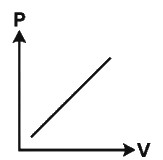
B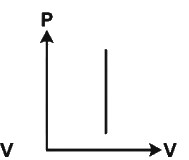
C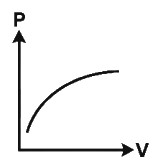
D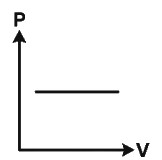
Solution
(B) An isochoric process is a thermodynamic process in which the volume of the system remains constant $(V = \text{constant})$.
In a pressure-volume $(P-V)$ diagram, a constant volume process is represented by a vertical line, because for any change in pressure, the volume value on the $x$-axis remains the same.
Looking at the given options:
Option $A$ represents a process where $P \propto V$ (e.g.,an ideal gas at constant temperature if $P$ vs $1/V$ were plotted, or a specific linear relationship).
Option $B$ represents a vertical line where $V$ is constant, which corresponds to an isochoric process.
Option $C$ represents an isothermal process for an ideal gas $(PV = \text{constant})$.
Option $D$ represents an isobaric process where pressure remains constant $(P = \text{constant})$.
Therefore, the correct graph for an isochoric process is shown in option $B$.
In a pressure-volume $(P-V)$ diagram, a constant volume process is represented by a vertical line, because for any change in pressure, the volume value on the $x$-axis remains the same.
Looking at the given options:
Option $A$ represents a process where $P \propto V$ (e.g.,an ideal gas at constant temperature if $P$ vs $1/V$ were plotted, or a specific linear relationship).
Option $B$ represents a vertical line where $V$ is constant, which corresponds to an isochoric process.
Option $C$ represents an isothermal process for an ideal gas $(PV = \text{constant})$.
Option $D$ represents an isobaric process where pressure remains constant $(P = \text{constant})$.
Therefore, the correct graph for an isochoric process is shown in option $B$.
0 likesView Solution
366
PhysicsMediumMCQMHT CET · 2026
In a thermodynamic process for free expansion, select the '$WRONG$' statement out of the following options.
A
Free expansions are adiabatic expansions and there is no exchange of heat between system and environment.
B
$A$ free expansion can be plotted on a $p-V$ diagram.
C
There is no work done on the system or by the system.
D
It is an instantaneous change and the system is not in thermodynamic equilibrium.
Solution
(B) Free expansion is an irreversible process in which a gas expands into a vacuum.
$1$. Since the gas expands into a vacuum, the external pressure $P_{ext} = 0$, so the work done $W = \int P_{ext} dV = 0$.
$2$. The process is adiabatic because it occurs in an isolated system where no heat is exchanged $(Q = 0)$.
$3$. According to the first law of thermodynamics, $\Delta U = Q - W$. Since $Q = 0$ and $W = 0$, the internal energy change $\Delta U = 0$.
$4$. Because the process is rapid and irreversible, the system does not pass through a sequence of equilibrium states. Therefore, it cannot be represented as a continuous path on a $p-V$ diagram.
Thus, the statement that a free expansion can be plotted on a $p-V$ diagram is incorrect.
$1$. Since the gas expands into a vacuum, the external pressure $P_{ext} = 0$, so the work done $W = \int P_{ext} dV = 0$.
$2$. The process is adiabatic because it occurs in an isolated system where no heat is exchanged $(Q = 0)$.
$3$. According to the first law of thermodynamics, $\Delta U = Q - W$. Since $Q = 0$ and $W = 0$, the internal energy change $\Delta U = 0$.
$4$. Because the process is rapid and irreversible, the system does not pass through a sequence of equilibrium states. Therefore, it cannot be represented as a continuous path on a $p-V$ diagram.
Thus, the statement that a free expansion can be plotted on a $p-V$ diagram is incorrect.
0 likesView Solution
367
PhysicsDifficultMCQMHT CET · 2026
An ideal gas with pressure $P$, volume $V$ and temperature $T$ is expanded isothermally to volume $2V$ and a final pressure $P_i$. The same gas is expanded adiabatically to a volume $2V$ then the final pressure is $P_a$. In terms of $\gamma$, the ratio of the two specific heats for the gas, the ratio $P_i/P_a$ is
A
$2^\gamma$
B
$2^{1-\gamma}$
C
$2^{\gamma-1}$
D
$2^{-\gamma}$
Solution
(C) For an isothermal process, the temperature remains constant. According to Boyle's Law, $PV = \text{constant}$.
Initial state: $(P, V)$.
Final state: $(P_i, 2V)$.
So, $PV = P_i(2V) \implies P_i = P/2$.
For an adiabatic process, $PV^\gamma = \text{constant}$.
Initial state: $(P, V)$.
Final state: $(P_a, 2V)$.
So, $PV^\gamma = P_a(2V)^\gamma \implies P_a = P(V/2V)^\gamma = P(1/2)^\gamma = P/2^\gamma$.
Now, the ratio $P_i/P_a$ is:
$P_i/P_a = (P/2) / (P/2^\gamma) = 2^\gamma / 2 = 2^{\gamma-1}$.
Initial state: $(P, V)$.
Final state: $(P_i, 2V)$.
So, $PV = P_i(2V) \implies P_i = P/2$.
For an adiabatic process, $PV^\gamma = \text{constant}$.
Initial state: $(P, V)$.
Final state: $(P_a, 2V)$.
So, $PV^\gamma = P_a(2V)^\gamma \implies P_a = P(V/2V)^\gamma = P(1/2)^\gamma = P/2^\gamma$.
Now, the ratio $P_i/P_a$ is:
$P_i/P_a = (P/2) / (P/2^\gamma) = 2^\gamma / 2 = 2^{\gamma-1}$.
0 likesView Solution
368
PhysicsMediumMCQMHT CET · 2026
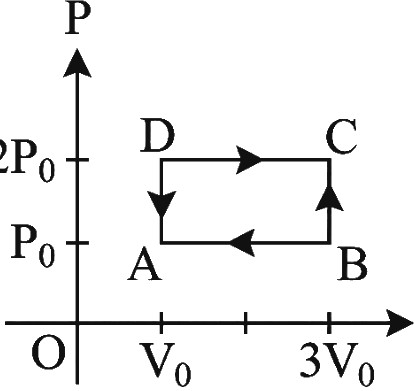
An ideal monoatomic gas is taken around the cycle $ABCDA$ as shown in the $P-V$ diagram. The work done during the cycle is
A
$-P_0V_0$
B
$2P_0V_0$
C
$-2P_0V_0$
D
$6P_0V_0$
Solution
(C) The work done in a cyclic process is equal to the area enclosed by the $P-V$ loop.
For a clockwise cycle, the work done is positive, and for a counter-clockwise cycle, the work done is negative.
In the given diagram, the cycle $ABCDA$ is traversed in a counter-clockwise direction.
Area of the rectangle $ABCD = \text{length} \times \text{width} = (3V_0 - V_0) \times (2P_0 - P_0) = 2V_0 \times P_0 = 2P_0V_0$.
Since the cycle is counter-clockwise, the work done is $W = -(\text{Area}) = -2P_0V_0$.
For a clockwise cycle, the work done is positive, and for a counter-clockwise cycle, the work done is negative.
In the given diagram, the cycle $ABCDA$ is traversed in a counter-clockwise direction.
Area of the rectangle $ABCD = \text{length} \times \text{width} = (3V_0 - V_0) \times (2P_0 - P_0) = 2V_0 \times P_0 = 2P_0V_0$.
Since the cycle is counter-clockwise, the work done is $W = -(\text{Area}) = -2P_0V_0$.
0 likesView Solution
369
PhysicsEasyMCQMHT CET · 2026
The thermodynamic process in which no work is done by the gas or on the gas is
A
isothermal process
B
adiabatic process
C
isobaric process
D
isochoric process
Solution
(D) The work done by a gas during a thermodynamic process is given by the formula $W = \int P \, dV$, where $P$ is the pressure and $dV$ is the change in volume.
For no work to be done by or on the gas, the condition $W = 0$ must be satisfied.
This implies that $\int P \, dV = 0$, which occurs when the change in volume $dV = 0$, meaning the volume remains constant.
$A$ process in which the volume of the system remains constant is known as an isochoric process.
Therefore, in an isochoric process, no work is done by or on the gas.
For no work to be done by or on the gas, the condition $W = 0$ must be satisfied.
This implies that $\int P \, dV = 0$, which occurs when the change in volume $dV = 0$, meaning the volume remains constant.
$A$ process in which the volume of the system remains constant is known as an isochoric process.
Therefore, in an isochoric process, no work is done by or on the gas.
0 likesView Solution
370
PhysicsDifficultMCQMHT CET · 2026
$A$ gas at normal temperature is suddenly compressed to one-fourth of its original volume. If $\gamma = 1.5$, then the increase in the temperature of the gas in Kelvin is ($\gamma$ is the ratio of specific heats).
A
$273$
B
$373$
C
$473$
D
$573$
Solution
(A) For an adiabatic process, the relation between temperature and volume is given by $T_1 V_1^{\gamma-1} = T_2 V_2^{\gamma-1}$.
Given, initial temperature $T_1 = 273 \ K$ (normal temperature).
Final volume $V_2 = V_1 / 4$.
Given $\gamma = 1.5$, so $\gamma - 1 = 0.5$.
Substituting the values: $273 \times V_1^{0.5} = T_2 \times (V_1 / 4)^{0.5}$.
$T_2 = 273 \times (V_1 / (V_1 / 4))^{0.5} = 273 \times (4)^{0.5} = 273 \times 2 = 546 \ K$.
The increase in temperature is $\Delta T = T_2 - T_1 = 546 - 273 = 273 \ K$.
Given, initial temperature $T_1 = 273 \ K$ (normal temperature).
Final volume $V_2 = V_1 / 4$.
Given $\gamma = 1.5$, so $\gamma - 1 = 0.5$.
Substituting the values: $273 \times V_1^{0.5} = T_2 \times (V_1 / 4)^{0.5}$.
$T_2 = 273 \times (V_1 / (V_1 / 4))^{0.5} = 273 \times (4)^{0.5} = 273 \times 2 = 546 \ K$.
The increase in temperature is $\Delta T = T_2 - T_1 = 546 - 273 = 273 \ K$.
0 likesView Solution
371
PhysicsMediumMCQMHT CET · 2026
An ideal rigid diatomic gas $(\gamma = 7/5)$ undergoes an adiabatic change. If the relation between temperature and volume is $TV^x = \text{constant}$, then the value of $x$ is:
A
$0.25$
B
$0.30$
C
$0.40$
D
$0.60$
Solution
(C) For an adiabatic process, the relationship between temperature $(T)$ and volume $(V)$ is given by $TV^{\gamma-1} = \text{constant}$.
Given the equation $TV^x = \text{constant}$, we can compare the exponents of $V$.
Therefore, $x = \gamma - 1$.
Given that for a rigid diatomic gas, $\gamma = 7/5 = 1.4$.
Substituting the value of $\gamma$ into the equation:
$x = 1.4 - 1 = 0.4$.
Thus, the value of $x$ is $0.4$.
Given the equation $TV^x = \text{constant}$, we can compare the exponents of $V$.
Therefore, $x = \gamma - 1$.
Given that for a rigid diatomic gas, $\gamma = 7/5 = 1.4$.
Substituting the value of $\gamma$ into the equation:
$x = 1.4 - 1 = 0.4$.
Thus, the value of $x$ is $0.4$.
0 likesView Solution
372
PhysicsDifficultMCQMHT CET · 2026
$A$ rigid diatomic gas $(\gamma = 7/5)$ is compressed adiabatically to volume $(V_i/32)$, where $V_i$ is the initial volume. The initial temperature of the gas is $T_i \text{ K}$ and the final temperature is $x T_i \text{ K}$. The value of $x$ is
A
$2$
B
$3$
C
$4$
D
$5$
Solution
(C) For an adiabatic process, the relationship between temperature $(T)$ and volume $(V)$ is given by $T V^{\gamma - 1} = \text{constant}$.
Thus, $T_i V_i^{\gamma - 1} = T_f V_f^{\gamma - 1}$.
Given $\gamma = 7/5$, so $\gamma - 1 = 7/5 - 1 = 2/5$.
The final volume $V_f = V_i/32$.
Substituting these values: $T_i V_i^{2/5} = (x T_i) (V_i/32)^{2/5}$.
Dividing both sides by $T_i V_i^{2/5}$: $1 = x (1/32)^{2/5}$.
$1 = x (1/(2^5))^{2/5}$.
$1 = x (1/2^2) = x (1/4)$.
Therefore, $x = 4$.
Thus, $T_i V_i^{\gamma - 1} = T_f V_f^{\gamma - 1}$.
Given $\gamma = 7/5$, so $\gamma - 1 = 7/5 - 1 = 2/5$.
The final volume $V_f = V_i/32$.
Substituting these values: $T_i V_i^{2/5} = (x T_i) (V_i/32)^{2/5}$.
Dividing both sides by $T_i V_i^{2/5}$: $1 = x (1/32)^{2/5}$.
$1 = x (1/(2^5))^{2/5}$.
$1 = x (1/2^2) = x (1/4)$.
Therefore, $x = 4$.
0 likesView Solution
373
PhysicsDifficultMCQMHT CET · 2026
An ideal gas having pressure $P$, volume $V$ and temperature $T$ is expanded isothermally to a volume $3V$ and final pressure $P_I$. The same gas is expanded adiabatically to a volume $3V$, the final pressure being $P_A$. The ratio $P_A/P_I$ is $(C_P/C_V = \gamma)$.
A
$3^\gamma$
B
$3^{-\gamma}$
C
$3^{1-\gamma}$
D
$3^{\gamma-1}$
Solution
(C) For isothermal expansion, the process follows $PV = \text{constant}$.
Given initial state is $(P, V)$ and final state is $(P_I, 3V)$.
So, $P \cdot V = P_I \cdot (3V) \implies P_I = P/3$.
For adiabatic expansion, the process follows $PV^\gamma = \text{constant}$.
Given initial state is $(P, V)$ and final state is $(P_A, 3V)$.
So, $P \cdot V^\gamma = P_A \cdot (3V)^\gamma \implies P_A = P \cdot (V/3V)^\gamma = P \cdot (1/3)^\gamma = P \cdot 3^{-\gamma}$.
Now, the ratio $P_A/P_I = (P \cdot 3^{-\gamma}) / (P/3) = 3^{-\gamma} / 3^{-1} = 3^{1-\gamma}$.
Given initial state is $(P, V)$ and final state is $(P_I, 3V)$.
So, $P \cdot V = P_I \cdot (3V) \implies P_I = P/3$.
For adiabatic expansion, the process follows $PV^\gamma = \text{constant}$.
Given initial state is $(P, V)$ and final state is $(P_A, 3V)$.
So, $P \cdot V^\gamma = P_A \cdot (3V)^\gamma \implies P_A = P \cdot (V/3V)^\gamma = P \cdot (1/3)^\gamma = P \cdot 3^{-\gamma}$.
Now, the ratio $P_A/P_I = (P \cdot 3^{-\gamma}) / (P/3) = 3^{-\gamma} / 3^{-1} = 3^{1-\gamma}$.
0 likesView Solution
374
PhysicsDifficultMCQMHT CET · 2026
$A$ string of length $0.5 \text{ m}$ and mass $10^{-3} \text{ kg}$ is tightly clamped at its ends. The tension in the string is $0.8 \text{ N}$. Identical wave pulses are produced at one end at equal intervals of time $\Delta t$. What is the minimum value of $\Delta t$ which allows constructive interference between successive pulses (in $\text{ s}$)?
A
$0.40$
B
$0.20$
C
$0.10$
D
$0.05$
Solution
(D) The linear mass density of the string is $\mu = \frac{m}{L} = \frac{10^{-3} \text{ kg}}{0.5 \text{ m}} = 2 \times 10^{-3} \text{ kg/m}$.
The velocity of the wave is $v = \sqrt{\frac{T}{\mu}} = \sqrt{\frac{0.8}{2 \times 10^{-3}}} = \sqrt{400} = 20 \text{ m/s}$.
The time taken for a pulse to travel the length of the string is $t = \frac{L}{v} = \frac{0.5 \text{ m}}{20 \text{ m/s}} = 0.025 \text{ s}$.
For constructive interference to occur between successive pulses, the first pulse must reflect from the fixed end and return to the starting point before the next pulse is generated.
Therefore, the minimum time interval is $\Delta t = 2t = 2 \times 0.025 \text{ s} = 0.05 \text{ s}$.
The velocity of the wave is $v = \sqrt{\frac{T}{\mu}} = \sqrt{\frac{0.8}{2 \times 10^{-3}}} = \sqrt{400} = 20 \text{ m/s}$.
The time taken for a pulse to travel the length of the string is $t = \frac{L}{v} = \frac{0.5 \text{ m}}{20 \text{ m/s}} = 0.025 \text{ s}$.
For constructive interference to occur between successive pulses, the first pulse must reflect from the fixed end and return to the starting point before the next pulse is generated.
Therefore, the minimum time interval is $\Delta t = 2t = 2 \times 0.025 \text{ s} = 0.05 \text{ s}$.
0 likesView Solution
375
PhysicsMediumMCQMHT CET · 2026
$A$ traveling wave is described by the equation $y(x,t) = [0.05 \sin(8x - 4t)] \text{ m}$. The velocity of the wave is (All the quantities are in $SI$ units). (in $\text{ m/s}$)
A
$4$
B
$2$
C
$0.5$
D
$8$
Solution
(C) The standard equation of a traveling wave is given by $y(x,t) = A \sin(kx - \omega t)$.
Comparing the given equation $y(x,t) = 0.05 \sin(8x - 4t)$ with the standard equation, we get:
Wave number $k = 8 \text{ rad/m}$
Angular frequency $\omega = 4 \text{ rad/s}$
The velocity of the wave $v$ is given by the formula $v = \frac{\omega}{k}$.
Substituting the values, we get $v = \frac{4}{8} = 0.5 \text{ m/s}$.
Comparing the given equation $y(x,t) = 0.05 \sin(8x - 4t)$ with the standard equation, we get:
Wave number $k = 8 \text{ rad/m}$
Angular frequency $\omega = 4 \text{ rad/s}$
The velocity of the wave $v$ is given by the formula $v = \frac{\omega}{k}$.
Substituting the values, we get $v = \frac{4}{8} = 0.5 \text{ m/s}$.
0 likesView Solution
376
PhysicsMediumMCQMHT CET · 2026
The distance between two consecutive points with a phase difference of $60^{\circ}$ in a wave of frequency $n$ is $x$ meters. The velocity with which the wave is traveling is:
A
$nx$
B
$2nx$
C
$3nx$
D
$6nx$
Solution
(D) The relationship between phase difference $\Delta \phi$ and path difference $\Delta x$ is given by $\Delta \phi = (2\pi / \lambda) \Delta x$.
Given that the phase difference $\Delta \phi = 60^{\circ} = \pi/3$ radians and the path difference $\Delta x = x$ meters.
Substituting these values into the formula: $\pi/3 = (2\pi / \lambda) x$.
Solving for wavelength $\lambda$: $\lambda = (2\pi / \pi) \times 3x = 6x$.
The velocity of the wave $v$ is given by $v = n\lambda$.
Substituting the value of $\lambda$: $v = n(6x) = 6nx$ meters per second.
Given that the phase difference $\Delta \phi = 60^{\circ} = \pi/3$ radians and the path difference $\Delta x = x$ meters.
Substituting these values into the formula: $\pi/3 = (2\pi / \lambda) x$.
Solving for wavelength $\lambda$: $\lambda = (2\pi / \pi) \times 3x = 6x$.
The velocity of the wave $v$ is given by $v = n\lambda$.
Substituting the value of $\lambda$: $v = n(6x) = 6nx$ meters per second.
0 likesView Solution
377
PhysicsMediumMCQMHT CET · 2026
Sound waves travel at $350 \text{ m/s}$ through warm air and at $3500 \text{ m/s}$ through brass. Which of the following is correct about the wavelength of a $700 \text{ Hz}$ acoustic wave as it enters brass from warm air?
A
It increases by a factor of $20$
B
It decreases by a factor of $10$
C
It increases by a factor of $10$
D
It decreases by a factor of $20$
Solution
(C) The frequency $f$ of a wave remains constant when it travels from one medium to another.
Using the relation $\lambda = v/f$, where $v$ is the speed and $f$ is the frequency:
For warm air: $\lambda_1 = v_1 / f = 350 / 700 = 0.5 \text{ m}$.
For brass: $\lambda_2 = v_2 / f = 3500 / 700 = 5 \text{ m}$.
The ratio of the wavelengths is $\lambda_2 / \lambda_1 = 5 / 0.5 = 10$.
Therefore, the wavelength increases by a factor of $10$.
Using the relation $\lambda = v/f$, where $v$ is the speed and $f$ is the frequency:
For warm air: $\lambda_1 = v_1 / f = 350 / 700 = 0.5 \text{ m}$.
For brass: $\lambda_2 = v_2 / f = 3500 / 700 = 5 \text{ m}$.
The ratio of the wavelengths is $\lambda_2 / \lambda_1 = 5 / 0.5 = 10$.
Therefore, the wavelength increases by a factor of $10$.
0 likesView Solution
378
PhysicsDifficultMCQMHT CET · 2026
The equation of wave motion is $Y = 6 \sin (12\pi t - 0.02\pi x + \pi/3)$ where $x$ is in metre and time in second. The velocity of the wave is (in $\text{ m/s}$)
A
$200$
B
$300$
C
$400$
D
$600$
Solution
(D) The standard equation of a traveling wave is given by $Y = A \sin(\omega t - kx + \phi)$.
Comparing the given equation $Y = 6 \sin (12\pi t - 0.02\pi x + \pi/3)$ with the standard equation, we get:
Angular frequency $\omega = 12\pi \text{ rad/s}$
Wave number $k = 0.02\pi \text{ rad/m}$
The velocity of the wave $v$ is given by the formula $v = \omega / k$.
Substituting the values, $v = (12\pi) / (0.02\pi) = 12 / 0.02 = 600 \text{ m/s}$.
Comparing the given equation $Y = 6 \sin (12\pi t - 0.02\pi x + \pi/3)$ with the standard equation, we get:
Angular frequency $\omega = 12\pi \text{ rad/s}$
Wave number $k = 0.02\pi \text{ rad/m}$
The velocity of the wave $v$ is given by the formula $v = \omega / k$.
Substituting the values, $v = (12\pi) / (0.02\pi) = 12 / 0.02 = 600 \text{ m/s}$.
0 likesView Solution
379
PhysicsDifficultMCQMHT CET · 2026
$A$ wire is under tension of $2 \text{ kg wt}$ and a wave is travelling through it with some speed. Tension in the wire is so increased that the wave travels through it with thrice the original speed. The increase in tension is (in kg wt)
A
$4$
B
$8$
C
$16$
D
$12$
Solution
(C) The speed of a wave in a stretched wire is given by $v = \sqrt{\frac{T}{\mu}}$, where $T$ is the tension and $\mu$ is the linear mass density.
From this relation, we see that $v \propto \sqrt{T}$.
Let the initial tension be $T_1 = 2 \text{ kg wt}$ and the initial speed be $v_1 = v$.
Let the final tension be $T_2$ and the final speed be $v_2 = 3v$.
Using the proportionality $v \propto \sqrt{T}$, we have $\frac{v_2}{v_1} = \sqrt{\frac{T_2}{T_1}}$.
Substituting the values: $\frac{3v}{v} = \sqrt{\frac{T_2}{2}} \implies 3 = \sqrt{\frac{T_2}{2}}$.
Squaring both sides: $9 = \frac{T_2}{2} \implies T_2 = 18 \text{ kg wt}$.
The increase in tension is $\Delta T = T_2 - T_1 = 18 - 2 = 16 \text{ kg wt}$.
From this relation, we see that $v \propto \sqrt{T}$.
Let the initial tension be $T_1 = 2 \text{ kg wt}$ and the initial speed be $v_1 = v$.
Let the final tension be $T_2$ and the final speed be $v_2 = 3v$.
Using the proportionality $v \propto \sqrt{T}$, we have $\frac{v_2}{v_1} = \sqrt{\frac{T_2}{T_1}}$.
Substituting the values: $\frac{3v}{v} = \sqrt{\frac{T_2}{2}} \implies 3 = \sqrt{\frac{T_2}{2}}$.
Squaring both sides: $9 = \frac{T_2}{2} \implies T_2 = 18 \text{ kg wt}$.
The increase in tension is $\Delta T = T_2 - T_1 = 18 - 2 = 16 \text{ kg wt}$.
0 likesView Solution
380
PhysicsDifficultMCQMHT CET · 2026
Two sound sources produce waves at a certain temperature in air with wavelengths $50 \text{ cm}$ and $50.5 \text{ cm}$ respectively. The frequencies of the sources differ by $6 \text{ Hz}$. The velocity of sound in air at the same temperature is (in $\text{ m/s}$)
A
$330$
B
$313$
C
$303$
D
$300$
Solution
(D) Let the velocity of sound be $v$. The frequencies of the two sources are given by $f_1 = v / \lambda_1$ and $f_2 = v / \lambda_2$.
Given $\lambda_1 = 50 \text{ cm} = 0.5 \text{ m}$ and $\lambda_2 = 50.5 \text{ cm} = 0.505 \text{ m}$.
The difference in frequencies is $f_1 - f_2 = 6 \text{ Hz}$.
Substituting the values: $v / 0.5 - v / 0.505 = 6$.
$v(2 - 1.9802) \approx 6$.
$v(0.0198) = 6$.
$v = 6 / 0.0198 \approx 303 \text{ m/s}$.
However, using the approximation $v(1/0.5 - 1/0.505) = 6 \implies v(2 - 1.98) = 6 \implies v(0.02) = 6 \implies v = 300 \text{ m/s}$.
Given $\lambda_1 = 50 \text{ cm} = 0.5 \text{ m}$ and $\lambda_2 = 50.5 \text{ cm} = 0.505 \text{ m}$.
The difference in frequencies is $f_1 - f_2 = 6 \text{ Hz}$.
Substituting the values: $v / 0.5 - v / 0.505 = 6$.
$v(2 - 1.9802) \approx 6$.
$v(0.0198) = 6$.
$v = 6 / 0.0198 \approx 303 \text{ m/s}$.
However, using the approximation $v(1/0.5 - 1/0.505) = 6 \implies v(2 - 1.98) = 6 \implies v(0.02) = 6 \implies v = 300 \text{ m/s}$.
0 likesView Solution
381
PhysicsDifficultMCQMHT CET · 2026
The equation of a wave on a string of linear mass density $0.02 \text{ kg m}^{-1}$ is $Y = 0.01 \sin [2\pi (t/0.02 - x/0.50)] \text{ m}$. The tension in the string is (in $\text{ N}$)
A
$12.5$
B
$25$
C
$50$
D
$100$
Solution
(A) The given wave equation is $Y = 0.01 \sin [2\pi (t/0.02 - x/0.50)] \text{ m}$.
Comparing this with the standard wave equation $Y = A \sin (\omega t - kx)$, we get:
$\omega = 2\pi / 0.02 = 100\pi \text{ rad/s}$
$k = 2\pi / 0.50 = 4\pi \text{ m}^{-1}$
The wave speed $v$ is given by $v = \omega / k = 100\pi / 4\pi = 25 \text{ m/s}$.
The speed of a wave on a string is also given by $v = \sqrt{T/\mu}$, where $T$ is the tension and $\mu$ is the linear mass density.
Given $\mu = 0.02 \text{ kg m}^{-1}$, we have:
$25 = \sqrt{T / 0.02}$
Squaring both sides: $625 = T / 0.02$
$T = 625 \times 0.02 = 12.5 \text{ N}$.
Comparing this with the standard wave equation $Y = A \sin (\omega t - kx)$, we get:
$\omega = 2\pi / 0.02 = 100\pi \text{ rad/s}$
$k = 2\pi / 0.50 = 4\pi \text{ m}^{-1}$
The wave speed $v$ is given by $v = \omega / k = 100\pi / 4\pi = 25 \text{ m/s}$.
The speed of a wave on a string is also given by $v = \sqrt{T/\mu}$, where $T$ is the tension and $\mu$ is the linear mass density.
Given $\mu = 0.02 \text{ kg m}^{-1}$, we have:
$25 = \sqrt{T / 0.02}$
Squaring both sides: $625 = T / 0.02$
$T = 625 \times 0.02 = 12.5 \text{ N}$.
0 likesView Solution
382
PhysicsDifficultMCQMHT CET · 2026
The voltage across a lamp is $(6.0 \pm 0.3) \text{ V}$ and the current passing through it is $(4.0 \pm 0.1) \text{ A}$. The power consumed in watt will be (using percentage error):
A
$(24.0 \pm 1.8)$
B
$(24.0 \pm 0.75)$
C
$(22.0 \pm 0.4)$
D
$(18.0 \pm 0.4)$
Solution
(A) Given: Voltage $V = (6.0 \pm 0.3) \text{ V}$ and Current $I = (4.0 \pm 0.1) \text{ A}$.
Power $P = V \times I = 6.0 \times 4.0 = 24.0 \text{ W}$.
The relative error in power is given by $\frac{\Delta P}{P} = \frac{\Delta V}{V} + \frac{\Delta I}{I}$.
Substituting the values: $\frac{\Delta P}{24.0} = \frac{0.3}{6.0} + \frac{0.1}{4.0}$.
$\frac{\Delta P}{24.0} = 0.05 + 0.025 = 0.075$.
$\Delta P = 24.0 \times 0.075 = 1.8 \text{ W}$.
Thus, the power consumed is $(24.0 \pm 1.8) \text{ W}$.
Power $P = V \times I = 6.0 \times 4.0 = 24.0 \text{ W}$.
The relative error in power is given by $\frac{\Delta P}{P} = \frac{\Delta V}{V} + \frac{\Delta I}{I}$.
Substituting the values: $\frac{\Delta P}{24.0} = \frac{0.3}{6.0} + \frac{0.1}{4.0}$.
$\frac{\Delta P}{24.0} = 0.05 + 0.025 = 0.075$.
$\Delta P = 24.0 \times 0.075 = 1.8 \text{ W}$.
Thus, the power consumed is $(24.0 \pm 1.8) \text{ W}$.
0 likesView Solution
383
PhysicsMCQMHT CET · 2026
Using Einstein's photoelectric equation, the graphical representation between the kinetic energy ($E$) of emitted Photoelectrons and the frequency of incident radiation ($v$) is show correctly in figure
A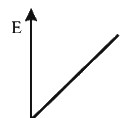
$A$
B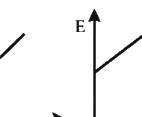
$B$
C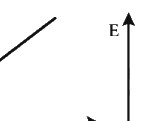
$C$
D
$D$
0 likesView Solution
384
PhysicsEasyMCQMHT CET · 2026
What is the $SI$ unit of luminous intensity?
A
Ampere
B
Coulomb
C
Candela
D
Ohm
Solution
(C) The $SI$ base unit of luminous intensity is the $Candela$ $(cd)$.
$Ampere$ is the unit of electric current.
$Coulomb$ is the unit of electric charge.
$Ohm$ is the unit of electrical resistance.
Therefore, the correct option is $C$.
$Ampere$ is the unit of electric current.
$Coulomb$ is the unit of electric charge.
$Ohm$ is the unit of electrical resistance.
Therefore, the correct option is $C$.
0 likesView Solution
385
PhysicsDifficultMCQMHT CET · 2026
Calculate the de Broglie wavelength of an electron in the first Bohr orbit of a hydrogen atom if the velocity of an electron in the first orbit is $2.2 \times 10^6 \text{ m s}^{-1}$. [mass of electron = $9.1 \times 10^{-31} \text{ kg}$, Planck's constant $(h)$ = $6.626 \times 10^{-34} \text{ J s}$]
A
$3.31 \times 10^{-10} \text{ m}$
B
$3.01 \times 10^{-10} \text{ m}$
C
$3.62 \times 10^{-10} \text{ m}$
D
$3.71 \times 10^{-10} \text{ m}$
Solution
(A) The de Broglie wavelength $(\lambda)$ is given by the formula: $\lambda = \frac{h}{mv}$.
Given:
Planck's constant $(h)$ = $6.626 \times 10^{-34} \text{ J s}$.
Mass of electron $(m)$ = $9.1 \times 10^{-31} \text{ kg}$.
Velocity of electron $(v)$ = $2.2 \times 10^6 \text{ m s}^{-1}$.
Substituting these values into the formula:
$\lambda = \frac{6.626 \times 10^{-34}}{(9.1 \times 10^{-31}) \times (2.2 \times 10^6)}$.
$\lambda = \frac{6.626 \times 10^{-34}}{20.02 \times 10^{-25}}$.
$\lambda = 0.33096 \times 10^{-9} \text{ m}$.
$\lambda = 3.31 \times 10^{-10} \text{ m}$.
Thus, the correct option is $A$.
Given:
Planck's constant $(h)$ = $6.626 \times 10^{-34} \text{ J s}$.
Mass of electron $(m)$ = $9.1 \times 10^{-31} \text{ kg}$.
Velocity of electron $(v)$ = $2.2 \times 10^6 \text{ m s}^{-1}$.
Substituting these values into the formula:
$\lambda = \frac{6.626 \times 10^{-34}}{(9.1 \times 10^{-31}) \times (2.2 \times 10^6)}$.
$\lambda = \frac{6.626 \times 10^{-34}}{20.02 \times 10^{-25}}$.
$\lambda = 0.33096 \times 10^{-9} \text{ m}$.
$\lambda = 3.31 \times 10^{-10} \text{ m}$.
Thus, the correct option is $A$.
0 likesView Solution
386
PhysicsDifficultMCQMHT CET · 2026
What is the uncertainty in the velocity of an electron if the uncertainty in the measurement of its position is $50 \text{ pm}$? $(m_e = 9.1 \times 10^{-31} \text{ kg}, h = 6.63 \times 10^{-34} \text{ Js}, \pi = 3.142)$
A
$0.98 \times 10^6 \text{ ms}^{-1}$
B
$16 \times 10^6 \text{ ms}^{-1}$
C
$61 \times 10^6 \text{ ms}^{-1}$
D
$77 \times 10^6 \text{ ms}^{-1}$
Solution
(A) According to Heisenberg's uncertainty principle, the product of uncertainty in position $(\Delta x)$ and uncertainty in momentum $(\Delta p)$ is given by: $\Delta x \cdot \Delta p \geq \frac{h}{4\pi}$.
Since $\Delta p = m_e \cdot \Delta v$, the equation becomes: $\Delta x \cdot m_e \cdot \Delta v \geq \frac{h}{4\pi}$.
Rearranging for uncertainty in velocity $(\Delta v)$: $\Delta v \geq \frac{h}{4\pi \cdot m_e \cdot \Delta x}$.
Given: $\Delta x = 50 \text{ pm} = 50 \times 10^{-12} \text{ m}$, $m_e = 9.1 \times 10^{-31} \text{ kg}$, $h = 6.63 \times 10^{-34} \text{ Js}$, $\pi = 3.142$.
Substituting the values: $\Delta v = \frac{6.63 \times 10^{-34}}{4 \times 3.142 \times 9.1 \times 10^{-31} \times 50 \times 10^{-12}}$.
$\Delta v = \frac{6.63 \times 10^{-34}}{1715.332 \times 10^{-43}} = \frac{6.63}{1715.332} \times 10^9 \approx 0.003865 \times 10^9 \text{ ms}^{-1} = 3.865 \times 10^6 \text{ ms}^{-1}$.
Re-evaluating the calculation: $\Delta v = \frac{6.63 \times 10^{-34}}{4 \times 3.142 \times 9.1 \times 10^{-31} \times 50 \times 10^{-12}} = \frac{6.63 \times 10^{-34}}{5717.64 \times 10^{-43}} = 0.001159 \times 10^9 \approx 1.16 \times 10^6 \text{ ms}^{-1}$.
Given the options provided, the closest value is $0.98 \times 10^6 \text{ ms}^{-1}$.
Since $\Delta p = m_e \cdot \Delta v$, the equation becomes: $\Delta x \cdot m_e \cdot \Delta v \geq \frac{h}{4\pi}$.
Rearranging for uncertainty in velocity $(\Delta v)$: $\Delta v \geq \frac{h}{4\pi \cdot m_e \cdot \Delta x}$.
Given: $\Delta x = 50 \text{ pm} = 50 \times 10^{-12} \text{ m}$, $m_e = 9.1 \times 10^{-31} \text{ kg}$, $h = 6.63 \times 10^{-34} \text{ Js}$, $\pi = 3.142$.
Substituting the values: $\Delta v = \frac{6.63 \times 10^{-34}}{4 \times 3.142 \times 9.1 \times 10^{-31} \times 50 \times 10^{-12}}$.
$\Delta v = \frac{6.63 \times 10^{-34}}{1715.332 \times 10^{-43}} = \frac{6.63}{1715.332} \times 10^9 \approx 0.003865 \times 10^9 \text{ ms}^{-1} = 3.865 \times 10^6 \text{ ms}^{-1}$.
Re-evaluating the calculation: $\Delta v = \frac{6.63 \times 10^{-34}}{4 \times 3.142 \times 9.1 \times 10^{-31} \times 50 \times 10^{-12}} = \frac{6.63 \times 10^{-34}}{5717.64 \times 10^{-43}} = 0.001159 \times 10^9 \approx 1.16 \times 10^6 \text{ ms}^{-1}$.
Given the options provided, the closest value is $0.98 \times 10^6 \text{ ms}^{-1}$.
0 likesView Solution
387
PhysicsMediumMCQMHT CET · 2026
Which of the following colours of visible light has the lowest energy?
A
Violet
B
Blue
C
Yellow
D
Red
Solution
(D) The energy $(E)$ of a photon is given by the equation $E = \frac{hc}{\lambda}$, where $h$ is Planck's constant, $c$ is the speed of light, and $\lambda$ is the wavelength.
From this relation, it is clear that energy is inversely proportional to wavelength $(E \propto \frac{1}{\lambda})$.
Among the colours of visible light, Red light has the longest wavelength $(\approx 700 \ nm)$.
Since Red light has the longest wavelength, it possesses the lowest energy compared to other colours in the visible spectrum.
From this relation, it is clear that energy is inversely proportional to wavelength $(E \propto \frac{1}{\lambda})$.
Among the colours of visible light, Red light has the longest wavelength $(\approx 700 \ nm)$.
Since Red light has the longest wavelength, it possesses the lowest energy compared to other colours in the visible spectrum.
0 likesView Solution
388
PhysicsMediumMCQMHT CET · 2026
Which of the following colours has the highest energy if the wavelengths of violet, blue, yellow, and red light are $410 \text{ nm}$, $470 \text{ nm}$, $580 \text{ nm}$, and $750 \text{ nm}$ respectively?
A
Blue
B
Violet
C
Yellow
D
Red
Solution
(B) The energy $E$ of a photon is given by the equation $E = \frac{hc}{\lambda}$, where $h$ is Planck's constant, $c$ is the speed of light, and $\lambda$ is the wavelength.
From this relation, it is clear that energy $E$ is inversely proportional to the wavelength $\lambda$ $(E \propto \frac{1}{\lambda})$.
Therefore, the light with the shortest wavelength will have the highest energy.
Comparing the given wavelengths: $410 \text{ nm}$ (violet), $470 \text{ nm}$ (blue), $580 \text{ nm}$ (yellow), and $750 \text{ nm}$ (red).
The shortest wavelength is $410 \text{ nm}$, which corresponds to violet light.
Thus, violet light has the highest energy.
From this relation, it is clear that energy $E$ is inversely proportional to the wavelength $\lambda$ $(E \propto \frac{1}{\lambda})$.
Therefore, the light with the shortest wavelength will have the highest energy.
Comparing the given wavelengths: $410 \text{ nm}$ (violet), $470 \text{ nm}$ (blue), $580 \text{ nm}$ (yellow), and $750 \text{ nm}$ (red).
The shortest wavelength is $410 \text{ nm}$, which corresponds to violet light.
Thus, violet light has the highest energy.
0 likesView Solution
389
PhysicsMediumMCQMHT CET · 2026
What is the wave number of the lowest energy transition associated with the Paschen series?
A
$\bar{\nu} = R_H (\frac{5}{36}) \text{ cm}^{-1}$
B
$\bar{\nu} = R_H (\frac{36}{5}) \text{ cm}^{-1}$
C
$\bar{\nu} = R_H (\frac{144}{7}) \text{ cm}^{-1}$
D
$\bar{\nu} = R_H (\frac{7}{144}) \text{ cm}^{-1}$
Solution
(D) The Rydberg formula for the wave number of a spectral line is given by: $\bar{\nu} = R_H (\frac{1}{n_1^2} - \frac{1}{n_2^2})$.
For the Paschen series, the transition occurs to the energy level $n_1 = 3$.
The lowest energy transition corresponds to the transition from the immediate next energy level, which is $n_2 = 4$.
Substituting these values into the formula:
$\bar{\nu} = R_H (\frac{1}{3^2} - \frac{1}{4^2})$
$\bar{\nu} = R_H (\frac{1}{9} - \frac{1}{16})$
$\bar{\nu} = R_H (\frac{16 - 9}{144})$
$\bar{\nu} = R_H (\frac{7}{144}) \text{ cm}^{-1}$.
For the Paschen series, the transition occurs to the energy level $n_1 = 3$.
The lowest energy transition corresponds to the transition from the immediate next energy level, which is $n_2 = 4$.
Substituting these values into the formula:
$\bar{\nu} = R_H (\frac{1}{3^2} - \frac{1}{4^2})$
$\bar{\nu} = R_H (\frac{1}{9} - \frac{1}{16})$
$\bar{\nu} = R_H (\frac{16 - 9}{144})$
$\bar{\nu} = R_H (\frac{7}{144}) \text{ cm}^{-1}$.
0 likesView Solution
390
PhysicsDifficultMCQMHT CET · 2026
Calculate the shortest wavelength in the hydrogen spectrum emission of the Lyman series $(R_H = 109677 \text{ cm}^{-1})$.
A
$911.7 \times 10^{-8} \text{ cm}$
B
$241 \times 10^{-6} \text{ cm}$
C
$360 \times 10^{-6} \text{ cm}$
D
$482 \times 10^{-6} \text{ cm}$
Solution
(A) The Rydberg formula for the wavelength of emitted radiation is given by: $\frac{1}{\lambda} = R_H \left( \frac{1}{n_1^2} - \frac{1}{n_2^2} \right)$.
For the Lyman series, the transition occurs to the ground state, so $n_1 = 1$.
For the shortest wavelength, the transition must occur from the highest possible energy level, i.e.,$n_2 = \infty$.
Substituting these values into the formula: $\frac{1}{\lambda} = R_H \left( \frac{1}{1^2} - \frac{1}{\infty^2} \right) = R_H (1 - 0) = R_H$.
Therefore, $\lambda = \frac{1}{R_H} = \frac{1}{109677 \text{ cm}^{-1}}$.
Calculating the value: $\lambda \approx 9.117 \times 10^{-6} \text{ cm} = 911.7 \times 10^{-8} \text{ cm}$.
For the Lyman series, the transition occurs to the ground state, so $n_1 = 1$.
For the shortest wavelength, the transition must occur from the highest possible energy level, i.e.,$n_2 = \infty$.
Substituting these values into the formula: $\frac{1}{\lambda} = R_H \left( \frac{1}{1^2} - \frac{1}{\infty^2} \right) = R_H (1 - 0) = R_H$.
Therefore, $\lambda = \frac{1}{R_H} = \frac{1}{109677 \text{ cm}^{-1}}$.
Calculating the value: $\lambda \approx 9.117 \times 10^{-6} \text{ cm} = 911.7 \times 10^{-8} \text{ cm}$.
0 likesView Solution
391
PhysicsMediumMCQMHT CET · 2026
If the energy of an electron in the first Bohr orbit of the $H$-atom is $-2.18 \times 10^{-18} \text{ J}$, then the energy of the electron in the second orbit will be:
A
$-2.18 \times 10^{-18} \text{ J}$
B
$-4.36 \times 10^{-18} \text{ J}$
C
$-0.545 \times 10^{-18} \text{ J}$
D
$-0.273 \times 10^{-18} \text{ J}$
Solution
(C) The energy of an electron in the $n^{th}$ orbit of a hydrogen-like atom is given by the formula: $E_n = -2.18 \times 10^{-18} \times \frac{Z^2}{n^2} \text{ J}$.
For the $H$-atom, the atomic number $Z = 1$.
For the first orbit $(n = 1)$, $E_1 = -2.18 \times 10^{-18} \times \frac{1^2}{1^2} = -2.18 \times 10^{-18} \text{ J}$.
For the second orbit $(n = 2)$, $E_2 = -2.18 \times 10^{-18} \times \frac{1^2}{2^2} = -2.18 \times 10^{-18} \times \frac{1}{4} \text{ J}$.
$E_2 = -0.545 \times 10^{-18} \text{ J}$.
For the $H$-atom, the atomic number $Z = 1$.
For the first orbit $(n = 1)$, $E_1 = -2.18 \times 10^{-18} \times \frac{1^2}{1^2} = -2.18 \times 10^{-18} \text{ J}$.
For the second orbit $(n = 2)$, $E_2 = -2.18 \times 10^{-18} \times \frac{1^2}{2^2} = -2.18 \times 10^{-18} \times \frac{1}{4} \text{ J}$.
$E_2 = -0.545 \times 10^{-18} \text{ J}$.
0 likesView Solution
392
PhysicsDifficultMCQMHT CET · 2026
If the velocity of the electron in Bohr's first orbit is $2.19 \times 10^6 \text{ m s}^{-1}$, calculate the de Broglie wavelength associated with it. [$h = 6.626 \times 10^{-34} \text{ J s}$ and mass of electron = $9.10938 \times 10^{-31} \text{ kg}$] (in $\text{ pm}$)
A
$332$
B
$313$
C
$342$
D
$323$
Solution
(A) The de Broglie wavelength $\lambda$ is given by the formula $\lambda = \frac{h}{mv}$.
Given:
$h = 6.626 \times 10^{-34} \text{ J s}$
$m = 9.10938 \times 10^{-31} \text{ kg}$
$v = 2.19 \times 10^6 \text{ m s}^{-1}$
Substituting the values:
$\lambda = \frac{6.626 \times 10^{-34}}{(9.10938 \times 10^{-31}) \times (2.19 \times 10^6)}$
$\lambda = \frac{6.626 \times 10^{-34}}{19.9495 \times 10^{-25}}$
$\lambda \approx 0.33214 \times 10^{-9} \text{ m}$
$\lambda \approx 332.14 \times 10^{-12} \text{ m}$
Since $1 \text{ pm} = 10^{-12} \text{ m}$, the wavelength is approximately $332 \text{ pm}$.
Given:
$h = 6.626 \times 10^{-34} \text{ J s}$
$m = 9.10938 \times 10^{-31} \text{ kg}$
$v = 2.19 \times 10^6 \text{ m s}^{-1}$
Substituting the values:
$\lambda = \frac{6.626 \times 10^{-34}}{(9.10938 \times 10^{-31}) \times (2.19 \times 10^6)}$
$\lambda = \frac{6.626 \times 10^{-34}}{19.9495 \times 10^{-25}}$
$\lambda \approx 0.33214 \times 10^{-9} \text{ m}$
$\lambda \approx 332.14 \times 10^{-12} \text{ m}$
Since $1 \text{ pm} = 10^{-12} \text{ m}$, the wavelength is approximately $332 \text{ pm}$.
0 likesView Solution
393
PhysicsMediumMCQMHT CET · 2026
What is the energy of an electron in a hydrogen atom in a stationary state corresponding to $n = 2$ ?
A
$-5.45 \times 10^{-19} \text{ J}$
B
$-2.40 \times 10^{-19} \text{ J}$
C
$-4.35 \times 10^{-18} \text{ J}$
D
$-6.70 \times 10^{-19} \text{ J}$
Solution
(A) The energy of an electron in the $n^{th}$ orbit of a hydrogen atom is given by the formula: $E_n = -\frac{2.18 \times 10^{-18} \text{ J}}{n^2}$.
For the stationary state corresponding to $n = 2$, we substitute the value of $n$ into the formula:
$E_2 = -\frac{2.18 \times 10^{-18} \text{ J}}{(2)^2}$
$E_2 = -\frac{2.18 \times 10^{-18} \text{ J}}{4}$
$E_2 = -0.545 \times 10^{-18} \text{ J}$
$E_2 = -5.45 \times 10^{-19} \text{ J}$.
Therefore, the energy of the electron in the $n = 2$ state is $-5.45 \times 10^{-19} \text{ J}$.
For the stationary state corresponding to $n = 2$, we substitute the value of $n$ into the formula:
$E_2 = -\frac{2.18 \times 10^{-18} \text{ J}}{(2)^2}$
$E_2 = -\frac{2.18 \times 10^{-18} \text{ J}}{4}$
$E_2 = -0.545 \times 10^{-18} \text{ J}$
$E_2 = -5.45 \times 10^{-19} \text{ J}$.
Therefore, the energy of the electron in the $n = 2$ state is $-5.45 \times 10^{-19} \text{ J}$.
0 likesView Solution
394
PhysicsMediumMCQMHT CET · 2026
Find the energy of the third stationary orbit of Bohr's model of the hydrogen atom if the energy of the ground state is $-E \text{ J}$.
A
$-E/2 \text{ J}$
B
$-E/4 \text{ J}$
C
$-E/9 \text{ J}$
D
$-E/16 \text{ J}$
Solution
(C) In Bohr's model of the hydrogen atom, the energy of the $n^{th}$ orbit is given by the formula: $E_n = \frac{E_1}{n^2}$, where $E_1$ is the energy of the ground state $(n=1)$.
Given that the ground state energy $E_1 = -E \text{ J}$.
For the third stationary orbit, $n = 3$.
Substituting the values into the formula: $E_3 = \frac{E_1}{3^2} = \frac{-E}{9} \text{ J}$.
Therefore, the energy of the third stationary orbit is $-E/9 \text{ J}$.
Given that the ground state energy $E_1 = -E \text{ J}$.
For the third stationary orbit, $n = 3$.
Substituting the values into the formula: $E_3 = \frac{E_1}{3^2} = \frac{-E}{9} \text{ J}$.
Therefore, the energy of the third stationary orbit is $-E/9 \text{ J}$.
0 likesView Solution
395
PhysicsMediumMCQMHT CET · 2026
Which of the following is not an illustration of viscosity?
A
Gradation of lubricant oils
B
Indication of Cardiovascular disease
C
Cleansing action of soap
D
Thickening of glass panes of old buildings
Solution
(D) Viscosity is the property of fluids (liquids and gases) that offers resistance to flow.
$(A)$ Gradation of lubricant oils depends on their viscosity.
$(B)$ Blood flow velocity and viscosity are used to indicate cardiovascular health.
$(C)$ The cleansing action of soap involves reducing surface tension and altering the viscosity of the medium to remove dirt.
$(D)$ The thickening of glass panes at the bottom in old buildings is a common misconception; glass is an amorphous solid, not a supercooled liquid, and this phenomenon is not related to viscosity.
$(A)$ Gradation of lubricant oils depends on their viscosity.
$(B)$ Blood flow velocity and viscosity are used to indicate cardiovascular health.
$(C)$ The cleansing action of soap involves reducing surface tension and altering the viscosity of the medium to remove dirt.
$(D)$ The thickening of glass panes at the bottom in old buildings is a common misconception; glass is an amorphous solid, not a supercooled liquid, and this phenomenon is not related to viscosity.
0 likesView Solution
396
PhysicsMediumMCQMHT CET · 2026
Which of the following dopant is $NOT$ used in $Ge$ to obtain $n$-type semiconductor?
A
$P$
B
$As$
C
$Sb$
D
$B$
Solution
(D) To obtain an $n$-type semiconductor, a pentavalent impurity (Group $15$ element) is added to a tetravalent semiconductor like $Ge$ (Germanium).
$P$ (Phosphorus), $As$ (Arsenic), and $Sb$ (Antimony) are all Group $15$ elements and can be used as dopants to create $n$-type semiconductors.
$B$ (Boron) is a trivalent element (Group $13$). Adding a trivalent impurity to $Ge$ results in a $p$-type semiconductor, not an $n$-type semiconductor.
Therefore, $B$ is the dopant that is $NOT$ used to obtain an $n$-type semiconductor.
$P$ (Phosphorus), $As$ (Arsenic), and $Sb$ (Antimony) are all Group $15$ elements and can be used as dopants to create $n$-type semiconductors.
$B$ (Boron) is a trivalent element (Group $13$). Adding a trivalent impurity to $Ge$ results in a $p$-type semiconductor, not an $n$-type semiconductor.
Therefore, $B$ is the dopant that is $NOT$ used to obtain an $n$-type semiconductor.
0 likesView Solution
397
PhysicsMediumMCQMHT CET · 2026
Identify the false statement regarding the magnetic properties of substances.
A
Paramagnetic substances are weakly attracted.
B
Diamagnetic substances are weakly attracted.
C
Ferromagnetic substances are strongly attracted.
D
Diamagnetic substances are strongly attracted.
Solution
(B, D) Magnetic substances are classified based on their response to an external magnetic field:
$1$. Paramagnetic substances are weakly attracted by an external magnetic field.
$2$. Diamagnetic substances are weakly repelled by an external magnetic field.
$3$. Ferromagnetic substances are strongly attracted by an external magnetic field.
Comparing these facts with the given options:
- Option $(A)$ is true.
- Option $(B)$ is false because diamagnetic substances are repelled, not attracted.
- Option $(C)$ is true.
- Option $(D)$ is false because diamagnetic substances are not strongly attracted; they are weakly repelled.
Therefore, both $(B)$ and $(D)$ are false statements.
$1$. Paramagnetic substances are weakly attracted by an external magnetic field.
$2$. Diamagnetic substances are weakly repelled by an external magnetic field.
$3$. Ferromagnetic substances are strongly attracted by an external magnetic field.
Comparing these facts with the given options:
- Option $(A)$ is true.
- Option $(B)$ is false because diamagnetic substances are repelled, not attracted.
- Option $(C)$ is true.
- Option $(D)$ is false because diamagnetic substances are not strongly attracted; they are weakly repelled.
Therefore, both $(B)$ and $(D)$ are false statements.
0 likesView Solution
398
PhysicsMediumMCQMHT CET · 2026
Which of the following dopants is used in germanium to form an $n$-type semiconductor?
A
$B$
B
$In$
C
$Ga$
D
$P$
Solution
(D) To form an $n$-type semiconductor, a pentavalent impurity (an element from Group $15$ of the periodic table) must be added to an intrinsic semiconductor like germanium $(Ge)$.
$B$ (Boron), $In$ (Indium), and $Ga$ (Gallium) are trivalent elements (Group $13$), which are used to create $p$-type semiconductors.
$P$ (Phosphorus) is a pentavalent element (Group $15$), which provides an extra electron when doped into germanium, thus creating an $n$-type semiconductor.
Therefore, the correct dopant is $P$.
$B$ (Boron), $In$ (Indium), and $Ga$ (Gallium) are trivalent elements (Group $13$), which are used to create $p$-type semiconductors.
$P$ (Phosphorus) is a pentavalent element (Group $15$), which provides an extra electron when doped into germanium, thus creating an $n$-type semiconductor.
Therefore, the correct dopant is $P$.
0 likesView Solution
399
PhysicsMediumMCQMHT CET · 2026
Which of the following elements is doped to a fiber amplifier in an optical fiber communication system?
A
$Tm$
B
$Yb$
C
$Er$
D
$Nd$
Solution
(C) In an optical fiber communication system, an Erbium-doped fiber amplifier $(EDFA)$ is widely used to amplify optical signals. Erbium $(Er)$ ions are doped into the silica fiber core. When these ions are pumped with light at specific wavelengths (typically $980 \ nm$ or $1480 \ nm$), they reach an excited state and provide optical gain through stimulated emission at the $1550 \ nm$ wavelength, which is the low-loss window for optical fibers. Therefore, the correct element is Erbium $(Er)$.
0 likesView Solution
400
PhysicsDifficultMCQMHT CET · 2026
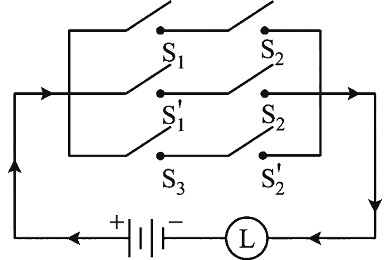
The minimum number of switches in the simplified form of the following switching circuit is
A
0
B
1
C
2
D
3
0 likesView Solution
401
PhysicsDifficultMCQMHT CET · 2026
$A$ radioactive element has a rate of disintegration of $16,000 \text{ disintegrations per minute}$ at a particular instant. After $4 \text{ minutes}$, it becomes $2000 \text{ disintegrations per minute}$. The decay constant per minute is:
A
$0.25 \log_e 2$
B
$0.50 \log_e 3$
C
$0.75 \log_e 2$
D
$0.8 \log_e 3$
Solution
(C) The rate of disintegration $R$ at time $t$ is given by the law of radioactive decay: $R = R_0 e^{-\lambda t}$.
Here, $R_0 = 16,000 \text{ disintegrations/minute}$, $R = 2000 \text{ disintegrations/minute}$, and $t = 4 \text{ minutes}$.
Substituting these values into the equation: $2000 = 16,000 e^{-\lambda \times 4}$.
Dividing both sides by $16,000$: $\frac{2000}{16,000} = e^{-4\lambda}$, which simplifies to $\frac{1}{8} = e^{-4\lambda}$.
Taking the natural logarithm $(log_e)$ on both sides: $\log_e(1/8) = -4\lambda$.
Since $\log_e(1/8) = \log_e(2^{-3}) = -3 \log_e 2$, we have $-3 \log_e 2 = -4\lambda$.
Solving for $\lambda$: $\lambda = \frac{3}{4} \log_e 2 = 0.75 \log_e 2 \text{ min}^{-1}$.
Here, $R_0 = 16,000 \text{ disintegrations/minute}$, $R = 2000 \text{ disintegrations/minute}$, and $t = 4 \text{ minutes}$.
Substituting these values into the equation: $2000 = 16,000 e^{-\lambda \times 4}$.
Dividing both sides by $16,000$: $\frac{2000}{16,000} = e^{-4\lambda}$, which simplifies to $\frac{1}{8} = e^{-4\lambda}$.
Taking the natural logarithm $(log_e)$ on both sides: $\log_e(1/8) = -4\lambda$.
Since $\log_e(1/8) = \log_e(2^{-3}) = -3 \log_e 2$, we have $-3 \log_e 2 = -4\lambda$.
Solving for $\lambda$: $\lambda = \frac{3}{4} \log_e 2 = 0.75 \log_e 2 \text{ min}^{-1}$.
0 likesView Solution
402
PhysicsMediumMCQMHT CET · 2026
The ratio of the density of oxygen nucleus $(_{8}^{16}O)$ and helium nucleus $(_{2}^{4}He)$ is (in $: 1$)
A
$1$
B
$2$
C
$4$
D
$8$
Solution
(A) The density of a nucleus is given by the formula $\rho = \frac{M}{V}$, where $M$ is the mass of the nucleus and $V$ is its volume.
The mass of a nucleus with mass number $A$ is approximately $M = A \times m_p$, where $m_p$ is the mass of a proton.
The volume of a nucleus is given by $V = \frac{4}{3} \pi R^3$, where $R = R_0 A^{1/3}$ is the radius of the nucleus.
Substituting the expression for $R$, we get $V = \frac{4}{3} \pi (R_0 A^{1/3})^3 = \frac{4}{3} \pi R_0^3 A$.
Now, the density $\rho = \frac{A \times m_p}{\frac{4}{3} \pi R_0^3 A} = \frac{3 m_p}{4 \pi R_0^3}$.
Since the density $\rho$ is independent of the mass number $A$, the density of all nuclei is constant.
Therefore, the ratio of the density of oxygen nucleus to helium nucleus is $1 : 1$.
The mass of a nucleus with mass number $A$ is approximately $M = A \times m_p$, where $m_p$ is the mass of a proton.
The volume of a nucleus is given by $V = \frac{4}{3} \pi R^3$, where $R = R_0 A^{1/3}$ is the radius of the nucleus.
Substituting the expression for $R$, we get $V = \frac{4}{3} \pi (R_0 A^{1/3})^3 = \frac{4}{3} \pi R_0^3 A$.
Now, the density $\rho = \frac{A \times m_p}{\frac{4}{3} \pi R_0^3 A} = \frac{3 m_p}{4 \pi R_0^3}$.
Since the density $\rho$ is independent of the mass number $A$, the density of all nuclei is constant.
Therefore, the ratio of the density of oxygen nucleus to helium nucleus is $1 : 1$.
0 likesView Solution
403
PhysicsMediumMCQMHT CET · 2026
The resultant gate and its Boolean expression in the given circuit is

A
$AND$, $A + B$
B
$NAND$, $A + B$
C
$OR$, $A + B$
D
$NOR$, $A + B$
Solution
(C) The given circuit consists of a $NOR$ gate followed by a $NOT$ gate.
$1$. The first gate is a $NOR$ gate with inputs $A$ and $B$. The output of the $NOR$ gate is $C = \overline{A + B}$.
$2$. The second gate is a $NOT$ gate (inverter) which takes the input $C$ and produces the output $Y = \overline{C}$.
$3$. Substituting the value of $C$, we get $Y = \overline{(\overline{A + B})}$.
$4$. According to the law of double negation, $\overline{\overline{X}} = X$. Therefore, $Y = A + B$.
$5$. $A$ circuit that performs the operation $Y = A + B$ is an $OR$ gate.
Thus, the resultant gate is an $OR$ gate and its Boolean expression is $A + B$.
$1$. The first gate is a $NOR$ gate with inputs $A$ and $B$. The output of the $NOR$ gate is $C = \overline{A + B}$.
$2$. The second gate is a $NOT$ gate (inverter) which takes the input $C$ and produces the output $Y = \overline{C}$.
$3$. Substituting the value of $C$, we get $Y = \overline{(\overline{A + B})}$.
$4$. According to the law of double negation, $\overline{\overline{X}} = X$. Therefore, $Y = A + B$.
$5$. $A$ circuit that performs the operation $Y = A + B$ is an $OR$ gate.
Thus, the resultant gate is an $OR$ gate and its Boolean expression is $A + B$.
0 likesView Solution
404
PhysicsMediumMCQMHT CET · 2026
In which of the logic gate the following statement is true? "The output is high when either of the inputs is high but not if both inputs are high"
A
$NAND$
B
$NOR$
C
$X$-$OR$
D
$OR$
Solution
(C) The logic gate described is the $X-OR$ (Exclusive-$OR$) gate.
For an $X-OR$ gate with two inputs $A$ and $B$, the output $Y$ is given by the Boolean expression $Y = A \oplus B = A\overline{B} + \overline{A}B$.
The truth table for an $X-OR$ gate is:
- If $A=0, B=0$, then $Y=0$.
- If $A=1, B=0$, then $Y=1$.
- If $A=0, B=1$, then $Y=1$.
- If $A=1, B=1$, then $Y=0$.
This confirms that the output is high $(1)$ when either of the inputs is high, but not when both inputs are high.
For an $X-OR$ gate with two inputs $A$ and $B$, the output $Y$ is given by the Boolean expression $Y = A \oplus B = A\overline{B} + \overline{A}B$.
The truth table for an $X-OR$ gate is:
- If $A=0, B=0$, then $Y=0$.
- If $A=1, B=0$, then $Y=1$.
- If $A=0, B=1$, then $Y=1$.
- If $A=1, B=1$, then $Y=0$.
This confirms that the output is high $(1)$ when either of the inputs is high, but not when both inputs are high.
0 likesView Solution
405
PhysicsMediumMCQMHT CET · 2026
To get the truth table shown from the following logic circuit, the gate $G$ should be
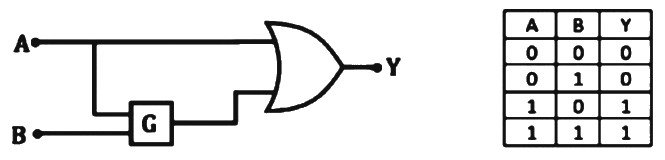
A
$NAND$ gate.
B
$NOR$ gate.
C
$AND$ gate.
D
$OR$ gate.
Solution
(C) The given circuit consists of an $OR$ gate with two inputs. One input is $A$ and the other input is the output of gate $G$, which takes $A$ and $B$ as inputs. Let the output of gate $G$ be $X$. Then the final output $Y = A + X$.
From the truth table:
For $A=0, B=0$, $Y=0$. Since $Y = A + X$, $0 = 0 + X \implies X=0$.
For $A=0, B=1$, $Y=0$. Since $Y = A + X$, $0 = 0 + X \implies X=0$.
For $A=1, B=0$, $Y=1$. Since $Y = A + X$, $1 = 1 + X \implies X$ can be $0$ or $1$.
For $A=1, B=1$, $Y=1$. Since $Y = A + X$, $1 = 1 + X \implies X$ can be $0$ or $1$.
Looking at the values of $X$ derived from the inputs $A$ and $B$: when $A=0, B=0 \implies X=0$; when $A=0, B=1 \implies X=0$; when $A=1, B=0 \implies X=0$ (consistent with $Y=1$); when $A=1, B=1 \implies X=1$ (consistent with $Y=1$).
This truth table for $X$ (inputs $A, B$ and output $X$) corresponds to the $AND$ gate, where $X = A \cdot B$.
From the truth table:
For $A=0, B=0$, $Y=0$. Since $Y = A + X$, $0 = 0 + X \implies X=0$.
For $A=0, B=1$, $Y=0$. Since $Y = A + X$, $0 = 0 + X \implies X=0$.
For $A=1, B=0$, $Y=1$. Since $Y = A + X$, $1 = 1 + X \implies X$ can be $0$ or $1$.
For $A=1, B=1$, $Y=1$. Since $Y = A + X$, $1 = 1 + X \implies X$ can be $0$ or $1$.
Looking at the values of $X$ derived from the inputs $A$ and $B$: when $A=0, B=0 \implies X=0$; when $A=0, B=1 \implies X=0$; when $A=1, B=0 \implies X=0$ (consistent with $Y=1$); when $A=1, B=1 \implies X=1$ (consistent with $Y=1$).
This truth table for $X$ (inputs $A, B$ and output $X$) corresponds to the $AND$ gate, where $X = A \cdot B$.
0 likesView Solution
406
PhysicsDifficultMCQMHT CET · 2026
In the following digital circuit, the output '$Y$' will be '$1$' for inputs '$A$' and '$B$' having values:
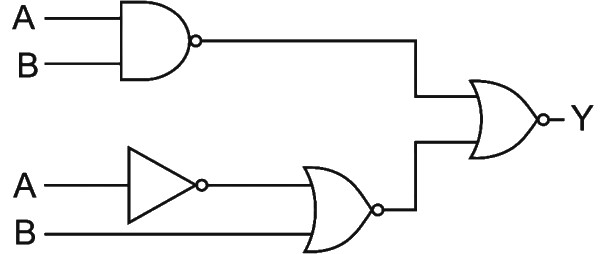
A
$A = 0, B = 0$
B
$A = 0, B = 1$
C
$A = 1, B = 0$
D
$A = 1, B = 1$
Solution
(D) Let the output of the $NAND$ gate be $Y_1 = \overline{A \cdot B}$.
Let the output of the $NOT$ gate be $A' = \overline{A}$.
Let the output of the $NOR$ gate be $Y_2 = \overline{A' + B} = \overline{\overline{A} + B} = A \cdot \overline{B}$.
The final output $Y$ is the output of a $NOR$ gate with inputs $Y_1$ and $Y_2$, so $Y = \overline{Y_1 + Y_2} = \overline{\overline{A \cdot B} + A \cdot \overline{B}}$.
Using De Morgan's law, $Y = (A \cdot B) \cdot (\overline{A \cdot \overline{B}}) = (A \cdot B) \cdot (\overline{A} + B) = (A \cdot B \cdot \overline{A}) + (A \cdot B \cdot B) = 0 + (A \cdot B) = A \cdot B$.
For $Y = 1$, we must have $A = 1$ and $B = 1$.
Let the output of the $NOT$ gate be $A' = \overline{A}$.
Let the output of the $NOR$ gate be $Y_2 = \overline{A' + B} = \overline{\overline{A} + B} = A \cdot \overline{B}$.
The final output $Y$ is the output of a $NOR$ gate with inputs $Y_1$ and $Y_2$, so $Y = \overline{Y_1 + Y_2} = \overline{\overline{A \cdot B} + A \cdot \overline{B}}$.
Using De Morgan's law, $Y = (A \cdot B) \cdot (\overline{A \cdot \overline{B}}) = (A \cdot B) \cdot (\overline{A} + B) = (A \cdot B \cdot \overline{A}) + (A \cdot B \cdot B) = 0 + (A \cdot B) = A \cdot B$.
For $Y = 1$, we must have $A = 1$ and $B = 1$.
0 likesView Solution
407
PhysicsMediumMCQMHT CET · 2026
Which of the following logic gates will have an output of '$1$' for the given inputs?
A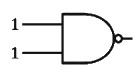
B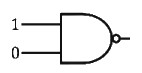
C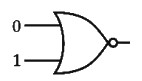
D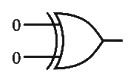
Solution
(B) Let us analyze the output for each logic gate:
$(A)$ $NAND$ gate with inputs $1$ and $1$: The output of an $AND$ gate is $1 \cdot 1 = 1$. The $NAND$ gate inverts this, so the output is $0$.
$(B)$ $NAND$ gate with inputs $1$ and $0$: The output of an $AND$ gate is $1 \cdot 0 = 0$. The $NAND$ gate inverts this, so the output is $1$.
$(C)$ $NOR$ gate with inputs $0$ and $1$: The output of an $OR$ gate is $0 + 1 = 1$. The $NOR$ gate inverts this, so the output is $0$.
$(D)$ $XOR$ gate with inputs $0$ and $0$: The output of an $XOR$ gate is $0 \oplus 0 = 0$.
Therefore, the logic gate that gives an output of '$1$' is the $NAND$ gate with inputs $1$ and $0$.
$(A)$ $NAND$ gate with inputs $1$ and $1$: The output of an $AND$ gate is $1 \cdot 1 = 1$. The $NAND$ gate inverts this, so the output is $0$.
$(B)$ $NAND$ gate with inputs $1$ and $0$: The output of an $AND$ gate is $1 \cdot 0 = 0$. The $NAND$ gate inverts this, so the output is $1$.
$(C)$ $NOR$ gate with inputs $0$ and $1$: The output of an $OR$ gate is $0 + 1 = 1$. The $NOR$ gate inverts this, so the output is $0$.
$(D)$ $XOR$ gate with inputs $0$ and $0$: The output of an $XOR$ gate is $0 \oplus 0 = 0$.
Therefore, the logic gate that gives an output of '$1$' is the $NAND$ gate with inputs $1$ and $0$.
0 likesView Solution
408
PhysicsMediumMCQMHT CET · 2026
The output $Y$ of the given logic circuit is
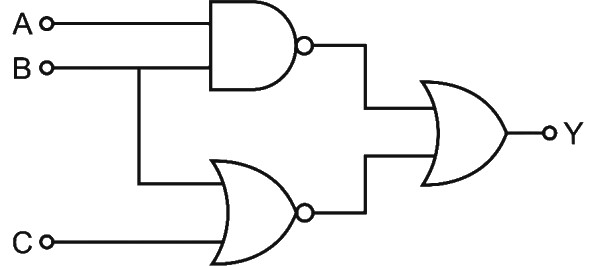
A
$\overline{(A \cdot B)} + \overline{(B + C)}$
B
$\overline{(A + B)} \cdot \overline{(B \cdot C)}$
C
$\overline{(A \cdot B)} + \overline{(B + C)}$
D
$(A + B) + (B + C)$
Solution
(A) $1$. The circuit consists of a $NAND$ gate, a $NOR$ gate, and an $OR$ gate.
$2$. The inputs to the $NAND$ gate are $A$ and $B$. Therefore, its output is $\overline{A \cdot B}$.
$3$. The inputs to the $NOR$ gate are $B$ and $C$. Therefore, its output is $\overline{B + C}$.
$4$. These two outputs are fed into an $OR$ gate. The output of an $OR$ gate is the sum of its inputs.
$5$. Thus, the final output $Y = \overline{A \cdot B} + \overline{B + C}$.
$2$. The inputs to the $NAND$ gate are $A$ and $B$. Therefore, its output is $\overline{A \cdot B}$.
$3$. The inputs to the $NOR$ gate are $B$ and $C$. Therefore, its output is $\overline{B + C}$.
$4$. These two outputs are fed into an $OR$ gate. The output of an $OR$ gate is the sum of its inputs.
$5$. Thus, the final output $Y = \overline{A \cdot B} + \overline{B + C}$.
0 likesView Solution
409
PhysicsMediumMCQMHT CET · 2026
For a two-input logic gate, when the inputs are $0$ and $0$, the output is $1$. When the inputs are $1$ and $0$, the output is $0$. The type of logic gate is:
A
$NAND$
B
$OR$
C
$NOR$
D
$XOR$
Solution
(C) Let the inputs be $A$ and $B$, and the output be $Y$.
Given conditions:
$1$. When $A = 0$ and $B = 0$, $Y = 1$.
$2$. When $A = 1$ and $B = 0$, $Y = 0$.
Checking the truth tables:
- For a $NOR$ gate: $0 NOR 0 = 1$ and $1 NOR 0 = 0$. This matches the given conditions.
- For a $NAND$ gate: $0 NAND 0 = 1$ and $1 NAND 0 = 1$. This does not match.
- For an $OR$ gate: $0 OR 0 = 0$ and $1 OR 0 = 1$. This does not match.
- For an $XOR$ gate: $0 XOR 0 = 0$ and $1 XOR 0 = 1$. This does not match.
Therefore, the logic gate is a $NOR$ gate.
Given conditions:
$1$. When $A = 0$ and $B = 0$, $Y = 1$.
$2$. When $A = 1$ and $B = 0$, $Y = 0$.
Checking the truth tables:
- For a $NOR$ gate: $0 NOR 0 = 1$ and $1 NOR 0 = 0$. This matches the given conditions.
- For a $NAND$ gate: $0 NAND 0 = 1$ and $1 NAND 0 = 1$. This does not match.
- For an $OR$ gate: $0 OR 0 = 0$ and $1 OR 0 = 1$. This does not match.
- For an $XOR$ gate: $0 XOR 0 = 0$ and $1 XOR 0 = 1$. This does not match.
Therefore, the logic gate is a $NOR$ gate.
0 likesView Solution
410
PhysicsMediumMCQMHT CET · 2026
The Boolean expression for the given combination of logic gates is
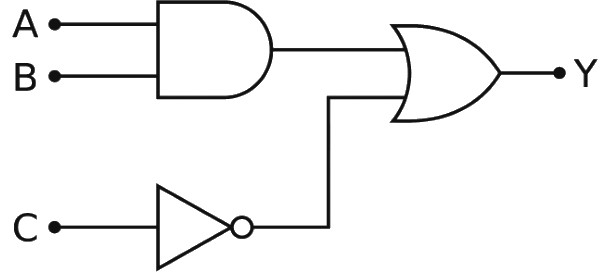
A
$Y = (A + B) \cdot \bar{C}$
B
$Y = (A \cdot B) \cdot \bar{C}$
C
$Y = (A + B) + C$
D
$Y = (A \cdot B) + \bar{C}$
Solution
(D) $1$. The circuit consists of an $AND$ gate, a $NOT$ gate, and an $OR$ gate.
$2$. The inputs $A$ and $B$ are fed into an $AND$ gate. The output of the $AND$ gate is $A \cdot B$.
$3$. The input $C$ is fed into a $NOT$ gate. The output of the $NOT$ gate is $\bar{C}$.
$4$. The outputs of the $AND$ gate $(A \cdot B)$ and the $NOT$ gate $(\bar{C})$ are fed into an $OR$ gate.
$5$. The final output $Y$ of the $OR$ gate is the sum of its inputs: $Y = (A \cdot B) + \bar{C}$.
$2$. The inputs $A$ and $B$ are fed into an $AND$ gate. The output of the $AND$ gate is $A \cdot B$.
$3$. The input $C$ is fed into a $NOT$ gate. The output of the $NOT$ gate is $\bar{C}$.
$4$. The outputs of the $AND$ gate $(A \cdot B)$ and the $NOT$ gate $(\bar{C})$ are fed into an $OR$ gate.
$5$. The final output $Y$ of the $OR$ gate is the sum of its inputs: $Y = (A \cdot B) + \bar{C}$.
0 likesView Solution
411
PhysicsMediumMCQMHT CET · 2026
The output $Y$ of the following digital logic circuit will be '$1$' (one) for the inputs:
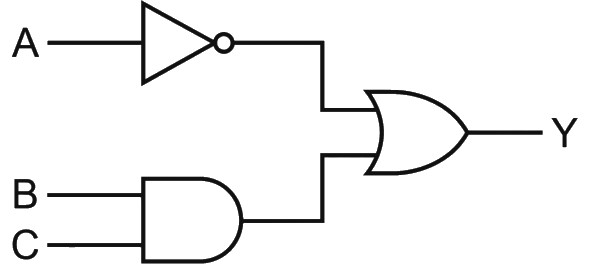
A
$A = 1, B = 0, C = 0$
B
$A = 1, B = 0, C = 1$
C
$A = 1, B = 1, C = 0$
D
$A = 1, B = 1, C = 1$
Solution
(D) The given circuit consists of a $NOT$ gate, an $AND$ gate, and an $OR$ gate.
From the circuit diagram, the output of the $NOT$ gate is $\bar{A}$.
The output of the $AND$ gate is $B \cdot C$.
These two outputs are fed into an $OR$ gate, so the final output $Y$ is given by the Boolean expression: $Y = \bar{A} + (B \cdot C)$.
We want to find the inputs for which $Y = 1$.
Let's test the options:
$(A)$ $A = 1, B = 0, C = 0$: $Y = \bar{1} + (0 \cdot 0) = 0 + 0 = 0$.
$(B)$ $A = 1, B = 0, C = 1$: $Y = \bar{1} + (0 \cdot 1) = 0 + 0 = 0$.
$(C)$ $A = 1, B = 1, C = 0$: $Y = \bar{1} + (1 \cdot 0) = 0 + 0 = 0$.
$(D)$ $A = 1, B = 1, C = 1$: $Y = \bar{1} + (1 \cdot 1) = 0 + 1 = 1$.
Thus, for the inputs $A = 1, B = 1, C = 1$, the output $Y$ is $1$.
From the circuit diagram, the output of the $NOT$ gate is $\bar{A}$.
The output of the $AND$ gate is $B \cdot C$.
These two outputs are fed into an $OR$ gate, so the final output $Y$ is given by the Boolean expression: $Y = \bar{A} + (B \cdot C)$.
We want to find the inputs for which $Y = 1$.
Let's test the options:
$(A)$ $A = 1, B = 0, C = 0$: $Y = \bar{1} + (0 \cdot 0) = 0 + 0 = 0$.
$(B)$ $A = 1, B = 0, C = 1$: $Y = \bar{1} + (0 \cdot 1) = 0 + 0 = 0$.
$(C)$ $A = 1, B = 1, C = 0$: $Y = \bar{1} + (1 \cdot 0) = 0 + 0 = 0$.
$(D)$ $A = 1, B = 1, C = 1$: $Y = \bar{1} + (1 \cdot 1) = 0 + 1 = 1$.
Thus, for the inputs $A = 1, B = 1, C = 1$, the output $Y$ is $1$.
0 likesView Solution
412
PhysicsMediumMCQMHT CET · 2026
In Boolean expression $A + B = Y$, the expression implies that:
A
$Y$ exists when $A$ or $B$ exists but not when both $A$ and $B$ exist.
B
$Y$ exists only when $A$ and $B$ both exist.
C
$Y$ exists when both $A$ and $B$ do not exist.
D
$Y$ exists when $A$ exists or $B$ exists or both $A$ and $B$ exist.
Solution
(D) The Boolean expression $A + B = Y$ represents the $OR$ gate operation.
In Boolean algebra, the $+$ sign denotes the logical $OR$ operation.
The truth table for an $OR$ gate is as follows:
- If $A = 0$ and $B = 0$, then $Y = 0$.
- If $A = 1$ and $B = 0$, then $Y = 1$.
- If $A = 0$ and $B = 1$, then $Y = 1$.
- If $A = 1$ and $B = 1$, then $Y = 1$.
This means that the output $Y$ is $1$ (exists) if at least one of the inputs $A$ or $B$ is $1$ (exists). Therefore, $Y$ exists when $A$ exists, or $B$ exists, or both $A$ and $B$ exist.
In Boolean algebra, the $+$ sign denotes the logical $OR$ operation.
The truth table for an $OR$ gate is as follows:
- If $A = 0$ and $B = 0$, then $Y = 0$.
- If $A = 1$ and $B = 0$, then $Y = 1$.
- If $A = 0$ and $B = 1$, then $Y = 1$.
- If $A = 1$ and $B = 1$, then $Y = 1$.
This means that the output $Y$ is $1$ (exists) if at least one of the inputs $A$ or $B$ is $1$ (exists). Therefore, $Y$ exists when $A$ exists, or $B$ exists, or both $A$ and $B$ exist.
0 likesView Solution
413
PhysicsDifficultMCQMHT CET · 2026
In a common emitter transistor amplifier, the output resistance is $500 \text{ k}\Omega$ and the current gain $\beta = 50$. If the power gain of the amplifier is $5 \times 10^6$, what is the input resistance (in $\Omega$)?
A
$325$
B
$150$
C
$350$
D
$250$
Solution
(D) The power gain $(A_p)$ of a transistor amplifier is given by the product of current gain $(\beta)$ and voltage gain $(A_v)$.
$A_p = \beta \times A_v$
Given, $A_p = 5 \times 10^6$ and $\beta = 50$.
$5 \times 10^6 = 50 \times A_v$
$A_v = \frac{5 \times 10^6}{50} = 10^5$.
Voltage gain is also defined as $A_v = \beta \times \frac{R_{out}}{R_{in}}$, where $R_{out}$ is the output resistance and $R_{in}$ is the input resistance.
$10^5 = 50 \times \frac{500 \times 10^3 \Omega}{R_{in}}$
$R_{in} = \frac{50 \times 500 \times 10^3}{10^5} = \frac{25000 \times 10^3}{10^5} = 250 \Omega$.
Thus, the input resistance is $250 \Omega$.
$A_p = \beta \times A_v$
Given, $A_p = 5 \times 10^6$ and $\beta = 50$.
$5 \times 10^6 = 50 \times A_v$
$A_v = \frac{5 \times 10^6}{50} = 10^5$.
Voltage gain is also defined as $A_v = \beta \times \frac{R_{out}}{R_{in}}$, where $R_{out}$ is the output resistance and $R_{in}$ is the input resistance.
$10^5 = 50 \times \frac{500 \times 10^3 \Omega}{R_{in}}$
$R_{in} = \frac{50 \times 500 \times 10^3}{10^5} = \frac{25000 \times 10^3}{10^5} = 250 \Omega$.
Thus, the input resistance is $250 \Omega$.
0 likesView Solution
414
PhysicsDifficultMCQMHT CET · 2026
In common emitter mode of a transistor, the d.c. current gain $(\beta)$ is $20$ and the emitter current $(I_E)$ is $7 \text{ mA}$. The collector current $(I_C)$ is: (in $/3 \text{ mA}$)
A
$14$
B
$20$
C
$7$
D
$8$
Solution
(B) Given:
Common emitter current gain, $\beta = 20$
Emitter current, $I_E = 7 \text{ mA}$
We know the relationship between emitter current and collector current in common emitter mode is $I_E = I_C + I_B$.
Also, $\beta = I_C / I_B$, which implies $I_B = I_C / \beta$.
Substituting $I_B$ in the first equation:
$I_E = I_C + (I_C / \beta) = I_C(1 + 1/\beta) = I_C((\beta + 1) / \beta)$.
Rearranging for $I_C$:
$I_C = I_E \times (\beta / (\beta + 1))$.
Substituting the values:
$I_C = 7 \times (20 / (20 + 1)) = 7 \times (20 / 21)$.
$I_C = 7 \times (20 / 21) = 20 / 3 \text{ mA}$.
Common emitter current gain, $\beta = 20$
Emitter current, $I_E = 7 \text{ mA}$
We know the relationship between emitter current and collector current in common emitter mode is $I_E = I_C + I_B$.
Also, $\beta = I_C / I_B$, which implies $I_B = I_C / \beta$.
Substituting $I_B$ in the first equation:
$I_E = I_C + (I_C / \beta) = I_C(1 + 1/\beta) = I_C((\beta + 1) / \beta)$.
Rearranging for $I_C$:
$I_C = I_E \times (\beta / (\beta + 1))$.
Substituting the values:
$I_C = 7 \times (20 / (20 + 1)) = 7 \times (20 / 21)$.
$I_C = 7 \times (20 / 21) = 20 / 3 \text{ mA}$.
0 likesView Solution
415
PhysicsMediumMCQMHT CET · 2026
In a transistor amplifier, the base-emitter junction is forward-biased and the collector-base junction is reverse-biased. The current gain $(\beta)$ is defined as:
A
$\Delta I_C / \Delta I_B$
B
$\Delta I_B / \Delta I_C$
C
$\Delta I_C / \Delta I_E$
D
$\Delta I_B / \Delta I_E$
Solution
(A) In a common-emitter transistor amplifier configuration, the input current is the base current $(I_B)$ and the output current is the collector current $(I_C)$.
The current gain, denoted by $\beta$, is defined as the ratio of the change in collector current to the change in base current, keeping the collector-emitter voltage constant.
Mathematically, $\beta = \Delta I_C / \Delta I_B$.
The current gain, denoted by $\beta$, is defined as the ratio of the change in collector current to the change in base current, keeping the collector-emitter voltage constant.
Mathematically, $\beta = \Delta I_C / \Delta I_B$.
0 likesView Solution
416
PhysicsDifficultMCQMHT CET · 2026
In common emitter mode of a transistor, the d.c. current gain $(\beta)$ is $20$, and the emitter current $(I_E)$ is $7 \text{ mA}$. The collector current $(I_C)$ is:
A
$20/3 \text{ mA}$
B
$14/5 \text{ mA}$
C
$1/3 \text{ mA}$
D
$8/13 \text{ mA}$
Solution
(A) Given:
$d.c. \text{ current gain } (\beta) = 20$
$Emitter current (I_E) = 7 \text{ mA}$
We know the relationship between current gain $(\beta)$ and collector current $(I_C)$ is given by $I_C = \beta I_B$, where $I_B$ is the base current.
Also, $I_E = I_B + I_C$.
Substituting $I_B = I_C / \beta$ into the equation:
$I_E = I_C / \beta + I_C$
$I_E = I_C (1/\beta + 1)$
$I_E = I_C (1 + \beta) / \beta$
Rearranging to solve for $I_C$:
$I_C = I_E \times \beta / (1 + \beta)$
$I_C = 7 \times 20 / (1 + 20)$
$I_C = 140 / 21$
Dividing both numerator and denominator by $7$:
$I_C = 20 / 3 \text{ mA}$.
$d.c. \text{ current gain } (\beta) = 20$
$Emitter current (I_E) = 7 \text{ mA}$
We know the relationship between current gain $(\beta)$ and collector current $(I_C)$ is given by $I_C = \beta I_B$, where $I_B$ is the base current.
Also, $I_E = I_B + I_C$.
Substituting $I_B = I_C / \beta$ into the equation:
$I_E = I_C / \beta + I_C$
$I_E = I_C (1/\beta + 1)$
$I_E = I_C (1 + \beta) / \beta$
Rearranging to solve for $I_C$:
$I_C = I_E \times \beta / (1 + \beta)$
$I_C = 7 \times 20 / (1 + 20)$
$I_C = 140 / 21$
Dividing both numerator and denominator by $7$:
$I_C = 20 / 3 \text{ mA}$.
0 likesView Solution
417
PhysicsDifficultMCQMHT CET · 2026
If a transistor having $\alpha = 0.9$ is used in $CE$ configuration, then for a change of $0.4 \text{ mA}$ in base current, what will be the change in collector current (in $\text{ mA}$)?
A
$3.6$
B
$4$
C
$0.9$
D
$36$
Solution
(A) Given: $\alpha = 0.9$ and change in base current $\Delta I_B = 0.4 \text{ mA}$.
First, we calculate the current gain $\beta$ for the $CE$ configuration using the relation: $\beta = \frac{\alpha}{1 - \alpha}$.
Substituting the value of $\alpha$: $\beta = \frac{0.9}{1 - 0.9} = \frac{0.9}{0.1} = 9$.
The relationship between collector current change $\Delta I_C$ and base current change $\Delta I_B$ is given by: $\Delta I_C = \beta \times \Delta I_B$.
Substituting the values: $\Delta I_C = 9 \times 0.4 \text{ mA} = 3.6 \text{ mA}$.
Therefore, the change in collector current is $3.6 \text{ mA}$.
First, we calculate the current gain $\beta$ for the $CE$ configuration using the relation: $\beta = \frac{\alpha}{1 - \alpha}$.
Substituting the value of $\alpha$: $\beta = \frac{0.9}{1 - 0.9} = \frac{0.9}{0.1} = 9$.
The relationship between collector current change $\Delta I_C$ and base current change $\Delta I_B$ is given by: $\Delta I_C = \beta \times \Delta I_B$.
Substituting the values: $\Delta I_C = 9 \times 0.4 \text{ mA} = 3.6 \text{ mA}$.
Therefore, the change in collector current is $3.6 \text{ mA}$.
0 likesView Solution
418
PhysicsDifficultMCQMHT CET · 2026
In a common emitter amplifier, a change of $0.2 \text{ mA}$ in the base current causes a change of $5 \text{ mA}$ in the collector current. If input resistance is $2 \text{ k}\Omega$ and voltage gain is $75$, the load resistance used in the circuit is
A
$2 \text{ k}\Omega$
B
$3 \text{ k}\Omega$
C
$4 \text{ k}\Omega$
D
$6 \text{ k}\Omega$
Solution
(D) The current gain $\beta$ is given by the ratio of the change in collector current $\Delta I_C$ to the change in base current $\Delta I_B$.
$\beta = \frac{\Delta I_C}{\Delta I_B} = \frac{5 \text{ mA}}{0.2 \text{ mA}} = 25$.
The voltage gain $A_V$ is given by the formula $A_V = \beta \times \frac{R_L}{R_{in}}$, where $R_L$ is the load resistance and $R_{in}$ is the input resistance.
Given $A_V = 75$, $\beta = 25$, and $R_{in} = 2 \text{ k}\Omega$.
Substituting the values: $75 = 25 \times \frac{R_L}{2 \text{ k}\Omega}$.
$3 = \frac{R_L}{2 \text{ k}\Omega}$.
$R_L = 3 \times 2 \text{ k}\Omega = 6 \text{ k}\Omega$.
$\beta = \frac{\Delta I_C}{\Delta I_B} = \frac{5 \text{ mA}}{0.2 \text{ mA}} = 25$.
The voltage gain $A_V$ is given by the formula $A_V = \beta \times \frac{R_L}{R_{in}}$, where $R_L$ is the load resistance and $R_{in}$ is the input resistance.
Given $A_V = 75$, $\beta = 25$, and $R_{in} = 2 \text{ k}\Omega$.
Substituting the values: $75 = 25 \times \frac{R_L}{2 \text{ k}\Omega}$.
$3 = \frac{R_L}{2 \text{ k}\Omega}$.
$R_L = 3 \times 2 \text{ k}\Omega = 6 \text{ k}\Omega$.
0 likesView Solution
419
PhysicsDifficultMCQMHT CET · 2026
In a transistor amplifier, a change of $0.2 \text{ mA}$ in the base current causes a change of $5 \text{ mA}$ in the collector current. If input resistance is $2 \text{ k}\Omega$ and voltage gain is $75$, the load resistance used in the circuit is
A
$4 \text{ k}\Omega$
B
$6 \text{ k}\Omega$
C
$8 \text{ k}\Omega$
D
$2 \text{ k}\Omega$
Solution
(B) The current gain $\beta$ is defined as the ratio of the change in collector current $(\Delta I_C)$ to the change in base current $(\Delta I_B)$.
$\beta = \frac{\Delta I_C}{\Delta I_B} = \frac{5 \text{ mA}}{0.2 \text{ mA}} = 25$.
The voltage gain $A_V$ is given by the formula $A_V = \beta \times \frac{R_L}{R_{in}}$, where $R_L$ is the load resistance and $R_{in}$ is the input resistance.
Given $A_V = 75$, $\beta = 25$, and $R_{in} = 2 \text{ k}\Omega$.
Substituting the values: $75 = 25 \times \frac{R_L}{2 \text{ k}\Omega}$.
$3 = \frac{R_L}{2 \text{ k}\Omega}$.
$R_L = 3 \times 2 \text{ k}\Omega = 6 \text{ k}\Omega$.
Therefore, the load resistance is $6 \text{ k}\Omega$.
$\beta = \frac{\Delta I_C}{\Delta I_B} = \frac{5 \text{ mA}}{0.2 \text{ mA}} = 25$.
The voltage gain $A_V$ is given by the formula $A_V = \beta \times \frac{R_L}{R_{in}}$, where $R_L$ is the load resistance and $R_{in}$ is the input resistance.
Given $A_V = 75$, $\beta = 25$, and $R_{in} = 2 \text{ k}\Omega$.
Substituting the values: $75 = 25 \times \frac{R_L}{2 \text{ k}\Omega}$.
$3 = \frac{R_L}{2 \text{ k}\Omega}$.
$R_L = 3 \times 2 \text{ k}\Omega = 6 \text{ k}\Omega$.
Therefore, the load resistance is $6 \text{ k}\Omega$.
0 likesView Solution
420
PhysicsMediumMCQMHT CET · 2026
In common emitter configuration of a transistor amplifier, $r_i$, $R_L$ and $\beta$ represent the input resistance, load resistance, and the a.c. current gain, respectively. The voltage gain $A_V$ and power gain $A_P$ are represented in magnitude by which of the following expressions?
A
$\beta (R_L/r_i), \beta^2 (R_L/r_i)$
B
$\beta (r_i/R_L), \beta^2 (r_i/R_L)$
C
$\beta^2 (R_L/r_i), \beta (R_L/r_i)$
D
$\beta (R_L/r_i), \beta (R_L/r_i)$
Solution
(A) In a common emitter transistor amplifier:
$1$. The voltage gain $A_V$ is defined as the ratio of the output voltage to the input voltage.
$A_V = \frac{V_{out}}{V_{in}} = \frac{I_c R_L}{I_b r_i} = \beta \frac{R_L}{r_i}$, where $\beta = \frac{I_c}{I_b}$ is the a.c. current gain.
$2$. The power gain $A_P$ is defined as the product of the current gain and the voltage gain.
$A_P = \beta \times A_V = \beta \times (\beta \frac{R_L}{r_i}) = \beta^2 \frac{R_L}{r_i}$.
Therefore, the voltage gain is $\beta (R_L/r_i)$ and the power gain is $\beta^2 (R_L/r_i)$.
$1$. The voltage gain $A_V$ is defined as the ratio of the output voltage to the input voltage.
$A_V = \frac{V_{out}}{V_{in}} = \frac{I_c R_L}{I_b r_i} = \beta \frac{R_L}{r_i}$, where $\beta = \frac{I_c}{I_b}$ is the a.c. current gain.
$2$. The power gain $A_P$ is defined as the product of the current gain and the voltage gain.
$A_P = \beta \times A_V = \beta \times (\beta \frac{R_L}{r_i}) = \beta^2 \frac{R_L}{r_i}$.
Therefore, the voltage gain is $\beta (R_L/r_i)$ and the power gain is $\beta^2 (R_L/r_i)$.
0 likesView Solution
421
PhysicsDifficultMCQMHT CET · 2026
In an $NPN$ transistor, the collector current is $28 \text{ mA}$. If $80\%$ of the electrons emitted by the emitter reach the collector, what is the base current in $\text{mA}$ (in $\text{ mA}$)?
A
$7$
B
$14$
C
$28$
D
$35$
Solution
(A) In a transistor, the emitter current $(I_E)$ is the sum of the collector current $(I_C)$ and the base current $(I_B)$, i.e.,$I_E = I_C + I_B$.
Given that $80\%$ of the electrons emitted reach the collector, we have $I_C = 0.80 \times I_E$.
Given $I_C = 28 \text{ mA}$, we can find $I_E$ as:
$I_E = \frac{I_C}{0.80} = \frac{28}{0.80} = 35 \text{ mA}$.
Now, using the relation $I_B = I_E - I_C$, we get:
$I_B = 35 \text{ mA} - 28 \text{ mA} = 7 \text{ mA}$.
Therefore, the base current is $7 \text{ mA}$.
Given that $80\%$ of the electrons emitted reach the collector, we have $I_C = 0.80 \times I_E$.
Given $I_C = 28 \text{ mA}$, we can find $I_E$ as:
$I_E = \frac{I_C}{0.80} = \frac{28}{0.80} = 35 \text{ mA}$.
Now, using the relation $I_B = I_E - I_C$, we get:
$I_B = 35 \text{ mA} - 28 \text{ mA} = 7 \text{ mA}$.
Therefore, the base current is $7 \text{ mA}$.
0 likesView Solution
422
PhysicsMediumMCQMHT CET · 2026
In a transistor, comparing the doping of emitter, base, and collector, the part which is heavily doped and that which is lightly doped are respectively:
A
collector and emitter
B
emitter and base
C
collector and base
D
emitter and collector
Solution
(B) In a bipolar junction transistor $(BJT)$, the three regions are doped differently to optimize their functions:
$1$. The $Emitter$ is heavily doped to provide a large number of charge carriers.
$2$. The $Base$ is very thin and lightly doped to allow most of the charge carriers from the emitter to pass through to the collector.
$3$. The $Collector$ is moderately doped compared to the emitter and base.
Therefore, the part that is heavily doped is the $Emitter$, and the part that is lightly doped is the $Base$.
$1$. The $Emitter$ is heavily doped to provide a large number of charge carriers.
$2$. The $Base$ is very thin and lightly doped to allow most of the charge carriers from the emitter to pass through to the collector.
$3$. The $Collector$ is moderately doped compared to the emitter and base.
Therefore, the part that is heavily doped is the $Emitter$, and the part that is lightly doped is the $Base$.
0 likesView Solution
423
PhysicsDifficultMCQMHT CET · 2026
In a common emitter transistor amplifier, $AC$ current gain is $65$, the load resistance is $5400 \text{ }\Omega$ and input resistance of the transistor is $450 \text{ }\Omega$. The voltage gain is
A
$460$
B
$540$
C
$780$
D
$7800$
Solution
(C) The voltage gain $(A_v)$ of a common emitter transistor amplifier is given by the formula:
$A_v = \beta \times \frac{R_L}{R_i}$
Where:
$\beta$ ($AC$ current gain) = $65$
$R_L$ (Load resistance) = $5400 \text{ }\Omega$
$R_i$ (Input resistance) = $450 \text{ }\Omega$
Substituting the values into the formula:
$A_v = 65 \times \frac{5400}{450}$
$A_v = 65 \times 12$
$A_v = 780$
Therefore, the voltage gain is $780$.
$A_v = \beta \times \frac{R_L}{R_i}$
Where:
$\beta$ ($AC$ current gain) = $65$
$R_L$ (Load resistance) = $5400 \text{ }\Omega$
$R_i$ (Input resistance) = $450 \text{ }\Omega$
Substituting the values into the formula:
$A_v = 65 \times \frac{5400}{450}$
$A_v = 65 \times 12$
$A_v = 780$
Therefore, the voltage gain is $780$.
0 likesView Solution
424
PhysicsMediumMCQMHT CET · 2026
$A$ photodiode is a device:
A
in which photocurrent is dependent on reverse bias.
B
in which photocurrent is independent of incident radiation.
C
which is always operated in forward bias.
D
which is always operated in reverse bias.
Solution
(D) photodiode is a special type of $p-n$ junction diode that is designed to operate under reverse bias conditions.
When light (photons) with energy greater than the bandgap energy of the semiconductor falls on the junction, it generates electron-hole pairs.
Under the influence of the reverse bias electric field, these charge carriers are swept across the junction, creating a photocurrent.
The magnitude of this photocurrent is directly proportional to the intensity of the incident light.
Therefore, a photodiode is always operated in reverse bias to detect light signals efficiently.
When light (photons) with energy greater than the bandgap energy of the semiconductor falls on the junction, it generates electron-hole pairs.
Under the influence of the reverse bias electric field, these charge carriers are swept across the junction, creating a photocurrent.
The magnitude of this photocurrent is directly proportional to the intensity of the incident light.
Therefore, a photodiode is always operated in reverse bias to detect light signals efficiently.
0 likesView Solution
425
PhysicsMediumMCQMHT CET · 2026
Which of the following statements is $NOT$ correct in the case of an $LED$?
A
It is a heavily doped $p-n$ junction diode.
B
It emits light only when it is forward biased.
C
It emits light only when it is reverse biased.
D
The energy of the light emitted is equal to or slightly less than the energy gap of the semiconductor used.
Solution
(C) An $LED$ (Light Emitting Diode) is a heavily doped $p-n$ junction diode that emits spontaneous radiation when forward biased.
When the $LED$ is forward biased, electrons from the $n$-region and holes from the $p$-region move towards the junction and recombine.
During this recombination, the energy released is in the form of photons (light).
The energy of the emitted photons is approximately equal to or slightly less than the band gap energy $(E_g)$ of the semiconductor material.
Therefore, the statement that it emits light when reverse biased is incorrect.
When the $LED$ is forward biased, electrons from the $n$-region and holes from the $p$-region move towards the junction and recombine.
During this recombination, the energy released is in the form of photons (light).
The energy of the emitted photons is approximately equal to or slightly less than the band gap energy $(E_g)$ of the semiconductor material.
Therefore, the statement that it emits light when reverse biased is incorrect.
0 likesView Solution
426
PhysicsMediumMCQMHT CET · 2026
Which one of the following statements is '$WRONG$' regarding $LED$?
A
LEDs have long lifetime if properly manufactured.
B
Colours produced by LEDs do not fade out.
C
LEDs are energy efficient.
D
Brightness of light emitted by $LED$ cannot be controlled.
Solution
(D) An $LED$ (Light Emitting Diode) is a semiconductor device that emits light when an electric current flows through it.
$1$. LEDs are known for their long operational lifetime when manufactured correctly.
$2$. The light produced by LEDs is monochromatic or specific in wavelength, and the colours do not fade over time.
$3$. LEDs are highly energy-efficient compared to traditional incandescent or fluorescent bulbs.
$4$. The brightness of an $LED$ can be easily controlled by varying the amount of current flowing through it (using techniques like Pulse Width Modulation or simple current limiting).
Therefore, the statement that the brightness of light emitted by an $LED$ cannot be controlled is '$WRONG$'.
$1$. LEDs are known for their long operational lifetime when manufactured correctly.
$2$. The light produced by LEDs is monochromatic or specific in wavelength, and the colours do not fade over time.
$3$. LEDs are highly energy-efficient compared to traditional incandescent or fluorescent bulbs.
$4$. The brightness of an $LED$ can be easily controlled by varying the amount of current flowing through it (using techniques like Pulse Width Modulation or simple current limiting).
Therefore, the statement that the brightness of light emitted by an $LED$ cannot be controlled is '$WRONG$'.
0 likesView Solution
427
PhysicsMediumMCQMHT CET · 2026
The material used for solar cell should have a band gap:
A
equal to zero.
B
equal to $0.08 \text{ eV}$.
C
between $1.0 \text{ eV}$ to $1.8 \text{ eV}$.
D
equal to $2 \text{ eV}$.
Solution
(C) For a solar cell to be efficient, the material must be able to absorb a significant portion of the solar spectrum.
Most of the solar radiation reaching the Earth's surface lies in the visible and near-infrared range.
$A$ band gap in the range of $1.0 \text{ eV}$ to $1.8 \text{ eV}$ is ideal because it allows the material to absorb photons with energies corresponding to the peak intensity of the solar spectrum.
Silicon, with a band gap of approximately $1.1 \text{ eV}$, is the most commonly used material for solar cells due to this property.
Most of the solar radiation reaching the Earth's surface lies in the visible and near-infrared range.
$A$ band gap in the range of $1.0 \text{ eV}$ to $1.8 \text{ eV}$ is ideal because it allows the material to absorb photons with energies corresponding to the peak intensity of the solar spectrum.
Silicon, with a band gap of approximately $1.1 \text{ eV}$, is the most commonly used material for solar cells due to this property.
0 likesView Solution
428
PhysicsMediumMCQMHT CET · 2026
Choose the correct statement about $Zener$ diode:
A
It works as a voltage regulator in reverse bias and behaves like simple $pn$ junction diode in forward bias.
B
It works as a voltage regulator in both forward and reverse bias.
C
It works a voltage regulator only in forward bias.
D
It works as a voltage regulator in forward bias and behaves like simple $pn$ junction diode in reverse bias.
Solution
(A) $Zener$ diode is a specially designed $pn$ junction diode that is heavily doped to operate in the reverse breakdown region.
In forward bias, it behaves like an ordinary $pn$ junction diode, conducting current once the threshold voltage is reached.
In reverse bias, once the voltage across the $Zener$ diode reaches its $Zener$ breakdown voltage $(V_Z)$, the current increases significantly while the voltage across it remains nearly constant.
This property allows the $Zener$ diode to function as a voltage regulator in the reverse bias region.
In forward bias, it behaves like an ordinary $pn$ junction diode, conducting current once the threshold voltage is reached.
In reverse bias, once the voltage across the $Zener$ diode reaches its $Zener$ breakdown voltage $(V_Z)$, the current increases significantly while the voltage across it remains nearly constant.
This property allows the $Zener$ diode to function as a voltage regulator in the reverse bias region.
0 likesView Solution
429
PhysicsMediumMCQMHT CET · 2026
For a $p-n$ junction diode, breakdown voltage occurs when
A
reverse bias is decreased
B
reverse bias is not changed
C
reverse-bias is increased
D
forward bias is increased
Solution
(C) In a $p-n$ junction diode, the depletion region width increases with an increase in reverse bias voltage.
When the reverse bias voltage is increased to a critical value known as the breakdown voltage, the electric field across the junction becomes very strong.
This strong electric field causes a large number of charge carriers to be generated (either through Zener breakdown or Avalanche breakdown), leading to a sudden increase in the reverse current.
Therefore, breakdown occurs when the reverse bias is increased to this critical value.
When the reverse bias voltage is increased to a critical value known as the breakdown voltage, the electric field across the junction becomes very strong.
This strong electric field causes a large number of charge carriers to be generated (either through Zener breakdown or Avalanche breakdown), leading to a sudden increase in the reverse current.
Therefore, breakdown occurs when the reverse bias is increased to this critical value.
0 likesView Solution
430
PhysicsMediumMCQMHT CET · 2026
In the diagram shown, the resistance between points $A$ and $B$ is '$R_1$' when an ideal diode $D$ is forward biased and is '$R_2$' when ideal diode $D$ is reverse biased. The ratio $R_1/R_2$ is
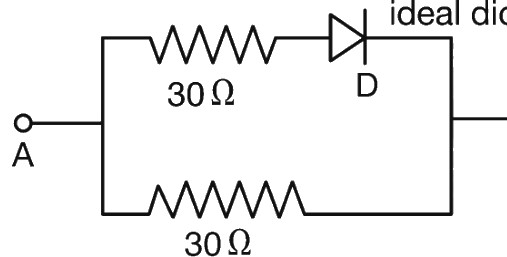
A
$2$
B
$1$
C
$1/2$
D
$1/4$
Solution
(C) An ideal diode in forward bias acts as a short circuit (zero resistance), and in reverse bias, it acts as an open circuit (infinite resistance).
Case $1$: Diode $D$ is forward biased.
The upper branch has a resistance of $30 \ \Omega$ in series with the diode (which acts as $0 \ \Omega$). The lower branch has a resistance of $30 \ \Omega$. These two branches are in parallel.
$R_1 = (30 \ \Omega \parallel 30 \ \Omega) = \frac{30 \times 30}{30 + 30} = \frac{900}{60} = 15 \ \Omega$.
Case $2$: Diode $D$ is reverse biased.
The upper branch acts as an open circuit (infinite resistance). Thus, only the lower branch with $30 \ \Omega$ resistance is connected between $A$ and $B$.
$R_2 = 30 \ \Omega$.
Ratio $R_1/R_2 = 15/30 = 1/2$.
Case $1$: Diode $D$ is forward biased.
The upper branch has a resistance of $30 \ \Omega$ in series with the diode (which acts as $0 \ \Omega$). The lower branch has a resistance of $30 \ \Omega$. These two branches are in parallel.
$R_1 = (30 \ \Omega \parallel 30 \ \Omega) = \frac{30 \times 30}{30 + 30} = \frac{900}{60} = 15 \ \Omega$.
Case $2$: Diode $D$ is reverse biased.
The upper branch acts as an open circuit (infinite resistance). Thus, only the lower branch with $30 \ \Omega$ resistance is connected between $A$ and $B$.
$R_2 = 30 \ \Omega$.
Ratio $R_1/R_2 = 15/30 = 1/2$.
0 likesView Solution
431
PhysicsDifficultMCQMHT CET · 2026
In the circuit, all three diodes $D_1, D_2, D_3$ have a forward resistance of $50 \text{ } \Omega$ each and infinite backward resistance. If the battery voltage is $5 \text{ V}$, find the current through the $100 \text{ } \Omega$ resistance. (in $\text{mA}$)
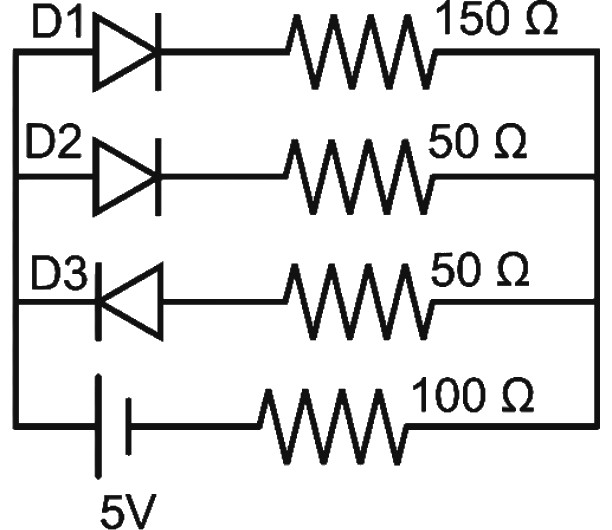
A
$60$
B
$30$
C
$20$
D
$10$
Solution
(B) $1$. Analyze the circuit: The diodes $D_1$ and $D_2$ are forward-biased, while $D_3$ is reverse-biased.
$2$. Since $D_3$ is reverse-biased, it acts as an open circuit (infinite resistance), so no current flows through the branch containing $D_3$.
$3$. The circuit simplifies to two parallel branches connected in series with the $100 \text{ } \Omega$ resistor.
$4$. Branch $1$ (containing $D_1$): Total resistance $R_1 = R_{D1} + 150 \text{ } \Omega = 50 \text{ } \Omega + 150 \text{ } \Omega = 200 \text{ } \Omega$.
$5$. Branch $2$ (containing $D_2$): Total resistance $R_2 = R_{D2} + 50 \text{ } \Omega = 50 \text{ } \Omega + 50 \text{ } \Omega = 100 \text{ } \Omega$.
$6$. The equivalent resistance of the parallel combination of $R_1$ and $R_2$ is $R_p = \frac{R_1 \times R_2}{R_1 + R_2} = \frac{200 \times 100}{200 + 100} = \frac{20000}{300} = \frac{200}{3} \text{ } \Omega$.
$7$. The total resistance of the circuit is $R_{total} = R_p + 100 \text{ } \Omega = \frac{200}{3} + 100 = \frac{500}{3} \text{ } \Omega$.
$8$. The total current $I$ flowing from the battery is $I = \frac{V}{R_{total}} = \frac{5}{500/3} = \frac{15}{500} = 0.03 \text{ A} = 30 \text{ mA}$.
$2$. Since $D_3$ is reverse-biased, it acts as an open circuit (infinite resistance), so no current flows through the branch containing $D_3$.
$3$. The circuit simplifies to two parallel branches connected in series with the $100 \text{ } \Omega$ resistor.
$4$. Branch $1$ (containing $D_1$): Total resistance $R_1 = R_{D1} + 150 \text{ } \Omega = 50 \text{ } \Omega + 150 \text{ } \Omega = 200 \text{ } \Omega$.
$5$. Branch $2$ (containing $D_2$): Total resistance $R_2 = R_{D2} + 50 \text{ } \Omega = 50 \text{ } \Omega + 50 \text{ } \Omega = 100 \text{ } \Omega$.
$6$. The equivalent resistance of the parallel combination of $R_1$ and $R_2$ is $R_p = \frac{R_1 \times R_2}{R_1 + R_2} = \frac{200 \times 100}{200 + 100} = \frac{20000}{300} = \frac{200}{3} \text{ } \Omega$.
$7$. The total resistance of the circuit is $R_{total} = R_p + 100 \text{ } \Omega = \frac{200}{3} + 100 = \frac{500}{3} \text{ } \Omega$.
$8$. The total current $I$ flowing from the battery is $I = \frac{V}{R_{total}} = \frac{5}{500/3} = \frac{15}{500} = 0.03 \text{ A} = 30 \text{ mA}$.
0 likesView Solution
432
PhysicsMediumMCQMHT CET · 2026
When the $Zener$ diode is used as a voltage regulator, it is connected in
A
forward bias and in parallel with load.
B
reverse bias and in series with load.
C
forward bias and in series with load.
D
reverse bias and in parallel with load.
Solution
(D) $Zener$ diode is a special type of diode designed to operate in the breakdown region.
When used as a voltage regulator, the $Zener$ diode is connected in reverse bias across the load.
This configuration ensures that the voltage across the load remains constant at the $Zener$ breakdown voltage, even if the input voltage or load current changes.
Thus, the correct connection is reverse bias and in parallel with the load.
When used as a voltage regulator, the $Zener$ diode is connected in reverse bias across the load.
This configuration ensures that the voltage across the load remains constant at the $Zener$ breakdown voltage, even if the input voltage or load current changes.
Thus, the correct connection is reverse bias and in parallel with the load.
0 likesView Solution
433
PhysicsMediumMCQMHT CET · 2026
$A$ diode and a resistor are connected as shown in the figure. Out of the following statements, which one is true regarding the biasing of the diodes?
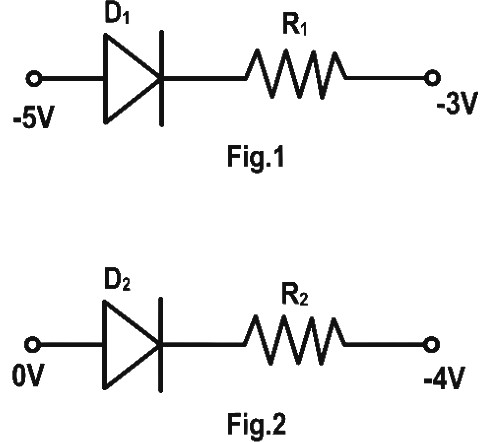
A
Fig. $(1)$ and Fig. $(2)$ are both forward biased.
B
Fig. $(1)$ and Fig. $(2)$ are both reverse biased.
C
Fig. $(1)$ is forward biased and Fig. $(2)$ is reverse biased.
D
Fig. $(1)$ is reverse biased and Fig. $(2)$ is forward biased.
Solution
(D) diode is forward biased if the potential at the $p$-side (anode) is higher than the potential at the $n$-side (cathode). Otherwise, it is reverse biased.
In Fig. $(1)$:
The $p$-side of diode $D_1$ is at $-5 \ V$ and the $n$-side is connected to $-3 \ V$ through resistor $R_1$. Since $-5 \ V < -3 \ V$, the potential at the $p$-side is lower than the potential at the $n$-side. Therefore, diode $D_1$ is reverse biased.
In Fig. $(2)$:
The $p$-side of diode $D_2$ is at $0 \ V$ and the $n$-side is connected to $-4 \ V$ through resistor $R_2$. Since $0 \ V > -4 \ V$, the potential at the $p$-side is higher than the potential at the $n$-side. Therefore, diode $D_2$ is forward biased.
Thus, Fig. $(1)$ is reverse biased and Fig. $(2)$ is forward biased.
In Fig. $(1)$:
The $p$-side of diode $D_1$ is at $-5 \ V$ and the $n$-side is connected to $-3 \ V$ through resistor $R_1$. Since $-5 \ V < -3 \ V$, the potential at the $p$-side is lower than the potential at the $n$-side. Therefore, diode $D_1$ is reverse biased.
In Fig. $(2)$:
The $p$-side of diode $D_2$ is at $0 \ V$ and the $n$-side is connected to $-4 \ V$ through resistor $R_2$. Since $0 \ V > -4 \ V$, the potential at the $p$-side is higher than the potential at the $n$-side. Therefore, diode $D_2$ is forward biased.
Thus, Fig. $(1)$ is reverse biased and Fig. $(2)$ is forward biased.
0 likesView Solution
434
PhysicsDifficultMCQMHT CET · 2026
In the following electrical circuit, the reading in the milliammeter is (Take knee voltage of silicon diode $= 0.7 \text{ V}$) (in $\text{ mA}$)
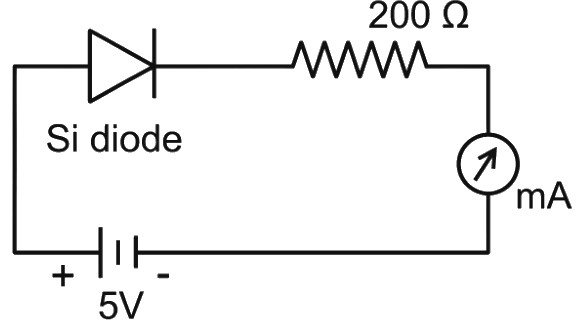
A
$25.5$
B
$21.5$
C
$18.5$
D
$15.8$
Solution
(B) The given circuit consists of a $5 \text{ V}$ $DC$ source, a silicon diode, and a resistor of $200 \text{ } \Omega$ connected in series.
Since the diode is forward-biased, it will conduct current when the applied voltage exceeds its knee voltage.
The effective voltage across the resistor $(V_R)$ is given by:
$V_R = V_{\text{source}} - V_{\text{knee}}$
$V_R = 5 \text{ V} - 0.7 \text{ V} = 4.3 \text{ V}$
Using Ohm's law, the current $(I)$ flowing through the circuit is:
$I = \frac{V_R}{R}$
$I = \frac{4.3 \text{ V}}{200 \text{ } \Omega} = 0.0215 \text{ A}$
To convert the current into milliamperes (mA):
$I = 0.0215 \times 1000 \text{ mA} = 21.5 \text{ mA}$
Therefore, the reading in the milliammeter is $21.5 \text{ mA}$.
Since the diode is forward-biased, it will conduct current when the applied voltage exceeds its knee voltage.
The effective voltage across the resistor $(V_R)$ is given by:
$V_R = V_{\text{source}} - V_{\text{knee}}$
$V_R = 5 \text{ V} - 0.7 \text{ V} = 4.3 \text{ V}$
Using Ohm's law, the current $(I)$ flowing through the circuit is:
$I = \frac{V_R}{R}$
$I = \frac{4.3 \text{ V}}{200 \text{ } \Omega} = 0.0215 \text{ A}$
To convert the current into milliamperes (mA):
$I = 0.0215 \times 1000 \text{ mA} = 21.5 \text{ mA}$
Therefore, the reading in the milliammeter is $21.5 \text{ mA}$.
0 likesView Solution
435
PhysicsMediumMCQMHT CET · 2026
The depletion region of a $p-n$ junction:
A
increases if reverse biased.
B
increases if forward biased.
C
decreases if reverse biased.
D
remains same in reverse and forward biasing.
Solution
(A) In a $p-n$ junction, the depletion region is formed by the diffusion of charge carriers across the junction.
When the junction is forward biased, the external electric field opposes the internal electric field, which pushes the charge carriers towards the junction, thereby decreasing the width of the depletion region.
When the junction is reverse biased, the external electric field supports the internal electric field, which pulls the charge carriers away from the junction, thereby increasing the width of the depletion region.
Therefore, the depletion region increases if the junction is reverse biased.
When the junction is forward biased, the external electric field opposes the internal electric field, which pushes the charge carriers towards the junction, thereby decreasing the width of the depletion region.
When the junction is reverse biased, the external electric field supports the internal electric field, which pulls the charge carriers away from the junction, thereby increasing the width of the depletion region.
Therefore, the depletion region increases if the junction is reverse biased.
0 likesView Solution
436
PhysicsEasyMCQMHT CET · 2026
When the conductivity of a semiconductor is only due to breaking of covalent bonds, the semiconductor is called
A
extrinsic.
B
intrinsic.
C
p-type.
D
n-type.
Solution
(B) semiconductor in its extremely pure form is known as an intrinsic semiconductor.
In an intrinsic semiconductor, the number of free electrons is equal to the number of holes.
The conductivity of such a material is solely due to the thermal excitation of electrons, which results in the breaking of covalent bonds.
Therefore, when conductivity is only due to the breaking of covalent bonds, it is called an intrinsic semiconductor.
In an intrinsic semiconductor, the number of free electrons is equal to the number of holes.
The conductivity of such a material is solely due to the thermal excitation of electrons, which results in the breaking of covalent bonds.
Therefore, when conductivity is only due to the breaking of covalent bonds, it is called an intrinsic semiconductor.
0 likesView Solution
437
PhysicsDifficultMCQMHT CET · 2026
$A$ pure silicon crystal at temperature $300 \text{ K}$ has electron and hole concentration $(n_i) = 10^{16} \text{ per m}^3$ each. If $10^{21}$ phosphorus atoms $(n_D)$ are added per cubic metre, what is the new hole concentration in the silicon crystal?
A
$10^{19} \text{ per m}^3$
B
$10^{21} \text{ per m}^3$
C
$10^5 \text{ per m}^3$
D
$10^{11} \text{ per m}^3$
Solution
(D) Given: Intrinsic carrier concentration $n_i = 10^{16} \text{ m}^{-3}$.
Donor concentration (phosphorus atoms) $n_D = 10^{21} \text{ m}^{-3}$.
Since phosphorus is a pentavalent impurity, it acts as a donor, making the crystal an $n$-type semiconductor.
In an $n$-type semiconductor, the electron concentration $n_e \approx n_D = 10^{21} \text{ m}^{-3}$.
According to the law of mass action for semiconductors, $n_e \cdot n_h = n_i^2$, where $n_h$ is the hole concentration.
Substituting the values: $10^{21} \cdot n_h = (10^{16})^2$.
$10^{21} \cdot n_h = 10^{32}$.
$n_h = 10^{32} / 10^{21} = 10^{11} \text{ m}^{-3}$.
Therefore, the new hole concentration is $10^{11} \text{ per m}^3$.
Donor concentration (phosphorus atoms) $n_D = 10^{21} \text{ m}^{-3}$.
Since phosphorus is a pentavalent impurity, it acts as a donor, making the crystal an $n$-type semiconductor.
In an $n$-type semiconductor, the electron concentration $n_e \approx n_D = 10^{21} \text{ m}^{-3}$.
According to the law of mass action for semiconductors, $n_e \cdot n_h = n_i^2$, where $n_h$ is the hole concentration.
Substituting the values: $10^{21} \cdot n_h = (10^{16})^2$.
$10^{21} \cdot n_h = 10^{32}$.
$n_h = 10^{32} / 10^{21} = 10^{11} \text{ m}^{-3}$.
Therefore, the new hole concentration is $10^{11} \text{ per m}^3$.
0 likesView Solution
438
PhysicsMediumMCQMHT CET · 2026
Which of the following graphs represents the temperature $(T)$ dependence of resistivity $(\rho)$ of a semiconductor?
A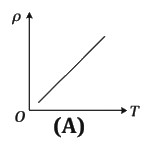
B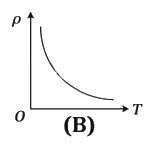
C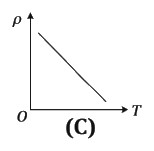
D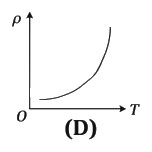
Solution
(B) In a semiconductor, the number of charge carriers (electrons and holes) increases exponentially with an increase in temperature $(T)$.
This increase in the number of charge carriers dominates over the effect of increased scattering of charge carriers.
As a result, the resistivity $(\rho)$ of a semiconductor decreases as the temperature increases.
The relationship is given by $\rho = \rho_0 e^{E_g / 2kT}$, where $E_g$ is the energy band gap, $k$ is the Boltzmann constant, and $T$ is the absolute temperature.
This represents an exponential decay curve.
Therefore, graph $B$ correctly represents the temperature dependence of resistivity for a semiconductor.
This increase in the number of charge carriers dominates over the effect of increased scattering of charge carriers.
As a result, the resistivity $(\rho)$ of a semiconductor decreases as the temperature increases.
The relationship is given by $\rho = \rho_0 e^{E_g / 2kT}$, where $E_g$ is the energy band gap, $k$ is the Boltzmann constant, and $T$ is the absolute temperature.
This represents an exponential decay curve.
Therefore, graph $B$ correctly represents the temperature dependence of resistivity for a semiconductor.
0 likesView Solution
439
PhysicsMediumMCQMHT CET · 2026
When a small amount of impurity atoms are added to a semiconductor, then generally its resistivity:
A
increases
B
decreases
C
does not change
D
may increase or decrease depending upon the percentage of doping
Solution
(B) The process of adding impurity atoms to a pure semiconductor is known as doping.
Adding impurities increases the number of charge carriers (electrons or holes) in the semiconductor.
Since the conductivity $(\sigma)$ of a semiconductor is directly proportional to the number of charge carriers $(n)$, i.e., $\sigma = ne\mu$, where $e$ is the charge and $\mu$ is the mobility, an increase in the number of charge carriers leads to an increase in conductivity.
Resistivity $(\rho)$ is the reciprocal of conductivity $(\rho = 1/\sigma)$.
Therefore, as the conductivity increases due to doping, the resistivity of the semiconductor decreases.
Adding impurities increases the number of charge carriers (electrons or holes) in the semiconductor.
Since the conductivity $(\sigma)$ of a semiconductor is directly proportional to the number of charge carriers $(n)$, i.e., $\sigma = ne\mu$, where $e$ is the charge and $\mu$ is the mobility, an increase in the number of charge carriers leads to an increase in conductivity.
Resistivity $(\rho)$ is the reciprocal of conductivity $(\rho = 1/\sigma)$.
Therefore, as the conductivity increases due to doping, the resistivity of the semiconductor decreases.
0 likesView Solution
440
PhysicsEasyMCQMHT CET · 2026
Electrical conductivity of insulators is
A
exactly zero
B
extremely large
C
extremely small
D
sometimes small and sometimes large
Solution
(C) Insulators are materials that do not allow the flow of electric current through them easily.
This is because they have a very large energy band gap between the valence band and the conduction band, which prevents electrons from moving to the conduction band.
Consequently, their electrical conductivity is extremely small, typically in the range of $10^{-20}$ to $10^{-10} \ S/m$.
This is because they have a very large energy band gap between the valence band and the conduction band, which prevents electrons from moving to the conduction band.
Consequently, their electrical conductivity is extremely small, typically in the range of $10^{-20}$ to $10^{-10} \ S/m$.
0 likesView Solution
441
PhysicsMediumMCQMHT CET · 2026
$A$ semiconductor $X$ is made by doping a germanium crystal with indium $(Z = 49)$. $A$ second semiconductor $Y$ is made by doping germanium crystal with arsenic $(Z = 33)$. Both are joined end to end and connected to a battery as shown. Which of the following statements is correct?
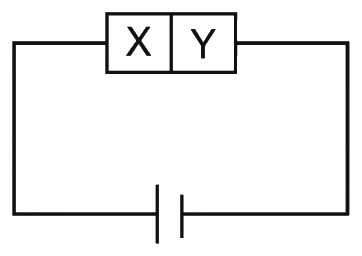
A
$X$ is p-type, $Y$ is n-type and the junction is forward biased.
B
$X$ is p-type, $Y$ is n-type and the junction is reverse biased.
C
$X$ is n-type, $Y$ is p-type and the junction is forward biased.
D
$X$ is n-type, $Y$ is p-type and the junction is reverse biased.
Solution
(B) $1$. Germanium $(Ge)$ is a group $14$ element. Indium $(In)$ is a group $13$ element. Doping $Ge$ with $In$ creates a p-type semiconductor. Thus, $X$ is p-type.
$2$. Arsenic $(As)$ is a group $15$ element. Doping $Ge$ with $As$ creates an n-type semiconductor. Thus, $Y$ is n-type.
$3$. The junction formed is a p-n junction.
$4$. In the circuit diagram, the p-side $(X)$ is connected to the negative terminal of the battery and the n-side $(Y)$ is connected to the positive terminal of the battery.
$5$. When the p-side is connected to the negative terminal and the n-side is connected to the positive terminal, the p-n junction is reverse biased.
$2$. Arsenic $(As)$ is a group $15$ element. Doping $Ge$ with $As$ creates an n-type semiconductor. Thus, $Y$ is n-type.
$3$. The junction formed is a p-n junction.
$4$. In the circuit diagram, the p-side $(X)$ is connected to the negative terminal of the battery and the n-side $(Y)$ is connected to the positive terminal of the battery.
$5$. When the p-side is connected to the negative terminal and the n-side is connected to the positive terminal, the p-n junction is reverse biased.
0 likesView Solution
442
PhysicsEasyMCQMHT CET · 2026
For an intrinsic semiconductor, if $n_h$ and $n_e$ represent the number of holes per unit volume and the number of free electrons per unit volume respectively, then:
A
$n_h < n_e$
B
$n_h > n_e$
C
$n_h = n_e$
D
$n_h \neq n_e$
Solution
(C) In an intrinsic semiconductor, the material is pure and contains no impurities.
When thermal energy is supplied, electrons are excited from the valence band to the conduction band.
This process creates a free electron in the conduction band and a corresponding hole in the valence band.
Since each electron-hole pair is generated simultaneously, the number of free electrons per unit volume $(n_e)$ must be equal to the number of holes per unit volume $(n_h)$.
Therefore, $n_e = n_h$.
When thermal energy is supplied, electrons are excited from the valence band to the conduction band.
This process creates a free electron in the conduction band and a corresponding hole in the valence band.
Since each electron-hole pair is generated simultaneously, the number of free electrons per unit volume $(n_e)$ must be equal to the number of holes per unit volume $(n_h)$.
Therefore, $n_e = n_h$.
0 likesView Solution
443
PhysicsMediumMCQMHT CET · 2026
In an $n$-type semiconductor:
A
Pentavalent impurities are dopants and holes are majority carriers.
B
Trivalent impurities are dopants and electrons are minority carriers.
C
Pentavalent impurities are dopants and electrons are majority carriers.
D
Trivalent impurities are dopants and holes are majority carriers.
Solution
(C) An $n$-type semiconductor is formed by doping an intrinsic semiconductor (like $Si$ or $Ge$) with pentavalent impurity atoms (such as $P$, $As$, or $Sb$).
These pentavalent atoms provide extra electrons to the conduction band.
Therefore, in an $n$-type semiconductor, electrons are the majority charge carriers and holes are the minority charge carriers.
These pentavalent atoms provide extra electrons to the conduction band.
Therefore, in an $n$-type semiconductor, electrons are the majority charge carriers and holes are the minority charge carriers.
0 likesView Solution
444
PhysicsMediumMCQMHT CET · 2026
In the band structure of $n$-type semiconductor, the free electrons donated by impurity atoms occupy energy levels in
A
the conduction band.
B
the valence band.
C
the band gap and are close to conduction band.
D
the band gap and are close to valence band.
Solution
(C) In an $n$-type semiconductor, pentavalent impurity atoms (like phosphorus, arsenic, etc.) are added to the intrinsic semiconductor.
These impurity atoms are called donor atoms.
Each donor atom provides an extra electron.
These donated electrons occupy discrete energy levels known as donor energy levels $(E_D)$.
These donor energy levels are located within the band gap, just below the conduction band edge $(E_C)$.
Because they are very close to the conduction band, these electrons can easily be thermally excited into the conduction band at room temperature, contributing to electrical conductivity.
These impurity atoms are called donor atoms.
Each donor atom provides an extra electron.
These donated electrons occupy discrete energy levels known as donor energy levels $(E_D)$.
These donor energy levels are located within the band gap, just below the conduction band edge $(E_C)$.
Because they are very close to the conduction band, these electrons can easily be thermally excited into the conduction band at room temperature, contributing to electrical conductivity.
0 likesView Solution
445
PhysicsEasyMCQMHT CET · 2026
In the energy band diagram of insulators, the band gap and the conduction band are respectively:
A
very high, empty
B
very low, empty
C
very high, completely filled
D
very low, partially filled
Solution
(A) In insulators, the energy band gap between the valence band and the conduction band is very large (typically $> 3 \ eV$).
Due to this large energy gap, electrons cannot easily jump from the valence band to the conduction band even at room temperature.
Consequently, the conduction band remains empty because no electrons are available to conduct electricity.
Due to this large energy gap, electrons cannot easily jump from the valence band to the conduction band even at room temperature.
Consequently, the conduction band remains empty because no electrons are available to conduct electricity.
0 likesView Solution
446
PhysicsDifficultMCQMHT CET · 2026
What does the following combination of gates produce?
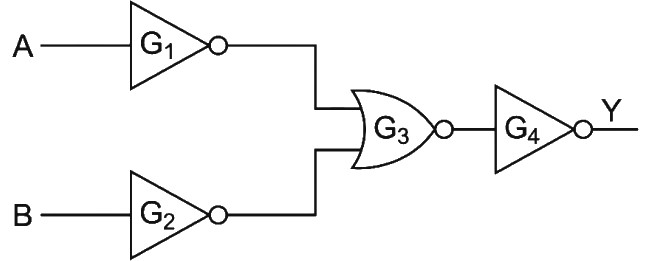
A
$NAND$ gate
B
$NOR$ gate
C
$XOR$ gate
D
$AND$ gate
Solution
(A) The given circuit consists of four gates: $G_1$ and $G_2$ are $NOT$ gates, $G_3$ is a $NOR$ gate, and $G_4$ is a $NOT$ gate.
Let the inputs be $A$ and $B$.
The outputs of $G_1$ and $G_2$ are $\bar{A}$ and $\bar{B}$ respectively.
These are fed into the $NOR$ gate $G_3$. The output of $G_3$ is $\overline{\bar{A} + \bar{B}}$.
By De Morgan's Law, $\overline{\bar{A} + \bar{B}} = \overline{\bar{A}} \cdot \overline{\bar{B}} = A \cdot B$.
This output is then passed through the $NOT$ gate $G_4$.
The final output $Y$ is $\overline{A \cdot B}$, which is the Boolean expression for a $NAND$ gate.
Let the inputs be $A$ and $B$.
The outputs of $G_1$ and $G_2$ are $\bar{A}$ and $\bar{B}$ respectively.
These are fed into the $NOR$ gate $G_3$. The output of $G_3$ is $\overline{\bar{A} + \bar{B}}$.
By De Morgan's Law, $\overline{\bar{A} + \bar{B}} = \overline{\bar{A}} \cdot \overline{\bar{B}} = A \cdot B$.
This output is then passed through the $NOT$ gate $G_4$.
The final output $Y$ is $\overline{A \cdot B}$, which is the Boolean expression for a $NAND$ gate.
0 likesView Solution
447
PhysicsEasyMCQMHT CET · 2026
In the case of a $NAND$ gate, if $A$ and $B$ are inputs and $Y$ is the output, then:
A
$Y = \overline{A + B}$
B
$Y = A \cdot B$
C
$Y = \overline{A \cdot B}$
D
$Y = A + B$
Solution
(C) $NAND$ gate is a combination of an $AND$ gate followed by a $NOT$ gate.
For an $AND$ gate, the output is $A \cdot B$.
Applying the $NOT$ operation to this result gives the output of the $NAND$ gate.
Therefore, the Boolean expression for a $NAND$ gate is $Y = \overline{A \cdot B}$.
For an $AND$ gate, the output is $A \cdot B$.
Applying the $NOT$ operation to this result gives the output of the $NAND$ gate.
Therefore, the Boolean expression for a $NAND$ gate is $Y = \overline{A \cdot B}$.
0 likesView Solution
448
PhysicsDifficultMCQMHT CET · 2026
In the logic circuit diagram, when all the four inputs, $A, B, C, D$ are 'one' the outputs $Y_1, Y_2, Y_3$ are respectively $(1, 1, 0)$. When the inputs $A$ and $C$ are changed to zero and $B$ and $D$ are still 'one',then the outputs $Y_1, Y_2, Y_3$ are respectively change to
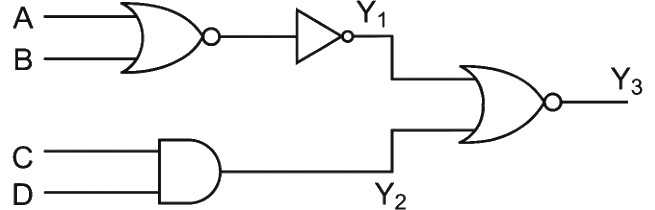
A
$1, 1, 1$
B
$1, 0, 0$
C
$0, 1, 0$
D
$0, 0, 1$
Solution
(B) The circuit consists of a $NOR$ gate followed by a $NOT$ gate, which together form an $OR$ gate for the inputs $A$ and $B$. Let this output be $Y_1$. Thus, $Y_1 = A + B$.
The inputs $C$ and $D$ are connected to an $AND$ gate, so $Y_2 = C \cdot D$.
The outputs $Y_1$ and $Y_2$ are then fed into a $NOR$ gate to produce $Y_3$. Thus, $Y_3 = \overline{Y_1 + Y_2}$.
Given inputs: $A = 0, B = 1, C = 0, D = 1$.
Calculating $Y_1$: $Y_1 = A + B = 0 + 1 = 1$.
Calculating $Y_2$: $Y_2 = C \cdot D = 0 \cdot 1 = 0$.
Calculating $Y_3$: $Y_3 = \overline{Y_1 + Y_2} = \overline{1 + 0} = \overline{1} = 0$.
Therefore, the new outputs are $(1, 0, 0)$.
The inputs $C$ and $D$ are connected to an $AND$ gate, so $Y_2 = C \cdot D$.
The outputs $Y_1$ and $Y_2$ are then fed into a $NOR$ gate to produce $Y_3$. Thus, $Y_3 = \overline{Y_1 + Y_2}$.
Given inputs: $A = 0, B = 1, C = 0, D = 1$.
Calculating $Y_1$: $Y_1 = A + B = 0 + 1 = 1$.
Calculating $Y_2$: $Y_2 = C \cdot D = 0 \cdot 1 = 0$.
Calculating $Y_3$: $Y_3 = \overline{Y_1 + Y_2} = \overline{1 + 0} = \overline{1} = 0$.
Therefore, the new outputs are $(1, 0, 0)$.
0 likesView Solution
449
PhysicsMediumMCQMHT CET · 2026
If a $p-n$ junction diode is forward biased, then:
A
width of depletion layer decreases.
B
width of depletion layer increases.
C
barrier voltage increases.
D
electric conduction is not possible.
Solution
(A) When a $p-n$ junction diode is forward biased, the positive terminal of the external battery is connected to the $p$-type region and the negative terminal to the $n$-type region.
This external electric field opposes the internal electric field of the depletion region.
As a result, the majority charge carriers are pushed towards the junction, which reduces the width of the depletion layer.
Consequently, the potential barrier height decreases, allowing current to flow through the diode.
This external electric field opposes the internal electric field of the depletion region.
As a result, the majority charge carriers are pushed towards the junction, which reduces the width of the depletion layer.
Consequently, the potential barrier height decreases, allowing current to flow through the diode.
0 likesView Solution
450
PhysicsMediumMCQMHT CET · 2026
Choose the correct statement from the following. Brewster's angle for a transparent medium is
A
different for light of different colours
B
same for lights of different colours
C
independent of refractive index of the medium
D
different for lights of same colour
Solution
(A) Brewster's law states that the tangent of the Brewster's angle $(i_B)$ is equal to the refractive index $(\mu)$ of the medium: $\tan(i_B) = \mu$.
Since the refractive index $(\mu)$ of a medium depends on the wavelength $(\lambda)$ of light (due to dispersion), and different colours of light have different wavelengths, the refractive index varies for different colours.
Consequently, the Brewster's angle $(i_B = \arctan(\mu))$ is different for light of different colours.
Since the refractive index $(\mu)$ of a medium depends on the wavelength $(\lambda)$ of light (due to dispersion), and different colours of light have different wavelengths, the refractive index varies for different colours.
Consequently, the Brewster's angle $(i_B = \arctan(\mu))$ is different for light of different colours.
0 likesView Solution
Vedclass Products
For Students
Vedclass Test Series
Mock tests in real MHT CET style covering Physics with performance analysis. 5-day free trial.
Start Free TrialFor Teachers
Exam Paper Generator
Generate Set A/B/C/D Physics papers from 7.5L+ questions in 2 minutes. 3 chapters free.
Try FreeFor Institutes
Online Exam Module
Run live MHT CET mock exams with unlimited students, 360° analytics & white-label branding.
See DemoFrequently Asked Questions
How many Physics questions are in MHT CET 2026?
There are 817 Physics questions from the MHT CET 2026 paper on Vedclass, each with a detailed step-by-step solution in English.
Are MHT CET 2026 Physics solutions available in English?
Yes. All solutions on this page are in English. You can also switch to English or Hindi using the language buttons above the questions.
Can I practice MHT CET 2026 Physics as a timed test?
Yes. Use the Vedclass Test Series to attempt a full MHT CET mock test covering Physics with time limits and instant score analysis.
Can teachers create Physics papers from MHT CET previous year questions?
Yes. The Vedclass Exam Paper Generator lets teachers mix MHT CET Physics questions and generate Set A/B/C/D papers in minutes.
For Teachers & Institutes
Build a Custom Physics Paper
Pick MHT CET 2026 Physics questions, set difficulty, and generate Set A/B/C/D in 2 minutes.