
MathematicsQ201–300 of 949 questions
Page 5 of 13 · Gujarati
201
MathematicsMediumMCQMHT CET · 2026
વિધાન પેટર્ન $[p \lor (p \to q)] \to (p \land \sim q)$ નો પ્રતિધનાત્મક (contrapositive) છે
A
$(p \land \sim q) \to [p \land (p \to q)]$
B
$(\sim p \land \sim q) \to [\sim p \land (p \to \sim q)]$
C
$(\sim p \lor q) \land [\sim p \lor (p \land \sim q)]$
D
$(\sim p \lor q) \to [\sim p \land (p \land \sim q)]$
Solution
(D) શરતી વિધાન $A \to B$ નો પ્રતિધનાત્મક $\sim B \to \sim A$ તરીકે વ્યાખ્યાયિત થયેલ છે.
આપેલ વિધાન: $[p \lor (p \to q)] \to (p \land \sim q)$.
અહીં, $A = [p \lor (p \to q)]$ અને $B = (p \land \sim q)$ છે.
પગલું $1$: $\sim B = \sim (p \land \sim q) = \sim p \lor \sim (\sim q) = \sim p \lor q$ શોધો.
પગલું $2$: $\sim A = \sim [p \lor (p \to q)] = \sim p \land \sim (p \to q)$ શોધો.
કારણ કે $\sim (p \to q) = p \land \sim q$ છે, તેથી $\sim A = \sim p \land (p \land \sim q)$ થશે.
પગલું $3$: $\sim B \to \sim A$ બનાવવા માટે સંયોજિત કરો, જે $(\sim p \lor q) \to [\sim p \land (p \land \sim q)]$ છે.
આ વિકલ્પ $D$ સાથે મેળ ખાય છે.
આપેલ વિધાન: $[p \lor (p \to q)] \to (p \land \sim q)$.
અહીં, $A = [p \lor (p \to q)]$ અને $B = (p \land \sim q)$ છે.
પગલું $1$: $\sim B = \sim (p \land \sim q) = \sim p \lor \sim (\sim q) = \sim p \lor q$ શોધો.
પગલું $2$: $\sim A = \sim [p \lor (p \to q)] = \sim p \land \sim (p \to q)$ શોધો.
કારણ કે $\sim (p \to q) = p \land \sim q$ છે, તેથી $\sim A = \sim p \land (p \land \sim q)$ થશે.
પગલું $3$: $\sim B \to \sim A$ બનાવવા માટે સંયોજિત કરો, જે $(\sim p \lor q) \to [\sim p \land (p \land \sim q)]$ છે.
આ વિકલ્પ $D$ સાથે મેળ ખાય છે.
0 likesView Solution
202
MathematicsDifficultMCQMHT CET · 2026
નીચેનામાંથી સાચી તાર્કિક સમાનતાઓ છે:
$(I)$ $p \to (q \to r) \equiv (p \land q) \to r$
$(II)$ $(p \to q) \to r \equiv p \to (q \lor r)$
$(III)$ $(p \to q) \to r \equiv (p \to r) \land (\sim q \to r)$
$(IV)$ $p \to (q \to r) \equiv q \to (p \to r)$
$(I)$ $p \to (q \to r) \equiv (p \land q) \to r$
$(II)$ $(p \to q) \to r \equiv p \to (q \lor r)$
$(III)$ $(p \to q) \to r \equiv (p \to r) \land (\sim q \to r)$
$(IV)$ $p \to (q \to r) \equiv q \to (p \to r)$
A
માત્ર $(I)$ અને $(II)$
B
માત્ર $(III)$ અને $(IV)$
C
માત્ર $(II)$ અને $(IV)$
D
માત્ર $(I)$ અને $(IV)$
Solution
(D) પગલું $1$: $(I)$ નું વિશ્લેષણ કરો. $p \to (q \to r) \equiv p \to (\sim q \lor r) \equiv \sim p \lor (\sim q \lor r) \equiv (\sim p \lor \sim q) \lor r \equiv \sim (p \land q) \lor r \equiv (p \land q) \to r$। આ સાચું છે.
પગલું $2$: $(II)$ નું વિશ્લેષણ કરો. $(p \to q) \to r \equiv \sim (p \to q) \lor r \equiv \sim (\sim p \lor q) \lor r \equiv (p \land \sim q) \lor r \equiv (p \lor r) \land (\sim q \lor r)$। આ $p \to (q \lor r) \equiv \sim p \lor q \lor r$ ને સમાન નથી. આ ખોટું છે.
પગલું $3$: $(III)$ નું વિશ્લેષણ કરો. $(p \to q) \to r \equiv (p \land \sim q) \lor r \equiv (p \lor r) \land (\sim q \lor r) \equiv (\sim p \to r) \land (q \to r)$। આ $(p \to r) \land (\sim q \to r)$ ને સમાન નથી. આ ખોટું છે.
પગલું $4$: $(IV)$ નું વિશ્લેષણ કરો. $p \to (q \to r) \equiv \sim p \lor (\sim q \lor r) \equiv \sim q \lor (\sim p \lor r) \equiv q \to (p \to r)$। આ સાચું છે.
નિષ્કર્ષ: $(I)$ અને $(IV)$ સાચા છે.
પગલું $2$: $(II)$ નું વિશ્લેષણ કરો. $(p \to q) \to r \equiv \sim (p \to q) \lor r \equiv \sim (\sim p \lor q) \lor r \equiv (p \land \sim q) \lor r \equiv (p \lor r) \land (\sim q \lor r)$। આ $p \to (q \lor r) \equiv \sim p \lor q \lor r$ ને સમાન નથી. આ ખોટું છે.
પગલું $3$: $(III)$ નું વિશ્લેષણ કરો. $(p \to q) \to r \equiv (p \land \sim q) \lor r \equiv (p \lor r) \land (\sim q \lor r) \equiv (\sim p \to r) \land (q \to r)$। આ $(p \to r) \land (\sim q \to r)$ ને સમાન નથી. આ ખોટું છે.
પગલું $4$: $(IV)$ નું વિશ્લેષણ કરો. $p \to (q \to r) \equiv \sim p \lor (\sim q \lor r) \equiv \sim q \lor (\sim p \lor r) \equiv q \to (p \to r)$। આ સાચું છે.
નિષ્કર્ષ: $(I)$ અને $(IV)$ સાચા છે.
0 likesView Solution
203
MathematicsDifficultMCQMHT CET · 2026
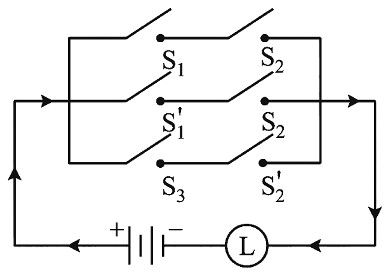
નીચે આપેલા સ્વિચિંગ સર્કિટના સાદું રૂપમાં સ્વિચની ન્યૂનતમ સંખ્યા કેટલી છે
A
$0$
B
$1$
C
$2$
D
$3$
Solution
(C) ધારો કે $S_1, S_2, S_3$ સ્વિચ છે. સર્કિટ ત્રણ સમાંતર શાખાઓની બનેલી છે.
શાખા $1$: $S_1$ અને $S_2$ શ્રેણીમાં $\rightarrow (S_1 \land S_2)$
શાખા $2$: $S_1'$ અને $S_2$ શ્રેણીમાં $\rightarrow (S_1' \land S_2)$
શાખા $3$: $S_3$ અને $S_2'$ શ્રેણીમાં $\rightarrow (S_3 \land S_2')$
કુલ સર્કિટનું પદ $C = (S_1 \land S_2) \lor (S_1' \land S_2) \lor (S_3 \land S_2')$ છે.
પ્રથમ બે પદો પર વિભાજનનો નિયમ વાપરતા: $(S_1 \lor S_1') \land S_2 \lor (S_3 \land S_2')$.
કારણ કે $(S_1 \lor S_1') = T$ (એક નિત્યસત્ય), પદ $T \land S_2 \lor (S_3 \land S_2')$ બને છે.
આ $S_2 \lor (S_3 \land S_2')$ માં સરળ થાય છે.
ફરીથી વિભાજનનો નિયમ વાપરતા: $(S_2 \lor S_3) \land (S_2 \lor S_2')$.
કારણ કે $(S_2 \lor S_2') = T$, પદ $(S_2 \lor S_3)$ માં સરળ થાય છે.
આ સમાંતરમાં બે સ્વિચ $S_2$ અને $S_3$ દર્શાવે છે. સ્વિચની ન્યૂનતમ સંખ્યા $2$ છે.
શાખા $1$: $S_1$ અને $S_2$ શ્રેણીમાં $\rightarrow (S_1 \land S_2)$
શાખા $2$: $S_1'$ અને $S_2$ શ્રેણીમાં $\rightarrow (S_1' \land S_2)$
શાખા $3$: $S_3$ અને $S_2'$ શ્રેણીમાં $\rightarrow (S_3 \land S_2')$
કુલ સર્કિટનું પદ $C = (S_1 \land S_2) \lor (S_1' \land S_2) \lor (S_3 \land S_2')$ છે.
પ્રથમ બે પદો પર વિભાજનનો નિયમ વાપરતા: $(S_1 \lor S_1') \land S_2 \lor (S_3 \land S_2')$.
કારણ કે $(S_1 \lor S_1') = T$ (એક નિત્યસત્ય), પદ $T \land S_2 \lor (S_3 \land S_2')$ બને છે.
આ $S_2 \lor (S_3 \land S_2')$ માં સરળ થાય છે.
ફરીથી વિભાજનનો નિયમ વાપરતા: $(S_2 \lor S_3) \land (S_2 \lor S_2')$.
કારણ કે $(S_2 \lor S_2') = T$, પદ $(S_2 \lor S_3)$ માં સરળ થાય છે.
આ સમાંતરમાં બે સ્વિચ $S_2$ અને $S_3$ દર્શાવે છે. સ્વિચની ન્યૂનતમ સંખ્યા $2$ છે.
0 likesView Solution
204
MathematicsDifficultMCQMHT CET · 2026
જો વિધાન પેટર્ન $(\sim p \land q) \lor (\sim p \land \sim q) \lor (p \land \sim q)$ નું સત્ય મૂલ્ય $F$ હોય, તો $(p \lor \sim q)$ અને $(p \to q)$ ના સત્ય મૂલ્યો અનુક્રમે ... છે.
A
$F, F$
B
$F, T$
C
$T, T$
D
$T, F$
Solution
(C) આપેલ વિધાન પેટર્ન $(\sim p \land q) \lor (\sim p \land \sim q) \lor (p \land \sim q) = F$ છે.
કારણ કે વિયોજન (disjunction) $F$ છે, તેથી બધા ઘટકો $F$ હોવા જોઈએ: $(\sim p \land q) = F$, $(\sim p \land \sim q) = F$, અને $(p \land \sim q) = F$।
$(\sim p \land q) = F$ અને $(\sim p \land \sim q) = F$ પરથી, આપણે $\sim p$ સામાન્ય લઈ શકીએ છીએ: $\sim p \land (q \lor \sim q) = F$। કારણ કે $(q \lor \sim q)$ એ નિત્યસત્ય (tautology) $T$ છે, આપણી પાસે $\sim p \land T = F$ છે, જેનો અર્થ છે $\sim p = F$, તેથી $p = T$।
હવે $p = T$ ને $(p \land \sim q) = F$ માં મૂકતા: $T \land \sim q = F$, જેનો અર્થ છે $\sim q = F$, તેથી $q = T$।
હવે $(p \lor \sim q) = (T \lor \sim T) = (T \lor F) = T$ નું મૂલ્યાંકન કરો.
હવે $(p \to q) = (T \to T) = T$ નું મૂલ્યાંકન કરો.
આમ, સત્ય મૂલ્યો $T, T$ છે.
કારણ કે વિયોજન (disjunction) $F$ છે, તેથી બધા ઘટકો $F$ હોવા જોઈએ: $(\sim p \land q) = F$, $(\sim p \land \sim q) = F$, અને $(p \land \sim q) = F$।
$(\sim p \land q) = F$ અને $(\sim p \land \sim q) = F$ પરથી, આપણે $\sim p$ સામાન્ય લઈ શકીએ છીએ: $\sim p \land (q \lor \sim q) = F$। કારણ કે $(q \lor \sim q)$ એ નિત્યસત્ય (tautology) $T$ છે, આપણી પાસે $\sim p \land T = F$ છે, જેનો અર્થ છે $\sim p = F$, તેથી $p = T$।
હવે $p = T$ ને $(p \land \sim q) = F$ માં મૂકતા: $T \land \sim q = F$, જેનો અર્થ છે $\sim q = F$, તેથી $q = T$।
હવે $(p \lor \sim q) = (T \lor \sim T) = (T \lor F) = T$ નું મૂલ્યાંકન કરો.
હવે $(p \to q) = (T \to T) = T$ નું મૂલ્યાંકન કરો.
આમ, સત્ય મૂલ્યો $T, T$ છે.
0 likesView Solution
205
MathematicsMediumMCQMHT CET · 2026
એક સ્વિચિંગ સર્કિટમાં, જો સંયોજન $(S_1 \land S_2)$ ને સંયોજન $(S'_1 \land S'_2)$ સાથે સમાંતર જોડવામાં આવે, તો રૂમ ત્યારે જ પ્રકાશિત થાય છે જ્યારે ...
A
$S_1$ ચાલુ $(ON)$ છે અને $S_2$ બંધ $(OFF)$ છે
B
$S_1$ બંધ $(OFF)$ છે અને $S_2$ ચાલુ $(ON)$ છે
C
$S_1$ અને $S_2$ બંને ચાલુ $(ON)$ છે અથવા $S_1$ અને $S_2$ બંને બંધ $(OFF)$ છે
D
રૂમ હંમેશા પ્રકાશિત રહે છે.
Solution
(C) ધારો કે $1$ એ $ON$ સ્થિતિ દર્શાવે છે અને $0$ એ $OFF$ સ્થિતિ દર્શાવે છે.
સર્કિટને બુલિયન અભિવ્યક્તિ દ્વારા દર્શાવવામાં આવે છે: $L = (S_1 \land S_2) \lor (S'_1 \land S'_2)$।
અહીં, $S'_1$ એ $S_1$ નું નિષેધ છે (એટલે કે $S'_1 = \neg S_1$) અને $S'_2$ એ $S_2$ નું નિષેધ છે (એટલે કે $S'_2 = \neg S_2$)।
સર્કિટ પ્રકાશિત $(L=1)$ થાય છે જો $(S_1 \land S_2) = 1$ અથવા $(S'_1 \land S'_2) = 1$ હોય.
$(S_1 \land S_2) = 1$ નો અર્થ છે $S_1 = 1$ અને $S_2 = 1$.
$(S'_1 \land S'_2) = 1$ નો અર્થ છે $S'_1 = 1$ અને $S'_2 = 1$, જેનો અર્થ છે $S_1 = 0$ અને $S_2 = 0$.
આમ, રૂમ ત્યારે પ્રકાશિત થાય છે જ્યારે $S_1$ અને $S_2$ બંને $ON$ હોય અથવા બંને $OFF$ હોય.
સર્કિટને બુલિયન અભિવ્યક્તિ દ્વારા દર્શાવવામાં આવે છે: $L = (S_1 \land S_2) \lor (S'_1 \land S'_2)$।
અહીં, $S'_1$ એ $S_1$ નું નિષેધ છે (એટલે કે $S'_1 = \neg S_1$) અને $S'_2$ એ $S_2$ નું નિષેધ છે (એટલે કે $S'_2 = \neg S_2$)।
સર્કિટ પ્રકાશિત $(L=1)$ થાય છે જો $(S_1 \land S_2) = 1$ અથવા $(S'_1 \land S'_2) = 1$ હોય.
$(S_1 \land S_2) = 1$ નો અર્થ છે $S_1 = 1$ અને $S_2 = 1$.
$(S'_1 \land S'_2) = 1$ નો અર્થ છે $S'_1 = 1$ અને $S'_2 = 1$, જેનો અર્થ છે $S_1 = 0$ અને $S_2 = 0$.
આમ, રૂમ ત્યારે પ્રકાશિત થાય છે જ્યારે $S_1$ અને $S_2$ બંને $ON$ હોય અથવા બંને $OFF$ હોય.
0 likesView Solution
206
MathematicsMediumMCQMHT CET · 2026
નીચેનામાંથી કયું તાર્કિક વિધાન એક નિત્યસત્ય (tautology) છે?
A
$[(p \to q) \land \sim q] \to \sim p$
B
$(p \to q) \land (p \land \sim q)$
C
$[(p \lor q) \land \sim p] \land \sim q$
D
$[(p \lor \sim q) \lor (\sim p \land q)] \land r$
Solution
(A) નિત્યસત્ય (tautology) એવું વિધાન છે જે તેના ઘટકોના તમામ શક્ય સત્ય મૂલ્યો માટે સાચું હોય છે.
પગલું $1$: વિકલ્પ $(A)$ નું વિશ્લેષણ કરો: $[(p \to q) \land \sim q] \to \sim p$।
જો $p=T, q=T$, તો $[(T \to T) \land F] \to F \implies [T \land F] \to F \implies F \to F = T$।
જો $p=T, q=F$, તો $[(T \to F) \land T] \to F \implies [F \land T] \to F \implies F \to F = T$।
જો $p=F, q=T$, તો $[(F \to T) \land F] \to T \implies [T \land F] \to T \implies F \to T = T$।
જો $p=F, q=F$, તો $[(F \to F) \land T] \to T \implies [T \land T] \to T \implies T \to T = T$।
આમ, આ વિધાન તમામ કિસ્સાઓમાં સાચું હોવાથી તે એક નિત્યસત્ય છે.
પગલું $1$: વિકલ્પ $(A)$ નું વિશ્લેષણ કરો: $[(p \to q) \land \sim q] \to \sim p$।
જો $p=T, q=T$, તો $[(T \to T) \land F] \to F \implies [T \land F] \to F \implies F \to F = T$।
જો $p=T, q=F$, તો $[(T \to F) \land T] \to F \implies [F \land T] \to F \implies F \to F = T$।
જો $p=F, q=T$, તો $[(F \to T) \land F] \to T \implies [T \land F] \to T \implies F \to T = T$।
જો $p=F, q=F$, તો $[(F \to F) \land T] \to T \implies [T \land T] \to T \implies T \to T = T$।
આમ, આ વિધાન તમામ કિસ્સાઓમાં સાચું હોવાથી તે એક નિત્યસત્ય છે.
0 likesView Solution
207
MathematicsMediumMCQMHT CET · 2026
નીચેના સર્કિટ માટે સરળ સ્વિચિંગ સર્કિટ છે (ધારો કે સર્કિટમાં બે સ્વિચ $S_1$ અને $S_2$ સમાંતર છે, જે $S_3$ સ્વિચ સાથે શ્રેણીમાં જોડાયેલ છે):
A
$S_3$ અને $(S_1 \text{ અથવા } S_2)$ નું શ્રેણી જોડાણ
B
$S_3$ અને $(S_1 \text{ અને } S_2)$ નું સમાંતર જોડાણ
C
$S_1$ અને $(S_2 \text{ અથવા } S_3)$ નું શ્રેણી જોડાણ
D
$S_1$ અને $(S_2 \text{ અથવા } S_3)$ નું સમાંતર જોડાણ
Solution
(A) $1$. ધારો કે સ્વિચને $S_1, S_2, S_3$ ચલ દ્વારા દર્શાવવામાં આવે છે.
$2$. વર્ણવેલ સર્કિટ $(S_1 \lor S_2) \land S_3$ છે.
$3$. સ્વિચિંગ સર્કિટ તર્કમાં, '$OR$' પ્રક્રિયા સમાંતર જોડાણને અનુરૂપ છે અને '$AND$' પ્રક્રિયા શ્રેણી જોડાણને અનુરૂપ છે.
$4$. તેથી, $(S_1 \lor S_2)$ નો અર્થ છે $S_1$ અને $S_2$ સમાંતરમાં છે.
$5$. $\land S_3$ પદ સૂચવે છે કે આ સમાંતર બ્લોક $S_3$ સાથે શ્રેણીમાં જોડાયેલ છે.
$6$. આ વર્ણન સાથે મેળ ખાય છે: $S_3$ અને $S_1$ તથા $S_2$ ના સમાંતર જોડાણનું શ્રેણી જોડાણ.
$2$. વર્ણવેલ સર્કિટ $(S_1 \lor S_2) \land S_3$ છે.
$3$. સ્વિચિંગ સર્કિટ તર્કમાં, '$OR$' પ્રક્રિયા સમાંતર જોડાણને અનુરૂપ છે અને '$AND$' પ્રક્રિયા શ્રેણી જોડાણને અનુરૂપ છે.
$4$. તેથી, $(S_1 \lor S_2)$ નો અર્થ છે $S_1$ અને $S_2$ સમાંતરમાં છે.
$5$. $\land S_3$ પદ સૂચવે છે કે આ સમાંતર બ્લોક $S_3$ સાથે શ્રેણીમાં જોડાયેલ છે.
$6$. આ વર્ણન સાથે મેળ ખાય છે: $S_3$ અને $S_1$ તથા $S_2$ ના સમાંતર જોડાણનું શ્રેણી જોડાણ.
0 likesView Solution
208
MathematicsMediumMCQMHT CET · 2026
જો $\sim p \to q$ અસત્ય હોય અને $q \leftrightarrow r$ અસત્ય હોય, તો $(p, q, r)$ નું સત્યતા મૂલ્ય શું થશે...
A
$(T, F, T)$
B
$(F, T, F)$
C
$(F, F, T)$
D
$(F, T, T)$
Solution
(C) $1$. શરતી વિધાન $\sim p \to q$ ત્યારે જ અસત્ય હોય જ્યારે $\sim p$ એ $T$ હોય અને $q$ એ $F$ હોય.
$2$. કારણ કે $\sim p = T$, તેથી $p = F$ મળે.
$3$. આપેલ છે કે $q = F$, દ્વિ-શરતી વિધાન $q \leftrightarrow r$ ત્યારે જ અસત્ય હોય જ્યારે $q$ અને $r$ ના સત્યતા મૂલ્યો અલગ હોય.
$4$. કારણ કે $q = F$, તેથી $q \leftrightarrow r$ ને અસત્ય થવા માટે $r$ નું મૂલ્ય $T$ હોવું જોઈએ.
$5$. તેથી, સત્યતા મૂલ્યો $p = F$, $q = F$, અને $r = T$ છે, જે $(F, F, T)$ છે.
$2$. કારણ કે $\sim p = T$, તેથી $p = F$ મળે.
$3$. આપેલ છે કે $q = F$, દ્વિ-શરતી વિધાન $q \leftrightarrow r$ ત્યારે જ અસત્ય હોય જ્યારે $q$ અને $r$ ના સત્યતા મૂલ્યો અલગ હોય.
$4$. કારણ કે $q = F$, તેથી $q \leftrightarrow r$ ને અસત્ય થવા માટે $r$ નું મૂલ્ય $T$ હોવું જોઈએ.
$5$. તેથી, સત્યતા મૂલ્યો $p = F$, $q = F$, અને $r = T$ છે, જે $(F, F, T)$ છે.
0 likesView Solution
209
MathematicsDifficultMCQMHT CET · 2026
જો $p, q, r$ એ સાદા વિધાનો હોય જેના સત્ય મૂલ્યો અનુક્રમે $T, F, T$ હોય, તો નીચેનામાંથી કયું વિધાન સત્ય નથી?
A
$[q \land (p \to q)] \to p$
B
$(p \land q) \to (q \lor \sim p)$
C
$[(\sim p \lor q) \land \sim r] \leftrightarrow p$
D
$(p \land q) \lor (\sim q \lor r)$
Solution
(C) આપેલ સત્ય મૂલ્યો: $p = T, q = F, r = T$.
$(A)$ $[F \land (T \to F)] \to T = [F \land F] \to T = F \to T = T$.
$(B)$ $(T \land F) \to (F \lor \sim T) = F \to (F \lor F) = F \to F = T$.
$(C)$ $[(\sim T \lor F) \land \sim T] \leftrightarrow T = [(F \lor F) \land F] \leftrightarrow T = [F \land F] \leftrightarrow T = F \leftrightarrow T = F$.
$(D)$ $(T \land F) \lor (\sim F \lor T) = F \lor (T \lor T) = F \lor T = T$.
વિકલ્પ $(C)$ નું પરિણામ $F$ હોવાથી, તે સત્ય વિધાન નથી.
$(A)$ $[F \land (T \to F)] \to T = [F \land F] \to T = F \to T = T$.
$(B)$ $(T \land F) \to (F \lor \sim T) = F \to (F \lor F) = F \to F = T$.
$(C)$ $[(\sim T \lor F) \land \sim T] \leftrightarrow T = [(F \lor F) \land F] \leftrightarrow T = [F \land F] \leftrightarrow T = F \leftrightarrow T = F$.
$(D)$ $(T \land F) \lor (\sim F \lor T) = F \lor (T \lor T) = F \lor T = T$.
વિકલ્પ $(C)$ નું પરિણામ $F$ હોવાથી, તે સત્ય વિધાન નથી.
0 likesView Solution
210
MathematicsDifficultMCQMHT CET · 2026
જો $[(p \lor q) \land (q \to r) \land (\sim r)] \to (p \land q)$ નું સત્ય મૂલ્ય અસત્ય હોય, તો નીચેનામાંથી કયું સત્ય નથી?
A
$p \to q$ નું સત્ય મૂલ્ય અસત્ય છે
B
$p \to r$ નું સત્ય મૂલ્ય અસત્ય છે.
C
$(\sim q) \to p$ નું સત્ય મૂલ્ય અસત્ય છે.
D
$(\sim p) \land r$ નું સત્ય મૂલ્ય અસત્ય છે.
Solution
(C) ગર્ભિતાર્થ $A \to B$ ત્યારે જ અસત્ય હોય જ્યારે $A$ સત્ય હોય અને $B$ અસત્ય હોય.
અહીં, $A = [(p \lor q) \land (q \to r) \land (\sim r)]$ અને $B = (p \land q)$ છે.
કારણ કે $B$ અસત્ય છે, $(p \land q) = F$ છે.
કારણ કે $A$ સત્ય છે, $(p \lor q) = T$, $(q \to r) = T$, અને $(\sim r) = T$ છે.
$(\sim r) = T$ પરથી, આપણને $r = F$ મળે છે.
કારણ કે $(q \to r) = T$ અને $r = F$ છે, તેથી $q$ એ $F$ હોવું જોઈએ (કારણ કે $T \to F$ એ $F$ છે).
કારણ કે $(p \lor q) = T$ અને $q = F$ છે, તેથી $p$ એ $T$ હોવું જોઈએ.
આમ, $p = T, q = F, r = F$ છે.
હવે વિકલ્પો તપાસો:
$(A)$ $p \to q = T \to F = F$ (સત્ય વિધાન).
$(B)$ $p \to r = T \to F = F$ (સત્ય વિધાન).
$(C)$ $(\sim q) \to p = (\sim F) \to T = T \to T = T$ (આ સત્ય નથી કારણ કે તે સત્ય છે).
$(D)$ $(\sim p) \land r = (\sim T) \land F = F \land F = F$ (સત્ય વિધાન).
તેથી, વિકલ્પ $(C)$ સાચો જવાબ છે.
અહીં, $A = [(p \lor q) \land (q \to r) \land (\sim r)]$ અને $B = (p \land q)$ છે.
કારણ કે $B$ અસત્ય છે, $(p \land q) = F$ છે.
કારણ કે $A$ સત્ય છે, $(p \lor q) = T$, $(q \to r) = T$, અને $(\sim r) = T$ છે.
$(\sim r) = T$ પરથી, આપણને $r = F$ મળે છે.
કારણ કે $(q \to r) = T$ અને $r = F$ છે, તેથી $q$ એ $F$ હોવું જોઈએ (કારણ કે $T \to F$ એ $F$ છે).
કારણ કે $(p \lor q) = T$ અને $q = F$ છે, તેથી $p$ એ $T$ હોવું જોઈએ.
આમ, $p = T, q = F, r = F$ છે.
હવે વિકલ્પો તપાસો:
$(A)$ $p \to q = T \to F = F$ (સત્ય વિધાન).
$(B)$ $p \to r = T \to F = F$ (સત્ય વિધાન).
$(C)$ $(\sim q) \to p = (\sim F) \to T = T \to T = T$ (આ સત્ય નથી કારણ કે તે સત્ય છે).
$(D)$ $(\sim p) \land r = (\sim T) \land F = F \land F = F$ (સત્ય વિધાન).
તેથી, વિકલ્પ $(C)$ સાચો જવાબ છે.
0 likesView Solution
211
MathematicsDifficultMCQMHT CET · 2026
વિધાન $∼ p \lor q$ ના પ્રતિલોમ (inverse) નું નિષેધ (negation) શું છે?
A
$p \land \sim q$
B
$p \land q$
C
$\sim p \land \sim q$
D
$p \lor q$
Solution
(B) પગલું $1$: આપેલ વિધાન $S = \sim p \lor q$ છે, જે $p \to q$ ને સમાન છે.
પગલું $2$: $p \to q$ નું પ્રતિલોમ $\sim p \to \sim q$ છે.
પગલું $3$: $\sim p \to \sim q$ ને $\sim (\sim p) \lor \sim q$ એટલે કે $p \lor \sim q$ તરીકે લખી શકાય છે.
પગલું $4$: આ પ્રતિલોમનું નિષેધ $\sim (p \lor \sim q)$ છે.
પગલું $5$: ડી મોર્ગનના નિયમનો ઉપયોગ કરતા, $\sim (p \lor \sim q) = \sim p \land \sim (\sim q) = \sim p \land q$.
પગલું $2$: $p \to q$ નું પ્રતિલોમ $\sim p \to \sim q$ છે.
પગલું $3$: $\sim p \to \sim q$ ને $\sim (\sim p) \lor \sim q$ એટલે કે $p \lor \sim q$ તરીકે લખી શકાય છે.
પગલું $4$: આ પ્રતિલોમનું નિષેધ $\sim (p \lor \sim q)$ છે.
પગલું $5$: ડી મોર્ગનના નિયમનો ઉપયોગ કરતા, $\sim (p \lor \sim q) = \sim p \land \sim (\sim q) = \sim p \land q$.
0 likesView Solution
212
MathematicsMediumMCQMHT CET · 2026
નીચેનામાંથી કયું/કયા વિધાન અસત્ય છે?
$I$) જો $1$ અવિભાજ્ય સંખ્યા નથી, તો $2$ અવિભાજ્ય સંખ્યા નથી.
$II$) $e$ એક સ્વર છે અને $12 \times 3 = 36$ છે.
$III$) તે સત્ય નથી કે $14$ એક વિભાજ્ય સંખ્યા છે અને $3$ એક બેકી સંખ્યા છે.
$IV$) $\sqrt{5}$ એક અસંમેય સંખ્યા છે, પરંતુ $3 + \sqrt{5}$ એક સંકર સંખ્યા છે.
$I$) જો $1$ અવિભાજ્ય સંખ્યા નથી, તો $2$ અવિભાજ્ય સંખ્યા નથી.
$II$) $e$ એક સ્વર છે અને $12 \times 3 = 36$ છે.
$III$) તે સત્ય નથી કે $14$ એક વિભાજ્ય સંખ્યા છે અને $3$ એક બેકી સંખ્યા છે.
$IV$) $\sqrt{5}$ એક અસંમેય સંખ્યા છે, પરંતુ $3 + \sqrt{5}$ એક સંકર સંખ્યા છે.
A
માત્ર $I$ અને $IV$
B
માત્ર $I$
C
માત્ર $II$ અને $III$
D
માત્ર $I$, $II$ અને $IV$
Solution
(B) પગલું $1$: વિધાન $I$ નું વિશ્લેષણ કરો. 'જો $1$ અવિભાજ્ય સંખ્યા નથી (સત્ય), તો $2$ અવિભાજ્ય સંખ્યા નથી (અસત્ય).' શરતી વિધાન $P \implies Q$ ત્યારે જ અસત્ય હોય છે જ્યારે $P$ સત્ય હોય અને $Q$ અસત્ય હોય. તેથી, $I$ અસત્ય છે.
પગલું $2$: વિધાન $II$ નું વિશ્લેષણ કરો. '$e$ એક સ્વર છે (સત્ય) અને $12 \times 3 = 36$ (સત્ય).' બંને ભાગ સત્ય હોવાથી, સંયોજન સત્ય છે.
પગલું $3$: વિધાન $III$ નું વિશ્લેષણ કરો. 'તે સત્ય નથી કે ($14$ વિભાજ્ય છે (સત્ય) અને $3$ બેકી છે (અસત્ય)).' આંતરિક સંયોજન અસત્ય છે, તેથી તેનું નિષેધ સત્ય છે. તેથી, $III$ સત્ય છે.
પગલું $4$: વિધાન $IV$ નું વિશ્લેષણ કરો. '$\sqrt{5}$ અસંમેય છે (સત્ય) અને $3 + \sqrt{5}$ એક સંકર સંખ્યા છે (સત્ય, કારણ કે બધી વાસ્તવિક સંખ્યાઓ સંકર હોય છે).' બંને સત્ય હોવાથી, વિધાન સત્ય છે.
પગલું $5$: નિષ્કર્ષ. માત્ર વિધાન $I$ અસત્ય છે. સાચો વિકલ્પ $B$ છે.
પગલું $2$: વિધાન $II$ નું વિશ્લેષણ કરો. '$e$ એક સ્વર છે (સત્ય) અને $12 \times 3 = 36$ (સત્ય).' બંને ભાગ સત્ય હોવાથી, સંયોજન સત્ય છે.
પગલું $3$: વિધાન $III$ નું વિશ્લેષણ કરો. 'તે સત્ય નથી કે ($14$ વિભાજ્ય છે (સત્ય) અને $3$ બેકી છે (અસત્ય)).' આંતરિક સંયોજન અસત્ય છે, તેથી તેનું નિષેધ સત્ય છે. તેથી, $III$ સત્ય છે.
પગલું $4$: વિધાન $IV$ નું વિશ્લેષણ કરો. '$\sqrt{5}$ અસંમેય છે (સત્ય) અને $3 + \sqrt{5}$ એક સંકર સંખ્યા છે (સત્ય, કારણ કે બધી વાસ્તવિક સંખ્યાઓ સંકર હોય છે).' બંને સત્ય હોવાથી, વિધાન સત્ય છે.
પગલું $5$: નિષ્કર્ષ. માત્ર વિધાન $I$ અસત્ય છે. સાચો વિકલ્પ $B$ છે.
0 likesView Solution
213
MathematicsDifficultMCQMHT CET · 2026
નીચેના વિધાનો પર વિચાર કરો.
$p$: જો $3^4 > 4^3$, તો $3^3 > 4^4$
$q$: સમીકરણ $x^2 - 2x + 2 = 0$ ના બીજ વાસ્તવિક છે જો અને માત્ર જો મુંબઈ મહારાષ્ટ્રમાં હોય.
$r$: વિધાન $p$ સત્ય છે અથવા વિધાન $q$ અસત્ય છે.
નીચેનામાંથી કોનું સત્યતા મૂલ્ય $T$ (સત્ય) છે?
$p$: જો $3^4 > 4^3$, તો $3^3 > 4^4$
$q$: સમીકરણ $x^2 - 2x + 2 = 0$ ના બીજ વાસ્તવિક છે જો અને માત્ર જો મુંબઈ મહારાષ્ટ્રમાં હોય.
$r$: વિધાન $p$ સત્ય છે અથવા વિધાન $q$ અસત્ય છે.
નીચેનામાંથી કોનું સત્યતા મૂલ્ય $T$ (સત્ય) છે?
A
$(p \lor q) \land r$
B
$p \lor (q \land r)$
C
$p \land (q \lor r)$
D
$(p \land q) \lor r$
Solution
(D) પગલું $1$: $p$ નું મૂલ્યાંકન કરો. $3^4 = 81$ અને $4^3 = 64$ છે. કારણ કે $81 > 64$, પૂર્વવર્તી સત્ય છે. $3^3 = 27$ અને $4^4 = 256$ છે. કારણ કે $27 > 256$ અસત્ય છે, તેથી ગર્ભિતાર્થ $T \implies F$ એ $F$ છે. આમ, $p$ અસત્ય $(F)$ છે.
પગલું $2$: $q$ નું મૂલ્યાંકન કરો. $x^2 - 2x + 2 = 0$ માટે, વિવેચક $D = (-2)^2 - 4(1)(2) = 4 - 8 = -4$ છે. કારણ કે $D < 0$, બીજ વાસ્તવિક નથી. વિધાન 'મુંબઈ મહારાષ્ટ્રમાં છે' સત્ય $(T)$ છે. દ્વિ-શરતી વિધાન $F \iff T$ એ $F$ છે. આમ, $q$ અસત્ય $(F)$ છે.
પગલું $3$: $r$ નું મૂલ્યાંકન કરો. $r$ એ '$p$ સત્ય છે અથવા $q$ અસત્ય છે' છે. કારણ કે $p$ અસત્ય છે અને $q$ અસત્ય છે, '$q$ અસત્ય છે' એ સત્ય $(T)$ છે. તેથી, $F \lor T$ એ $T$ છે. એટલે કે, $r$ સત્ય $(T)$ છે.
પગલું $4$: વિકલ્પો તપાસો. $p=F, q=F, r=T$ છે.
$(A)$ $(F \lor F) \land T = F \land T = F$.
$(B)$ $F \lor (F \land T) = F \lor F = F$.
$(C)$ $F \land (F \lor T) = F \land T = F$.
$(D)$ $(F \land F) \lor T = F \lor T = T$.
તેથી, વિકલ્પ $D$ સાચો છે.
પગલું $2$: $q$ નું મૂલ્યાંકન કરો. $x^2 - 2x + 2 = 0$ માટે, વિવેચક $D = (-2)^2 - 4(1)(2) = 4 - 8 = -4$ છે. કારણ કે $D < 0$, બીજ વાસ્તવિક નથી. વિધાન 'મુંબઈ મહારાષ્ટ્રમાં છે' સત્ય $(T)$ છે. દ્વિ-શરતી વિધાન $F \iff T$ એ $F$ છે. આમ, $q$ અસત્ય $(F)$ છે.
પગલું $3$: $r$ નું મૂલ્યાંકન કરો. $r$ એ '$p$ સત્ય છે અથવા $q$ અસત્ય છે' છે. કારણ કે $p$ અસત્ય છે અને $q$ અસત્ય છે, '$q$ અસત્ય છે' એ સત્ય $(T)$ છે. તેથી, $F \lor T$ એ $T$ છે. એટલે કે, $r$ સત્ય $(T)$ છે.
પગલું $4$: વિકલ્પો તપાસો. $p=F, q=F, r=T$ છે.
$(A)$ $(F \lor F) \land T = F \land T = F$.
$(B)$ $F \lor (F \land T) = F \lor F = F$.
$(C)$ $F \land (F \lor T) = F \land T = F$.
$(D)$ $(F \land F) \lor T = F \lor T = T$.
તેથી, વિકલ્પ $D$ સાચો છે.
0 likesView Solution
214
MathematicsMediumMCQMHT CET · 2026
$\sim q \to p$ નું પ્રતિધનાત્મક (contrapositive) કોના સમતુલ્ય છે?
A
$p \to q$
B
$p \wedge q$
C
$p \vee q$
D
$\sim p \to \sim q$
Solution
(A) શરતી વિધાન $P \to Q$ નું પ્રતિધનાત્મક $\sim Q \to \sim P$ તરીકે વ્યાખ્યાયિત થાય છે.
આપેલ વિધાન $\sim q \to p$ છે.
અહીં, $P = \sim q$ અને $Q = p$ છે.
તેથી, પ્રતિધનાત્મક $\sim Q \to \sim P$ થશે, જે $\sim p \to \sim(\sim q)$ બને છે.
દ્વિ-નિષેધના નિયમનો ઉપયોગ કરતા, $\sim(\sim q) = q$ થાય છે.
આમ, પ્રતિધનાત્મક $\sim p \to q$ છે.
આપેલ વિધાન $\sim q \to p$ છે.
અહીં, $P = \sim q$ અને $Q = p$ છે.
તેથી, પ્રતિધનાત્મક $\sim Q \to \sim P$ થશે, જે $\sim p \to \sim(\sim q)$ બને છે.
દ્વિ-નિષેધના નિયમનો ઉપયોગ કરતા, $\sim(\sim q) = q$ થાય છે.
આમ, પ્રતિધનાત્મક $\sim p \to q$ છે.
0 likesView Solution
215
MathematicsMediumMCQMHT CET · 2026
જો $\sim p \lor q$ અસત્ય હોય, તો નીચેનામાંથી કયું સાચું છે?
A
$p \leftrightarrow q$ સત્ય $(T)$ છે
B
$p \rightarrow q$ સત્ય $(T)$ છે
C
$q \rightarrow p$ સત્ય $(T)$ છે
D
$q \rightarrow p$ અસત્ય $(F)$ છે
Solution
(C) $1$. તાર્કિક પદાવલિ $\sim p \lor q$ ત્યારે જ અસત્ય હોય જ્યારે $\sim p$ અસત્ય હોય અને $q$ પણ અસત્ય હોય.
$2$. જો $\sim p$ અસત્ય હોય, તો $p$ સત્ય $(T)$ હોવું જોઈએ.
$3$. કારણ કે $q$ અસત્ય $(F)$ છે, તેથી $p = T$ અને $q = F$ મળે છે.
$4$. હવે, વિકલ્પોનું મૂલ્યાંકન કરો:
$(a)$ $p \leftrightarrow q \equiv T \leftrightarrow F = F$
$(b)$ $p \rightarrow q \equiv T \rightarrow F = F$
$(c)$ $q \rightarrow p \equiv F \rightarrow T = T$
$(d)$ $q \rightarrow p \equiv F \rightarrow T = T$
$5$. આમ, $q \rightarrow p$ સત્ય છે.
$2$. જો $\sim p$ અસત્ય હોય, તો $p$ સત્ય $(T)$ હોવું જોઈએ.
$3$. કારણ કે $q$ અસત્ય $(F)$ છે, તેથી $p = T$ અને $q = F$ મળે છે.
$4$. હવે, વિકલ્પોનું મૂલ્યાંકન કરો:
$(a)$ $p \leftrightarrow q \equiv T \leftrightarrow F = F$
$(b)$ $p \rightarrow q \equiv T \rightarrow F = F$
$(c)$ $q \rightarrow p \equiv F \rightarrow T = T$
$(d)$ $q \rightarrow p \equiv F \rightarrow T = T$
$5$. આમ, $q \rightarrow p$ સત્ય છે.
0 likesView Solution
216
MathematicsMediumMCQMHT CET · 2026
વિધાન પેટર્ન $(p \lor q) \to \sim r$ તાર્કિક રીતે કોના સમકક્ષ છે?
A
$( \sim p \lor \sim q) \lor \sim r$
B
$( \sim p \land \sim q) \land \sim r$
C
$( \sim p \land \sim q) \lor \sim r$
D
$( \sim p \lor \sim q) \land \sim r$
Solution
(C) તાર્કિક સમકક્ષતા $A \to B \equiv \sim A \lor B$ નો ઉપયોગ કરતા:
$(p \lor q) \to \sim r \equiv \sim (p \lor q) \lor \sim r$ મળે છે.
ડી મોર્ગનના નિયમનો ઉપયોગ કરતા, $\sim (p \lor q) \equiv \sim p \land \sim q$ થાય છે.
આને પાછું મૂકતા, આપણને $\sim p \land \sim q \lor \sim r$ મળે છે, જે $( \sim p \land \sim q) \lor \sim r$ છે.
$(p \lor q) \to \sim r \equiv \sim (p \lor q) \lor \sim r$ મળે છે.
ડી મોર્ગનના નિયમનો ઉપયોગ કરતા, $\sim (p \lor q) \equiv \sim p \land \sim q$ થાય છે.
આને પાછું મૂકતા, આપણને $\sim p \land \sim q \lor \sim r$ મળે છે, જે $( \sim p \land \sim q) \lor \sim r$ છે.
0 likesView Solution
217
MathematicsDifficultMCQMHT CET · 2026
જો સંયુક્ત વિધાન $[(p \lor q) \land (q \to r) \land (\sim r)] \to (p \land q)$ નું સત્યતા મૂલ્ય $False$ હોય, તો $p \to q$ અને $q \to p$ ના સત્યતા મૂલ્યો અનુક્રમે...... છે.
A
$(T, T)$
B
$(T, F)$
C
$(F, T)$
D
$(F, F)$
Solution
(C) શરતી વિધાન $A \to B$ ફક્ત ત્યારે જ $False$ હોય છે જ્યારે $A$ એ $True$ હોય અને $B$ એ $False$ હોય.
અહીં, $A = [(p \lor q) \land (q \to r) \land (\sim r)]$ અને $B = (p \land q)$ છે.
$B$ એ $False$ હોવાથી, $(p \land q) = False$ છે.
$A$ એ $True$ હોવાથી, $(p \lor q) = True$, $(q \to r) = True$, અને $(\sim r) = True$ છે.
$(\sim r) = True$ પરથી, આપણને $r = False$ મળે છે.
$r = False$ ને $(q \to r) = True$ માં મૂકતા: $(q \to False) = True$, જેનો અર્થ છે કે $q = False$ છે.
$q = False$ ને $(p \lor q) = True$ માં મૂકતા: $(p \lor False) = True$, જેનો અર્થ છે કે $p = True$ છે.
હવે, $(p \land q) = (True \land False) = False$ તપાસો, જે આપણી શરત સાથે સુસંગત છે.
આમ, $p = True$ અને $q = False$ છે.
તેથી, $p \to q = (True \to False) = False$ છે.
અને $q \to p = (False \to True) = True$ છે.
સત્યતા મૂલ્યો $(F, T)$ છે.
અહીં, $A = [(p \lor q) \land (q \to r) \land (\sim r)]$ અને $B = (p \land q)$ છે.
$B$ એ $False$ હોવાથી, $(p \land q) = False$ છે.
$A$ એ $True$ હોવાથી, $(p \lor q) = True$, $(q \to r) = True$, અને $(\sim r) = True$ છે.
$(\sim r) = True$ પરથી, આપણને $r = False$ મળે છે.
$r = False$ ને $(q \to r) = True$ માં મૂકતા: $(q \to False) = True$, જેનો અર્થ છે કે $q = False$ છે.
$q = False$ ને $(p \lor q) = True$ માં મૂકતા: $(p \lor False) = True$, જેનો અર્થ છે કે $p = True$ છે.
હવે, $(p \land q) = (True \land False) = False$ તપાસો, જે આપણી શરત સાથે સુસંગત છે.
આમ, $p = True$ અને $q = False$ છે.
તેથી, $p \to q = (True \to False) = False$ છે.
અને $q \to p = (False \to True) = True$ છે.
સત્યતા મૂલ્યો $(F, T)$ છે.
0 likesView Solution
218
MathematicsDifficultMCQMHT CET · 2026
નીચેના વિધાનો પર વિચાર કરો:
$r$: જો $p \to q$ અસત્ય હોય તો $p \lor q$ અસત્ય છે.
$s$: જો $p \leftrightarrow q$ અસત્ય હોય તો $p \lor q$ અસત્ય છે.
$r \to s$ અને $s \to r$ ના સત્ય મૂલ્યો અનુક્રમે . . . . . . છે.
$r$: જો $p \to q$ અસત્ય હોય તો $p \lor q$ અસત્ય છે.
$s$: જો $p \leftrightarrow q$ અસત્ય હોય તો $p \lor q$ અસત્ય છે.
$r \to s$ અને $s \to r$ ના સત્ય મૂલ્યો અનુક્રમે . . . . . . છે.
A
$T, T$
B
$T, F$
C
$F, T$
D
$F, F$
Solution
(A) પગલું $1$: વિધાન $r$ નું વિશ્લેષણ કરો.
$p \to q$ માત્ર ત્યારે જ અસત્ય હોય છે જ્યારે $p = T$ અને $q = F$ હોય. આ કિસ્સામાં, $p \lor q = T \lor F = T$ છે. વિધાન દાવો કરે છે કે $p \lor q$ અસત્ય છે, તેથી $r$ અસત્ય $(F)$ છે.
પગલું $2$: વિધાન $s$ નું વિશ્લેષણ કરો.
$p \leftrightarrow q$ ત્યારે અસત્ય હોય છે જ્યારે $p$ અને $q$ ના સત્ય મૂલ્યો અલગ હોય ($p=T, q=F$ અથવા $p=F, q=T$).
જો $p=T, q=F$, તો $p \lor q = T$ છે. જો $p=F, q=T$, તો $p \lor q = T$ છે. બંને કિસ્સામાં, $p \lor q$ સત્ય છે. વિધાન દાવો કરે છે કે $p \lor q$ અસત્ય છે, તેથી $s$ અસત્ય $(F)$ છે.
પગલું $3$: $r \to s$ અને $s \to r$ નું મૂલ્યાંકન કરો.
કારણ કે $r = F$ અને $s = F$, તેથી $r \to s = F \to F = T$ અને $s \to r = F \to F = T$ છે. આમ, સત્ય મૂલ્યો $T, T$ છે.
$p \to q$ માત્ર ત્યારે જ અસત્ય હોય છે જ્યારે $p = T$ અને $q = F$ હોય. આ કિસ્સામાં, $p \lor q = T \lor F = T$ છે. વિધાન દાવો કરે છે કે $p \lor q$ અસત્ય છે, તેથી $r$ અસત્ય $(F)$ છે.
પગલું $2$: વિધાન $s$ નું વિશ્લેષણ કરો.
$p \leftrightarrow q$ ત્યારે અસત્ય હોય છે જ્યારે $p$ અને $q$ ના સત્ય મૂલ્યો અલગ હોય ($p=T, q=F$ અથવા $p=F, q=T$).
જો $p=T, q=F$, તો $p \lor q = T$ છે. જો $p=F, q=T$, તો $p \lor q = T$ છે. બંને કિસ્સામાં, $p \lor q$ સત્ય છે. વિધાન દાવો કરે છે કે $p \lor q$ અસત્ય છે, તેથી $s$ અસત્ય $(F)$ છે.
પગલું $3$: $r \to s$ અને $s \to r$ નું મૂલ્યાંકન કરો.
કારણ કે $r = F$ અને $s = F$, તેથી $r \to s = F \to F = T$ અને $s \to r = F \to F = T$ છે. આમ, સત્ય મૂલ્યો $T, T$ છે.
0 likesView Solution
219
MathematicsMediumMCQMHT CET · 2026
જો $A = \{1, 2, 3, 4, 5, 6\}$ હોય, તો નીચેનામાંથી કયું વિધાન સત્ય નથી?
A
$∃x ∈ A$ એવું છે કે $x + 3 = 9$.
B
$∃x ∈ A$ એવું છે કે $x + 2 < 9$.
C
$∀x ∈ A, x + 6 ≥ 10$.
D
$∃x ∈ A$ એવું છે કે $x + 6 < 10$.
Solution
(C) પગલું $1$: વિકલ્પ $(A)$ નું વિશ્લેષણ કરો: $∃x ∈ A$ એવું છે કે $x + 3 = 9$। જો $x = 6$ હોય, તો $6 + 3 = 9$ થાય. કારણ કે $6 ∈ A$ છે, આ વિધાન સત્ય છે.
પગલું $2$: વિકલ્પ $(B)$ નું વિશ્લેષણ કરો: $∃x ∈ A$ એવું છે કે $x + 2 < 9$। જો $x = 1$ હોય, તો $1 + 2 = 3 < 9$ થાય. કારણ કે $1 ∈ A$ છે, આ વિધાન સત્ય છે.
પગલું $3$: વિકલ્પ $(C)$ નું વિશ્લેષણ કરો: $∀x ∈ A, x + 6 ≥ 10$। જો $x = 1$ હોય, તો $1 + 6 = 7$ થાય. કારણ કે $7 < 10$ છે, તેથી શરત $x + 6 ≥ 10$ એ બધા $x ∈ A$ માટે સાચી નથી. આમ, આ વિધાન અસત્ય છે.
પગલું $4$: વિકલ્પ $(D)$ નું વિશ્લેષણ કરો: $∃x ∈ A$ એવું છે કે $x + 6 < 10$। જો $x = 1$ હોય, તો $1 + 6 = 7 < 10$ થાય. કારણ કે $1 ∈ A$ છે, આ વિધાન સત્ય છે.
નિષ્કર્ષ: વિકલ્પ $(C)$ સત્ય નથી.
પગલું $2$: વિકલ્પ $(B)$ નું વિશ્લેષણ કરો: $∃x ∈ A$ એવું છે કે $x + 2 < 9$। જો $x = 1$ હોય, તો $1 + 2 = 3 < 9$ થાય. કારણ કે $1 ∈ A$ છે, આ વિધાન સત્ય છે.
પગલું $3$: વિકલ્પ $(C)$ નું વિશ્લેષણ કરો: $∀x ∈ A, x + 6 ≥ 10$। જો $x = 1$ હોય, તો $1 + 6 = 7$ થાય. કારણ કે $7 < 10$ છે, તેથી શરત $x + 6 ≥ 10$ એ બધા $x ∈ A$ માટે સાચી નથી. આમ, આ વિધાન અસત્ય છે.
પગલું $4$: વિકલ્પ $(D)$ નું વિશ્લેષણ કરો: $∃x ∈ A$ એવું છે કે $x + 6 < 10$। જો $x = 1$ હોય, તો $1 + 6 = 7 < 10$ થાય. કારણ કે $1 ∈ A$ છે, આ વિધાન સત્ય છે.
નિષ્કર્ષ: વિકલ્પ $(C)$ સત્ય નથી.
0 likesView Solution
220
MathematicsMediumMCQMHT CET · 2026
વિધાન પેટર્ન $(p \land q) \to (r \lor \sim s)$ અસત્ય છે. તો $p, q, r$ અને $s$ ના સત્ય મૂલ્યો અનુક્રમે છે
A
$T, F, T, T$
B
$T, T, F, T$
C
$T, T, T, F$
D
$T, T, F, F$
Solution
(B) $1$. શરતી વિધાન $A \to B$ ત્યારે જ અસત્ય હોય જ્યારે $A$ સત્ય $(T)$ હોય અને $B$ અસત્ય $(F)$ હોય.
$2$. અહીં, $(p \land q) \to (r \lor \sim s)$ અસત્ય છે, તેથી $(p \land q) = T$ અને $(r \lor \sim s) = F$ છે.
$3$. $(p \land q) = T$ માટે, $p$ અને $q$ બંને $T$ હોવા જોઈએ.
$4$. $(r \lor \sim s) = F$ માટે, $r$ અને $\sim s$ બંને $F$ હોવા જોઈએ.
$5$. કારણ કે $r = F$ અને $\sim s = F$ છે, તેથી $s = T$ થાય.
$6$. આમ, સત્ય મૂલ્યો $p = T, q = T, r = F, s = T$ છે.
$2$. અહીં, $(p \land q) \to (r \lor \sim s)$ અસત્ય છે, તેથી $(p \land q) = T$ અને $(r \lor \sim s) = F$ છે.
$3$. $(p \land q) = T$ માટે, $p$ અને $q$ બંને $T$ હોવા જોઈએ.
$4$. $(r \lor \sim s) = F$ માટે, $r$ અને $\sim s$ બંને $F$ હોવા જોઈએ.
$5$. કારણ કે $r = F$ અને $\sim s = F$ છે, તેથી $s = T$ થાય.
$6$. આમ, સત્ય મૂલ્યો $p = T, q = T, r = F, s = T$ છે.
0 likesView Solution
221
MathematicsDifficultMCQMHT CET · 2026
વિધાન પેટર્ન પર વિચાર કરો:
$A. (q \to p) \lor (p \to q)$
$B. (\sim p \lor \sim q) \leftrightarrow \sim (p \land q)$
$C. [(p \lor q) \land \sim p] \land \sim q$
$D. (p \land q) \land (\sim p \lor \sim q)$
તો આ વિધાન પેટર્નનો પ્રકાર ઓળખો.
$A. (q \to p) \lor (p \to q)$
$B. (\sim p \lor \sim q) \leftrightarrow \sim (p \land q)$
$C. [(p \lor q) \land \sim p] \land \sim q$
$D. (p \land q) \land (\sim p \lor \sim q)$
તો આ વિધાન પેટર્નનો પ્રકાર ઓળખો.
A
$A$ અને $B$ વિરોધાભાસ (contradictions) છે, $C$ અને $D$ નિત્યસત્ય (tautologies) છે.
B
$A$ અને $B$ નિત્યસત્ય છે, $C$ અને $D$ વિરોધાભાસ છે.
C
$A, B, C, D$ બધા નિત્યસત્ય છે.
D
$A, B, C, D$ બધા વિરોધાભાસ છે.
Solution
(B) પગલું $1$: $A$ નું વિશ્લેષણ: $(q \to p) \lor (p \to q) \equiv (\sim q \lor p) \lor (\sim p \lor q) \equiv (\sim q \lor q) \lor (\sim p \lor p) \equiv T \lor T \equiv T$। તેથી, $A$ નિત્યસત્ય છે.
પગલું $2$: $B$ નું વિશ્લેષણ: $(\sim p \lor \sim q) \leftrightarrow \sim (p \land q)$। ડી મોર્ગનના નિયમ મુજબ, $\sim p \lor \sim q \equiv \sim (p \land q)$। તેથી, $B$ એ $X \leftrightarrow X$ છે, જે નિત્યસત્ય છે.
પગલું $3$: $C$ નું વિશ્લેષણ: $[(p \lor q) \land \sim p] \land \sim q \equiv [(p \land \sim p) \lor (q \land \sim p)] \land \sim q \equiv [F \lor (q \land \sim p)] \land \sim q \equiv (q \land \sim p) \land \sim q \equiv (q \land \sim q) \land \sim p \equiv F \land \sim p \equiv F$। તેથી, $C$ વિરોધાભાસ છે.
પગલું $4$: $D$ નું વિશ્લેષણ: $(p \land q) \land (\sim p \lor \sim q) \equiv (p \land q) \land \sim (p \land q) \equiv F$। તેથી, $D$ વિરોધાભાસ છે.
નિષ્કર્ષ: $A$ અને $B$ નિત્યસત્ય છે, $C$ અને $D$ વિરોધાભાસ છે.
પગલું $2$: $B$ નું વિશ્લેષણ: $(\sim p \lor \sim q) \leftrightarrow \sim (p \land q)$। ડી મોર્ગનના નિયમ મુજબ, $\sim p \lor \sim q \equiv \sim (p \land q)$। તેથી, $B$ એ $X \leftrightarrow X$ છે, જે નિત્યસત્ય છે.
પગલું $3$: $C$ નું વિશ્લેષણ: $[(p \lor q) \land \sim p] \land \sim q \equiv [(p \land \sim p) \lor (q \land \sim p)] \land \sim q \equiv [F \lor (q \land \sim p)] \land \sim q \equiv (q \land \sim p) \land \sim q \equiv (q \land \sim q) \land \sim p \equiv F \land \sim p \equiv F$। તેથી, $C$ વિરોધાભાસ છે.
પગલું $4$: $D$ નું વિશ્લેષણ: $(p \land q) \land (\sim p \lor \sim q) \equiv (p \land q) \land \sim (p \land q) \equiv F$। તેથી, $D$ વિરોધાભાસ છે.
નિષ્કર્ષ: $A$ અને $B$ નિત્યસત્ય છે, $C$ અને $D$ વિરોધાભાસ છે.
0 likesView Solution
222
MathematicsMediumMCQMHT CET · 2026
નીચેનામાંથી કયું વિધાન $∼ (p \leftrightarrow q)$ ને તાર્કિક રીતે સમાન છે?
A
$∼ p \to q$
B
$∼ p \leftrightarrow ∼ q$
C
$∼ (q \to ∼ p)$
D
$p \leftrightarrow ∼ q$
Solution
(D) દ્વિ-શરતી વિધાન $p \leftrightarrow q$ એ $(p \to q) \land (q \to p)$ ને સમાન છે.
તેથી, $∼ (p \leftrightarrow q) \equiv ∼ ((p \to q) \land (q \to p))$.
ડી મોર્ગનના નિયમનો ઉપયોગ કરતા, આ $∼ (p \to q) \lor ∼ (q \to p)$ બને છે.
કારણ કે $p \to q \equiv ∼ p \lor q$, તેથી $∼ (p \to q) \equiv p \land ∼ q$.
તે જ રીતે, $∼ (q \to p) \equiv q \land ∼ p$.
તેથી, $∼ (p \leftrightarrow q) \equiv (p \land ∼ q) \lor (q \land ∼ p)$.
હવે, વિકલ્પ $(D)$ તપાસો: $p \leftrightarrow ∼ q \equiv (p \to ∼ q) \land (∼ q \to p) \equiv (∼ p \lor ∼ q) \land (q \lor p) \equiv (p \land q) \lor (∼ p \land ∼ q)$.
સત્યતા કોષ્ટક મુજબ, $p \leftrightarrow ∼ q$ અને $∼ (p \leftrightarrow q)$ ના મૂલ્યો તમામ કિસ્સાઓમાં સમાન છે. તેથી, $∼ (p \leftrightarrow q) \equiv p \leftrightarrow ∼ q$.
તેથી, $∼ (p \leftrightarrow q) \equiv ∼ ((p \to q) \land (q \to p))$.
ડી મોર્ગનના નિયમનો ઉપયોગ કરતા, આ $∼ (p \to q) \lor ∼ (q \to p)$ બને છે.
કારણ કે $p \to q \equiv ∼ p \lor q$, તેથી $∼ (p \to q) \equiv p \land ∼ q$.
તે જ રીતે, $∼ (q \to p) \equiv q \land ∼ p$.
તેથી, $∼ (p \leftrightarrow q) \equiv (p \land ∼ q) \lor (q \land ∼ p)$.
હવે, વિકલ્પ $(D)$ તપાસો: $p \leftrightarrow ∼ q \equiv (p \to ∼ q) \land (∼ q \to p) \equiv (∼ p \lor ∼ q) \land (q \lor p) \equiv (p \land q) \lor (∼ p \land ∼ q)$.
સત્યતા કોષ્ટક મુજબ, $p \leftrightarrow ∼ q$ અને $∼ (p \leftrightarrow q)$ ના મૂલ્યો તમામ કિસ્સાઓમાં સમાન છે. તેથી, $∼ (p \leftrightarrow q) \equiv p \leftrightarrow ∼ q$.
0 likesView Solution
223
MathematicsDifficultMCQMHT CET · 2026
જો સંયુક્ત વિધાન $[(p \lor q) \land (q \to r) \land (\sim r)] \to (p \land q)$ નું સત્યતા મૂલ્ય અસત્ય $(F)$ હોય, તો $p \to q$ અને $q \to p$ ના સત્યતા મૂલ્યો અનુક્રમે શું થશે...
A
$(F, T)$
B
$(T, F)$
C
$(T, T)$
D
$(F, F)$
Solution
(A) પગલું $1$: શરતી વિધાન $A \to B$ ત્યારે જ અસત્ય હોય જ્યારે $A$ સત્ય હોય અને $B$ અસત્ય હોય.
પગલું $2$: અહીં, $A = [(p \lor q) \land (q \to r) \land (\sim r)]$ અને $B = (p \land q)$ છે.
પગલું $3$: $B = (p \land q)$ અસત્ય હોવા માટે, $p$ અથવા $q$ માંથી ઓછામાં ઓછું એક અસત્ય હોવું જોઈએ.
પગલું $4$: $A$ સત્ય હોવા માટે, $(p \lor q)$ સત્ય હોવું જોઈએ, $(q \to r)$ સત્ય હોવું જોઈએ, અને $(\sim r)$ સત્ય હોવું જોઈએ.
પગલું $5$: $(\sim r) = T$ પરથી, આપણને $r = F$ મળે છે.
પગલું $6$: કારણ કે $(q \to r) = T$ અને $r = F$ છે, તેથી $q$ અસત્ય હોવું જોઈએ.
પગલું $7$: કારણ કે $(p \lor q) = T$ અને $q = F$ છે, તેથી $p$ સત્ય હોવું જોઈએ.
પગલું $8$: હવે, $p \to q$ નું મૂલ્ય શોધો: $T \to F = F$.
પગલું $9$: $q \to p$ નું મૂલ્ય શોધો: $F \to T = T$.
પગલું $10$: સત્યતા મૂલ્યો $(F, T)$ છે.
પગલું $2$: અહીં, $A = [(p \lor q) \land (q \to r) \land (\sim r)]$ અને $B = (p \land q)$ છે.
પગલું $3$: $B = (p \land q)$ અસત્ય હોવા માટે, $p$ અથવા $q$ માંથી ઓછામાં ઓછું એક અસત્ય હોવું જોઈએ.
પગલું $4$: $A$ સત્ય હોવા માટે, $(p \lor q)$ સત્ય હોવું જોઈએ, $(q \to r)$ સત્ય હોવું જોઈએ, અને $(\sim r)$ સત્ય હોવું જોઈએ.
પગલું $5$: $(\sim r) = T$ પરથી, આપણને $r = F$ મળે છે.
પગલું $6$: કારણ કે $(q \to r) = T$ અને $r = F$ છે, તેથી $q$ અસત્ય હોવું જોઈએ.
પગલું $7$: કારણ કે $(p \lor q) = T$ અને $q = F$ છે, તેથી $p$ સત્ય હોવું જોઈએ.
પગલું $8$: હવે, $p \to q$ નું મૂલ્ય શોધો: $T \to F = F$.
પગલું $9$: $q \to p$ નું મૂલ્ય શોધો: $F \to T = T$.
પગલું $10$: સત્યતા મૂલ્યો $(F, T)$ છે.
0 likesView Solution
224
MathematicsDifficultMCQMHT CET · 2026
વિધાનો $p, q$ અને $r$ ના સત્યતા મૂલ્યો અનુક્રમે True, False અને False છે. તાર્કિક વિધાન $[\sim (p \land \sim q) \lor (q \lor \sim r)]$ અને તેના દ્વૈત (dual) ના સત્યતા મૂલ્યો અનુક્રમે શું છે.....
A
True, True
B
True, False
C
False, True
D
False, False
Solution
(B) આપેલ છે: $p = T, q = F, r = F$।
પગલું $1$: વિધાન $S = [\sim (p \land \sim q) \lor (q \lor \sim r)]$ નું મૂલ્યાંકન કરો.
$\sim q = T$, તેથી $(p \land \sim q) = (T \land T) = T$। આમ, $\sim (p \land \sim q) = F$।
$\sim r = T$, તેથી $(q \lor \sim r) = (F \lor T) = T$।
$S = (F \lor T) = T$।
પગલું $2$: દ્વૈત વિધાન $S^*$ શોધો. $\land$ ને $\lor$ થી, $\lor$ ને $\land$ થી, $T$ ને $F$ થી, અને $F$ ને $T$ થી બદલો.
દ્વૈત $S^*$ છે $[\sim (p \lor \sim q) \land (q \land \sim r)]$।
પગલું $3$: $S^*$ નું મૂલ્યાંકન કરો.
$(p \lor \sim q) = (T \lor T) = T$, તેથી $\sim (p \lor \sim q) = F$।
$(q \land \sim r) = (F \land T) = F$।
$S^* = (F \land F) = F$।
સત્યતા મૂલ્યો અનુક્રમે $T$ અને $F$ છે.
પગલું $1$: વિધાન $S = [\sim (p \land \sim q) \lor (q \lor \sim r)]$ નું મૂલ્યાંકન કરો.
$\sim q = T$, તેથી $(p \land \sim q) = (T \land T) = T$। આમ, $\sim (p \land \sim q) = F$।
$\sim r = T$, તેથી $(q \lor \sim r) = (F \lor T) = T$।
$S = (F \lor T) = T$।
પગલું $2$: દ્વૈત વિધાન $S^*$ શોધો. $\land$ ને $\lor$ થી, $\lor$ ને $\land$ થી, $T$ ને $F$ થી, અને $F$ ને $T$ થી બદલો.
દ્વૈત $S^*$ છે $[\sim (p \lor \sim q) \land (q \land \sim r)]$।
પગલું $3$: $S^*$ નું મૂલ્યાંકન કરો.
$(p \lor \sim q) = (T \lor T) = T$, તેથી $\sim (p \lor \sim q) = F$।
$(q \land \sim r) = (F \land T) = F$।
$S^* = (F \land F) = F$।
સત્યતા મૂલ્યો અનુક્રમે $T$ અને $F$ છે.
0 likesView Solution
225
MathematicsAdvancedMCQMHT CET · 2026
તાર્કિક વિધાન $p \to (q \to r)$ ના પ્રતિલોમ (inverse) ના પ્રતીપ (converse) નું દ્વૈત (dual) કોના સમતુલ્ય છે...
A
$∼ [p \lor (r \to q)]$
B
$p \lor (r \to q)$
C
$∼ [p \lor (q \to r)]$
D
$p \lor (q \to r)$
Solution
(A) પગલું $1$: આપેલ વિધાન $S = p \to (q \to r)$ છે.
પગલું $2$: $S$ નું પ્રતિલોમ $∼ p \to ∼ (q \to r)$ છે.
પગલું $3$: પ્રતિલોમનું પ્રતીપ $∼ (q \to r) \to ∼ p$ છે.
પગલું $4$: $q \to r \equiv ∼ q \lor r$ નો ઉપયોગ કરતા, પદાવલિ $∼ (∼ q \lor r) \to ∼ p$ બને છે, જે $(q \land ∼ r) \to ∼ p$ છે.
પગલું $5$: વિધાનનું દ્વૈત $\land$ ને $\lor$ સાથે, $\lor$ ને $\land$ સાથે, $T$ ને $F$ સાથે અને $F$ ને $T$ સાથે બદલીને મેળવવામાં આવે છે. ગર્ભિતાર્થ $A \to B$ એટલે $∼ A \lor B$. તેથી, $(q \land ∼ r) \to ∼ p$ એટલે $∼ (q \land ∼ r) \lor ∼ p \equiv (∼ q \lor r) \lor ∼ p$.
પગલું $6$: $(∼ q \lor r) \lor ∼ p$ નું દ્વૈત $(∼ q \land r) \land ∼ p$ છે.
પગલું $7$: વિકલ્પ $∼ [p \lor (r \to q)]$ નું મૂલ્ય $∼ [p \lor (∼ r \lor q)] \equiv ∼ p \land (r \land ∼ q)$ છે, જે દ્વૈત સ્વરૂપ સાથે મેળ ખાય છે.
પગલું $2$: $S$ નું પ્રતિલોમ $∼ p \to ∼ (q \to r)$ છે.
પગલું $3$: પ્રતિલોમનું પ્રતીપ $∼ (q \to r) \to ∼ p$ છે.
પગલું $4$: $q \to r \equiv ∼ q \lor r$ નો ઉપયોગ કરતા, પદાવલિ $∼ (∼ q \lor r) \to ∼ p$ બને છે, જે $(q \land ∼ r) \to ∼ p$ છે.
પગલું $5$: વિધાનનું દ્વૈત $\land$ ને $\lor$ સાથે, $\lor$ ને $\land$ સાથે, $T$ ને $F$ સાથે અને $F$ ને $T$ સાથે બદલીને મેળવવામાં આવે છે. ગર્ભિતાર્થ $A \to B$ એટલે $∼ A \lor B$. તેથી, $(q \land ∼ r) \to ∼ p$ એટલે $∼ (q \land ∼ r) \lor ∼ p \equiv (∼ q \lor r) \lor ∼ p$.
પગલું $6$: $(∼ q \lor r) \lor ∼ p$ નું દ્વૈત $(∼ q \land r) \land ∼ p$ છે.
પગલું $7$: વિકલ્પ $∼ [p \lor (r \to q)]$ નું મૂલ્ય $∼ [p \lor (∼ r \lor q)] \equiv ∼ p \land (r \land ∼ q)$ છે, જે દ્વૈત સ્વરૂપ સાથે મેળ ખાય છે.
0 likesView Solution
226
MathematicsMediumMCQMHT CET · 2026
વિધાન "જો કોઈ પૂર્ણાંક $4$ થી મોટો અને $5$ થી નાનો હોય, તો તે $3$ નો ગુણક છે" નું નિષેધ છે:
A
એક પૂર્ણાંક $4$ થી મોટો અને $5$ થી નાનો નથી અને તે $3$ નો ગુણક છે.
B
જો એક પૂર્ણાંક $4$ થી મોટો અને $5$ થી નાનો નથી તો તે $3$ નો ગુણક નથી.
C
એક પૂર્ણાંક $4$ થી મોટો અને $5$ થી નાનો છે પરંતુ તે $3$ નો ગુણક નથી.
D
એક પૂર્ણાંક $4$ થી મોટો નથી અને $5$ થી નાનો નથી પરંતુ તે $3$ નો ગુણક નથી.
Solution
(C) ધારો કે $p$ એ વિધાન "એક પૂર્ણાંક $4$ થી મોટો અને $5$ થી નાનો છે" છે અને $q$ એ વિધાન "તે $3$ નો ગુણક છે" છે.
આપેલ વિધાન "જો $p$, તો $q$" સ્વરૂપમાં છે, જેને $p \implies q$ તરીકે દર્શાવવામાં આવે છે.
$p \implies q$ નું નિષેધ $\sim(p \implies q) \equiv p \land \sim q$ દ્વારા આપવામાં આવે છે.
અહીં, $p$ એ "એક પૂર્ણાંક $4$ થી મોટો અને $5$ થી નાનો છે" અને $\sim q$ એ "તે $3$ નો ગુણક નથી" છે.
તેથી, નિષેધ "એક પૂર્ણાંક $4$ થી મોટો અને $5$ થી નાનો છે પરંતુ તે $3$ નો ગુણક નથી" છે.
આ વિકલ્પ $C$ ને અનુરૂપ છે.
આપેલ વિધાન "જો $p$, તો $q$" સ્વરૂપમાં છે, જેને $p \implies q$ તરીકે દર્શાવવામાં આવે છે.
$p \implies q$ નું નિષેધ $\sim(p \implies q) \equiv p \land \sim q$ દ્વારા આપવામાં આવે છે.
અહીં, $p$ એ "એક પૂર્ણાંક $4$ થી મોટો અને $5$ થી નાનો છે" અને $\sim q$ એ "તે $3$ નો ગુણક નથી" છે.
તેથી, નિષેધ "એક પૂર્ણાંક $4$ થી મોટો અને $5$ થી નાનો છે પરંતુ તે $3$ નો ગુણક નથી" છે.
આ વિકલ્પ $C$ ને અનુરૂપ છે.
0 likesView Solution
227
MathematicsDifficultMCQMHT CET · 2026
વિધાન પેટર્ન $(p \land \sim q) \to (q \land \sim p)$ નું દ્વૈત (dual) કોના સમકક્ષ છે?
A
$\sim (p \to q) \land (q \to p)$
B
$(p \to q) \land \sim (q \to p)$
C
$(\sim p \to q) \land (q \to p)$
D
$(q \to p) \lor (\sim p \to \sim q)$
Solution
(D) પગલું $1$: વિધાન પેટર્નનું દ્વૈત શોધવા માટે, $\land$ ને $\lor$ સાથે, $\lor$ ને $\land$ સાથે, $T$ ને $F$ સાથે અને $F$ ને $T$ સાથે બદલો.
પગલું $2$: આપેલ વિધાન $(p \land \sim q) \to (q \land \sim p)$ છે.
પગલું $3$: દ્વૈત રૂપાંતરણ લાગુ કરતાં, આપણને $(p \lor \sim q) \land (q \lor \sim p)$ મળે છે.
પગલું $4$: કારણ કે $(p \lor \sim q) \equiv \sim p \to \sim q$ અને $(q \lor \sim p) \equiv p \to q$, તેથી પદાવલિ $(\sim p \to \sim q) \land (p \to q)$ છે.
પગલું $5$: વિકલ્પો તપાસતા, સાચો વિકલ્પ $D$ છે.
પગલું $2$: આપેલ વિધાન $(p \land \sim q) \to (q \land \sim p)$ છે.
પગલું $3$: દ્વૈત રૂપાંતરણ લાગુ કરતાં, આપણને $(p \lor \sim q) \land (q \lor \sim p)$ મળે છે.
પગલું $4$: કારણ કે $(p \lor \sim q) \equiv \sim p \to \sim q$ અને $(q \lor \sim p) \equiv p \to q$, તેથી પદાવલિ $(\sim p \to \sim q) \land (p \to q)$ છે.
પગલું $5$: વિકલ્પો તપાસતા, સાચો વિકલ્પ $D$ છે.
0 likesView Solution
228
MathematicsMediumMCQMHT CET · 2026
નીચે આપેલ સ્વિચિંગ સર્કિટનું સૌથી સરળ સ્વરૂપ કયું છે?
A
$p \lor q$
B
$p \land q$
C
$p$
D
$q$
Solution
(A) ધારો કે $S_1$ એ $p$ દ્વારા દર્શાવેલ સ્વિચ છે અને $S_2$ એ $q$ દ્વારા દર્શાવેલ સ્વિચ છે.
સમાંતર સર્કિટમાં, સ્વિચ એવી રીતે જોડાયેલ હોય છે કે જો $p$ અથવા $q$ માંથી કોઈ પણ બંધ હોય તો પ્રવાહ વહે છે.
આને તાર્કિક વિયોજન $p \lor q$ દ્વારા દર્શાવવામાં આવે છે.
જો સર્કિટ બે સ્વિચનું સરળ સમાંતર જોડાણ હોય, તો તેનું સૌથી સરળ સ્વરૂપ $p \lor q$ છે.
સમાંતર સર્કિટમાં, સ્વિચ એવી રીતે જોડાયેલ હોય છે કે જો $p$ અથવા $q$ માંથી કોઈ પણ બંધ હોય તો પ્રવાહ વહે છે.
આને તાર્કિક વિયોજન $p \lor q$ દ્વારા દર્શાવવામાં આવે છે.
જો સર્કિટ બે સ્વિચનું સરળ સમાંતર જોડાણ હોય, તો તેનું સૌથી સરળ સ્વરૂપ $p \lor q$ છે.
0 likesView Solution
229
MathematicsDifficultMCQMHT CET · 2026
વિધાન $(p \lor \sim q) \to (p \land \sim q)$ ના પ્રતિધનાત્મક (contrapositive) નું નિષેધ (negation) શું છે
A
$(p \land \sim q) \lor (\sim p \land \sim q)$
B
$(\sim p \land q) \lor (p \land \sim q)$
C
$(\sim p \lor \sim q) \land (p \lor q)$
D
$(\sim p \lor q) \land (p \lor \sim q)$
Solution
(D) ધારો કે $S$ એ વિધાન $(p \lor \sim q) \to (p \land \sim q)$ છે.
$A \to B$ નો પ્રતિધનાત્મક $\sim B \to \sim A$ થાય છે.
તેથી, $S$ નો પ્રતિધનાત્મક $\sim (p \land \sim q) \to \sim (p \lor \sim q)$ છે.
ડી મોર્ગનના નિયમોનો ઉપયોગ કરતા, આ $(\sim p \lor q) \to (\sim p \land q)$ થાય છે.
ગર્ભિત વિધાન $P \to Q$ નો નિષેધ $P \land \sim Q$ થાય છે.
અહીં, $P = (\sim p \lor q)$ અને $Q = (\sim p \land q)$ છે.
નિષેધ $= (\sim p \lor q) \land \sim (\sim p \land q)$.
બીજા ભાગ પર ડી મોર્ગનનો નિયમ લાગુ કરતા: $\sim (\sim p \land q) = (p \lor \sim q)$ મળે છે.
તેથી, નિષેધ $(\sim p \lor q) \land (p \lor \sim q)$ છે.
$A \to B$ નો પ્રતિધનાત્મક $\sim B \to \sim A$ થાય છે.
તેથી, $S$ નો પ્રતિધનાત્મક $\sim (p \land \sim q) \to \sim (p \lor \sim q)$ છે.
ડી મોર્ગનના નિયમોનો ઉપયોગ કરતા, આ $(\sim p \lor q) \to (\sim p \land q)$ થાય છે.
ગર્ભિત વિધાન $P \to Q$ નો નિષેધ $P \land \sim Q$ થાય છે.
અહીં, $P = (\sim p \lor q)$ અને $Q = (\sim p \land q)$ છે.
નિષેધ $= (\sim p \lor q) \land \sim (\sim p \land q)$.
બીજા ભાગ પર ડી મોર્ગનનો નિયમ લાગુ કરતા: $\sim (\sim p \land q) = (p \lor \sim q)$ મળે છે.
તેથી, નિષેધ $(\sim p \lor q) \land (p \lor \sim q)$ છે.
0 likesView Solution
230
MathematicsDifficultMCQMHT CET · 2026
જો સંયુક્ત વિધાન $[(p \leftrightarrow q) \land (q \to r) \land \sim r] \to (p \land \sim q)$ નું સત્યતા મૂલ્ય અસત્ય હોય, તો વિધાન સ્વરૂપો $(p \to q) \leftrightarrow (q \to r)$ અને $\sim (p \lor r) \to (q \land p)$ ના સત્યતા મૂલ્યો અનુક્રમે શું હશે ...
A
$(T, T)$
B
$(T, F)$
C
$(F, T)$
D
$(F, F)$
Solution
(B) પગલું $1$: આપેલ ગર્ભિતાર્થનું વિશ્લેષણ કરો. ગર્ભિતાર્થ $A \to B$ ત્યારે જ અસત્ય હોય જ્યારે $A$ સત્ય $(T)$ હોય અને $B$ અસત્ય $(F)$ હોય.
પગલું $2$: અહીં, $A = [(p \leftrightarrow q) \land (q \to r) \land \sim r]$ અને $B = (p \land \sim q)$ છે. કારણ કે $B$ અસત્ય છે, $(p \land \sim q)$ નું મૂલ્ય $F$ છે.
પગલું $3$: કારણ કે $A$ સત્ય છે, બધા ઘટકો સત્ય હોવા જોઈએ: $(p \leftrightarrow q) = T$, $(q \to r) = T$, અને $\sim r = T$। તેથી $r = F$ છે.
પગલું $4$: કારણ કે $(q \to r) = T$ અને $r = F$ છે, તો $q$ નું મૂલ્ય $F$ હોવું જોઈએ (કારણ કે $T \to F$ અસત્ય છે).
પગલું $5$: કારણ કે $(p \leftrightarrow q) = T$ અને $q = F$ છે, તો $p$ નું મૂલ્ય $F$ હોવું જોઈએ.
પગલું $6$: પ્રથમ સ્વરૂપનું મૂલ્યાંકન કરો: $(p \to q) \leftrightarrow (q \to r) = (F \to F) \leftrightarrow (F \to F) = T \leftrightarrow T = T$।
પગલું $7$: બીજા સ્વરૂપનું મૂલ્યાંકન કરો: $\sim (p \lor r) \to (q \land p) = \sim (F \lor F) \to (F \land F) = \sim F \to F = T \to F = F$।
પગલું $8$: સત્યતા મૂલ્યો $(T, F)$ છે.
પગલું $2$: અહીં, $A = [(p \leftrightarrow q) \land (q \to r) \land \sim r]$ અને $B = (p \land \sim q)$ છે. કારણ કે $B$ અસત્ય છે, $(p \land \sim q)$ નું મૂલ્ય $F$ છે.
પગલું $3$: કારણ કે $A$ સત્ય છે, બધા ઘટકો સત્ય હોવા જોઈએ: $(p \leftrightarrow q) = T$, $(q \to r) = T$, અને $\sim r = T$। તેથી $r = F$ છે.
પગલું $4$: કારણ કે $(q \to r) = T$ અને $r = F$ છે, તો $q$ નું મૂલ્ય $F$ હોવું જોઈએ (કારણ કે $T \to F$ અસત્ય છે).
પગલું $5$: કારણ કે $(p \leftrightarrow q) = T$ અને $q = F$ છે, તો $p$ નું મૂલ્ય $F$ હોવું જોઈએ.
પગલું $6$: પ્રથમ સ્વરૂપનું મૂલ્યાંકન કરો: $(p \to q) \leftrightarrow (q \to r) = (F \to F) \leftrightarrow (F \to F) = T \leftrightarrow T = T$।
પગલું $7$: બીજા સ્વરૂપનું મૂલ્યાંકન કરો: $\sim (p \lor r) \to (q \land p) = \sim (F \lor F) \to (F \land F) = \sim F \to F = T \to F = F$।
પગલું $8$: સત્યતા મૂલ્યો $(T, F)$ છે.
0 likesView Solution
231
MathematicsDifficultMCQMHT CET · 2026
જો $p \to (q \lor \sim r)$ અસત્ય હોય, તો $(p \leftrightarrow q) \land r$ અને $\sim p \to \sim q$ ના સત્ય મૂલ્યો છે :
A
$T, T$
B
$T, F$
C
$F, T$
D
$F, F$
Solution
(C) $1$. પ્રત્યય $p \to (q \lor \sim r)$ ત્યારે જ અસત્ય હોય જ્યારે $p$ સત્ય $(T)$ હોય અને $(q \lor \sim r)$ અસત્ય $(F)$ હોય.
$2$. $(q \lor \sim r)$ અસત્ય હોવા માટે, $q$ એ $F$ હોવું જોઈએ અને $\sim r$ એ $F$ હોવું જોઈએ. તેથી $q = F$ અને $r = T$ છે.
$3$. આપણી પાસે $p = T$, $q = F$, અને $r = T$ છે.
$4$. $(p \leftrightarrow q) \land r$ ની કિંમત શોધો: $(T \leftrightarrow F) \land T = F \land T = F$.
$5$. $\sim p \to \sim q$ ની કિંમત શોધો: $\sim T \to \sim F = F \to T = T$.
$6$. સત્ય મૂલ્યો $F, T$ છે.
$2$. $(q \lor \sim r)$ અસત્ય હોવા માટે, $q$ એ $F$ હોવું જોઈએ અને $\sim r$ એ $F$ હોવું જોઈએ. તેથી $q = F$ અને $r = T$ છે.
$3$. આપણી પાસે $p = T$, $q = F$, અને $r = T$ છે.
$4$. $(p \leftrightarrow q) \land r$ ની કિંમત શોધો: $(T \leftrightarrow F) \land T = F \land T = F$.
$5$. $\sim p \to \sim q$ ની કિંમત શોધો: $\sim T \to \sim F = F \to T = T$.
$6$. સત્ય મૂલ્યો $F, T$ છે.
0 likesView Solution
232
MathematicsMediumMCQMHT CET · 2026
નીચેના વિધાનો પર વિચાર કરો:
$p$: જો વોલ્ટેજ વધે, તો પ્રવાહ ઘટે છે.
$q$: જો વોલ્ટેજ વધતો નથી, તો પ્રવાહ ઘટતો નથી.
$r$: જો પ્રવાહ ઘટે, તો વોલ્ટેજ વધે છે.
$s$: જો પ્રવાહ ઘટતો નથી, તો વોલ્ટેજ વધતો નથી.
નીચેનામાંથી કઈ જોડીના વિધાનોનો અર્થ સમાન છે?
$p$: જો વોલ્ટેજ વધે, તો પ્રવાહ ઘટે છે.
$q$: જો વોલ્ટેજ વધતો નથી, તો પ્રવાહ ઘટતો નથી.
$r$: જો પ્રવાહ ઘટે, તો વોલ્ટેજ વધે છે.
$s$: જો પ્રવાહ ઘટતો નથી, તો વોલ્ટેજ વધતો નથી.
નીચેનામાંથી કઈ જોડીના વિધાનોનો અર્થ સમાન છે?
A
$p, q$ અને $r, s$
B
$p, r$ અને $q, s$
C
$p, s$ અને $q, r$
D
કોઈપણ જોડીનો અર્થ સમાન નથી
Solution
(C) ધારો કે $V$ એ વિધાન 'વોલ્ટેજ વધે છે' છે અને $C$ એ વિધાન 'પ્રવાહ ઘટે છે' છે.
$p: V \implies C$
$q: \neg V \implies \neg C$
$r: C \implies V$
$s: \neg C \implies \neg V$
$1$. શરતી વિધાન $A \implies B$ નું પ્રતિધનાત્મક (contrapositive) $\neg B \implies \neg A$ છે, અને તે તાર્કિક રીતે સમાન છે.
$2$. $p: V \implies C$ માટે, પ્રતિધનાત્મક $\neg C \implies \neg V$ છે, જે $s$ છે. તેથી, $p$ અને $s$ સમાન છે.
$3$. $q: \neg V \implies \neg C$ માટે, પ્રતિધનાત્મક $\neg(\neg C) \implies \neg(\neg V)$ છે, જેનું સાદું રૂપ $C \implies V$ થાય છે, જે $r$ છે. તેથી, $q$ અને $r$ સમાન છે.
તેથી, સમાન અર્થ ધરાવતી જોડીઓ $(p, s)$ અને $(q, r)$ છે.
$p: V \implies C$
$q: \neg V \implies \neg C$
$r: C \implies V$
$s: \neg C \implies \neg V$
$1$. શરતી વિધાન $A \implies B$ નું પ્રતિધનાત્મક (contrapositive) $\neg B \implies \neg A$ છે, અને તે તાર્કિક રીતે સમાન છે.
$2$. $p: V \implies C$ માટે, પ્રતિધનાત્મક $\neg C \implies \neg V$ છે, જે $s$ છે. તેથી, $p$ અને $s$ સમાન છે.
$3$. $q: \neg V \implies \neg C$ માટે, પ્રતિધનાત્મક $\neg(\neg C) \implies \neg(\neg V)$ છે, જેનું સાદું રૂપ $C \implies V$ થાય છે, જે $r$ છે. તેથી, $q$ અને $r$ સમાન છે.
તેથી, સમાન અર્થ ધરાવતી જોડીઓ $(p, s)$ અને $(q, r)$ છે.
0 likesView Solution
233
MathematicsMediumMCQMHT CET · 2026
વિધાન પેટર્ન $[(p \land q) \to (\sim p \lor r)] \lor [(\sim p \lor r) \to (p \land q)]$ એ
A
વ્યાઘાત (contradiction) છે
B
પુનરુક્તિ (tautology) છે
C
$(p \land q) \lor r$ ને સમતુલ્ય છે.
D
$(p \lor q)$ ને સમતુલ્ય છે.
Solution
(B) ધારો કે $A = (p \land q)$ અને $B = (\sim p \lor r)$ છે.
આપેલ વિધાન પેટર્ન $(A \to B) \lor (B \to A)$ છે.
આપણે જાણીએ છીએ કે $(A \to B) \equiv (\sim A \lor B)$ અને $(B \to A) \equiv (\sim B \lor A)$ થાય છે.
તેથી, પદાવલિ $(\sim A \lor B) \lor (\sim B \lor A)$ બને છે.
ક્રમના અને જૂથના નિયમો દ્વારા, આ $(\sim A \lor A) \lor (\sim B \lor B)$ ને સમતુલ્ય છે.
કારણ કે $(\sim A \lor A) \equiv T$ (પુનરુક્તિ) અને $(\sim B \lor B) \equiv T$ થાય છે, પદાવલિ $T \lor T$ બને છે, જે $T$ છે.
તેથી, વિધાન પેટર્ન એક પુનરુક્તિ છે.
આપેલ વિધાન પેટર્ન $(A \to B) \lor (B \to A)$ છે.
આપણે જાણીએ છીએ કે $(A \to B) \equiv (\sim A \lor B)$ અને $(B \to A) \equiv (\sim B \lor A)$ થાય છે.
તેથી, પદાવલિ $(\sim A \lor B) \lor (\sim B \lor A)$ બને છે.
ક્રમના અને જૂથના નિયમો દ્વારા, આ $(\sim A \lor A) \lor (\sim B \lor B)$ ને સમતુલ્ય છે.
કારણ કે $(\sim A \lor A) \equiv T$ (પુનરુક્તિ) અને $(\sim B \lor B) \equiv T$ થાય છે, પદાવલિ $T \lor T$ બને છે, જે $T$ છે.
તેથી, વિધાન પેટર્ન એક પુનરુક્તિ છે.
0 likesView Solution
234
MathematicsDifficultMCQMHT CET · 2026
$(p \land q) \to ((p \lor r) \to \sim q)$ નું નિષેધ (negation) કોના સમતુલ્ય છે?
A
$p \land q$
B
$p \land \sim r$
C
$q \land (p \lor r)$
D
$\sim p \land \sim q$
Solution
(A) ધારો કે આપેલ વિધાન $S = (p \land q) \to ((p \lor r) \to \sim q)$ છે.
ગર્ભિતાર્થ (implication) ના નિયમ $A \to B \equiv \sim A \lor B$ નો ઉપયોગ કરતા, $S \equiv \sim (p \land q) \lor (\sim (p \lor r) \lor \sim q)$ મળે છે.
$S$ નું નિષેધ $\sim S = \sim [\sim (p \land q) \lor (\sim (p \lor r) \lor \sim q)]$ છે.
ડી મોર્ગનના નિયમ $\sim (A \lor B) = \sim A \land \sim B$ નો ઉપયોગ કરતા, $\sim S = (p \land q) \land \sim (\sim (p \lor r) \lor \sim q)$ મળે છે.
ફરીથી ડી મોર્ગનનો નિયમ લાગુ કરતા, $\sim S = (p \land q) \land ((p \lor r) \land q)$ મળે છે.
કારણ કે $(p \land q) \land q = p \land q$, તેથી $\sim S = (p \land q) \land (p \lor r) = q \land (p \land (p \lor r))$ છે.
શોષણના નિયમ (absorption law) મુજબ, $p \land (p \lor r) = p$, તેથી $\sim S = q \land p = p \land q$ થાય છે.
ગર્ભિતાર્થ (implication) ના નિયમ $A \to B \equiv \sim A \lor B$ નો ઉપયોગ કરતા, $S \equiv \sim (p \land q) \lor (\sim (p \lor r) \lor \sim q)$ મળે છે.
$S$ નું નિષેધ $\sim S = \sim [\sim (p \land q) \lor (\sim (p \lor r) \lor \sim q)]$ છે.
ડી મોર્ગનના નિયમ $\sim (A \lor B) = \sim A \land \sim B$ નો ઉપયોગ કરતા, $\sim S = (p \land q) \land \sim (\sim (p \lor r) \lor \sim q)$ મળે છે.
ફરીથી ડી મોર્ગનનો નિયમ લાગુ કરતા, $\sim S = (p \land q) \land ((p \lor r) \land q)$ મળે છે.
કારણ કે $(p \land q) \land q = p \land q$, તેથી $\sim S = (p \land q) \land (p \lor r) = q \land (p \land (p \lor r))$ છે.
શોષણના નિયમ (absorption law) મુજબ, $p \land (p \lor r) = p$, તેથી $\sim S = q \land p = p \land q$ થાય છે.
0 likesView Solution
235
MathematicsMediumMCQMHT CET · 2026
નીચેનામાંથી કયું/કયા વિધાન અસત્ય છે?
$S_1: \exists n \in N$, જેથી $n^2 + n + 2$ એ $4$ વડે વિભાજ્ય છે.
$S_2: \exists x \in N$, જેથી $x - 17 < 20$.
$S_3: \forall n \in N, x^2 + 3x - 10 = 0$.
$S_4: \forall n \in N, n^2 \geq 1$.
$S_1: \exists n \in N$, જેથી $n^2 + n + 2$ એ $4$ વડે વિભાજ્ય છે.
$S_2: \exists x \in N$, જેથી $x - 17 < 20$.
$S_3: \forall n \in N, x^2 + 3x - 10 = 0$.
$S_4: \forall n \in N, n^2 \geq 1$.
A
$S_1$ અને $S_2$.
B
$S_1$ અને $S_3$.
C
માત્ર $S_3$.
D
$S_2$ અને $S_4$.
Solution
(C) પગલું $1$: $S_1$ નું વિશ્લેષણ કરો. $n=1$ માટે, $n^2+n+2 = 1+1+2 = 4$, જે $4$ વડે વિભાજ્ય છે. તેથી, $S_1$ સત્ય છે.
પગલું $2$: $S_2$ નું વિશ્લેષણ કરો. $x=1$ માટે, $1-17 = -16 < 20$. તેથી, $S_2$ સત્ય છે.
પગલું $3$: $S_3$ નું વિશ્લેષણ કરો. સમીકરણ $x^2+3x-10=0$ ના અવયવો $(x+5)(x-2)=0$ છે, જે $x=-5$ અથવા $x=2$ આપે છે. આ તમામ $n \in N$ માટે સત્ય નથી. તેથી, $S_3$ અસત્ય છે.
પગલું $4$: $S_4$ નું વિશ્લેષણ કરો. તમામ $n \in N$ (જ્યાં $N = \{1, 2, 3, ...\}$) માટે, $n \geq 1$, તેથી $n^2 \geq 1$. તેથી, $S_4$ સત્ય છે.
પગલું $5$: નિષ્કર્ષ. માત્ર $S_3$ અસત્ય છે.
પગલું $2$: $S_2$ નું વિશ્લેષણ કરો. $x=1$ માટે, $1-17 = -16 < 20$. તેથી, $S_2$ સત્ય છે.
પગલું $3$: $S_3$ નું વિશ્લેષણ કરો. સમીકરણ $x^2+3x-10=0$ ના અવયવો $(x+5)(x-2)=0$ છે, જે $x=-5$ અથવા $x=2$ આપે છે. આ તમામ $n \in N$ માટે સત્ય નથી. તેથી, $S_3$ અસત્ય છે.
પગલું $4$: $S_4$ નું વિશ્લેષણ કરો. તમામ $n \in N$ (જ્યાં $N = \{1, 2, 3, ...\}$) માટે, $n \geq 1$, તેથી $n^2 \geq 1$. તેથી, $S_4$ સત્ય છે.
પગલું $5$: નિષ્કર્ષ. માત્ર $S_3$ અસત્ય છે.
0 likesView Solution
236
MathematicsDifficultMCQMHT CET · 2026
વિધાન $p \lor q$ ના પ્રતિવિધાન (converse) નું નિષેધ (negation) શું છે?
A
$p \land q$
B
$\sim p \land \sim q$
C
$\sim p \lor \sim q$
D
$\sim p \land q$
Solution
(D) પગલું $1$: આપેલ વિધાન $p \lor q$ છે. વિધાન $p \to q$ નું પ્રતિવિધાન $q \to p$ છે. તર્કશાસ્ત્રના પ્રશ્નોના સંદર્ભમાં, $p \lor q$ નું પ્રતિવિધાન એ $p \to q$ ના પ્રતિવિધાન તરીકે લેવામાં આવે છે, જે $q \to p$ છે.
પગલું $2$: ગર્ભિતાર્થ $q \to p$ નું નિષેધ $\sim(q \to p)$ દ્વારા આપવામાં આવે છે.
પગલું $3$: તાર્કિક સમાનતા $\sim(q \to p) \equiv q \land \sim p$ નો ઉપયોગ કરતા.
પગલું $4$: તેથી, નિષેધ $q \land \sim p$ છે, જે $\sim p \land q$ ને સમાન છે.
પગલું $2$: ગર્ભિતાર્થ $q \to p$ નું નિષેધ $\sim(q \to p)$ દ્વારા આપવામાં આવે છે.
પગલું $3$: તાર્કિક સમાનતા $\sim(q \to p) \equiv q \land \sim p$ નો ઉપયોગ કરતા.
પગલું $4$: તેથી, નિષેધ $q \land \sim p$ છે, જે $\sim p \land q$ ને સમાન છે.
0 likesView Solution
237
MathematicsDifficultMCQMHT CET · 2026
વિધાન પેટર્ન $[p \lor (p \to q)] \to (p \land \sim q)$ નું પ્રતિધનાત્મક (contrapositive) શું છે?
A
$(p \land \sim q) \to [p \land (p \to q)]$
B
$( \sim p \lor q) \to [ \sim p \land ( \sim p \lor \sim q)]$
C
$( \sim p \lor q) \land [ \sim p \lor (p \land \sim q)]$
D
$( \sim p \lor q) \to [ \sim p \land (p \land \sim q)]$
Solution
(D) શરતી વિધાન $P \to Q$ નું પ્રતિધનાત્મક $\sim Q \to \sim P$ છે.
અહીં, $P = [p \lor (p \to q)]$ અને $Q = (p \land \sim q)$ છે.
પ્રથમ, $\sim Q$ શોધો: $\sim (p \land \sim q) = \sim p \lor \sim (\sim q) = \sim p \lor q$.
આગળ, $\sim P$ શોધો: $\sim [p \lor (p \to q)] = \sim p \land \sim (p \to q) = \sim p \land \sim (\sim p \lor q) = \sim p \land (p \land \sim q)$.
આમ, પ્રતિધનાત્મક $\sim Q \to \sim P$ એ $(\sim p \lor q) \to [\sim p \land (p \land \sim q)]$ છે.
વિકલ્પો સાથે સરખામણી કરતા, વિકલ્પ $(D)$ સાચું સ્વરૂપ છે.
અહીં, $P = [p \lor (p \to q)]$ અને $Q = (p \land \sim q)$ છે.
પ્રથમ, $\sim Q$ શોધો: $\sim (p \land \sim q) = \sim p \lor \sim (\sim q) = \sim p \lor q$.
આગળ, $\sim P$ શોધો: $\sim [p \lor (p \to q)] = \sim p \land \sim (p \to q) = \sim p \land \sim (\sim p \lor q) = \sim p \land (p \land \sim q)$.
આમ, પ્રતિધનાત્મક $\sim Q \to \sim P$ એ $(\sim p \lor q) \to [\sim p \land (p \land \sim q)]$ છે.
વિકલ્પો સાથે સરખામણી કરતા, વિકલ્પ $(D)$ સાચું સ્વરૂપ છે.
0 likesView Solution
238
MathematicsDifficultMCQMHT CET · 2026
નીચેનામાંથી સાચી તાર્કિક સમાનતાઓ છે:
$(I)$ $p \to (q \to r) \equiv (p \land q) \to r$
$(II)$ $(p \to q) \to r \equiv p \to (q \lor r)$
$(III)$ $(p \to q) \to r \equiv (p \to r) \land (\sim q \to r)$
$(IV)$ $p \to (q \to r) \equiv q \to (p \to r)$
$(I)$ $p \to (q \to r) \equiv (p \land q) \to r$
$(II)$ $(p \to q) \to r \equiv p \to (q \lor r)$
$(III)$ $(p \to q) \to r \equiv (p \to r) \land (\sim q \to r)$
$(IV)$ $p \to (q \to r) \equiv q \to (p \to r)$
A
માત્ર $(I)$ અને $(II)$
B
માત્ર $(III)$ અને $(IV)$
C
માત્ર $(II)$ અને $(IV)$
D
માત્ર $(I)$ અને $(IV)$
Solution
(D) પગલું $1$: $(I)$ નું વિશ્લેષણ કરો. નિયમ $p \to (q \to r) \equiv p \to (\sim q \lor r) \equiv \sim p \lor (\sim q \lor r) \equiv (\sim p \lor \sim q) \lor r \equiv \sim (p \land q) \lor r \equiv (p \land q) \to r$ નો ઉપયોગ કરતા. તેથી, $(I)$ સાચું છે.
પગલું $2$: $(II)$ નું વિશ્લેષણ કરો. $(p \to q) \to r \equiv \sim (\sim p \lor q) \lor r \equiv (p \land \sim q) \lor r \equiv (p \lor r) \land (\sim q \lor r)$। આ $p \to (q \lor r) \equiv \sim p \lor q \lor r$ ને સમાન નથી. તેથી, $(II)$ ખોટું છે.
પગલું $3$: $(III)$ નું વિશ્લેષણ કરો. $(p \to q) \to r \equiv (p \land \sim q) \lor r \equiv (p \lor r) \land (\sim q \lor r) \equiv (\sim p \to r) \land (q \to r)$। આ $(p \to r) \land (\sim q \to r)$ ને સમાન નથી. તેથી, $(III)$ ખોટું છે.
પગલું $4$: $(IV)$ નું વિશ્લેષણ કરો. $p \to (q \to r) \equiv \sim p \lor (\sim q \lor r) \equiv \sim p \lor \sim q \lor r$। તેમજ, $q \to (p \to r) \equiv \sim q \lor (\sim p \lor r) \equiv \sim q \lor \sim p \lor r$। બંને સમાન છે. તેથી, $(IV)$ સાચું છે.
નિષ્કર્ષ: $(I)$ અને $(IV)$ સાચા છે.
પગલું $2$: $(II)$ નું વિશ્લેષણ કરો. $(p \to q) \to r \equiv \sim (\sim p \lor q) \lor r \equiv (p \land \sim q) \lor r \equiv (p \lor r) \land (\sim q \lor r)$। આ $p \to (q \lor r) \equiv \sim p \lor q \lor r$ ને સમાન નથી. તેથી, $(II)$ ખોટું છે.
પગલું $3$: $(III)$ નું વિશ્લેષણ કરો. $(p \to q) \to r \equiv (p \land \sim q) \lor r \equiv (p \lor r) \land (\sim q \lor r) \equiv (\sim p \to r) \land (q \to r)$। આ $(p \to r) \land (\sim q \to r)$ ને સમાન નથી. તેથી, $(III)$ ખોટું છે.
પગલું $4$: $(IV)$ નું વિશ્લેષણ કરો. $p \to (q \to r) \equiv \sim p \lor (\sim q \lor r) \equiv \sim p \lor \sim q \lor r$। તેમજ, $q \to (p \to r) \equiv \sim q \lor (\sim p \lor r) \equiv \sim q \lor \sim p \lor r$। બંને સમાન છે. તેથી, $(IV)$ સાચું છે.
નિષ્કર્ષ: $(I)$ અને $(IV)$ સાચા છે.
0 likesView Solution
239
MathematicsDifficultMCQMHT CET · 2026
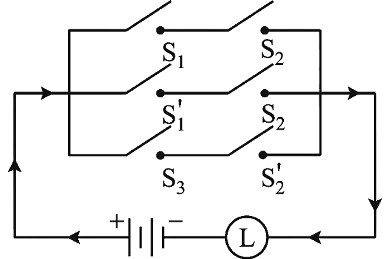
નીચે આપેલા સ્વિચિંગ સર્કિટના સરળ સ્વરૂપમાં સ્વિચની ન્યૂનતમ સંખ્યા કેટલી છે
A
$0$
B
$1$
C
$2$
D
$3$
Solution
(C) ધારો કે $S_1, S_2, S_3$ સ્વિચ છે. સર્કિટ ત્રણ સમાંતર શાખાઓની બનેલી છે.
શાખા $1$: $S_1$ અને $S_2$ શ્રેણીમાં, જેને $S_1 \land S_2$ દ્વારા દર્શાવવામાં આવે છે.
શાખા $2$: $S_1'$ અને $S_2$ શ્રેણીમાં, જેને $S_1' \land S_2$ દ્વારા દર્શાવવામાં આવે છે.
શાખા $3$: $S_3$ અને $S_2'$ શ્રેણીમાં, જેને $S_3 \land S_2'$ દ્વારા દર્શાવવામાં આવે છે.
કુલ સર્કિટ આ શાખાઓનું સમાંતર જોડાણ છે:
$L = (S_1 \land S_2) \lor (S_1' \land S_2) \lor (S_3 \land S_2')$
પ્રથમ બે પદો પર વિતરણના નિયમનો ઉપયોગ કરતા:
$L = ((S_1 \lor S_1') \land S_2) \lor (S_3 \land S_2')$
કારણ કે $S_1 \lor S_1' = T$ (એક પુનરુક્તિ, હંમેશા બંધ):
$L = (T \land S_2) \lor (S_3 \land S_2')$
$L = S_2 \lor (S_3 \land S_2')$
ફરીથી વિતરણના નિયમનો ઉપયોગ કરતા:
$L = (S_2 \lor S_3) \land (S_2 \lor S_2')$
કારણ કે $S_2 \lor S_2' = T$:
$L = S_2 \lor S_3$
આ સરળ સર્કિટ માટે $2$ સ્વિચ ($S_2$ અને $S_3$) ની જરૂર છે.
શાખા $1$: $S_1$ અને $S_2$ શ્રેણીમાં, જેને $S_1 \land S_2$ દ્વારા દર્શાવવામાં આવે છે.
શાખા $2$: $S_1'$ અને $S_2$ શ્રેણીમાં, જેને $S_1' \land S_2$ દ્વારા દર્શાવવામાં આવે છે.
શાખા $3$: $S_3$ અને $S_2'$ શ્રેણીમાં, જેને $S_3 \land S_2'$ દ્વારા દર્શાવવામાં આવે છે.
કુલ સર્કિટ આ શાખાઓનું સમાંતર જોડાણ છે:
$L = (S_1 \land S_2) \lor (S_1' \land S_2) \lor (S_3 \land S_2')$
પ્રથમ બે પદો પર વિતરણના નિયમનો ઉપયોગ કરતા:
$L = ((S_1 \lor S_1') \land S_2) \lor (S_3 \land S_2')$
કારણ કે $S_1 \lor S_1' = T$ (એક પુનરુક્તિ, હંમેશા બંધ):
$L = (T \land S_2) \lor (S_3 \land S_2')$
$L = S_2 \lor (S_3 \land S_2')$
ફરીથી વિતરણના નિયમનો ઉપયોગ કરતા:
$L = (S_2 \lor S_3) \land (S_2 \lor S_2')$
કારણ કે $S_2 \lor S_2' = T$:
$L = S_2 \lor S_3$
આ સરળ સર્કિટ માટે $2$ સ્વિચ ($S_2$ અને $S_3$) ની જરૂર છે.
0 likesView Solution
240
MathematicsDifficultMCQMHT CET · 2026
જો વિધાન પેટર્ન $( \sim p \land q) \lor ( \sim p \land \sim q) \lor (p \land \sim q)$ નું સત્ય મૂલ્ય $F$ હોય, તો $(p \lor \sim q)$ અને $(p \to q)$ ના સત્ય મૂલ્યો અનુક્રમે ... છે.
A
$F, F$
B
$F, T$
C
$T, T$
D
$T, F$
Solution
(C) પગલું $1$: આપેલ વિધાન પેટર્ન $( \sim p \land q) \lor ( \sim p \land \sim q) \lor (p \land \sim q)$ ને સરળ બનાવો.
પગલું $2$: પ્રથમ બે પદો પર વિભાજનનો નિયમ વાપરો: $( \sim p \land (q \lor \sim q)) \lor (p \land \sim q)$.
પગલું $3$: કારણ કે $(q \lor \sim q) \equiv T$, પદાવલિ $( \sim p \land T) \lor (p \land \sim q) \equiv \sim p \lor (p \land \sim q)$ બને છે.
પગલું $4$: ફરીથી વિભાજનનો નિયમ લાગુ કરો: $(\sim p \lor p) \land (\sim p \lor \sim q) \equiv T \land (\sim p \lor \sim q) \equiv \sim p \lor \sim q$.
પગલું $5$: આપેલ છે કે સત્ય મૂલ્ય $F$ છે, તેથી $\sim p \lor \sim q \equiv F$. આનો અર્થ એ છે કે $\sim p \equiv F$ (તેથી $p \equiv T$) અને $\sim q \equiv F$ (તેથી $q \equiv T$).
પગલું $6$: $(p \lor \sim q) \equiv (T \lor \sim T) \equiv (T \lor F) \equiv T$ નું મૂલ્યાંકન કરો.
પગલું $7$: $(p \to q) \equiv (T \to T) \equiv T$ નું મૂલ્યાંકન કરો.
પગલું $8$: સત્ય મૂલ્યો $T, T$ છે.
પગલું $2$: પ્રથમ બે પદો પર વિભાજનનો નિયમ વાપરો: $( \sim p \land (q \lor \sim q)) \lor (p \land \sim q)$.
પગલું $3$: કારણ કે $(q \lor \sim q) \equiv T$, પદાવલિ $( \sim p \land T) \lor (p \land \sim q) \equiv \sim p \lor (p \land \sim q)$ બને છે.
પગલું $4$: ફરીથી વિભાજનનો નિયમ લાગુ કરો: $(\sim p \lor p) \land (\sim p \lor \sim q) \equiv T \land (\sim p \lor \sim q) \equiv \sim p \lor \sim q$.
પગલું $5$: આપેલ છે કે સત્ય મૂલ્ય $F$ છે, તેથી $\sim p \lor \sim q \equiv F$. આનો અર્થ એ છે કે $\sim p \equiv F$ (તેથી $p \equiv T$) અને $\sim q \equiv F$ (તેથી $q \equiv T$).
પગલું $6$: $(p \lor \sim q) \equiv (T \lor \sim T) \equiv (T \lor F) \equiv T$ નું મૂલ્યાંકન કરો.
પગલું $7$: $(p \to q) \equiv (T \to T) \equiv T$ નું મૂલ્યાંકન કરો.
પગલું $8$: સત્ય મૂલ્યો $T, T$ છે.
0 likesView Solution
241
MathematicsMediumMCQMHT CET · 2026
એક સ્વિચિંગ સર્કિટમાં, જો સંયોજન $(S_1 \land S_2)$ ને સંયોજન $(S'_1 \land S'_2)$ સાથે સમાંતર જોડવામાં આવે, તો રૂમ ત્યારે જ પ્રકાશિત થાય છે જ્યારે ...
A
$S_1$ ચાલુ છે અને $S_2$ બંધ છે
B
$S_1$ બંધ છે અને $S_2$ ચાલુ છે
C
$S_1$ અને $S_2$ બંને ચાલુ છે અથવા $S_1$ અને $S_2$ બંને બંધ છે
D
રૂમ હંમેશા પ્રકાશિત રહે છે.
Solution
(C) ધારો કે $1$ એ ચાલુ સ્થિતિ દર્શાવે છે અને $0$ એ બંધ સ્થિતિ દર્શાવે છે.
ધારો કે $S_1$ અને $S_2$ એ સ્વિચની સ્થિતિ છે.
$S'_1$ અને $S'_2$ એ અનુક્રમે $S_1$ અને $S_2$ ના પૂરક છે.
સર્કિટને બુલિયન અભિવ્યક્તિ દ્વારા દર્શાવવામાં આવે છે: $L = (S_1 \land S_2) \lor (S'_1 \land S'_2)$।
આ અભિવ્યક્તિ $XNOR$ ગેટ ઓપરેશનની સમકક્ષ છે, જે ફક્ત ત્યારે જ $1$ (પ્રકાશિત) આઉટપુટ આપે છે જ્યારે બંને ઇનપુટ સમાન હોય.
તેથી, રૂમ ત્યારે પ્રકાશિત થાય છે જ્યારે $S_1 = S_2$ હોય, જેનો અર્થ છે કે બંને ચાલુ છે અથવા બંને બંધ છે.
ધારો કે $S_1$ અને $S_2$ એ સ્વિચની સ્થિતિ છે.
$S'_1$ અને $S'_2$ એ અનુક્રમે $S_1$ અને $S_2$ ના પૂરક છે.
સર્કિટને બુલિયન અભિવ્યક્તિ દ્વારા દર્શાવવામાં આવે છે: $L = (S_1 \land S_2) \lor (S'_1 \land S'_2)$।
આ અભિવ્યક્તિ $XNOR$ ગેટ ઓપરેશનની સમકક્ષ છે, જે ફક્ત ત્યારે જ $1$ (પ્રકાશિત) આઉટપુટ આપે છે જ્યારે બંને ઇનપુટ સમાન હોય.
તેથી, રૂમ ત્યારે પ્રકાશિત થાય છે જ્યારે $S_1 = S_2$ હોય, જેનો અર્થ છે કે બંને ચાલુ છે અથવા બંને બંધ છે.
0 likesView Solution
242
MathematicsMediumMCQMHT CET · 2026
નીચેનામાંથી કયું તાર્કિક વિધાન એક પુનરુક્તિ (tautology) છે?
A
$[(p \to q) \land \sim q] \to \sim p$
B
$(p \to q) \land (p \land \sim q)$
C
$[(p \lor q) \land \sim p] \land \sim q$
D
$[(p \lor \sim q) \lor (\sim p \land q)] \land r$
Solution
(A) પગલું $1$: પુનરુક્તિ (tautology) એવું વિધાન છે જે તેના ઘટકોના તમામ સંભવિત સત્ય મૂલ્યો માટે સત્ય હોય છે.
પગલું $2$: વિકલ્પ $(A)$ નું વિશ્લેષણ કરો: $[(p \to q) \land \sim q] \to \sim p$।
પગલું $3$: $[(p \to q) \land \sim q] \to \sim p$ માટે સત્યતા કોષ્ટક બનાવો:
- જો $p=T, q=T$: $[(T \to T) \land F] \to F \implies [T \land F] \to F \implies F \to F = T$।
- જો $p=T, q=F$: $[(T \to F) \land T] \to F \implies [F \land T] \to F \implies F \to F = T$।
- જો $p=F, q=T$: $[(F \to T) \land F] \to T \implies [T \land F] \to T \implies F \to T = T$।
- જો $p=F, q=F$: $[(F \to F) \land T] \to T \implies [T \land T] \to T \implies T \to T = T$।
પગલું $4$: કારણ કે તમામ સત્ય મૂલ્યો $T$ છે, તેથી આ વિધાન એક પુનરુક્તિ છે।
પગલું $2$: વિકલ્પ $(A)$ નું વિશ્લેષણ કરો: $[(p \to q) \land \sim q] \to \sim p$।
પગલું $3$: $[(p \to q) \land \sim q] \to \sim p$ માટે સત્યતા કોષ્ટક બનાવો:
- જો $p=T, q=T$: $[(T \to T) \land F] \to F \implies [T \land F] \to F \implies F \to F = T$।
- જો $p=T, q=F$: $[(T \to F) \land T] \to F \implies [F \land T] \to F \implies F \to F = T$।
- જો $p=F, q=T$: $[(F \to T) \land F] \to T \implies [T \land F] \to T \implies F \to T = T$।
- જો $p=F, q=F$: $[(F \to F) \land T] \to T \implies [T \land T] \to T \implies T \to T = T$।
પગલું $4$: કારણ કે તમામ સત્ય મૂલ્યો $T$ છે, તેથી આ વિધાન એક પુનરુક્તિ છે।
0 likesView Solution
243
MathematicsDifficultMCQMHT CET · 2026
તાર્કિક વિધાન $(p \lor q) \land [(\sim p \land q) \lor (p \land \sim q)] \land \sim q$ તાર્કિક રીતે કોના સમતુલ્ય છે?
A
$p \land \sim q$
B
$\sim p \land q$
C
$p \land q$
D
$\sim p \lor \sim q$
Solution
(A) ધારો કે આપેલ પદાવલિ $S = (p \lor q) \land [(\sim p \land q) \lor (p \land \sim q)] \land \sim q$ છે.
જૂથના નિયમનો ઉપયોગ કરીને, આપણે લખી શકીએ $S = (p \lor q) \land \sim q \land [(\sim p \land q) \lor (p \land \sim q)]$.
સૌ પ્રથમ, $(p \lor q) \land \sim q$ નું મૂલ્યાંકન કરો. વિભાજનના નિયમ દ્વારા, આ $(p \land \sim q) \lor (q \land \sim q)$ છે. કારણ કે $(q \land \sim q) = F$ (એક વ્યાઘાત) છે, તેથી આ સરળ બનીને $(p \land \sim q) \lor F = (p \land \sim q)$ થાય છે.
હવે આને $S$ માં પાછું મૂકતા: $S = (p \land \sim q) \land [(\sim p \land q) \lor (p \land \sim q)]$.
ધારો કે $A = (p \land \sim q)$ છે. તો $S = A \land [(\sim p \land q) \lor A]$ થશે.
શોષણના નિયમ મુજબ, $A \land (B \lor A) = A$ થાય છે.
તેથી, $S = A = (p \land \sim q)$.
જૂથના નિયમનો ઉપયોગ કરીને, આપણે લખી શકીએ $S = (p \lor q) \land \sim q \land [(\sim p \land q) \lor (p \land \sim q)]$.
સૌ પ્રથમ, $(p \lor q) \land \sim q$ નું મૂલ્યાંકન કરો. વિભાજનના નિયમ દ્વારા, આ $(p \land \sim q) \lor (q \land \sim q)$ છે. કારણ કે $(q \land \sim q) = F$ (એક વ્યાઘાત) છે, તેથી આ સરળ બનીને $(p \land \sim q) \lor F = (p \land \sim q)$ થાય છે.
હવે આને $S$ માં પાછું મૂકતા: $S = (p \land \sim q) \land [(\sim p \land q) \lor (p \land \sim q)]$.
ધારો કે $A = (p \land \sim q)$ છે. તો $S = A \land [(\sim p \land q) \lor A]$ થશે.
શોષણના નિયમ મુજબ, $A \land (B \lor A) = A$ થાય છે.
તેથી, $S = A = (p \land \sim q)$.
0 likesView Solution
244
MathematicsMediumMCQMHT CET · 2026
નીચે આપેલા સર્કિટ માટે સરળ સ્વિચિંગ સર્કિટ કઈ છે
A
B
C
D
Solution
(C) ધારો કે $S_1$ અને $S_2$ એ સમાંતર (parallel) માં જોડાયેલી બે સ્વિચ છે. લેમ્પ $L$ ત્યારે જ પ્રકાશિત થશે જો કાં તો $S_1$ બંધ હોય અથવા $S_2$ બંધ હોય.
બુલિયન બીજગણિતમાં, આને $S_1 \lor S_2$ ($OR$ ગેટ લોજિક) તરીકે દર્શાવવામાં આવે છે.
$OR$ ઓપરેશન માટે સર્કિટ ડાયાગ્રામમાં સમાંતરમાં જોડાયેલી બે સ્વિચ હોય છે.
વિકલ્પો જોતા:
$(A)$ એક સિંગલ સ્વિચ $S_1$ દર્શાવે છે.
$(B)$ એક સિંગલ સ્વિચ $S_2$ દર્શાવે છે.
$(C)$ સમાંતરમાં જોડાયેલી બે સ્વિચ $S_1$ અને $S_2$ દર્શાવે છે.
$(D)$ શ્રેણીમાં (series) જોડાયેલી બે સ્વિચ $S_1$ અને $S_2$ દર્શાવે છે.
તેથી, સમાંતર જોડાણ દર્શાવતી સર્કિટ $(C)$ છે.
બુલિયન બીજગણિતમાં, આને $S_1 \lor S_2$ ($OR$ ગેટ લોજિક) તરીકે દર્શાવવામાં આવે છે.
$OR$ ઓપરેશન માટે સર્કિટ ડાયાગ્રામમાં સમાંતરમાં જોડાયેલી બે સ્વિચ હોય છે.
વિકલ્પો જોતા:
$(A)$ એક સિંગલ સ્વિચ $S_1$ દર્શાવે છે.
$(B)$ એક સિંગલ સ્વિચ $S_2$ દર્શાવે છે.
$(C)$ સમાંતરમાં જોડાયેલી બે સ્વિચ $S_1$ અને $S_2$ દર્શાવે છે.
$(D)$ શ્રેણીમાં (series) જોડાયેલી બે સ્વિચ $S_1$ અને $S_2$ દર્શાવે છે.
તેથી, સમાંતર જોડાણ દર્શાવતી સર્કિટ $(C)$ છે.
0 likesView Solution
245
MathematicsMediumMCQMHT CET · 2026
જો $\sim p \to q$ અસત્ય હોય અને $q \leftrightarrow r$ અસત્ય હોય, તો $(p, q, r)$ નું સત્ય મૂલ્ય શું છે...
A
$(T, F, T)$
B
$(F, T, F)$
C
$(F, F, T)$
D
$(F, T, T)$
Solution
(C) $1$. શરતી વિધાન $\sim p \to q$ ત્યારે જ અસત્ય હોય જ્યારે $\sim p$ એ $T$ હોય અને $q$ એ $F$ હોય.
$2$. કારણ કે $\sim p = T$ છે, તેથી $p = F$ થશે.
$3$. દ્વિ-શરતી વિધાન $q \leftrightarrow r$ ત્યારે અસત્ય હોય જ્યારે $q$ અને $r$ ના સત્ય મૂલ્યો અલગ હોય.
$4$. આપણે જાણીએ છીએ કે $q = F$ છે, તેથી $q \leftrightarrow r$ ને અસત્ય થવા માટે $r$ નું મૂલ્ય $T$ હોવું જોઈએ.
$5$. આમ, સત્ય મૂલ્યો $p = F$, $q = F$, અને $r = T$ છે.
$2$. કારણ કે $\sim p = T$ છે, તેથી $p = F$ થશે.
$3$. દ્વિ-શરતી વિધાન $q \leftrightarrow r$ ત્યારે અસત્ય હોય જ્યારે $q$ અને $r$ ના સત્ય મૂલ્યો અલગ હોય.
$4$. આપણે જાણીએ છીએ કે $q = F$ છે, તેથી $q \leftrightarrow r$ ને અસત્ય થવા માટે $r$ નું મૂલ્ય $T$ હોવું જોઈએ.
$5$. આમ, સત્ય મૂલ્યો $p = F$, $q = F$, અને $r = T$ છે.
0 likesView Solution
246
MathematicsDifficultMCQMHT CET · 2026
જો $p$, $q$, $r$ સાદા વિધાનો હોય જેના સત્ય મૂલ્યો અનુક્રમે $T$, $F$, $T$ હોય, તો નીચેનામાંથી કયું વિધાન સત્ય નથી?
A
$[q \land (p \to q)] \to p$
B
$(p \land q) \to (q \lor \sim p)$
C
$[(\sim p \lor q) \land \sim r] \leftrightarrow p$
D
$(p \land q) \lor (\sim q \lor r)$
Solution
(C) આપેલ સત્ય મૂલ્યો: $p = T$, $q = F$, $r = T$।
$(A)$ $[q \land (p \to q)] \to p = [F \land (T \to F)] \to T = [F \land F] \to T = F \to T = T$।
$(B)$ $(p \land q) \to (q \lor \sim p) = (T \land F) \to (F \lor \sim T) = F \to (F \lor F) = F \to F = T$।
$(C)$ $[(\sim p \lor q) \land \sim r] \leftrightarrow p = [(\sim T \lor F) \land \sim T] \leftrightarrow T = [(F \lor F) \land F] \leftrightarrow T = [F \land F] \leftrightarrow T = F \leftrightarrow T = F$।
$(D)$ $(p \land q) \lor (\sim q \lor r) = (T \land F) \lor (\sim F \lor T) = F \lor (T \lor T) = F \lor T = T$।
વિકલ્પ $(C)$ નું પરિણામ $F$ હોવાથી, તે સત્ય વિધાન નથી.
$(A)$ $[q \land (p \to q)] \to p = [F \land (T \to F)] \to T = [F \land F] \to T = F \to T = T$।
$(B)$ $(p \land q) \to (q \lor \sim p) = (T \land F) \to (F \lor \sim T) = F \to (F \lor F) = F \to F = T$।
$(C)$ $[(\sim p \lor q) \land \sim r] \leftrightarrow p = [(\sim T \lor F) \land \sim T] \leftrightarrow T = [(F \lor F) \land F] \leftrightarrow T = [F \land F] \leftrightarrow T = F \leftrightarrow T = F$।
$(D)$ $(p \land q) \lor (\sim q \lor r) = (T \land F) \lor (\sim F \lor T) = F \lor (T \lor T) = F \lor T = T$।
વિકલ્પ $(C)$ નું પરિણામ $F$ હોવાથી, તે સત્ય વિધાન નથી.
0 likesView Solution
247
MathematicsDifficultMCQMHT CET · 2026
જો $[(p \lor q) \land (q \to r) \land (\sim r)] \to (p \land q)$ નું સત્ય મૂલ્ય અસત્ય હોય, તો નીચેનામાંથી કયું સત્ય નથી?
A
$p \to q$ નું સત્ય મૂલ્ય અસત્ય છે
B
$p \to r$ નું સત્ય મૂલ્ય અસત્ય છે
C
$(\sim q) \to p$ નું સત્ય મૂલ્ય અસત્ય છે
D
$(\sim p) \land r$ નું સત્ય મૂલ્ય અસત્ય છે
Solution
(C) પગલું $1$: ગર્ભિતાર્થ $A \to B$ અસત્ય હોવા માટે, $A$ સત્ય અને $B$ અસત્ય હોવું જોઈએ.
પગલું $2$: $B = (p \land q)$ અસત્ય છે, તેથી $p$ અથવા $q$ માંથી ઓછામાં ઓછું એક અસત્ય છે.
પગલું $3$: $A = [(p \lor q) \land (q \to r) \land (\sim r)]$ સત્ય છે. આનો અર્થ એ છે કે $(p \lor q)$ સત્ય છે, $(q \to r)$ સત્ય છે, અને $(\sim r)$ સત્ય છે.
પગલું $4$: કારણ કે $(\sim r)$ સત્ય છે, $r$ અસત્ય છે. કારણ કે $(q \to r)$ સત્ય છે અને $r$ અસત્ય છે, તેથી $q$ અસત્ય હોવું જોઈએ.
પગલું $5$: કારણ કે $(p \lor q)$ સત્ય છે અને $q$ અસત્ય છે, તેથી $p$ સત્ય હોવું જોઈએ.
પગલું $6$: આમ, $p = T, q = F, r = F$ છે.
પગલું $7$: વિકલ્પો તપાસો:
$(A)$ $p \to q = T \to F = F$ (સત્ય વિધાન).
$(B)$ $p \to r = T \to F = F$ (સત્ય વિધાન).
$(C)$ $(\sim q) \to p = T \to T = T$ (અસત્ય વિધાન, કારણ કે તે સત્ય છે).
$(D)$ $(\sim p) \land r = F \land F = F$ (સત્ય વિધાન).
પગલું $8$: વિકલ્પ $(C)$ એ છે જે સત્ય નથી.
પગલું $2$: $B = (p \land q)$ અસત્ય છે, તેથી $p$ અથવા $q$ માંથી ઓછામાં ઓછું એક અસત્ય છે.
પગલું $3$: $A = [(p \lor q) \land (q \to r) \land (\sim r)]$ સત્ય છે. આનો અર્થ એ છે કે $(p \lor q)$ સત્ય છે, $(q \to r)$ સત્ય છે, અને $(\sim r)$ સત્ય છે.
પગલું $4$: કારણ કે $(\sim r)$ સત્ય છે, $r$ અસત્ય છે. કારણ કે $(q \to r)$ સત્ય છે અને $r$ અસત્ય છે, તેથી $q$ અસત્ય હોવું જોઈએ.
પગલું $5$: કારણ કે $(p \lor q)$ સત્ય છે અને $q$ અસત્ય છે, તેથી $p$ સત્ય હોવું જોઈએ.
પગલું $6$: આમ, $p = T, q = F, r = F$ છે.
પગલું $7$: વિકલ્પો તપાસો:
$(A)$ $p \to q = T \to F = F$ (સત્ય વિધાન).
$(B)$ $p \to r = T \to F = F$ (સત્ય વિધાન).
$(C)$ $(\sim q) \to p = T \to T = T$ (અસત્ય વિધાન, કારણ કે તે સત્ય છે).
$(D)$ $(\sim p) \land r = F \land F = F$ (સત્ય વિધાન).
પગલું $8$: વિકલ્પ $(C)$ એ છે જે સત્ય નથી.
0 likesView Solution
248
MathematicsDifficultMCQMHT CET · 2026
વિધાન $\sim p \lor q$ ના પ્રતિલોમ (inverse) નું નિષેધ (negation) શું છે...
A
$p \land \sim q$
B
$\sim p \land q$
C
$\sim p \land \sim q$
D
$p \lor q$
Solution
(B) પગલું $1$: આપેલ વિધાન $S = \sim p \lor q$ છે.
પગલું $2$: વિધાન $p \implies q$ નો પ્રતિલોમ $\sim p \implies \sim q$ થાય છે, જે $\sim(\sim p) \lor \sim q = p \lor \sim q$ ને સમાન છે.
પગલું $3$: આ પ્રતિલોમનું નિષેધ $\sim(p \lor \sim q)$ છે.
પગલું $4$: ડી મોર્ગનના નિયમનો ઉપયોગ કરતા, $\sim(p \lor \sim q) = \sim p \land \sim(\sim q) = \sim p \land q$ મળે છે. તેથી સાચો વિકલ્પ $B$ છે.
પગલું $2$: વિધાન $p \implies q$ નો પ્રતિલોમ $\sim p \implies \sim q$ થાય છે, જે $\sim(\sim p) \lor \sim q = p \lor \sim q$ ને સમાન છે.
પગલું $3$: આ પ્રતિલોમનું નિષેધ $\sim(p \lor \sim q)$ છે.
પગલું $4$: ડી મોર્ગનના નિયમનો ઉપયોગ કરતા, $\sim(p \lor \sim q) = \sim p \land \sim(\sim q) = \sim p \land q$ મળે છે. તેથી સાચો વિકલ્પ $B$ છે.
0 likesView Solution
249
MathematicsMediumMCQMHT CET · 2026
નીચેનામાંથી કયું/કયા વિધાન અસત્ય છે?
$I$) જો $1$ અવિભાજ્ય સંખ્યા નથી, તો $2$ અવિભાજ્ય સંખ્યા નથી.
$II$) $e$ એક સ્વર છે અને $12 \times 3 = 36$ છે.
$III$) તે સત્ય નથી કે $14$ એક વિભાજ્ય સંખ્યા છે અને $3$ એક બેકી સંખ્યા છે.
$IV$) $\sqrt{5}$ એક અસંમેય સંખ્યા છે, પરંતુ $3 + \sqrt{5}$ એક સંકર સંખ્યા છે.
$I$) જો $1$ અવિભાજ્ય સંખ્યા નથી, તો $2$ અવિભાજ્ય સંખ્યા નથી.
$II$) $e$ એક સ્વર છે અને $12 \times 3 = 36$ છે.
$III$) તે સત્ય નથી કે $14$ એક વિભાજ્ય સંખ્યા છે અને $3$ એક બેકી સંખ્યા છે.
$IV$) $\sqrt{5}$ એક અસંમેય સંખ્યા છે, પરંતુ $3 + \sqrt{5}$ એક સંકર સંખ્યા છે.
A
$\text{માત્ર I અને IV}$
B
$\text{માત્ર I}$
C
$\text{માત્ર II અને III}$
D
$\text{માત્ર I, II અને IV}$
Solution
(B) પગલું $1$: વિધાન $I$ નું વિશ્લેષણ કરો. ધારો કે $P$ એ '$1$ અવિભાજ્ય સંખ્યા નથી' (સત્ય) છે અને $Q$ એ '$2$ અવિભાજ્ય સંખ્યા નથી' (અસત્ય) છે. ગર્ભિતાર્થ $P \implies Q$ એ $T \implies F$ છે, જે અસત્ય છે.
પગલું $2$: વિધાન $II$ નું વિશ્લેષણ કરો. '$e$ એક સ્વર છે' સત્ય છે અને '$12 \times 3 = 36$' સત્ય છે. બંને સત્ય હોવાથી, સંયોજન સત્ય છે.
પગલું $3$: વિધાન $III$ નું વિશ્લેષણ કરો. ધારો કે $P$ એ '$14$ એક વિભાજ્ય સંખ્યા છે' (સત્ય) છે અને $Q$ એ '$3$ એક બેકી સંખ્યા છે' (અસત્ય) છે. સંયોજન $P \land Q$ અસત્ય છે. વિધાન 'તે સત્ય નથી કે $P \land Q$' એ $\neg(F)$ છે, જે સત્ય છે.
પગલું $4$: વિધાન $IV$ નું વિશ્લેષણ કરો. '$\sqrt{5}$ એક અસંમેય સંખ્યા છે' સત્ય છે. '$3 + \sqrt{5}$ એક સંકર સંખ્યા છે' સત્ય છે (કારણ કે બધી વાસ્તવિક સંખ્યાઓ સંકર સંખ્યાઓ છે). બંને સત્ય હોવાથી, વિધાન સત્ય છે.
પગલું $5$: નિષ્કર્ષ. માત્ર વિધાન $I$ અસત્ય છે. તેથી, સાચો વિકલ્પ $B$ છે.
પગલું $2$: વિધાન $II$ નું વિશ્લેષણ કરો. '$e$ એક સ્વર છે' સત્ય છે અને '$12 \times 3 = 36$' સત્ય છે. બંને સત્ય હોવાથી, સંયોજન સત્ય છે.
પગલું $3$: વિધાન $III$ નું વિશ્લેષણ કરો. ધારો કે $P$ એ '$14$ એક વિભાજ્ય સંખ્યા છે' (સત્ય) છે અને $Q$ એ '$3$ એક બેકી સંખ્યા છે' (અસત્ય) છે. સંયોજન $P \land Q$ અસત્ય છે. વિધાન 'તે સત્ય નથી કે $P \land Q$' એ $\neg(F)$ છે, જે સત્ય છે.
પગલું $4$: વિધાન $IV$ નું વિશ્લેષણ કરો. '$\sqrt{5}$ એક અસંમેય સંખ્યા છે' સત્ય છે. '$3 + \sqrt{5}$ એક સંકર સંખ્યા છે' સત્ય છે (કારણ કે બધી વાસ્તવિક સંખ્યાઓ સંકર સંખ્યાઓ છે). બંને સત્ય હોવાથી, વિધાન સત્ય છે.
પગલું $5$: નિષ્કર્ષ. માત્ર વિધાન $I$ અસત્ય છે. તેથી, સાચો વિકલ્પ $B$ છે.
0 likesView Solution
250
MathematicsDifficultMCQMHT CET · 2026
નીચેના વિધાનો પર વિચાર કરો.
$p$: જો $3^4 > 4^3$, તો $3^3 > 4^4$
$q$: સમીકરણ $x^2 - 2x + 2 = 0$ ના બીજ વાસ્તવિક છે જો અને માત્ર જો મુંબઈ મહારાષ્ટ્રમાં હોય.
$r$: વિધાન $p$ સત્ય છે અથવા વિધાન $q$ અસત્ય છે.
નીચેનામાંથી કોનું સત્યતા મૂલ્ય $T$ (સત્ય) છે?
$p$: જો $3^4 > 4^3$, તો $3^3 > 4^4$
$q$: સમીકરણ $x^2 - 2x + 2 = 0$ ના બીજ વાસ્તવિક છે જો અને માત્ર જો મુંબઈ મહારાષ્ટ્રમાં હોય.
$r$: વિધાન $p$ સત્ય છે અથવા વિધાન $q$ અસત્ય છે.
નીચેનામાંથી કોનું સત્યતા મૂલ્ય $T$ (સત્ય) છે?
A
$(p \lor q) \land r$
B
$p \lor (q \land r)$
C
$p \land (q \lor r)$
D
$(p \land q) \lor r$
Solution
(D) $1$. $p$ નું મૂલ્યાંકન કરો: $3^4 = 81$ અને $4^3 = 64$, તેથી $3^4 > 4^3$ સત્ય છે. $3^3 = 27$ અને $4^4 = 256$, તેથી $3^3 > 4^4$ અસત્ય છે. ગર્ભિતાર્થ $T \implies F$ અસત્ય છે. આમ, $p$ નું મૂલ્ય $F$ છે.
$2$. $q$ નું મૂલ્યાંકન કરો: $x^2 - 2x + 2 = 0$ નો વિવેચક $D = (-2)^2 - 4(1)(2) = 4 - 8 = -4 < 0$ છે. બીજ સંકર છે, વાસ્તવિક નથી. તેથી, પ્રથમ ભાગ $F$ છે. 'મુંબઈ મહારાષ્ટ્રમાં છે' $T$ છે. દ્વિ-શરતી વિધાન $F \iff T$ અસત્ય છે. આમ, $q$ નું મૂલ્ય $F$ છે.
$3$. $r$ નું મૂલ્યાંકન કરો: $r$ એટલે $p \lor \neg q$. કારણ કે $p$ નું મૂલ્ય $F$ છે અને $\neg q$ નું મૂલ્ય $T$ છે $(F \lor T)$, તેથી $r$ નું મૂલ્ય $T$ છે.
$4$. વિકલ્પો તપાસો:
$(A)$ $(F \lor F) \land T = F \land T = F$
$(B)$ $F \lor (F \land T) = F \lor F = F$
$(C)$ $F \land (F \lor T) = F \land T = F$
$(D)$ $(F \land F) \lor T = F \lor T = T$
તેથી, વિકલ્પ $(D)$ સત્ય છે.
$2$. $q$ નું મૂલ્યાંકન કરો: $x^2 - 2x + 2 = 0$ નો વિવેચક $D = (-2)^2 - 4(1)(2) = 4 - 8 = -4 < 0$ છે. બીજ સંકર છે, વાસ્તવિક નથી. તેથી, પ્રથમ ભાગ $F$ છે. 'મુંબઈ મહારાષ્ટ્રમાં છે' $T$ છે. દ્વિ-શરતી વિધાન $F \iff T$ અસત્ય છે. આમ, $q$ નું મૂલ્ય $F$ છે.
$3$. $r$ નું મૂલ્યાંકન કરો: $r$ એટલે $p \lor \neg q$. કારણ કે $p$ નું મૂલ્ય $F$ છે અને $\neg q$ નું મૂલ્ય $T$ છે $(F \lor T)$, તેથી $r$ નું મૂલ્ય $T$ છે.
$4$. વિકલ્પો તપાસો:
$(A)$ $(F \lor F) \land T = F \land T = F$
$(B)$ $F \lor (F \land T) = F \lor F = F$
$(C)$ $F \land (F \lor T) = F \land T = F$
$(D)$ $(F \land F) \lor T = F \lor T = T$
તેથી, વિકલ્પ $(D)$ સત્ય છે.
0 likesView Solution
251
MathematicsDifficultMCQMHT CET · 2026
ધારો કે $f(x) = 3x^3 + 4e^x$ અને $g(x) = f^{-1}(x)$ છે. $g'(4)$ નું મૂલ્ય કોના બરાબર છે...
A
$4$
B
$2$
C
$1$
D
$\frac{1}{4}$
Solution
(D) આપેલ છે કે $f(x) = 3x^3 + 4e^x$ અને $g(x) = f^{-1}(x)$ છે.
આપણે જાણીએ છીએ કે $g'(y) = \frac{1}{f'(x)}$ જ્યાં $y = f(x)$ છે.
સૌ પ્રથમ, $x$ ની કિંમત શોધો જેથી $f(x) = 4$ થાય: $3x^3 + 4e^x = 4$. નિરીક્ષણ દ્વારા, $x = 0$ આ સમીકરણનું સમાધાન કરે છે કારણ કે $3(0)^3 + 4e^0 = 0 + 4(1) = 4$ થાય છે.
હવે, $f'(x) = \frac{d}{dx}(3x^3 + 4e^x) = 9x^2 + 4e^x$ શોધો.
$x = 0$ પર, $f'(0) = 9(0)^2 + 4e^0 = 0 + 4 = 4$ થાય છે.
તેથી, $g'(4) = \frac{1}{f'(0)} = \frac{1}{4}$ થાય છે.
આપણે જાણીએ છીએ કે $g'(y) = \frac{1}{f'(x)}$ જ્યાં $y = f(x)$ છે.
સૌ પ્રથમ, $x$ ની કિંમત શોધો જેથી $f(x) = 4$ થાય: $3x^3 + 4e^x = 4$. નિરીક્ષણ દ્વારા, $x = 0$ આ સમીકરણનું સમાધાન કરે છે કારણ કે $3(0)^3 + 4e^0 = 0 + 4(1) = 4$ થાય છે.
હવે, $f'(x) = \frac{d}{dx}(3x^3 + 4e^x) = 9x^2 + 4e^x$ શોધો.
$x = 0$ પર, $f'(0) = 9(0)^2 + 4e^0 = 0 + 4 = 4$ થાય છે.
તેથી, $g'(4) = \frac{1}{f'(0)} = \frac{1}{4}$ થાય છે.
0 likesView Solution
252
MathematicsDifficultMCQMHT CET · 2026
જો $f(x)$ અને $g(x)$ એકબીજાના પ્રતિવિધેયો હોય અને $f(x) = x + e^x$ હોય, તો $g'(x) = ...$
A
$\frac{1}{1 + e^{g(x)}}$
B
$\frac{1}{1 + e^x}$
C
$1 + e^{g(x)}$
D
$1 + e^x$
Solution
(A) આપેલ છે કે $f(x)$ અને $g(x)$ પ્રતિવિધેયો છે, તેથી $f(g(x)) = x$ થાય.
સાંકળના નિયમ (chain rule) નો ઉપયોગ કરીને $x$ ની સાપેક્ષે બંને બાજુ વિકલન કરતા:
$f'(g(x)) \cdot g'(x) = 1$ મળે.
તેથી, $g'(x) = \frac{1}{f'(g(x))}$ થાય.
$f(x) = x + e^x$ હોવાથી, તેનું વિકલિત $f'(x) = 1 + e^x$ મળે.
$f'(x)$ માં $g(x)$ મૂકતા, આપણને $f'(g(x)) = 1 + e^{g(x)}$ મળે છે.
આમ, $g'(x) = \frac{1}{1 + e^{g(x)}}$ થાય.
સાંકળના નિયમ (chain rule) નો ઉપયોગ કરીને $x$ ની સાપેક્ષે બંને બાજુ વિકલન કરતા:
$f'(g(x)) \cdot g'(x) = 1$ મળે.
તેથી, $g'(x) = \frac{1}{f'(g(x))}$ થાય.
$f(x) = x + e^x$ હોવાથી, તેનું વિકલિત $f'(x) = 1 + e^x$ મળે.
$f'(x)$ માં $g(x)$ મૂકતા, આપણને $f'(g(x)) = 1 + e^{g(x)}$ મળે છે.
આમ, $g'(x) = \frac{1}{1 + e^{g(x)}}$ થાય.
0 likesView Solution
253
MathematicsDifficultMCQMHT CET · 2026
જો $x = 0$ પર $\tan^{-1}(a + bx)$ નું $x$ ની સાપેક્ષ વિકલન $1$ હોય, તો $a^6 - b^3 = $
A
$3a^2b - 1$
B
$-3ab^2 + 1$
C
$-1 - 3a^2b$
D
$1 + 3ab^2$
Solution
(C) ધારો કે $y = \tan^{-1}(a + bx)$ છે.
ચેઈન રૂલનો ઉપયોગ કરતા, $x$ ની સાપેક્ષ વિકલન:
$\frac{dy}{dx} = \frac{1}{1 + (a + bx)^2} \cdot \frac{d}{dx}(a + bx) = \frac{b}{1 + (a + bx)^2}$.
આપેલ છે કે $x = 0$ પર, $\frac{dy}{dx} = 1$:
$\frac{b}{1 + (a + 0)^2} = 1 \implies \frac{b}{1 + a^2} = 1 \implies b = 1 + a^2$.
આપણે $a^6 - b^3$ શોધવાનું છે. $b = 1 + a^2$ મૂકતા:
$a^6 - (1 + a^2)^3 = a^6 - (1^3 + 3(1)^2(a^2) + 3(1)(a^2)^2 + (a^2)^3)$.
$a^6 - (1 + 3a^2 + 3a^4 + a^6) = -1 - 3a^2 - 3a^4$.
જો $a=0$ લેવામાં આવે, તો $b=1$ મળે, જેથી $a^6 - b^3 = -1$ થાય. વિકલ્પ $C$ માં $a=0$ મૂકતા $-1$ મળે છે. તેથી, $C$ સાચો વિકલ્પ છે.
ચેઈન રૂલનો ઉપયોગ કરતા, $x$ ની સાપેક્ષ વિકલન:
$\frac{dy}{dx} = \frac{1}{1 + (a + bx)^2} \cdot \frac{d}{dx}(a + bx) = \frac{b}{1 + (a + bx)^2}$.
આપેલ છે કે $x = 0$ પર, $\frac{dy}{dx} = 1$:
$\frac{b}{1 + (a + 0)^2} = 1 \implies \frac{b}{1 + a^2} = 1 \implies b = 1 + a^2$.
આપણે $a^6 - b^3$ શોધવાનું છે. $b = 1 + a^2$ મૂકતા:
$a^6 - (1 + a^2)^3 = a^6 - (1^3 + 3(1)^2(a^2) + 3(1)(a^2)^2 + (a^2)^3)$.
$a^6 - (1 + 3a^2 + 3a^4 + a^6) = -1 - 3a^2 - 3a^4$.
જો $a=0$ લેવામાં આવે, તો $b=1$ મળે, જેથી $a^6 - b^3 = -1$ થાય. વિકલ્પ $C$ માં $a=0$ મૂકતા $-1$ મળે છે. તેથી, $C$ સાચો વિકલ્પ છે.
0 likesView Solution
254
MathematicsDifficultMCQMHT CET · 2026
$\frac{d}{dx} [\sin^2 \{ \cot^{-1} \sqrt{\frac{1-x}{1+x}} \}]$ ની કિંમત શોધો.
A
$-1$
B
$\frac{1}{2}$
C
$-\frac{1}{2}$
D
$1$
Solution
(B) ધારો કે $y = \sin^2 \{ \cot^{-1} \sqrt{\frac{1-x}{1+x}} \}$ છે.
ધારો કે $x = \cos \theta$, તો $\theta = \cos^{-1} x$ થાય.
$\sqrt{\frac{1-\cos \theta}{1+\cos \theta}} = \sqrt{\frac{2\sin^2(\theta/2)}{2\cos^2(\theta/2)}} = \tan(\theta/2)$ થાય.
તેથી, $\cot^{-1} \sqrt{\frac{1-x}{1+x}} = \cot^{-1}(\tan(\theta/2)) = \cot^{-1}(\cot(\frac{\pi}{2} - \frac{\theta}{2})) = \frac{\pi}{2} - \frac{\theta}{2}$ થાય.
આ કિંમત મૂકતા, $y = \sin^2(\frac{\pi}{2} - \frac{\theta}{2}) = \cos^2(\theta/2) = \frac{1+\cos \theta}{2}$ મળે.
કારણ કે $x = \cos \theta$ છે, તેથી $y = \frac{1+x}{2} = \frac{1}{2} + \frac{x}{2}$ થાય.
હવે, $\frac{dy}{dx} = \frac{d}{dx}(\frac{1}{2} + \frac{x}{2}) = 0 + \frac{1}{2} = \frac{1}{2}$ મળે.
ધારો કે $x = \cos \theta$, તો $\theta = \cos^{-1} x$ થાય.
$\sqrt{\frac{1-\cos \theta}{1+\cos \theta}} = \sqrt{\frac{2\sin^2(\theta/2)}{2\cos^2(\theta/2)}} = \tan(\theta/2)$ થાય.
તેથી, $\cot^{-1} \sqrt{\frac{1-x}{1+x}} = \cot^{-1}(\tan(\theta/2)) = \cot^{-1}(\cot(\frac{\pi}{2} - \frac{\theta}{2})) = \frac{\pi}{2} - \frac{\theta}{2}$ થાય.
આ કિંમત મૂકતા, $y = \sin^2(\frac{\pi}{2} - \frac{\theta}{2}) = \cos^2(\theta/2) = \frac{1+\cos \theta}{2}$ મળે.
કારણ કે $x = \cos \theta$ છે, તેથી $y = \frac{1+x}{2} = \frac{1}{2} + \frac{x}{2}$ થાય.
હવે, $\frac{dy}{dx} = \frac{d}{dx}(\frac{1}{2} + \frac{x}{2}) = 0 + \frac{1}{2} = \frac{1}{2}$ મળે.
0 likesView Solution
255
MathematicsDifficultMCQMHT CET · 2026
જો $y = \cos^{-1}(\sin x)$, જ્યાં $\frac{\pi}{2} < x < \pi$, તો $\frac{dy}{dx} = \dots$
A
$-1$
B
$0$
C
$1$
D
$2$
Solution
(C) આપેલ છે $y = \cos^{-1}(\sin x)$।
આપણે જાણીએ છીએ કે $\sin x = \cos(\frac{\pi}{2} - x)$।
તેથી, $y = \cos^{-1}(\cos(\frac{\pi}{2} - x))$।
કારણ કે $\frac{\pi}{2} < x < \pi$, આપણે જાણીએ છીએ કે $\cos(\frac{\pi}{2} - x) = \cos(x - \frac{\pi}{2})$।
કારણ કે $0 < x - \frac{\pi}{2} < \frac{\pi}{2}$, પદ $y = \cos^{-1}(\cos(x - \frac{\pi}{2})) = x - \frac{\pi}{2}$ બને છે।
તેથી, $\frac{dy}{dx} = \frac{d}{dx}(x - \frac{\pi}{2}) = 1$।
આપણે જાણીએ છીએ કે $\sin x = \cos(\frac{\pi}{2} - x)$।
તેથી, $y = \cos^{-1}(\cos(\frac{\pi}{2} - x))$।
કારણ કે $\frac{\pi}{2} < x < \pi$, આપણે જાણીએ છીએ કે $\cos(\frac{\pi}{2} - x) = \cos(x - \frac{\pi}{2})$।
કારણ કે $0 < x - \frac{\pi}{2} < \frac{\pi}{2}$, પદ $y = \cos^{-1}(\cos(x - \frac{\pi}{2})) = x - \frac{\pi}{2}$ બને છે।
તેથી, $\frac{dy}{dx} = \frac{d}{dx}(x - \frac{\pi}{2}) = 1$।
0 likesView Solution
256
MathematicsDifficultMCQMHT CET · 2026
જો $y = \cos^{-1} \left( \frac{1-4^x}{1+4^x} \right)$ હોય, તો $x = 1$ આગળ $\frac{dy}{dx}$ શોધો.
A
$\frac{4 \log 2}{5}$
B
$\frac{\log 2}{5}$
C
$\frac{2 \log 8}{5}$
D
$\frac{5 \log 8}{2}$
Solution
(A) ધારો કે $u = 2^x$ છે. તેથી $4^x = (2^x)^2 = u^2$ થશે.
પદાવલિ $y = \cos^{-1} \left( \frac{1-u^2}{1+u^2} \right)$ બને છે.
$u = \tan \theta$ આદેશ લેતા, આપણને મળે છે $y = \cos^{-1} \left( \frac{1-\tan^2 \theta}{1+\tan^2 \theta} \right) = \cos^{-1} (\cos 2\theta) = 2\theta = 2 \tan^{-1} u = 2 \tan^{-1} (2^x)$.
$x$ ની સાપેક્ષ વિકલન કરતા:
$\frac{dy}{dx} = 2 \cdot \frac{1}{1+(2^x)^2} \cdot \frac{d}{dx}(2^x) = \frac{2}{1+4^x} \cdot 2^x \log 2$.
$x = 1$ આગળ:
$\frac{dy}{dx} = \frac{2 \cdot 2^1 \log 2}{1+4^1} = \frac{4 \log 2}{5}$.
પદાવલિ $y = \cos^{-1} \left( \frac{1-u^2}{1+u^2} \right)$ બને છે.
$u = \tan \theta$ આદેશ લેતા, આપણને મળે છે $y = \cos^{-1} \left( \frac{1-\tan^2 \theta}{1+\tan^2 \theta} \right) = \cos^{-1} (\cos 2\theta) = 2\theta = 2 \tan^{-1} u = 2 \tan^{-1} (2^x)$.
$x$ ની સાપેક્ષ વિકલન કરતા:
$\frac{dy}{dx} = 2 \cdot \frac{1}{1+(2^x)^2} \cdot \frac{d}{dx}(2^x) = \frac{2}{1+4^x} \cdot 2^x \log 2$.
$x = 1$ આગળ:
$\frac{dy}{dx} = \frac{2 \cdot 2^1 \log 2}{1+4^1} = \frac{4 \log 2}{5}$.
0 likesView Solution
257
MathematicsDifficultMCQMHT CET · 2026
જો $f(x) = \cot^{-1} \left( \frac{3x - x^3}{1 - 3x^2} \right)$ અને $g(x) = \cos^{-1} \left( \frac{1 - x^2}{1 + x^2} \right)$ હોય, તો $0 < a < \frac{1}{2}$ માટે $\lim_{x \to a} \frac{f(x) - f(a)}{g(x) - g(a)}$ ની કિંમત શોધો.
A
$\frac{3}{2}$
B
$\frac{1}{2}$
C
$-\frac{3}{2}$
D
$-\frac{1}{2}$
Solution
(C) ધારો કે $x = \tan \theta$. $0 < a < \frac{1}{2}$ માટે, $x = \tan \theta$ જ્યાં $\theta \in (0, \pi/6)$ છે.
$f(x) = \cot^{-1}(\tan 3\theta) = \cot^{-1}(\cot(\pi/2 - 3\theta)) = \pi/2 - 3\theta = \pi/2 - 3\tan^{-1} x$.
$g(x) = \cos^{-1}(\cos 2\theta) = 2\theta = 2\tan^{-1} x$.
હવે, $\frac{f(x) - f(a)}{g(x) - g(a)} = \frac{(\pi/2 - 3\tan^{-1} x) - (\pi/2 - 3\tan^{-1} a)}{(2\tan^{-1} x) - (2\tan^{-1} a)} = \frac{-3(\tan^{-1} x - \tan^{-1} a)}{2(\tan^{-1} x - \tan^{-1} a)}$.
$x \to a$ લક્ષ લેતા, આપણને $\frac{-3}{2}$ મળે છે.
$f(x) = \cot^{-1}(\tan 3\theta) = \cot^{-1}(\cot(\pi/2 - 3\theta)) = \pi/2 - 3\theta = \pi/2 - 3\tan^{-1} x$.
$g(x) = \cos^{-1}(\cos 2\theta) = 2\theta = 2\tan^{-1} x$.
હવે, $\frac{f(x) - f(a)}{g(x) - g(a)} = \frac{(\pi/2 - 3\tan^{-1} x) - (\pi/2 - 3\tan^{-1} a)}{(2\tan^{-1} x) - (2\tan^{-1} a)} = \frac{-3(\tan^{-1} x - \tan^{-1} a)}{2(\tan^{-1} x - \tan^{-1} a)}$.
$x \to a$ લક્ષ લેતા, આપણને $\frac{-3}{2}$ મળે છે.
0 likesView Solution
258
MathematicsDifficultMCQMHT CET · 2026
જો $y = \cot^{-1} \left( \frac{1 + \sin 5x}{\cos 5x} \right)$ હોય, તો $\frac{dy}{dx}$ નું મૂલ્ય છે
A
$-5$
B
$5$
C
$-\frac{2}{5}$
D
$-\frac{5}{2}$
Solution
(D) આપેલ છે $y = \cot^{-1} \left( \frac{1 + \sin 5x}{\cos 5x} \right)$।
ત્રિકોણમિતીય નિત્યસમ $1 + \sin \theta = \left( \cos \frac{\theta}{2} + \sin \frac{\theta}{2} \right)^2$ અને $\cos \theta = \cos^2 \frac{\theta}{2} - \sin^2 \frac{\theta}{2}$ નો ઉપયોગ કરતા:
$y = \cot^{-1} \left( \frac{(\cos \frac{5x}{2} + \sin \frac{5x}{2})^2}{(\cos \frac{5x}{2} - \sin \frac{5x}{2})(\cos \frac{5x}{2} + \sin \frac{5x}{2})} \right)$
$y = \cot^{-1} \left( \frac{\cos \frac{5x}{2} + \sin \frac{5x}{2}}{\cos \frac{5x}{2} - \sin \frac{5x}{2}} \right)$
અંશ અને છેદને $\cos \frac{5x}{2}$ વડે ભાગતા:
$y = \cot^{-1} \left( \frac{1 + \tan \frac{5x}{2}}{1 - \tan \frac{5x}{2}} \right) = \cot^{-1} \left( \tan \left( \frac{\pi}{4} + \frac{5x}{2} \right) \right)$
કારણ કે $\cot^{-1}(\tan \theta) = \cot^{-1}(\cot(\frac{\pi}{2} - \theta))$, આપણને મળે છે:
$y = \frac{\pi}{2} - (\frac{\pi}{4} + \frac{5x}{2}) = \frac{\pi}{4} - \frac{5x}{2}$
તેથી, $\frac{dy}{dx} = \frac{d}{dx} (\frac{\pi}{4} - \frac{5x}{2}) = -\frac{5}{2}$।
ત્રિકોણમિતીય નિત્યસમ $1 + \sin \theta = \left( \cos \frac{\theta}{2} + \sin \frac{\theta}{2} \right)^2$ અને $\cos \theta = \cos^2 \frac{\theta}{2} - \sin^2 \frac{\theta}{2}$ નો ઉપયોગ કરતા:
$y = \cot^{-1} \left( \frac{(\cos \frac{5x}{2} + \sin \frac{5x}{2})^2}{(\cos \frac{5x}{2} - \sin \frac{5x}{2})(\cos \frac{5x}{2} + \sin \frac{5x}{2})} \right)$
$y = \cot^{-1} \left( \frac{\cos \frac{5x}{2} + \sin \frac{5x}{2}}{\cos \frac{5x}{2} - \sin \frac{5x}{2}} \right)$
અંશ અને છેદને $\cos \frac{5x}{2}$ વડે ભાગતા:
$y = \cot^{-1} \left( \frac{1 + \tan \frac{5x}{2}}{1 - \tan \frac{5x}{2}} \right) = \cot^{-1} \left( \tan \left( \frac{\pi}{4} + \frac{5x}{2} \right) \right)$
કારણ કે $\cot^{-1}(\tan \theta) = \cot^{-1}(\cot(\frac{\pi}{2} - \theta))$, આપણને મળે છે:
$y = \frac{\pi}{2} - (\frac{\pi}{4} + \frac{5x}{2}) = \frac{\pi}{4} - \frac{5x}{2}$
તેથી, $\frac{dy}{dx} = \frac{d}{dx} (\frac{\pi}{4} - \frac{5x}{2}) = -\frac{5}{2}$।
0 likesView Solution
259
MathematicsDifficultMCQMHT CET · 2026
જો $y = \sin^{-1} \left( \frac{25 - x^2}{25 + x^2} \right)$ હોય, તો $y'(1)$ ની કિંમત શોધો.
A
$-\frac{5}{13}$
B
$\frac{5}{13}$
C
$\frac{13}{5}$
D
$\frac{2}{7}$
Solution
(A) ધારો કે $x = 5 \tan \theta$, તો $\theta = \tan^{-1} \left( \frac{x}{5} \right)$.
પદાવલિમાં કિંમત મૂકતા: $y = \sin^{-1} \left( \frac{25 - 25 \tan^2 \theta}{25 + 25 \tan^2 \theta} \right) = \sin^{-1} \left( \frac{1 - \tan^2 \theta}{1 + \tan^2 \theta} \right) = \sin^{-1} (\cos 2\theta)$.
નિત્યસમ $\cos 2\theta = \sin \left( \frac{\pi}{2} - 2\theta \right)$ નો ઉપયોગ કરતા, આપણને મળે $y = \sin^{-1} \left( \sin \left( \frac{\pi}{2} - 2\theta \right) \right) = \frac{\pi}{2} - 2\theta$.
$\theta$ ની કિંમત પાછી મૂકતા: $y = \frac{\pi}{2} - 2 \tan^{-1} \left( \frac{x}{5} \right)$.
$x$ ની સાપેક્ષ વિકલન કરતા: $y' = 0 - 2 \cdot \frac{1}{1 + (x/5)^2} \cdot \frac{1}{5} = -\frac{2}{5} \cdot \frac{1}{1 + x^2/25} = -\frac{2}{5} \cdot \frac{25}{25 + x^2} = -\frac{10}{25 + x^2}$.
$x = 1$ માટે: $y'(1) = -\frac{10}{25 + 1^2} = -\frac{10}{26} = -\frac{5}{13}$.
પદાવલિમાં કિંમત મૂકતા: $y = \sin^{-1} \left( \frac{25 - 25 \tan^2 \theta}{25 + 25 \tan^2 \theta} \right) = \sin^{-1} \left( \frac{1 - \tan^2 \theta}{1 + \tan^2 \theta} \right) = \sin^{-1} (\cos 2\theta)$.
નિત્યસમ $\cos 2\theta = \sin \left( \frac{\pi}{2} - 2\theta \right)$ નો ઉપયોગ કરતા, આપણને મળે $y = \sin^{-1} \left( \sin \left( \frac{\pi}{2} - 2\theta \right) \right) = \frac{\pi}{2} - 2\theta$.
$\theta$ ની કિંમત પાછી મૂકતા: $y = \frac{\pi}{2} - 2 \tan^{-1} \left( \frac{x}{5} \right)$.
$x$ ની સાપેક્ષ વિકલન કરતા: $y' = 0 - 2 \cdot \frac{1}{1 + (x/5)^2} \cdot \frac{1}{5} = -\frac{2}{5} \cdot \frac{1}{1 + x^2/25} = -\frac{2}{5} \cdot \frac{25}{25 + x^2} = -\frac{10}{25 + x^2}$.
$x = 1$ માટે: $y'(1) = -\frac{10}{25 + 1^2} = -\frac{10}{26} = -\frac{5}{13}$.
0 likesView Solution
260
MathematicsDifficultMCQMHT CET · 2026
જો $y = \cos^2 [\cot^{-1} (\sqrt{\frac{1-x}{1+x}})]$ હોય, તો $\frac{dy}{dx} = \dots$
A
$-1$
B
$\frac{1}{2}$
C
$1$
D
$0$
Solution
(D) ધારો કે $x = \cos \theta$, તો $\theta = \cos^{-1} x$ થાય.
$\sqrt{\frac{1-x}{1+x}} = \sqrt{\frac{1-\cos \theta}{1+\cos \theta}} = \sqrt{\frac{2\sin^2(\theta/2)}{2\cos^2(\theta/2)}} = \tan(\theta/2)$ થાય.
હવે, $\cot^{-1}(\tan(\theta/2)) = \cot^{-1}(\cot(\frac{\pi}{2} - \frac{\theta}{2})) = \frac{\pi}{2} - \frac{\theta}{2}$ થાય.
આને $y$ ના પદમાં મૂકતા:
$y = \cos^2(\frac{\pi}{2} - \frac{\theta}{2}) = \sin^2(\theta/2)$ થાય.
નિત્યસમ $\sin^2(\theta/2) = \frac{1-\cos \theta}{2}$ નો ઉપયોગ કરતા:
$y = \frac{1-x}{2} = \frac{1}{2} - \frac{x}{2}$ થાય.
તેથી, $\frac{dy}{dx} = \frac{d}{dx}(\frac{1}{2} - \frac{x}{2}) = -\frac{1}{2}$ થાય.
$\sqrt{\frac{1-x}{1+x}} = \sqrt{\frac{1-\cos \theta}{1+\cos \theta}} = \sqrt{\frac{2\sin^2(\theta/2)}{2\cos^2(\theta/2)}} = \tan(\theta/2)$ થાય.
હવે, $\cot^{-1}(\tan(\theta/2)) = \cot^{-1}(\cot(\frac{\pi}{2} - \frac{\theta}{2})) = \frac{\pi}{2} - \frac{\theta}{2}$ થાય.
આને $y$ ના પદમાં મૂકતા:
$y = \cos^2(\frac{\pi}{2} - \frac{\theta}{2}) = \sin^2(\theta/2)$ થાય.
નિત્યસમ $\sin^2(\theta/2) = \frac{1-\cos \theta}{2}$ નો ઉપયોગ કરતા:
$y = \frac{1-x}{2} = \frac{1}{2} - \frac{x}{2}$ થાય.
તેથી, $\frac{dy}{dx} = \frac{d}{dx}(\frac{1}{2} - \frac{x}{2}) = -\frac{1}{2}$ થાય.
0 likesView Solution
261
MathematicsDifficultMCQMHT CET · 2026
$\sin^{-1} \left( \frac{2x}{1+x^2} \right)$ ની સાપેક્ષે $\tan^{-1} \left( \frac{\sqrt{1+x^2} - 1}{x} \right)$ નું વિકલિત શોધો...
A
$\frac{1}{2}$
B
$\frac{1}{4}$
C
$1$
D
$2$
Solution
(B) ધારો કે $u = \tan^{-1} \left( \frac{\sqrt{1+x^2} - 1}{x} \right)$. $x = \tan \theta$ લેતા, $\theta = \tan^{-1} x$ થાય.
$u = \tan^{-1} \left( \frac{\sec \theta - 1}{\tan \theta} \right) = \tan^{-1} \left( \frac{1 - \cos \theta}{\sin \theta} \right) = \tan^{-1} \left( \tan \frac{\theta}{2} \right) = \frac{\theta}{2} = \frac{1}{2} \tan^{-1} x$ થાય.
તેથી, $\frac{du}{dx} = \frac{1}{2(1+x^2)}$ મળે.
ધારો કે $v = \sin^{-1} \left( \frac{2x}{1+x^2} \right)$. $|x| \le 1$ માટે, $v = 2 \tan^{-1} x$ થાય.
તેથી, $\frac{dv}{dx} = \frac{2}{1+x^2}$ મળે.
$v$ ની સાપેક્ષે $u$ નું વિકલિત $\frac{du}{dv} = \frac{du/dx}{dv/dx} = \frac{1/(2(1+x^2))}{2/(1+x^2)} = \frac{1}{4}$ થાય.
$u = \tan^{-1} \left( \frac{\sec \theta - 1}{\tan \theta} \right) = \tan^{-1} \left( \frac{1 - \cos \theta}{\sin \theta} \right) = \tan^{-1} \left( \tan \frac{\theta}{2} \right) = \frac{\theta}{2} = \frac{1}{2} \tan^{-1} x$ થાય.
તેથી, $\frac{du}{dx} = \frac{1}{2(1+x^2)}$ મળે.
ધારો કે $v = \sin^{-1} \left( \frac{2x}{1+x^2} \right)$. $|x| \le 1$ માટે, $v = 2 \tan^{-1} x$ થાય.
તેથી, $\frac{dv}{dx} = \frac{2}{1+x^2}$ મળે.
$v$ ની સાપેક્ષે $u$ નું વિકલિત $\frac{du}{dv} = \frac{du/dx}{dv/dx} = \frac{1/(2(1+x^2))}{2/(1+x^2)} = \frac{1}{4}$ થાય.
0 likesView Solution
262
MathematicsDifficultMCQMHT CET · 2026
જો $\cot[f(x)] = \frac{3x - x^3}{1 - 3x^2}$ અને $\sin[g(x)] = \frac{1 - x^2}{1 + x^2}$ હોય, તો $\lim_{x \to t} \frac{f(x) - f(t)}{g(x) - g(t)} = \dots$
A
$\frac{3}{2(1+t^2)}$
B
$\frac{3}{2}$
C
$\frac{5}{2}$
D
$-\frac{5}{2(1+t^2)}$
Solution
(B) આપેલ છે કે $\cot[f(x)] = \frac{3x - x^3}{1 - 3x^2} = \tan(3\theta)$ જ્યાં $x = \tan \theta$ છે. તેથી, $f(x) = \text{arccot}(\tan(3\theta)) = \frac{\pi}{2} - 3\arctan(x)$.
તેથી $f'(x) = -\frac{3}{1+x^2}$.
આપેલ છે કે $\sin[g(x)] = \frac{1 - x^2}{1 + x^2} = \cos(2\theta)$ જ્યાં $x = \tan \theta$ છે. તેથી, $g(x) = \arcsin(\cos(2\theta)) = \arcsin(\sin(\frac{\pi}{2} - 2\theta)) = \frac{\pi}{2} - 2\arctan(x)$.
તેથી $g'(x) = -\frac{2}{1+x^2}$.
એલ'હોપિટલના નિયમનો ઉપયોગ કરતા, $\lim_{x \to t} \frac{f(x) - f(t)}{g(x) - g(t)} = \frac{f'(t)}{g'(t)} = \frac{-3/(1+t^2)}{-2/(1+t^2)} = \frac{3}{2}$.
તેથી $f'(x) = -\frac{3}{1+x^2}$.
આપેલ છે કે $\sin[g(x)] = \frac{1 - x^2}{1 + x^2} = \cos(2\theta)$ જ્યાં $x = \tan \theta$ છે. તેથી, $g(x) = \arcsin(\cos(2\theta)) = \arcsin(\sin(\frac{\pi}{2} - 2\theta)) = \frac{\pi}{2} - 2\arctan(x)$.
તેથી $g'(x) = -\frac{2}{1+x^2}$.
એલ'હોપિટલના નિયમનો ઉપયોગ કરતા, $\lim_{x \to t} \frac{f(x) - f(t)}{g(x) - g(t)} = \frac{f'(t)}{g'(t)} = \frac{-3/(1+t^2)}{-2/(1+t^2)} = \frac{3}{2}$.
0 likesView Solution
263
MathematicsDifficultMCQMHT CET · 2026
$\log_{10} x$ નું $\log_x 10$ ની સાપેક્ષમાં વિકલન શું થાય?
A
$-\log_{10} x^2$
B
$-(\log_{10} x)^2$
C
$(\log_x 10)^2$
D
$\frac{x^2}{100}$
Solution
(B) ધારો કે $u = \log_{10} x = \frac{\ln x}{\ln 10}$ અને $v = \log_x 10 = \frac{\ln 10}{\ln x}$ છે.
આપણે $\frac{du}{dv}$ શોધવાનું છે.
નોંધો કે $v = \frac{1}{u}$ થાય છે.
તેથી, $\frac{dv}{du} = -u^{-2} = -\frac{1}{u^2}$ થશે.
તેથી, $\frac{du}{dv} = \frac{1}{dv/du} = -u^2$ થશે.
કારણ કે $u = \log_{10} x$ છે, તેથી $\frac{du}{dv} = -(\log_{10} x)^2$ મળે છે.
આપણે $\frac{du}{dv}$ શોધવાનું છે.
નોંધો કે $v = \frac{1}{u}$ થાય છે.
તેથી, $\frac{dv}{du} = -u^{-2} = -\frac{1}{u^2}$ થશે.
તેથી, $\frac{du}{dv} = \frac{1}{dv/du} = -u^2$ થશે.
કારણ કે $u = \log_{10} x$ છે, તેથી $\frac{du}{dv} = -(\log_{10} x)^2$ મળે છે.
0 likesView Solution
264
MathematicsDifficultMCQMHT CET · 2026
જો $y = [(x+1)(2x+1)(3x+1) \dots (nx+1)]^4$, જ્યાં $n \in N$ અને $x = 0$ આગળ $\frac{dy}{dx}$ નું મૂલ્ય $2k$ હોય, તો $k$ નું મૂલ્ય છે
A
$\frac{n(n+1)}{2}$
B
$n(n+1)$
C
$2n(n+1)$
D
$4n(n+1)$
Solution
(B) ધારો કે $f(x) = (x+1)(2x+1)(3x+1) \dots (nx+1)$ છે. તેથી $y = [f(x)]^4$ છે.
ચેઈન રૂલનો ઉપયોગ કરતા, $\frac{dy}{dx} = 4[f(x)]^3 \cdot f'(x)$ મળે.
$x = 0$ આગળ, $f(0) = (1)(1)(1) \dots (1) = 1$ થાય.
$f'(0)$ શોધવા માટે, આપણે લઘુગણકીય વિકલન (logarithmic differentiation) નો ઉપયોગ કરીએ: $\ln f(x) = \sum_{i=1}^{n} \ln(ix+1)$.
બંને બાજુ વિકલન કરતા: $\frac{f'(x)}{f(x)} = \sum_{i=1}^{n} \frac{i}{ix+1}$ મળે.
$x = 0$ આગળ, $\frac{f'(0)}{f(0)} = \sum_{i=1}^{n} i = \frac{n(n+1)}{2}$ થાય.
કારણ કે $f(0) = 1$ છે, તેથી $f'(0) = \frac{n(n+1)}{2}$ મળે.
હવે, $\frac{dy}{dx} \big|_{x=0} = 4[f(0)]^3 \cdot f'(0) = 4(1)^3 \cdot \frac{n(n+1)}{2} = 2n(n+1)$ થાય.
આપેલ છે કે $\frac{dy}{dx} \big|_{x=0} = 2k$, તેથી $2k = 2n(n+1)$, જેનાથી $k = n(n+1)$ મળે છે.
ચેઈન રૂલનો ઉપયોગ કરતા, $\frac{dy}{dx} = 4[f(x)]^3 \cdot f'(x)$ મળે.
$x = 0$ આગળ, $f(0) = (1)(1)(1) \dots (1) = 1$ થાય.
$f'(0)$ શોધવા માટે, આપણે લઘુગણકીય વિકલન (logarithmic differentiation) નો ઉપયોગ કરીએ: $\ln f(x) = \sum_{i=1}^{n} \ln(ix+1)$.
બંને બાજુ વિકલન કરતા: $\frac{f'(x)}{f(x)} = \sum_{i=1}^{n} \frac{i}{ix+1}$ મળે.
$x = 0$ આગળ, $\frac{f'(0)}{f(0)} = \sum_{i=1}^{n} i = \frac{n(n+1)}{2}$ થાય.
કારણ કે $f(0) = 1$ છે, તેથી $f'(0) = \frac{n(n+1)}{2}$ મળે.
હવે, $\frac{dy}{dx} \big|_{x=0} = 4[f(0)]^3 \cdot f'(0) = 4(1)^3 \cdot \frac{n(n+1)}{2} = 2n(n+1)$ થાય.
આપેલ છે કે $\frac{dy}{dx} \big|_{x=0} = 2k$, તેથી $2k = 2n(n+1)$, જેનાથી $k = n(n+1)$ મળે છે.
0 likesView Solution
265
MathematicsDifficultMCQMHT CET · 2026
જો $x > 0$ માટે $y = (x^2 + 1)^{\sin x}$ હોય, જેથી $\frac{dy}{dx} = y [\frac{2x \sin x}{g(x)} + \cos x \cdot \log(g(x))]$, તો વિધેય $\frac{1}{g(x)}$ એ...
A
વધતું વિધેય
B
ચુસ્ત વધતું વિધેય
C
ઘટતું વિધેય
D
ચુસ્ત ઘટતું વિધેય
Solution
(D) આપેલ છે $y = (x^2 + 1)^{\sin x}$।
બંને બાજુ પ્રાકૃતિક લઘુગણક લેતા: $\ln y = \sin x \cdot \ln(x^2 + 1)$।
$x$ ની સાપેક્ષમાં વિકલન કરતા: $\frac{1}{y} \frac{dy}{dx} = \cos x \cdot \ln(x^2 + 1) + \sin x \cdot \frac{1}{x^2 + 1} \cdot 2x$।
તેથી, $\frac{dy}{dx} = y [\frac{2x \sin x}{x^2 + 1} + \cos x \cdot \ln(x^2 + 1)]$।
આને આપેલ સ્વરૂપ $\frac{dy}{dx} = y [\frac{2x \sin x}{g(x)} + \cos x \cdot \log(g(x))]$ સાથે સરખાવતા, આપણને $g(x) = x^2 + 1$ મળે છે।
આપણે વિધેય $f(x) = \frac{1}{g(x)} = \frac{1}{x^2 + 1}$ નું વિશ્લેષણ કરવાનું છે.
$x > 0$ માટે, જેમ $x$ વધે છે, તેમ $x^2 + 1$ વધે છે.
કારણ કે $x^2 + 1$ છેદમાં છે અને હંમેશા ધન છે, તેથી જેમ $x^2 + 1$ વધે છે, તેમ $\frac{1}{x^2 + 1}$ ઘટે છે.
ખાસ કરીને, $f'(x) = -\frac{2x}{(x^2 + 1)^2}$। કારણ કે $x > 0$, તેથી $f'(x) < 0$।
તેથી, વિધેય ચુસ્ત ઘટતું વિધેય છે.
બંને બાજુ પ્રાકૃતિક લઘુગણક લેતા: $\ln y = \sin x \cdot \ln(x^2 + 1)$।
$x$ ની સાપેક્ષમાં વિકલન કરતા: $\frac{1}{y} \frac{dy}{dx} = \cos x \cdot \ln(x^2 + 1) + \sin x \cdot \frac{1}{x^2 + 1} \cdot 2x$।
તેથી, $\frac{dy}{dx} = y [\frac{2x \sin x}{x^2 + 1} + \cos x \cdot \ln(x^2 + 1)]$।
આને આપેલ સ્વરૂપ $\frac{dy}{dx} = y [\frac{2x \sin x}{g(x)} + \cos x \cdot \log(g(x))]$ સાથે સરખાવતા, આપણને $g(x) = x^2 + 1$ મળે છે।
આપણે વિધેય $f(x) = \frac{1}{g(x)} = \frac{1}{x^2 + 1}$ નું વિશ્લેષણ કરવાનું છે.
$x > 0$ માટે, જેમ $x$ વધે છે, તેમ $x^2 + 1$ વધે છે.
કારણ કે $x^2 + 1$ છેદમાં છે અને હંમેશા ધન છે, તેથી જેમ $x^2 + 1$ વધે છે, તેમ $\frac{1}{x^2 + 1}$ ઘટે છે.
ખાસ કરીને, $f'(x) = -\frac{2x}{(x^2 + 1)^2}$। કારણ કે $x > 0$, તેથી $f'(x) < 0$।
તેથી, વિધેય ચુસ્ત ઘટતું વિધેય છે.
0 likesView Solution
266
MathematicsDifficultMCQMHT CET · 2026
જો $x = \sin(t)$, $y = \cos(pt)$, તો $(1 - x^2) \frac{d^2y}{dx^2} - x \frac{dy}{dx} = $
A
$-p^2y$
B
$p^2y$
C
$-py$
D
$py$
Solution
(A) આપેલ છે $x = \sin(t)$, તેથી $\frac{dx}{dt} = \cos(t)$.
આપેલ છે $y = \cos(pt)$, તેથી $\frac{dy}{dt} = -p \sin(pt)$.
ચેઈન રૂલનો ઉપયોગ કરતા, $\frac{dy}{dx} = \frac{dy/dt}{dx/dt} = \frac{-p \sin(pt)}{\cos(t)}$.
કારણ કે $\cos(t) = \sqrt{1 - \sin^2(t)} = \sqrt{1 - x^2}$, તેથી $\frac{dy}{dx} = \frac{-p \sin(pt)}{\sqrt{1 - x^2}}$.
આમ, $\sqrt{1 - x^2} \frac{dy}{dx} = -p \sin(pt)$.
બંને બાજુ $x$ ની સાપેક્ષ વિકલન કરતા:
$\sqrt{1 - x^2} \frac{d^2y}{dx^2} + \frac{dy}{dx} \left( \frac{-2x}{2\sqrt{1 - x^2}} \right) = -p^2 \cos(pt) \frac{dt}{dx}$.
કારણ કે $\frac{dt}{dx} = \frac{1}{\cos(t)} = \frac{1}{\sqrt{1 - x^2}}$, આપણને મળે છે:
$\sqrt{1 - x^2} \frac{d^2y}{dx^2} - \frac{x}{\sqrt{1 - x^2}} \frac{dy}{dx} = -p^2 \frac{\cos(pt)}{\sqrt{1 - x^2}}$.
આખા સમીકરણને $\sqrt{1 - x^2}$ વડે ગુણતા:
$(1 - x^2) \frac{d^2y}{dx^2} - x \frac{dy}{dx} = -p^2 \cos(pt) = -p^2 y$.
આપેલ છે $y = \cos(pt)$, તેથી $\frac{dy}{dt} = -p \sin(pt)$.
ચેઈન રૂલનો ઉપયોગ કરતા, $\frac{dy}{dx} = \frac{dy/dt}{dx/dt} = \frac{-p \sin(pt)}{\cos(t)}$.
કારણ કે $\cos(t) = \sqrt{1 - \sin^2(t)} = \sqrt{1 - x^2}$, તેથી $\frac{dy}{dx} = \frac{-p \sin(pt)}{\sqrt{1 - x^2}}$.
આમ, $\sqrt{1 - x^2} \frac{dy}{dx} = -p \sin(pt)$.
બંને બાજુ $x$ ની સાપેક્ષ વિકલન કરતા:
$\sqrt{1 - x^2} \frac{d^2y}{dx^2} + \frac{dy}{dx} \left( \frac{-2x}{2\sqrt{1 - x^2}} \right) = -p^2 \cos(pt) \frac{dt}{dx}$.
કારણ કે $\frac{dt}{dx} = \frac{1}{\cos(t)} = \frac{1}{\sqrt{1 - x^2}}$, આપણને મળે છે:
$\sqrt{1 - x^2} \frac{d^2y}{dx^2} - \frac{x}{\sqrt{1 - x^2}} \frac{dy}{dx} = -p^2 \frac{\cos(pt)}{\sqrt{1 - x^2}}$.
આખા સમીકરણને $\sqrt{1 - x^2}$ વડે ગુણતા:
$(1 - x^2) \frac{d^2y}{dx^2} - x \frac{dy}{dx} = -p^2 \cos(pt) = -p^2 y$.
0 likesView Solution
267
MathematicsDifficultMCQMHT CET · 2026
ધારો કે $x = at^2 - 1$, જ્યાં $a > 0$ અને $y = t^3 + 1$ છે. જો $t = 1$ પર, $\frac{d^2y}{dx^2} = \frac{3}{16}$ હોય, તો $a$ ની કિંમત છે:
A
$3$
B
$-2$
C
$1$
D
$2$
Solution
(D) આપેલ છે $x = at^2 - 1$ અને $y = t^3 + 1$.
પ્રથમ, $t$ ની સાપેક્ષમાં વિકલન મેળવો: $\frac{dx}{dt} = 2at$ અને $\frac{dy}{dt} = 3t^2$.
તેથી, $\frac{dy}{dx} = \frac{dy/dt}{dx/dt} = \frac{3t^2}{2at} = \frac{3t}{2a}$.
હવે, દ્વિતીય વિકલન $\frac{d^2y}{dx^2} = \frac{d}{dx}(\frac{3t}{2a}) = \frac{d}{dt}(\frac{3t}{2a}) \cdot \frac{dt}{dx} = \frac{3}{2a} \cdot \frac{1}{2at} = \frac{3}{4a^2t}$ મેળવો.
$t = 1$ પર, $\frac{d^2y}{dx^2} = \frac{3}{4a^2(1)} = \frac{3}{4a^2}$.
આપેલ છે કે $\frac{3}{4a^2} = \frac{3}{16}$, તેથી $4a^2 = 16$, એટલે કે $a^2 = 4$.
કારણ કે $a > 0$, તેથી $a = 2$.
પ્રથમ, $t$ ની સાપેક્ષમાં વિકલન મેળવો: $\frac{dx}{dt} = 2at$ અને $\frac{dy}{dt} = 3t^2$.
તેથી, $\frac{dy}{dx} = \frac{dy/dt}{dx/dt} = \frac{3t^2}{2at} = \frac{3t}{2a}$.
હવે, દ્વિતીય વિકલન $\frac{d^2y}{dx^2} = \frac{d}{dx}(\frac{3t}{2a}) = \frac{d}{dt}(\frac{3t}{2a}) \cdot \frac{dt}{dx} = \frac{3}{2a} \cdot \frac{1}{2at} = \frac{3}{4a^2t}$ મેળવો.
$t = 1$ પર, $\frac{d^2y}{dx^2} = \frac{3}{4a^2(1)} = \frac{3}{4a^2}$.
આપેલ છે કે $\frac{3}{4a^2} = \frac{3}{16}$, તેથી $4a^2 = 16$, એટલે કે $a^2 = 4$.
કારણ કે $a > 0$, તેથી $a = 2$.
0 likesView Solution
268
MathematicsDifficultMCQMHT CET · 2026
જો $x = a \sin^3 t$ અને $y = a \cos^3 t$ હોય, તો $t = \frac{\pi}{3}$ આગળ $\frac{d^2y}{dx^2}$ નું મૂલ્ય કેટલું થાય?
A
$\frac{-32}{27a}$
B
$\frac{-32}{3\sqrt{3}a}$
C
$\frac{32}{27a}$
D
$\frac{-32}{9a}$
Solution
(C) આપેલ છે કે $x = a \sin^3 t$ અને $y = a \cos^3 t$.
$\frac{dx}{dt} = 3a \sin^2 t \cos t$ અને $\frac{dy}{dt} = -3a \cos^2 t \sin t$.
$\frac{dy}{dx} = \frac{dy/dt}{dx/dt} = \frac{-3a \cos^2 t \sin t}{3a \sin^2 t \cos t} = -\cot t$.
$\frac{d^2y}{dx^2} = \frac{d}{dx}(-\cot t) = \frac{d}{dt}(-\cot t) \cdot \frac{dt}{dx} = \csc^2 t \cdot \frac{1}{3a \sin^2 t \cos t}$.
$\frac{d^2y}{dx^2} = \frac{1}{3a \sin^4 t \cos t} = \frac{\sec t \csc^4 t}{3a}$.
$t = \frac{\pi}{3}$ આગળ, $\sin t = \frac{\sqrt{3}}{2}$ અને $\cos t = \frac{1}{2}$.
$\frac{d^2y}{dx^2} = \frac{1}{3a (\sqrt{3}/2)^4 (1/2)} = \frac{1}{3a (9/16) (1/2)} = \frac{1}{27a/32} = \frac{32}{27a}$.
$\frac{dx}{dt} = 3a \sin^2 t \cos t$ અને $\frac{dy}{dt} = -3a \cos^2 t \sin t$.
$\frac{dy}{dx} = \frac{dy/dt}{dx/dt} = \frac{-3a \cos^2 t \sin t}{3a \sin^2 t \cos t} = -\cot t$.
$\frac{d^2y}{dx^2} = \frac{d}{dx}(-\cot t) = \frac{d}{dt}(-\cot t) \cdot \frac{dt}{dx} = \csc^2 t \cdot \frac{1}{3a \sin^2 t \cos t}$.
$\frac{d^2y}{dx^2} = \frac{1}{3a \sin^4 t \cos t} = \frac{\sec t \csc^4 t}{3a}$.
$t = \frac{\pi}{3}$ આગળ, $\sin t = \frac{\sqrt{3}}{2}$ અને $\cos t = \frac{1}{2}$.
$\frac{d^2y}{dx^2} = \frac{1}{3a (\sqrt{3}/2)^4 (1/2)} = \frac{1}{3a (9/16) (1/2)} = \frac{1}{27a/32} = \frac{32}{27a}$.
0 likesView Solution
269
MathematicsDifficultMCQMHT CET · 2026
જો $x = 4t^3 + 3$, $y = 3t^4 + 4$ અને $\frac{d^2x}{dy^2} = (\frac{dx}{dy})^n$ અચળ હોય, તો $n$ ની કિંમત શોધો
A
$1$
B
$2$
C
$6$
D
$5$
Solution
(D) આપેલ છે $x = 4t^3 + 3$ અને $y = 3t^4 + 4$।
$\frac{dx}{dt} = 12t^2$ અને $\frac{dy}{dt} = 12t^3$।
$\frac{dx}{dy} = \frac{dx/dt}{dy/dt} = \frac{12t^2}{12t^3} = \frac{1}{t} = t^{-1}$।
હવે, $\frac{d^2x}{dy^2} = \frac{d}{dy}(\frac{dx}{dy}) = \frac{d}{dt}(\frac{dx}{dy}) \cdot \frac{dt}{dy}$।
$\frac{d^2x}{dy^2} = \frac{d}{dt}(t^{-1}) \cdot \frac{1}{12t^3} = (-t^{-2}) \cdot \frac{1}{12t^3} = -\frac{1}{12t^5}$।
આપેલ છે કે $\frac{d^2x}{dy^2} = (\frac{dx}{dy})^n$, તેથી $-\frac{1}{12t^5} = (t^{-1})^n = t^{-n}$।
સમીકરણ $-\frac{1}{12} (t^{-1})^5 = (\frac{dx}{dy})^5$ સાથે સરખાવતા, $n = 5$ મળે છે।
$\frac{dx}{dt} = 12t^2$ અને $\frac{dy}{dt} = 12t^3$।
$\frac{dx}{dy} = \frac{dx/dt}{dy/dt} = \frac{12t^2}{12t^3} = \frac{1}{t} = t^{-1}$।
હવે, $\frac{d^2x}{dy^2} = \frac{d}{dy}(\frac{dx}{dy}) = \frac{d}{dt}(\frac{dx}{dy}) \cdot \frac{dt}{dy}$।
$\frac{d^2x}{dy^2} = \frac{d}{dt}(t^{-1}) \cdot \frac{1}{12t^3} = (-t^{-2}) \cdot \frac{1}{12t^3} = -\frac{1}{12t^5}$।
આપેલ છે કે $\frac{d^2x}{dy^2} = (\frac{dx}{dy})^n$, તેથી $-\frac{1}{12t^5} = (t^{-1})^n = t^{-n}$।
સમીકરણ $-\frac{1}{12} (t^{-1})^5 = (\frac{dx}{dy})^5$ સાથે સરખાવતા, $n = 5$ મળે છે।
0 likesView Solution
270
MathematicsDifficultMCQMHT CET · 2026
જો $y = \sqrt{\tan x + \sqrt{\tan x + \sqrt{\tan x + \dots \infty}}}$, તો $x = \frac{\pi}{4}$ પર $(\frac{dy}{dx})^2$ ની કિંમત છે
A
$\frac{5}{4}$
B
$\frac{-5}{4}$
C
$\frac{4}{5}$
D
$\frac{-4}{5}$
Solution
(C) આપેલ છે $y = \sqrt{\tan x + y}$।
બંને બાજુ વર્ગ કરતા, $y^2 = \tan x + y$ મળે છે.
$x$ ની સાપેક્ષમાં વિકલન કરતા, $2y \frac{dy}{dx} = \sec^2 x + \frac{dy}{dx}$ મળે છે.
પદોને ગોઠવતા, $(2y - 1) \frac{dy}{dx} = \sec^2 x$, તેથી $\frac{dy}{dx} = \frac{\sec^2 x}{2y - 1}$.
$x = \frac{\pi}{4}$ પર, $\tan x = 1$. સમીકરણ $y^2 - y - \tan x = 0$ માં કિંમત મૂકતા, $y^2 - y - 1 = 0$ મળે છે.
દ્વિઘાત સૂત્રનો ઉપયોગ કરીને $y$ ની કિંમત શોધતા, $y = \frac{1 \pm \sqrt{1 + 4}}{2} = \frac{1 \pm \sqrt{5}}{2}$. કારણ કે $y > 0$, તેથી $y = \frac{1 + \sqrt{5}}{2}$.
ત્યારે $2y - 1 = 2(\frac{1 + \sqrt{5}}{2}) - 1 = \sqrt{5}$.
$x = \frac{\pi}{4}$ પર, $\sec^2 x = (\sqrt{2})^2 = 2$.
તેથી, $\frac{dy}{dx} = \frac{2}{\sqrt{5}}$.
તેથી, $(\frac{dy}{dx})^2 = (\frac{2}{\sqrt{5}})^2 = \frac{4}{5}$.
બંને બાજુ વર્ગ કરતા, $y^2 = \tan x + y$ મળે છે.
$x$ ની સાપેક્ષમાં વિકલન કરતા, $2y \frac{dy}{dx} = \sec^2 x + \frac{dy}{dx}$ મળે છે.
પદોને ગોઠવતા, $(2y - 1) \frac{dy}{dx} = \sec^2 x$, તેથી $\frac{dy}{dx} = \frac{\sec^2 x}{2y - 1}$.
$x = \frac{\pi}{4}$ પર, $\tan x = 1$. સમીકરણ $y^2 - y - \tan x = 0$ માં કિંમત મૂકતા, $y^2 - y - 1 = 0$ મળે છે.
દ્વિઘાત સૂત્રનો ઉપયોગ કરીને $y$ ની કિંમત શોધતા, $y = \frac{1 \pm \sqrt{1 + 4}}{2} = \frac{1 \pm \sqrt{5}}{2}$. કારણ કે $y > 0$, તેથી $y = \frac{1 + \sqrt{5}}{2}$.
ત્યારે $2y - 1 = 2(\frac{1 + \sqrt{5}}{2}) - 1 = \sqrt{5}$.
$x = \frac{\pi}{4}$ પર, $\sec^2 x = (\sqrt{2})^2 = 2$.
તેથી, $\frac{dy}{dx} = \frac{2}{\sqrt{5}}$.
તેથી, $(\frac{dy}{dx})^2 = (\frac{2}{\sqrt{5}})^2 = \frac{4}{5}$.
0 likesView Solution
271
MathematicsDifficultMCQMHT CET · 2026
જો $x^3 + y^3 = 6$ અને $\frac{d^2y}{dx^2} \cdot \frac{d^2x}{dy^2} = \frac{m}{(xy)^n}$ હોય, જ્યાં $m, n \in R$, તો $\frac{m}{n}$ ની કિંમત શોધો.
A
$36$
B
$9$
C
$6$
D
$4$
Solution
(A) આપેલ છે $x^3 + y^3 = 6$। $x$ ની સાપેક્ષ વિકલન કરતા: $3x^2 + 3y^2 \frac{dy}{dx} = 0 \implies \frac{dy}{dx} = -\frac{x^2}{y^2}$।
હવે, $\frac{d^2y}{dx^2} = -\frac{y^2(2x) - x^2(2y \frac{dy}{dx})}{y^4} = -\frac{2xy^2 - 2x^2y(-\frac{x^2}{y^2})}{y^4} = -\frac{2xy^3 + 2x^4}{y^5} = -\frac{2x(y^3 + x^3)}{y^5}$।
કારણ કે $x^3 + y^3 = 6$, તેથી $\frac{d^2y}{dx^2} = -\frac{12x}{y^5}$।
તે જ રીતે, સંમિતતા દ્વારા, $\frac{d^2x}{dy^2} = -\frac{12y}{x^5}$।
તેમનો ગુણાકાર કરતા: $\frac{d^2y}{dx^2} \cdot \frac{d^2x}{dy^2} = (-\frac{12x}{y^5})(-\frac{12y}{x^5}) = \frac{144}{x^4 y^4} = \frac{144}{(xy)^4}$।
$\frac{m}{(xy)^n}$ સાથે સરખાવતા, આપણને $m = 144$ અને $n = 4$ મળે છે.
તેથી, $\frac{m}{n} = \frac{144}{4} = 36$।
હવે, $\frac{d^2y}{dx^2} = -\frac{y^2(2x) - x^2(2y \frac{dy}{dx})}{y^4} = -\frac{2xy^2 - 2x^2y(-\frac{x^2}{y^2})}{y^4} = -\frac{2xy^3 + 2x^4}{y^5} = -\frac{2x(y^3 + x^3)}{y^5}$।
કારણ કે $x^3 + y^3 = 6$, તેથી $\frac{d^2y}{dx^2} = -\frac{12x}{y^5}$।
તે જ રીતે, સંમિતતા દ્વારા, $\frac{d^2x}{dy^2} = -\frac{12y}{x^5}$।
તેમનો ગુણાકાર કરતા: $\frac{d^2y}{dx^2} \cdot \frac{d^2x}{dy^2} = (-\frac{12x}{y^5})(-\frac{12y}{x^5}) = \frac{144}{x^4 y^4} = \frac{144}{(xy)^4}$।
$\frac{m}{(xy)^n}$ સાથે સરખાવતા, આપણને $m = 144$ અને $n = 4$ મળે છે.
તેથી, $\frac{m}{n} = \frac{144}{4} = 36$।
0 likesView Solution
272
MathematicsDifficultMCQMHT CET · 2026
જો $\sqrt{y + x} + \sqrt{y - x} = c$ હોય, તો $\frac{dy}{dx} = f(x) - \sqrt{[f(x)]^2 - 1}$ છે. $f(x)$ શોધો.
A
$\frac{y}{x}$
B
$-\frac{x}{y}$
C
$-\frac{y}{x}$
D
$\frac{x}{y}$
Solution
(A) આપેલ છે $\sqrt{y + x} + \sqrt{y - x} = c$. બંને બાજુ વર્ગ કરતા: $(y + x) + (y - x) + 2\sqrt{y^2 - x^2} = c^2 \implies 2y + 2\sqrt{y^2 - x^2} = c^2 \implies \sqrt{y^2 - x^2} = \frac{c^2}{2} - y$.
ફરીથી વર્ગ કરતા: $y^2 - x^2 = \frac{c^4}{4} - c^2y + y^2 \implies -x^2 = \frac{c^4}{4} - c^2y \implies c^2y = x^2 + \frac{c^4}{4}$.
$x$ ની સાપેક્ષ વિકલન કરતા: $c^2 \frac{dy}{dx} = 2x \implies \frac{dy}{dx} = \frac{2x}{c^2}$.
$\sqrt{y^2 - x^2} = \frac{c^2}{2} - y$ પરથી, આપણી પાસે $\frac{c^2}{2} = y + \sqrt{y^2 - x^2}$ છે.
તેથી, $\frac{dy}{dx} = \frac{2x}{2(y + \sqrt{y^2 - x^2})} = \frac{x}{y + \sqrt{y^2 - x^2}} = \frac{x}{y + y\sqrt{1 - (x/y)^2}} = \frac{x/y}{1 + \sqrt{1 - (x/y)^2}}$.
છેદનું સંમેયીકરણ કરતા: $\frac{dy}{dx} = \frac{x/y (1 - \sqrt{1 - (x/y)^2})}{1 - (1 - (x/y)^2)} = \frac{x/y (1 - \sqrt{1 - (x/y)^2})}{(x/y)^2} = \frac{1 - \sqrt{1 - (x/y)^2}}{x/y} = \frac{y}{x} - \sqrt{(y/x)^2 - 1}$.
$\frac{dy}{dx} = f(x) - \sqrt{[f(x)]^2 - 1}$ સાથે સરખાવતા, $f(x) = \frac{y}{x}$ મળે છે.
ફરીથી વર્ગ કરતા: $y^2 - x^2 = \frac{c^4}{4} - c^2y + y^2 \implies -x^2 = \frac{c^4}{4} - c^2y \implies c^2y = x^2 + \frac{c^4}{4}$.
$x$ ની સાપેક્ષ વિકલન કરતા: $c^2 \frac{dy}{dx} = 2x \implies \frac{dy}{dx} = \frac{2x}{c^2}$.
$\sqrt{y^2 - x^2} = \frac{c^2}{2} - y$ પરથી, આપણી પાસે $\frac{c^2}{2} = y + \sqrt{y^2 - x^2}$ છે.
તેથી, $\frac{dy}{dx} = \frac{2x}{2(y + \sqrt{y^2 - x^2})} = \frac{x}{y + \sqrt{y^2 - x^2}} = \frac{x}{y + y\sqrt{1 - (x/y)^2}} = \frac{x/y}{1 + \sqrt{1 - (x/y)^2}}$.
છેદનું સંમેયીકરણ કરતા: $\frac{dy}{dx} = \frac{x/y (1 - \sqrt{1 - (x/y)^2})}{1 - (1 - (x/y)^2)} = \frac{x/y (1 - \sqrt{1 - (x/y)^2})}{(x/y)^2} = \frac{1 - \sqrt{1 - (x/y)^2}}{x/y} = \frac{y}{x} - \sqrt{(y/x)^2 - 1}$.
$\frac{dy}{dx} = f(x) - \sqrt{[f(x)]^2 - 1}$ સાથે સરખાવતા, $f(x) = \frac{y}{x}$ મળે છે.
0 likesView Solution
273
MathematicsDifficultMCQMHT CET · 2026
જો $e^y + xy = e$ હોય, તો $x = 0$ આગળ ક્રમિત જોડ $(\frac{dy}{dx}, \frac{d^2y}{dx^2})$ નું મૂલ્ય શું થાય?
A
$(\frac{1}{e}, \frac{-1}{e^2})$
B
$(\frac{-1}{e}, \frac{1}{e^2})$
C
$(\frac{1}{e}, \frac{1}{e^2})$
D
$(\frac{-1}{e}, \frac{-1}{e^2})$
Solution
(B) પગલું $1$: $x = 0$ આગળ $y$ શોધો. $e^y + xy = e$ માં $x = 0$ મૂકતા, $e^y + 0 = e$, તેથી $y = 1$ મળે છે.
પગલું $2$: $e^y + xy = e$ નું $x$ ની સાપેક્ષ વિકલન કરતા: $e^y \frac{dy}{dx} + y + x \frac{dy}{dx} = 0$.
પગલું $3$: $x = 0, y = 1$ ને વિકલિતમાં મૂકતા: $e^1 \frac{dy}{dx} + 1 + 0 = 0 \implies \frac{dy}{dx} = -\frac{1}{e}$.
પગલું $4$: $e^y \frac{dy}{dx} + y + x \frac{dy}{dx} = 0$ નું ફરીથી વિકલન કરતા: $e^y (\frac{dy}{dx})^2 + e^y \frac{d^2y}{dx^2} + \frac{dy}{dx} + \frac{dy}{dx} + x \frac{d^2y}{dx^2} = 0$.
પગલું $5$: $x = 0, y = 1, \frac{dy}{dx} = -\frac{1}{e}$ ને દ્વિતીય વિકલિત સમીકરણમાં મૂકતા: $e^1(-\frac{1}{e})^2 + e^1 \frac{d^2y}{dx^2} + 2(-\frac{1}{e}) + 0 = 0$.
પગલું $6$: સાદું રૂપ આપતા: $\frac{1}{e} + e \frac{d^2y}{dx^2} - \frac{2}{e} = 0 \implies e \frac{d^2y}{dx^2} = \frac{1}{e} \implies \frac{d^2y}{dx^2} = \frac{1}{e^2}$.
પગલું $7$: ક્રમિત જોડ $(-\frac{1}{e}, \frac{1}{e^2})$ છે.
પગલું $2$: $e^y + xy = e$ નું $x$ ની સાપેક્ષ વિકલન કરતા: $e^y \frac{dy}{dx} + y + x \frac{dy}{dx} = 0$.
પગલું $3$: $x = 0, y = 1$ ને વિકલિતમાં મૂકતા: $e^1 \frac{dy}{dx} + 1 + 0 = 0 \implies \frac{dy}{dx} = -\frac{1}{e}$.
પગલું $4$: $e^y \frac{dy}{dx} + y + x \frac{dy}{dx} = 0$ નું ફરીથી વિકલન કરતા: $e^y (\frac{dy}{dx})^2 + e^y \frac{d^2y}{dx^2} + \frac{dy}{dx} + \frac{dy}{dx} + x \frac{d^2y}{dx^2} = 0$.
પગલું $5$: $x = 0, y = 1, \frac{dy}{dx} = -\frac{1}{e}$ ને દ્વિતીય વિકલિત સમીકરણમાં મૂકતા: $e^1(-\frac{1}{e})^2 + e^1 \frac{d^2y}{dx^2} + 2(-\frac{1}{e}) + 0 = 0$.
પગલું $6$: સાદું રૂપ આપતા: $\frac{1}{e} + e \frac{d^2y}{dx^2} - \frac{2}{e} = 0 \implies e \frac{d^2y}{dx^2} = \frac{1}{e} \implies \frac{d^2y}{dx^2} = \frac{1}{e^2}$.
પગલું $7$: ક્રમિત જોડ $(-\frac{1}{e}, \frac{1}{e^2})$ છે.
0 likesView Solution
274
MathematicsDifficultMCQMHT CET · 2026
જો $y^m + y^{-m} = 2x$ હોય, તો $(x^2 - 1) \left( \frac{dy}{dx} \right)^2 = $
A
$m^2 y^2$
B
$m y^2$
C
$m^2 y$
D
$m y$
Solution
(A) આપેલ છે $y^m + y^{-m} = 2x$।
$x$ ની સાપેક્ષ બંને બાજુ વિકલન કરતા:
$m y^{m-1} \frac{dy}{dx} - m y^{-m-1} \frac{dy}{dx} = 2$।
$\frac{dy}{dx} (m y^{m-1} - m y^{-m-1}) = 2$।
$\frac{dy}{dx} = \frac{2}{m(y^{m-1} - y^{-m-1})} = \frac{2y}{m(y^m - y^{-m})}$।
આપેલ સમીકરણ પરથી, $(y^m - y^{-m})^2 = (y^m + y^{-m})^2 - 4 = (2x)^2 - 4 = 4(x^2 - 1)$।
તેથી, $y^m - y^{-m} = 2\sqrt{x^2 - 1}$।
આ કિંમત વિકલિતમાં મૂકતા: $\frac{dy}{dx} = \frac{2y}{m(2\sqrt{x^2 - 1})} = \frac{y}{m\sqrt{x^2 - 1}}$।
બંને બાજુ વર્ગ કરતા: $\left( \frac{dy}{dx} \right)^2 = \frac{y^2}{m^2(x^2 - 1)}$।
તેથી, $(x^2 - 1) \left( \frac{dy}{dx} \right)^2 = \frac{y^2}{m^2}$।
$x$ ની સાપેક્ષ બંને બાજુ વિકલન કરતા:
$m y^{m-1} \frac{dy}{dx} - m y^{-m-1} \frac{dy}{dx} = 2$।
$\frac{dy}{dx} (m y^{m-1} - m y^{-m-1}) = 2$।
$\frac{dy}{dx} = \frac{2}{m(y^{m-1} - y^{-m-1})} = \frac{2y}{m(y^m - y^{-m})}$।
આપેલ સમીકરણ પરથી, $(y^m - y^{-m})^2 = (y^m + y^{-m})^2 - 4 = (2x)^2 - 4 = 4(x^2 - 1)$।
તેથી, $y^m - y^{-m} = 2\sqrt{x^2 - 1}$।
આ કિંમત વિકલિતમાં મૂકતા: $\frac{dy}{dx} = \frac{2y}{m(2\sqrt{x^2 - 1})} = \frac{y}{m\sqrt{x^2 - 1}}$।
બંને બાજુ વર્ગ કરતા: $\left( \frac{dy}{dx} \right)^2 = \frac{y^2}{m^2(x^2 - 1)}$।
તેથી, $(x^2 - 1) \left( \frac{dy}{dx} \right)^2 = \frac{y^2}{m^2}$।
0 likesView Solution
275
MathematicsDifficultMCQMHT CET · 2026
જો $x e^{xy} = y + \sin^2 x$ હોય, તો $x = 0$ આગળ $\frac{dy}{dx}$ ની કિંમત કેટલી થાય?
A
-$1$
B
$1$
C
-$2$
D
$2$
Solution
(B) આપેલ સમીકરણ: $x e^{xy} = y + \sin^2 x$ છે.
પગલું $1$: $x = 0$ આગળ $y$ ની કિંમત શોધો.
સમીકરણમાં $x = 0$ મૂકતા: $0 \cdot e^{0} = y + \sin^2(0) \implies 0 = y + 0 \implies y = 0$ મળે.
પગલું $2$: ગુણાકારનો નિયમ અને સાંકળના નિયમનો ઉપયોગ કરીને બંને બાજુ $x$ ની સાપેક્ષે વિકલન કરો:
$\frac{d}{dx}(x e^{xy}) = \frac{d}{dx}(y + \sin^2 x)$
$e^{xy} + x \cdot e^{xy} \cdot (y + x \frac{dy}{dx}) = \frac{dy}{dx} + 2 \sin x \cos x$ મળે.
પગલું $3$: વિકલિત સમીકરણમાં $x = 0$ અને $y = 0$ મૂકતા:
$e^{0} + 0 \cdot e^{0} \cdot (0 + 0 \cdot \frac{dy}{dx}) = \frac{dy}{dx} + 2 \sin(0) \cos(0)$
$1 + 0 = \frac{dy}{dx} + 0$
$\frac{dy}{dx} = 1$ મળે.
પગલું $1$: $x = 0$ આગળ $y$ ની કિંમત શોધો.
સમીકરણમાં $x = 0$ મૂકતા: $0 \cdot e^{0} = y + \sin^2(0) \implies 0 = y + 0 \implies y = 0$ મળે.
પગલું $2$: ગુણાકારનો નિયમ અને સાંકળના નિયમનો ઉપયોગ કરીને બંને બાજુ $x$ ની સાપેક્ષે વિકલન કરો:
$\frac{d}{dx}(x e^{xy}) = \frac{d}{dx}(y + \sin^2 x)$
$e^{xy} + x \cdot e^{xy} \cdot (y + x \frac{dy}{dx}) = \frac{dy}{dx} + 2 \sin x \cos x$ મળે.
પગલું $3$: વિકલિત સમીકરણમાં $x = 0$ અને $y = 0$ મૂકતા:
$e^{0} + 0 \cdot e^{0} \cdot (0 + 0 \cdot \frac{dy}{dx}) = \frac{dy}{dx} + 2 \sin(0) \cos(0)$
$1 + 0 = \frac{dy}{dx} + 0$
$\frac{dy}{dx} = 1$ મળે.
0 likesView Solution
276
MathematicsDifficultMCQMHT CET · 2026
ધારો કે $y = \sqrt{p x^3 y}$ છે. જો $y = 1$ હોય ત્યારે $\frac{dy}{dx} = \frac{3}{2}$ હોય, તો $p$ નું મૂલ્ય કેટલું થાય?
A
$1$
B
$2$
C
$3$
D
$4$
Solution
(A) આપેલ છે $y = \sqrt{p x^3 y}$. બંને બાજુ વર્ગ કરતા, આપણને $y^2 = p x^3 y$ મળે છે. $y \neq 0$ હોવાથી, $y$ વડે ભાગતા $y = p x^3$ મળે છે.
$x$ ની સાપેક્ષે બંને બાજુ વિકલન કરતા, $\frac{dy}{dx} = 3 p x^2$ મળે છે.
આપેલ છે કે જ્યારે $y = 1$ હોય ત્યારે $\frac{dy}{dx} = \frac{3}{2}$ છે. $y = p x^3$ પરથી, જ્યારે $y = 1$, ત્યારે $1 = p x^3$, તેથી $x^3 = \frac{1}{p}$, જેનો અર્થ છે $x = p^{-1/3}$.
$\frac{dy}{dx} = \frac{3}{2}$ અને $x = p^{-1/3}$ ને વિકલિત સમીકરણમાં મૂકતા:
$\frac{3}{2} = 3 p (p^{-1/3})^2$
$\frac{3}{2} = 3 p (p^{-2/3})$
$\frac{3}{2} = 3 p^{1/3}$
$\frac{1}{2} = p^{1/3}$
$p = (\frac{1}{2})^3 = \frac{1}{8}$.
નોંધ: આપેલા વિકલ્પોમાં સાચું મૂલ્ય $\frac{1}{8}$ નથી. જો પ્રશ્નમાં $y^2 = p x^3$ ની ભૂલ હોય તેમ માનીએ, તો $p = 1$ મળે છે.
$x$ ની સાપેક્ષે બંને બાજુ વિકલન કરતા, $\frac{dy}{dx} = 3 p x^2$ મળે છે.
આપેલ છે કે જ્યારે $y = 1$ હોય ત્યારે $\frac{dy}{dx} = \frac{3}{2}$ છે. $y = p x^3$ પરથી, જ્યારે $y = 1$, ત્યારે $1 = p x^3$, તેથી $x^3 = \frac{1}{p}$, જેનો અર્થ છે $x = p^{-1/3}$.
$\frac{dy}{dx} = \frac{3}{2}$ અને $x = p^{-1/3}$ ને વિકલિત સમીકરણમાં મૂકતા:
$\frac{3}{2} = 3 p (p^{-1/3})^2$
$\frac{3}{2} = 3 p (p^{-2/3})$
$\frac{3}{2} = 3 p^{1/3}$
$\frac{1}{2} = p^{1/3}$
$p = (\frac{1}{2})^3 = \frac{1}{8}$.
નોંધ: આપેલા વિકલ્પોમાં સાચું મૂલ્ય $\frac{1}{8}$ નથી. જો પ્રશ્નમાં $y^2 = p x^3$ ની ભૂલ હોય તેમ માનીએ, તો $p = 1$ મળે છે.
0 likesView Solution
277
MathematicsDifficultMCQMHT CET · 2026
જો $3y^2 - 2xy - x = 0$ હોય, તો $y = 2$ આગળ $\frac{dy}{dx}$ ની કિંમત શું થાય...
A
$\frac{5}{36}$
B
$\frac{35}{36}$
C
$\frac{25}{36}$
D
$\frac{36}{25}$
Solution
(C) આપેલ સમીકરણ: $3y^2 - 2xy - x = 0$ છે.
સૌ પ્રથમ, જ્યારે $y = 2$ હોય ત્યારે $x$ ની કિંમત શોધો: $3(2)^2 - 2x(2) - x = 0 \implies 12 - 4x - x = 0 \implies 12 = 5x \implies x = \frac{12}{5}$.
સમીકરણનું $x$ ની સાપેક્ષમાં વિકલન કરો: $\frac{d}{dx}(3y^2) - \frac{d}{dx}(2xy) - \frac{d}{dx}(x) = 0$.
$6y \frac{dy}{dx} - (2y + 2x \frac{dy}{dx}) - 1 = 0$.
$y = 2$ અને $x = \frac{12}{5}$ મૂકતા: $6(2) \frac{dy}{dx} - 2(2) - 2(\frac{12}{5}) \frac{dy}{dx} - 1 = 0$.
$12 \frac{dy}{dx} - 4 - \frac{24}{5} \frac{dy}{dx} - 1 = 0$.
$(12 - \frac{24}{5}) \frac{dy}{dx} = 5$.
$(\frac{60 - 24}{5}) \frac{dy}{dx} = 5$.
$\frac{36}{5} \frac{dy}{dx} = 5$.
$\frac{dy}{dx} = \frac{25}{36}$.
સૌ પ્રથમ, જ્યારે $y = 2$ હોય ત્યારે $x$ ની કિંમત શોધો: $3(2)^2 - 2x(2) - x = 0 \implies 12 - 4x - x = 0 \implies 12 = 5x \implies x = \frac{12}{5}$.
સમીકરણનું $x$ ની સાપેક્ષમાં વિકલન કરો: $\frac{d}{dx}(3y^2) - \frac{d}{dx}(2xy) - \frac{d}{dx}(x) = 0$.
$6y \frac{dy}{dx} - (2y + 2x \frac{dy}{dx}) - 1 = 0$.
$y = 2$ અને $x = \frac{12}{5}$ મૂકતા: $6(2) \frac{dy}{dx} - 2(2) - 2(\frac{12}{5}) \frac{dy}{dx} - 1 = 0$.
$12 \frac{dy}{dx} - 4 - \frac{24}{5} \frac{dy}{dx} - 1 = 0$.
$(12 - \frac{24}{5}) \frac{dy}{dx} = 5$.
$(\frac{60 - 24}{5}) \frac{dy}{dx} = 5$.
$\frac{36}{5} \frac{dy}{dx} = 5$.
$\frac{dy}{dx} = \frac{25}{36}$.
0 likesView Solution
278
MathematicsAdvancedMCQMHT CET · 2026
જો $x^m + y^m = k$ જ્યાં $(m \neq 1)$ અને $\frac{d^2y}{dx^2} = \frac{ax^b}{y^c}$ એ રીતે હોય કે $a + b + c = 0$, તો $k$ ની કિંમત છે...
A
$1$
B
$2$
C
$3$
D
$m$
Solution
(C) આપેલ છે $x^m + y^m = k$. $x$ ની સાપેક્ષમાં વિકલન કરતા:
$mx^{m-1} + my^{m-1} \frac{dy}{dx} = 0 \implies \frac{dy}{dx} = -\frac{x^{m-1}}{y^{m-1}}$.
ભાગાકારના નિયમનો ઉપયોગ કરીને $x$ ની સાપેક્ષમાં ફરીથી વિકલન કરતા:
$\frac{d^2y}{dx^2} = -\left[ \frac{(m-1)x^{m-2}y^{m-1} - x^{m-1}(m-1)y^{m-2} \frac{dy}{dx}}{(y^{m-1})^2} \right]$.
$\frac{dy}{dx} = -\frac{x^{m-1}}{y^{m-1}}$ મૂકતા:
$\frac{d^2y}{dx^2} = -\left[ \frac{(m-1)x^{m-2}y^{m-1} - x^{m-1}(m-1)y^{m-2} (-\frac{x^{m-1}}{y^{m-1}})}{y^{2m-2}} \right] = -\frac{(m-1)x^{m-2}y^{2m-2} + (m-1)x^{2m-2}y^{m-2}}{y^{3m-3}}$.
આનું સાદું રૂપ $\frac{d^2y}{dx^2} = -\frac{(m-1)x^{m-2}y^{m-2}(y^m + x^m)}{y^{3m-3}} = -\frac{(m-1)x^{m-2}k}{y^{2m-1}}$ થાય છે.
$\frac{ax^b}{y^c}$ સાથે સરખાવતા, $a = -k(m-1)$, $b = m-2$, $c = 2m-1$ મળે છે.
આપેલ છે $a + b + c = 0$, તેથી $-k(m-1) + (m-2) + (2m-1) = 0$.
$-k(m-1) + 3m - 3 = 0 \implies -k(m-1) + 3(m-1) = 0$.
કારણ કે $m \neq 1$, $(m-1)$ વડે ભાગતા $-k + 3 = 0$, તેથી $k = 3$.
$mx^{m-1} + my^{m-1} \frac{dy}{dx} = 0 \implies \frac{dy}{dx} = -\frac{x^{m-1}}{y^{m-1}}$.
ભાગાકારના નિયમનો ઉપયોગ કરીને $x$ ની સાપેક્ષમાં ફરીથી વિકલન કરતા:
$\frac{d^2y}{dx^2} = -\left[ \frac{(m-1)x^{m-2}y^{m-1} - x^{m-1}(m-1)y^{m-2} \frac{dy}{dx}}{(y^{m-1})^2} \right]$.
$\frac{dy}{dx} = -\frac{x^{m-1}}{y^{m-1}}$ મૂકતા:
$\frac{d^2y}{dx^2} = -\left[ \frac{(m-1)x^{m-2}y^{m-1} - x^{m-1}(m-1)y^{m-2} (-\frac{x^{m-1}}{y^{m-1}})}{y^{2m-2}} \right] = -\frac{(m-1)x^{m-2}y^{2m-2} + (m-1)x^{2m-2}y^{m-2}}{y^{3m-3}}$.
આનું સાદું રૂપ $\frac{d^2y}{dx^2} = -\frac{(m-1)x^{m-2}y^{m-2}(y^m + x^m)}{y^{3m-3}} = -\frac{(m-1)x^{m-2}k}{y^{2m-1}}$ થાય છે.
$\frac{ax^b}{y^c}$ સાથે સરખાવતા, $a = -k(m-1)$, $b = m-2$, $c = 2m-1$ મળે છે.
આપેલ છે $a + b + c = 0$, તેથી $-k(m-1) + (m-2) + (2m-1) = 0$.
$-k(m-1) + 3m - 3 = 0 \implies -k(m-1) + 3(m-1) = 0$.
કારણ કે $m \neq 1$, $(m-1)$ વડે ભાગતા $-k + 3 = 0$, તેથી $k = 3$.
0 likesView Solution
279
MathematicsDifficultMCQMHT CET · 2026
જો $\sqrt{y + x} + \sqrt{y - x} = c$ અને $\frac{dy}{dx} = K - \sqrt{\frac{y^2}{x^2} - 1}$ હોય, તો $K$ ની કિંમત છે
A
$-\frac{x}{y}$
B
$-\frac{y}{x}$
C
$\frac{x}{y}$
D
$\frac{y}{x}$
Solution
(D) આપેલ છે $\sqrt{y + x} + \sqrt{y - x} = c$। બંને બાજુ વર્ગ કરતા:
$(y + x) + (y - x) + 2\sqrt{(y + x)(y - x)} = c^2$
$2y + 2\sqrt{y^2 - x^2} = c^2$
$\sqrt{y^2 - x^2} = \frac{c^2}{2} - y$
ફરીથી વર્ગ કરતા:
$y^2 - x^2 = (\frac{c^2}{2} - y)^2 = \frac{c^4}{4} - c^2y + y^2$
$-x^2 = \frac{c^4}{4} - c^2y$
$c^2y = x^2 + \frac{c^4}{4}$
$x$ ની સાપેક્ષ વિકલન કરતા:
$c^2 \frac{dy}{dx} = 2x$
$\frac{dy}{dx} = \frac{2x}{c^2}$
$\sqrt{y^2 - x^2} = \frac{c^2}{2} - y$ પરથી, $c^2 = 2(\sqrt{y^2 - x^2} + y)$ મળે છે.
$\frac{dy}{dx}$ માં $c^2$ ની કિંમત મૂકતા:
$\frac{dy}{dx} = \frac{2x}{2(\sqrt{y^2 - x^2} + y)} = \frac{x}{\sqrt{y^2 - x^2} + y}$
અંશ અને છેદનું સંમેયીકરણ કરતા:
$\frac{dy}{dx} = \frac{x(y - \sqrt{y^2 - x^2})}{y^2 - (y^2 - x^2)} = \frac{x(y - \sqrt{y^2 - x^2})}{x^2} = \frac{y - \sqrt{y^2 - x^2}}{x} = \frac{y}{x} - \sqrt{\frac{y^2}{x^2} - 1}$
$\frac{dy}{dx} = K - \sqrt{\frac{y^2}{x^2} - 1}$ સાથે સરખાવતા, $K = \frac{y}{x}$ મળે છે.
$(y + x) + (y - x) + 2\sqrt{(y + x)(y - x)} = c^2$
$2y + 2\sqrt{y^2 - x^2} = c^2$
$\sqrt{y^2 - x^2} = \frac{c^2}{2} - y$
ફરીથી વર્ગ કરતા:
$y^2 - x^2 = (\frac{c^2}{2} - y)^2 = \frac{c^4}{4} - c^2y + y^2$
$-x^2 = \frac{c^4}{4} - c^2y$
$c^2y = x^2 + \frac{c^4}{4}$
$x$ ની સાપેક્ષ વિકલન કરતા:
$c^2 \frac{dy}{dx} = 2x$
$\frac{dy}{dx} = \frac{2x}{c^2}$
$\sqrt{y^2 - x^2} = \frac{c^2}{2} - y$ પરથી, $c^2 = 2(\sqrt{y^2 - x^2} + y)$ મળે છે.
$\frac{dy}{dx}$ માં $c^2$ ની કિંમત મૂકતા:
$\frac{dy}{dx} = \frac{2x}{2(\sqrt{y^2 - x^2} + y)} = \frac{x}{\sqrt{y^2 - x^2} + y}$
અંશ અને છેદનું સંમેયીકરણ કરતા:
$\frac{dy}{dx} = \frac{x(y - \sqrt{y^2 - x^2})}{y^2 - (y^2 - x^2)} = \frac{x(y - \sqrt{y^2 - x^2})}{x^2} = \frac{y - \sqrt{y^2 - x^2}}{x} = \frac{y}{x} - \sqrt{\frac{y^2}{x^2} - 1}$
$\frac{dy}{dx} = K - \sqrt{\frac{y^2}{x^2} - 1}$ સાથે સરખાવતા, $K = \frac{y}{x}$ મળે છે.
0 likesView Solution
280
MathematicsDifficultMCQMHT CET · 2026
જો $\sqrt{\frac{x}{y}} + \sqrt{\frac{y}{x}} = 6$ હોય, તો $\frac{dy}{dx} = $
A
$\frac{x + 17y}{17x - y}$
B
$\frac{x - 17y}{17x - y}$
C
$\frac{x - 17y}{17x + y}$
D
$\frac{x + 17y}{17x + y}$
Solution
(B) આપેલ છે: $\sqrt{\frac{x}{y}} + \sqrt{\frac{y}{x}} = 6$।
$\sqrt{xy}$ વડે ગુણતા: $x + y = 6\sqrt{xy}$।
બંને બાજુ વર્ગ કરતા: $(x + y)^2 = 36xy$।
$x^2 + 2xy + y^2 = 36xy \implies x^2 - 34xy + y^2 = 0$।
$x$ ની સાપેક્ષ વિકલન કરતા: $\frac{d}{dx}(x^2) - 34\frac{d}{dx}(xy) + \frac{d}{dx}(y^2) = 0$।
$2x - 34(y + x\frac{dy}{dx}) + 2y\frac{dy}{dx} = 0$।
$2$ વડે ભાગતા: $x - 17y - 17x\frac{dy}{dx} + y\frac{dy}{dx} = 0$।
$x - 17y = \frac{dy}{dx}(17x - y)$।
$\frac{dy}{dx} = \frac{x - 17y}{17x - y}$।
$\sqrt{xy}$ વડે ગુણતા: $x + y = 6\sqrt{xy}$।
બંને બાજુ વર્ગ કરતા: $(x + y)^2 = 36xy$।
$x^2 + 2xy + y^2 = 36xy \implies x^2 - 34xy + y^2 = 0$।
$x$ ની સાપેક્ષ વિકલન કરતા: $\frac{d}{dx}(x^2) - 34\frac{d}{dx}(xy) + \frac{d}{dx}(y^2) = 0$।
$2x - 34(y + x\frac{dy}{dx}) + 2y\frac{dy}{dx} = 0$।
$2$ વડે ભાગતા: $x - 17y - 17x\frac{dy}{dx} + y\frac{dy}{dx} = 0$।
$x - 17y = \frac{dy}{dx}(17x - y)$।
$\frac{dy}{dx} = \frac{x - 17y}{17x - y}$।
0 likesView Solution
281
MathematicsDifficultMCQMHT CET · 2026
જો $y = \sin(e^{\log 2x})$ હોય, તો $x = \frac{\pi}{2}$ આગળ $\frac{dy}{dx}$ નું મૂલ્ય શોધો.
A
$2$
B
$-2$
C
$1$
D
$-1$
Solution
(B) આપેલ છે $y = \sin(e^{\log 2x})$.
ગુણધર્મ $e^{\log_e f(x)} = f(x)$ નો ઉપયોગ કરીને, આપણે પદાવલિને સરળ બનાવીએ:
$y = \sin(2x)$.
હવે, $x$ ની સાપેક્ષમાં વિકલન કરતા:
$\frac{dy}{dx} = \frac{d}{dx}(\sin(2x)) = \cos(2x) \cdot \frac{d}{dx}(2x) = 2\cos(2x)$.
વિકલિતમાં $x = \frac{\pi}{2}$ મૂકતા:
$\frac{dy}{dx} = 2\cos(2 \cdot \frac{\pi}{2}) = 2\cos(\pi)$.
કારણ કે $\cos(\pi) = -1$, તેથી:
$\frac{dy}{dx} = 2(-1) = -2$.
ગુણધર્મ $e^{\log_e f(x)} = f(x)$ નો ઉપયોગ કરીને, આપણે પદાવલિને સરળ બનાવીએ:
$y = \sin(2x)$.
હવે, $x$ ની સાપેક્ષમાં વિકલન કરતા:
$\frac{dy}{dx} = \frac{d}{dx}(\sin(2x)) = \cos(2x) \cdot \frac{d}{dx}(2x) = 2\cos(2x)$.
વિકલિતમાં $x = \frac{\pi}{2}$ મૂકતા:
$\frac{dy}{dx} = 2\cos(2 \cdot \frac{\pi}{2}) = 2\cos(\pi)$.
કારણ કે $\cos(\pi) = -1$, તેથી:
$\frac{dy}{dx} = 2(-1) = -2$.
0 likesView Solution
282
MathematicsDifficultMCQMHT CET · 2026
જો $y = \sqrt{x + \sqrt{x^2 + 1}}$, હોય તો $\frac{dy}{dx}$ ની કિંમત શોધો.
A
$\frac{\sqrt{x^2 + 1} + x}{2y\sqrt{x^2 + 1}}$
B
$\frac{\sqrt{x^2 + 1} + x}{y\sqrt{x^2 + 1}}$
C
$\frac{\sqrt{x^2 + 1} + x}{4y\sqrt{x^2 + 1}}$
D
$\frac{\sqrt{x^2 + 1} + x}{y}$
Solution
(A) આપેલ છે $y = (x + (x^2 + 1)^{1/2})^{1/2}$.
ચેઈન રૂલ (chain rule) નો ઉપયોગ કરીને $x$ ની સાપેક્ષમાં વિકલન કરતા:
$\frac{dy}{dx} = \frac{1}{2}(x + (x^2 + 1)^{1/2})^{-1/2} \cdot \frac{d}{dx}(x + (x^2 + 1)^{1/2})$
$\frac{dy}{dx} = \frac{1}{2y} \cdot (1 + \frac{1}{2}(x^2 + 1)^{-1/2} \cdot 2x)$
$\frac{dy}{dx} = \frac{1}{2y} \cdot (1 + \frac{x}{\sqrt{x^2 + 1}})$
$\frac{dy}{dx} = \frac{1}{2y} \cdot (\frac{\sqrt{x^2 + 1} + x}{\sqrt{x^2 + 1}})$
$\frac{dy}{dx} = \frac{\sqrt{x^2 + 1} + x}{2y\sqrt{x^2 + 1}}$
ચેઈન રૂલ (chain rule) નો ઉપયોગ કરીને $x$ ની સાપેક્ષમાં વિકલન કરતા:
$\frac{dy}{dx} = \frac{1}{2}(x + (x^2 + 1)^{1/2})^{-1/2} \cdot \frac{d}{dx}(x + (x^2 + 1)^{1/2})$
$\frac{dy}{dx} = \frac{1}{2y} \cdot (1 + \frac{1}{2}(x^2 + 1)^{-1/2} \cdot 2x)$
$\frac{dy}{dx} = \frac{1}{2y} \cdot (1 + \frac{x}{\sqrt{x^2 + 1}})$
$\frac{dy}{dx} = \frac{1}{2y} \cdot (\frac{\sqrt{x^2 + 1} + x}{\sqrt{x^2 + 1}})$
$\frac{dy}{dx} = \frac{\sqrt{x^2 + 1} + x}{2y\sqrt{x^2 + 1}}$
0 likesView Solution
283
MathematicsDifficultMCQMHT CET · 2026
જો $\int f'(x) \cdot e^{x^2} dx = (x - 1) \cdot e^{x^2} + k$ હોય, જ્યાં $k$ એ સંકલનનો અચળાંક છે, તો $f(x) = \dots$
A
$2x^3 - \frac{x^2}{2} + x + c$, જ્યાં $c$ એ સંકલનનો અચળાંક છે.
B
$\frac{x^3}{2} + 3x^2 + 4x + c$, જ્યાં $c$ એ સંકલનનો અચળાંક છે.
C
$x^3 + 4x^2 + 6x + c$, જ્યાં $c$ એ સંકલનનો અચળાંક છે.
D
$\frac{2x^3}{3} - x^2 + x + c$, જ્યાં $c$ એ સંકલનનો અચળાંક છે.
Solution
(D) આપેલ છે કે $\int f'(x) e^{x^2} dx = (x - 1) e^{x^2} + k$.
બંને બાજુ $x$ ની સાપેક્ષમાં વિકલન કરતા:
$f'(x) e^{x^2} = \frac{d}{dx} [(x - 1) e^{x^2}]$
$f'(x) e^{x^2} = (1) e^{x^2} + (x - 1) e^{x^2} (2x)$
$f'(x) e^{x^2} = e^{x^2} [1 + 2x^2 - 2x]$
$f'(x) = 2x^2 - 2x + 1$
$f'(x)$ નું $x$ ની સાપેક્ષમાં સંકલન કરતા:
$f(x) = \int (2x^2 - 2x + 1) dx$
$f(x) = \frac{2x^3}{3} - x^2 + x + c$
આમ, વિકલ્પ $D$ સાચો છે.
બંને બાજુ $x$ ની સાપેક્ષમાં વિકલન કરતા:
$f'(x) e^{x^2} = \frac{d}{dx} [(x - 1) e^{x^2}]$
$f'(x) e^{x^2} = (1) e^{x^2} + (x - 1) e^{x^2} (2x)$
$f'(x) e^{x^2} = e^{x^2} [1 + 2x^2 - 2x]$
$f'(x) = 2x^2 - 2x + 1$
$f'(x)$ નું $x$ ની સાપેક્ષમાં સંકલન કરતા:
$f(x) = \int (2x^2 - 2x + 1) dx$
$f(x) = \frac{2x^3}{3} - x^2 + x + c$
આમ, વિકલ્પ $D$ સાચો છે.
0 likesView Solution
284
MathematicsDifficultMCQMHT CET · 2026
જો $y = \sin(2 \sin^{-1} x)$ હોય, તો $\frac{dy}{dx} = \dots$
A
$\frac{2 - 4x^2}{\sqrt{1 - x^2}}$
B
$\frac{2 + 4x^2}{\sqrt{1 - x^2}}$
C
$\frac{2 - 4x^2}{\sqrt{1 + x^2}}$
D
$\frac{2 + 4x^2}{\sqrt{1 + x^2}}$
Solution
(A) આપેલ છે $y = \sin(2 \sin^{-1} x)$।
ધારો કે $\sin^{-1} x = \theta$, તો $x = \sin \theta$ થાય.
તેથી, $y = \sin(2\theta) = 2 \sin \theta \cos \theta$ થાય.
કારણ કે $\sin \theta = x$, તેથી $\cos \theta = \sqrt{1 - x^2}$ થાય.
આમ, $y = 2x \sqrt{1 - x^2}$ મળે.
ગુણાકારના નિયમનો ઉપયોગ કરીને $x$ ની સાપેક્ષમાં વિકલન કરતા:
$\frac{dy}{dx} = 2 \left[ x \cdot \frac{d}{dx}(\sqrt{1 - x^2}) + \sqrt{1 - x^2} \cdot \frac{d}{dx}(x) \right]$
$\frac{dy}{dx} = 2 \left[ x \cdot \frac{-2x}{2\sqrt{1 - x^2}} + \sqrt{1 - x^2} \cdot 1 \right]$
$\frac{dy}{dx} = 2 \left[ \frac{-x^2 + (1 - x^2)}{\sqrt{1 - x^2}} \right] = 2 \left[ \frac{1 - 2x^2}{\sqrt{1 - x^2}} \right] = \frac{2 - 4x^2}{\sqrt{1 - x^2}}$।
ધારો કે $\sin^{-1} x = \theta$, તો $x = \sin \theta$ થાય.
તેથી, $y = \sin(2\theta) = 2 \sin \theta \cos \theta$ થાય.
કારણ કે $\sin \theta = x$, તેથી $\cos \theta = \sqrt{1 - x^2}$ થાય.
આમ, $y = 2x \sqrt{1 - x^2}$ મળે.
ગુણાકારના નિયમનો ઉપયોગ કરીને $x$ ની સાપેક્ષમાં વિકલન કરતા:
$\frac{dy}{dx} = 2 \left[ x \cdot \frac{d}{dx}(\sqrt{1 - x^2}) + \sqrt{1 - x^2} \cdot \frac{d}{dx}(x) \right]$
$\frac{dy}{dx} = 2 \left[ x \cdot \frac{-2x}{2\sqrt{1 - x^2}} + \sqrt{1 - x^2} \cdot 1 \right]$
$\frac{dy}{dx} = 2 \left[ \frac{-x^2 + (1 - x^2)}{\sqrt{1 - x^2}} \right] = 2 \left[ \frac{1 - 2x^2}{\sqrt{1 - x^2}} \right] = \frac{2 - 4x^2}{\sqrt{1 - x^2}}$।
0 likesView Solution
285
MathematicsDifficultMCQMHT CET · 2026
$x = \frac{\pi}{4}$ આગળ $g(\sec x)$ ની સાપેક્ષમાં $f(\sin x)$ નું વિકલિત શોધો, જો $f'(\frac{1}{\sqrt{2}}) = 3$ અને $g'(\sqrt{2}) = 1$ આપેલ હોય.
A
$\frac{3}{2}$
B
$\frac{2}{3}$
C
$3$
D
$1$
Solution
(A) ધારો કે $u = f(\sin x)$ અને $v = g(\sec x)$ છે. આપણે $\frac{du}{dv} = \frac{du/dx}{dv/dx}$ શોધવાનું છે.
ચેઈન રૂલનો ઉપયોગ કરતા, $\frac{du}{dx} = f'(\sin x) \cdot \cos x$ અને $\frac{dv}{dx} = g'(\sec x) \cdot \sec x \tan x$ થાય.
$x = \frac{\pi}{4}$ આગળ, $\sin x = \frac{1}{\sqrt{2}}$, $\cos x = \frac{1}{\sqrt{2}}$, $\sec x = \sqrt{2}$, અને $\tan x = 1$ છે.
આ કિંમતો મૂકતા: $\frac{du}{dx} = f'(\frac{1}{\sqrt{2}}) \cdot \frac{1}{\sqrt{2}} = 3 \cdot \frac{1}{\sqrt{2}} = \frac{3}{\sqrt{2}}$.
$\frac{dv}{dx} = g'(\sqrt{2}) \cdot \sqrt{2} \cdot 1 = 1 \cdot \sqrt{2} = \sqrt{2}$.
તેથી, $\frac{du}{dv} = \frac{3/\sqrt{2}}{\sqrt{2}} = \frac{3}{2}$.
ચેઈન રૂલનો ઉપયોગ કરતા, $\frac{du}{dx} = f'(\sin x) \cdot \cos x$ અને $\frac{dv}{dx} = g'(\sec x) \cdot \sec x \tan x$ થાય.
$x = \frac{\pi}{4}$ આગળ, $\sin x = \frac{1}{\sqrt{2}}$, $\cos x = \frac{1}{\sqrt{2}}$, $\sec x = \sqrt{2}$, અને $\tan x = 1$ છે.
આ કિંમતો મૂકતા: $\frac{du}{dx} = f'(\frac{1}{\sqrt{2}}) \cdot \frac{1}{\sqrt{2}} = 3 \cdot \frac{1}{\sqrt{2}} = \frac{3}{\sqrt{2}}$.
$\frac{dv}{dx} = g'(\sqrt{2}) \cdot \sqrt{2} \cdot 1 = 1 \cdot \sqrt{2} = \sqrt{2}$.
તેથી, $\frac{du}{dv} = \frac{3/\sqrt{2}}{\sqrt{2}} = \frac{3}{2}$.
0 likesView Solution
286
MathematicsDifficultMCQMHT CET · 2026
જો વિધેય $f(x) = ax^3 + bx^2 + 11x - 6$, જે $[1, 3]$ પર વ્યાખ્યાયિત છે, તે $c = 2 + \frac{1}{\sqrt{3}}$ માટે રોલેના પ્રમેયની તમામ શરતોનું પાલન કરે છે, તો
A
$a = -1, b = 6$
B
$a = 1, b = -6$
C
$a = -1, b = -6$
D
$a = 2, b = -1$
Solution
(B) $1$. $[1, 3]$ પર રોલેના પ્રમેય માટે, $f(1) = f(3)$ હોવું જોઈએ।
$f(1) = a + b + 5$ અને $f(3) = 27a + 9b + 27$।
$f(1) = f(3) \implies 13a + 4b = -11$ (સમીકરણ $1$)।
$2$. રોલેના પ્રમેય મુજબ $f'(c) = 0$।
$f'(x) = 3ax^2 + 2bx + 11$।
$f'(2 + \frac{1}{\sqrt{3}}) = 3a(2 + \frac{1}{\sqrt{3}})^2 + 2b(2 + \frac{1}{\sqrt{3}}) + 11 = 0$।
આને ઉકેલતા: $13a + 4b + 11 + \sqrt{3}(4a + \frac{2b}{3}) = 0$।
તેથી $4a + \frac{2b}{3} = 0 \implies b = -6a$।
$3$. $b = -6a$ ને સમીકરણ $1$ માં મૂકતા: $13a + 4(-6a) = -11 \implies -11a = -11 \implies a = 1, b = -6$।
$f(1) = a + b + 5$ અને $f(3) = 27a + 9b + 27$।
$f(1) = f(3) \implies 13a + 4b = -11$ (સમીકરણ $1$)।
$2$. રોલેના પ્રમેય મુજબ $f'(c) = 0$।
$f'(x) = 3ax^2 + 2bx + 11$।
$f'(2 + \frac{1}{\sqrt{3}}) = 3a(2 + \frac{1}{\sqrt{3}})^2 + 2b(2 + \frac{1}{\sqrt{3}}) + 11 = 0$।
આને ઉકેલતા: $13a + 4b + 11 + \sqrt{3}(4a + \frac{2b}{3}) = 0$।
તેથી $4a + \frac{2b}{3} = 0 \implies b = -6a$।
$3$. $b = -6a$ ને સમીકરણ $1$ માં મૂકતા: $13a + 4(-6a) = -11 \implies -11a = -11 \implies a = 1, b = -6$।
0 likesView Solution
287
MathematicsDifficultMCQMHT CET · 2026
ધારો કે $f(x)$ એ તમામ $x$ માટે વિકલનીય વિધેય છે, જ્યાં $f'(x) \le 5$ અને $f(1) = 4$ છે. $f(5)$ ની મહત્તમ કિંમત શું છે...
A
$16$
B
$20$
C
$24$
D
$25$
Solution
(C) મધ્યકમાન પ્રમેય (Mean Value Theorem) મુજબ, અંતરાલ $[1, 5]$ પર વિકલનીય વિધેય $f(x)$ માટે, એક $c \in (1, 5)$ એવું મળે કે જેથી $\frac{f(5) - f(1)}{5 - 1} = f'(c)$ થાય.
આપેલ છે કે $f'(x) \le 5$, તેથી $f'(c) \le 5$ થાય.
તેથી, $\frac{f(5) - 4}{4} \le 5$ થાય.
$f(5) - 4 \le 20$ થાય.
$f(5) \le 24$ થાય.
$f(5)$ ની મહત્તમ કિંમત $24$ છે.
આપેલ છે કે $f'(x) \le 5$, તેથી $f'(c) \le 5$ થાય.
તેથી, $\frac{f(5) - 4}{4} \le 5$ થાય.
$f(5) - 4 \le 20$ થાય.
$f(5) \le 24$ થાય.
$f(5)$ ની મહત્તમ કિંમત $24$ છે.
0 likesView Solution
288
MathematicsDifficultMCQMHT CET · 2026
જો વિધેય $f(x) = \log \left( \frac{x^2 + a}{x} \right)$ માટે અંતરાલ $[3, 4]$ પર રોલેનું પ્રમેય લાગુ પડતું હોય અને $c \in (3, 4)$ એવું હોય કે જેથી $f'(c) = 0$, તો $f''(c)$ નું મૂલ્ય છે
A
$\frac{1}{48}$
B
$\frac{1}{36}$
C
$\frac{1}{24}$
D
$\frac{1}{12}$
Solution
(D) આપેલ છે $f(x) = \log(x^2 + a) - \log(x)$।
રોલેનું પ્રમેય લાગુ પડતું હોવાથી, $f(3) = f(4)$।
$\log(9+a) - \log(3) = \log(16+a) - \log(4) \implies \frac{9+a}{3} = \frac{16+a}{4}$।
$36 + 4a = 48 + 3a \implies a = 12$।
તેથી, $f(x) = \log(x^2 + 12) - \log(x)$।
$f'(x) = \frac{2x}{x^2+12} - \frac{1}{x} = \frac{2x^2 - (x^2+12)}{x(x^2+12)} = \frac{x^2-12}{x(x^2+12)}$।
આપેલ છે $f'(c) = 0$, તેથી $c^2 - 12 = 0 \implies c^2 = 12$।
$f''(x) = \frac{d}{dx} \left( \frac{x^2-12}{x^3+12x} \right) = \frac{(2x)(x^3+12x) - (x^2-12)(3x^2+12)}{(x^3+12x)^2}$।
$c^2=12$ મૂકતા: $f''(c) = \frac{(2c)(c^3+12c) - (0)(3c^2+12)}{(c^3+12c)^2} = \frac{2c^4+24c^2}{(c^3+12c)^2} = \frac{2(12)^2 + 24(12)}{(12c+12c)^2} = \frac{288+288}{(24c)^2} = \frac{576}{576c^2} = \frac{1}{c^2} = \frac{1}{12}$।
રોલેનું પ્રમેય લાગુ પડતું હોવાથી, $f(3) = f(4)$।
$\log(9+a) - \log(3) = \log(16+a) - \log(4) \implies \frac{9+a}{3} = \frac{16+a}{4}$।
$36 + 4a = 48 + 3a \implies a = 12$।
તેથી, $f(x) = \log(x^2 + 12) - \log(x)$।
$f'(x) = \frac{2x}{x^2+12} - \frac{1}{x} = \frac{2x^2 - (x^2+12)}{x(x^2+12)} = \frac{x^2-12}{x(x^2+12)}$।
આપેલ છે $f'(c) = 0$, તેથી $c^2 - 12 = 0 \implies c^2 = 12$।
$f''(x) = \frac{d}{dx} \left( \frac{x^2-12}{x^3+12x} \right) = \frac{(2x)(x^3+12x) - (x^2-12)(3x^2+12)}{(x^3+12x)^2}$।
$c^2=12$ મૂકતા: $f''(c) = \frac{(2c)(c^3+12c) - (0)(3c^2+12)}{(c^3+12c)^2} = \frac{2c^4+24c^2}{(c^3+12c)^2} = \frac{2(12)^2 + 24(12)}{(12c+12c)^2} = \frac{288+288}{(24c)^2} = \frac{576}{576c^2} = \frac{1}{c^2} = \frac{1}{12}$।
0 likesView Solution
289
MathematicsDifficultMCQMHT CET · 2026
જો વિધેય $f(x) = ax^3 - bx^2 - 8x - 4$ એ અંતરાલ $[1, 3]$ માં રોલ (Rolle's) પ્રમેયનું પાલન કરતું હોય અને $f'(2) = 0$ હોય, તો $a - b$ ની કિંમત શોધો:
A
$2$
B
$-2$
C
$0$
D
$1$
Solution
(A) પગલું $1$: કારણ કે $f(x)$ એ $[1, 3]$ પર રોલ પ્રમેયનું પાલન કરે છે, તેથી $f(1) = f(3)$ હોવું જોઈએ.
પગલું $2$: $f(1) = a(1)^3 - b(1)^2 - 8(1) - 4 = a - b - 12$ ની ગણતરી કરો.
પગલું $3$: $f(3) = a(3)^3 - b(3)^2 - 8(3) - 4 = 27a - 9b - 28$ ની ગણતરી કરો.
પગલું $4$: $f(1) = f(3)$ ને સરખાવતા, આપણને $a - b - 12 = 27a - 9b - 28$ મળે છે, જેનું સાદું રૂપ $26a - 8b = 16$ અથવા $13a - 4b = 8$ (સમીકરણ $1$) થાય છે.
પગલું $5$: $f'(x) = 3ax^2 - 2bx - 8$ મેળવો. આપેલ છે કે $f'(2) = 0$, તેથી $3a(2)^2 - 2b(2) - 8 = 0$, જે $12a - 4b = 8$ (સમીકરણ $2$) છે.
પગલું $6$: સમીકરણ $1$ માંથી સમીકરણ $2$ બાદ કરતા: $(13a - 4b) - (12a - 4b) = 8 - 8$, જે આપણને $a = 0$ આપે છે.
પગલું $7$: $a = 0$ ને સમીકરણ $2$ માં મૂકતા: $12(0) - 4b = 8$, તેથી $-4b = 8$, જે આપણને $b = -2$ આપે છે.
પગલું $8$: તેથી, $a - b = 0 - (-2) = 2$.
પગલું $2$: $f(1) = a(1)^3 - b(1)^2 - 8(1) - 4 = a - b - 12$ ની ગણતરી કરો.
પગલું $3$: $f(3) = a(3)^3 - b(3)^2 - 8(3) - 4 = 27a - 9b - 28$ ની ગણતરી કરો.
પગલું $4$: $f(1) = f(3)$ ને સરખાવતા, આપણને $a - b - 12 = 27a - 9b - 28$ મળે છે, જેનું સાદું રૂપ $26a - 8b = 16$ અથવા $13a - 4b = 8$ (સમીકરણ $1$) થાય છે.
પગલું $5$: $f'(x) = 3ax^2 - 2bx - 8$ મેળવો. આપેલ છે કે $f'(2) = 0$, તેથી $3a(2)^2 - 2b(2) - 8 = 0$, જે $12a - 4b = 8$ (સમીકરણ $2$) છે.
પગલું $6$: સમીકરણ $1$ માંથી સમીકરણ $2$ બાદ કરતા: $(13a - 4b) - (12a - 4b) = 8 - 8$, જે આપણને $a = 0$ આપે છે.
પગલું $7$: $a = 0$ ને સમીકરણ $2$ માં મૂકતા: $12(0) - 4b = 8$, તેથી $-4b = 8$, જે આપણને $b = -2$ આપે છે.
પગલું $8$: તેથી, $a - b = 0 - (-2) = 2$.
0 likesView Solution
290
MathematicsDifficultMCQMHT CET · 2026
જો વિધેય $f(x) = ax^2 + bx + \sin x$ એ $[0, \pi]$ પર રોલના પ્રમેયની તમામ શરતોનું પાલન કરે છે અને વક્ર $y = f(x)$ ના $x = \frac{\pi}{4}$ આગળના સ્પર્શકનો ઢાળ શૂન્ય હોય, તો $a - b = \dots$
A
$\frac{\sqrt{2}(1 - \pi)}{\pi}$
B
$\frac{\sqrt{2}(2 + \pi)}{\pi}$
C
$\frac{\sqrt{2}(\pi - 1)}{\pi}$
D
$\frac{\sqrt{2}(\pi + 1)}{\pi}$
Solution
(D) $1$. રોલના પ્રમેય માટે $f(0) = f(\pi)$ જરૂરી છે.
$2$. $f(0) = a(0)^2 + b(0) + \sin(0) = 0$.
$3$. $f(\pi) = a\pi^2 + b\pi + \sin(\pi) = a\pi^2 + b\pi = 0$. કારણ કે $\pi \neq 0$, તેથી $a\pi + b = 0$, એટલે કે $b = -a\pi$.
$4$. સ્પર્શકનો ઢાળ $f'(x) = 2ax + b + \cos x$ છે.
$5$. આપેલ છે કે $f'(\frac{\pi}{4}) = 0$, તેથી $2a(\frac{\pi}{4}) + b + \cos(\frac{\pi}{4}) = 0$.
$6$. $\frac{a\pi}{2} + b + \frac{1}{\sqrt{2}} = 0$.
$7$. $b = -a\pi$ મૂકતા: $\frac{a\pi}{2} - a\pi + \frac{1}{\sqrt{2}} = 0 \implies -\frac{a\pi}{2} = -\frac{1}{\sqrt{2}} \implies a = \frac{2}{\pi\sqrt{2}} = \frac{\sqrt{2}}{\pi}$.
$8$. તેથી $b = -a\pi = -\frac{\sqrt{2}}{\pi} \cdot \pi = -\sqrt{2}$.
$9$. $a - b = \frac{\sqrt{2}}{\pi} - (-\sqrt{2}) = \frac{\sqrt{2} + \sqrt{2}\pi}{\pi} = \frac{\sqrt{2}(1 + \pi)}{\pi}$.
$2$. $f(0) = a(0)^2 + b(0) + \sin(0) = 0$.
$3$. $f(\pi) = a\pi^2 + b\pi + \sin(\pi) = a\pi^2 + b\pi = 0$. કારણ કે $\pi \neq 0$, તેથી $a\pi + b = 0$, એટલે કે $b = -a\pi$.
$4$. સ્પર્શકનો ઢાળ $f'(x) = 2ax + b + \cos x$ છે.
$5$. આપેલ છે કે $f'(\frac{\pi}{4}) = 0$, તેથી $2a(\frac{\pi}{4}) + b + \cos(\frac{\pi}{4}) = 0$.
$6$. $\frac{a\pi}{2} + b + \frac{1}{\sqrt{2}} = 0$.
$7$. $b = -a\pi$ મૂકતા: $\frac{a\pi}{2} - a\pi + \frac{1}{\sqrt{2}} = 0 \implies -\frac{a\pi}{2} = -\frac{1}{\sqrt{2}} \implies a = \frac{2}{\pi\sqrt{2}} = \frac{\sqrt{2}}{\pi}$.
$8$. તેથી $b = -a\pi = -\frac{\sqrt{2}}{\pi} \cdot \pi = -\sqrt{2}$.
$9$. $a - b = \frac{\sqrt{2}}{\pi} - (-\sqrt{2}) = \frac{\sqrt{2} + \sqrt{2}\pi}{\pi} = \frac{\sqrt{2}(1 + \pi)}{\pi}$.
0 likesView Solution
291
MathematicsDifficultMCQMHT CET · 2026
અંતરાલ $x \in [0, 1]$ માં વિધેય $f(x) = x^2(1 - x)^2$ માટે રોલના પ્રમેય (Rolle's theorem) નું પાલન કરતું $c$ નું મૂલ્ય છે...
A
$0$
B
$1$
C
$\frac{1}{2}$
D
$-1$
Solution
(C) પગલું $1$: રોલના પ્રમેયની શરતો ચકાસો. $f(x)$ એક બહુપદી છે, તેથી તે $[0, 1]$ પર સતત છે અને $(0, 1)$ પર વિકલનીય છે.
પગલું $2$: સીમાના મૂલ્યો ચકાસો. $f(0) = 0^2(1-0)^2 = 0$ અને $f(1) = 1^2(1-1)^2 = 0$। કારણ કે $f(0) = f(1)$, રોલનું પ્રમેય લાગુ પડે છે.
પગલું $3$: $f'(x)$ શોધો. $f(x) = x^2(1 - 2x + x^2) = x^2 - 2x^3 + x^4$। તેથી, $f'(x) = 2x - 6x^2 + 4x^3$।
પગલું $4$: $f'(c) = 0$ ઉકેલો. $2c - 6c^2 + 4c^3 = 0 \implies 2c(1 - 3c + 2c^2) = 0$।
પગલું $5$: દ્વિઘાત સમીકરણના અવયવ પાડો. $2c(1 - c)(1 - 2c) = 0$। ઉકેલો $c = 0, c = 1, c = \frac{1}{2}$ છે.
પગલું $6$: રોલના પ્રમેય મુજબ $c \in (0, 1)$ હોવું જોઈએ. તેથી, $c = \frac{1}{2}$ એ યોગ્ય મૂલ્ય છે.
પગલું $2$: સીમાના મૂલ્યો ચકાસો. $f(0) = 0^2(1-0)^2 = 0$ અને $f(1) = 1^2(1-1)^2 = 0$। કારણ કે $f(0) = f(1)$, રોલનું પ્રમેય લાગુ પડે છે.
પગલું $3$: $f'(x)$ શોધો. $f(x) = x^2(1 - 2x + x^2) = x^2 - 2x^3 + x^4$। તેથી, $f'(x) = 2x - 6x^2 + 4x^3$।
પગલું $4$: $f'(c) = 0$ ઉકેલો. $2c - 6c^2 + 4c^3 = 0 \implies 2c(1 - 3c + 2c^2) = 0$।
પગલું $5$: દ્વિઘાત સમીકરણના અવયવ પાડો. $2c(1 - c)(1 - 2c) = 0$। ઉકેલો $c = 0, c = 1, c = \frac{1}{2}$ છે.
પગલું $6$: રોલના પ્રમેય મુજબ $c \in (0, 1)$ હોવું જોઈએ. તેથી, $c = \frac{1}{2}$ એ યોગ્ય મૂલ્ય છે.
0 likesView Solution
292
MathematicsAdvancedMCQMHT CET · 2026
એક મોનિક દ્વિઘાત બહુપદી $f(x)$ માટે અંતરાલ $[\alpha, \alpha + 3]$ પર રોલેનું પ્રમેય લાગુ પડે છે, જ્યાં $f(\alpha) = 0$ છે. તેવી જ રીતે, $g(x) = f(x) + 2$ પણ અંતરાલ $[\beta, 3]$ પર રોલેના પ્રમેયનું પાલન કરે છે, જ્યાં $g(3) = 0$ છે, જેથી $c$ ની કિંમત (જ્યાં $f'(c) = g'(c) = 0$) $f(x)$ અને $g(x)$ બંને માટે સમાન છે. તો $(f \circ g)(\alpha)$ ની કિંમત છે...
A
-$4$
B
$4$
C
-$2$
D
$2$
Solution
(C) ધારો કે $f(x) = (x - \alpha)(x - k)$ છે. $f(x)$ મોનિક હોવાથી, $x^2$ નો સહગુણક $1$ છે. અંતરાલ $[\alpha, \alpha + 3]$ પર રોલેનું પ્રમેય સૂચવે છે કે $f(\alpha) = f(\alpha + 3) = 0$, તેથી $k = \alpha + 3$ મળે. આમ $f(x) = (x - \alpha)(x - \alpha - 3)$ છે.
$f(x)$ નું શિરોબિંદુ $c$, $x = \frac{\alpha + (\alpha + 3)}{2} = \alpha + 1.5$ પર છે.
$g(x) = f(x) + 2$ હોવાથી, $g'(x) = f'(x)$, તેથી $g(x)$ નું શિરોબિંદુ પણ $c = \alpha + 1.5$ છે.
$g(x)$ માટે $[\beta, 3]$ પર રોલેનું પ્રમેય સૂચવે છે કે $g(\beta) = g(3) = 0$ છે. $g(x)$ એ પરવલય હોવાથી જેનું શિરોબિંદુ $x = c$ પર છે, તેના બીજ $c$ ની સાપેક્ષે સંમિત છે. તેથી $\frac{\beta + 3}{2} = c = \alpha + 1.5$, જેમાંથી $\beta + 3 = 2\alpha + 3$, એટલે કે $\beta = 2\alpha$ મળે છે.
$g(3) = 0$ હોવાથી, $f(3) + 2 = 0$, તેથી $f(3) = -2$ મળે. $f(x)$ માં $x=3$ મૂકતા: $(3 - \alpha)(3 - \alpha - 3) = -2 \implies (3 - \alpha)(-\alpha) = -2 \implies \alpha^2 - 3\alpha - 2 = 0$ મળે.
હવે, $(f \circ g)(\alpha) = f(g(\alpha))$ છે. $g(x) = f(x) + 2$ હોવાથી, $g(\alpha) = f(\alpha) + 2 = 0 + 2 = 2$ થાય.
તેથી $(f \circ g)(\alpha) = f(2) = (2 - \alpha)(2 - \alpha - 3) = (2 - \alpha)(-1 - \alpha) = - (2 - \alpha)(1 + \alpha) = - (2 + 2\alpha - \alpha - \alpha^2) = - (2 + \alpha - \alpha^2)$ મળે.
$\alpha^2 - 3\alpha - 2 = 0$ હોવાથી, $\alpha^2 = 3\alpha + 2$ થાય. આ કિંમત મૂકતા: $-(2 + \alpha - (3\alpha + 2)) = -(-2\alpha) = 2\alpha$ મળે.
આપેલ શરતો મુજબ, $\alpha = 1$ દ્વિઘાત સમીકરણનું સમાધાન કરે છે. તેથી $f(2) = (2-1)(2-1-3) = 1(-2) = -2$ થાય.
$f(x)$ નું શિરોબિંદુ $c$, $x = \frac{\alpha + (\alpha + 3)}{2} = \alpha + 1.5$ પર છે.
$g(x) = f(x) + 2$ હોવાથી, $g'(x) = f'(x)$, તેથી $g(x)$ નું શિરોબિંદુ પણ $c = \alpha + 1.5$ છે.
$g(x)$ માટે $[\beta, 3]$ પર રોલેનું પ્રમેય સૂચવે છે કે $g(\beta) = g(3) = 0$ છે. $g(x)$ એ પરવલય હોવાથી જેનું શિરોબિંદુ $x = c$ પર છે, તેના બીજ $c$ ની સાપેક્ષે સંમિત છે. તેથી $\frac{\beta + 3}{2} = c = \alpha + 1.5$, જેમાંથી $\beta + 3 = 2\alpha + 3$, એટલે કે $\beta = 2\alpha$ મળે છે.
$g(3) = 0$ હોવાથી, $f(3) + 2 = 0$, તેથી $f(3) = -2$ મળે. $f(x)$ માં $x=3$ મૂકતા: $(3 - \alpha)(3 - \alpha - 3) = -2 \implies (3 - \alpha)(-\alpha) = -2 \implies \alpha^2 - 3\alpha - 2 = 0$ મળે.
હવે, $(f \circ g)(\alpha) = f(g(\alpha))$ છે. $g(x) = f(x) + 2$ હોવાથી, $g(\alpha) = f(\alpha) + 2 = 0 + 2 = 2$ થાય.
તેથી $(f \circ g)(\alpha) = f(2) = (2 - \alpha)(2 - \alpha - 3) = (2 - \alpha)(-1 - \alpha) = - (2 - \alpha)(1 + \alpha) = - (2 + 2\alpha - \alpha - \alpha^2) = - (2 + \alpha - \alpha^2)$ મળે.
$\alpha^2 - 3\alpha - 2 = 0$ હોવાથી, $\alpha^2 = 3\alpha + 2$ થાય. આ કિંમત મૂકતા: $-(2 + \alpha - (3\alpha + 2)) = -(-2\alpha) = 2\alpha$ મળે.
આપેલ શરતો મુજબ, $\alpha = 1$ દ્વિઘાત સમીકરણનું સમાધાન કરે છે. તેથી $f(2) = (2-1)(2-1-3) = 1(-2) = -2$ થાય.
0 likesView Solution
293
MathematicsDifficultMCQMHT CET · 2026
વિધેય $f(x) = x(x + 3)e^{-\frac{1}{2}x}$, $[-3, 0]$ માં રોલના પ્રમેયની તમામ શરતોનું પાલન કરે છે. $c$ ની કિંમત શોધો જેના માટે $f'(c) = 0$ થાય.
A
-$3$
B
-$2$
C
-$1$
D
$0$
Solution
(B) આપેલ છે $f(x) = (x^2 + 3x)e^{-\frac{1}{2}x}$।
ગુણાકારના નિયમનો ઉપયોગ કરીને વિકલિત $f'(x)$ શોધો:
$f'(x) = (2x + 3)e^{-\frac{1}{2}x} + (x^2 + 3x)e^{-\frac{1}{2}x} \cdot (-\frac{1}{2})$
$f'(x) = e^{-\frac{1}{2}x} [2x + 3 - \frac{1}{2}x^2 - \frac{3}{2}x]$
$f'(x) = e^{-\frac{1}{2}x} [-\frac{1}{2}x^2 + \frac{1}{2}x + 3]$
$f'(c) = 0$ લેતા:
$-\frac{1}{2}c^2 + \frac{1}{2}c + 3 = 0$
$-2$ વડે ગુણતા:
$c^2 - c - 6 = 0$
$(c - 3)(c + 2) = 0$
$c = 3$ અથવા $c = -2$।
$c$ એ વિવૃત અંતરાલ $(-3, 0)$ માં હોવું જોઈએ, તેથી આપણે $c = -2$ પસંદ કરીએ છીએ।
ગુણાકારના નિયમનો ઉપયોગ કરીને વિકલિત $f'(x)$ શોધો:
$f'(x) = (2x + 3)e^{-\frac{1}{2}x} + (x^2 + 3x)e^{-\frac{1}{2}x} \cdot (-\frac{1}{2})$
$f'(x) = e^{-\frac{1}{2}x} [2x + 3 - \frac{1}{2}x^2 - \frac{3}{2}x]$
$f'(x) = e^{-\frac{1}{2}x} [-\frac{1}{2}x^2 + \frac{1}{2}x + 3]$
$f'(c) = 0$ લેતા:
$-\frac{1}{2}c^2 + \frac{1}{2}c + 3 = 0$
$-2$ વડે ગુણતા:
$c^2 - c - 6 = 0$
$(c - 3)(c + 2) = 0$
$c = 3$ અથવા $c = -2$।
$c$ એ વિવૃત અંતરાલ $(-3, 0)$ માં હોવું જોઈએ, તેથી આપણે $c = -2$ પસંદ કરીએ છીએ।
0 likesView Solution
294
MathematicsDifficultMCQMHT CET · 2026
$64 \text{ m}$ લંબાઈના તારને વાળીને એક લંબચોરસ બનાવવામાં આવે છે જેથી તેનું ક્ષેત્રફળ મહત્તમ થાય. મહત્તમ ક્ષેત્રફળ કેટલું છે ($\text{ m}^2$ માં)?
A
$156$
B
$324$
C
$256$
D
$320$
Solution
(C) ધારો કે લંબચોરસની લંબાઈ $l$ અને પહોળાઈ $b$ છે.
લંબચોરસની પરિમિતિ $2(l + b) = 64 \text{ m}$ છે, તેથી $l + b = 32 \text{ m}$, જેનો અર્થ છે $b = 32 - l$।
ક્ષેત્રફળ $A = l \times b = l(32 - l) = 32l - l^2$ દ્વારા મળે છે.
મહત્તમ ક્ષેત્રફળ શોધવા માટે, આપણે $A$ નું $l$ ની સાપેક્ષમાં વિકલન કરીએ છીએ: $\frac{dA}{dl} = 32 - 2l$।
$\frac{dA}{dl} = 0$ લેતા, આપણને $32 - 2l = 0$ મળે છે, તેથી $l = 16 \text{ m}$।
ત્યારબાદ $b = 32 - 16 = 16 \text{ m}$।
મહત્તમ ક્ષેત્રફળ $A = 16 \times 16 = 256 \text{ m}^2$ છે.
લંબચોરસની પરિમિતિ $2(l + b) = 64 \text{ m}$ છે, તેથી $l + b = 32 \text{ m}$, જેનો અર્થ છે $b = 32 - l$।
ક્ષેત્રફળ $A = l \times b = l(32 - l) = 32l - l^2$ દ્વારા મળે છે.
મહત્તમ ક્ષેત્રફળ શોધવા માટે, આપણે $A$ નું $l$ ની સાપેક્ષમાં વિકલન કરીએ છીએ: $\frac{dA}{dl} = 32 - 2l$।
$\frac{dA}{dl} = 0$ લેતા, આપણને $32 - 2l = 0$ મળે છે, તેથી $l = 16 \text{ m}$।
ત્યારબાદ $b = 32 - 16 = 16 \text{ m}$।
મહત્તમ ક્ષેત્રફળ $A = 16 \times 16 = 256 \text{ m}^2$ છે.
0 likesView Solution
295
MathematicsDifficultMCQMHT CET · 2026
વિધેય $f(x) = 2x^3 - 15x^2 + 36x + 40$ ના સ્થાનિક અંતિમ મૂલ્યો વચ્ચેનો તફાવત ...... છે.
A
$4$
B
$3$
C
$2$
D
$1$
Solution
(D) પગલું $1$: વિકલિત $f'(x) = 6x^2 - 30x + 36$ શોધો.
પગલું $2$: ક્રાંતિક બિંદુઓ શોધવા માટે $f'(x) = 0$ લો: $6(x^2 - 5x + 6) = 0 \implies 6(x-2)(x-3) = 0$। તેથી, $x = 2$ અને $x = 3$ મળે છે.
પગલું $3$: $x = 2$ પર સ્થાનિક મહત્તમ મૂલ્યની ગણતરી કરો: $f(2) = 2(8) - 15(4) + 36(2) + 40 = 16 - 60 + 72 + 40 = 68$।
પગલું $4$: $x = 3$ પર સ્થાનિક ન્યૂનતમ મૂલ્યની ગણતરી કરો: $f(3) = 2(27) - 15(9) + 36(3) + 40 = 54 - 135 + 108 + 40 = 67$।
પગલું $5$: સ્થાનિક અંતિમ મૂલ્યો વચ્ચેનો તફાવત $|68 - 67| = 1$ છે.
પગલું $2$: ક્રાંતિક બિંદુઓ શોધવા માટે $f'(x) = 0$ લો: $6(x^2 - 5x + 6) = 0 \implies 6(x-2)(x-3) = 0$। તેથી, $x = 2$ અને $x = 3$ મળે છે.
પગલું $3$: $x = 2$ પર સ્થાનિક મહત્તમ મૂલ્યની ગણતરી કરો: $f(2) = 2(8) - 15(4) + 36(2) + 40 = 16 - 60 + 72 + 40 = 68$।
પગલું $4$: $x = 3$ પર સ્થાનિક ન્યૂનતમ મૂલ્યની ગણતરી કરો: $f(3) = 2(27) - 15(9) + 36(3) + 40 = 54 - 135 + 108 + 40 = 67$।
પગલું $5$: સ્થાનિક અંતિમ મૂલ્યો વચ્ચેનો તફાવત $|68 - 67| = 1$ છે.
0 likesView Solution
296
MathematicsDifficultMCQMHT CET · 2026
$40 \text{ m}$ લાંબા એક તારને બે ટુકડાઓમાં કાપવાનો છે. એક ટુકડામાંથી ચોરસ અને બીજા ટુકડામાંથી વર્તુળ બનાવવામાં આવે છે. બંને ટુકડાઓની લંબાઈ કેટલી હોવી જોઈએ જેથી ચોરસ અને વર્તુળનું સંયુક્ત ક્ષેત્રફળ ન્યૂનતમ થાય?
A
$\frac{160}{\pi + 4}, \frac{40\pi}{\pi + 4}$
B
$\frac{40\pi}{\pi + 4}, \frac{160}{\pi + 4}$
C
$\frac{160}{\pi + 4}, \frac{40}{\pi + 4}$
D
$30 \text{ m}, 10 \text{ m}$
Solution
(A) ધારો કે ચોરસ માટેના ટુકડાની લંબાઈ $x$ છે અને વર્તુળ માટેના ટુકડાની લંબાઈ $40 - x$ છે.
ચોરસની બાજુ $s = \frac{x}{4}$ છે. ચોરસનું ક્ષેત્રફળ $A_s = (\frac{x}{4})^2 = \frac{x^2}{16}$ છે.
વર્તુળનો પરિઘ $2\pi r = 40 - x$ છે, તેથી $r = \frac{40 - x}{2\pi}$ છે. વર્તુળનું ક્ષેત્રફળ $A_c = \pi r^2 = \pi (\frac{40 - x}{2\pi})^2 = \frac{(40 - x)^2}{4\pi}$ છે.
કુલ ક્ષેત્રફળ $A(x) = \frac{x^2}{16} + \frac{(40 - x)^2}{4\pi}$ છે.
ન્યૂનતમ કરવા માટે, $A'(x) = \frac{2x}{16} + \frac{2(40 - x)(-1)}{4\pi} = \frac{x}{8} - \frac{40 - x}{2\pi} = 0$ શોધો.
$\frac{x}{8} = \frac{40 - x}{2\pi} \implies \pi x = 160 - 4x \implies x(\pi + 4) = 160$ છે.
$x = \frac{160}{\pi + 4}$ છે.
બીજો ટુકડો $40 - \frac{160}{\pi + 4} = \frac{40\pi + 160 - 160}{\pi + 4} = \frac{40\pi}{\pi + 4}$ છે.
ચોરસની બાજુ $s = \frac{x}{4}$ છે. ચોરસનું ક્ષેત્રફળ $A_s = (\frac{x}{4})^2 = \frac{x^2}{16}$ છે.
વર્તુળનો પરિઘ $2\pi r = 40 - x$ છે, તેથી $r = \frac{40 - x}{2\pi}$ છે. વર્તુળનું ક્ષેત્રફળ $A_c = \pi r^2 = \pi (\frac{40 - x}{2\pi})^2 = \frac{(40 - x)^2}{4\pi}$ છે.
કુલ ક્ષેત્રફળ $A(x) = \frac{x^2}{16} + \frac{(40 - x)^2}{4\pi}$ છે.
ન્યૂનતમ કરવા માટે, $A'(x) = \frac{2x}{16} + \frac{2(40 - x)(-1)}{4\pi} = \frac{x}{8} - \frac{40 - x}{2\pi} = 0$ શોધો.
$\frac{x}{8} = \frac{40 - x}{2\pi} \implies \pi x = 160 - 4x \implies x(\pi + 4) = 160$ છે.
$x = \frac{160}{\pi + 4}$ છે.
બીજો ટુકડો $40 - \frac{160}{\pi + 4} = \frac{40\pi + 160 - 160}{\pi + 4} = \frac{40\pi}{\pi + 4}$ છે.
0 likesView Solution
297
MathematicsDifficultMCQMHT CET · 2026
એક ગોળાકાર દડાનું પૃષ્ઠફળ $4\pi \text{ cm}^2/\text{s}$ ના દરે વધી રહ્યું છે. જ્યારે પૃષ્ઠફળ $16\pi \text{ cm}^2$ હોય ત્યારે ત્રિજ્યા વધવાનો દર કેટલો છે ($\text{ cm/s}$ માં)?
A
$0.5$
B
$0.25$
C
$0.125$
D
$1$
Solution
(B) ધારો કે પૃષ્ઠફળ $S = 4\pi r^2$ છે, જ્યાં $r$ ત્રિજ્યા છે.
સમય $t$ ની સાપેક્ષે વિકલન કરતા, આપણને $\frac{dS}{dt} = 8\pi r \frac{dr}{dt}$ મળે છે.
આપેલ છે કે $\frac{dS}{dt} = 4\pi \text{ cm}^2/\text{s}$.
જ્યારે $S = 16\pi \text{ cm}^2$ હોય, ત્યારે $4\pi r^2 = 16\pi$, જેનો અર્થ છે કે $r^2 = 4$, તેથી $r = 2 \text{ cm}$.
આ કિંમતોને વિકલિત સમીકરણમાં મૂકતા: $4\pi = 8\pi(2) \frac{dr}{dt}$.
$4\pi = 16\pi \frac{dr}{dt}$.
$\frac{dr}{dt} = \frac{4\pi}{16\pi} = 0.25 \text{ cm/s}$.
સમય $t$ ની સાપેક્ષે વિકલન કરતા, આપણને $\frac{dS}{dt} = 8\pi r \frac{dr}{dt}$ મળે છે.
આપેલ છે કે $\frac{dS}{dt} = 4\pi \text{ cm}^2/\text{s}$.
જ્યારે $S = 16\pi \text{ cm}^2$ હોય, ત્યારે $4\pi r^2 = 16\pi$, જેનો અર્થ છે કે $r^2 = 4$, તેથી $r = 2 \text{ cm}$.
આ કિંમતોને વિકલિત સમીકરણમાં મૂકતા: $4\pi = 8\pi(2) \frac{dr}{dt}$.
$4\pi = 16\pi \frac{dr}{dt}$.
$\frac{dr}{dt} = \frac{4\pi}{16\pi} = 0.25 \text{ cm/s}$.
0 likesView Solution
298
MathematicsDifficultMCQMHT CET · 2026
એક ત્રિકોણના બે નિશ્ચિત શિરોબિંદુઓ $A(a, 0)$ અને $B(0, b)$ છે. ધારો કે તેનું ત્રીજું શિરોબિંદુ $C$ એ રેખા $x = y$ પર ગતિ કરે છે. જો $s$ એ ત્રિકોણ $ABC$ નું ક્ષેત્રફળ હોય, તો $\frac{ds}{dx} =$
A
$a + b$
B
$-\frac{a + b}{2}$
C
$\frac{a - b}{2}$
D
$\frac{a + b}{2}$
Solution
(D) શિરોબિંદુઓ $(x_1, y_1)$, $(x_2, y_2)$, અને $(x_3, y_3)$ ધરાવતા ત્રિકોણનું ક્ષેત્રફળ $s = \frac{1}{2} |x_1(y_2 - y_3) + x_2(y_3 - y_1) + x_3(y_1 - y_2)|$ દ્વારા મળે છે.
આપેલ શિરોબિંદુઓ $A(a, 0)$, $B(0, b)$, અને $C(x, x)$ છે:
$s = \frac{1}{2} |a(b - x) + 0(x - 0) + x(0 - b)|$
$s = \frac{1}{2} |ab - ax - bx| = \frac{1}{2} |ab - x(a + b)|$।
$s$ એ નિરપેક્ષ મૂલ્ય હોવાથી, $s = \pm \frac{1}{2} (ab - x(a + b))$ થાય.
$x$ ની સાપેક્ષમાં વિકલન કરતા:
$\frac{ds}{dx} = \pm \frac{1}{2} (-(a + b)) = \mp \frac{a + b}{2}$।
વિકલ્પોને ધ્યાનમાં લેતા, મૂલ્ય $\frac{a + b}{2}$ છે.
આપેલ શિરોબિંદુઓ $A(a, 0)$, $B(0, b)$, અને $C(x, x)$ છે:
$s = \frac{1}{2} |a(b - x) + 0(x - 0) + x(0 - b)|$
$s = \frac{1}{2} |ab - ax - bx| = \frac{1}{2} |ab - x(a + b)|$।
$s$ એ નિરપેક્ષ મૂલ્ય હોવાથી, $s = \pm \frac{1}{2} (ab - x(a + b))$ થાય.
$x$ ની સાપેક્ષમાં વિકલન કરતા:
$\frac{ds}{dx} = \pm \frac{1}{2} (-(a + b)) = \mp \frac{a + b}{2}$।
વિકલ્પોને ધ્યાનમાં લેતા, મૂલ્ય $\frac{a + b}{2}$ છે.
0 likesView Solution
299
MathematicsDifficultMCQMHT CET · 2026
એક ગોળાકાર બરફનો ગોળો એવી રીતે ઓગળી રહ્યો છે કે તેનું ઘનફળ $8 \text{ cm}^3/\text{s}$ ના દરે ઘટી રહ્યું છે. જ્યારે ત્રિજ્યા $2 \text{ cm}$ હોય ત્યારે ત્રિજ્યામાં થતા ફેરફારનો દર શોધો.
A
ત્રિજ્યા $\frac{1}{2\pi} \text{ cm/s}$ ના દરે વધી રહી છે
B
ત્રિજ્યા $\frac{1}{2\pi} \text{ cm/s}$ ના દરે ઘટી રહી છે
C
ત્રિજ્યા $\frac{1}{\pi} \text{ cm/s}$ ના દરે વધી રહી છે
D
ત્રિજ્યા $\frac{1}{\pi} \text{ cm/s}$ ના દરે ઘટી રહી છે
Solution
(B) ગોળાનું ઘનફળ $V = \frac{4}{3}\pi r^3$ છે.
સમય $t$ ની સાપેક્ષમાં વિકલન કરતા, $\frac{dV}{dt} = 4\pi r^2 \frac{dr}{dt}$ મળે છે.
આપેલ છે કે $\frac{dV}{dt} = -8 \text{ cm}^3/\text{s}$ (કારણ કે ઘનફળ ઘટી રહ્યું છે) અને $r = 2 \text{ cm}$.
કિંમતો મૂકતા: $-8 = 4\pi(2)^2 \frac{dr}{dt}$.
$-8 = 16\pi \frac{dr}{dt}$.
$\frac{dr}{dt} = -\frac{8}{16\pi} = -\frac{1}{2\pi} \text{ cm/s}$.
ઋણ નિશાની દર્શાવે છે કે ત્રિજ્યા $\frac{1}{2\pi} \text{ cm/s}$ ના દરે ઘટી રહી છે.
સમય $t$ ની સાપેક્ષમાં વિકલન કરતા, $\frac{dV}{dt} = 4\pi r^2 \frac{dr}{dt}$ મળે છે.
આપેલ છે કે $\frac{dV}{dt} = -8 \text{ cm}^3/\text{s}$ (કારણ કે ઘનફળ ઘટી રહ્યું છે) અને $r = 2 \text{ cm}$.
કિંમતો મૂકતા: $-8 = 4\pi(2)^2 \frac{dr}{dt}$.
$-8 = 16\pi \frac{dr}{dt}$.
$\frac{dr}{dt} = -\frac{8}{16\pi} = -\frac{1}{2\pi} \text{ cm/s}$.
ઋણ નિશાની દર્શાવે છે કે ત્રિજ્યા $\frac{1}{2\pi} \text{ cm/s}$ ના દરે ઘટી રહી છે.
0 likesView Solution
300
MathematicsDifficultMCQMHT CET · 2026
જો એક સમબાજુ ત્રિકોણની બાજુ $\sqrt{3} \text{ cm/sec}$ ના દરે વધતી હોય, તો જ્યારે બાજુ $12 \text{ cm}$ હોય ત્યારે તેના ક્ષેત્રફળમાં થતા ફેરફારનો દર શોધો.
A
$18 \text{ cm}^2/\text{sec}$
B
$10 \text{ cm}^2/\text{sec}$
C
$12 \text{ cm}^2/\text{sec}$
D
$3\sqrt{3} \text{ cm}^2/\text{sec}$
Solution
(A) ધારો કે સમબાજુ ત્રિકોણની બાજુ $x$ છે.
સમબાજુ ત્રિકોણનું ક્ષેત્રફળ $A = \frac{\sqrt{3}}{4} x^2$ દ્વારા આપવામાં આવે છે.
સમય $t$ ની સાપેક્ષમાં બંને બાજુ વિકલન કરતા, $\frac{dA}{dt} = \frac{\sqrt{3}}{4} \cdot 2x \cdot \frac{dx}{dt} = \frac{\sqrt{3}}{2} x \frac{dx}{dt}$ મળે છે.
આપેલ છે કે $\frac{dx}{dt} = \sqrt{3} \text{ cm/sec}$ અને $x = 12 \text{ cm}$.
આ કિંમતો મૂકતા, $\frac{dA}{dt} = \frac{\sqrt{3}}{2} (12) (\sqrt{3}) = 6 \times 3 = 18 \text{ cm}^2/\text{sec}$.
સમબાજુ ત્રિકોણનું ક્ષેત્રફળ $A = \frac{\sqrt{3}}{4} x^2$ દ્વારા આપવામાં આવે છે.
સમય $t$ ની સાપેક્ષમાં બંને બાજુ વિકલન કરતા, $\frac{dA}{dt} = \frac{\sqrt{3}}{4} \cdot 2x \cdot \frac{dx}{dt} = \frac{\sqrt{3}}{2} x \frac{dx}{dt}$ મળે છે.
આપેલ છે કે $\frac{dx}{dt} = \sqrt{3} \text{ cm/sec}$ અને $x = 12 \text{ cm}$.
આ કિંમતો મૂકતા, $\frac{dA}{dt} = \frac{\sqrt{3}}{2} (12) (\sqrt{3}) = 6 \times 3 = 18 \text{ cm}^2/\text{sec}$.
0 likesView Solution
Vedclass Products
For Students
Vedclass Test Series
Mock tests in real MHT CET style covering Mathematics with performance analysis. 5-day free trial.
Start Free TrialFor Teachers
Exam Paper Generator
Generate Set A/B/C/D Mathematics papers from 7.5L+ questions in 2 minutes. 3 chapters free.
Try FreeFor Institutes
Online Exam Module
Run live MHT CET mock exams with unlimited students, 360° analytics & white-label branding.
See DemoFrequently Asked Questions
How many Mathematics questions are in MHT CET 2026?
There are 949 Mathematics questions from the MHT CET 2026 paper on Vedclass, each with a detailed step-by-step solution in Gujarati.
Are MHT CET 2026 Mathematics solutions available in Gujarati?
Yes. All solutions on this page are in Gujarati. You can also switch to English or Hindi using the language buttons above the questions.
Can I practice MHT CET 2026 Mathematics as a timed test?
Yes. Use the Vedclass Test Series to attempt a full MHT CET mock test covering Mathematics with time limits and instant score analysis.
Can teachers create Mathematics papers from MHT CET previous year questions?
Yes. The Vedclass Exam Paper Generator lets teachers mix MHT CET Mathematics questions and generate Set A/B/C/D papers in minutes.
For Teachers & Institutes
Build a Custom Mathematics Paper
Pick MHT CET 2026 Mathematics questions, set difficulty, and generate Set A/B/C/D in 2 minutes.