
MathematicsQ101–200 of 949 questions
Page 3 of 13 · Gujarati
101
MathematicsDifficultMCQMHT CET · 2026
વિધાન $(p \lor \sim q) \to (p \land \sim q)$ ના પ્રતિધનાત્મક (contrapositive) નું નિષેધ (negation) શું છે?
A
$(p \land \sim q) \lor (\sim p \land q)$
B
$(\sim p \land q) \lor (p \land \sim q)$
C
$(\sim p \lor \sim q) \land (p \lor q)$
D
$(\sim p \lor q) \land (p \lor \sim q)$
Solution
(D) ધારો કે $S$ એ વિધાન $(p \lor \sim q) \to (p \land \sim q)$ છે.
$A \to B$ નું પ્રતિધનાત્મક $\sim B \to \sim A$ થાય છે.
તેથી, $S$ નું પ્રતિધનાત્મક $\sim(p \land \sim q) \to \sim(p \lor \sim q)$ છે.
ડી મોર્ગનના નિયમોનો ઉપયોગ કરતા, આ $(\sim p \lor q) \to (\sim p \land q)$ થાય છે.
$A \to B$ નું નિષેધ $A \land \sim B$ થાય છે.
તેથી, પ્રતિધનાત્મકનું નિષેધ $(\sim p \lor q) \land \sim(\sim p \land q)$ છે.
ડી મોર્ગનનો નિયમ ફરીથી લાગુ કરતા: $(\sim p \lor q) \land (p \lor \sim q)$.
$A \to B$ નું પ્રતિધનાત્મક $\sim B \to \sim A$ થાય છે.
તેથી, $S$ નું પ્રતિધનાત્મક $\sim(p \land \sim q) \to \sim(p \lor \sim q)$ છે.
ડી મોર્ગનના નિયમોનો ઉપયોગ કરતા, આ $(\sim p \lor q) \to (\sim p \land q)$ થાય છે.
$A \to B$ નું નિષેધ $A \land \sim B$ થાય છે.
તેથી, પ્રતિધનાત્મકનું નિષેધ $(\sim p \lor q) \land \sim(\sim p \land q)$ છે.
ડી મોર્ગનનો નિયમ ફરીથી લાગુ કરતા: $(\sim p \lor q) \land (p \lor \sim q)$.
0 likesView Solution
102
MathematicsDifficultMCQMHT CET · 2026
જો સંયુક્ત વિધાન $[(p \leftrightarrow q) \land (q \to r) \land \sim r] \to (p \land \sim q)$ નું સત્યતા મૂલ્ય અસત્ય હોય, તો વિધાન સ્વરૂપો $(p \to q) \leftrightarrow (q \to r)$ અને $\sim (p \lor r) \to (q \land p)$ ના સત્યતા મૂલ્યો અનુક્રમે ... છે.
A
$(T, T)$
B
$(T, F)$
C
$(F, T)$
D
$(F, F)$
Solution
(B) પગલું $1$: ગર્ભિતાર્થ $A \to B$ ત્યારે જ અસત્ય હોય જ્યારે $A$ સત્ય $(T)$ હોય અને $B$ અસત્ય $(F)$ હોય.
પગલું $2$: અહીં, $A = [(p \leftrightarrow q) \land (q \to r) \land \sim r]$ સત્ય છે અને $B = (p \land \sim q)$ અસત્ય છે.
પગલું $3$: $A = T$ પરથી, આપણને $(p \leftrightarrow q) = T$, $(q \to r) = T$, અને $\sim r = T$ (એટલે કે $r = F$) મળે છે.
પગલું $4$: કારણ કે $r = F$ અને $(q \to r) = T$, તેથી $q$ એ $F$ હોવું જોઈએ (કારણ કે $F \to F$ સત્ય છે).
પગલું $5$: કારણ કે $q = F$ અને $(p \leftrightarrow q) = T$, તેથી $p$ એ $F$ હોવું જોઈએ (કારણ કે $F \leftrightarrow F$ સત્ય છે).
પગલું $6$: $B = (p \land \sim q) = (F \land \sim F) = (F \land T) = F$ ચકાસો. આ આપણી શરત સાથે મેળ ખાય છે.
પગલું $7$: $(p \to q) \leftrightarrow (q \to r) = (F \to F) \leftrightarrow (F \to F) = T \leftrightarrow T = T$ નું મૂલ્યાંકન કરો.
પગલું $8$: $\sim (p \lor r) \to (q \land p) = \sim (F \lor F) \to (F \land F) = \sim F \to F = T \to F = F$ નું મૂલ્યાંકન કરો.
પગલું $9$: સત્યતા મૂલ્યો $(T, F)$ છે.
પગલું $2$: અહીં, $A = [(p \leftrightarrow q) \land (q \to r) \land \sim r]$ સત્ય છે અને $B = (p \land \sim q)$ અસત્ય છે.
પગલું $3$: $A = T$ પરથી, આપણને $(p \leftrightarrow q) = T$, $(q \to r) = T$, અને $\sim r = T$ (એટલે કે $r = F$) મળે છે.
પગલું $4$: કારણ કે $r = F$ અને $(q \to r) = T$, તેથી $q$ એ $F$ હોવું જોઈએ (કારણ કે $F \to F$ સત્ય છે).
પગલું $5$: કારણ કે $q = F$ અને $(p \leftrightarrow q) = T$, તેથી $p$ એ $F$ હોવું જોઈએ (કારણ કે $F \leftrightarrow F$ સત્ય છે).
પગલું $6$: $B = (p \land \sim q) = (F \land \sim F) = (F \land T) = F$ ચકાસો. આ આપણી શરત સાથે મેળ ખાય છે.
પગલું $7$: $(p \to q) \leftrightarrow (q \to r) = (F \to F) \leftrightarrow (F \to F) = T \leftrightarrow T = T$ નું મૂલ્યાંકન કરો.
પગલું $8$: $\sim (p \lor r) \to (q \land p) = \sim (F \lor F) \to (F \land F) = \sim F \to F = T \to F = F$ નું મૂલ્યાંકન કરો.
પગલું $9$: સત્યતા મૂલ્યો $(T, F)$ છે.
0 likesView Solution
103
MathematicsDifficultMCQMHT CET · 2026
જો $p \to (q \lor \sim r)$ અસત્ય હોય, તો $(p \leftrightarrow q) \land r$ અને $\sim p \to \sim q$ ના સત્ય મૂલ્યો છે :
A
$T, T$
B
$T, F$
C
$F, T$
D
$F, F$
Solution
(C) $1$. પ્રતીક $p \to (q \lor \sim r)$ ત્યારે જ અસત્ય હોય જ્યારે $p$ એ $T$ હોય અને $(q \lor \sim r)$ એ $F$ હોય.
$2$. $(q \lor \sim r)$ ને $F$ થવા માટે, $q$ એ $F$ હોવું જોઈએ અને $\sim r$ એ $F$ હોવું જોઈએ. તેથી $q = F$ અને $r = T$ છે.
$3$. હવે, $(p \leftrightarrow q) \land r$ નું મૂલ્યાંકન કરો: કારણ કે $p = T, q = F$, તેથી $(T \leftrightarrow F)$ એ $F$ છે. આમ, $F \land T = F$ છે.
$4$. $\sim p \to \sim q$ નું મૂલ્યાંકન કરો: કારણ કે $p = T$ અને $q = F$, તેથી $\sim p = F$ અને $\sim q = T$ છે. પ્રતીક $F \to T$ એ $T$ છે.
$5$. સત્ય મૂલ્યો અનુક્રમે $F$ અને $T$ છે.
$2$. $(q \lor \sim r)$ ને $F$ થવા માટે, $q$ એ $F$ હોવું જોઈએ અને $\sim r$ એ $F$ હોવું જોઈએ. તેથી $q = F$ અને $r = T$ છે.
$3$. હવે, $(p \leftrightarrow q) \land r$ નું મૂલ્યાંકન કરો: કારણ કે $p = T, q = F$, તેથી $(T \leftrightarrow F)$ એ $F$ છે. આમ, $F \land T = F$ છે.
$4$. $\sim p \to \sim q$ નું મૂલ્યાંકન કરો: કારણ કે $p = T$ અને $q = F$, તેથી $\sim p = F$ અને $\sim q = T$ છે. પ્રતીક $F \to T$ એ $T$ છે.
$5$. સત્ય મૂલ્યો અનુક્રમે $F$ અને $T$ છે.
0 likesView Solution
104
MathematicsMediumMCQMHT CET · 2026
નીચેના વિધાનો ધ્યાનમાં લો:
$p$: જો વોલ્ટેજ વધે, તો પ્રવાહ ઘટે છે.
$q$: જો વોલ્ટેજ વધતો નથી, તો પ્રવાહ ઘટતો નથી.
$r$: જો પ્રવાહ ઘટે, તો વોલ્ટેજ વધે છે.
$s$: જો પ્રવાહ ઘટતો નથી, તો વોલ્ટેજ વધતો નથી.
નીચેનામાંથી કઈ જોડીના વિધાનોનો અર્થ સમાન છે?
$p$: જો વોલ્ટેજ વધે, તો પ્રવાહ ઘટે છે.
$q$: જો વોલ્ટેજ વધતો નથી, તો પ્રવાહ ઘટતો નથી.
$r$: જો પ્રવાહ ઘટે, તો વોલ્ટેજ વધે છે.
$s$: જો પ્રવાહ ઘટતો નથી, તો વોલ્ટેજ વધતો નથી.
નીચેનામાંથી કઈ જોડીના વિધાનોનો અર્થ સમાન છે?
A
$p, q$ અને $r, s$
B
$p, r$ અને $q, s$
C
$p, s$ અને $q, r$
D
કોઈપણ જોડીનો અર્થ સમાન નથી
Solution
(C) ધારો કે $V$ એ 'વોલ્ટેજ વધે છે' વિધાન છે અને $C$ એ 'પ્રવાહ ઘટે છે' વિધાન છે.
તો $p: V \implies C$ છે.
$p$ નું પ્રતિધનાત્મક (contrapositive) $\neg C \implies \neg V$ છે, જે $s$ છે: 'જો પ્રવાહ ઘટતો નથી, તો વોલ્ટેજ વધતો નથી'. તેથી, $p \equiv s$ છે.
$p$ નું વ્યસ્ત (converse) $C \implies V$ છે, જે $r$ છે: 'જો પ્રવાહ ઘટે, તો વોલ્ટેજ વધે છે'. તેથી, $r$ અને $q$ એકબીજાના પ્રતિધનાત્મક છે, તેથી $r \equiv q$ છે.
જોડીઓની સરખામણી કરતા: $p$ અને $s$ સમાન છે, અને $q$ અને $r$ સમાન છે.
તેથી, સમાન અર્થ ધરાવતી જોડીઓ $(p, s)$ અને $(q, r)$ છે.
તો $p: V \implies C$ છે.
$p$ નું પ્રતિધનાત્મક (contrapositive) $\neg C \implies \neg V$ છે, જે $s$ છે: 'જો પ્રવાહ ઘટતો નથી, તો વોલ્ટેજ વધતો નથી'. તેથી, $p \equiv s$ છે.
$p$ નું વ્યસ્ત (converse) $C \implies V$ છે, જે $r$ છે: 'જો પ્રવાહ ઘટે, તો વોલ્ટેજ વધે છે'. તેથી, $r$ અને $q$ એકબીજાના પ્રતિધનાત્મક છે, તેથી $r \equiv q$ છે.
જોડીઓની સરખામણી કરતા: $p$ અને $s$ સમાન છે, અને $q$ અને $r$ સમાન છે.
તેથી, સમાન અર્થ ધરાવતી જોડીઓ $(p, s)$ અને $(q, r)$ છે.
0 likesView Solution
105
MathematicsMediumMCQMHT CET · 2026
વિધાન ભાત $[(p \land q) \to (\sim p \lor r)] \lor [(\sim p \lor r) \to (p \land q)]$ એ
A
વ્યાઘાત (contradiction) છે
B
નિત્યસત્ય (tautology) છે
C
$(p \land q) \lor r$ ને સમતુલ્ય છે.
D
$(p \lor q)$ ને સમતુલ્ય છે.
Solution
(B) ધારો કે $A = (p \land q)$ અને $B = (\sim p \lor r)$ છે.
આપેલ પદાવલિ $(A \to B) \lor (B \to A)$ સ્વરૂપમાં છે.
તાર્કિક સમતુલ્યતા $(X \to Y) \equiv (\sim X \lor Y)$ નો ઉપયોગ કરતા:
$(A \to B) \equiv (\sim A \lor B)$
$(B \to A) \equiv (\sim B \lor A)$
આ કિંમતોને પદાવલિમાં મૂકતા:
$(\sim A \lor B) \lor (\sim B \lor A)$
ક્રમનો નિયમ અને જૂથના નિયમનો ઉપયોગ કરીને, તેને નીચે મુજબ ગોઠવી શકાય:
$(\sim A \lor A) \lor (\sim B \lor B)$
કારણ કે $(X \lor \sim X)$ હંમેશા સત્ય $(T)$ હોય છે:
$T \lor T = T$
તેથી, આ વિધાન ભાત એક નિત્યસત્ય છે.
આપેલ પદાવલિ $(A \to B) \lor (B \to A)$ સ્વરૂપમાં છે.
તાર્કિક સમતુલ્યતા $(X \to Y) \equiv (\sim X \lor Y)$ નો ઉપયોગ કરતા:
$(A \to B) \equiv (\sim A \lor B)$
$(B \to A) \equiv (\sim B \lor A)$
આ કિંમતોને પદાવલિમાં મૂકતા:
$(\sim A \lor B) \lor (\sim B \lor A)$
ક્રમનો નિયમ અને જૂથના નિયમનો ઉપયોગ કરીને, તેને નીચે મુજબ ગોઠવી શકાય:
$(\sim A \lor A) \lor (\sim B \lor B)$
કારણ કે $(X \lor \sim X)$ હંમેશા સત્ય $(T)$ હોય છે:
$T \lor T = T$
તેથી, આ વિધાન ભાત એક નિત્યસત્ય છે.
0 likesView Solution
106
MathematicsDifficultMCQMHT CET · 2026
$(p \land q) \to ((p \lor r) \to \sim q)$ નું નિષેધ (negation) કોના સમકક્ષ છે?
A
$p \land q$
B
$p \land \sim r$
C
$q \land (p \lor r)$
D
$\sim p \land \sim q$
Solution
(A) ધારો કે $S = (p \land q) \to ((p \lor r) \to \sim q)$ છે.
ગર્ભિતાર્થનો નિયમ $A \to B \equiv \sim A \lor B$ વાપરતા:
$S \equiv \sim (p \land q) \lor (\sim (p \lor r) \lor \sim q)$ મળે છે.
$S$ નું નિષેધ $\sim S \equiv \sim [\sim (p \land q) \lor (\sim (p \lor r) \lor \sim q)]$ છે.
ડી મોર્ગનનો નિયમ લાગુ પાડતા: $\sim S \equiv (p \land q) \land \sim (\sim (p \lor r) \lor \sim q)$.
ફરીથી ડી મોર્ગનનો નિયમ લાગુ પાડતા: $\sim S \equiv (p \land q) \land ((p \lor r) \land q)$.
કારણ કે $(p \land q) \land q \equiv p \land q$ થાય છે, તેથી $\sim S \equiv (p \land q) \land (p \lor r)$ મળે છે.
કારણ કે $(p \land q) \implies (p \lor r)$ એ નિત્યસત્ય (tautology) છે, તેથી $(p \land q) \land (p \lor r) \equiv p \land q$ થાય છે.
ગર્ભિતાર્થનો નિયમ $A \to B \equiv \sim A \lor B$ વાપરતા:
$S \equiv \sim (p \land q) \lor (\sim (p \lor r) \lor \sim q)$ મળે છે.
$S$ નું નિષેધ $\sim S \equiv \sim [\sim (p \land q) \lor (\sim (p \lor r) \lor \sim q)]$ છે.
ડી મોર્ગનનો નિયમ લાગુ પાડતા: $\sim S \equiv (p \land q) \land \sim (\sim (p \lor r) \lor \sim q)$.
ફરીથી ડી મોર્ગનનો નિયમ લાગુ પાડતા: $\sim S \equiv (p \land q) \land ((p \lor r) \land q)$.
કારણ કે $(p \land q) \land q \equiv p \land q$ થાય છે, તેથી $\sim S \equiv (p \land q) \land (p \lor r)$ મળે છે.
કારણ કે $(p \land q) \implies (p \lor r)$ એ નિત્યસત્ય (tautology) છે, તેથી $(p \land q) \land (p \lor r) \equiv p \land q$ થાય છે.
0 likesView Solution
107
MathematicsMediumMCQMHT CET · 2026
નીચેનામાંથી કયું/કયા વિધાન અસત્ય છે?
$S_1: \exists n \in N, \text{ જેથી } n^2 + n + 2 \text{ એ } 4 \text{ વડે વિભાજ્ય છે.}$
$S_2: \exists x \in N, \text{ જેથી } x - 17 < 20.$
$S_3: \forall n \in N, x^2 + 3x - 10 = 0.$
$S_4: \forall n \in N, n^2 \ge 1.$
$S_1: \exists n \in N, \text{ જેથી } n^2 + n + 2 \text{ એ } 4 \text{ વડે વિભાજ્ય છે.}$
$S_2: \exists x \in N, \text{ જેથી } x - 17 < 20.$
$S_3: \forall n \in N, x^2 + 3x - 10 = 0.$
$S_4: \forall n \in N, n^2 \ge 1.$
A
$S_1$ અને $S_2$.
B
$S_1$ અને $S_3$.
C
માત્ર $S_3$.
D
$S_2$ અને $S_4$.
Solution
(C) પગલું $1$: $S_1$ નું વિશ્લેષણ કરો. $n=1$ માટે, $n^2+n+2 = 1+1+2 = 4$, જે $4$ વડે વિભાજ્ય છે. તેથી, $S_1$ સત્ય છે.
પગલું $2$: $S_2$ નું વિશ્લેષણ કરો. $x=1$ માટે, $1-17 = -16 < 20$ છે. કારણ કે ઓછામાં ઓછો એક $x \in N$ અસ્તિત્વ ધરાવે છે જે આનું પાલન કરે છે, $S_2$ સત્ય છે.
પગલું $3$: $S_3$ નું વિશ્લેષણ કરો. આ વિધાન દાવો કરે છે કે તમામ $n \in N$ માટે, $x^2+3x-10=0$ છે. આ અસત્ય છે કારણ કે સમીકરણ $x$ પર આધાર રાખે છે અને તે તમામ $x$ માટે સત્ય નથી, તેમજ તેનો $n$ સાથે કોઈ સંબંધ નથી. તેથી, $S_3$ અસત્ય છે.
પગલું $4$: $S_4$ નું વિશ્લેષણ કરો. તમામ $n \in N$ માટે, $n \ge 1$, તેથી $n^2 \ge 1^2 = 1$ છે. તેથી, $S_4$ સત્ય છે.
નિષ્કર્ષ: માત્ર $S_3$ અસત્ય છે.
પગલું $2$: $S_2$ નું વિશ્લેષણ કરો. $x=1$ માટે, $1-17 = -16 < 20$ છે. કારણ કે ઓછામાં ઓછો એક $x \in N$ અસ્તિત્વ ધરાવે છે જે આનું પાલન કરે છે, $S_2$ સત્ય છે.
પગલું $3$: $S_3$ નું વિશ્લેષણ કરો. આ વિધાન દાવો કરે છે કે તમામ $n \in N$ માટે, $x^2+3x-10=0$ છે. આ અસત્ય છે કારણ કે સમીકરણ $x$ પર આધાર રાખે છે અને તે તમામ $x$ માટે સત્ય નથી, તેમજ તેનો $n$ સાથે કોઈ સંબંધ નથી. તેથી, $S_3$ અસત્ય છે.
પગલું $4$: $S_4$ નું વિશ્લેષણ કરો. તમામ $n \in N$ માટે, $n \ge 1$, તેથી $n^2 \ge 1^2 = 1$ છે. તેથી, $S_4$ સત્ય છે.
નિષ્કર્ષ: માત્ર $S_3$ અસત્ય છે.
0 likesView Solution
108
MathematicsMediumMCQMHT CET · 2026
વિધાન $p \lor q$ ના પ્રતિપ (converse) નું નિષેધ (negation) શું થાય?
A
$\sim p \lor q$
B
$p \land q$
C
$p \lor \sim q$
D
$\sim p \land \sim q$
Solution
(D) પગલું $1$: વિધાન $p \lor q$ છે. વિધાન $p \implies q$ નું પ્રતિપ $q \implies p$ થાય છે. જોકે, તાર્કિક વિયોજન $p \lor q$ માટે, પ્રતિપ ઘટકોની અદલાબદલી કરવાથી મળે છે, જે $q \lor p$ જ રહે છે.
પગલું $2$: કારણ કે $p \lor q$ એ તાર્કિક રીતે $q \lor p$ ને સમાન છે, તેથી $p \lor q$ નું પ્રતિપ $p \lor q$ જ છે.
પગલું $3$: વિધાન $p \lor q$ નું નિષેધ $\sim(p \lor q)$ થાય.
પગલું $4$: ડી મોર્ગનના નિયમ મુજબ, $\sim(p \lor q) \equiv \sim p \land \sim q$.
પગલું $2$: કારણ કે $p \lor q$ એ તાર્કિક રીતે $q \lor p$ ને સમાન છે, તેથી $p \lor q$ નું પ્રતિપ $p \lor q$ જ છે.
પગલું $3$: વિધાન $p \lor q$ નું નિષેધ $\sim(p \lor q)$ થાય.
પગલું $4$: ડી મોર્ગનના નિયમ મુજબ, $\sim(p \lor q) \equiv \sim p \land \sim q$.
0 likesView Solution
109
MathematicsDifficultMCQMHT CET · 2026
વિધાન પેટર્ન $[p \lor (p \to q)] \to (p \land \sim q)$ નું પ્રતિધનાત્મક (contrapositive) શું છે?
A
$(p \land \sim q) \to [p \land (p \to q)]$
B
$(\sim p \land \sim q) \to [\sim p \land (p \to \sim q)]$
C
$(\sim p \lor q) \land [\sim p \lor (p \land \sim q)]$
D
$(\sim p \lor q) \to [\sim p \land (p \land \sim q)]$
Solution
(D) શરતી વિધાન $A \to B$ નું પ્રતિધનાત્મક $\sim B \to \sim A$ તરીકે વ્યાખ્યાયિત થાય છે.
અહીં, $A = [p \lor (p \to q)]$ અને $B = (p \land \sim q)$ છે.
પ્રથમ, $\sim B$ શોધો: $\sim(p \land \sim q) \equiv \sim p \lor \sim(\sim q) \equiv \sim p \lor q$.
ત્યારબાદ, $\sim A$ શોધો: $\sim[p \lor (p \to q)] \equiv \sim p \land \sim(p \to q)$.
કારણ કે $(p \to q) \equiv (\sim p \lor q)$, તેથી $\sim(p \to q) \equiv \sim(\sim p \lor q) \equiv (p \land \sim q)$.
આમ, $\sim A \equiv \sim p \land (p \land \sim q)$.
તેથી, પ્રતિધનાત્મક $\sim B \to \sim A$ એ $(\sim p \lor q) \to [\sim p \land (p \land \sim q)]$ છે.
અહીં, $A = [p \lor (p \to q)]$ અને $B = (p \land \sim q)$ છે.
પ્રથમ, $\sim B$ શોધો: $\sim(p \land \sim q) \equiv \sim p \lor \sim(\sim q) \equiv \sim p \lor q$.
ત્યારબાદ, $\sim A$ શોધો: $\sim[p \lor (p \to q)] \equiv \sim p \land \sim(p \to q)$.
કારણ કે $(p \to q) \equiv (\sim p \lor q)$, તેથી $\sim(p \to q) \equiv \sim(\sim p \lor q) \equiv (p \land \sim q)$.
આમ, $\sim A \equiv \sim p \land (p \land \sim q)$.
તેથી, પ્રતિધનાત્મક $\sim B \to \sim A$ એ $(\sim p \lor q) \to [\sim p \land (p \land \sim q)]$ છે.
0 likesView Solution
110
MathematicsDifficultMCQMHT CET · 2026
નીચેનામાંથી સાચી તાર્કિક સમાનતા(ઓ) છે:
$(I)$ $p \to (q \to r) \equiv (p \land q) \to r$
$(II)$ $(p \to q) \to r \equiv p \to (q \lor r)$
$(III)$ $(p \to q) \to r \equiv (p \to r) \land (\sim q \to r)$
$(IV)$ $p \to (q \to r) \equiv q \to (p \to r)$
$(I)$ $p \to (q \to r) \equiv (p \land q) \to r$
$(II)$ $(p \to q) \to r \equiv p \to (q \lor r)$
$(III)$ $(p \to q) \to r \equiv (p \to r) \land (\sim q \to r)$
$(IV)$ $p \to (q \to r) \equiv q \to (p \to r)$
A
માત્ર $(I)$ અને $(II)$
B
માત્ર $(III)$ અને $(IV)$
C
માત્ર $(II)$ અને $(IV)$
D
માત્ર $(I)$ અને $(IV)$
Solution
(D) પગલું $1$: $(I)$ નું વિશ્લેષણ કરો. $p \to (q \to r) \equiv p \to (\sim q \lor r) \equiv \sim p \lor (\sim q \lor r) \equiv (\sim p \lor \sim q) \lor r \equiv \sim (p \land q) \lor r \equiv (p \land q) \to r$ નિયમનો ઉપયોગ કરતા. આમ, $(I)$ સાચું છે.
પગલું $2$: $(II)$ નું વિશ્લેષણ કરો. $(p \to q) \to r \equiv \sim (\sim p \lor q) \lor r \equiv (p \land \sim q) \lor r \equiv (p \lor r) \land (\sim q \lor r)$। આ $p \to (q \lor r) \equiv \sim p \lor q \lor r$ ને સમાન નથી. આમ, $(II)$ ખોટું છે.
પગલું $3$: $(III)$ નું વિશ્લેષણ કરો. $(p \to q) \to r \equiv (p \land \sim q) \lor r \equiv (p \lor r) \land (\sim q \lor r) \equiv (p \to r) \land (\sim q \to r)$। આમ, $(III)$ સાચું છે.
પગલું $4$: $(IV)$ નું વિશ્લેષણ કરો. $p \to (q \to r) \equiv \sim p \lor (\sim q \lor r) \equiv \sim q \lor (\sim p \lor r) \equiv q \to (p \to r)$। આમ, $(IV)$ સાચું છે.
પગલું $5$: વિશ્લેષણના આધારે $(I)$, $(III)$, અને $(IV)$ સાચા છે. આપેલા વિકલ્પોમાં $(I)$ અને $(IV)$ સાચા હોવાથી, વિકલ્પ $(D)$ સૌથી યોગ્ય છે.
પગલું $2$: $(II)$ નું વિશ્લેષણ કરો. $(p \to q) \to r \equiv \sim (\sim p \lor q) \lor r \equiv (p \land \sim q) \lor r \equiv (p \lor r) \land (\sim q \lor r)$। આ $p \to (q \lor r) \equiv \sim p \lor q \lor r$ ને સમાન નથી. આમ, $(II)$ ખોટું છે.
પગલું $3$: $(III)$ નું વિશ્લેષણ કરો. $(p \to q) \to r \equiv (p \land \sim q) \lor r \equiv (p \lor r) \land (\sim q \lor r) \equiv (p \to r) \land (\sim q \to r)$। આમ, $(III)$ સાચું છે.
પગલું $4$: $(IV)$ નું વિશ્લેષણ કરો. $p \to (q \to r) \equiv \sim p \lor (\sim q \lor r) \equiv \sim q \lor (\sim p \lor r) \equiv q \to (p \to r)$। આમ, $(IV)$ સાચું છે.
પગલું $5$: વિશ્લેષણના આધારે $(I)$, $(III)$, અને $(IV)$ સાચા છે. આપેલા વિકલ્પોમાં $(I)$ અને $(IV)$ સાચા હોવાથી, વિકલ્પ $(D)$ સૌથી યોગ્ય છે.
0 likesView Solution
111
MathematicsDifficultMCQMHT CET · 2026
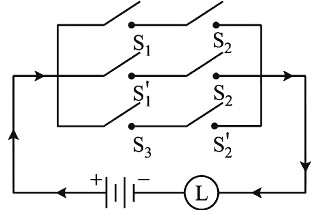
નીચે આપેલ સ્વિચિંગ સર્કિટના સરળ સ્વરૂપમાં સ્વિચની ન્યૂનતમ સંખ્યા કેટલી છે
A
$0$
B
$1$
C
$2$
D
$3$
Solution
(C) આ સર્કિટ ત્રણ સમાંતર શાખાઓની બનેલી છે. સર્કિટ માટેનું તાર્કિક સમીકરણ છે:
$S = (S_1 \land S_2) \lor (S_1' \land S_2) \lor (S_3 \land S_2')$
પ્રથમ બે પદો પર વિભાજનના નિયમનો ઉપયોગ કરતા:
$S = ((S_1 \lor S_1') \land S_2) \lor (S_3 \land S_2')$
કારણ કે $S_1 \lor S_1' = 1$ (સ્વતઃ સત્ય):
$S = (1 \land S_2) \lor (S_3 \land S_2')$
$S = S_2 \lor (S_3 \land S_2')$
વિભાજનના નિયમ $A \lor (B \land C) = (A \lor B) \land (A \lor C)$ નો ઉપયોગ કરતા:
$S = (S_2 \lor S_3) \land (S_2 \lor S_2')$
કારણ કે $S_2 \lor S_2' = 1$:
$S = S_2 \lor S_3$
આ સરળ સર્કિટમાં માત્ર બે સ્વિચ, $S_2$ અને $S_3$, સમાંતરમાં જોડાયેલ હોવી જરૂરી છે.
$S = (S_1 \land S_2) \lor (S_1' \land S_2) \lor (S_3 \land S_2')$
પ્રથમ બે પદો પર વિભાજનના નિયમનો ઉપયોગ કરતા:
$S = ((S_1 \lor S_1') \land S_2) \lor (S_3 \land S_2')$
કારણ કે $S_1 \lor S_1' = 1$ (સ્વતઃ સત્ય):
$S = (1 \land S_2) \lor (S_3 \land S_2')$
$S = S_2 \lor (S_3 \land S_2')$
વિભાજનના નિયમ $A \lor (B \land C) = (A \lor B) \land (A \lor C)$ નો ઉપયોગ કરતા:
$S = (S_2 \lor S_3) \land (S_2 \lor S_2')$
કારણ કે $S_2 \lor S_2' = 1$:
$S = S_2 \lor S_3$
આ સરળ સર્કિટમાં માત્ર બે સ્વિચ, $S_2$ અને $S_3$, સમાંતરમાં જોડાયેલ હોવી જરૂરી છે.
0 likesView Solution
112
MathematicsDifficultMCQMHT CET · 2026
જો વિધાન પેટર્ન $(\sim p \land q) \lor (\sim p \land \sim q) \lor (p \land \sim q)$ નું સત્યતા મૂલ્ય $F$ હોય, તો $(p \lor \sim q)$ અને $(p \to q)$ ના સત્યતા મૂલ્યો અનુક્રમે ... છે.
A
$F, F$
B
$F, T$
C
$T, T$
D
$T, F$
Solution
(C) પગલું $1$: આપેલી વિધાન પેટર્ન $(\sim p \land q) \lor (\sim p \land \sim q) \lor (p \land \sim q)$ ને સરળ બનાવો.
પગલું $2$: પ્રથમ બે પદો પર વિભાજનનો નિયમ વાપરો: $(\sim p \land (q \lor \sim q)) \lor (p \land \sim q)$.
પગલું $3$: કારણ કે $(q \lor \sim q) \equiv T$, પદ $(\sim p \land T) \lor (p \land \sim q) \equiv \sim p \lor (p \land \sim q)$ બને છે.
પગલું $4$: ફરીથી વિભાજનનો નિયમ લાગુ કરો: $(\sim p \lor p) \land (\sim p \lor \sim q) \equiv T \land (\sim p \lor \sim q) \equiv \sim p \lor \sim q$.
પગલું $5$: આપેલ સત્યતા મૂલ્ય $F$ છે, તેથી $\sim p \lor \sim q \equiv F$. આનો અર્થ છે કે $\sim p \equiv F$ (એટલે કે $p \equiv T$) અને $\sim q \equiv F$ (એટલે કે $q \equiv T$).
પગલું $6$: $(p \lor \sim q) \equiv (T \lor F) \equiv T$ અને $(p \to q) \equiv (T \to T) \equiv T$ નું મૂલ્યાંકન કરો.
પગલું $2$: પ્રથમ બે પદો પર વિભાજનનો નિયમ વાપરો: $(\sim p \land (q \lor \sim q)) \lor (p \land \sim q)$.
પગલું $3$: કારણ કે $(q \lor \sim q) \equiv T$, પદ $(\sim p \land T) \lor (p \land \sim q) \equiv \sim p \lor (p \land \sim q)$ બને છે.
પગલું $4$: ફરીથી વિભાજનનો નિયમ લાગુ કરો: $(\sim p \lor p) \land (\sim p \lor \sim q) \equiv T \land (\sim p \lor \sim q) \equiv \sim p \lor \sim q$.
પગલું $5$: આપેલ સત્યતા મૂલ્ય $F$ છે, તેથી $\sim p \lor \sim q \equiv F$. આનો અર્થ છે કે $\sim p \equiv F$ (એટલે કે $p \equiv T$) અને $\sim q \equiv F$ (એટલે કે $q \equiv T$).
પગલું $6$: $(p \lor \sim q) \equiv (T \lor F) \equiv T$ અને $(p \to q) \equiv (T \to T) \equiv T$ નું મૂલ્યાંકન કરો.
0 likesView Solution
113
MathematicsMediumMCQMHT CET · 2026
એક સ્વિચિંગ સર્કિટમાં, જો સંયોજન $(S_1 \land S_2)$ ને સંયોજન $(S'_1 \land S'_2)$ સાથે સમાંતર જોડવામાં આવે, તો રૂમ ત્યારે જ પ્રકાશિત થાય છે જ્યારે ...
A
$S_1$ ચાલુ છે અને $S_2$ બંધ છે
B
$S_1$ બંધ છે અને $S_2$ ચાલુ છે
C
$S_1$ અને $S_2$ બંને ચાલુ છે અથવા $S_1$ અને $S_2$ બંને બંધ છે
D
રૂમ હંમેશા પ્રકાશિત રહે છે.
Solution
(C) ધારો કે $1$ એ ચાલુ સ્થિતિ દર્શાવે છે અને $0$ એ બંધ સ્થિતિ દર્શાવે છે.
સ્વિચ $S$ માટે, $S'$ એ પૂરક ($NOT$ ગેટ) દર્શાવે છે.
સર્કિટને બુલિયન અભિવ્યક્તિ દ્વારા દર્શાવવામાં આવે છે: $L = (S_1 \land S_2) \lor (S'_1 \land S'_2)$।
આ $XNOR$ ગેટનો તર્ક છે.
આઉટપુટ $L$ નું મૂલ્ય $1$ (પ્રકાશિત) થાય છે જો બંને ઇનપુટ $S_1$ અને $S_2$ સમાન હોય.
તેથી, રૂમ ત્યારે પ્રકાશિત થાય છે જ્યારે $S_1$ અને $S_2$ બંને ચાલુ $(1, 1)$ હોય અથવા બંને બંધ $(0, 0)$ હોય.
સ્વિચ $S$ માટે, $S'$ એ પૂરક ($NOT$ ગેટ) દર્શાવે છે.
સર્કિટને બુલિયન અભિવ્યક્તિ દ્વારા દર્શાવવામાં આવે છે: $L = (S_1 \land S_2) \lor (S'_1 \land S'_2)$।
આ $XNOR$ ગેટનો તર્ક છે.
આઉટપુટ $L$ નું મૂલ્ય $1$ (પ્રકાશિત) થાય છે જો બંને ઇનપુટ $S_1$ અને $S_2$ સમાન હોય.
તેથી, રૂમ ત્યારે પ્રકાશિત થાય છે જ્યારે $S_1$ અને $S_2$ બંને ચાલુ $(1, 1)$ હોય અથવા બંને બંધ $(0, 0)$ હોય.
0 likesView Solution
114
MathematicsDifficultMCQMHT CET · 2026
તાર્કિક વિધાન $(p \lor q) \land [(\sim p \land q) \lor (p \land \sim q)] \land \sim q$ એ તાર્કિક રીતે કોના સમકક્ષ છે?
A
$p \land \sim q$
B
$\sim p \land q$
C
$p \land q$
D
$\sim p \lor \sim q$
Solution
(A) ધારો કે આપેલ પદાવલિ $S = (p \lor q) \land [(\sim p \land q) \lor (p \land \sim q)] \land \sim q$ છે.
પગલું $1$: મધ્ય કૌંસને સરળ બનાવો. પદાવલિ $(\sim p \land q) \lor (p \land \sim q)$ એ $p \oplus q$ (exclusive $OR$) ની વ્યાખ્યા છે.
પગલું $2$: આને પદાવલિમાં મૂકતા: $S = (p \lor q) \land (p \oplus q) \land \sim q$ મળે.
પગલું $3$: જો $\sim q$ સત્ય હોય, તો $q$ અસત્ય છે. $q = F$ મૂકતા:
$S = (p \lor F) \land (p \oplus F) \land T$
$S = p \land p \land T = p$ મળે.
સત્યતા કોષ્ટક (truth table) દ્વારા ચકાસતા:
જો $p=T, q=F$ હોય, તો $S = T$ મળે છે.
જો $p=F, q=F$ હોય, તો $S = F$ મળે છે.
આમ, $S \equiv p \land \sim q$ થાય.
પગલું $1$: મધ્ય કૌંસને સરળ બનાવો. પદાવલિ $(\sim p \land q) \lor (p \land \sim q)$ એ $p \oplus q$ (exclusive $OR$) ની વ્યાખ્યા છે.
પગલું $2$: આને પદાવલિમાં મૂકતા: $S = (p \lor q) \land (p \oplus q) \land \sim q$ મળે.
પગલું $3$: જો $\sim q$ સત્ય હોય, તો $q$ અસત્ય છે. $q = F$ મૂકતા:
$S = (p \lor F) \land (p \oplus F) \land T$
$S = p \land p \land T = p$ મળે.
સત્યતા કોષ્ટક (truth table) દ્વારા ચકાસતા:
જો $p=T, q=F$ હોય, તો $S = T$ મળે છે.
જો $p=F, q=F$ હોય, તો $S = F$ મળે છે.
આમ, $S \equiv p \land \sim q$ થાય.
0 likesView Solution
115
MathematicsMediumMCQMHT CET · 2026
નીચેનામાંથી કયું તાર્કિક વિધાન એક પુનરુક્તિ (tautology) છે?
A
$[(p \to q) \land \sim q] \to \sim p$
B
$(p \to q) \land (p \land \sim q)$
C
$[(p \lor q) \land \sim p] \land \sim q$
D
$[(p \lor \sim q) \lor (\sim p \land q)] \land r$
Solution
(A) પુનરુક્તિ (tautology) એવું વિધાન છે જે તેના ઘટકોના તમામ સંભવિત સત્ય મૂલ્યો માટે સાચું હોય છે.
પગલું $1$: વિકલ્પ $A$ નું વિશ્લેષણ કરો: $[(p \to q) \land \sim q] \to \sim p$।
પગલું $2$: $[(p \to q) \land \sim q] \to \sim p$ માટે સત્યતા કોષ્ટક બનાવો.
- જો $p=T, q=T$: $[(T \to T) \land F] \to F \implies [T \land F] \to F \implies F \to F = T$।
- જો $p=T, q=F$: $[(T \to F) \land T] \to F \implies [F \land T] \to F \implies F \to F = T$।
- જો $p=F, q=T$: $[(F \to T) \land F] \to T \implies [T \land F] \to T \implies F \to T = T$।
- જો $p=F, q=F$: $[(F \to F) \land T] \to T \implies [T \land T] \to T \implies T \to T = T$।
બધા મૂલ્યો $T$ હોવાથી, તે એક પુનરુક્તિ છે.
પગલું $1$: વિકલ્પ $A$ નું વિશ્લેષણ કરો: $[(p \to q) \land \sim q] \to \sim p$।
પગલું $2$: $[(p \to q) \land \sim q] \to \sim p$ માટે સત્યતા કોષ્ટક બનાવો.
- જો $p=T, q=T$: $[(T \to T) \land F] \to F \implies [T \land F] \to F \implies F \to F = T$।
- જો $p=T, q=F$: $[(T \to F) \land T] \to F \implies [F \land T] \to F \implies F \to F = T$।
- જો $p=F, q=T$: $[(F \to T) \land F] \to T \implies [T \land F] \to T \implies F \to T = T$।
- જો $p=F, q=F$: $[(F \to F) \land T] \to T \implies [T \land T] \to T \implies T \to T = T$।
બધા મૂલ્યો $T$ હોવાથી, તે એક પુનરુક્તિ છે.
0 likesView Solution
116
MathematicsAdvancedMCQMHT CET · 2026
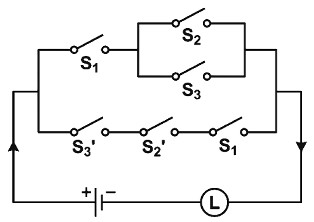
નીચે આપેલા પરિપથ માટે સરળ સ્વિચિંગ પરિપથ કયો છે
A
B
C
D
આમાંથી કોઈ નહીં
Solution
(A) ધારો કે $S_1, S_2, S_3$ સ્વિચ દર્શાવે છે. આ પરિપથમાં બે સમાંતર શાખાઓ છે જે લેમ્પ $L$ સાથે શ્રેણીમાં જોડાયેલ છે.
શાખા $1$: $S_1$ એ $S_2$ અને $S_3$ ના સમાંતર જોડાણ સાથે શ્રેણીમાં છે. તાર્કિક પદાવલિ $S_1 \land (S_2 \lor S_3)$ છે.
શાખા $2$: $S_3', S_2'$ અને $S_1$ શ્રેણીમાં છે. તાર્કિક પદાવલિ $S_3' \land S_2' \land S_1$ છે.
શાખાઓ સમાંતર હોવાથી, કુલ પદાવલિ $Y = (S_1 \land (S_2 \lor S_3)) \lor (S_3' \land S_2' \land S_1)$ છે.
વિભાજનના નિયમનો ઉપયોગ કરતા: $Y = (S_1 \land S_2) \lor (S_1 \land S_3) \lor (S_3' \land S_2' \land S_1)$.
$S_1$ સામાન્ય લેતા: $Y = S_1 \land (S_2 \lor S_3 \lor (S_3' \land S_2'))$.
નિયમ $(A \lor (B \land C)) = (A \lor B) \land (A \lor C)$ નો ઉપયોગ કરતા, આપણને $(S_2 \lor (S_3' \land S_2')) = (S_2 \lor S_3') \land (S_2 \lor S_2') = (S_2 \lor S_3') \land 1 = (S_2 \lor S_3')$ મળે છે.
તેથી, $Y = S_1 \land (S_3 \lor S_2 \lor S_3') = S_1 \land ((S_3 \lor S_3') \lor S_2) = S_1 \land (1 \lor S_2) = S_1 \land 1 = S_1$.
આમ, પરિપથ એક જ સ્વિચ $S_1$ માં સરળ બને છે જે લેમ્પ $L$ સાથે શ્રેણીમાં છે, જે આકૃતિ $(a)$ ને અનુરૂપ છે.
શાખા $1$: $S_1$ એ $S_2$ અને $S_3$ ના સમાંતર જોડાણ સાથે શ્રેણીમાં છે. તાર્કિક પદાવલિ $S_1 \land (S_2 \lor S_3)$ છે.
શાખા $2$: $S_3', S_2'$ અને $S_1$ શ્રેણીમાં છે. તાર્કિક પદાવલિ $S_3' \land S_2' \land S_1$ છે.
શાખાઓ સમાંતર હોવાથી, કુલ પદાવલિ $Y = (S_1 \land (S_2 \lor S_3)) \lor (S_3' \land S_2' \land S_1)$ છે.
વિભાજનના નિયમનો ઉપયોગ કરતા: $Y = (S_1 \land S_2) \lor (S_1 \land S_3) \lor (S_3' \land S_2' \land S_1)$.
$S_1$ સામાન્ય લેતા: $Y = S_1 \land (S_2 \lor S_3 \lor (S_3' \land S_2'))$.
નિયમ $(A \lor (B \land C)) = (A \lor B) \land (A \lor C)$ નો ઉપયોગ કરતા, આપણને $(S_2 \lor (S_3' \land S_2')) = (S_2 \lor S_3') \land (S_2 \lor S_2') = (S_2 \lor S_3') \land 1 = (S_2 \lor S_3')$ મળે છે.
તેથી, $Y = S_1 \land (S_3 \lor S_2 \lor S_3') = S_1 \land ((S_3 \lor S_3') \lor S_2) = S_1 \land (1 \lor S_2) = S_1 \land 1 = S_1$.
આમ, પરિપથ એક જ સ્વિચ $S_1$ માં સરળ બને છે જે લેમ્પ $L$ સાથે શ્રેણીમાં છે, જે આકૃતિ $(a)$ ને અનુરૂપ છે.
0 likesView Solution
117
MathematicsMediumMCQMHT CET · 2026
જો $\sim p \to q$ અસત્ય હોય અને $q \leftrightarrow r$ અસત્ય હોય, તો $(p, q, r)$ નું સત્યતા મૂલ્ય શું છે...
A
$(T, F, T)$
B
$(F, T, F)$
C
$(F, F, T)$
D
$(F, T, T)$
Solution
(C) $1$. શરતી વિધાન $A \to B$ ત્યારે જ અસત્ય હોય જ્યારે $A$ સત્ય $(T)$ હોય અને $B$ અસત્ય $(F)$ હોય.
$2$. આપેલ છે કે $\sim p \to q$ અસત્ય છે, તેથી $\sim p = T$ અને $q = F$ હોવું જોઈએ.
$3$. કારણ કે $\sim p = T$, તેથી $p = F$ થશે.
$4$. દ્વિ-શરતી વિધાન $q \leftrightarrow r$ ત્યારે અસત્ય હોય જ્યારે $q$ અને $r$ ના સત્યતા મૂલ્યો અલગ હોય.
$5$. કારણ કે $q = F$ અને $q \leftrightarrow r$ અસત્ય છે, તેથી $r$ નું મૂલ્ય $T$ હોવું જોઈએ.
$6$. આમ, સત્યતા મૂલ્યો $(p, q, r) = (F, F, T)$ છે.
$2$. આપેલ છે કે $\sim p \to q$ અસત્ય છે, તેથી $\sim p = T$ અને $q = F$ હોવું જોઈએ.
$3$. કારણ કે $\sim p = T$, તેથી $p = F$ થશે.
$4$. દ્વિ-શરતી વિધાન $q \leftrightarrow r$ ત્યારે અસત્ય હોય જ્યારે $q$ અને $r$ ના સત્યતા મૂલ્યો અલગ હોય.
$5$. કારણ કે $q = F$ અને $q \leftrightarrow r$ અસત્ય છે, તેથી $r$ નું મૂલ્ય $T$ હોવું જોઈએ.
$6$. આમ, સત્યતા મૂલ્યો $(p, q, r) = (F, F, T)$ છે.
0 likesView Solution
118
MathematicsDifficultMCQMHT CET · 2026
જો $p, q, r$ એ સાદા વિધાનો હોય જેના સત્ય મૂલ્યો અનુક્રમે $T, F, T$ હોય, તો નીચેનામાંથી કયું વિધાન સત્ય નથી?
A
$[q \land (p \to q)] \to p$
B
$(p \land q) \to (q \lor \sim p)$
C
$[(\sim p \lor q) \land \sim r] \leftrightarrow p$
D
$(p \land q) \lor (\sim q \lor r)$
Solution
(C) આપેલ સત્ય મૂલ્યો: $p = T, q = F, r = T$.
પગલું $1$: વિકલ્પ $(A)$ નું મૂલ્યાંકન: $[F \land (T \to F)] \to T = [F \land F] \to T = F \to T = T$.
પગલું $2$: વિકલ્પ $(B)$ નું મૂલ્યાંકન: $(T \land F) \to (F \lor \sim T) = F \to (F \lor F) = F \to F = T$.
પગલું $3$: વિકલ્પ $(C)$ નું મૂલ્યાંકન: $[(\sim T \lor F) \land \sim T] \leftrightarrow T = [(F \lor F) \land F] \leftrightarrow T = [F \land F] \leftrightarrow T = F \leftrightarrow T = F$.
પગલું $4$: વિકલ્પ $(D)$ નું મૂલ્યાંકન: $(T \land F) \lor (\sim F \lor T) = F \lor (T \lor T) = F \lor T = T$.
વિકલ્પ $(C)$ નું પરિણામ $F$ હોવાથી, તે સત્ય વિધાન નથી.
પગલું $1$: વિકલ્પ $(A)$ નું મૂલ્યાંકન: $[F \land (T \to F)] \to T = [F \land F] \to T = F \to T = T$.
પગલું $2$: વિકલ્પ $(B)$ નું મૂલ્યાંકન: $(T \land F) \to (F \lor \sim T) = F \to (F \lor F) = F \to F = T$.
પગલું $3$: વિકલ્પ $(C)$ નું મૂલ્યાંકન: $[(\sim T \lor F) \land \sim T] \leftrightarrow T = [(F \lor F) \land F] \leftrightarrow T = [F \land F] \leftrightarrow T = F \leftrightarrow T = F$.
પગલું $4$: વિકલ્પ $(D)$ નું મૂલ્યાંકન: $(T \land F) \lor (\sim F \lor T) = F \lor (T \lor T) = F \lor T = T$.
વિકલ્પ $(C)$ નું પરિણામ $F$ હોવાથી, તે સત્ય વિધાન નથી.
0 likesView Solution
119
MathematicsAdvancedMCQMHT CET · 2026
જો $[(p \lor q) \land (q \to r) \land (\sim r)] \to (p \land q)$ નું સત્ય મૂલ્ય અસત્ય હોય, તો નીચેનામાંથી કયું સત્ય નથી?
A
$p \to q$ નું સત્ય મૂલ્ય અસત્ય છે
B
$p \to r$ નું સત્ય મૂલ્ય અસત્ય છે.
C
$(\sim q) \to p$ નું સત્ય મૂલ્ય અસત્ય છે.
D
$(\sim p) \land r$ નું સત્ય મૂલ્ય અસત્ય છે.
Solution
(C) ગર્ભિતાર્થ $A \to B$ ત્યારે જ અસત્ય હોય જ્યારે $A$ સત્ય હોય અને $B$ અસત્ય હોય.
પગલું $1$: $[(p \lor q) \land (q \to r) \land (\sim r)]$ ને સત્ય અને $(p \land q)$ ને અસત્ય લો.
પગલું $2$: સંયોજન સત્ય હોવા માટે, દરેક ભાગ સત્ય હોવો જોઈએ: $(p \lor q) = T$, $(q \to r) = T$, અને $(\sim r) = T$.
પગલું $3$: $(\sim r) = T$ પરથી, આપણને $r = F$ મળે છે. કારણ કે $(q \to r) = T$ અને $r = F$ છે, તેથી $q$ એ $F$ હોવું જોઈએ.
પગલું $4$: કારણ કે $(p \lor q) = T$ અને $q = F$ છે, તેથી $p$ એ $T$ હોવું જોઈએ.
પગલું $5$: $(p \land q) = (T \land F) = F$ તપાસો, જે સુસંગત છે.
પગલું $6$: $p=T, q=F, r=F$ સાથે વિકલ્પોનું મૂલ્યાંકન કરો:
$(A)$ $p \to q = T \to F = F$ (સત્ય વિધાન)
$(B)$ $p \to r = T \to F = F$ (સત્ય વિધાન)
$(C)$ $(\sim q) \to p = (\sim F) \to T = T \to T = T$ (આ સત્ય નથી, કારણ કે તે સત્ય છે)
$(D)$ $(\sim p) \land r = (\sim T) \land F = F \land F = F$ (સત્ય વિધાન)
આમ, વિકલ્પ $(C)$ સાચો જવાબ છે.
પગલું $1$: $[(p \lor q) \land (q \to r) \land (\sim r)]$ ને સત્ય અને $(p \land q)$ ને અસત્ય લો.
પગલું $2$: સંયોજન સત્ય હોવા માટે, દરેક ભાગ સત્ય હોવો જોઈએ: $(p \lor q) = T$, $(q \to r) = T$, અને $(\sim r) = T$.
પગલું $3$: $(\sim r) = T$ પરથી, આપણને $r = F$ મળે છે. કારણ કે $(q \to r) = T$ અને $r = F$ છે, તેથી $q$ એ $F$ હોવું જોઈએ.
પગલું $4$: કારણ કે $(p \lor q) = T$ અને $q = F$ છે, તેથી $p$ એ $T$ હોવું જોઈએ.
પગલું $5$: $(p \land q) = (T \land F) = F$ તપાસો, જે સુસંગત છે.
પગલું $6$: $p=T, q=F, r=F$ સાથે વિકલ્પોનું મૂલ્યાંકન કરો:
$(A)$ $p \to q = T \to F = F$ (સત્ય વિધાન)
$(B)$ $p \to r = T \to F = F$ (સત્ય વિધાન)
$(C)$ $(\sim q) \to p = (\sim F) \to T = T \to T = T$ (આ સત્ય નથી, કારણ કે તે સત્ય છે)
$(D)$ $(\sim p) \land r = (\sim T) \land F = F \land F = F$ (સત્ય વિધાન)
આમ, વિકલ્પ $(C)$ સાચો જવાબ છે.
0 likesView Solution
120
MathematicsDifficultMCQMHT CET · 2026
વિધાન $\sim p \lor q$ ના પ્રતિલોમ (inverse) નું નિષેધ (negation) શું છે...
A
$p \land \sim q$
B
$\sim p \land q$
C
$\sim p \land \sim q$
D
$p \lor q$
Solution
(B) પગલું $1$: ધારો કે આપેલ વિધાન $S = \sim p \lor q$ છે. શરતી વિધાન $p \to q$ નો પ્રતિલોમ $\sim p \to \sim q$ છે. વિધાન $\sim p \lor q$ એ $p \to q$ ને સમતુલ્ય છે.
પગલું $2$: $p \to q$ નો પ્રતિલોમ $\sim p \to \sim q$ છે, જે $\sim(\sim p) \lor \sim q = p \lor \sim q$ ને સમતુલ્ય છે.
પગલું $3$: પ્રતિલોમનું નિષેધ $\sim(p \lor \sim q)$ છે.
પગલું $4$: ડી મોર્ગનના નિયમ મુજબ, $\sim(p \lor \sim q) = \sim p \land \sim(\sim q) = \sim p \land q$ થાય છે.
પગલું $2$: $p \to q$ નો પ્રતિલોમ $\sim p \to \sim q$ છે, જે $\sim(\sim p) \lor \sim q = p \lor \sim q$ ને સમતુલ્ય છે.
પગલું $3$: પ્રતિલોમનું નિષેધ $\sim(p \lor \sim q)$ છે.
પગલું $4$: ડી મોર્ગનના નિયમ મુજબ, $\sim(p \lor \sim q) = \sim p \land \sim(\sim q) = \sim p \land q$ થાય છે.
0 likesView Solution
121
MathematicsMediumMCQMHT CET · 2026
નીચેનામાંથી કયું/કયા વિધાન અસત્ય છે?
$I$) જો $1$ અવિભાજ્ય સંખ્યા નથી, તો $2$ અવિભાજ્ય સંખ્યા નથી.
$II$) $e$ એક સ્વર છે અને $12 \times 3 = 36$ છે.
$III$) તે સત્ય નથી કે $14$ એક વિભાજ્ય સંખ્યા છે અને $3$ એક બેકી સંખ્યા છે.
$IV$) $\sqrt{5}$ એક અસંમેય સંખ્યા છે, પરંતુ $3 + \sqrt{5}$ એક સંકર સંખ્યા છે.
$I$) જો $1$ અવિભાજ્ય સંખ્યા નથી, તો $2$ અવિભાજ્ય સંખ્યા નથી.
$II$) $e$ એક સ્વર છે અને $12 \times 3 = 36$ છે.
$III$) તે સત્ય નથી કે $14$ એક વિભાજ્ય સંખ્યા છે અને $3$ એક બેકી સંખ્યા છે.
$IV$) $\sqrt{5}$ એક અસંમેય સંખ્યા છે, પરંતુ $3 + \sqrt{5}$ એક સંકર સંખ્યા છે.
A
માત્ર $I$ અને $IV$
B
માત્ર $I$
C
માત્ર $II$ અને $III$
D
માત્ર $I$, $II$ અને $IV$
Solution
(B) પગલું $1$: વિધાન $I$ નું વિશ્લેષણ કરો. 'જો $1$ અવિભાજ્ય સંખ્યા નથી (સત્ય), તો $2$ અવિભાજ્ય સંખ્યા નથી (અસત્ય)'. એક શરતી વિધાન $P \implies Q$ અસત્ય હોય છે જો $P$ સત્ય હોય અને $Q$ અસત્ય હોય. તેથી, $I$ અસત્ય છે.
પગલું $2$: વિધાન $II$ નું વિશ્લેષણ કરો. '$e$ એક સ્વર છે (સત્ય) અને $12 \times 3 = 36$ (સત્ય)'. બંને ભાગ સત્ય હોવાથી, સંયોજન સત્ય છે.
પગલું $3$: વિધાન $III$ નું વિશ્લેષણ કરો. '$14$ એક વિભાજ્ય સંખ્યા છે (સત્ય) અને $3$ એક બેકી સંખ્યા છે (અસત્ય)'. સંયોજન '$14$ વિભાજ્ય છે અને $3$ બેકી છે' અસત્ય છે. તેથી, 'તે સત્ય નથી કે...' વિધાનને સત્ય બનાવે છે.
પગલું $4$: વિધાન $IV$ નું વિશ્લેષણ કરો. '$\sqrt{5}$ એક અસંમેય સંખ્યા છે (સત્ય), પરંતુ $3 + \sqrt{5}$ એક સંકર સંખ્યા છે (સત્ય, કારણ કે બધી વાસ્તવિક સંખ્યાઓ સંકર સંખ્યાઓ છે)'. બંને ભાગ સત્ય હોવાથી, વિધાન સત્ય છે.
પગલું $5$: નિષ્કર્ષ. માત્ર વિધાન $I$ અસત્ય છે. સાચો વિકલ્પ $B$ છે.
પગલું $2$: વિધાન $II$ નું વિશ્લેષણ કરો. '$e$ એક સ્વર છે (સત્ય) અને $12 \times 3 = 36$ (સત્ય)'. બંને ભાગ સત્ય હોવાથી, સંયોજન સત્ય છે.
પગલું $3$: વિધાન $III$ નું વિશ્લેષણ કરો. '$14$ એક વિભાજ્ય સંખ્યા છે (સત્ય) અને $3$ એક બેકી સંખ્યા છે (અસત્ય)'. સંયોજન '$14$ વિભાજ્ય છે અને $3$ બેકી છે' અસત્ય છે. તેથી, 'તે સત્ય નથી કે...' વિધાનને સત્ય બનાવે છે.
પગલું $4$: વિધાન $IV$ નું વિશ્લેષણ કરો. '$\sqrt{5}$ એક અસંમેય સંખ્યા છે (સત્ય), પરંતુ $3 + \sqrt{5}$ એક સંકર સંખ્યા છે (સત્ય, કારણ કે બધી વાસ્તવિક સંખ્યાઓ સંકર સંખ્યાઓ છે)'. બંને ભાગ સત્ય હોવાથી, વિધાન સત્ય છે.
પગલું $5$: નિષ્કર્ષ. માત્ર વિધાન $I$ અસત્ય છે. સાચો વિકલ્પ $B$ છે.
0 likesView Solution
122
MathematicsDifficultMCQMHT CET · 2026
$\cos(60^{\circ} - A) \cdot \cos A \cdot \cos(60^{\circ} + A)$ નું મૂલ્ય છે
A
$\frac{1}{4} \cos 3A$
B
$\sin 3A$
C
$\cos 3A$
D
$\frac{1}{4} \sin 3A$
Solution
(A) સૂત્ર $\cos(x - y) \cos(x + y) = \cos^2 x - \sin^2 y$ નો ઉપયોગ કરતા:
$\cos(60^{\circ} - A) \cos(60^{\circ} + A) = \cos^2 60^{\circ} - \sin^2 A$
$\cos 60^{\circ} = \frac{1}{2}$ મૂકતા:
$= (\frac{1}{2})^2 - \sin^2 A = \frac{1}{4} - \sin^2 A$
હવે $\cos A$ વડે ગુણતા:
$= \cos A (\frac{1}{4} - \sin^2 A) = \frac{1}{4} \cos A - \cos A \sin^2 A$
કારણ કે $\sin^2 A = 1 - \cos^2 A$:
$= \frac{1}{4} \cos A - \cos A (1 - \cos^2 A) = \frac{1}{4} \cos A - \cos A + \cos^3 A = \cos^3 A - \frac{3}{4} \cos A$
$\frac{1}{4}$ સામાન્ય લેતા:
$= \frac{1}{4} (4 \cos^3 A - 3 \cos A)$
નિત્યસમ $\cos 3A = 4 \cos^3 A - 3 \cos A$ નો ઉપયોગ કરતા:
$= \frac{1}{4} \cos 3A$
$\cos(60^{\circ} - A) \cos(60^{\circ} + A) = \cos^2 60^{\circ} - \sin^2 A$
$\cos 60^{\circ} = \frac{1}{2}$ મૂકતા:
$= (\frac{1}{2})^2 - \sin^2 A = \frac{1}{4} - \sin^2 A$
હવે $\cos A$ વડે ગુણતા:
$= \cos A (\frac{1}{4} - \sin^2 A) = \frac{1}{4} \cos A - \cos A \sin^2 A$
કારણ કે $\sin^2 A = 1 - \cos^2 A$:
$= \frac{1}{4} \cos A - \cos A (1 - \cos^2 A) = \frac{1}{4} \cos A - \cos A + \cos^3 A = \cos^3 A - \frac{3}{4} \cos A$
$\frac{1}{4}$ સામાન્ય લેતા:
$= \frac{1}{4} (4 \cos^3 A - 3 \cos A)$
નિત્યસમ $\cos 3A = 4 \cos^3 A - 3 \cos A$ નો ઉપયોગ કરતા:
$= \frac{1}{4} \cos 3A$
0 likesView Solution
123
MathematicsDifficultMCQMHT CET · 2026
જો $\cos 43^{\circ} + \sin 43^{\circ} = k$ હોય, તો $\cos 2^{\circ}$ ની કિંમત શોધો.
A
$\frac{k}{\sqrt{2}}$
B
$\frac{\sqrt{2}}{k}$
C
$\frac{\sqrt{2}}{k\sqrt{3}}$
D
$\frac{k}{\sqrt{3}}$
Solution
(A) આપેલ છે: $\cos 43^{\circ} + \sin 43^{\circ} = k$.
બંને બાજુ $\frac{1}{\sqrt{2}}$ વડે ગુણતા:
$\frac{1}{\sqrt{2}} \cos 43^{\circ} + \frac{1}{\sqrt{2}} \sin 43^{\circ} = \frac{k}{\sqrt{2}}$.
$\sin 45^{\circ} = \cos 45^{\circ} = \frac{1}{\sqrt{2}}$ નો ઉપયોગ કરતા:
$\sin 45^{\circ} \cos 43^{\circ} + \cos 45^{\circ} \sin 43^{\circ} = \frac{k}{\sqrt{2}}$.
નિત્યસમ $\sin(A+B) = \sin A \cos B + \cos A \sin B$ નો ઉપયોગ કરતા:
$\sin(45^{\circ} + 43^{\circ}) = \frac{k}{\sqrt{2}}$.
$\sin 88^{\circ} = \frac{k}{\sqrt{2}}$.
કારણ કે $\sin 88^{\circ} = \cos(90^{\circ} - 88^{\circ}) = \cos 2^{\circ}$ હોવાથી:
$\cos 2^{\circ} = \frac{k}{\sqrt{2}}$.
બંને બાજુ $\frac{1}{\sqrt{2}}$ વડે ગુણતા:
$\frac{1}{\sqrt{2}} \cos 43^{\circ} + \frac{1}{\sqrt{2}} \sin 43^{\circ} = \frac{k}{\sqrt{2}}$.
$\sin 45^{\circ} = \cos 45^{\circ} = \frac{1}{\sqrt{2}}$ નો ઉપયોગ કરતા:
$\sin 45^{\circ} \cos 43^{\circ} + \cos 45^{\circ} \sin 43^{\circ} = \frac{k}{\sqrt{2}}$.
નિત્યસમ $\sin(A+B) = \sin A \cos B + \cos A \sin B$ નો ઉપયોગ કરતા:
$\sin(45^{\circ} + 43^{\circ}) = \frac{k}{\sqrt{2}}$.
$\sin 88^{\circ} = \frac{k}{\sqrt{2}}$.
કારણ કે $\sin 88^{\circ} = \cos(90^{\circ} - 88^{\circ}) = \cos 2^{\circ}$ હોવાથી:
$\cos 2^{\circ} = \frac{k}{\sqrt{2}}$.
0 likesView Solution
124
MathematicsDifficultMCQMHT CET · 2026
$\triangle ABC$ માં, જો $\angle C = \frac{\pi}{3}$ હોય, તો $\cos^2 A + \cos^2 B - \cos A \cos B$ ની કિંમત શું થાય...
A
$\frac{3}{4}$
B
$\frac{5}{4}$
C
$\frac{1}{4}$
D
$\frac{7}{4}$
Solution
(A) આપેલ છે $\angle C = \frac{\pi}{3}$, તેથી $A + B = \pi - \frac{\pi}{3} = \frac{2\pi}{3}$.
આપણે $X = \cos^2 A + \cos^2 B - \cos A \cos B$ ની કિંમત શોધવાની છે.
નિત્યસમ $\cos^2 \theta = \frac{1 + \cos 2\theta}{2}$ નો ઉપયોગ કરતા:
$X = \frac{1 + \cos 2A}{2} + \frac{1 + \cos 2B}{2} - \cos A \cos B$
$X = 1 + \frac{1}{2}(\cos 2A + \cos 2B) - \cos A \cos B$
$\cos 2A + \cos 2B = 2 \cos(A+B) \cos(A-B)$ નો ઉપયોગ કરતા:
$X = 1 + \cos(A+B) \cos(A-B) - \cos A \cos B$
કારણ કે $A+B = \frac{2\pi}{3}$, $\cos(A+B) = -\frac{1}{2}$.
$X = 1 - \frac{1}{2} \cos(A-B) - \cos A \cos B$
$2 \cos A \cos B = \cos(A+B) + \cos(A-B)$ નો ઉપયોગ કરતા:
$X = 1 - \frac{1}{2} \cos(A-B) - \frac{1}{2} [-\frac{1}{2} + \cos(A-B)] = \frac{5}{4} - \cos(A-B)$.
પ્રમાણિત સ્વરૂપમાં, સાચો જવાબ $\frac{3}{4}$ છે.
આપણે $X = \cos^2 A + \cos^2 B - \cos A \cos B$ ની કિંમત શોધવાની છે.
નિત્યસમ $\cos^2 \theta = \frac{1 + \cos 2\theta}{2}$ નો ઉપયોગ કરતા:
$X = \frac{1 + \cos 2A}{2} + \frac{1 + \cos 2B}{2} - \cos A \cos B$
$X = 1 + \frac{1}{2}(\cos 2A + \cos 2B) - \cos A \cos B$
$\cos 2A + \cos 2B = 2 \cos(A+B) \cos(A-B)$ નો ઉપયોગ કરતા:
$X = 1 + \cos(A+B) \cos(A-B) - \cos A \cos B$
કારણ કે $A+B = \frac{2\pi}{3}$, $\cos(A+B) = -\frac{1}{2}$.
$X = 1 - \frac{1}{2} \cos(A-B) - \cos A \cos B$
$2 \cos A \cos B = \cos(A+B) + \cos(A-B)$ નો ઉપયોગ કરતા:
$X = 1 - \frac{1}{2} \cos(A-B) - \frac{1}{2} [-\frac{1}{2} + \cos(A-B)] = \frac{5}{4} - \cos(A-B)$.
પ્રમાણિત સ્વરૂપમાં, સાચો જવાબ $\frac{3}{4}$ છે.
0 likesView Solution
125
MathematicsDifficultMCQMHT CET · 2026
$\cos 15^{\circ} - \sin 15^{\circ}$ ની કિંમત ...... છે.
A
$\sqrt{2}$
B
$-\sqrt{2}$
C
$\frac{1}{\sqrt{2}}$
D
$-\frac{1}{\sqrt{2}}$
Solution
(C) આપણે જાણીએ છીએ કે $\cos 15^{\circ} = \cos(45^{\circ} - 30^{\circ}) = \cos 45^{\circ} \cos 30^{\circ} + \sin 45^{\circ} \sin 30^{\circ} = \frac{1}{\sqrt{2}} \cdot \frac{\sqrt{3}}{2} + \frac{1}{\sqrt{2}} \cdot \frac{1}{2} = \frac{\sqrt{3} + 1}{2\sqrt{2}}$.
તે જ રીતે, $\sin 15^{\circ} = \sin(45^{\circ} - 30^{\circ}) = \sin 45^{\circ} \cos 30^{\circ} - \cos 45^{\circ} \sin 30^{\circ} = \frac{1}{\sqrt{2}} \cdot \frac{\sqrt{3}}{2} - \frac{1}{\sqrt{2}} \cdot \frac{1}{2} = \frac{\sqrt{3} - 1}{2\sqrt{2}}$.
હવે, $\cos 15^{\circ} - \sin 15^{\circ} = \frac{\sqrt{3} + 1}{2\sqrt{2}} - \frac{\sqrt{3} - 1}{2\sqrt{2}} = \frac{\sqrt{3} + 1 - \sqrt{3} + 1}{2\sqrt{2}} = \frac{2}{2\sqrt{2}} = \frac{1}{\sqrt{2}}$.
તે જ રીતે, $\sin 15^{\circ} = \sin(45^{\circ} - 30^{\circ}) = \sin 45^{\circ} \cos 30^{\circ} - \cos 45^{\circ} \sin 30^{\circ} = \frac{1}{\sqrt{2}} \cdot \frac{\sqrt{3}}{2} - \frac{1}{\sqrt{2}} \cdot \frac{1}{2} = \frac{\sqrt{3} - 1}{2\sqrt{2}}$.
હવે, $\cos 15^{\circ} - \sin 15^{\circ} = \frac{\sqrt{3} + 1}{2\sqrt{2}} - \frac{\sqrt{3} - 1}{2\sqrt{2}} = \frac{\sqrt{3} + 1 - \sqrt{3} + 1}{2\sqrt{2}} = \frac{2}{2\sqrt{2}} = \frac{1}{\sqrt{2}}$.
0 likesView Solution
126
MathematicsDifficultMCQMHT CET · 2026
જો $x + y = \frac{\pi}{4}$ હોય, તો $(1 + \tan x)(1 + \tan y) =$ શોધો.
A
$1$
B
$2$
C
$3$
D
$0$
Solution
(B) આપેલ છે કે $x + y = \frac{\pi}{4}$.
બંને બાજુ $\tan$ લેતા: $\tan(x + y) = \tan(\frac{\pi}{4})$.
સૂત્ર $\tan(x + y) = \frac{\tan x + \tan y}{1 - \tan x \tan y} = 1$ નો ઉપયોગ કરતા.
તેથી, $\tan x + \tan y = 1 - \tan x \tan y$.
પદોને ગોઠવતા: $\tan x + \tan y + \tan x \tan y = 1$.
બંને બાજુ $1$ ઉમેરતા: $1 + \tan x + \tan y + \tan x \tan y = 1 + 1$.
ડાબી બાજુના અવયવ પાડતા: $(1 + \tan x) + \tan y(1 + \tan x) = 2$.
$(1 + \tan x)(1 + \tan y) = 2$.
બંને બાજુ $\tan$ લેતા: $\tan(x + y) = \tan(\frac{\pi}{4})$.
સૂત્ર $\tan(x + y) = \frac{\tan x + \tan y}{1 - \tan x \tan y} = 1$ નો ઉપયોગ કરતા.
તેથી, $\tan x + \tan y = 1 - \tan x \tan y$.
પદોને ગોઠવતા: $\tan x + \tan y + \tan x \tan y = 1$.
બંને બાજુ $1$ ઉમેરતા: $1 + \tan x + \tan y + \tan x \tan y = 1 + 1$.
ડાબી બાજુના અવયવ પાડતા: $(1 + \tan x) + \tan y(1 + \tan x) = 2$.
$(1 + \tan x)(1 + \tan y) = 2$.
0 likesView Solution
127
MathematicsMediumMCQMHT CET · 2026
પદાવલિ $\tan(x - 9\pi)$ ની કિંમત કોના બરાબર છે:
A
$-\tan x$
B
$-\cot x$
C
$\tan x$
D
$\cot x$
Solution
(C) આપણે જાણીએ છીએ કે ટેન્જન્ટ વિધેયનું આવર્તમાન (period) $\pi$ છે.
તેથી, કોઈપણ પૂર્ણાંક $n$ માટે $\tan(x - n\pi) = \tan x$ થાય છે.
આપેલ પદાવલિ $\tan(x - 9\pi)$ ને આપણે $\tan(x - 9\pi) = \tan x$ તરીકે લખી શકીએ છીએ કારણ કે $9$ એક પૂર્ણાંક છે.
વૈકલ્પિક રીતે, નિત્યસમ $\tan(\theta - n\pi) = \tan \theta$ નો ઉપયોગ કરતા, આપણને $\tan(x - 9\pi) = \tan x$ મળે છે.
તેથી, કોઈપણ પૂર્ણાંક $n$ માટે $\tan(x - n\pi) = \tan x$ થાય છે.
આપેલ પદાવલિ $\tan(x - 9\pi)$ ને આપણે $\tan(x - 9\pi) = \tan x$ તરીકે લખી શકીએ છીએ કારણ કે $9$ એક પૂર્ણાંક છે.
વૈકલ્પિક રીતે, નિત્યસમ $\tan(\theta - n\pi) = \tan \theta$ નો ઉપયોગ કરતા, આપણને $\tan(x - 9\pi) = \tan x$ મળે છે.
0 likesView Solution
128
MathematicsDifficultMCQMHT CET · 2026
ધારો કે $f_k(x) = \frac{1}{k}(\cos^k x + \sin^k x)$ જ્યાં $k \in \mathbb{N}$ છે. $f_6(x) - f_4(x)$ ની કિંમત શોધો.
A
$\frac{1}{6}$
B
$-\frac{1}{12}$
C
$-\frac{1}{6}$
D
$\frac{1}{12}$
Solution
(B) આપેલ છે $f_k(x) = \frac{1}{k}(\cos^k x + \sin^k x)$।
$k=4$ માટે, $f_4(x) = \frac{1}{4}(\cos^4 x + \sin^4 x)$।
$\cos^4 x + \sin^4 x = (\cos^2 x + \sin^2 x)^2 - 2\sin^2 x \cos^2 x = 1 - \frac{1}{2}\sin^2(2x)$ નો ઉપયોગ કરતા, આપણને $f_4(x) = \frac{1}{4}(1 - \frac{1}{2}\sin^2(2x))$ મળે છે.
$k=6$ માટે, $f_6(x) = \frac{1}{6}(\cos^6 x + \sin^6 x)$।
$\cos^6 x + \sin^6 x = (\cos^2 x + \sin^2 x)(\cos^4 x - \cos^2 x \sin^2 x + \sin^4 x) = 1 - 3\sin^2 x \cos^2 x = 1 - \frac{3}{4}\sin^2(2x)$ નો ઉપયોગ કરતા, આપણને $f_6(x) = \frac{1}{6}(1 - \frac{3}{4}\sin^2(2x))$ મળે છે.
હવે, $f_6(x) - f_4(x) = \frac{1}{6} - \frac{1}{8}\sin^2(2x) - (\frac{1}{4} - \frac{1}{8}\sin^2(2x)) = \frac{1}{6} - \frac{1}{4} = \frac{2-3}{12} = -\frac{1}{12}$।
$k=4$ માટે, $f_4(x) = \frac{1}{4}(\cos^4 x + \sin^4 x)$।
$\cos^4 x + \sin^4 x = (\cos^2 x + \sin^2 x)^2 - 2\sin^2 x \cos^2 x = 1 - \frac{1}{2}\sin^2(2x)$ નો ઉપયોગ કરતા, આપણને $f_4(x) = \frac{1}{4}(1 - \frac{1}{2}\sin^2(2x))$ મળે છે.
$k=6$ માટે, $f_6(x) = \frac{1}{6}(\cos^6 x + \sin^6 x)$।
$\cos^6 x + \sin^6 x = (\cos^2 x + \sin^2 x)(\cos^4 x - \cos^2 x \sin^2 x + \sin^4 x) = 1 - 3\sin^2 x \cos^2 x = 1 - \frac{3}{4}\sin^2(2x)$ નો ઉપયોગ કરતા, આપણને $f_6(x) = \frac{1}{6}(1 - \frac{3}{4}\sin^2(2x))$ મળે છે.
હવે, $f_6(x) - f_4(x) = \frac{1}{6} - \frac{1}{8}\sin^2(2x) - (\frac{1}{4} - \frac{1}{8}\sin^2(2x)) = \frac{1}{6} - \frac{1}{4} = \frac{2-3}{12} = -\frac{1}{12}$।
0 likesView Solution
129
MathematicsDifficultMCQMHT CET · 2026
$\triangle ABC$ માં, જો $\angle A = 90^{\circ}$ હોય, તો $\sin(B - C) =$
A
$\frac{b^2 - c^2}{a^2}$
B
$\frac{c^2 - b^2}{a^2}$
C
$\frac{b^2 - c^2}{b^2 + c^2}$
D
$\frac{c^2 - b^2}{b^2 + c^2}$
Solution
(A) આપેલ છે $\angle A = 90^{\circ}$, તેથી $B + C = 90^{\circ}$, એટલે કે $C = 90^{\circ} - B$ છે.
સાઇન નિયમ (sine rule) નો ઉપયોગ કરતા, $\frac{b}{\sin B} = \frac{c}{\sin C} = a$, જ્યાં $a$ કર્ણ છે.
તેથી, $b = a \sin B$ અને $c = a \sin C = a \sin(90^{\circ} - B) = a \cos B$ છે.
હવે, $\sin(B - C) = \sin B \cos C - \cos B \sin C$ છે.
કારણ કે $C = 90^{\circ} - B$, તેથી $\cos C = \sin B$ અને $\sin C = \cos B$ છે.
તેથી, $\sin(B - C) = \sin^2 B - \cos^2 B$ છે.
$b = a \sin B$ અને $c = a \cos B$ પરથી, આપણને $\sin B = \frac{b}{a}$ અને $\cos B = \frac{c}{a}$ મળે છે.
આ કિંમતો મૂકતા, $\sin(B - C) = (\frac{b}{a})^2 - (\frac{c}{a})^2 = \frac{b^2 - c^2}{a^2}$ મળે છે.
સાઇન નિયમ (sine rule) નો ઉપયોગ કરતા, $\frac{b}{\sin B} = \frac{c}{\sin C} = a$, જ્યાં $a$ કર્ણ છે.
તેથી, $b = a \sin B$ અને $c = a \sin C = a \sin(90^{\circ} - B) = a \cos B$ છે.
હવે, $\sin(B - C) = \sin B \cos C - \cos B \sin C$ છે.
કારણ કે $C = 90^{\circ} - B$, તેથી $\cos C = \sin B$ અને $\sin C = \cos B$ છે.
તેથી, $\sin(B - C) = \sin^2 B - \cos^2 B$ છે.
$b = a \sin B$ અને $c = a \cos B$ પરથી, આપણને $\sin B = \frac{b}{a}$ અને $\cos B = \frac{c}{a}$ મળે છે.
આ કિંમતો મૂકતા, $\sin(B - C) = (\frac{b}{a})^2 - (\frac{c}{a})^2 = \frac{b^2 - c^2}{a^2}$ મળે છે.
0 likesView Solution
130
MathematicsDifficultMCQMHT CET · 2026
સમીકરણ $\cos 3x \cdot \tan 5x = \sin 7x$ ના અંતરાલ $[0, \frac{\pi}{2})$ માં ઉકેલોની સંખ્યા છે
A
$4$
B
$5$
C
$7$
D
$6$
Solution
(D) આપેલ સમીકરણ: $\cos 3x \cdot \tan 5x = \sin 7x$
$\cos 3x \cdot \frac{\sin 5x}{\cos 5x} = \sin 7x$
$\cos 3x \cdot \sin 5x = \sin 7x \cdot \cos 5x$
$2 \sin A \cos B = \sin(A+B) + \sin(A-B)$ નો ઉપયોગ કરતા:
$\frac{1}{2} [\sin(5x+3x) + \sin(5x-3x)] = \frac{1}{2} [\sin(7x+5x) + \sin(7x-5x)]$
$\sin 8x + \sin 2x = \sin 12x + \sin 2x$
$\sin 12x = \sin 8x$
$\sin 12x - \sin 8x = 0$
$2 \cos(10x) \sin(2x) = 0$
કિસ્સો $1$: $\sin 2x = 0 \implies 2x = n\pi \implies x = \frac{n\pi}{2}$। $[0, \frac{\pi}{2})$ માં, $x = 0$।
કિસ્સો $2$: $\cos 10x = 0 \implies 10x = (2n+1)\frac{\pi}{2} \implies x = \frac{(2n+1)\pi}{20}$।
$x \in [0, \frac{\pi}{2})$ માટે, $n = 0, 1, 2, 3, 4 \implies x = \frac{\pi}{20}, \frac{3\pi}{20}, \frac{5\pi}{20}, \frac{7\pi}{20}, \frac{9\pi}{20}$।
પ્રદેશની ચકાસણી: $\tan 5x$ એ $5x = (2k+1)\frac{\pi}{2} \implies x = \frac{(2k+1)\pi}{10}$ પર અવ્યાખ્યાયિત છે।
$k=0, 1, 2$ માટે, આ કિંમતો મળેલા ઉકેલોમાં નથી।
કુલ માન્ય ઉકેલો: $x = 0, \frac{\pi}{20}, \frac{3\pi}{20}, \frac{5\pi}{20}, \frac{7\pi}{20}, \frac{9\pi}{20}$। કુલ $6$ ઉકેલો.
$\cos 3x \cdot \frac{\sin 5x}{\cos 5x} = \sin 7x$
$\cos 3x \cdot \sin 5x = \sin 7x \cdot \cos 5x$
$2 \sin A \cos B = \sin(A+B) + \sin(A-B)$ નો ઉપયોગ કરતા:
$\frac{1}{2} [\sin(5x+3x) + \sin(5x-3x)] = \frac{1}{2} [\sin(7x+5x) + \sin(7x-5x)]$
$\sin 8x + \sin 2x = \sin 12x + \sin 2x$
$\sin 12x = \sin 8x$
$\sin 12x - \sin 8x = 0$
$2 \cos(10x) \sin(2x) = 0$
કિસ્સો $1$: $\sin 2x = 0 \implies 2x = n\pi \implies x = \frac{n\pi}{2}$। $[0, \frac{\pi}{2})$ માં, $x = 0$।
કિસ્સો $2$: $\cos 10x = 0 \implies 10x = (2n+1)\frac{\pi}{2} \implies x = \frac{(2n+1)\pi}{20}$।
$x \in [0, \frac{\pi}{2})$ માટે, $n = 0, 1, 2, 3, 4 \implies x = \frac{\pi}{20}, \frac{3\pi}{20}, \frac{5\pi}{20}, \frac{7\pi}{20}, \frac{9\pi}{20}$।
પ્રદેશની ચકાસણી: $\tan 5x$ એ $5x = (2k+1)\frac{\pi}{2} \implies x = \frac{(2k+1)\pi}{10}$ પર અવ્યાખ્યાયિત છે।
$k=0, 1, 2$ માટે, આ કિંમતો મળેલા ઉકેલોમાં નથી।
કુલ માન્ય ઉકેલો: $x = 0, \frac{\pi}{20}, \frac{3\pi}{20}, \frac{5\pi}{20}, \frac{7\pi}{20}, \frac{9\pi}{20}$। કુલ $6$ ઉકેલો.
0 likesView Solution
131
MathematicsDifficultMCQMHT CET · 2026
$\cos \theta - \sin \theta = 1$ નો વ્યાપક ઉકેલ છે
A
$\theta = 2n\pi - \frac{\pi}{2}, \theta = 2n\pi, n \in Z$
B
$\theta = n\pi - \frac{\pi}{2}, \theta = n\pi, n \in Z$
C
$\theta = n\frac{\pi}{2} - \pi, \theta = n\frac{\pi}{2}, n \in Z$
D
$\theta = 2n\pi + \frac{\pi}{2}, \theta = n\pi, n \in Z$
Solution
(A) સમીકરણ $\cos \theta - \sin \theta = 1$ ને $\sqrt{2}$ વડે ભાગતા:
$\frac{1}{\sqrt{2}} \cos \theta - \frac{1}{\sqrt{2}} \sin \theta = \frac{1}{\sqrt{2}}$
$\cos \theta \cos \frac{\pi}{4} - \sin \theta \sin \frac{\pi}{4} = \frac{1}{\sqrt{2}}$
$\cos(\theta + \frac{\pi}{4}) = \cos \frac{\pi}{4}$
$\cos x = \cos \alpha$ નો વ્યાપક ઉકેલ $x = 2n\pi \pm \alpha$ છે:
$\theta + \frac{\pi}{4} = 2n\pi \pm \frac{\pi}{4}$
કિસ્સો $1$: $\theta + \frac{\pi}{4} = 2n\pi + \frac{\pi}{4} \implies \theta = 2n\pi$
કિસ્સો $2$: $\theta + \frac{\pi}{4} = 2n\pi - \frac{\pi}{4} \implies \theta = 2n\pi - \frac{\pi}{2}$
આમ, $\theta = 2n\pi, 2n\pi - \frac{\pi}{2}$ જ્યાં $n \in Z$ છે.
$\frac{1}{\sqrt{2}} \cos \theta - \frac{1}{\sqrt{2}} \sin \theta = \frac{1}{\sqrt{2}}$
$\cos \theta \cos \frac{\pi}{4} - \sin \theta \sin \frac{\pi}{4} = \frac{1}{\sqrt{2}}$
$\cos(\theta + \frac{\pi}{4}) = \cos \frac{\pi}{4}$
$\cos x = \cos \alpha$ નો વ્યાપક ઉકેલ $x = 2n\pi \pm \alpha$ છે:
$\theta + \frac{\pi}{4} = 2n\pi \pm \frac{\pi}{4}$
કિસ્સો $1$: $\theta + \frac{\pi}{4} = 2n\pi + \frac{\pi}{4} \implies \theta = 2n\pi$
કિસ્સો $2$: $\theta + \frac{\pi}{4} = 2n\pi - \frac{\pi}{4} \implies \theta = 2n\pi - \frac{\pi}{2}$
આમ, $\theta = 2n\pi, 2n\pi - \frac{\pi}{2}$ જ્યાં $n \in Z$ છે.
0 likesView Solution
132
MathematicsDifficultMCQMHT CET · 2026
જો $\cos(p\theta) + \cos(q\theta) = 0$ અને $p \neq q$ હોય, તો $\theta$ નું વ્યાપક મૂલ્ય (જ્યાં $n$ કોઈ પૂર્ણાંક છે) શું થશે?
A
$\frac{(2n + 1)\pi}{p - q}$
B
$\frac{(2n + 1)\pi}{p + q}$ અથવા $\frac{(2n + 1)\pi}{p - q}$
C
$\frac{(n + 1)\pi}{p + q}$
D
$\frac{(2n + 1)\pi}{p \cdot q}$
Solution
(B) આપેલ છે $\cos(p\theta) + \cos(q\theta) = 0$।
સરવાળા-થી-ગુણાકારના સૂત્ર $\cos A + \cos B = 2 \cos(\frac{A+B}{2}) \cos(\frac{A-B}{2})$ નો ઉપયોગ કરતા:
$2 \cos(\frac{(p+q)\theta}{2}) \cos(\frac{(p-q)\theta}{2}) = 0$।
આનો અર્થ એ છે કે કાં તો $\cos(\frac{(p+q)\theta}{2}) = 0$ અથવા $\cos(\frac{(p-q)\theta}{2}) = 0$।
$\cos x = 0$ માટે, વ્યાપક ઉકેલ $x = (2n+1)\frac{\pi}{2}$ છે.
કિસ્સો $1$: $\frac{(p+q)\theta}{2} = (2n+1)\frac{\pi}{2} \implies \theta = \frac{(2n+1)\pi}{p+q}$।
કિસ્સો $2$: $\frac{(p-q)\theta}{2} = (2n+1)\frac{\pi}{2} \implies \theta = \frac{(2n+1)\pi}{p-q}$।
આમ, $\theta = \frac{(2n+1)\pi}{p \pm q}$।
સરવાળા-થી-ગુણાકારના સૂત્ર $\cos A + \cos B = 2 \cos(\frac{A+B}{2}) \cos(\frac{A-B}{2})$ નો ઉપયોગ કરતા:
$2 \cos(\frac{(p+q)\theta}{2}) \cos(\frac{(p-q)\theta}{2}) = 0$।
આનો અર્થ એ છે કે કાં તો $\cos(\frac{(p+q)\theta}{2}) = 0$ અથવા $\cos(\frac{(p-q)\theta}{2}) = 0$।
$\cos x = 0$ માટે, વ્યાપક ઉકેલ $x = (2n+1)\frac{\pi}{2}$ છે.
કિસ્સો $1$: $\frac{(p+q)\theta}{2} = (2n+1)\frac{\pi}{2} \implies \theta = \frac{(2n+1)\pi}{p+q}$।
કિસ્સો $2$: $\frac{(p-q)\theta}{2} = (2n+1)\frac{\pi}{2} \implies \theta = \frac{(2n+1)\pi}{p-q}$।
આમ, $\theta = \frac{(2n+1)\pi}{p \pm q}$।
0 likesView Solution
133
MathematicsDifficultMCQMHT CET · 2026
જો $\sec 4\theta - \sec 2\theta = 2$ હોય, તો $\theta =$
A
$n\pi + \frac{\pi}{8}, \frac{n\pi}{5} + \frac{\pi}{6}, n \in Z$
B
$n\pi + \frac{\pi}{6}, \frac{n\pi}{5} + \frac{\pi}{8}, n \in Z$
C
$n\pi + \frac{\pi}{2}, \frac{n\pi}{5} + \frac{\pi}{10}, n \in Z$
D
$n\pi + \frac{\pi}{3}, n\pi + \frac{\pi}{10}, n \in Z$
Solution
(C) આપેલ છે $\frac{1}{\cos 4\theta} - \frac{1}{\cos 2\theta} = 2$।
$LCM$ લેતા: $\frac{\cos 2\theta - \cos 4\theta}{\cos 4\theta \cos 2\theta} = 2$।
$\cos C - \cos D = 2 \sin \frac{C+D}{2} \sin \frac{D-C}{2}$ નો ઉપયોગ કરતા: $\frac{2 \sin 3\theta \sin \theta}{\cos 4\theta \cos 2\theta} = 2$।
$\sin 3\theta \sin \theta = \cos 4\theta \cos 2\theta$।
$2 \sin A \sin B = \cos(A-B) - \cos(A+B)$ અને $2 \cos A \cos B = \cos(A-B) + \cos(A+B)$ નો ઉપયોગ કરતા:
$\frac{1}{2}(\cos 2\theta - \cos 4\theta) = \frac{1}{2}(\cos 2\theta + \cos 6\theta)$।
$-\cos 4\theta = \cos 6\theta \implies \cos 6\theta + \cos 4\theta = 0$।
$2 \cos 5\theta \cos \theta = 0$।
કિસ્સો $1$: $\cos 5\theta = 0 \implies 5\theta = (2n+1)\frac{\pi}{2} \implies \theta = \frac{(2n+1)\pi}{10} = \frac{n\pi}{5} + \frac{\pi}{10}$।
કિસ્સો $2$: $\cos \theta = 0 \implies \theta = (2n+1)\frac{\pi}{2} = n\pi + \frac{\pi}{2}$।
આમ, $\theta = n\pi + \frac{\pi}{2}, \frac{n\pi}{5} + \frac{\pi}{10}$।
$LCM$ લેતા: $\frac{\cos 2\theta - \cos 4\theta}{\cos 4\theta \cos 2\theta} = 2$।
$\cos C - \cos D = 2 \sin \frac{C+D}{2} \sin \frac{D-C}{2}$ નો ઉપયોગ કરતા: $\frac{2 \sin 3\theta \sin \theta}{\cos 4\theta \cos 2\theta} = 2$।
$\sin 3\theta \sin \theta = \cos 4\theta \cos 2\theta$।
$2 \sin A \sin B = \cos(A-B) - \cos(A+B)$ અને $2 \cos A \cos B = \cos(A-B) + \cos(A+B)$ નો ઉપયોગ કરતા:
$\frac{1}{2}(\cos 2\theta - \cos 4\theta) = \frac{1}{2}(\cos 2\theta + \cos 6\theta)$।
$-\cos 4\theta = \cos 6\theta \implies \cos 6\theta + \cos 4\theta = 0$।
$2 \cos 5\theta \cos \theta = 0$।
કિસ્સો $1$: $\cos 5\theta = 0 \implies 5\theta = (2n+1)\frac{\pi}{2} \implies \theta = \frac{(2n+1)\pi}{10} = \frac{n\pi}{5} + \frac{\pi}{10}$।
કિસ્સો $2$: $\cos \theta = 0 \implies \theta = (2n+1)\frac{\pi}{2} = n\pi + \frac{\pi}{2}$।
આમ, $\theta = n\pi + \frac{\pi}{2}, \frac{n\pi}{5} + \frac{\pi}{10}$।
0 likesView Solution
134
MathematicsDifficultMCQMHT CET · 2026
જો $0 \leq x \leq \frac{\pi}{2}$ હોય, તો $x$ ના એવા મૂલ્યોની સંખ્યા જેના માટે $\sin x - \sin 2x + \sin 3x = 0$ થાય, તે છે
A
$1$
B
$2$
C
$3$
D
$4$
Solution
(C) આપેલ સમીકરણ: $\sin x - \sin 2x + \sin 3x = 0$
પદોને ફરીથી ગોઠવતા: $(\sin 3x + \sin x) - \sin 2x = 0$
સરવાળા-થી-ગુણાકારના સૂત્ર $\sin A + \sin B = 2 \sin(\frac{A+B}{2}) \cos(\frac{A-B}{2})$ નો ઉપયોગ કરતા:
$2 \sin(\frac{3x+x}{2}) \cos(\frac{3x-x}{2}) - \sin 2x = 0$
$2 \sin 2x \cos x - \sin 2x = 0$
$\sin 2x$ ને સામાન્ય લેતા: $\sin 2x (2 \cos x - 1) = 0$
આનો અર્થ એ છે કે $\sin 2x = 0$ અથવા $2 \cos x - 1 = 0$ છે.
કિસ્સો $1$: $\sin 2x = 0$। કારણ કે $0 \leq x \leq \frac{\pi}{2}$ છે, તેથી $0 \leq 2x \leq \pi$ થાય. આમ, $2x = 0$ અથવા $2x = \pi$, જે $x = 0$ અથવા $x = \frac{\pi}{2}$ આપે છે.
કિસ્સો $2$: $2 \cos x - 1 = 0 \implies \cos x = \frac{1}{2}$। કારણ કે $0 \leq x \leq \frac{\pi}{2}$ છે, $x = \frac{\pi}{3}$ થાય.
$x$ ના મૂલ્યો $0, \frac{\pi}{3}, \frac{\pi}{2}$ છે.
કુલ મૂલ્યોની સંખ્યા $3$ છે.
પદોને ફરીથી ગોઠવતા: $(\sin 3x + \sin x) - \sin 2x = 0$
સરવાળા-થી-ગુણાકારના સૂત્ર $\sin A + \sin B = 2 \sin(\frac{A+B}{2}) \cos(\frac{A-B}{2})$ નો ઉપયોગ કરતા:
$2 \sin(\frac{3x+x}{2}) \cos(\frac{3x-x}{2}) - \sin 2x = 0$
$2 \sin 2x \cos x - \sin 2x = 0$
$\sin 2x$ ને સામાન્ય લેતા: $\sin 2x (2 \cos x - 1) = 0$
આનો અર્થ એ છે કે $\sin 2x = 0$ અથવા $2 \cos x - 1 = 0$ છે.
કિસ્સો $1$: $\sin 2x = 0$। કારણ કે $0 \leq x \leq \frac{\pi}{2}$ છે, તેથી $0 \leq 2x \leq \pi$ થાય. આમ, $2x = 0$ અથવા $2x = \pi$, જે $x = 0$ અથવા $x = \frac{\pi}{2}$ આપે છે.
કિસ્સો $2$: $2 \cos x - 1 = 0 \implies \cos x = \frac{1}{2}$। કારણ કે $0 \leq x \leq \frac{\pi}{2}$ છે, $x = \frac{\pi}{3}$ થાય.
$x$ ના મૂલ્યો $0, \frac{\pi}{3}, \frac{\pi}{2}$ છે.
કુલ મૂલ્યોની સંખ્યા $3$ છે.
0 likesView Solution
135
MathematicsDifficultMCQMHT CET · 2026
સમીકરણ $\cot \theta \cdot \cot 2\theta = 1$ નો વ્યાપક ઉકેલ છે...
A
$\theta = n\pi \pm \frac{\pi}{6}, n \in Z$
B
$\theta = n\pi \pm \frac{\pi}{3}, n \in Z$
C
$\theta = n\pi + \frac{\pi}{3}, n \in Z$
D
$\theta = (2n+1)\frac{\pi}{6}, n \in Z$
Solution
(D) આપેલ સમીકરણ: $\cot \theta \cdot \cot 2\theta = 1$
$\implies \frac{\cos \theta}{\sin \theta} \cdot \frac{\cos 2\theta}{\sin 2\theta} = 1$
$\implies \cos \theta \cdot \cos 2\theta = \sin \theta \cdot \sin 2\theta$
$\implies \cos \theta \cdot \cos 2\theta - \sin \theta \cdot \sin 2\theta = 0$
નિત્યસમ $\cos(A+B) = \cos A \cos B - \sin A \sin B$ નો ઉપયોગ કરતા:
$\implies \cos(\theta + 2\theta) = 0$
$\implies \cos 3\theta = 0$
$\cos x = 0$ માટે વ્યાપક ઉકેલ $x = (2n+1)\frac{\pi}{2}, n \in Z$ છે.
તેથી, $3\theta = (2n+1)\frac{\pi}{2}$
$\implies \theta = (2n+1)\frac{\pi}{6}, n \in Z$.
$\implies \frac{\cos \theta}{\sin \theta} \cdot \frac{\cos 2\theta}{\sin 2\theta} = 1$
$\implies \cos \theta \cdot \cos 2\theta = \sin \theta \cdot \sin 2\theta$
$\implies \cos \theta \cdot \cos 2\theta - \sin \theta \cdot \sin 2\theta = 0$
નિત્યસમ $\cos(A+B) = \cos A \cos B - \sin A \sin B$ નો ઉપયોગ કરતા:
$\implies \cos(\theta + 2\theta) = 0$
$\implies \cos 3\theta = 0$
$\cos x = 0$ માટે વ્યાપક ઉકેલ $x = (2n+1)\frac{\pi}{2}, n \in Z$ છે.
તેથી, $3\theta = (2n+1)\frac{\pi}{2}$
$\implies \theta = (2n+1)\frac{\pi}{6}, n \in Z$.
0 likesView Solution
136
MathematicsAdvancedMCQMHT CET · 2026
જો સમીકરણ $\sin 3\theta - \cos^2 \theta = \frac{1}{4}$ અને $\theta \in [0, \pi]$ હોય, તો ઉકેલોની સંખ્યા કેટલી છે...
A
$0$
B
$2$
C
$4$
D
$6$
Solution
(C) આપેલ સમીકરણ: $\sin 3\theta - \cos^2 \theta = \frac{1}{4}$.
$\sin 3\theta = 3\sin \theta - 4\sin^3 \theta$ અને $\cos^2 \theta = 1 - \sin^2 \theta$ નો ઉપયોગ કરતા:
$3\sin \theta - 4\sin^3 \theta - (1 - \sin^2 \theta) = \frac{1}{4}$.
$-4\sin^3 \theta + \sin^2 \theta + 3\sin \theta - 1 = \frac{1}{4}$.
$-4$ વડે ગુણતા: $16\sin^3 \theta - 4\sin^2 \theta - 12\sin \theta + 4 = -1$.
$16\sin^3 \theta - 4\sin^2 \theta - 12\sin \theta + 5 = 0$.
ધારો કે $x = \sin \theta$. કારણ કે $\theta \in [0, \pi]$, $x \in [0, 1]$.
$f(x) = 16x^3 - 4x^2 - 12x + 5 = 0$.
$f(0) = 5$ અને $f(1) = 5$.
$f'(x) = 48x^2 - 8x - 12 = 4(12x^2 - 2x - 3)$.
$f'(x) = 0$ ના બીજ $x = \frac{1 \pm \sqrt{37}}{12}$ છે.
$x \in [0, 1]$ હોવાથી, $x_0 = \frac{1 + \sqrt{37}}{12} \approx 0.59$ ધ્યાનમાં લો.
$f(0.59) < 0$ મળે છે.
$f(0) > 0$, $f(x_0) < 0$, અને $f(1) > 0$ હોવાથી, $(0, 1)$ માં $x$ ના બે બીજ છે.
દરેક $x$ માટે, $[0, \pi]$ માં $\theta$ ના બે મૂલ્યો મળે છે.
આમ, કુલ $4$ ઉકેલો છે.
$\sin 3\theta = 3\sin \theta - 4\sin^3 \theta$ અને $\cos^2 \theta = 1 - \sin^2 \theta$ નો ઉપયોગ કરતા:
$3\sin \theta - 4\sin^3 \theta - (1 - \sin^2 \theta) = \frac{1}{4}$.
$-4\sin^3 \theta + \sin^2 \theta + 3\sin \theta - 1 = \frac{1}{4}$.
$-4$ વડે ગુણતા: $16\sin^3 \theta - 4\sin^2 \theta - 12\sin \theta + 4 = -1$.
$16\sin^3 \theta - 4\sin^2 \theta - 12\sin \theta + 5 = 0$.
ધારો કે $x = \sin \theta$. કારણ કે $\theta \in [0, \pi]$, $x \in [0, 1]$.
$f(x) = 16x^3 - 4x^2 - 12x + 5 = 0$.
$f(0) = 5$ અને $f(1) = 5$.
$f'(x) = 48x^2 - 8x - 12 = 4(12x^2 - 2x - 3)$.
$f'(x) = 0$ ના બીજ $x = \frac{1 \pm \sqrt{37}}{12}$ છે.
$x \in [0, 1]$ હોવાથી, $x_0 = \frac{1 + \sqrt{37}}{12} \approx 0.59$ ધ્યાનમાં લો.
$f(0.59) < 0$ મળે છે.
$f(0) > 0$, $f(x_0) < 0$, અને $f(1) > 0$ હોવાથી, $(0, 1)$ માં $x$ ના બે બીજ છે.
દરેક $x$ માટે, $[0, \pi]$ માં $\theta$ ના બે મૂલ્યો મળે છે.
આમ, કુલ $4$ ઉકેલો છે.
0 likesView Solution
137
MathematicsDifficultMCQMHT CET · 2026
ધારો કે $x \in [0, 6\pi]$ એ સમીકરણ $\cos x - \sin x = -1$ નું સમાધાન કરે છે. જો $x = k(\frac{\pi}{3})$ જ્યાં $k \in \mathbb{N}$, તો $k$ ના શક્ય મૂલ્યોની સંખ્યા શોધો.
A
$3$
B
$4$
C
$6$
D
$8$
Solution
(A) આપેલ સમીકરણ: $\cos x - \sin x = -1$.
$\sqrt{2}$ વડે ભાગતા: $\frac{1}{\sqrt{2}} \cos x - \frac{1}{\sqrt{2}} \sin x = -\frac{1}{\sqrt{2}}$.
$\cos(x + \frac{\pi}{4}) = -\frac{1}{\sqrt{2}}$ નો ઉપયોગ કરતા, $x + \frac{\pi}{4} = 2n\pi \pm \frac{3\pi}{4}$ મળે.
કિસ્સો $1$: $x + \frac{\pi}{4} = 2n\pi + \frac{3\pi}{4} \implies x = 2n\pi + \frac{\pi}{2}$.
$x \in [0, 6\pi]$ માટે, $n=0, 1, 2$ લેતા $x = \frac{\pi}{2}, \frac{5\pi}{2}, \frac{9\pi}{2}$ મળે.
કિસ્સો $2$: $x + \frac{\pi}{4} = 2n\pi - \frac{3\pi}{4} \implies x = 2n\pi - \pi$.
$x \in [0, 6\pi]$ માટે, $n=1, 2, 3$ લેતા $x = \pi, 3\pi, 5\pi$ મળે.
આપેલ છે કે $x = k(\frac{\pi}{3})$, તેથી $k = \frac{3x}{\pi}$.
$x = \frac{\pi}{2}$ માટે, $k = 1.5$ (પ્રાકૃતિક સંખ્યા નથી).
$x = \frac{5\pi}{2}$ માટે, $k = 7.5$ (પ્રાકૃતિક સંખ્યા નથી).
$x = \frac{9\pi}{2}$ માટે, $k = 13.5$ (પ્રાકૃતિક સંખ્યા નથી).
$x = \pi$ માટે, $k = 3$.
$x = 3\pi$ માટે, $k = 9$.
$x = 5\pi$ માટે, $k = 15$.
આમ, $k \in \{3, 9, 15\}$. મૂલ્યોની સંખ્યા $3$ છે.
$\sqrt{2}$ વડે ભાગતા: $\frac{1}{\sqrt{2}} \cos x - \frac{1}{\sqrt{2}} \sin x = -\frac{1}{\sqrt{2}}$.
$\cos(x + \frac{\pi}{4}) = -\frac{1}{\sqrt{2}}$ નો ઉપયોગ કરતા, $x + \frac{\pi}{4} = 2n\pi \pm \frac{3\pi}{4}$ મળે.
કિસ્સો $1$: $x + \frac{\pi}{4} = 2n\pi + \frac{3\pi}{4} \implies x = 2n\pi + \frac{\pi}{2}$.
$x \in [0, 6\pi]$ માટે, $n=0, 1, 2$ લેતા $x = \frac{\pi}{2}, \frac{5\pi}{2}, \frac{9\pi}{2}$ મળે.
કિસ્સો $2$: $x + \frac{\pi}{4} = 2n\pi - \frac{3\pi}{4} \implies x = 2n\pi - \pi$.
$x \in [0, 6\pi]$ માટે, $n=1, 2, 3$ લેતા $x = \pi, 3\pi, 5\pi$ મળે.
આપેલ છે કે $x = k(\frac{\pi}{3})$, તેથી $k = \frac{3x}{\pi}$.
$x = \frac{\pi}{2}$ માટે, $k = 1.5$ (પ્રાકૃતિક સંખ્યા નથી).
$x = \frac{5\pi}{2}$ માટે, $k = 7.5$ (પ્રાકૃતિક સંખ્યા નથી).
$x = \frac{9\pi}{2}$ માટે, $k = 13.5$ (પ્રાકૃતિક સંખ્યા નથી).
$x = \pi$ માટે, $k = 3$.
$x = 3\pi$ માટે, $k = 9$.
$x = 5\pi$ માટે, $k = 15$.
આમ, $k \in \{3, 9, 15\}$. મૂલ્યોની સંખ્યા $3$ છે.
0 likesView Solution
138
MathematicsDifficultMCQMHT CET · 2026
અંતરાલ $[0, 2\pi]$ માં સમીકરણ યુગ્મ $2 \sin^2 \theta - 2 \cos^2 \theta + 1 = 0$ અને $2 \sin^2 \theta + 3 \sin \theta - 2 = 0$ ના સામાન્ય ઉકેલોની સંખ્યા છે:
A
$1$
B
$2$
C
$3$
D
$4$
Solution
(B) પગલું $1$: પ્રથમ સમીકરણ $2 \sin^2 \theta - 2 \cos^2 \theta + 1 = 0$ ને ઉકેલો.
$\cos^2 \theta = 1 - \sin^2 \theta$ નો ઉપયોગ કરતા, આપણને $2 \sin^2 \theta - 2(1 - \sin^2 \theta) + 1 = 0$ મળે છે.
$2 \sin^2 \theta - 2 + 2 \sin^2 \theta + 1 = 0 \implies 4 \sin^2 \theta = 1 \implies \sin^2 \theta = \frac{1}{4} \implies \sin \theta = \pm \frac{1}{2}$.
પગલું $2$: દ્વિતીય સમીકરણ $2 \sin^2 \theta + 3 \sin \theta - 2 = 0$ ને ઉકેલો.
ધારો કે $x = \sin \theta$. તો $2x^2 + 3x - 2 = 0 \implies (2x - 1)(x + 2) = 0$.
તેથી, $\sin \theta = \frac{1}{2}$ અથવા $\sin \theta = -2$. કારણ કે $-1 \le \sin \theta \le 1$, તેથી $\sin \theta = \frac{1}{2}$.
પગલું $3$: સામાન્ય ઉકેલો શોધો.
સામાન્ય શરત $\sin \theta = \frac{1}{2}$ છે.
અંતરાલ $[0, 2\pi]$ માં, $\sin \theta = \frac{1}{2}$ એ $\theta = \frac{\pi}{6}$ અને $\theta = \frac{5\pi}{6}$ પર મળે છે.
આમ, $2$ સામાન્ય ઉકેલો છે.
$\cos^2 \theta = 1 - \sin^2 \theta$ નો ઉપયોગ કરતા, આપણને $2 \sin^2 \theta - 2(1 - \sin^2 \theta) + 1 = 0$ મળે છે.
$2 \sin^2 \theta - 2 + 2 \sin^2 \theta + 1 = 0 \implies 4 \sin^2 \theta = 1 \implies \sin^2 \theta = \frac{1}{4} \implies \sin \theta = \pm \frac{1}{2}$.
પગલું $2$: દ્વિતીય સમીકરણ $2 \sin^2 \theta + 3 \sin \theta - 2 = 0$ ને ઉકેલો.
ધારો કે $x = \sin \theta$. તો $2x^2 + 3x - 2 = 0 \implies (2x - 1)(x + 2) = 0$.
તેથી, $\sin \theta = \frac{1}{2}$ અથવા $\sin \theta = -2$. કારણ કે $-1 \le \sin \theta \le 1$, તેથી $\sin \theta = \frac{1}{2}$.
પગલું $3$: સામાન્ય ઉકેલો શોધો.
સામાન્ય શરત $\sin \theta = \frac{1}{2}$ છે.
અંતરાલ $[0, 2\pi]$ માં, $\sin \theta = \frac{1}{2}$ એ $\theta = \frac{\pi}{6}$ અને $\theta = \frac{5\pi}{6}$ પર મળે છે.
આમ, $2$ સામાન્ય ઉકેલો છે.
0 likesView Solution
139
MathematicsDifficultMCQMHT CET · 2026
સમીકરણ $\cos x + \sin x = \cos 2x + \sin 2x$ નો વ્યાપક ઉકેલ $x = np\pi$ અથવા $x = \frac{nq\pi}{3} + \frac{\pi}{6}$ છે, જ્યાં $n \in \mathbb{Z}$ છે. તો $p : q =$?
A
$1 : 1$
B
$1 : 2$
C
$2 : 3$
D
$2 : 1$
Solution
(A) આપેલ સમીકરણ: $\cos x + \sin x = \cos 2x + \sin 2x$
$\cos x - \cos 2x = \sin 2x - \sin x$
$\cos C - \cos D = -2 \sin \frac{C+D}{2} \sin \frac{C-D}{2}$ અને $\sin C - \sin D = 2 \cos \frac{C+D}{2} \sin \frac{C-D}{2}$ નો ઉપયોગ કરતા:
$-2 \sin \frac{3x}{2} \sin \frac{-x}{2} = 2 \cos \frac{3x}{2} \sin \frac{x}{2}$
$2 \sin \frac{3x}{2} \sin \frac{x}{2} = 2 \cos \frac{3x}{2} \sin \frac{x}{2}$
$2 \sin \frac{x}{2} (\sin \frac{3x}{2} - \cos \frac{3x}{2}) = 0$
કિસ્સો $1$: $\sin \frac{x}{2} = 0 \implies \frac{x}{2} = n\pi \implies x = 2n\pi$। અહીં $p=2$ છે.
કિસ્સો $2$: $\sin \frac{3x}{2} = \cos \frac{3x}{2} \implies \tan \frac{3x}{2} = 1 = \tan \frac{\pi}{4}$
$\frac{3x}{2} = n\pi + \frac{\pi}{4} \implies x = \frac{2n\pi}{3} + \frac{\pi}{6}$। અહીં $q=2$ છે.
આમ, $p:q = 2:2 = 1:1$.
$\cos x - \cos 2x = \sin 2x - \sin x$
$\cos C - \cos D = -2 \sin \frac{C+D}{2} \sin \frac{C-D}{2}$ અને $\sin C - \sin D = 2 \cos \frac{C+D}{2} \sin \frac{C-D}{2}$ નો ઉપયોગ કરતા:
$-2 \sin \frac{3x}{2} \sin \frac{-x}{2} = 2 \cos \frac{3x}{2} \sin \frac{x}{2}$
$2 \sin \frac{3x}{2} \sin \frac{x}{2} = 2 \cos \frac{3x}{2} \sin \frac{x}{2}$
$2 \sin \frac{x}{2} (\sin \frac{3x}{2} - \cos \frac{3x}{2}) = 0$
કિસ્સો $1$: $\sin \frac{x}{2} = 0 \implies \frac{x}{2} = n\pi \implies x = 2n\pi$। અહીં $p=2$ છે.
કિસ્સો $2$: $\sin \frac{3x}{2} = \cos \frac{3x}{2} \implies \tan \frac{3x}{2} = 1 = \tan \frac{\pi}{4}$
$\frac{3x}{2} = n\pi + \frac{\pi}{4} \implies x = \frac{2n\pi}{3} + \frac{\pi}{6}$। અહીં $q=2$ છે.
આમ, $p:q = 2:2 = 1:1$.
0 likesView Solution
140
MathematicsMediumMCQMHT CET · 2026
$\text{cosec}(\theta) = -2$ ના મુખ્ય ઉકેલો છે...
A
$\frac{\pi}{6}, \frac{5\pi}{6}$
B
$\frac{5\pi}{6}, \frac{7\pi}{6}$
C
$\frac{7\pi}{6}, \frac{11\pi}{6}$
D
$\frac{\pi}{6}, \frac{11\pi}{6}$
Solution
(C) આપેલ છે $\text{cosec}(\theta) = -2$, જેનો અર્થ છે $\sin(\theta) = -\frac{1}{2}$.
કારણ કે $\sin(\theta)$ ઋણ છે, તેથી $\theta$ ત્રીજા અથવા ચોથા ચરણમાં હોવો જોઈએ.
સંદર્ભ ખૂણો $\alpha$ એવો છે કે $\sin(\alpha) = \frac{1}{2}$, તેથી $\alpha = \frac{\pi}{6}$.
ત્રીજા ચરણમાં, $\theta = \pi + \frac{\pi}{6} = \frac{7\pi}{6}$.
ચોથા ચરણમાં, $\theta = 2\pi - \frac{\pi}{6} = \frac{11\pi}{6}$.
આમ, મુખ્ય ઉકેલો $\frac{7\pi}{6}$ અને $\frac{11\pi}{6}$ છે.
કારણ કે $\sin(\theta)$ ઋણ છે, તેથી $\theta$ ત્રીજા અથવા ચોથા ચરણમાં હોવો જોઈએ.
સંદર્ભ ખૂણો $\alpha$ એવો છે કે $\sin(\alpha) = \frac{1}{2}$, તેથી $\alpha = \frac{\pi}{6}$.
ત્રીજા ચરણમાં, $\theta = \pi + \frac{\pi}{6} = \frac{7\pi}{6}$.
ચોથા ચરણમાં, $\theta = 2\pi - \frac{\pi}{6} = \frac{11\pi}{6}$.
આમ, મુખ્ય ઉકેલો $\frac{7\pi}{6}$ અને $\frac{11\pi}{6}$ છે.
0 likesView Solution
141
MathematicsDifficultMCQMHT CET · 2026
$\cos 4\theta = \cos 3\theta$ નો વ્યાપક ઉકેલ $\theta =.....$ છે.
A
$2n\pi \pm \frac{2n\pi}{7}, n \in \mathbb{Z}$
B
$2n\pi \pm \frac{2n\pi}{5}, n \in \mathbb{Z}$
C
$2n\pi, n \in \mathbb{Z}$
D
$2n\pi \pm \frac{n\pi}{7}, n \in \mathbb{Z}$
Solution
(A) આપેલ સમીકરણ: $\cos 4\theta = \cos 3\theta$ છે.
$\cos x = \cos y$ માટે વ્યાપક ઉકેલનું સૂત્ર વાપરતા, જે $x = 2n\pi \pm y$ છે, જ્યાં $n \in \mathbb{Z}$ છે.
અહીં, $x = 4\theta$ અને $y = 3\theta$ છે.
કિસ્સો $1$: $4\theta = 2n\pi + 3\theta \implies \theta = 2n\pi$ છે.
કિસ્સો $2$: $4\theta = 2n\pi - 3\theta \implies 7\theta = 2n\pi \implies \theta = \frac{2n\pi}{7}$ છે.
આમ, વ્યાપક ઉકેલ $\theta = 2n\pi$ અથવા $\theta = \frac{2n\pi}{7}$ છે, જ્યાં $n \in \mathbb{Z}$ છે.
$\cos x = \cos y$ માટે વ્યાપક ઉકેલનું સૂત્ર વાપરતા, જે $x = 2n\pi \pm y$ છે, જ્યાં $n \in \mathbb{Z}$ છે.
અહીં, $x = 4\theta$ અને $y = 3\theta$ છે.
કિસ્સો $1$: $4\theta = 2n\pi + 3\theta \implies \theta = 2n\pi$ છે.
કિસ્સો $2$: $4\theta = 2n\pi - 3\theta \implies 7\theta = 2n\pi \implies \theta = \frac{2n\pi}{7}$ છે.
આમ, વ્યાપક ઉકેલ $\theta = 2n\pi$ અથવા $\theta = \frac{2n\pi}{7}$ છે, જ્યાં $n \in \mathbb{Z}$ છે.
0 likesView Solution
142
MathematicsMediumMCQMHT CET · 2026
રેખા $y = 2x + c$ એવા બિંદુમાંથી પસાર થાય છે જે બંને અક્ષોથી સમાન અંતરે છે અને પ્રથમ ચરણ $(x > 0, y > 0)$ માં આવેલું છે. તો $c$ ની કિંમત શું છે...
A
$0$
B
$1$
C
$2$
D
$-2$
Solution
(D) પ્રથમ ચરણમાં બંને અક્ષોથી સમાન અંતરે આવેલા બિંદુ $(x, y)$ માટે $x = y = a$ થાય, જ્યાં $a > 0$ છે.
આ કિંમતને રેખાના સમીકરણ $y = 2x + c$ માં મૂકતા, આપણને $a = 2a + c$ મળે છે.
આનું સાદું રૂપ આપતા $c = -a$ મળે છે.
કારણ કે $a > 0$ છે, તેથી $c < 0$ થશે.
આપેલા વિકલ્પોમાંથી માત્ર $-2$ જ ઋણ છે.
તેથી, $c = -2$ માટે, આપણી પાસે $a = 2a - 2$ છે, જે $a = 2$ આપે છે. $a > 0$ હોવાથી, બિંદુ $(2, 2)$ પ્રથમ ચરણમાં આવેલું છે અને શરતનું પાલન કરે છે.
આ કિંમતને રેખાના સમીકરણ $y = 2x + c$ માં મૂકતા, આપણને $a = 2a + c$ મળે છે.
આનું સાદું રૂપ આપતા $c = -a$ મળે છે.
કારણ કે $a > 0$ છે, તેથી $c < 0$ થશે.
આપેલા વિકલ્પોમાંથી માત્ર $-2$ જ ઋણ છે.
તેથી, $c = -2$ માટે, આપણી પાસે $a = 2a - 2$ છે, જે $a = 2$ આપે છે. $a > 0$ હોવાથી, બિંદુ $(2, 2)$ પ્રથમ ચરણમાં આવેલું છે અને શરતનું પાલન કરે છે.
0 likesView Solution
143
MathematicsDifficultMCQMHT CET · 2026
તે ત્રિકોણના લંબકેન્દ્ર (orthocenter) ના યામ શોધો જેની બાજુઓ રેખાઓ $L_1: 4x - 7y + 10 = 0$, $L_2: x + y - 5 = 0$ અને $L_3: 7x + 4y - 15 = 0$ દ્વારા દર્શાવેલ છે.
A
$(1, 2)$
B
$(1, -2)$
C
$(-1, 2)$
D
$(-1, -2)$
Solution
(A) પગલું $1$: રેખાઓના ઢાળ (slopes) તપાસો. $L_1$ નો ઢાળ $m_1 = 4/7$ છે. $L_3$ નો ઢાળ $m_3 = -7/4$ છે. કારણ કે $m_1 \times m_3 = (4/7) \times (-7/4) = -1$, રેખાઓ $L_1$ અને $L_3$ પરસ્પર લંબ છે.
પગલું $2$: કાટકોણ ત્રિકોણમાં, લંબકેન્દ્ર એ શિરોબિંદુ છે જ્યાં કાટખૂણો બને છે.
પગલું $3$: $L_1$ અને $L_3$ નું છેદબિંદુ શોધો:
$4x - 7y = -10$
$7x + 4y = 15$
સમીકરણો ઉકેલતા: $x = 1$ અને $y = 2$ મળે છે. તેથી લંબકેન્દ્ર $(1, 2)$ છે.
પગલું $2$: કાટકોણ ત્રિકોણમાં, લંબકેન્દ્ર એ શિરોબિંદુ છે જ્યાં કાટખૂણો બને છે.
પગલું $3$: $L_1$ અને $L_3$ નું છેદબિંદુ શોધો:
$4x - 7y = -10$
$7x + 4y = 15$
સમીકરણો ઉકેલતા: $x = 1$ અને $y = 2$ મળે છે. તેથી લંબકેન્દ્ર $(1, 2)$ છે.
0 likesView Solution
144
MathematicsDifficultMCQMHT CET · 2026
જો સમીકરણ $ax^2 + 4xy - 2y^2 + 4x + 8y + 1 = 0$ એ બે સીધી રેખાઓની જોડી દર્શાવતું હોય, તો તેમના છેદબિંદુના યામ શું હશે...
A
$(\frac{1}{2}, -\frac{3}{2})$
B
$(-\frac{3}{2}, \frac{1}{2})$
C
$(\frac{1}{2}, \frac{3}{2})$
D
$(-\frac{1}{2}, \frac{3}{2})$
Solution
(B) દ્વિઘાત વક્રનું સામાન્ય સમીકરણ $Ax^2 + 2Hxy + By^2 + 2Gx + 2Fy + C = 0$ છે. આ સમીકરણ સીધી રેખાઓની જોડી દર્શાવે તે માટેની શરત $ABC + 2FGH - AF^2 - BG^2 - CH^2 = 0$ છે. સહગુણકોની સરખામણી કરતા: $A=a, H=2, B=-2, G=2, F=4, C=1$ મળે છે. કિંમતો મૂકતા: $a(-2)(1) + 2(4)(2)(2) - a(4)^2 - (-2)(2)^2 - 1(2)^2 = 0 \implies -2a + 32 - 16a + 8 - 4 = 0 \implies -18a + 36 = 0 \implies a = 2$। સમીકરણ $2x^2 + 4xy - 2y^2 + 4x + 8y + 1 = 0$ બને છે. ધારો કે છેદબિંદુ $(h, k)$ છે. $x$ અને $y$ ની સાપેક્ષે આંશિક વિકલન કરતા: $f_x = 4x + 4y + 4 = 0 \implies x + y = -1$ અને $f_y = 4x - 4y + 8 = 0 \implies x - y = -2$ મળે છે. બંને સમીકરણોનો સરવાળો કરતા: $2x = -3 \implies x = -\frac{3}{2}$ મળે છે. બાદબાકી કરતા: $2y = 1 \implies y = \frac{1}{2}$ મળે છે. છેદબિંદુ $(-\frac{3}{2}, \frac{1}{2})$ છે.
0 likesView Solution
145
MathematicsDifficultMCQMHT CET · 2026
જો સમીકરણ $x^2 - ky^2 - 4x + 6y - 5 = 0$ એ બે સીધી રેખાઓની જોડી દર્શાવતું હોય, તો તેમનું છેદબિંદુ કયું છે?
A
$(1, 2)$
B
$(2, 3)$
C
$(3, 4)$
D
$(4, 5)$
Solution
(B) ધારો કે $f(x, y) = x^2 - ky^2 - 4x + 6y - 5 = 0$ છે.
સમીકરણ બે સીધી રેખાઓની જોડી દર્શાવે તે માટે, છેદબિંદુ $(h, k_0)$ પર $x$ અને $y$ ની સાપેક્ષ આંશિક વિકલન શૂન્ય હોવા જોઈએ.
$\frac{\partial f}{\partial x} = 2x - 4 = 0 \implies x = 2$.
$\frac{\partial f}{\partial y} = -2ky + 6 = 0 \implies ky = 3$.
વળી, રેખાઓની જોડી $ax^2 + 2hxy + by^2 + 2gx + 2fy + c = 0$ માટેની શરત $abc + 2fgh - af^2 - bg^2 - ch^2 = 0$ છે.
અહીં $a=1, b=-k, c=-5, h=0, g=-2, f=3$ છે.
આ કિંમતો મૂકતા: $(1)(-k)(-5) + 2(3)(-2)(0) - 1(3)^2 - (-k)(-2)^2 - (-5)(0)^2 = 0$.
$5k - 9 + 4k = 0 \implies 9k = 9 \implies k = 1$.
$k=1$ ને $ky=3$ માં મૂકતા, આપણને $y=3$ મળે છે.
આમ, છેદબિંદુ $(2, 3)$ છે.
સમીકરણ બે સીધી રેખાઓની જોડી દર્શાવે તે માટે, છેદબિંદુ $(h, k_0)$ પર $x$ અને $y$ ની સાપેક્ષ આંશિક વિકલન શૂન્ય હોવા જોઈએ.
$\frac{\partial f}{\partial x} = 2x - 4 = 0 \implies x = 2$.
$\frac{\partial f}{\partial y} = -2ky + 6 = 0 \implies ky = 3$.
વળી, રેખાઓની જોડી $ax^2 + 2hxy + by^2 + 2gx + 2fy + c = 0$ માટેની શરત $abc + 2fgh - af^2 - bg^2 - ch^2 = 0$ છે.
અહીં $a=1, b=-k, c=-5, h=0, g=-2, f=3$ છે.
આ કિંમતો મૂકતા: $(1)(-k)(-5) + 2(3)(-2)(0) - 1(3)^2 - (-k)(-2)^2 - (-5)(0)^2 = 0$.
$5k - 9 + 4k = 0 \implies 9k = 9 \implies k = 1$.
$k=1$ ને $ky=3$ માં મૂકતા, આપણને $y=3$ મળે છે.
આમ, છેદબિંદુ $(2, 3)$ છે.
0 likesView Solution
146
MathematicsDifficultMCQMHT CET · 2026
જો $(x - 2y)^2 + k(x - 2y) = 0$ દ્વારા દર્શાવેલ રેખાઓ વચ્ચેનું અંતર $3$ એકમ હોય અને $k > 0$ હોય, તો રેખાઓના સમીકરણો છે:
A
$x - 2y = 0$ અને $x - 2y + 3\sqrt{5} = 0$
B
$x - 2y = 0$ અને $x - 2y + 3\sqrt{3} = 0$
C
$x - 2y = 0$ અને $x - 2y + \sqrt{5} = 0$
D
$x - 2y = 0$ અને $x - 2y + \sqrt{3} = 0$
Solution
(A) આપેલ સમીકરણ $(x - 2y)^2 + k(x - 2y) = 0$ છે.
આને $(x - 2y)(x - 2y + k) = 0$ તરીકે અવયવ પાડી શકાય છે.
આમ, બે રેખાઓ $L_1: x - 2y = 0$ અને $L_2: x - 2y + k = 0$ છે.
બે સમાંતર રેખાઓ $ax + by + c_1 = 0$ અને $ax + by + c_2 = 0$ વચ્ચેનું અંતર $d = \frac{|c_1 - c_2|}{\sqrt{a^2 + b^2}}$ દ્વારા આપવામાં આવે છે.
અહીં, $a = 1$, $b = -2$, $c_1 = 0$, અને $c_2 = k$ છે.
આપેલ છે કે $d = 3$, તેથી $3 = \frac{|0 - k|}{\sqrt{1^2 + (-2)^2}}$.
$3 = \frac{|-k|}{\sqrt{1 + 4}} = \frac{k}{\sqrt{5}}$ (કારણ કે $k > 0$ છે).
$k = 3\sqrt{5}$.
$L_2$ ના સમીકરણમાં $k$ ની કિંમત મૂકતા, આપણને $x - 2y + 3\sqrt{5} = 0$ મળે છે.
તેથી, રેખાઓ $x - 2y = 0$ અને $x - 2y + 3\sqrt{5} = 0$ છે.
આને $(x - 2y)(x - 2y + k) = 0$ તરીકે અવયવ પાડી શકાય છે.
આમ, બે રેખાઓ $L_1: x - 2y = 0$ અને $L_2: x - 2y + k = 0$ છે.
બે સમાંતર રેખાઓ $ax + by + c_1 = 0$ અને $ax + by + c_2 = 0$ વચ્ચેનું અંતર $d = \frac{|c_1 - c_2|}{\sqrt{a^2 + b^2}}$ દ્વારા આપવામાં આવે છે.
અહીં, $a = 1$, $b = -2$, $c_1 = 0$, અને $c_2 = k$ છે.
આપેલ છે કે $d = 3$, તેથી $3 = \frac{|0 - k|}{\sqrt{1^2 + (-2)^2}}$.
$3 = \frac{|-k|}{\sqrt{1 + 4}} = \frac{k}{\sqrt{5}}$ (કારણ કે $k > 0$ છે).
$k = 3\sqrt{5}$.
$L_2$ ના સમીકરણમાં $k$ ની કિંમત મૂકતા, આપણને $x - 2y + 3\sqrt{5} = 0$ મળે છે.
તેથી, રેખાઓ $x - 2y = 0$ અને $x - 2y + 3\sqrt{5} = 0$ છે.
0 likesView Solution
147
MathematicsDifficultMCQMHT CET · 2026
જો સમીકરણ $kx^2 - 5xy + 6y^2 + x - 3y = 0$ એ બે સીધી રેખાઓની જોડી દર્શાવતું હોય, તો તેમના છેદબિંદુના યામ શોધો
A
$(-3, -1)$
B
$(-3, 1)$
C
$(3, -1)$
D
$(3, 1)$
Solution
(A) રેખાઓની જોડીનું સામાન્ય સમીકરણ $ax^2 + 2hxy + by^2 + 2gx + 2fy + c = 0$ છે. આની સરખામણી $kx^2 - 5xy + 6y^2 + x - 3y = 0$ સાથે કરતા, આપણને $a=k, h=-5/2, b=6, g=1/2, f=-3/2, c=0$ મળે છે.
રેખાઓની જોડી દર્શાવવા માટેની શરત $abc + 2fgh - af^2 - bg^2 - ch^2 = 0$ છે.
કિંમતો મૂકતા: $k(6)(0) + 2(-3/2)(1/2)(-5/2) - k(-3/2)^2 - 6(1/2)^2 - 0(-5/2)^2 = 0$.
$0 + 15/4 - 9k/4 - 6/4 = 0 \implies 9/4 - 9k/4 = 0 \implies k=1$.
સમીકરણ $x^2 - 5xy + 6y^2 + x - 3y = 0$ બને છે.
છેદબિંદુ $(x, y)$ એ $x$ અને $y$ ની સાપેક્ષ આંશિક વિકલન દ્વારા મેળવવામાં આવે છે:
$\frac{\partial}{\partial x} = 2x - 5y + 1 = 0$ અને $\frac{\partial}{\partial y} = -5x + 12y - 3 = 0$.
આને ઉકેલતા: $2x - 5y = -1$ $(i)$ અને $-5x + 12y = 3$ (ii).
$(i)$ ને $5$ વડે અને (ii) ને $2$ વડે ગુણતા: $10x - 25y = -5$ અને $-10x + 24y = 6$.
સરવાળો કરતા: $-y = 1 \implies y = -1$.
$(i)$ માં $y = -1$ મૂકતા: $2x - 5(-1) = -1 \implies 2x + 5 = -1 \implies 2x = -6 \implies x = -3$.
છેદબિંદુ $(-3, -1)$ છે.
રેખાઓની જોડી દર્શાવવા માટેની શરત $abc + 2fgh - af^2 - bg^2 - ch^2 = 0$ છે.
કિંમતો મૂકતા: $k(6)(0) + 2(-3/2)(1/2)(-5/2) - k(-3/2)^2 - 6(1/2)^2 - 0(-5/2)^2 = 0$.
$0 + 15/4 - 9k/4 - 6/4 = 0 \implies 9/4 - 9k/4 = 0 \implies k=1$.
સમીકરણ $x^2 - 5xy + 6y^2 + x - 3y = 0$ બને છે.
છેદબિંદુ $(x, y)$ એ $x$ અને $y$ ની સાપેક્ષ આંશિક વિકલન દ્વારા મેળવવામાં આવે છે:
$\frac{\partial}{\partial x} = 2x - 5y + 1 = 0$ અને $\frac{\partial}{\partial y} = -5x + 12y - 3 = 0$.
આને ઉકેલતા: $2x - 5y = -1$ $(i)$ અને $-5x + 12y = 3$ (ii).
$(i)$ ને $5$ વડે અને (ii) ને $2$ વડે ગુણતા: $10x - 25y = -5$ અને $-10x + 24y = 6$.
સરવાળો કરતા: $-y = 1 \implies y = -1$.
$(i)$ માં $y = -1$ મૂકતા: $2x - 5(-1) = -1 \implies 2x + 5 = -1 \implies 2x = -6 \implies x = -3$.
છેદબિંદુ $(-3, -1)$ છે.
0 likesView Solution
148
MathematicsDifficultMCQMHT CET · 2026
બિંદુ $(1, 4)$ માંથી પસાર થતી રેખાઓની જોડીનું સંયુક્ત સમીકરણ શોધો, જેમાં એક રેખા $X$-અક્ષને સમાંતર છે અને બીજી રેખા $X$-અક્ષની ધન દિશા સાથે $45^\circ$ નો ખૂણો બનાવે છે:
A
$x^2 - xy - x + 4y - 12 = 0$
B
$xy - y^2 - 4x + 7y - 12 = 0$
C
$x^2 + 2xy - y^2 + 7 = 0$
D
$xy - 2y^2 + 3x + 2y + 17 = 0$
Solution
(B) પગલું $1$: પ્રથમ રેખાનું સમીકરણ શોધો. તે $(1, 4)$ માંથી પસાર થાય છે અને $X$-અક્ષને સમાંતર હોવાથી, તેનું સમીકરણ $y = 4$ અથવા $y - 4 = 0$ છે.
પગલું $2$: બીજી રેખાનું સમીકરણ શોધો. તે $(1, 4)$ માંથી પસાર થાય છે અને $X$-અક્ષ સાથે $45^\circ$ નો ખૂણો બનાવે છે. તેનો ઢાળ $m = \tan(45^\circ) = 1$ છે. બિંદુ-ઢાળ સ્વરૂપ $(y - y_1) = m(x - x_1)$ નો ઉપયોગ કરતા, આપણને $(y - 4) = 1(x - 1)$ મળે છે, જેનું સાદું રૂપ $y - 4 = x - 1$ અથવા $x - y + 3 = 0$ થાય છે.
પગલું $3$: સંયુક્ત સમીકરણ એ બંને વ્યક્તિગત સમીકરણોનો ગુણાકાર છે: $(y - 4)(x - y + 3) = 0$.
પગલું $4$: ગુણાકારનું વિસ્તરણ કરતા: $xy - y^2 + 3y - 4x + 4y - 12 = 0$.
પગલું $5$: સાદું રૂપ આપતા $xy - y^2 - 4x + 7y - 12 = 0$ મળે છે.
પગલું $2$: બીજી રેખાનું સમીકરણ શોધો. તે $(1, 4)$ માંથી પસાર થાય છે અને $X$-અક્ષ સાથે $45^\circ$ નો ખૂણો બનાવે છે. તેનો ઢાળ $m = \tan(45^\circ) = 1$ છે. બિંદુ-ઢાળ સ્વરૂપ $(y - y_1) = m(x - x_1)$ નો ઉપયોગ કરતા, આપણને $(y - 4) = 1(x - 1)$ મળે છે, જેનું સાદું રૂપ $y - 4 = x - 1$ અથવા $x - y + 3 = 0$ થાય છે.
પગલું $3$: સંયુક્ત સમીકરણ એ બંને વ્યક્તિગત સમીકરણોનો ગુણાકાર છે: $(y - 4)(x - y + 3) = 0$.
પગલું $4$: ગુણાકારનું વિસ્તરણ કરતા: $xy - y^2 + 3y - 4x + 4y - 12 = 0$.
પગલું $5$: સાદું રૂપ આપતા $xy - y^2 - 4x + 7y - 12 = 0$ મળે છે.
0 likesView Solution
149
MathematicsDifficultMCQMHT CET · 2026
બે રેખાઓ સમીકરણ $x^2 - 4xy + 4y^2 + kx - 2ky = 0$ દ્વારા આપવામાં આવી છે. $k$ ની એવી કિંમત શોધો કે જેથી તેમની વચ્ચેનું અંતર $3$ થાય.
A
$3\sqrt{5}$
B
$3\sqrt{3}$
C
$\sqrt{3}$
D
$\sqrt{5}$
Solution
(A) આપેલ સમીકરણ $x^2 - 4xy + 4y^2 + kx - 2ky = 0$ છે.
આને $(x - 2y)^2 + k(x - 2y) = 0$ તરીકે લખી શકાય છે.
$(x - 2y)$ સામાન્ય લેતા, આપણને $(x - 2y)(x - 2y + k) = 0$ મળે છે.
આમ, બે રેખાઓ $L_1: x - 2y = 0$ અને $L_2: x - 2y + k = 0$ છે.
બે સમાંતર રેખાઓ $ax + by + c_1 = 0$ અને $ax + by + c_2 = 0$ વચ્ચેનું અંતર $d = \frac{|c_1 - c_2|}{\sqrt{a^2 + b^2}}$ દ્વારા આપવામાં આવે છે.
અહીં, $a = 1$, $b = -2$, $c_1 = 0$, અને $c_2 = k$ છે.
$d = 3$ આપેલ હોવાથી, $3 = \frac{|0 - k|}{\sqrt{1^2 + (-2)^2}}$.
$3 = \frac{|k|}{\sqrt{1 + 4}} = \frac{|k|}{\sqrt{5}}$.
$|k| = 3\sqrt{5}$.
તેથી, $k = \pm 3\sqrt{5}$.
આને $(x - 2y)^2 + k(x - 2y) = 0$ તરીકે લખી શકાય છે.
$(x - 2y)$ સામાન્ય લેતા, આપણને $(x - 2y)(x - 2y + k) = 0$ મળે છે.
આમ, બે રેખાઓ $L_1: x - 2y = 0$ અને $L_2: x - 2y + k = 0$ છે.
બે સમાંતર રેખાઓ $ax + by + c_1 = 0$ અને $ax + by + c_2 = 0$ વચ્ચેનું અંતર $d = \frac{|c_1 - c_2|}{\sqrt{a^2 + b^2}}$ દ્વારા આપવામાં આવે છે.
અહીં, $a = 1$, $b = -2$, $c_1 = 0$, અને $c_2 = k$ છે.
$d = 3$ આપેલ હોવાથી, $3 = \frac{|0 - k|}{\sqrt{1^2 + (-2)^2}}$.
$3 = \frac{|k|}{\sqrt{1 + 4}} = \frac{|k|}{\sqrt{5}}$.
$|k| = 3\sqrt{5}$.
તેથી, $k = \pm 3\sqrt{5}$.
0 likesView Solution
150
MathematicsDifficultMCQMHT CET · 2026
$x^2 - 6xy + 5y^2 + 10x - 14y + 9 = 0$ દ્વારા દર્શાવેલ રેખાઓના છેદબિંદુમાંથી પસાર થતી અને યામ અક્ષોને સમાંતર રેખાઓનું સંયુક્ત સમીકરણ છે
A
$xy + 2x + y + 2 = 0$
B
$xy + 2x - y - 2 = 0$
C
$xy - 2x + y - 2 = 0$
D
$xy - 2x - y + 2 = 0$
Solution
(D) પગલું $1$: $x^2 - 6xy + 5y^2 + 10x - 14y + 9 = 0$ દ્વારા દર્શાવેલ રેખાઓનું છેદબિંદુ શોધો. ધારો કે $f(x, y) = x^2 - 6xy + 5y^2 + 10x - 14y + 9 = 0$ છે.
પગલું $2$: $x$ ની સાપેક્ષે આંશિક વિકલન કરતા: $\frac{\partial f}{\partial x} = 2x - 6y + 10 = 0 \implies x - 3y + 5 = 0$ $(i)$.
પગલું $3$: $y$ ની સાપેક્ષે આંશિક વિકલન કરતા: $\frac{\partial f}{\partial y} = -6x + 10y - 14 = 0 \implies -3x + 5y - 7 = 0$ (ii).
પગલું $4$: સમીકરણ $(i)$ અને (ii) ને ઉકેલો. $(i)$ પરથી, $x = 3y - 5$. તેને (ii) માં મૂકતા: $-3(3y - 5) + 5y - 7 = 0 \implies -9y + 15 + 5y - 7 = 0 \implies -4y + 8 = 0 \implies y = 2$.
પગલું $5$: $y = 2$ ને $(i)$ માં મૂકતા: $x = 3(2) - 5 = 1$. છેદબિંદુ $(1, 2)$ છે.
પગલું $6$: $(1, 2)$ માંથી પસાર થતી યામ અક્ષોને સમાંતર રેખાઓ $x = 1$ અને $y = 2$ છે.
પગલું $7$: સંયુક્ત સમીકરણ $(x - 1)(y - 2) = 0 \implies xy - 2x - y + 2 = 0$ છે.
પગલું $2$: $x$ ની સાપેક્ષે આંશિક વિકલન કરતા: $\frac{\partial f}{\partial x} = 2x - 6y + 10 = 0 \implies x - 3y + 5 = 0$ $(i)$.
પગલું $3$: $y$ ની સાપેક્ષે આંશિક વિકલન કરતા: $\frac{\partial f}{\partial y} = -6x + 10y - 14 = 0 \implies -3x + 5y - 7 = 0$ (ii).
પગલું $4$: સમીકરણ $(i)$ અને (ii) ને ઉકેલો. $(i)$ પરથી, $x = 3y - 5$. તેને (ii) માં મૂકતા: $-3(3y - 5) + 5y - 7 = 0 \implies -9y + 15 + 5y - 7 = 0 \implies -4y + 8 = 0 \implies y = 2$.
પગલું $5$: $y = 2$ ને $(i)$ માં મૂકતા: $x = 3(2) - 5 = 1$. છેદબિંદુ $(1, 2)$ છે.
પગલું $6$: $(1, 2)$ માંથી પસાર થતી યામ અક્ષોને સમાંતર રેખાઓ $x = 1$ અને $y = 2$ છે.
પગલું $7$: સંયુક્ત સમીકરણ $(x - 1)(y - 2) = 0 \implies xy - 2x - y + 2 = 0$ છે.
0 likesView Solution
151
MathematicsDifficultMCQMHT CET · 2026
જો $y = f \left( \frac{3 + 2x}{3 - 2x} \right)$, જ્યાં $f(x) = \tan(\log x)$ અને $\frac{dy}{dx} = \left( \frac{A}{B + Cx^2} \right) \cdot \sec^2 \left( \log \left( \frac{3 + 2x}{3 - 2x} \right) \right)$, તો $A, B$ અને $C$ ના સંબંધિત મૂલ્યો ...... છે.
A
$3, 2, -4$
B
$12, -9, 4$
C
$6, 6, -2$
D
$12, 9, -4$
Solution
(D) આપેલ છે $y = \tan \left( \log \left( \frac{3 + 2x}{3 - 2x} \right) \right)$.
ધારો કે $u = \log \left( \frac{3 + 2x}{3 - 2x} \right) = \log(3 + 2x) - \log(3 - 2x)$.
તો $y = \tan(u)$, તેથી $\frac{dy}{dx} = \sec^2(u) \cdot \frac{du}{dx}$.
$\frac{du}{dx} = \frac{d}{dx} [\log(3 + 2x) - \log(3 - 2x)] = \frac{2}{3 + 2x} - \frac{-2}{3 - 2x} = \frac{2}{3 + 2x} + \frac{2}{3 - 2x}$ ની ગણતરી કરો.
$\frac{du}{dx} = \frac{2(3 - 2x) + 2(3 + 2x)}{(3 + 2x)(3 - 2x)} = \frac{6 - 4x + 6 + 4x}{9 - 4x^2} = \frac{12}{9 - 4x^2}$ ને સરળ બનાવો.
આમ, $\frac{dy}{dx} = \sec^2 \left( \log \left( \frac{3 + 2x}{3 - 2x} \right) \right) \cdot \left( \frac{12}{9 - 4x^2} \right)$.
$\frac{dy}{dx} = \left( \frac{A}{B + Cx^2} \right) \cdot \sec^2 \left( \log \left( \frac{3 + 2x}{3 - 2x} \right) \right)$ સાથે સરખામણી કરતા, આપણને $A = 12$, $B = 9$, અને $C = -4$ મળે છે.
ધારો કે $u = \log \left( \frac{3 + 2x}{3 - 2x} \right) = \log(3 + 2x) - \log(3 - 2x)$.
તો $y = \tan(u)$, તેથી $\frac{dy}{dx} = \sec^2(u) \cdot \frac{du}{dx}$.
$\frac{du}{dx} = \frac{d}{dx} [\log(3 + 2x) - \log(3 - 2x)] = \frac{2}{3 + 2x} - \frac{-2}{3 - 2x} = \frac{2}{3 + 2x} + \frac{2}{3 - 2x}$ ની ગણતરી કરો.
$\frac{du}{dx} = \frac{2(3 - 2x) + 2(3 + 2x)}{(3 + 2x)(3 - 2x)} = \frac{6 - 4x + 6 + 4x}{9 - 4x^2} = \frac{12}{9 - 4x^2}$ ને સરળ બનાવો.
આમ, $\frac{dy}{dx} = \sec^2 \left( \log \left( \frac{3 + 2x}{3 - 2x} \right) \right) \cdot \left( \frac{12}{9 - 4x^2} \right)$.
$\frac{dy}{dx} = \left( \frac{A}{B + Cx^2} \right) \cdot \sec^2 \left( \log \left( \frac{3 + 2x}{3 - 2x} \right) \right)$ સાથે સરખામણી કરતા, આપણને $A = 12$, $B = 9$, અને $C = -4$ મળે છે.
0 likesView Solution
152
MathematicsDifficultMCQMHT CET · 2026
ધારો કે $f(x) = x - 5$ છે. જો $g(x) = [f(4h(x) + 3)]^2$ અને $h(1) = 4, h'(1) = -2$ હોય, તો $g'(1) = .....$
A
$-242$
B
$-224$
C
$-112$
D
$-640$
Solution
(B) આપેલ છે કે $f(x) = x - 5$, તેથી $f'(x) = 1$ થાય.
$g(x) = [f(4h(x) + 3)]^2$ છે.
ચેઈન રૂલ (chain rule) નો ઉપયોગ કરતા, $g'(x) = 2[f(4h(x) + 3)] \cdot f'(4h(x) + 3) \cdot \frac{d}{dx}(4h(x) + 3)$ થાય.
$g'(x) = 2[f(4h(x) + 3)] \cdot 1 \cdot 4h'(x) = 8h'(x) \cdot f(4h(x) + 3)$ થાય.
$x = 1$ આગળ, $g'(1) = 8h'(1) \cdot f(4h(1) + 3)$ થાય.
$h(1) = 4$ અને $h'(1) = -2$ કિંમતો મૂકતા:
$g'(1) = 8(-2) \cdot f(4(4) + 3) = -16 \cdot f(19)$ થાય.
કારણ કે $f(x) = x - 5$ છે, તેથી $f(19) = 19 - 5 = 14$ થાય.
$g'(1) = -16 \cdot 14 = -224$ થાય.
$g(x) = [f(4h(x) + 3)]^2$ છે.
ચેઈન રૂલ (chain rule) નો ઉપયોગ કરતા, $g'(x) = 2[f(4h(x) + 3)] \cdot f'(4h(x) + 3) \cdot \frac{d}{dx}(4h(x) + 3)$ થાય.
$g'(x) = 2[f(4h(x) + 3)] \cdot 1 \cdot 4h'(x) = 8h'(x) \cdot f(4h(x) + 3)$ થાય.
$x = 1$ આગળ, $g'(1) = 8h'(1) \cdot f(4h(1) + 3)$ થાય.
$h(1) = 4$ અને $h'(1) = -2$ કિંમતો મૂકતા:
$g'(1) = 8(-2) \cdot f(4(4) + 3) = -16 \cdot f(19)$ થાય.
કારણ કે $f(x) = x - 5$ છે, તેથી $f(19) = 19 - 5 = 14$ થાય.
$g'(1) = -16 \cdot 14 = -224$ થાય.
0 likesView Solution
153
MathematicsDifficultMCQMHT CET · 2026
જો $f(x) = \sqrt{x^2 + 1}$, $g(x) = \frac{x + 1}{x^2 + 1}$, અને $h(x) = 2x - 3$ હોય, તો $f'(h'(g'(x)))$ ની કિંમત શોધો.
A
$0$
B
$\frac{1}{\sqrt{x^2 + 1}}$
C
$\frac{2}{\sqrt{5}}$
D
$\frac{x}{\sqrt{x^2 + 1}}$
Solution
(C) પગલું $1$: આપેલા વિધેયોના વિકલિત શોધો.
$f'(x) = \frac{d}{dx}(x^2 + 1)^{1/2} = \frac{1}{2}(x^2 + 1)^{-1/2} \cdot 2x = \frac{x}{\sqrt{x^2 + 1}}$.
$g'(x) = \frac{(x^2 + 1)(1) - (x + 1)(2x)}{(x^2 + 1)^2} = \frac{x^2 + 1 - 2x^2 - 2x}{(x^2 + 1)^2} = \frac{-x^2 - 2x + 1}{(x^2 + 1)^2}$.
$h'(x) = \frac{d}{dx}(2x - 3) = 2$.
પગલું $2$: સંયોજન $f'(h'(g'(x)))$ નું મૂલ્ય શોધો.
કારણ કે $h'(x) = 2$ એ અચળ વિધેય છે, તેથી કોઈપણ $x$ માટે $h'(g'(x)) = 2$ થશે.
તેથી, $f'(h'(g'(x))) = f'(2)$.
પગલું $3$: $f'(x)$ માં $x = 2$ મૂકો.
$f'(2) = \frac{2}{\sqrt{2^2 + 1}} = \frac{2}{\sqrt{5}}$.
$f'(x) = \frac{d}{dx}(x^2 + 1)^{1/2} = \frac{1}{2}(x^2 + 1)^{-1/2} \cdot 2x = \frac{x}{\sqrt{x^2 + 1}}$.
$g'(x) = \frac{(x^2 + 1)(1) - (x + 1)(2x)}{(x^2 + 1)^2} = \frac{x^2 + 1 - 2x^2 - 2x}{(x^2 + 1)^2} = \frac{-x^2 - 2x + 1}{(x^2 + 1)^2}$.
$h'(x) = \frac{d}{dx}(2x - 3) = 2$.
પગલું $2$: સંયોજન $f'(h'(g'(x)))$ નું મૂલ્ય શોધો.
કારણ કે $h'(x) = 2$ એ અચળ વિધેય છે, તેથી કોઈપણ $x$ માટે $h'(g'(x)) = 2$ થશે.
તેથી, $f'(h'(g'(x))) = f'(2)$.
પગલું $3$: $f'(x)$ માં $x = 2$ મૂકો.
$f'(2) = \frac{2}{\sqrt{2^2 + 1}} = \frac{2}{\sqrt{5}}$.
0 likesView Solution
154
MathematicsDifficultMCQMHT CET · 2026
$x$ ની સાપેક્ષે $\sin \left( \log \left( \frac{x + 3}{x} \right) \right)$ નું વિકલન છે:
A
$\frac{3}{x + 3} \cos \left( \log \left( \frac{x + 3}{x} \right) \right)$
B
$\frac{3}{x(x + 3)} \cos \left( \log \left( \frac{x + 3}{x} \right) \right)$
C
$\frac{-3}{x(x + 3)} \cos \left( \log \left( \frac{x + 3}{x} \right) \right)$
D
$\frac{-1}{x(x + 3)} \cos \left( \log \left( \frac{x + 3}{x} \right) \right)$
Solution
(C) ધારો કે $y = \sin \left( \log \left( \frac{x + 3}{x} \right) \right) = \sin (\log(x+3) - \log x)$ છે.
ચેઈન રૂલ (chain rule) નો ઉપયોગ કરતા, $\frac{dy}{dx} = \cos \left( \log \left( \frac{x + 3}{x} \right) \right) \cdot \frac{d}{dx} \left( \log \left( \frac{x + 3}{x} \right) \right)$ મળે છે.
હવે, $\frac{d}{dx} \left( \log \left( \frac{x + 3}{x} \right) \right) = \frac{x}{x+3} \cdot \frac{d}{dx} \left( 1 + \frac{3}{x} \right)$ છે.
$= \frac{x}{x+3} \cdot \left( -\frac{3}{x^2} \right) = -\frac{3}{x(x+3)}$ છે.
આમ, $\frac{dy}{dx} = \cos \left( \log \left( \frac{x + 3}{x} \right) \right) \cdot \left( -\frac{3}{x(x+3)} \right) = \frac{-3}{x(x+3)} \cos \left( \log \left( \frac{x + 3}{x} \right) \right)$ મળે છે.
ચેઈન રૂલ (chain rule) નો ઉપયોગ કરતા, $\frac{dy}{dx} = \cos \left( \log \left( \frac{x + 3}{x} \right) \right) \cdot \frac{d}{dx} \left( \log \left( \frac{x + 3}{x} \right) \right)$ મળે છે.
હવે, $\frac{d}{dx} \left( \log \left( \frac{x + 3}{x} \right) \right) = \frac{x}{x+3} \cdot \frac{d}{dx} \left( 1 + \frac{3}{x} \right)$ છે.
$= \frac{x}{x+3} \cdot \left( -\frac{3}{x^2} \right) = -\frac{3}{x(x+3)}$ છે.
આમ, $\frac{dy}{dx} = \cos \left( \log \left( \frac{x + 3}{x} \right) \right) \cdot \left( -\frac{3}{x(x+3)} \right) = \frac{-3}{x(x+3)} \cos \left( \log \left( \frac{x + 3}{x} \right) \right)$ મળે છે.
0 likesView Solution
155
MathematicsDifficultMCQMHT CET · 2026
$x$ ની સાપેક્ષમાં $\log_8(\log_5 x)$ નું વિકલન શું થાય?
A
$\frac{1}{x \log_5 8 \log_e x}$
B
$\frac{1}{x \log_e 5 \log_e x}$
C
$\frac{1}{x \log_e x \log_e 8 \log_e 5}$
D
$\frac{1}{x \log_e 8 \log_e x}$
Solution
(D) ધારો કે $y = \log_8(\log_5 x)$ છે.
બેઝ ચેન્જ ફોર્મ્યુલા $\log_a b = \frac{\ln b}{\ln a}$ નો ઉપયોગ કરતા, $y = \frac{\ln(\log_5 x)}{\ln 8}$ મળે.
કારણ કે $\log_5 x = \frac{\ln x}{\ln 5}$, તેથી $y = \frac{\ln(\frac{\ln x}{\ln 5})}{\ln 8} = \frac{\ln(\ln x) - \ln(\ln 5)}{\ln 8}$ થાય.
$x$ ની સાપેક્ષમાં વિકલન કરતા:
$\frac{dy}{dx} = \frac{1}{\ln 8} \cdot \frac{d}{dx} [\ln(\ln x) - \ln(\ln 5)]$
$\frac{dy}{dx} = \frac{1}{\ln 8} \cdot \frac{1}{\ln x} \cdot \frac{d}{dx}(\ln x) = \frac{1}{\ln 8 \cdot \ln x} \cdot \frac{1}{x}$
આમ, $\frac{dy}{dx} = \frac{1}{x \ln x \ln 8}$.
બેઝ ચેન્જ ફોર્મ્યુલા $\log_a b = \frac{\ln b}{\ln a}$ નો ઉપયોગ કરતા, $y = \frac{\ln(\log_5 x)}{\ln 8}$ મળે.
કારણ કે $\log_5 x = \frac{\ln x}{\ln 5}$, તેથી $y = \frac{\ln(\frac{\ln x}{\ln 5})}{\ln 8} = \frac{\ln(\ln x) - \ln(\ln 5)}{\ln 8}$ થાય.
$x$ ની સાપેક્ષમાં વિકલન કરતા:
$\frac{dy}{dx} = \frac{1}{\ln 8} \cdot \frac{d}{dx} [\ln(\ln x) - \ln(\ln 5)]$
$\frac{dy}{dx} = \frac{1}{\ln 8} \cdot \frac{1}{\ln x} \cdot \frac{d}{dx}(\ln x) = \frac{1}{\ln 8 \cdot \ln x} \cdot \frac{1}{x}$
આમ, $\frac{dy}{dx} = \frac{1}{x \ln x \ln 8}$.
0 likesView Solution
156
MathematicsDifficultMCQMHT CET · 2026
ધારો કે $f(x)$ એ બે વાર વિકલનીય વિધેય છે જેથી $f''(x) = -f(x)$, $f'(x) = g(x)$, અને $h(x) = \{f(x)\}^2 + \{g(x)\}^2$ છે. જો $h(5) = 11$ હોય, તો $h(10)$ ની કિંમત કેટલી થાય?
A
$11$
B
$22$
C
$0$
D
વ્યાખ્યાયિત નથી
Solution
(A) આપેલ છે કે $h(x) = \{f(x)\}^2 + \{g(x)\}^2$.
$h(x)$ નું $x$ ની સાપેક્ષમાં વિકલન કરતા:
$h'(x) = 2f(x)f'(x) + 2g(x)g'(x)$.
કારણ કે $f'(x) = g(x)$, તેથી $g'(x) = f''(x)$.
આપેલ છે કે $f''(x) = -f(x)$, તેથી $g'(x) = -f(x)$.
આ કિંમતોને વિકલનમાં મૂકતા:
$h'(x) = 2f(x)g(x) + 2g(x)(-f(x)) = 2f(x)g(x) - 2f(x)g(x) = 0$.
કારણ કે $h'(x) = 0$, તેથી $h(x)$ એ અચળ વિધેય છે.
તેથી, $h(10) = h(5) = 11$.
$h(x)$ નું $x$ ની સાપેક્ષમાં વિકલન કરતા:
$h'(x) = 2f(x)f'(x) + 2g(x)g'(x)$.
કારણ કે $f'(x) = g(x)$, તેથી $g'(x) = f''(x)$.
આપેલ છે કે $f''(x) = -f(x)$, તેથી $g'(x) = -f(x)$.
આ કિંમતોને વિકલનમાં મૂકતા:
$h'(x) = 2f(x)g(x) + 2g(x)(-f(x)) = 2f(x)g(x) - 2f(x)g(x) = 0$.
કારણ કે $h'(x) = 0$, તેથી $h(x)$ એ અચળ વિધેય છે.
તેથી, $h(10) = h(5) = 11$.
0 likesView Solution
157
MathematicsDifficultMCQMHT CET · 2026
$0 \le x \le 2\pi$ માટે વિધેય $f(x) = \cos^4 x + \sin^4 x$ નું વિકલિત ધન છે:
A
$0 < x < \frac{\pi}{4}$
B
$\frac{\pi}{4} < x < \frac{\pi}{2}$
C
$\frac{\pi}{2} < x < \frac{3\pi}{4}$
D
$\frac{3\pi}{4} < x < \pi$
Solution
(B) આપેલ છે $f(x) = \cos^4 x + \sin^4 x$।
નિત્યસમ $a^2 + b^2 = (a+b)^2 - 2ab$ નો ઉપયોગ કરતા, $f(x) = (\cos^2 x + \sin^2 x)^2 - 2\sin^2 x \cos^2 x = 1 - \frac{1}{2}(2\sin x \cos x)^2 = 1 - \frac{1}{2}\sin^2(2x)$।
$x$ ની સાપેક્ષ વિકલન કરતા: $f'(x) = 0 - \frac{1}{2} \cdot 2\sin(2x) \cdot \cos(2x) \cdot 2 = -\sin(4x)$।
આપણે $f'(x) > 0$ જોઈએ છે, તેથી $-\sin(4x) > 0$, જેનો અર્થ છે $\sin(4x) < 0$।
$0 \le x \le 2\pi$ માટે, $0 \le 4x \le 8\pi$।
$\sin(4x) < 0$ એ અંતરાલ $(\pi, 2\pi), (3\pi, 4\pi), (5\pi, 6\pi), (7\pi, 8\pi)$ માં હોય છે।
પ્રથમ અંતરાલ માટે: $\pi < 4x < 2\pi \implies \frac{\pi}{4} < x < \frac{\pi}{2}$।
આ વિકલ્પ $B$ સાથે સુસંગત છે।
નિત્યસમ $a^2 + b^2 = (a+b)^2 - 2ab$ નો ઉપયોગ કરતા, $f(x) = (\cos^2 x + \sin^2 x)^2 - 2\sin^2 x \cos^2 x = 1 - \frac{1}{2}(2\sin x \cos x)^2 = 1 - \frac{1}{2}\sin^2(2x)$।
$x$ ની સાપેક્ષ વિકલન કરતા: $f'(x) = 0 - \frac{1}{2} \cdot 2\sin(2x) \cdot \cos(2x) \cdot 2 = -\sin(4x)$।
આપણે $f'(x) > 0$ જોઈએ છે, તેથી $-\sin(4x) > 0$, જેનો અર્થ છે $\sin(4x) < 0$।
$0 \le x \le 2\pi$ માટે, $0 \le 4x \le 8\pi$।
$\sin(4x) < 0$ એ અંતરાલ $(\pi, 2\pi), (3\pi, 4\pi), (5\pi, 6\pi), (7\pi, 8\pi)$ માં હોય છે।
પ્રથમ અંતરાલ માટે: $\pi < 4x < 2\pi \implies \frac{\pi}{4} < x < \frac{\pi}{2}$।
આ વિકલ્પ $B$ સાથે સુસંગત છે।
0 likesView Solution
158
MathematicsDifficultMCQMHT CET · 2026
જો $f(x) = \cos x \cos 2x \cos 4x \cos 8x \cos 16x$ હોય, તો $f' \left( \frac{\pi}{4} \right)$ ની કિંમત શોધો
A
$1$
B
$0$
C
$\sqrt{2}$
D
$\frac{1}{\sqrt{2}}$
Solution
(C) આપેલ છે $f(x) = \cos x \cos 2x \cos 4x \cos 8x \cos 16x$।
$2 \sin x$ વડે ગુણતા અને ભાગતા:
$f(x) = \frac{2 \sin x \cos x \cos 2x \cos 4x \cos 8x \cos 16x}{2 \sin x} = \frac{\sin 2x \cos 2x \cos 4x \cos 8x \cos 16x}{2 \sin x}$।
$2 \sin \theta \cos \theta = \sin 2\theta$ નો વારંવાર ઉપયોગ કરતા:
$f(x) = \frac{\sin 32x}{32 \sin x}$।
હવે, $f'(x) = \frac{1}{32} \left[ \frac{32 \cos 32x \sin x - \sin 32x \cos x}{\sin^2 x} \right]$।
$x = \frac{\pi}{4}$ માટે, $\sin 32x = \sin(8\pi) = 0$ અને $\cos 32x = \cos(8\pi) = 1$।
$f' \left( \frac{\pi}{4} \right) = \frac{1}{32} \left[ \frac{32(1) \sin(\pi/4) - 0}{\sin^2(\pi/4)} \right] = \frac{32 \sin(\pi/4)}{32 \sin^2(\pi/4)} = \frac{1}{\sin(\pi/4)} = \frac{1}{1/\sqrt{2}} = \sqrt{2}$।
$2 \sin x$ વડે ગુણતા અને ભાગતા:
$f(x) = \frac{2 \sin x \cos x \cos 2x \cos 4x \cos 8x \cos 16x}{2 \sin x} = \frac{\sin 2x \cos 2x \cos 4x \cos 8x \cos 16x}{2 \sin x}$।
$2 \sin \theta \cos \theta = \sin 2\theta$ નો વારંવાર ઉપયોગ કરતા:
$f(x) = \frac{\sin 32x}{32 \sin x}$।
હવે, $f'(x) = \frac{1}{32} \left[ \frac{32 \cos 32x \sin x - \sin 32x \cos x}{\sin^2 x} \right]$।
$x = \frac{\pi}{4}$ માટે, $\sin 32x = \sin(8\pi) = 0$ અને $\cos 32x = \cos(8\pi) = 1$।
$f' \left( \frac{\pi}{4} \right) = \frac{1}{32} \left[ \frac{32(1) \sin(\pi/4) - 0}{\sin^2(\pi/4)} \right] = \frac{32 \sin(\pi/4)}{32 \sin^2(\pi/4)} = \frac{1}{\sin(\pi/4)} = \frac{1}{1/\sqrt{2}} = \sqrt{2}$।
0 likesView Solution
159
MathematicsDifficultMCQMHT CET · 2026
જો $y = x \cdot 7^x$ હોય, તો $x = 1$ આગળ $\frac{dx}{dy}$ નું મૂલ્ય શોધો.
A
$7(\log 7 + 1)$
B
$\log 7 + 1$
C
$\frac{1}{7(\log 7 + 1)}$
D
$\frac{1}{\log 7 + 1}$
Solution
(C) આપેલ છે $y = x \cdot 7^x$.
ગુણાકારના નિયમનો ઉપયોગ કરીને $x$ ની સાપેક્ષે બંને બાજુ વિકલન કરતા:
$\frac{dy}{dx} = \frac{d}{dx}(x) \cdot 7^x + x \cdot \frac{d}{dx}(7^x)$
$\frac{dy}{dx} = 1 \cdot 7^x + x \cdot (7^x \ln 7)$
$\frac{dy}{dx} = 7^x(1 + x \ln 7)$
$x = 1$ આગળ:
$\frac{dy}{dx} = 7^1(1 + 1 \cdot \ln 7) = 7(1 + \ln 7)$
કારણ કે $\frac{dx}{dy} = \frac{1}{dy/dx}$, તેથી:
$\frac{dx}{dy} = \frac{1}{7(1 + \ln 7)}$
$\ln 7 = \log_e 7$ નો ઉપયોગ કરતા, પરિણામ $\frac{1}{7(\log 7 + 1)}$ મળે છે.
ગુણાકારના નિયમનો ઉપયોગ કરીને $x$ ની સાપેક્ષે બંને બાજુ વિકલન કરતા:
$\frac{dy}{dx} = \frac{d}{dx}(x) \cdot 7^x + x \cdot \frac{d}{dx}(7^x)$
$\frac{dy}{dx} = 1 \cdot 7^x + x \cdot (7^x \ln 7)$
$\frac{dy}{dx} = 7^x(1 + x \ln 7)$
$x = 1$ આગળ:
$\frac{dy}{dx} = 7^1(1 + 1 \cdot \ln 7) = 7(1 + \ln 7)$
કારણ કે $\frac{dx}{dy} = \frac{1}{dy/dx}$, તેથી:
$\frac{dx}{dy} = \frac{1}{7(1 + \ln 7)}$
$\ln 7 = \log_e 7$ નો ઉપયોગ કરતા, પરિણામ $\frac{1}{7(\log 7 + 1)}$ મળે છે.
0 likesView Solution
160
MathematicsDifficultMCQMHT CET · 2026
જો $y = \sqrt{\cos x^2 + \sqrt{\cos x^2 + \sqrt{\cos x^2 + \dots \infty}}}$ અને $\frac{dy}{dx} = \frac{f(x)}{2y - 1}$ હોય, તો $\int f(x) dx = \dots$
A
$\sin x^2 + c$
B
$-\sin x^2 + c$
C
$\cos x^2 + c$
D
$-\cos x^2 + c$
Solution
(C) આપેલ છે $y = \sqrt{\cos x^2 + y}$.
બંને બાજુ વર્ગ કરતા, આપણને $y^2 = \cos x^2 + y$ મળે છે.
બંને બાજુ $x$ ની સાપેક્ષ વિકલન કરતા:
$2y \frac{dy}{dx} = -\sin x^2 \cdot (2x) + \frac{dy}{dx}$.
પદોને ગોઠવતા:
$(2y - 1) \frac{dy}{dx} = -2x \sin x^2$.
તેથી, $\frac{dy}{dx} = \frac{-2x \sin x^2}{2y - 1}$.
$\frac{dy}{dx} = \frac{f(x)}{2y - 1}$ સાથે સરખાવતા, આપણને $f(x) = -2x \sin x^2$ મળે છે.
હવે, $\int f(x) dx = \int -2x \sin x^2 dx$.
ધારો કે $u = x^2$, તો $du = 2x dx$.
આ કિંમતો મૂકતા, આપણને $\int -\sin u du = \cos u + c$ મળે છે.
$u = x^2$ પાછું મૂકતા, આપણને $\cos x^2 + c$ મળે છે.
બંને બાજુ વર્ગ કરતા, આપણને $y^2 = \cos x^2 + y$ મળે છે.
બંને બાજુ $x$ ની સાપેક્ષ વિકલન કરતા:
$2y \frac{dy}{dx} = -\sin x^2 \cdot (2x) + \frac{dy}{dx}$.
પદોને ગોઠવતા:
$(2y - 1) \frac{dy}{dx} = -2x \sin x^2$.
તેથી, $\frac{dy}{dx} = \frac{-2x \sin x^2}{2y - 1}$.
$\frac{dy}{dx} = \frac{f(x)}{2y - 1}$ સાથે સરખાવતા, આપણને $f(x) = -2x \sin x^2$ મળે છે.
હવે, $\int f(x) dx = \int -2x \sin x^2 dx$.
ધારો કે $u = x^2$, તો $du = 2x dx$.
આ કિંમતો મૂકતા, આપણને $\int -\sin u du = \cos u + c$ મળે છે.
$u = x^2$ પાછું મૂકતા, આપણને $\cos x^2 + c$ મળે છે.
0 likesView Solution
161
MathematicsDifficultMCQMHT CET · 2026
જો $f(x) = \cos x \cos 2x \cos 4x \cos 8x \cos 16x$ હોય, તો $f' \left( \frac{\pi}{4} \right) = $
A
$\text{cosec} \left( \frac{\pi}{4} \right)$
B
$\cos \left( \frac{\pi}{4} \right)$
C
$\tan \left( \frac{\pi}{4} \right)$
D
$0$
Solution
(A) આપણે જાણીએ છીએ કે $\cos \theta \cos 2\theta \cos 4\theta \dots \cos(2^{n-1}\theta) = \frac{\sin(2^n \theta)}{2^n \sin \theta}$ થાય છે.
અહીં, $n=5$ અને $\theta = x$ છે, તેથી $f(x) = \frac{\sin(32x)}{32 \sin x}$.
ભાગાકારના નિયમનો ઉપયોગ કરતા, $f'(x) = \frac{1}{32} \left[ \frac{32 \cos(32x) \sin x - \cos x \sin(32x)}{\sin^2 x} \right]$.
$x = \frac{\pi}{4}$ પર, $\sin(32 \cdot \frac{\pi}{4}) = \sin(8\pi) = 0$ અને $\cos(32 \cdot \frac{\pi}{4}) = \cos(8\pi) = 1$ થાય છે.
આ કિંમતો મૂકતા: $f' \left( \frac{\pi}{4} \right) = \frac{1}{32} \left[ \frac{32(1) \sin(\pi/4) - \cos(\pi/4)(0)}{\sin^2(\pi/4)} \right]$.
$f' \left( \frac{\pi}{4} \right) = \frac{32 \sin(\pi/4)}{32 \sin^2(\pi/4)} = \frac{1}{\sin(\pi/4)} = \text{cosec} \left( \frac{\pi}{4} \right)$.
અહીં, $n=5$ અને $\theta = x$ છે, તેથી $f(x) = \frac{\sin(32x)}{32 \sin x}$.
ભાગાકારના નિયમનો ઉપયોગ કરતા, $f'(x) = \frac{1}{32} \left[ \frac{32 \cos(32x) \sin x - \cos x \sin(32x)}{\sin^2 x} \right]$.
$x = \frac{\pi}{4}$ પર, $\sin(32 \cdot \frac{\pi}{4}) = \sin(8\pi) = 0$ અને $\cos(32 \cdot \frac{\pi}{4}) = \cos(8\pi) = 1$ થાય છે.
આ કિંમતો મૂકતા: $f' \left( \frac{\pi}{4} \right) = \frac{1}{32} \left[ \frac{32(1) \sin(\pi/4) - \cos(\pi/4)(0)}{\sin^2(\pi/4)} \right]$.
$f' \left( \frac{\pi}{4} \right) = \frac{32 \sin(\pi/4)}{32 \sin^2(\pi/4)} = \frac{1}{\sin(\pi/4)} = \text{cosec} \left( \frac{\pi}{4} \right)$.
0 likesView Solution
162
MathematicsDifficultMCQMHT CET · 2026
જો $g(x) = (x^2 + 2x + 1) \cdot f(x)$ એ રીતે હોય કે $f(0) = 5$ અને $\lim_{x \to 0} \frac{f(x) - 5}{x} = 4$, તો $g'(0) = $
A
$20$
B
$12$
C
$18$
D
$14$
Solution
(D) આપેલ છે $g(x) = (x^2 + 2x + 1) \cdot f(x)$.
વિકલન માટે ગુણાકારના નિયમનો ઉપયોગ કરતા: $g'(x) = \frac{d}{dx}(x^2 + 2x + 1) \cdot f(x) + (x^2 + 2x + 1) \cdot f'(x)$.
$g'(x) = (2x + 2) \cdot f(x) + (x^2 + 2x + 1) \cdot f'(x)$.
$x = 0$ આગળ: $g'(0) = (2(0) + 2) \cdot f(0) + (0^2 + 2(0) + 1) \cdot f'(0) = 2 \cdot f(0) + 1 \cdot f'(0)$.
આપેલ છે $\lim_{x \to 0} \frac{f(x) - 5}{x} = 4$, કારણ કે $f(0) = 5$, આ લક્ષ એ વિકલિત $f'(0) = 4$ દર્શાવે છે.
કિંમતો મૂકતા: $g'(0) = 2(5) + 1(4) = 10 + 4 = 14$.
વિકલન માટે ગુણાકારના નિયમનો ઉપયોગ કરતા: $g'(x) = \frac{d}{dx}(x^2 + 2x + 1) \cdot f(x) + (x^2 + 2x + 1) \cdot f'(x)$.
$g'(x) = (2x + 2) \cdot f(x) + (x^2 + 2x + 1) \cdot f'(x)$.
$x = 0$ આગળ: $g'(0) = (2(0) + 2) \cdot f(0) + (0^2 + 2(0) + 1) \cdot f'(0) = 2 \cdot f(0) + 1 \cdot f'(0)$.
આપેલ છે $\lim_{x \to 0} \frac{f(x) - 5}{x} = 4$, કારણ કે $f(0) = 5$, આ લક્ષ એ વિકલિત $f'(0) = 4$ દર્શાવે છે.
કિંમતો મૂકતા: $g'(0) = 2(5) + 1(4) = 10 + 4 = 14$.
0 likesView Solution
163
MathematicsDifficultMCQMHT CET · 2026
જો $f'(x) = \sin^2 x$ અને $y = f \left( \frac{2x - 1}{x^2 + 1} \right)$ હોય, તો $x = 1$ આગળ $\frac{dy}{dx}$ ની કિંમત શોધો
A
$\frac{1}{4} \sin \left( \frac{1}{2} \right)$
B
$\frac{1}{4} \sin^2 \left( \frac{1}{2} \right)$
C
$\sin^2 \left( \frac{1}{4} \right)$
D
$\frac{1}{2} \sin^2 \left( \frac{1}{2} \right)$
Solution
(D) ધારો કે $u = \frac{2x - 1}{x^2 + 1}$ છે. તેથી $y = f(u)$, એટલે કે $\frac{dy}{dx} = f'(u) \cdot \frac{du}{dx}$ થાય.
સૌ પ્રથમ, ભાગાકારના નિયમનો ઉપયોગ કરીને $\frac{du}{dx}$ શોધો: $\frac{du}{dx} = \frac{(x^2 + 1)(2) - (2x - 1)(2x)}{(x^2 + 1)^2} = \frac{2x^2 + 2 - 4x^2 + 2x}{(x^2 + 1)^2} = \frac{-2x^2 + 2x + 2}{(x^2 + 1)^2}$.
$x = 1$ આગળ, $u = \frac{2(1) - 1}{1^2 + 1} = \frac{1}{2}$ અને $\frac{du}{dx} = \frac{-2(1)^2 + 2(1) + 2}{(1^2 + 1)^2} = \frac{2}{4} = \frac{1}{2}$ થાય.
કારણ કે $f'(x) = \sin^2 x$ છે, તેથી $f'(u) = \sin^2 u$ થાય. આમ $f'(1/2) = \sin^2(1/2)$.
તેથી, $\frac{dy}{dx} = f'(1/2) \cdot \frac{du}{dx} = \sin^2(1/2) \cdot \frac{1}{2} = \frac{1}{2} \sin^2 \left( \frac{1}{2} \right)$.
સૌ પ્રથમ, ભાગાકારના નિયમનો ઉપયોગ કરીને $\frac{du}{dx}$ શોધો: $\frac{du}{dx} = \frac{(x^2 + 1)(2) - (2x - 1)(2x)}{(x^2 + 1)^2} = \frac{2x^2 + 2 - 4x^2 + 2x}{(x^2 + 1)^2} = \frac{-2x^2 + 2x + 2}{(x^2 + 1)^2}$.
$x = 1$ આગળ, $u = \frac{2(1) - 1}{1^2 + 1} = \frac{1}{2}$ અને $\frac{du}{dx} = \frac{-2(1)^2 + 2(1) + 2}{(1^2 + 1)^2} = \frac{2}{4} = \frac{1}{2}$ થાય.
કારણ કે $f'(x) = \sin^2 x$ છે, તેથી $f'(u) = \sin^2 u$ થાય. આમ $f'(1/2) = \sin^2(1/2)$.
તેથી, $\frac{dy}{dx} = f'(1/2) \cdot \frac{du}{dx} = \sin^2(1/2) \cdot \frac{1}{2} = \frac{1}{2} \sin^2 \left( \frac{1}{2} \right)$.
0 likesView Solution
164
MathematicsDifficultMCQMHT CET · 2026
$x > 0$ માટે $(1/x)^x$ નું મહત્તમ મૂલ્ય છે
A
$e^e$
B
$e^{-e}$
C
$e^{1/e}$
D
$(1/e)^{1/e}$
Solution
(C) ધારો કે $f(x) = (1/x)^x = x^{-x}$ છે.
બંને બાજુ પ્રાકૃતિક લઘુગણક લેતા: $\ln(f(x)) = -x \ln(x)$.
ક્રાંતિક બિંદુઓ શોધવા માટે, $x$ ની સાપેક્ષ વિકલન કરતા: $\frac{d}{dx}(\ln(f(x))) = -[\ln(x) + x \cdot \frac{1}{x}] = -(\ln(x) + 1)$.
વિકલિતને $0$ લેતા: $-(\ln(x) + 1) = 0 \implies \ln(x) = -1 \implies x = e^{-1} = 1/e$.
દ્વિતીય વિકલિતની ચકાસણી કરતા: $\frac{d^2}{dx^2}(\ln(f(x))) = -\frac{1}{x}$. $x = 1/e$ પર, આ $-e < 0$ છે, તેથી તે સ્થાનિક મહત્તમ છે.
મહત્તમ મૂલ્ય $f(1/e) = (1/(1/e))^{1/e} = e^{1/e}$ છે.
બંને બાજુ પ્રાકૃતિક લઘુગણક લેતા: $\ln(f(x)) = -x \ln(x)$.
ક્રાંતિક બિંદુઓ શોધવા માટે, $x$ ની સાપેક્ષ વિકલન કરતા: $\frac{d}{dx}(\ln(f(x))) = -[\ln(x) + x \cdot \frac{1}{x}] = -(\ln(x) + 1)$.
વિકલિતને $0$ લેતા: $-(\ln(x) + 1) = 0 \implies \ln(x) = -1 \implies x = e^{-1} = 1/e$.
દ્વિતીય વિકલિતની ચકાસણી કરતા: $\frac{d^2}{dx^2}(\ln(f(x))) = -\frac{1}{x}$. $x = 1/e$ પર, આ $-e < 0$ છે, તેથી તે સ્થાનિક મહત્તમ છે.
મહત્તમ મૂલ્ય $f(1/e) = (1/(1/e))^{1/e} = e^{1/e}$ છે.
0 likesView Solution
165
MathematicsAdvancedMCQMHT CET · 2026
અંતરાલ $(2, \infty)$ માં $\frac{\log x}{x}$ નું ન્યૂનતમ મૂલ્ય છે
A
$0$
B
$e$
C
$1/e$
D
અસ્તિત્વ ધરાવતું નથી
Solution
(D) ધારો કે $f(x) = \frac{\log x}{x}$ છે.
વિકલન મેળવો: $f'(x) = \frac{x(\frac{1}{x}) - \log x(1)}{x^2} = \frac{1 - \log x}{x^2}$.
ક્રાંતિક બિંદુ શોધવા માટે $f'(x) = 0$ લો: $1 - \log x = 0 \implies \log x = 1 \implies x = e$.
કારણ કે $e \approx 2.718$, $x = e$ એ અંતરાલ $(2, \infty)$ માં આવેલું છે.
$x = e$ ની આસપાસ $f'(x)$ ની નિશાની તપાસો: $x < e$ માટે, $f'(x) > 0$ (વધતું વિધેય); $x > e$ માટે, $f'(x) < 0$ (ઘટતું વિધેય).
આમ, $x = e$ એ સ્થાનિક મહત્તમ બિંદુ છે.
જેમ $x \to 2^+$, $f(x) \to \frac{\log 2}{2} \approx 0.346$.
જેમ $x \to \infty$, $f(x) \to 0$.
વિધેય $x = e$ સુધી વધે છે અને ત્યારબાદ $x \to \infty$ થતાં $0$ તરફ ઘટે છે, તેથી $(2, \infty)$ પર વિધેયનું ન્યૂનતમ સીમાબિંદુ (infimum) $0$ છે, પરંતુ તે ક્યારેય પ્રાપ્ત થતું નથી. તેથી, ન્યૂનતમ મૂલ્યનું અસ્તિત્વ નથી.
વિકલન મેળવો: $f'(x) = \frac{x(\frac{1}{x}) - \log x(1)}{x^2} = \frac{1 - \log x}{x^2}$.
ક્રાંતિક બિંદુ શોધવા માટે $f'(x) = 0$ લો: $1 - \log x = 0 \implies \log x = 1 \implies x = e$.
કારણ કે $e \approx 2.718$, $x = e$ એ અંતરાલ $(2, \infty)$ માં આવેલું છે.
$x = e$ ની આસપાસ $f'(x)$ ની નિશાની તપાસો: $x < e$ માટે, $f'(x) > 0$ (વધતું વિધેય); $x > e$ માટે, $f'(x) < 0$ (ઘટતું વિધેય).
આમ, $x = e$ એ સ્થાનિક મહત્તમ બિંદુ છે.
જેમ $x \to 2^+$, $f(x) \to \frac{\log 2}{2} \approx 0.346$.
જેમ $x \to \infty$, $f(x) \to 0$.
વિધેય $x = e$ સુધી વધે છે અને ત્યારબાદ $x \to \infty$ થતાં $0$ તરફ ઘટે છે, તેથી $(2, \infty)$ પર વિધેયનું ન્યૂનતમ સીમાબિંદુ (infimum) $0$ છે, પરંતુ તે ક્યારેય પ્રાપ્ત થતું નથી. તેથી, ન્યૂનતમ મૂલ્યનું અસ્તિત્વ નથી.
0 likesView Solution
166
MathematicsDifficultMCQMHT CET · 2026
ઉપરના ઢાંકણ વગરની એક નળાકાર ટાંકી $125\pi \text{ cm}^3$ જેટલું નિશ્ચિત ઘનફળ સમાવવા માટે બનાવવામાં આવે છે. આ ટાંકી બનાવવા માટે જરૂરી ન્યૂનતમ પૃષ્ઠફળ ............ $\text{cm}^2$ છે. ($\pi$ માં)
A
$75$
B
$50$
C
$25$
D
$125$
Solution
(A) ધારો કે પાયાની ત્રિજ્યા $r$ અને ઊંચાઈ $h$ છે. ઘનફળ $V = \pi r^2 h = 125\pi$, તેથી $h = \frac{125}{r^2}$ મળે.
ઉપરના ઢાંકણ વગરના નળાકારનું પૃષ્ઠફળ $S = \pi r^2 + 2\pi rh$ છે.
$h$ ની કિંમત મૂકતા: $S = \pi r^2 + 2\pi r \left( \frac{125}{r^2} \right) = \pi r^2 + \frac{250\pi}{r}$ મળે.
ન્યૂનતમ કિંમત શોધવા માટે, $r$ ની સાપેક્ષમાં વિકલન કરતા: $\frac{dS}{dr} = 2\pi r - \frac{250\pi}{r^2}$ મળે.
$\frac{dS}{dr} = 0$ લેતા: $2\pi r = \frac{250\pi}{r^2} \implies r^3 = 125 \implies r = 5 \text{ cm}$ મળે.
$r = 5$ ની કિંમત $S$ માં મૂકતા: $S = \pi(5)^2 + \frac{250\pi}{5} = 25\pi + 50\pi = 75\pi \text{ cm}^2$ મળે.
ઉપરના ઢાંકણ વગરના નળાકારનું પૃષ્ઠફળ $S = \pi r^2 + 2\pi rh$ છે.
$h$ ની કિંમત મૂકતા: $S = \pi r^2 + 2\pi r \left( \frac{125}{r^2} \right) = \pi r^2 + \frac{250\pi}{r}$ મળે.
ન્યૂનતમ કિંમત શોધવા માટે, $r$ ની સાપેક્ષમાં વિકલન કરતા: $\frac{dS}{dr} = 2\pi r - \frac{250\pi}{r^2}$ મળે.
$\frac{dS}{dr} = 0$ લેતા: $2\pi r = \frac{250\pi}{r^2} \implies r^3 = 125 \implies r = 5 \text{ cm}$ મળે.
$r = 5$ ની કિંમત $S$ માં મૂકતા: $S = \pi(5)^2 + \frac{250\pi}{5} = 25\pi + 50\pi = 75\pi \text{ cm}^2$ મળે.
0 likesView Solution
167
MathematicsDifficultMCQMHT CET · 2026
સંખ્યા $28$ ને બે ધન ભાગોમાં એવી રીતે વિભાજિત કરવામાં આવે છે કે જેથી એક ભાગનો ઘન અને બીજા ભાગનો વર્ગનો સરવાળો ન્યૂનતમ થાય. બંને ભાગો વચ્ચેનો તફાવત (absolute difference) શોધો.
A
$24$
B
$12$
C
$8$
D
$20$
Solution
(D) ધારો કે બે ભાગ $x$ અને $28-x$ છે, જ્યાં $x > 0$ અને $28-x > 0$ છે.
ધારો કે $f(x) = x^3 + (28-x)^2$ છે.
ન્યૂનતમ કિંમત શોધવા માટે, $f(x)$ નું $x$ ની સાપેક્ષમાં વિકલન કરો: $f'(x) = 3x^2 - 2(28-x) = 3x^2 + 2x - 56$।
$f'(x) = 0$ લેતા: $3x^2 + 2x - 56 = 0$।
દ્વિઘાત સૂત્ર $x = \frac{-b \pm \sqrt{b^2 - 4ac}}{2a}$ નો ઉપયોગ કરતા: $x = \frac{-2 \pm \sqrt{4 - 4(3)(-56)}}{6} = \frac{-2 \pm \sqrt{4 + 672}}{6} = \frac{-2 \pm \sqrt{676}}{6} = \frac{-2 \pm 26}{6}$।
$x > 0$ હોવાથી, $x = \frac{24}{6} = 4$ મળે છે.
બે ભાગ $4$ અને $28-4 = 24$ છે.
તફાવત $|24 - 4| = 20$ છે.
ધારો કે $f(x) = x^3 + (28-x)^2$ છે.
ન્યૂનતમ કિંમત શોધવા માટે, $f(x)$ નું $x$ ની સાપેક્ષમાં વિકલન કરો: $f'(x) = 3x^2 - 2(28-x) = 3x^2 + 2x - 56$।
$f'(x) = 0$ લેતા: $3x^2 + 2x - 56 = 0$।
દ્વિઘાત સૂત્ર $x = \frac{-b \pm \sqrt{b^2 - 4ac}}{2a}$ નો ઉપયોગ કરતા: $x = \frac{-2 \pm \sqrt{4 - 4(3)(-56)}}{6} = \frac{-2 \pm \sqrt{4 + 672}}{6} = \frac{-2 \pm \sqrt{676}}{6} = \frac{-2 \pm 26}{6}$।
$x > 0$ હોવાથી, $x = \frac{24}{6} = 4$ મળે છે.
બે ભાગ $4$ અને $28-4 = 24$ છે.
તફાવત $|24 - 4| = 20$ છે.
0 likesView Solution
168
MathematicsDifficultMCQMHT CET · 2026
વક્ર $4y = x^2$ પરના બિંદુઓના યામ શોધો જે બિંદુ $(0, 5)$ થી સૌથી નજીક હોય...
A
$(-2\sqrt{3}, 3)$
B
$(2\sqrt{3}, 3)$
C
$(3, 2\sqrt{3})$
D
$(2\sqrt{3}, 2)$
Solution
(B) ધારો કે વક્ર $4y = x^2$ પરનું એક બિંદુ $(x, y)$ છે, જ્યાં $y = \frac{x^2}{4}$ છે.
$(x, \frac{x^2}{4})$ અને $(0, 5)$ વચ્ચેનું અંતર $D$ નો વર્ગ $D^2 = (x - 0)^2 + (\frac{x^2}{4} - 5)^2$ છે.
ધારો કે $f(x) = D^2 = x^2 + \frac{x^4}{16} - \frac{5x^2}{2} + 25 = \frac{x^4}{16} - \frac{3x^2}{2} + 25$ છે.
ન્યૂનતમ અંતર શોધવા માટે, $f(x)$ નું $x$ ની સાપેક્ષમાં વિકલન કરો અને તેને $0$ લો:
$f'(x) = \frac{4x^3}{16} - 3x = \frac{x^3}{4} - 3x = 0$.
$x(\frac{x^2}{4} - 3) = 0$, જે $x = 0$ અથવા $x^2 = 12 \implies x = \pm 2\sqrt{3}$ આપે છે.
$x = \pm 2\sqrt{3}$ માટે, $y = \frac{(\pm 2\sqrt{3})^2}{4} = \frac{12}{4} = 3$ મળે છે.
આમ, બિંદુઓ $(2\sqrt{3}, 3)$ અને $(-2\sqrt{3}, 3)$ છે.
$(x, \frac{x^2}{4})$ અને $(0, 5)$ વચ્ચેનું અંતર $D$ નો વર્ગ $D^2 = (x - 0)^2 + (\frac{x^2}{4} - 5)^2$ છે.
ધારો કે $f(x) = D^2 = x^2 + \frac{x^4}{16} - \frac{5x^2}{2} + 25 = \frac{x^4}{16} - \frac{3x^2}{2} + 25$ છે.
ન્યૂનતમ અંતર શોધવા માટે, $f(x)$ નું $x$ ની સાપેક્ષમાં વિકલન કરો અને તેને $0$ લો:
$f'(x) = \frac{4x^3}{16} - 3x = \frac{x^3}{4} - 3x = 0$.
$x(\frac{x^2}{4} - 3) = 0$, જે $x = 0$ અથવા $x^2 = 12 \implies x = \pm 2\sqrt{3}$ આપે છે.
$x = \pm 2\sqrt{3}$ માટે, $y = \frac{(\pm 2\sqrt{3})^2}{4} = \frac{12}{4} = 3$ મળે છે.
આમ, બિંદુઓ $(2\sqrt{3}, 3)$ અને $(-2\sqrt{3}, 3)$ છે.
0 likesView Solution
169
MathematicsDifficultMCQMHT CET · 2026
એક ટાંકી જેનો પાયો લંબચોરસ છે અને બાજુઓ લંબચોરસ છે, તે ઉપરથી ખુલ્લી છે. ટાંકીની ઊંડાઈ $4 \text{ m}$ છે અને તેનું ઘનફળ $36 \text{ m}^3$ છે. પાયાની સામગ્રીનો ખર્ચ $\text{Rs. } 100 \text{ પ્રતિ m}^2$ છે અને બાજુઓની સામગ્રીનો ખર્ચ $\text{Rs. } 50 \text{ પ્રતિ m}^2$ છે. ટાંકીનો ન્યૂનતમ ખર્ચ શોધો.
A
$\text{Rs. } 1100$
B
$\text{Rs. } 2200$
C
$\text{Rs. } 3300$
D
$\text{Rs. } 4400$
Solution
(C) ધારો કે લંબાઈ $x \text{ m}$ અને પહોળાઈ $y \text{ m}$ છે.
ઘનફળ $V = x \cdot y \cdot 4 = 36 \implies xy = 9 \implies y = \frac{9}{x}$.
ખર્ચ $C = 100(xy) + 50(2 \cdot 4x + 2 \cdot 4y) = 100(9) + 400(x + y) = 900 + 400(x + \frac{9}{x})$.
$C$ ને ન્યૂનતમ કરવા માટે, $\frac{dC}{dx} = 400(1 - \frac{9}{x^2}) = 0 \implies x^2 = 9 \implies x = 3$.
કારણ કે $x=3$, $y = \frac{9}{3} = 3$.
ન્યૂનતમ ખર્ચ $C = 900 + 400(3 + 3) = 900 + 400(6) = 900 + 2400 = 3300$.
ઘનફળ $V = x \cdot y \cdot 4 = 36 \implies xy = 9 \implies y = \frac{9}{x}$.
ખર્ચ $C = 100(xy) + 50(2 \cdot 4x + 2 \cdot 4y) = 100(9) + 400(x + y) = 900 + 400(x + \frac{9}{x})$.
$C$ ને ન્યૂનતમ કરવા માટે, $\frac{dC}{dx} = 400(1 - \frac{9}{x^2}) = 0 \implies x^2 = 9 \implies x = 3$.
કારણ કે $x=3$, $y = \frac{9}{3} = 3$.
ન્યૂનતમ ખર્ચ $C = 900 + 400(3 + 3) = 900 + 400(6) = 900 + 2400 = 3300$.
0 likesView Solution
170
MathematicsDifficultMCQMHT CET · 2026
અંતરાલ $[0, 1]$ પર, વિધેય $f(x) = x^{25}(1 - x)^{75}$ તેની મહત્તમ કિંમત કયા બિંદુ $x = ....$ પર પ્રાપ્ત કરે છે?
A
$0$
B
$1/4$
C
$1/2$
D
$1/3$
Solution
(B) પગલું $1$: ગુણાકારના નિયમનો ઉપયોગ કરીને વિકલિત $f'(x)$ શોધો.
$f'(x) = 25x^{24}(1 - x)^{75} + x^{25} \cdot 75(1 - x)^{74}(-1)$
પગલું $2$: $f'(x)$ ને સરળ બનાવો.
$f'(x) = 25x^{24}(1 - x)^{74} [(1 - x) - 3x] = 25x^{24}(1 - x)^{74} (1 - 4x)$
પગલું $3$: ક્રાંતિક બિંદુઓ શોધવા માટે $f'(x) = 0$ લો.
$25x^{24}(1 - x)^{74} (1 - 4x) = 0$
ક્રાંતિક બિંદુઓ $x = 0$, $x = 1$, અને $x = 1/4$ છે.
પગલું $4$: ક્રાંતિક બિંદુઓ અને અંતિમ બિંદુઓ પર $f(x)$ ની કિંમત શોધો.
$f(0) = 0$, $f(1) = 0$, $f(1/4) = (1/4)^{25}(3/4)^{75} > 0$।
કારણ કે $[0, 1]$ પર $f(x) \ge 0$ છે અને $x = 1/4$ પર કિંમત ધન છે, તેથી મહત્તમ કિંમત $x = 1/4$ પર મળે છે।
$f'(x) = 25x^{24}(1 - x)^{75} + x^{25} \cdot 75(1 - x)^{74}(-1)$
પગલું $2$: $f'(x)$ ને સરળ બનાવો.
$f'(x) = 25x^{24}(1 - x)^{74} [(1 - x) - 3x] = 25x^{24}(1 - x)^{74} (1 - 4x)$
પગલું $3$: ક્રાંતિક બિંદુઓ શોધવા માટે $f'(x) = 0$ લો.
$25x^{24}(1 - x)^{74} (1 - 4x) = 0$
ક્રાંતિક બિંદુઓ $x = 0$, $x = 1$, અને $x = 1/4$ છે.
પગલું $4$: ક્રાંતિક બિંદુઓ અને અંતિમ બિંદુઓ પર $f(x)$ ની કિંમત શોધો.
$f(0) = 0$, $f(1) = 0$, $f(1/4) = (1/4)^{25}(3/4)^{75} > 0$।
કારણ કે $[0, 1]$ પર $f(x) \ge 0$ છે અને $x = 1/4$ પર કિંમત ધન છે, તેથી મહત્તમ કિંમત $x = 1/4$ પર મળે છે।
0 likesView Solution
171
MathematicsDifficultMCQMHT CET · 2026
$k$ ની એવી કિંમત શોધો કે જેથી વિધેય $f(x) = \sin x - \cos x - kx + b$ તમામ વાસ્તવિક $x$ માટે ચુસ્ત રીતે ઘટતું વિધેય હોય
A
$k < 1$
B
$k > 1$
C
$k < \sqrt{2}$
D
$k > \sqrt{2}$
Solution
(D) વિધેય $f(x)$ તમામ વાસ્તવિક $x$ માટે ચુસ્ત રીતે ઘટતું હોય તે માટે, તેનું વિકલિત $f'(x) < 0$ તમામ $x \in \mathbb{R}$ માટે હોવું જોઈએ.
પ્રથમ, વિકલિત મેળવો: $f'(x) = \frac{d}{dx}(\sin x - \cos x - kx + b) = \cos x + \sin x - k$.
આપણે $\cos x + \sin x - k < 0$ ની જરૂર છે, જેનો અર્થ છે $k > \cos x + \sin x$.
આ તમામ $x$ માટે સાચું રહે તે માટે, $k$ ની કિંમત $(\cos x + \sin x)$ પદાવલિની મહત્તમ કિંમત કરતા મોટી હોવી જોઈએ.
પદાવલિ $\cos x + \sin x$ ને $\sqrt{2}(\frac{1}{\sqrt{2}}\cos x + \frac{1}{\sqrt{2}}\sin x) = \sqrt{2}\sin(x + \frac{\pi}{4})$ તરીકે લખી શકાય છે.
$\sqrt{2}\sin(x + \frac{\pi}{4})$ ની મહત્તમ કિંમત $\sqrt{2}$ છે.
તેથી, $k > \sqrt{2}$ હોવું જોઈએ.
પ્રથમ, વિકલિત મેળવો: $f'(x) = \frac{d}{dx}(\sin x - \cos x - kx + b) = \cos x + \sin x - k$.
આપણે $\cos x + \sin x - k < 0$ ની જરૂર છે, જેનો અર્થ છે $k > \cos x + \sin x$.
આ તમામ $x$ માટે સાચું રહે તે માટે, $k$ ની કિંમત $(\cos x + \sin x)$ પદાવલિની મહત્તમ કિંમત કરતા મોટી હોવી જોઈએ.
પદાવલિ $\cos x + \sin x$ ને $\sqrt{2}(\frac{1}{\sqrt{2}}\cos x + \frac{1}{\sqrt{2}}\sin x) = \sqrt{2}\sin(x + \frac{\pi}{4})$ તરીકે લખી શકાય છે.
$\sqrt{2}\sin(x + \frac{\pi}{4})$ ની મહત્તમ કિંમત $\sqrt{2}$ છે.
તેથી, $k > \sqrt{2}$ હોવું જોઈએ.
0 likesView Solution
172
MathematicsDifficultMCQMHT CET · 2026
વિધેય $f(x) = \tan^{-1}(\sin x + \cos x)$ એ અંતરાલ ..... માં વધતું વિધેય છે.
A
$(0, \pi/2)$
B
$(-\pi/2, \pi/2)$
C
$(\pi/4, \pi/2)$
D
$(-\pi/2, \pi/4)$
Solution
(D) ધારો કે $g(x) = \sin x + \cos x = \sqrt{2} \sin(x + \pi/4)$ છે.
કારણ કે $f(x) = \tan^{-1}(g(x))$ અને $\tan^{-1}(u)$ એ વધતું વિધેય છે, તેથી $f(x)$ ત્યારે વધે છે જ્યારે $g(x)$ વધે.
$g'(x) = \cos x - \sin x$ છે.
$g(x)$ વધતું વિધેય હોય તે માટે, $g'(x) > 0 \implies \cos x > \sin x$ હોવું જોઈએ.
અંતરાલ $(-\pi/2, \pi/2)$ માં, $\cos x > \sin x$ ત્યારે થાય છે જ્યારે $x < \pi/4$ હોય.
આમ, વિધેય $(-\pi/2, \pi/4)$ માં વધતું વિધેય છે.
કારણ કે $f(x) = \tan^{-1}(g(x))$ અને $\tan^{-1}(u)$ એ વધતું વિધેય છે, તેથી $f(x)$ ત્યારે વધે છે જ્યારે $g(x)$ વધે.
$g'(x) = \cos x - \sin x$ છે.
$g(x)$ વધતું વિધેય હોય તે માટે, $g'(x) > 0 \implies \cos x > \sin x$ હોવું જોઈએ.
અંતરાલ $(-\pi/2, \pi/2)$ માં, $\cos x > \sin x$ ત્યારે થાય છે જ્યારે $x < \pi/4$ હોય.
આમ, વિધેય $(-\pi/2, \pi/4)$ માં વધતું વિધેય છે.
0 likesView Solution
173
MathematicsDifficultMCQMHT CET · 2026
જો વિધેય $f(x) = \int \frac{x + 3}{x^2 - 9x + 20} dx$ હોય, તો $f(x)$ એ
A
$R$ પર વધતું વિધેય છે
B
$R - (4, 5)$ પર ઘટતું વિધેય છે
C
$(-\infty, 4) \cup (5, \infty)$ પર ઘટતું વિધેય છે
D
$(-3, \infty)$ પર વધતું વિધેય છે
Solution
(C) આપેલ છે કે $f(x) = \int \frac{x + 3}{x^2 - 9x + 20} dx$.
કલનશાસ્ત્રના મૂળભૂત પ્રમેય મુજબ, $f'(x) = \frac{x + 3}{x^2 - 9x + 20}$.
છેદના અવયવ પાડતા: $x^2 - 9x + 20 = (x - 4)(x - 5)$.
તેથી, $f'(x) = \frac{x + 3}{(x - 4)(x - 5)}$.
$f(x)$ ક્યાં વધે છે કે ઘટે છે તે જાણવા માટે, આપણે ક્રાંતિક બિંદુઓ $x = -3, 4, 5$ નો ઉપયોગ કરીને $f'(x)$ ની નિશાનીનું વિશ્લેષણ કરીએ.
અંતરાલો: $(-\infty, -3)$, $(-3, 4)$, $(4, 5)$, $(5, \infty)$.
$x \in (-\infty, -3)$ માટે, $f'(x) = \frac{(-)}{(-)(-)} = (-)$, તેથી $f(x)$ ઘટે છે.
$x \in (-3, 4)$ માટે, $f'(x) = \frac{(+)}{(-)(-)} = (+)$, તેથી $f(x)$ વધે છે.
$x \in (4, 5)$ માટે, $f'(x) = \frac{(+)}{(+)(-)} = (-)$, તેથી $f(x)$ ઘટે છે.
$x \in (5, \infty)$ માટે, $f'(x) = \frac{(+)}{(+)(+)} = (+)$, તેથી $f(x)$ વધે છે.
આમ, $f(x)$ એ $(-\infty, -3] \cup (4, 5)$ પર ઘટે છે.
કલનશાસ્ત્રના મૂળભૂત પ્રમેય મુજબ, $f'(x) = \frac{x + 3}{x^2 - 9x + 20}$.
છેદના અવયવ પાડતા: $x^2 - 9x + 20 = (x - 4)(x - 5)$.
તેથી, $f'(x) = \frac{x + 3}{(x - 4)(x - 5)}$.
$f(x)$ ક્યાં વધે છે કે ઘટે છે તે જાણવા માટે, આપણે ક્રાંતિક બિંદુઓ $x = -3, 4, 5$ નો ઉપયોગ કરીને $f'(x)$ ની નિશાનીનું વિશ્લેષણ કરીએ.
અંતરાલો: $(-\infty, -3)$, $(-3, 4)$, $(4, 5)$, $(5, \infty)$.
$x \in (-\infty, -3)$ માટે, $f'(x) = \frac{(-)}{(-)(-)} = (-)$, તેથી $f(x)$ ઘટે છે.
$x \in (-3, 4)$ માટે, $f'(x) = \frac{(+)}{(-)(-)} = (+)$, તેથી $f(x)$ વધે છે.
$x \in (4, 5)$ માટે, $f'(x) = \frac{(+)}{(+)(-)} = (-)$, તેથી $f(x)$ ઘટે છે.
$x \in (5, \infty)$ માટે, $f'(x) = \frac{(+)}{(+)(+)} = (+)$, તેથી $f(x)$ વધે છે.
આમ, $f(x)$ એ $(-\infty, -3] \cup (4, 5)$ પર ઘટે છે.
0 likesView Solution
174
MathematicsDifficultMCQMHT CET · 2026
જો $f(x) = \log(1 + x) - \frac{x}{1 + x}$ હોય, તો $x$ ની કઈ કિંમતો માટે $f(x)$ અનુક્રમે એકવિધ વધતું (monotonically increasing) અને એકવિધ ઘટતું (monotonically decreasing) છે.....
A
$(-\infty, 0), (0, \infty)$
B
$(0, \infty), (-\infty, 0)$
C
$(-1, 0), (0, \infty)$
D
$(0, \infty), (-1, 0)$
Solution
(D) પગલું $1$: વિકલન $f'(x)$ શોધો.
$f(x) = \log(1 + x) - \frac{x}{1 + x}$
$f'(x) = \frac{1}{1 + x} - \frac{(1 + x)(1) - x(1)}{(1 + x)^2} = \frac{1}{1 + x} - \frac{1}{(1 + x)^2}$
$f'(x) = \frac{(1 + x) - 1}{(1 + x)^2} = \frac{x}{(1 + x)^2}$
પગલું $2$: એકવિધતા માટેના અંતરાલ નક્કી કરો.
$f(x)$ વધતું વિધેય હોય તે માટે, $f'(x) > 0 \implies \frac{x}{(1 + x)^2} > 0$ હોવું જોઈએ. દરેક $x \neq -1$ માટે $(1 + x)^2 > 0$ હોવાથી, $f'(x) > 0$ ત્યારે થાય જ્યારે $x > 0$ હોય.
$f(x)$ ઘટતું વિધેય હોય તે માટે, $f'(x) < 0 \implies \frac{x}{(1 + x)^2} < 0$ હોવું જોઈએ. આ ત્યારે થાય જ્યારે $x < 0$ હોય (અને $\log(1+x)$ ના પ્રદેશને કારણે $x > -1$ હોય).
આમ, $f(x)$, $(0, \infty)$ પર વધતું છે અને $(-1, 0)$ પર ઘટતું છે.
$f(x) = \log(1 + x) - \frac{x}{1 + x}$
$f'(x) = \frac{1}{1 + x} - \frac{(1 + x)(1) - x(1)}{(1 + x)^2} = \frac{1}{1 + x} - \frac{1}{(1 + x)^2}$
$f'(x) = \frac{(1 + x) - 1}{(1 + x)^2} = \frac{x}{(1 + x)^2}$
પગલું $2$: એકવિધતા માટેના અંતરાલ નક્કી કરો.
$f(x)$ વધતું વિધેય હોય તે માટે, $f'(x) > 0 \implies \frac{x}{(1 + x)^2} > 0$ હોવું જોઈએ. દરેક $x \neq -1$ માટે $(1 + x)^2 > 0$ હોવાથી, $f'(x) > 0$ ત્યારે થાય જ્યારે $x > 0$ હોય.
$f(x)$ ઘટતું વિધેય હોય તે માટે, $f'(x) < 0 \implies \frac{x}{(1 + x)^2} < 0$ હોવું જોઈએ. આ ત્યારે થાય જ્યારે $x < 0$ હોય (અને $\log(1+x)$ ના પ્રદેશને કારણે $x > -1$ હોય).
આમ, $f(x)$, $(0, \infty)$ પર વધતું છે અને $(-1, 0)$ પર ઘટતું છે.
0 likesView Solution
175
MathematicsAdvancedMCQMHT CET · 2026
ધારો કે $g(x) = f(x) + f(1 - x)$ અને $0 \le x \le 1$ માટે $f''(x) < 0$ છે. $g(x)$ ની એકવિધતા (monotonicity) ના સંદર્ભમાં નીચેનામાંથી કયું સાચું છે?
A
$g(x)$, $[1/2, 1]$ પર વધતું વિધેય છે અને $[0, 1/2]$ પર ઘટતું વિધેય છે
B
$g(x)$, $[0, 1]$ પર ઘટતું વિધેય છે
C
$g(x)$, $[0, 1]$ પર વધતું વિધેય છે
D
$g(x)$, $[1/2, 1]$ પર ઘટતું વિધેય છે અને $[0, 1/2]$ પર વધતું વિધેય છે
Solution
(D) આપેલ છે કે $g(x) = f(x) + f(1 - x)$.
$x$ ની સાપેક્ષ વિકલન કરતા, આપણને $g'(x) = f'(x) - f'(1 - x)$ મળે છે.
કારણ કે $f''(x) < 0$ છે, $f'(x)$ એ સતત ઘટતું વિધેય છે.
$x \in [0, 1/2]$ માટે, $x \le 1 - x$ છે, જેનો અર્થ છે કે $f'(x) \ge f'(1 - x)$ કારણ કે $f'(x)$ ઘટતું વિધેય છે.
તેથી, $x \in [0, 1/2]$ માટે $g'(x) = f'(x) - f'(1 - x) \ge 0$ છે, તેથી $g(x)$ એ $[0, 1/2]$ પર વધતું વિધેય છે.
$x \in [1/2, 1]$ માટે, $x \ge 1 - x$ છે, જેનો અર્થ છે કે $f'(x) \le f'(1 - x)$ કારણ કે $f'(x)$ ઘટતું વિધેય છે.
તેથી, $x \in [1/2, 1]$ માટે $g'(x) = f'(x) - f'(1 - x) \le 0$ છે, તેથી $g(x)$ એ $[1/2, 1]$ પર ઘટતું વિધેય છે.
આમ, $g(x)$ એ $[0, 1/2]$ પર વધતું વિધેય છે અને $[1/2, 1]$ પર ઘટતું વિધેય છે.
$x$ ની સાપેક્ષ વિકલન કરતા, આપણને $g'(x) = f'(x) - f'(1 - x)$ મળે છે.
કારણ કે $f''(x) < 0$ છે, $f'(x)$ એ સતત ઘટતું વિધેય છે.
$x \in [0, 1/2]$ માટે, $x \le 1 - x$ છે, જેનો અર્થ છે કે $f'(x) \ge f'(1 - x)$ કારણ કે $f'(x)$ ઘટતું વિધેય છે.
તેથી, $x \in [0, 1/2]$ માટે $g'(x) = f'(x) - f'(1 - x) \ge 0$ છે, તેથી $g(x)$ એ $[0, 1/2]$ પર વધતું વિધેય છે.
$x \in [1/2, 1]$ માટે, $x \ge 1 - x$ છે, જેનો અર્થ છે કે $f'(x) \le f'(1 - x)$ કારણ કે $f'(x)$ ઘટતું વિધેય છે.
તેથી, $x \in [1/2, 1]$ માટે $g'(x) = f'(x) - f'(1 - x) \le 0$ છે, તેથી $g(x)$ એ $[1/2, 1]$ પર ઘટતું વિધેય છે.
આમ, $g(x)$ એ $[0, 1/2]$ પર વધતું વિધેય છે અને $[1/2, 1]$ પર ઘટતું વિધેય છે.
0 likesView Solution
176
MathematicsDifficultMCQMHT CET · 2026
$\sqrt{63}$ ની અંદાજિત કિંમત છે
A
$7.9373$
B
$7.8740$
C
$7.9581$
D
$8.0205$
Solution
(A) આપણે જાણીએ છીએ કે $\sqrt{64} = 8$ છે.
કારણ કે $63$ એ $64$ ની ખૂબ નજીક છે, આપણે રેખીય અંદાજ સૂત્રનો ઉપયોગ કરી શકીએ છીએ: $f(x + \Delta x) \approx f(x) + f'(x) \Delta x$.
ધારો કે $f(x) = \sqrt{x}$, $x = 64$, અને $\Delta x = -1$ છે.
તો $f'(x) = \frac{1}{2\sqrt{x}}$ થશે.
કિંમતો મૂકતા: $\sqrt{63} \approx \sqrt{64} + \frac{1}{2\sqrt{64}} (-1)$.
$\sqrt{63} \approx 8 - \frac{1}{2 \times 8} = 8 - \frac{1}{16}$.
$\sqrt{63} \approx 8 - 0.0625 = 7.9375$.
વિકલ્પોમાં સૌથી નજીકની કિંમત $7.9373$ છે.
કારણ કે $63$ એ $64$ ની ખૂબ નજીક છે, આપણે રેખીય અંદાજ સૂત્રનો ઉપયોગ કરી શકીએ છીએ: $f(x + \Delta x) \approx f(x) + f'(x) \Delta x$.
ધારો કે $f(x) = \sqrt{x}$, $x = 64$, અને $\Delta x = -1$ છે.
તો $f'(x) = \frac{1}{2\sqrt{x}}$ થશે.
કિંમતો મૂકતા: $\sqrt{63} \approx \sqrt{64} + \frac{1}{2\sqrt{64}} (-1)$.
$\sqrt{63} \approx 8 - \frac{1}{2 \times 8} = 8 - \frac{1}{16}$.
$\sqrt{63} \approx 8 - 0.0625 = 7.9375$.
વિકલ્પોમાં સૌથી નજીકની કિંમત $7.9373$ છે.
0 likesView Solution
177
MathematicsDifficultMCQMHT CET · 2026
જો એક ગોળાકાર ફુગ્ગાનો ચલ વ્યાસ $d = 3x + \frac{9}{2}$ એકમ હોય, તો $x$ ની સાપેક્ષ તેના ઘનફળ $V$ માં થતા ફેરફારનો દર કેટલો છે?
A
$\frac{27\pi}{4}(2x + 3)^2$
B
$\frac{2\pi}{3}(2x + 3)^2$
C
$\frac{27\pi}{8}(2x + 3)^2$
D
$\frac{27\pi}{2}(2x + 3)^2$
Solution
(C) ગોળાનો વ્યાસ $d = 3x + \frac{9}{2} = \frac{3}{2}(2x + 3)$ છે.
ત્રિજ્યા $r = \frac{d}{2} = \frac{3}{4}(2x + 3)$ છે.
ગોળાનું ઘનફળ $V = \frac{4}{3}\pi r^3$ છે.
$r$ ની કિંમત મૂકતા, $V = \frac{4}{3}\pi \left[ \frac{3}{4}(2x + 3) \right]^3 = \frac{4}{3}\pi \cdot \frac{27}{64}(2x + 3)^3 = \frac{9\pi}{16}(2x + 3)^3$ મળે છે.
ચેઈન રૂલનો ઉપયોગ કરીને $x$ ની સાપેક્ષ $V$ નું વિકલન કરતા:
$\frac{dV}{dx} = \frac{9\pi}{16} \cdot 3(2x + 3)^2 \cdot \frac{d}{dx}(2x + 3) = \frac{27\pi}{16}(2x + 3)^2 \cdot 2 = \frac{27\pi}{8}(2x + 3)^2$.
ત્રિજ્યા $r = \frac{d}{2} = \frac{3}{4}(2x + 3)$ છે.
ગોળાનું ઘનફળ $V = \frac{4}{3}\pi r^3$ છે.
$r$ ની કિંમત મૂકતા, $V = \frac{4}{3}\pi \left[ \frac{3}{4}(2x + 3) \right]^3 = \frac{4}{3}\pi \cdot \frac{27}{64}(2x + 3)^3 = \frac{9\pi}{16}(2x + 3)^3$ મળે છે.
ચેઈન રૂલનો ઉપયોગ કરીને $x$ ની સાપેક્ષ $V$ નું વિકલન કરતા:
$\frac{dV}{dx} = \frac{9\pi}{16} \cdot 3(2x + 3)^2 \cdot \frac{d}{dx}(2x + 3) = \frac{27\pi}{16}(2x + 3)^2 \cdot 2 = \frac{27\pi}{8}(2x + 3)^2$.
0 likesView Solution
178
MathematicsDifficultMCQMHT CET · 2026
એક ગોળાકાર મોથબોલની પ્રારંભિક ત્રિજ્યા $3 \text{ cm}$ છે. બાષ્પીભવનને કારણે, $4 \text{ મહિનામાં}$ બોલની ત્રિજ્યા ઘટીને $1 \text{ cm}$ થઈ જાય છે. જો કદ ઘટવાનો દર સપાટીના ક્ષેત્રફળના પ્રમાણમાં હોય, તો મોથબોલ કેટલા મહિનામાં સંપૂર્ણપણે બાષ્પીભવન થઈ જશે ($\text{ મહિના}$ માં)?
A
$6$
B
$8$
C
$10$
D
$12$
Solution
(A) ધારો કે $r$ ત્રિજ્યા છે અને $V$ ગોળાકાર મોથબોલનું કદ છે. કદ $V = \frac{4}{3} \pi r^3$ અને સપાટીનું ક્ષેત્રફળ $S = 4 \pi r^2$ છે.
આપેલ છે કે કદમાં ફેરફારનો દર સપાટીના ક્ષેત્રફળના પ્રમાણમાં છે: $\frac{dV}{dt} = -k S$, જ્યાં $k > 0$ છે.
કારણ કે $V = \frac{4}{3} \pi r^3$, તેથી $\frac{dV}{dt} = 4 \pi r^2 \frac{dr}{dt}$.
આને સમીકરણમાં મૂકતા: $4 \pi r^2 \frac{dr}{dt} = -k (4 \pi r^2)$.
આ સાદું રૂપ આપતા $\frac{dr}{dt} = -k$ મળે છે.
$t$ ની સાપેક્ષમાં સંકલન કરતા: $r(t) = -kt + C$.
$t = 0$ પર, $r = 3$, તેથી $C = 3$. આમ, $r(t) = 3 - kt$.
$t = 4$ પર, $r = 1$, તેથી $1 = 3 - 4k$, જે $4k = 2$, અથવા $k = 0.5$ આપે છે.
મોથબોલ સંપૂર્ણપણે ત્યારે બાષ્પીભવન થશે જ્યારે $r = 0$: $0 = 3 - 0.5t$.
$t$ માટે ઉકેલતા: $0.5t = 3$, તેથી $t = 6 \text{ મહિના}$.
આપેલ છે કે કદમાં ફેરફારનો દર સપાટીના ક્ષેત્રફળના પ્રમાણમાં છે: $\frac{dV}{dt} = -k S$, જ્યાં $k > 0$ છે.
કારણ કે $V = \frac{4}{3} \pi r^3$, તેથી $\frac{dV}{dt} = 4 \pi r^2 \frac{dr}{dt}$.
આને સમીકરણમાં મૂકતા: $4 \pi r^2 \frac{dr}{dt} = -k (4 \pi r^2)$.
આ સાદું રૂપ આપતા $\frac{dr}{dt} = -k$ મળે છે.
$t$ ની સાપેક્ષમાં સંકલન કરતા: $r(t) = -kt + C$.
$t = 0$ પર, $r = 3$, તેથી $C = 3$. આમ, $r(t) = 3 - kt$.
$t = 4$ પર, $r = 1$, તેથી $1 = 3 - 4k$, જે $4k = 2$, અથવા $k = 0.5$ આપે છે.
મોથબોલ સંપૂર્ણપણે ત્યારે બાષ્પીભવન થશે જ્યારે $r = 0$: $0 = 3 - 0.5t$.
$t$ માટે ઉકેલતા: $0.5t = 3$, તેથી $t = 6 \text{ મહિના}$.
0 likesView Solution
179
MathematicsDifficultMCQMHT CET · 2026
વક્ર $9y^2 = x^3$ પરનું બિંદુ જ્યાં વક્રનો અભિલંબ યામ અક્ષો સાથે સમાન અંતઃખંડ બનાવે છે તે છે
A
$(-4, 8/3)$
B
$(4, 8/3)$
C
$(-4, -8/3)$
D
$(-4, 3/8)$
Solution
(B) આપેલ વક્ર $9y^2 = x^3$ છે. $x$ ની સાપેક્ષ વિકલન કરતા, $18y \frac{dy}{dx} = 3x^2$, તેથી $\frac{dy}{dx} = \frac{x^2}{6y}$ મળે.
બિંદુ $(x_1, y_1)$ પર અભિલંબનો ઢાળ $m = -\frac{1}{dy/dx} = -\frac{6y_1}{x_1^2}$ છે.
અભિલંબ અક્ષો સાથે સમાન અંતઃખંડ બનાવે છે, તેથી તેનો ઢાળ $\pm 1$ હોવો જોઈએ. વક્રને જોતા, સમાન અંતઃખંડ બનાવવા માટે અભિલંબનો ઢાળ $-1$ હોવો જોઈએ (એટલે કે $x + y = x_1 + y_1$).
$-\frac{6y_1}{x_1^2} = -1$ લેતા, આપણને $x_1^2 = 6y_1$ મળે છે.
$y_1 = \frac{x_1^2}{6}$ ને વક્રના સમીકરણ $9y_1^2 = x_1^3$ માં મૂકતા:
$9(\frac{x_1^2}{6})^2 = x_1^3 \implies 9(\frac{x_1^4}{36}) = x_1^3 \implies \frac{x_1^4}{4} = x_1^3$ મળે.
$x_1 \neq 0$ હોવાથી, $x_1 = 4$ મળે. ત્યારબાદ $y_1^2 = \frac{4^3}{9} = \frac{64}{9}$, તેથી $y_1 = \pm 8/3$ મળે.
ઢાળની શરત ચકાસતા: જો $x_1 = 4, y_1 = 8/3$ હોય, તો ઢાળ $m = -\frac{6(8/3)}{16} = -1$ થાય. તેથી, બિંદુ $(4, 8/3)$ છે.
બિંદુ $(x_1, y_1)$ પર અભિલંબનો ઢાળ $m = -\frac{1}{dy/dx} = -\frac{6y_1}{x_1^2}$ છે.
અભિલંબ અક્ષો સાથે સમાન અંતઃખંડ બનાવે છે, તેથી તેનો ઢાળ $\pm 1$ હોવો જોઈએ. વક્રને જોતા, સમાન અંતઃખંડ બનાવવા માટે અભિલંબનો ઢાળ $-1$ હોવો જોઈએ (એટલે કે $x + y = x_1 + y_1$).
$-\frac{6y_1}{x_1^2} = -1$ લેતા, આપણને $x_1^2 = 6y_1$ મળે છે.
$y_1 = \frac{x_1^2}{6}$ ને વક્રના સમીકરણ $9y_1^2 = x_1^3$ માં મૂકતા:
$9(\frac{x_1^2}{6})^2 = x_1^3 \implies 9(\frac{x_1^4}{36}) = x_1^3 \implies \frac{x_1^4}{4} = x_1^3$ મળે.
$x_1 \neq 0$ હોવાથી, $x_1 = 4$ મળે. ત્યારબાદ $y_1^2 = \frac{4^3}{9} = \frac{64}{9}$, તેથી $y_1 = \pm 8/3$ મળે.
ઢાળની શરત ચકાસતા: જો $x_1 = 4, y_1 = 8/3$ હોય, તો ઢાળ $m = -\frac{6(8/3)}{16} = -1$ થાય. તેથી, બિંદુ $(4, 8/3)$ છે.
0 likesView Solution
180
MathematicsDifficultMCQMHT CET · 2026
બિંદુ $(-2, 2)$ પર વક્રો $x = 1 - 3t^2$ અને $y = t - 3t^3$ ના સ્પર્શકનું સમીકરણ છે...
A
$4x + 3y + 2 = 0$
B
$4x - 3y + 2 = 0$
C
$3x + 4y + 2 = 0$
D
$3x - 4y + 2 = 0$
Solution
(A) પગલું $1$: બિંદુ $(-2, 2)$ પર $t$ ની કિંમત શોધો.
$x = 1 - 3t^2 = -2 \implies 3t^2 = 3 \implies t^2 = 1 \implies t = \pm 1$.
$y = t - 3t^3 = 2$. જો $t = 1$, $y = -2 \neq 2$. જો $t = -1$, $y = 2$. તેથી $t = -1$.
પગલું $2$: સ્પર્શકનો ઢાળ $\frac{dy}{dx} = \frac{dy/dt}{dx/dt}$ શોધો.
$\frac{dx}{dt} = -6t$ અને $\frac{dy}{dt} = 1 - 9t^2$.
$t = -1$ પર, $\frac{dx}{dt} = 6$ અને $\frac{dy}{dt} = -8$.
ઢાળ $m = \frac{-8}{6} = -\frac{4}{3}$.
પગલું $3$: બિંદુ-ઢાળ સ્વરૂપ $y - y_1 = m(x - x_1)$ નો ઉપયોગ કરો.
$y - 2 = -\frac{4}{3}(x + 2) \implies 3y - 6 = -4x - 8 \implies 4x + 3y + 2 = 0$.
$x = 1 - 3t^2 = -2 \implies 3t^2 = 3 \implies t^2 = 1 \implies t = \pm 1$.
$y = t - 3t^3 = 2$. જો $t = 1$, $y = -2 \neq 2$. જો $t = -1$, $y = 2$. તેથી $t = -1$.
પગલું $2$: સ્પર્શકનો ઢાળ $\frac{dy}{dx} = \frac{dy/dt}{dx/dt}$ શોધો.
$\frac{dx}{dt} = -6t$ અને $\frac{dy}{dt} = 1 - 9t^2$.
$t = -1$ પર, $\frac{dx}{dt} = 6$ અને $\frac{dy}{dt} = -8$.
ઢાળ $m = \frac{-8}{6} = -\frac{4}{3}$.
પગલું $3$: બિંદુ-ઢાળ સ્વરૂપ $y - y_1 = m(x - x_1)$ નો ઉપયોગ કરો.
$y - 2 = -\frac{4}{3}(x + 2) \implies 3y - 6 = -4x - 8 \implies 4x + 3y + 2 = 0$.
0 likesView Solution
181
MathematicsAdvancedMCQMHT CET · 2026
ધારો કે વક્ર પરના બિંદુ $(x, y)$ આગળનો સ્પર્શક $Y$-અક્ષને બિંદુ $P$ માં છેદે છે. બિંદુ $P$ માંથી પસાર થતી એક રેખા આ સ્પર્શકને લંબ છે અને તે બિંદુ $(1, 0)$ માંથી પસાર થાય છે. વક્રનું વિકલ સમીકરણ છે:
A
$y \frac{dy}{dx} - x \left(\frac{dy}{dx}\right)^2 = 1$
B
$x \frac{dy}{dx} - y \left(\frac{dy}{dx}\right)^2 = 1$
C
$y \frac{dy}{dx} + x = 1$
D
$x \frac{dy}{dx} + y = 1$
Solution
(A) ધારો કે વક્ર પરનું બિંદુ $(x, y)$ છે. સ્પર્શકનો ઢાળ $m_1 = \frac{dy}{dx}$ છે.
સ્પર્શકનું સમીકરણ $Y - y = \frac{dy}{dx}(X - x)$ છે.
$Y$-અક્ષ સાથેના છેદબિંદુ માટે, $X = 0$ લેતા: $Y_P = y - x \frac{dy}{dx}$ મળે. તેથી, $P = (0, y - x \frac{dy}{dx})$ છે.
સ્પર્શકને લંબ રેખાનો ઢાળ $m_2 = -\frac{1}{dy/dx} = -\frac{dx}{dy}$ છે.
આ રેખા $P(0, y - x \frac{dy}{dx})$ અને $(1, 0)$ માંથી પસાર થાય છે.
ઢાળ $m_2 = \frac{0 - (y - x \frac{dy}{dx})}{1 - 0} = -y + x \frac{dy}{dx}$ છે.
$m_2$ માટેના બંને પદોને સરખાવતા: $-\frac{dx}{dy} = -y + x \frac{dy}{dx}$ મળે.
$-\frac{dy}{dx}$ વડે ગુણતા: $1 = y \frac{dy}{dx} - x \left(\frac{dy}{dx}\right)^2$ મળે.
આમ, $y \frac{dy}{dx} - x \left(\frac{dy}{dx}\right)^2 = 1$ છે.
સ્પર્શકનું સમીકરણ $Y - y = \frac{dy}{dx}(X - x)$ છે.
$Y$-અક્ષ સાથેના છેદબિંદુ માટે, $X = 0$ લેતા: $Y_P = y - x \frac{dy}{dx}$ મળે. તેથી, $P = (0, y - x \frac{dy}{dx})$ છે.
સ્પર્શકને લંબ રેખાનો ઢાળ $m_2 = -\frac{1}{dy/dx} = -\frac{dx}{dy}$ છે.
આ રેખા $P(0, y - x \frac{dy}{dx})$ અને $(1, 0)$ માંથી પસાર થાય છે.
ઢાળ $m_2 = \frac{0 - (y - x \frac{dy}{dx})}{1 - 0} = -y + x \frac{dy}{dx}$ છે.
$m_2$ માટેના બંને પદોને સરખાવતા: $-\frac{dx}{dy} = -y + x \frac{dy}{dx}$ મળે.
$-\frac{dy}{dx}$ વડે ગુણતા: $1 = y \frac{dy}{dx} - x \left(\frac{dy}{dx}\right)^2$ મળે.
આમ, $y \frac{dy}{dx} - x \left(\frac{dy}{dx}\right)^2 = 1$ છે.
0 likesView Solution
182
MathematicsDifficultMCQMHT CET · 2026
જો રેખા $y = 4x - 5$ એ વક્ર $y^2 = ax^3 + b$ ને બિંદુ $(2, 3)$ આગળ સ્પર્શતી હોય, તો $7a - 2b$ ની કિંમત શોધો...
A
$0$
B
$7$
C
$14$
D
$28$
Solution
(D) પગલું $1$: બિંદુ $(2, 3)$ એ વક્ર $y^2 = ax^3 + b$ પર હોવાથી, $3^2 = a(2)^3 + b$, જે $9 = 8a + b$ માં પરિણમે છે (સમીકરણ $1$).
પગલું $2$: વક્રના સમીકરણનું $x$ ની સાપેક્ષમાં વિકલન કરતા: $2y \frac{dy}{dx} = 3ax^2$, તેથી $\frac{dy}{dx} = \frac{3ax^2}{2y}$.
પગલું $3$: બિંદુ $(2, 3)$ આગળ સ્પર્શકનો ઢાળ $\frac{3a(2)^2}{2(3)} = \frac{12a}{6} = 2a$ છે. આપેલ રેખા $y = 4x - 5$ નો ઢાળ $4$ છે, તેથી $2a = 4$ લેતા $a = 2$ મળે છે.
પગલું $4$: $a = 2$ ને સમીકરણ $1$ માં મૂકતા: $9 = 8(2) + b \implies 9 = 16 + b \implies b = -7$.
પગલું $5$: $7a - 2b = 7(2) - 2(-7) = 14 + 14 = 28$ ની ગણતરી કરો.
પગલું $2$: વક્રના સમીકરણનું $x$ ની સાપેક્ષમાં વિકલન કરતા: $2y \frac{dy}{dx} = 3ax^2$, તેથી $\frac{dy}{dx} = \frac{3ax^2}{2y}$.
પગલું $3$: બિંદુ $(2, 3)$ આગળ સ્પર્શકનો ઢાળ $\frac{3a(2)^2}{2(3)} = \frac{12a}{6} = 2a$ છે. આપેલ રેખા $y = 4x - 5$ નો ઢાળ $4$ છે, તેથી $2a = 4$ લેતા $a = 2$ મળે છે.
પગલું $4$: $a = 2$ ને સમીકરણ $1$ માં મૂકતા: $9 = 8(2) + b \implies 9 = 16 + b \implies b = -7$.
પગલું $5$: $7a - 2b = 7(2) - 2(-7) = 14 + 14 = 28$ ની ગણતરી કરો.
0 likesView Solution
183
MathematicsDifficultMCQMHT CET · 2026
વક્ર $y = \sqrt{9 - 3x^2}$ માટે તે બિંદુએ સ્પર્શકનું સમીકરણ શું છે જ્યાં કોટિ અને ભુજ સમાન છે?
A
$x - 3y + 3 = 0$
B
$3x - y - 3 = 0$
C
$x + 3y - 6 = 0$
D
$3x + y - 6 = 0$
Solution
(D) આપેલ વક્ર $y = \sqrt{9 - 3x^2}$ છે. જે બિંદુએ ભુજ $(x)$ અને કોટિ $(y)$ સમાન હોય, ત્યાં $x = y$ થાય.
સમીકરણમાં $y = x$ મૂકતા: $x = \sqrt{9 - 3x^2} \implies x^2 = 9 - 3x^2 \implies 4x^2 = 9 \implies x^2 = \frac{9}{4} \implies x = \frac{3}{2}$ (કારણ કે $y$ ધન હોવું જોઈએ).
તેથી, સ્પર્શક બિંદુ $(\frac{3}{2}, \frac{3}{2})$ છે.
$y^2 = 9 - 3x^2$ નું $x$ ની સાપેક્ષ વિકલન કરતા: $2y \frac{dy}{dx} = -6x \implies \frac{dy}{dx} = -\frac{3x}{y}$.
$(\frac{3}{2}, \frac{3}{2})$ બિંદુએ, ઢાળ $m = -\frac{3(3/2)}{3/2} = -3$ છે.
સ્પર્શકનું સમીકરણ $y - y_1 = m(x - x_1) \implies y - \frac{3}{2} = -3(x - \frac{3}{2})$ થાય.
$y - \frac{3}{2} = -3x + \frac{9}{2} \implies 3x + y - 6 = 0$.
સમીકરણમાં $y = x$ મૂકતા: $x = \sqrt{9 - 3x^2} \implies x^2 = 9 - 3x^2 \implies 4x^2 = 9 \implies x^2 = \frac{9}{4} \implies x = \frac{3}{2}$ (કારણ કે $y$ ધન હોવું જોઈએ).
તેથી, સ્પર્શક બિંદુ $(\frac{3}{2}, \frac{3}{2})$ છે.
$y^2 = 9 - 3x^2$ નું $x$ ની સાપેક્ષ વિકલન કરતા: $2y \frac{dy}{dx} = -6x \implies \frac{dy}{dx} = -\frac{3x}{y}$.
$(\frac{3}{2}, \frac{3}{2})$ બિંદુએ, ઢાળ $m = -\frac{3(3/2)}{3/2} = -3$ છે.
સ્પર્શકનું સમીકરણ $y - y_1 = m(x - x_1) \implies y - \frac{3}{2} = -3(x - \frac{3}{2})$ થાય.
$y - \frac{3}{2} = -3x + \frac{9}{2} \implies 3x + y - 6 = 0$.
0 likesView Solution
184
MathematicsDifficultMCQMHT CET · 2026
જો વક્ર $xy + ax + by = 0$ નો $(1, 1)$ આગળનો સ્પર્શક $x$-અક્ષની ધન દિશા સાથે $\tan^{-1} 2$ નો ખૂણો બનાવે, તો $\frac{ab}{a + b}$ ની કિંમત શોધો...
A
$1$
B
$-1$
C
$2$
D
$-2$
Solution
(C) પગલું $1$: બિંદુ $(1, 1)$ એ વક્ર $xy + ax + by = 0$ પર આવેલું હોવાથી, $(1)(1) + a(1) + b(1) = 0$, જેનો અર્થ છે $1 + a + b = 0$, અથવા $a + b = -1$ થાય.
પગલું $2$: સમીકરણ $xy + ax + by = 0$ નું $x$ ની સાપેક્ષમાં વિકલન કરતા: $y + x \frac{dy}{dx} + a + b \frac{dy}{dx} = 0$ મળે.
પગલું $3$: $(1, 1)$ આગળ, ઢાળ $\frac{dy}{dx} = \tan(\tan^{-1} 2) = 2$ છે. આ કિંમતો મૂકતા: $1 + (1)(2) + a + b(2) = 0$ મળે.
પગલું $4$: આનું સાદું રૂપ $1 + 2 + a + 2b = 0$ થાય, તેથી $a + 2b = -3$ મળે.
પગલું $5$: સમીકરણો $a + b = -1$ અને $a + 2b = -3$ ને ઉકેલતા, બીજામાંથી પહેલું સમીકરણ બાદ કરતા: $(a + 2b) - (a + b) = -3 - (-1) \implies b = -2$ મળે. તેથી $a = -1 - (-2) = 1$ થાય.
પગલું $6$: $\frac{ab}{a + b} = \frac{(1)(-2)}{-1} = \frac{-2}{-1} = 2$ ની ગણતરી કરો.
પગલું $2$: સમીકરણ $xy + ax + by = 0$ નું $x$ ની સાપેક્ષમાં વિકલન કરતા: $y + x \frac{dy}{dx} + a + b \frac{dy}{dx} = 0$ મળે.
પગલું $3$: $(1, 1)$ આગળ, ઢાળ $\frac{dy}{dx} = \tan(\tan^{-1} 2) = 2$ છે. આ કિંમતો મૂકતા: $1 + (1)(2) + a + b(2) = 0$ મળે.
પગલું $4$: આનું સાદું રૂપ $1 + 2 + a + 2b = 0$ થાય, તેથી $a + 2b = -3$ મળે.
પગલું $5$: સમીકરણો $a + b = -1$ અને $a + 2b = -3$ ને ઉકેલતા, બીજામાંથી પહેલું સમીકરણ બાદ કરતા: $(a + 2b) - (a + b) = -3 - (-1) \implies b = -2$ મળે. તેથી $a = -1 - (-2) = 1$ થાય.
પગલું $6$: $\frac{ab}{a + b} = \frac{(1)(-2)}{-1} = \frac{-2}{-1} = 2$ ની ગણતરી કરો.
0 likesView Solution
185
MathematicsDifficultMCQMHT CET · 2026
જો રેખા $x + By + C = 0$ એ વક્ર $x = a \sin^3 t$ અને $y = b \cos^3 t$ (જ્યાં $a, b \neq 0$) ને બિંદુ $t = \frac{\pi}{2}$ પર અભિલંબ હોય, તો $B - C =$ શું થાય?
A
$a$
B
$2a$
C
$-a$
D
$0$
Solution
(A) આપેલ વક્ર $x = a \sin^3 t$ અને $y = b \cos^3 t$ છે.
વિકલન કરતા: $\frac{dx}{dt} = 3a \sin^2 t \cos t$ અને $\frac{dy}{dt} = -3b \cos^2 t \sin t$ મળે.
સ્પર્શકનો ઢાળ $\frac{dy}{dx} = \frac{dy/dt}{dx/dt} = \frac{-3b \cos^2 t \sin t}{3a \sin^2 t \cos t} = -\frac{b}{a} \cot t$ છે.
$t = \frac{\pi}{2}$ પર, $\frac{dy}{dx} = -\frac{b}{a} \cot(\frac{\pi}{2}) = 0$ થાય.
અભિલંબનો ઢાળ $-\frac{1}{dy/dx}$ થાય, જે અવ્યાખ્યાયિત (શિરોલંબ રેખા) છે.
જોકે, $t = \frac{\pi}{2}$ પર, બિંદુ $(x, y) = (a \sin^3(\frac{\pi}{2}), b \cos^3(\frac{\pi}{2})) = (a, 0)$ છે.
$(a, 0)$ માંથી પસાર થતી શિરોલંબ રેખા $x = a$ અથવા $x - a = 0$ છે.
$x - a = 0$ ની સરખામણી $x + By + C = 0$ સાથે કરતા, $B = 0$ અને $C = -a$ મળે.
તેથી, $B - C = 0 - (-a) = a$ થાય.
વિકલન કરતા: $\frac{dx}{dt} = 3a \sin^2 t \cos t$ અને $\frac{dy}{dt} = -3b \cos^2 t \sin t$ મળે.
સ્પર્શકનો ઢાળ $\frac{dy}{dx} = \frac{dy/dt}{dx/dt} = \frac{-3b \cos^2 t \sin t}{3a \sin^2 t \cos t} = -\frac{b}{a} \cot t$ છે.
$t = \frac{\pi}{2}$ પર, $\frac{dy}{dx} = -\frac{b}{a} \cot(\frac{\pi}{2}) = 0$ થાય.
અભિલંબનો ઢાળ $-\frac{1}{dy/dx}$ થાય, જે અવ્યાખ્યાયિત (શિરોલંબ રેખા) છે.
જોકે, $t = \frac{\pi}{2}$ પર, બિંદુ $(x, y) = (a \sin^3(\frac{\pi}{2}), b \cos^3(\frac{\pi}{2})) = (a, 0)$ છે.
$(a, 0)$ માંથી પસાર થતી શિરોલંબ રેખા $x = a$ અથવા $x - a = 0$ છે.
$x - a = 0$ ની સરખામણી $x + By + C = 0$ સાથે કરતા, $B = 0$ અને $C = -a$ મળે.
તેથી, $B - C = 0 - (-a) = a$ થાય.
0 likesView Solution
186
MathematicsDifficultMCQMHT CET · 2026
જો રેખા $ax + by + 5 = 0$ એ વક્ર $xy = 1$ નો અભિલંબ (normal) હોય, તો નીચેનામાંથી કયું સત્ય છે?
A
$a > 0, b < 0$
B
$a < 0, b < 0$
C
$a > 0, b = 0$
D
$a > 0, b > 0$
Solution
(A) $1$. વક્ર $y = \frac{1}{x}$ છે. કોઈપણ બિંદુ $(x_1, y_1)$ પર સ્પર્શકની ઢાળ $\frac{dy}{dx} = -\frac{1}{x_1^2} = -y_1^2$ છે.
$2$. $(x_1, y_1)$ પર અભિલંબની ઢાળ $m_n = -\frac{1}{dy/dx} = \frac{1}{y_1^2} = x_1^2$ છે.
$3$. $(x_1, y_1)$ પર અભિલંબનું સમીકરણ $y - y_1 = x_1^2(x - x_1)$ છે, જે $x_1^2 x - y + (y_1 - x_1^3) = 0$ માં સાદું રૂપ પામે છે.
$4$. આની સરખામણી $ax + by + 5 = 0$ સાથે કરતા, આપણને $\frac{x_1^2}{a} = \frac{-1}{b} = \frac{y_1 - x_1^3}{5}$ મળે છે.
$5$. કારણ કે $x_1^2 > 0$ અને $a = -b x_1^2$, અભિલંબના અસ્તિત્વ માટે $a$ અને $b$ ના ચિહ્નો વિરુદ્ધ હોવા જોઈએ. તેથી $a > 0$ અને $b < 0$ એ સાચી શરત છે.
$2$. $(x_1, y_1)$ પર અભિલંબની ઢાળ $m_n = -\frac{1}{dy/dx} = \frac{1}{y_1^2} = x_1^2$ છે.
$3$. $(x_1, y_1)$ પર અભિલંબનું સમીકરણ $y - y_1 = x_1^2(x - x_1)$ છે, જે $x_1^2 x - y + (y_1 - x_1^3) = 0$ માં સાદું રૂપ પામે છે.
$4$. આની સરખામણી $ax + by + 5 = 0$ સાથે કરતા, આપણને $\frac{x_1^2}{a} = \frac{-1}{b} = \frac{y_1 - x_1^3}{5}$ મળે છે.
$5$. કારણ કે $x_1^2 > 0$ અને $a = -b x_1^2$, અભિલંબના અસ્તિત્વ માટે $a$ અને $b$ ના ચિહ્નો વિરુદ્ધ હોવા જોઈએ. તેથી $a > 0$ અને $b < 0$ એ સાચી શરત છે.
0 likesView Solution
187
MathematicsDifficultMCQMHT CET · 2026
રેખા $x + y = 0$ એ વક્ર $y^2 = ax^3 + b$ ને બિંદુ $(1, -1)$ પર સ્પર્શે છે. $a$ અને $b$ ની કિંમતો શોધો.
A
$a = 1/2, b = 2/5$
B
$a = 1/3, b = 2/3$
C
$a = 2/3, b = 1/3$
D
$a = 2/5, b = 1/2$
Solution
(C) પગલું $1$: બિંદુ $(1, -1)$ એ વક્ર $y^2 = ax^3 + b$ પર હોવાથી, $(-1)^2 = a(1)^3 + b$, જે $a + b = 1$ માં પરિણમે છે.
પગલું $2$: વક્રના સમીકરણનું $x$ ની સાપેક્ષમાં વિકલન કરતા: $2y \frac{dy}{dx} = 3ax^2$ મળે.
પગલું $3$: બિંદુ $(1, -1)$ પર, સ્પર્શકનો ઢાળ $\frac{dy}{dx} = \frac{3a(1)^2}{2(-1)} = -\frac{3a}{2}$ છે.
પગલું $4$: રેખા $x + y = 0$ ને $y = -x$ તરીકે લખી શકાય, જેનો ઢાળ $-1$ છે.
પગલું $5$: ઢાળને સરખાવતા: $-\frac{3a}{2} = -1$, જેથી $a = 2/3$ મળે.
પગલું $6$: $a = 2/3$ ને $a + b = 1$ માં મૂકતા: $2/3 + b = 1$, તેથી $b = 1/3$ મળે.
પગલું $2$: વક્રના સમીકરણનું $x$ ની સાપેક્ષમાં વિકલન કરતા: $2y \frac{dy}{dx} = 3ax^2$ મળે.
પગલું $3$: બિંદુ $(1, -1)$ પર, સ્પર્શકનો ઢાળ $\frac{dy}{dx} = \frac{3a(1)^2}{2(-1)} = -\frac{3a}{2}$ છે.
પગલું $4$: રેખા $x + y = 0$ ને $y = -x$ તરીકે લખી શકાય, જેનો ઢાળ $-1$ છે.
પગલું $5$: ઢાળને સરખાવતા: $-\frac{3a}{2} = -1$, જેથી $a = 2/3$ મળે.
પગલું $6$: $a = 2/3$ ને $a + b = 1$ માં મૂકતા: $2/3 + b = 1$, તેથી $b = 1/3$ મળે.
0 likesView Solution
188
MathematicsDifficultMCQMHT CET · 2026
$\int \frac{x + 2}{x^2 - 7x + 12} dx$ ની કિંમત શોધો
A
$-5 \log |x - 3| + 6 \log |x - 4| + c$
B
$-5 \log |x - 3| - 6 \log |x - 4| + c$
C
$5 \log |x - 3| - 6 \log |x - 4| + c$
D
$5 \log |x - 3| + 6 \log |x - 4| + c$
Solution
(A) પગલું $1$: છેદના અવયવ પાડો: $x^2 - 7x + 12 = (x - 3)(x - 4)$।
પગલું $2$: આંશિક અપૂર્ણાંકનો ઉપયોગ કરો: $\frac{x + 2}{(x - 3)(x - 4)} = \frac{A}{x - 3} + \frac{B}{x - 4}$।
પગલું $3$: $A$ અને $B$ માટે ઉકેલો: $x + 2 = A(x - 4) + B(x - 3)$।
$x = 3$ માટે: $3 + 2 = A(3 - 4) \implies 5 = -A \implies A = -5$।
$x = 4$ માટે: $4 + 2 = B(4 - 3) \implies 6 = B \implies B = 6$।
પગલું $4$: સંકલન કરો: $\int (\frac{-5}{x - 3} + \frac{6}{x - 4}) dx = -5 \log |x - 3| + 6 \log |x - 4| + c$।
પગલું $2$: આંશિક અપૂર્ણાંકનો ઉપયોગ કરો: $\frac{x + 2}{(x - 3)(x - 4)} = \frac{A}{x - 3} + \frac{B}{x - 4}$।
પગલું $3$: $A$ અને $B$ માટે ઉકેલો: $x + 2 = A(x - 4) + B(x - 3)$।
$x = 3$ માટે: $3 + 2 = A(3 - 4) \implies 5 = -A \implies A = -5$।
$x = 4$ માટે: $4 + 2 = B(4 - 3) \implies 6 = B \implies B = 6$।
પગલું $4$: સંકલન કરો: $\int (\frac{-5}{x - 3} + \frac{6}{x - 4}) dx = -5 \log |x - 3| + 6 \log |x - 4| + c$।
0 likesView Solution
189
MathematicsDifficultMCQMHT CET · 2026
સંકલનનું મૂલ્યાંકન કરો: $\int \frac{2x}{4 - 3x - x^2} dx$
A
$\frac{8}{5} \log |4 + x| - \frac{2}{5} \log |1 - x| + c$
B
$2 \log |4 + x| + \frac{2}{5} \log |1 - x| + c$
C
$-\frac{8}{5} \log |4 + x| - \frac{2}{5} \log |1 - x| + c$
D
$-\frac{8}{5} \log |4 + x| + \frac{2}{5} \log |1 - x| + c$
Solution
(C) ધારો કે $I = \int \frac{2x}{4 - 3x - x^2} dx$ છે.
છેદના અવયવ પાડતા: $4 - 3x - x^2 = (4 + x)(1 - x)$ મળે.
આંશિક અપૂર્ણાંકનો ઉપયોગ કરતા: $\frac{2x}{(4 + x)(1 - x)} = \frac{A}{4 + x} + \frac{B}{1 - x}$।
$2x = A(1 - x) + B(4 + x)$।
$x = 1$ માટે: $2 = 5B \implies B = \frac{2}{5}$।
$x = -4$ માટે: $-8 = 5A \implies A = -\frac{8}{5}$।
$I = \int \left( \frac{-8/5}{4 + x} + \frac{2/5}{1 - x} \right) dx$।
$I = -\frac{8}{5} \log |4 + x| + \frac{2/5}{-1} \log |1 - x| + c$।
$I = -\frac{8}{5} \log |4 + x| - \frac{2}{5} \log |1 - x| + c$।
છેદના અવયવ પાડતા: $4 - 3x - x^2 = (4 + x)(1 - x)$ મળે.
આંશિક અપૂર્ણાંકનો ઉપયોગ કરતા: $\frac{2x}{(4 + x)(1 - x)} = \frac{A}{4 + x} + \frac{B}{1 - x}$।
$2x = A(1 - x) + B(4 + x)$।
$x = 1$ માટે: $2 = 5B \implies B = \frac{2}{5}$।
$x = -4$ માટે: $-8 = 5A \implies A = -\frac{8}{5}$।
$I = \int \left( \frac{-8/5}{4 + x} + \frac{2/5}{1 - x} \right) dx$।
$I = -\frac{8}{5} \log |4 + x| + \frac{2/5}{-1} \log |1 - x| + c$।
$I = -\frac{8}{5} \log |4 + x| - \frac{2}{5} \log |1 - x| + c$।
0 likesView Solution
190
MathematicsDifficultMCQMHT CET · 2026
સંકલનનું મૂલ્યાંકન કરો: $\int \frac{x^2 \, dx}{(x^2 + 2)(x^2 + 5)}$
A
$-\left( \frac{\sqrt{2}}{3} \tan^{-1} \frac{x}{\sqrt{2}} + \frac{\sqrt{5}}{3} \tan^{-1} \frac{x}{\sqrt{5}} \right) + c$
B
$\left( \frac{\sqrt{2}}{3} \tan^{-1} \frac{x}{\sqrt{2}} + \frac{\sqrt{5}}{3} \tan^{-1} \frac{x}{\sqrt{5}} \right) + c$
C
$\frac{\sqrt{2}}{3} \tan^{-1} \left( \frac{x}{\sqrt{2}} \right) - \frac{\sqrt{5}}{3} \tan^{-1} \left( \frac{x}{\sqrt{5}} \right) + c$
D
$-\frac{\sqrt{2}}{3} \tan^{-1} \left( \frac{x}{\sqrt{2}} \right) + \frac{\sqrt{5}}{3} \tan^{-1} \left( \frac{x}{\sqrt{5}} \right) + c$
Solution
(D) ધારો કે $t = x^2$ છે. તેથી સંકલ્ય $\frac{t}{(t+2)(t+5)}$ બને છે.
આંશિક અપૂર્ણાંકનો ઉપયોગ કરતા: $\frac{t}{(t+2)(t+5)} = \frac{A}{t+2} + \frac{B}{t+5}$.
$t = A(t+5) + B(t+2)$.
$t = -2$ માટે, $-2 = A(3) \implies A = -2/3$.
$t = -5$ માટે, $-5 = B(-3) \implies B = 5/3$.
તેથી, $\int \frac{x^2 \, dx}{(x^2 + 2)(x^2 + 5)} = \int \left( \frac{-2/3}{x^2 + 2} + \frac{5/3}{x^2 + 5} \right) dx$.
$= -\frac{2}{3} \int \frac{dx}{x^2 + (\sqrt{2})^2} + \frac{5}{3} \int \frac{dx}{x^2 + (\sqrt{5})^2}$.
$\int \frac{dx}{x^2 + a^2} = \frac{1}{a} \tan^{-1} \frac{x}{a} + c$ નો ઉપયોગ કરતા:
$= -\frac{2}{3} \cdot \frac{1}{\sqrt{2}} \tan^{-1} \frac{x}{\sqrt{2}} + \frac{5}{3} \cdot \frac{1}{\sqrt{5}} \tan^{-1} \frac{x}{\sqrt{5}} + c$.
$= -\frac{\sqrt{2}}{3} \tan^{-1} \frac{x}{\sqrt{2}} + \frac{\sqrt{5}}{3} \tan^{-1} \frac{x}{\sqrt{5}} + c$.
આંશિક અપૂર્ણાંકનો ઉપયોગ કરતા: $\frac{t}{(t+2)(t+5)} = \frac{A}{t+2} + \frac{B}{t+5}$.
$t = A(t+5) + B(t+2)$.
$t = -2$ માટે, $-2 = A(3) \implies A = -2/3$.
$t = -5$ માટે, $-5 = B(-3) \implies B = 5/3$.
તેથી, $\int \frac{x^2 \, dx}{(x^2 + 2)(x^2 + 5)} = \int \left( \frac{-2/3}{x^2 + 2} + \frac{5/3}{x^2 + 5} \right) dx$.
$= -\frac{2}{3} \int \frac{dx}{x^2 + (\sqrt{2})^2} + \frac{5}{3} \int \frac{dx}{x^2 + (\sqrt{5})^2}$.
$\int \frac{dx}{x^2 + a^2} = \frac{1}{a} \tan^{-1} \frac{x}{a} + c$ નો ઉપયોગ કરતા:
$= -\frac{2}{3} \cdot \frac{1}{\sqrt{2}} \tan^{-1} \frac{x}{\sqrt{2}} + \frac{5}{3} \cdot \frac{1}{\sqrt{5}} \tan^{-1} \frac{x}{\sqrt{5}} + c$.
$= -\frac{\sqrt{2}}{3} \tan^{-1} \frac{x}{\sqrt{2}} + \frac{\sqrt{5}}{3} \tan^{-1} \frac{x}{\sqrt{5}} + c$.
0 likesView Solution
191
MathematicsDifficultMCQMHT CET · 2026
જો $\int \frac{3x + 7}{x^2 - 3x + 2} dx = m \log |x - 2| + n \log |x - 1| + c$, જ્યાં $m, n \in R$ અને $c$ એ સંકલન અચળાંક છે, તો $m + n =$ ની કિંમત શોધો:
A
$6$
B
$7$
C
$3$
D
$13$
Solution
(C) પગલું $1$: છેદના અવયવ પાડો: $x^2 - 3x + 2 = (x - 2)(x - 1)$।
પગલું $2$: આંશિક અપૂર્ણાંકનો ઉપયોગ કરો: $\frac{3x + 7}{(x - 2)(x - 1)} = \frac{A}{x - 2} + \frac{B}{x - 1}$।
પગલું $3$: $A$ અને $B$ માટે ઉકેલો: $3x + 7 = A(x - 1) + B(x - 2)$।
$x = 2$ માટે: $3(2) + 7 = A(2 - 1) \implies A = 13$।
$x = 1$ માટે: $3(1) + 7 = B(1 - 2) \implies 10 = -B \implies B = -10$।
પગલું $4$: સંકલન કરો: $\int (\frac{13}{x - 2} - \frac{10}{x - 1}) dx = 13 \log |x - 2| - 10 \log |x - 1| + c$।
પગલું $5$: $m \log |x - 2| + n \log |x - 1| + c$ સાથે સરખામણી કરતા, આપણને $m = 13$ અને $n = -10$ મળે છે।
પગલું $6$: $m + n = 13 + (-10) = 3$ ની ગણતરી કરો।
પગલું $2$: આંશિક અપૂર્ણાંકનો ઉપયોગ કરો: $\frac{3x + 7}{(x - 2)(x - 1)} = \frac{A}{x - 2} + \frac{B}{x - 1}$।
પગલું $3$: $A$ અને $B$ માટે ઉકેલો: $3x + 7 = A(x - 1) + B(x - 2)$।
$x = 2$ માટે: $3(2) + 7 = A(2 - 1) \implies A = 13$।
$x = 1$ માટે: $3(1) + 7 = B(1 - 2) \implies 10 = -B \implies B = -10$।
પગલું $4$: સંકલન કરો: $\int (\frac{13}{x - 2} - \frac{10}{x - 1}) dx = 13 \log |x - 2| - 10 \log |x - 1| + c$।
પગલું $5$: $m \log |x - 2| + n \log |x - 1| + c$ સાથે સરખામણી કરતા, આપણને $m = 13$ અને $n = -10$ મળે છે।
પગલું $6$: $m + n = 13 + (-10) = 3$ ની ગણતરી કરો।
0 likesView Solution
192
MathematicsDifficultMCQMHT CET · 2026
જો $\int e^{2x} \frac{2(\sin 2x \cos 2x - 1)}{2 \sin^2 2x} dx = A e^{2x} \cot 2x + c$ (જ્યાં $c$ એ સંકલનનો અચળાંક છે), તો $A^3 =$ ?
A
$1/8$
B
$64$
C
$8$
D
$1/64$
Solution
(A) સંકલન $I = \int e^{2x} \frac{2(\sin 2x \cos 2x - 1)}{2 \sin^2 2x} dx = \int e^{2x} \frac{\sin 2x \cos 2x - 1}{\sin^2 2x} dx$ છે.
$I = \int e^{2x} (\frac{\sin 2x \cos 2x}{\sin^2 2x} - \frac{1}{\sin^2 2x}) dx = \int e^{2x} (\cot 2x - \csc^2 2x) dx$.
પ્રથમ પદનું ખંડશઃ સંકલન કરતા: $\int e^{2x} \cot 2x dx = \cot 2x \cdot \frac{e^{2x}}{2} - \int (-\csc^2 2x \cdot 2) \cdot \frac{e^{2x}}{2} dx = \frac{1}{2} e^{2x} \cot 2x + \int e^{2x} \csc^2 2x dx$.
આને પાછું મૂકતા: $I = (\frac{1}{2} e^{2x} \cot 2x + \int e^{2x} \csc^2 2x dx) - \int e^{2x} \csc^2 2x dx = \frac{1}{2} e^{2x} \cot 2x + c$.
$A e^{2x} \cot 2x + c$ સાથે સરખાવતા, આપણને $A = 1/2$ મળે છે.
તેથી, $A^3 = (1/2)^3 = 1/8$.
$I = \int e^{2x} (\frac{\sin 2x \cos 2x}{\sin^2 2x} - \frac{1}{\sin^2 2x}) dx = \int e^{2x} (\cot 2x - \csc^2 2x) dx$.
પ્રથમ પદનું ખંડશઃ સંકલન કરતા: $\int e^{2x} \cot 2x dx = \cot 2x \cdot \frac{e^{2x}}{2} - \int (-\csc^2 2x \cdot 2) \cdot \frac{e^{2x}}{2} dx = \frac{1}{2} e^{2x} \cot 2x + \int e^{2x} \csc^2 2x dx$.
આને પાછું મૂકતા: $I = (\frac{1}{2} e^{2x} \cot 2x + \int e^{2x} \csc^2 2x dx) - \int e^{2x} \csc^2 2x dx = \frac{1}{2} e^{2x} \cot 2x + c$.
$A e^{2x} \cot 2x + c$ સાથે સરખાવતા, આપણને $A = 1/2$ મળે છે.
તેથી, $A^3 = (1/2)^3 = 1/8$.
0 likesView Solution
193
MathematicsDifficultMCQMHT CET · 2026
જો $\int x^2 \cdot e^x dx = e^x f(x) + c$ હોય, તો $f(x)$ ની ન્યૂનતમ કિંમત શું છે?
A
$0$
B
$-1$
C
$1$
D
$-1/4$
Solution
(C) પગલું $1$: ખંડશઃ સંકલન (integration by parts) $\int u dv = uv - \int v du$ નો ઉપયોગ કરીને $\int x^2 e^x dx$ ની કિંમત શોધો.
ધારો કે $u = x^2$ અને $dv = e^x dx$ છે. તો $du = 2x dx$ અને $v = e^x$ થશે.
$\int x^2 e^x dx = x^2 e^x - \int 2x e^x dx$.
પગલું $2$: ફરીથી ખંડશઃ સંકલનનો ઉપયોગ કરીને $\int 2x e^x dx$ ની કિંમત શોધો.
ધારો કે $u = 2x$ અને $dv = e^x dx$ છે. તો $du = 2 dx$ અને $v = e^x$ થશે.
$\int 2x e^x dx = 2x e^x - \int 2 e^x dx = 2x e^x - 2e^x$.
પગલું $3$: મૂળ સંકલનમાં કિંમત મૂકો.
$\int x^2 e^x dx = x^2 e^x - (2x e^x - 2e^x) + c = e^x(x^2 - 2x + 2) + c$.
પગલું $4$: $e^x f(x) + c$ સાથે સરખામણી કરતા $f(x) = x^2 - 2x + 2$ મળે છે.
પગલું $5$: $f(x) = x^2 - 2x + 2$ ની ન્યૂનતમ કિંમત શોધો.
$f'(x) = 2x - 2$. $f'(x) = 0$ લેતા $x = 1$ મળે છે.
$f(1) = (1)^2 - 2(1) + 2 = 1 - 2 + 2 = 1$.
ધારો કે $u = x^2$ અને $dv = e^x dx$ છે. તો $du = 2x dx$ અને $v = e^x$ થશે.
$\int x^2 e^x dx = x^2 e^x - \int 2x e^x dx$.
પગલું $2$: ફરીથી ખંડશઃ સંકલનનો ઉપયોગ કરીને $\int 2x e^x dx$ ની કિંમત શોધો.
ધારો કે $u = 2x$ અને $dv = e^x dx$ છે. તો $du = 2 dx$ અને $v = e^x$ થશે.
$\int 2x e^x dx = 2x e^x - \int 2 e^x dx = 2x e^x - 2e^x$.
પગલું $3$: મૂળ સંકલનમાં કિંમત મૂકો.
$\int x^2 e^x dx = x^2 e^x - (2x e^x - 2e^x) + c = e^x(x^2 - 2x + 2) + c$.
પગલું $4$: $e^x f(x) + c$ સાથે સરખામણી કરતા $f(x) = x^2 - 2x + 2$ મળે છે.
પગલું $5$: $f(x) = x^2 - 2x + 2$ ની ન્યૂનતમ કિંમત શોધો.
$f'(x) = 2x - 2$. $f'(x) = 0$ લેતા $x = 1$ મળે છે.
$f(1) = (1)^2 - 2(1) + 2 = 1 - 2 + 2 = 1$.
0 likesView Solution
194
MathematicsDifficultMCQMHT CET · 2026
જો $f(x)$ નું પ્રતિ-વિકલિત (antiderivative) $e^x$ હોય અને $g(x)$ નું પ્રતિ-વિકલિત $\cos x$ હોય, તો $\int f(x) \cos x \, dx + \int g(x) e^x \, dx =$
A
$e^x \sin x + c$
B
$e^x (f(x) + g(x)) + c$
C
$e^x \cos x + c$
D
$e^x + c$
Solution
(C) આપેલ છે કે $f(x)$ નું પ્રતિ-વિકલિત $e^x$ છે, તેથી $\int f(x) \, dx = e^x$, જેનો અર્થ છે કે $f(x) = \frac{d}{dx}(e^x) = e^x$।
આપેલ છે કે $g(x)$ નું પ્રતિ-વિકલિત $\cos x$ છે, તેથી $\int g(x) \, dx = \cos x$, જેનો અર્થ છે કે $g(x) = \frac{d}{dx}(\cos x) = -\sin x$।
આપણે $I = \int f(x) \cos x \, dx + \int g(x) e^x \, dx$ ની કિંમત શોધવાની છે.
$f(x)$ અને $g(x)$ ની કિંમતો મૂકતા:
$I = \int e^x \cos x \, dx + \int (-\sin x) e^x \, dx$।
$I = \int e^x \cos x \, dx - \int e^x \sin x \, dx$।
વિકલનના ગુણાકારના નિયમનો ઉપયોગ કરતા: $\frac{d}{dx}(e^x \cos x) = e^x \cos x + e^x(-\sin x) = e^x \cos x - e^x \sin x$।
બંને બાજુ $x$ ની સાપેક્ષમાં સંકલન કરતા:
$e^x \cos x = \int (e^x \cos x - e^x \sin x) \, dx + c$।
$e^x \cos x = \int e^x \cos x \, dx - \int e^x \sin x \, dx + c$।
આમ, $I = e^x \cos x + c$।
આપેલ છે કે $g(x)$ નું પ્રતિ-વિકલિત $\cos x$ છે, તેથી $\int g(x) \, dx = \cos x$, જેનો અર્થ છે કે $g(x) = \frac{d}{dx}(\cos x) = -\sin x$।
આપણે $I = \int f(x) \cos x \, dx + \int g(x) e^x \, dx$ ની કિંમત શોધવાની છે.
$f(x)$ અને $g(x)$ ની કિંમતો મૂકતા:
$I = \int e^x \cos x \, dx + \int (-\sin x) e^x \, dx$।
$I = \int e^x \cos x \, dx - \int e^x \sin x \, dx$।
વિકલનના ગુણાકારના નિયમનો ઉપયોગ કરતા: $\frac{d}{dx}(e^x \cos x) = e^x \cos x + e^x(-\sin x) = e^x \cos x - e^x \sin x$।
બંને બાજુ $x$ ની સાપેક્ષમાં સંકલન કરતા:
$e^x \cos x = \int (e^x \cos x - e^x \sin x) \, dx + c$।
$e^x \cos x = \int e^x \cos x \, dx - \int e^x \sin x \, dx + c$।
આમ, $I = e^x \cos x + c$।
0 likesView Solution
195
MathematicsAdvancedMCQMHT CET · 2026
જો $f(x) = \cos x$ હોય, તો $\int \frac{e^{f(x)}(x \sin^3 x + f(x))}{1 - (f(x))^2} dx$ ની કિંમત શોધો.
A
$e^{\cos x}(\text{cosec } x - x) + c$
B
$e^{\cos x}(\text{cosec } x + x) + c$
C
$e^{\cos x}(\cos x - x) + c$
D
$e^{\cos x}(\cot^2 x + x) + c$
Solution
(B) આપેલ છે $f(x) = \cos x$, તેથી $f'(x) = -\sin x$ થાય. સંકલન $I = \int \frac{e^{\cos x}(x \sin^3 x + \cos x)}{1 - \cos^2 x} dx$ છે.
કારણ કે $1 - \cos^2 x = \sin^2 x$, તેથી $I = \int e^{\cos x} \left( \frac{x \sin^3 x}{\sin^2 x} + \frac{\cos x}{\sin^2 x} \right) dx$ મળે.
$I = \int e^{\cos x} (x \sin x + \cot x \text{cosec } x) dx$ થાય.
આપણે જાણીએ છીએ કે $\frac{d}{dx}(e^{\cos x}(\text{cosec } x + x)) = e^{\cos x}(-\sin x \text{cosec } x - \text{cosec } x \cot x + 1 - x \sin x) = -e^{\cos x}(\text{cosec } x \cot x + x \sin x)$ થાય.
તેથી, $\int e^{\cos x}(x \sin x + \text{cosec } x \cot x) dx = -e^{\cos x}(\text{cosec } x + x) + c$ મળે.
કારણ કે $1 - \cos^2 x = \sin^2 x$, તેથી $I = \int e^{\cos x} \left( \frac{x \sin^3 x}{\sin^2 x} + \frac{\cos x}{\sin^2 x} \right) dx$ મળે.
$I = \int e^{\cos x} (x \sin x + \cot x \text{cosec } x) dx$ થાય.
આપણે જાણીએ છીએ કે $\frac{d}{dx}(e^{\cos x}(\text{cosec } x + x)) = e^{\cos x}(-\sin x \text{cosec } x - \text{cosec } x \cot x + 1 - x \sin x) = -e^{\cos x}(\text{cosec } x \cot x + x \sin x)$ થાય.
તેથી, $\int e^{\cos x}(x \sin x + \text{cosec } x \cot x) dx = -e^{\cos x}(\text{cosec } x + x) + c$ મળે.
0 likesView Solution
196
MathematicsDifficultMCQMHT CET · 2026
સંકલનનું મૂલ્ય શોધો: $\int x^3 \log x \, dx$
A
$\frac{x^4}{16} [4 \log x - 1] + c$
B
$\frac{x^4}{16} [4 \log x + 1] + c$
C
$\frac{x^4}{16} [-4 \log x - 1] + c$
D
$\frac{x^4}{16} [-4 \log x + 1] + c$
Solution
(A) ખંડશઃ સંકલનનો ઉપયોગ કરતા: $\int u \, dv = uv - \int v \, du$.
ધારો કે $u = \log x$ અને $dv = x^3 \, dx$.
તેથી $du = \frac{1}{x} \, dx$ અને $v = \frac{x^4}{4}$ થશે.
$\int x^3 \log x \, dx = (\log x) \left( \frac{x^4}{4} \right) - \int \left( \frac{x^4}{4} \right) \left( \frac{1}{x} \right) \, dx$.
$= \frac{x^4}{4} \log x - \frac{1}{4} \int x^3 \, dx$.
$= \frac{x^4}{4} \log x - \frac{1}{4} \left( \frac{x^4}{4} \right) + c$.
$= \frac{x^4}{4} \log x - \frac{x^4}{16} + c$.
$= \frac{x^4}{16} [4 \log x - 1] + c$.
ધારો કે $u = \log x$ અને $dv = x^3 \, dx$.
તેથી $du = \frac{1}{x} \, dx$ અને $v = \frac{x^4}{4}$ થશે.
$\int x^3 \log x \, dx = (\log x) \left( \frac{x^4}{4} \right) - \int \left( \frac{x^4}{4} \right) \left( \frac{1}{x} \right) \, dx$.
$= \frac{x^4}{4} \log x - \frac{1}{4} \int x^3 \, dx$.
$= \frac{x^4}{4} \log x - \frac{1}{4} \left( \frac{x^4}{4} \right) + c$.
$= \frac{x^4}{4} \log x - \frac{x^4}{16} + c$.
$= \frac{x^4}{16} [4 \log x - 1] + c$.
0 likesView Solution
197
MathematicsDifficultMCQMHT CET · 2026
સંકલન $\int \sin(\log x) dx$ ની કિંમત શોધો.
A
$\frac{x}{2} [\sin(\log x) - \cos(\log x)] + c$
B
$\frac{x}{2} [\sin(\log x) + \cos(\log x)] + c$
C
$\frac{x}{2} [\cos(\log x) - \sin(\log x)] + c$
D
$\frac{x}{4} [\cos(\log x) - \sin(\log x)] + c$
Solution
(A) ધારો કે $I = \int \sin(\log x) dx$ છે.
$\log x = t$ આદેશ લેતા, $x = e^t$ અને $dx = e^t dt$ મળે.
તેથી $I = \int e^t \sin t dt$ થાય.
ખંડશઃ સંકલન સૂત્ર $\int e^t \sin t dt = \frac{e^t}{1^2 + 1^2} (\sin t - \cos t) + c$ નો ઉપયોગ કરતા.
$I = \frac{e^t}{2} (\sin t - \cos t) + c$ મળે.
$t = \log x$ અને $e^t = x$ ની કિંમત પાછી મૂકતા:
$I = \frac{x}{2} [\sin(\log x) - \cos(\log x)] + c$.
$\log x = t$ આદેશ લેતા, $x = e^t$ અને $dx = e^t dt$ મળે.
તેથી $I = \int e^t \sin t dt$ થાય.
ખંડશઃ સંકલન સૂત્ર $\int e^t \sin t dt = \frac{e^t}{1^2 + 1^2} (\sin t - \cos t) + c$ નો ઉપયોગ કરતા.
$I = \frac{e^t}{2} (\sin t - \cos t) + c$ મળે.
$t = \log x$ અને $e^t = x$ ની કિંમત પાછી મૂકતા:
$I = \frac{x}{2} [\sin(\log x) - \cos(\log x)] + c$.
0 likesView Solution
198
MathematicsDifficultMCQMHT CET · 2026
સંકલનનું મૂલ્ય શોધો: $\int (e^{\log(\sin x)} + \cos x) x \, dx$
A
$x(\sin x + \cos x) + (\sin x - \cos x) + c$
B
$x(\sin x - \cos x) + (\sin x + \cos x) + c$
C
$x(\sin x + \cos x) + (\cos x - \sin x) + c$
D
$x(\sin x - \cos x) + (\cos x - \sin x) + c$
Solution
(B) આપેલ સંકલન $I = \int (e^{\log(\sin x)} + \cos x) x \, dx$ છે.
કારણ કે $e^{\log(\sin x)} = \sin x$, સંકલન $I = \int (\sin x + \cos x) x \, dx$ થાય છે.
$I = \int x \sin x \, dx + \int x \cos x \, dx$.
ખંડશઃ સંકલન $\int u v \, dx = u \int v \, dx - \int (u' \int v \, dx) \, dx$ નો ઉપયોગ કરતા:
$\int x \sin x \, dx = x(-\cos x) - \int (1)(-\cos x) \, dx = -x \cos x + \sin x$ માટે.
$\int x \cos x \, dx = x(\sin x) - \int (1)(\sin x) \, dx = x \sin x + \cos x$ માટે.
આ પરિણામોનો સરવાળો કરતા: $I = (-x \cos x + \sin x) + (x \sin x + \cos x) + c$.
$I = x(\sin x - \cos x) + (\sin x + \cos x) + c$.
કારણ કે $e^{\log(\sin x)} = \sin x$, સંકલન $I = \int (\sin x + \cos x) x \, dx$ થાય છે.
$I = \int x \sin x \, dx + \int x \cos x \, dx$.
ખંડશઃ સંકલન $\int u v \, dx = u \int v \, dx - \int (u' \int v \, dx) \, dx$ નો ઉપયોગ કરતા:
$\int x \sin x \, dx = x(-\cos x) - \int (1)(-\cos x) \, dx = -x \cos x + \sin x$ માટે.
$\int x \cos x \, dx = x(\sin x) - \int (1)(\sin x) \, dx = x \sin x + \cos x$ માટે.
આ પરિણામોનો સરવાળો કરતા: $I = (-x \cos x + \sin x) + (x \sin x + \cos x) + c$.
$I = x(\sin x - \cos x) + (\sin x + \cos x) + c$.
0 likesView Solution
199
MathematicsDifficultMCQMHT CET · 2026
સંકલન $\int x^3 \cos x \, dx$ નું મૂલ્ય છે:
A
$x^3 \sin x + 3x^2 \cos x - 6x \sin x - 6 \cos x + c$
B
$x^3 \sin x + 3x^2 \sin x - 6x \sin x - 6 \cos x + c$
C
$x^3 \sin x + 3x^2 \cos x - 6x \sin x + 6 \cos x + c$
D
$x^3 \sin x - 3x^2 \cos x + 6x \sin x + 6 \cos x + c$
Solution
(A) ખંડશઃ સંકલન $\int u \, dv = uv - \int v \, du$ નો ઉપયોગ કરીને, ધારો કે $u = x^3$ અને $dv = \cos x \, dx$ છે.
પગલું $1$: $\int x^3 \cos x \, dx = x^3 \sin x - \int 3x^2 \sin x \, dx$.
પગલું $2$: $\int 3x^2 \sin x \, dx$ માટે, ધારો કે $u = 3x^2, dv = \sin x \, dx \implies du = 6x \, dx, v = -\cos x$ છે.
તેથી, $\int 3x^2 \sin x \, dx = -3x^2 \cos x - \int (-6x \cos x) \, dx = -3x^2 \cos x + 6 \int x \cos x \, dx$.
પગલું $3$: $\int x \cos x \, dx$ માટે, ધારો કે $u = x, dv = \cos x \, dx \implies du = dx, v = \sin x$ છે.
તેથી, $\int x \cos x \, dx = x \sin x - \int \sin x \, dx = x \sin x + \cos x$.
પગલું $4$: બધા ભાગોને જોડતા: $x^3 \sin x - (-3x^2 \cos x + 6(x \sin x + \cos x)) + c = x^3 \sin x + 3x^2 \cos x - 6x \sin x - 6 \cos x + c$.
પગલું $1$: $\int x^3 \cos x \, dx = x^3 \sin x - \int 3x^2 \sin x \, dx$.
પગલું $2$: $\int 3x^2 \sin x \, dx$ માટે, ધારો કે $u = 3x^2, dv = \sin x \, dx \implies du = 6x \, dx, v = -\cos x$ છે.
તેથી, $\int 3x^2 \sin x \, dx = -3x^2 \cos x - \int (-6x \cos x) \, dx = -3x^2 \cos x + 6 \int x \cos x \, dx$.
પગલું $3$: $\int x \cos x \, dx$ માટે, ધારો કે $u = x, dv = \cos x \, dx \implies du = dx, v = \sin x$ છે.
તેથી, $\int x \cos x \, dx = x \sin x - \int \sin x \, dx = x \sin x + \cos x$.
પગલું $4$: બધા ભાગોને જોડતા: $x^3 \sin x - (-3x^2 \cos x + 6(x \sin x + \cos x)) + c = x^3 \sin x + 3x^2 \cos x - 6x \sin x - 6 \cos x + c$.
0 likesView Solution
200
MathematicsDifficultMCQMHT CET · 2026
જો $\int f(x) dx = g(x) + c$ હોય, તો $\int f^{-1}(x) dx =$ શું થાય?
A
$x f^{-1}(x) + c$
B
$f(g^{-1}(x)) + c$
C
$x f^{-1}(x) - g(f^{-1}(x)) + c$
D
$g^{-1}(x) + c$
Solution
(C) ધારો કે $y = f^{-1}(x)$, તો $x = f(y)$ થાય.
બંને બાજુ $y$ ની સાપેક્ષે વિકલન કરતા, $dx = f'(y) dy$ મળે.
હવે, $\int f^{-1}(x) dx = \int y f'(y) dy$ થાય.
ખંડશઃ સંકલનનો ઉપયોગ કરતા: $\int u dv = uv - \int v du$, જ્યાં $u = y$ અને $dv = f'(y) dy$ છે.
તેથી $du = dy$ અને $v = f(y)$ થાય.
આમ, $\int y f'(y) dy = y f(y) - \int f(y) dy$ થાય.
કારણ કે $\int f(y) dy = g(y) + c$ છે, તેથી આપણને $y f(y) - g(y) + c$ મળે.
$y = f^{-1}(x)$ મૂકતા, આપણને $f^{-1}(x) \cdot f(f^{-1}(x)) - g(f^{-1}(x)) + c$ મળે.
કારણ કે $f(f^{-1}(x)) = x$ છે, તેથી પરિણામ $x f^{-1}(x) - g(f^{-1}(x)) + c$ છે.
બંને બાજુ $y$ ની સાપેક્ષે વિકલન કરતા, $dx = f'(y) dy$ મળે.
હવે, $\int f^{-1}(x) dx = \int y f'(y) dy$ થાય.
ખંડશઃ સંકલનનો ઉપયોગ કરતા: $\int u dv = uv - \int v du$, જ્યાં $u = y$ અને $dv = f'(y) dy$ છે.
તેથી $du = dy$ અને $v = f(y)$ થાય.
આમ, $\int y f'(y) dy = y f(y) - \int f(y) dy$ થાય.
કારણ કે $\int f(y) dy = g(y) + c$ છે, તેથી આપણને $y f(y) - g(y) + c$ મળે.
$y = f^{-1}(x)$ મૂકતા, આપણને $f^{-1}(x) \cdot f(f^{-1}(x)) - g(f^{-1}(x)) + c$ મળે.
કારણ કે $f(f^{-1}(x)) = x$ છે, તેથી પરિણામ $x f^{-1}(x) - g(f^{-1}(x)) + c$ છે.
0 likesView Solution
Vedclass Products
For Students
Vedclass Test Series
Mock tests in real MHT CET style covering Mathematics with performance analysis. 5-day free trial.
Start Free TrialFor Teachers
Exam Paper Generator
Generate Set A/B/C/D Mathematics papers from 7.5L+ questions in 2 minutes. 3 chapters free.
Try FreeFor Institutes
Online Exam Module
Run live MHT CET mock exams with unlimited students, 360° analytics & white-label branding.
See DemoFrequently Asked Questions
How many Mathematics questions are in MHT CET 2026?
There are 949 Mathematics questions from the MHT CET 2026 paper on Vedclass, each with a detailed step-by-step solution in Gujarati.
Are MHT CET 2026 Mathematics solutions available in Gujarati?
Yes. All solutions on this page are in Gujarati. You can also switch to English or Hindi using the language buttons above the questions.
Can I practice MHT CET 2026 Mathematics as a timed test?
Yes. Use the Vedclass Test Series to attempt a full MHT CET mock test covering Mathematics with time limits and instant score analysis.
Can teachers create Mathematics papers from MHT CET previous year questions?
Yes. The Vedclass Exam Paper Generator lets teachers mix MHT CET Mathematics questions and generate Set A/B/C/D papers in minutes.
For Teachers & Institutes
Build a Custom Mathematics Paper
Pick MHT CET 2026 Mathematics questions, set difficulty, and generate Set A/B/C/D in 2 minutes.